
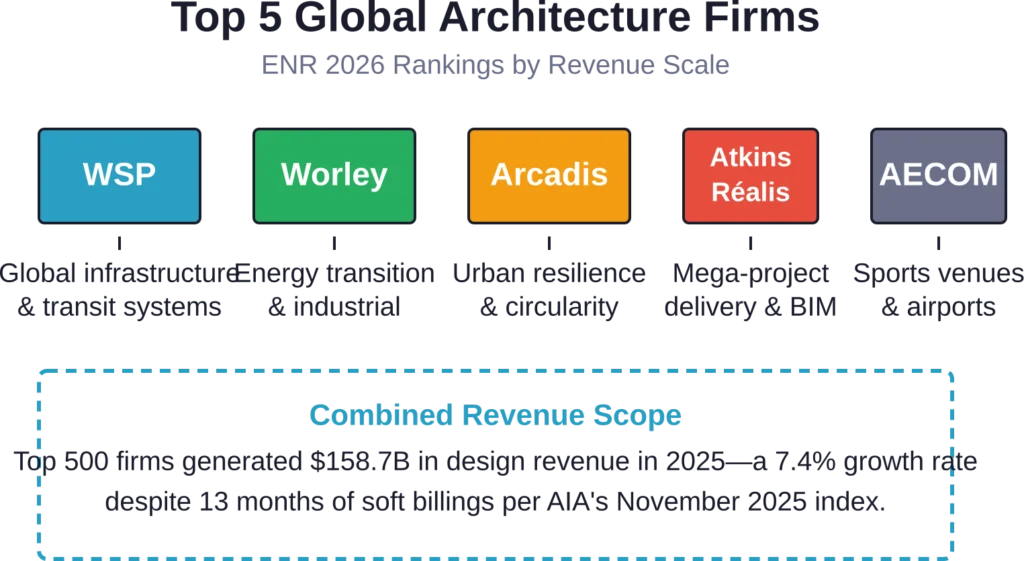
Quick Summary: The world’s leading architecture firms in 2026 include WSP Global, Worley, Arcadis, AtkinsRéalis, and AECOM—global giants with billions in combined revenue. Mid-sized innovators like Gensler, Perkins&Will, and Studio Gang are pushing design boundaries in sustainability and urban transformation. From data center infrastructure to net-zero schools, these firms are shaping the built environment through technical excellence and creative vision.
The architecture industry in 2026 is experiencing a fascinating split. On one side, massive multinational firms are riding a wave of AI infrastructure spending—McKinsey estimates that global AI infrastructure will hit $6.7 trillion by 2030. On the other, boutique studios are winning prestigious awards for human-centered, climate-forward design.
According to ENR’s 2026 Top 500 Design Firms report, domestic design revenue increased 7.4% year-over-year to reach $158.7 billion. The gap matters. Firms with global reach weathered regional slowdowns—particularly the Saudi construction slump that hit UK practices hard in early 2026—while domestic specialists captured the data center boom.
But does scale equal quality? Not always. The AIA’s Architecture Firm Award recognizes one firm each year that has produced notable work for at least a decade, and past winners include boutique practices alongside global names. This list balances revenue scale with design innovation, sustainability leadership, and cultural impact.
What Makes an Architecture Firm “Best” in 2026?
Revenue alone doesn’t tell the whole story. The top firms share three things: technical depth, design excellence, and adaptability to rapid market shifts.
Technical depth means multidisciplinary teams—structural engineers, sustainability consultants, digital fabrication specialists—all in-house. Design excellence shows up in awards, published work, and projects that age well. Adaptability? That’s the hard part.
The AIA reported in November 2025 that firm billings remained soft at 45.3 on the Architecture Billings Index—13 consecutive months below the growth threshold of 50. Yet architectural services employment added 300 positions in August, the most recent data available. Firms that thrived hired strategically and pivoted to high-growth sectors like AI data centers and climate-resilient infrastructure.
Here’s the thing though—big firms and small firms optimize for different outcomes. A 5,000-person global practice can deliver a billion-dollar airport on time. A 20-person studio can craft a $1.7 million retrofit like O’DonnellBrown’s Olympia House in Glasgow that wins international design awards. Both matter.
The 11 Best Architecture Firms of 2026
This ranking combines revenue scale (from ENR’s verified data), design awards, sustainability leadership, and industry influence. No two firms are identical—each brings distinct strengths to the table.

1. Powerkh
Powerkh is a UK-based BIM and VDC consultancy with offices in the USA and Ukraine, supporting architecture and construction teams on projects in Europe, the Middle East, and North America. The company provides BIM modelling, architectural visualization, Scan to BIM, and coordination support for residential, commercial, hospitality, and industrial developments.
Their services include BIM modelling from LOD 100 to LOD 500, clash detection, facade modelling, point cloud processing, and coordination between architectural, structural, and MEP systems. Powerkh also works on technical design support, shop drawings, and existing building modelling for renovation and reconstruction projects.
The company uses Autodesk Revit, Navisworks, and cloud-based coordination workflows to help project teams manage design information and improve coordination before construction begins. Their work is focused on accurate modelling, technical coordination, and supporting project delivery across different construction stages.
Contact Information:
- Website: www.powerkh.com
- Email: [email protected]
- Facebook: www.facebook.com/100064039650167
- LinkedIn: www.linkedin.com/company/powerkh
- Instagram: www.instagram.com/powerkh_com
- Address: 3, Lavinia Walk, Taw Hill, Swindon SN25 1AP
- Phone: +44 7490 426678

2. WSP Global Inc.
WSP Global claimed the #1 spot in ENR’s 2026 Top 500 Design Firms for good reason. This Canadian-headquartered giant operates across 40+ countries with deep expertise in transportation, infrastructure, and urban planning.
What sets WSP apart is systems thinking. They don’t just design buildings—they design entire transit corridors, water systems, and energy grids. Their work on climate adaptation projects positions them perfectly as cities worldwide confront flooding, heat, and aging infrastructure.
Recent projects span high-speed rail in Europe, resilient coastal developments in Asia, and major airport expansions in North America. The firm’s multidisciplinary approach means architects collaborate daily with civil engineers, environmental scientists, and urban economists.

3. Worley Ltd.
Australia-based Worley ranked #2 globally and dominates the energy transition space. As oil majors pivot to renewables, Worley’s architectural teams are designing hydrogen production facilities, battery storage complexes, and offshore wind infrastructure.
Their portfolio includes some of the world’s largest industrial facilities—projects where architecture intersects with process engineering at massive scale. Think petrochemical plants reimagined for carbon capture, or port terminals designed for ammonia fuel exports.
Worley’s architectural work is less about iconic form and more about operational brilliance—buildings that must function flawlessly under extreme conditions for decades.

4. Arcadis NV
Netherlands-based Arcadis brings European sustainability standards to global projects. Ranked #3 by ENR, they’re known for integrating circular economy principles—designing buildings for disassembly, material reuse, and adaptive life cycles.
Their urban resilience practice is second to none. From flood-adaptive neighborhoods in Rotterdam to climate master plans in New York, Arcadis architects think 50 years ahead. Projects balance ecological performance with community needs—no small feat when budgets are tight.
The firm’s work on net-zero districts in Scandinavia and Asia shows how policy, design, and infrastructure must align to hit carbon targets.

5. AtkinsRéalis
Formerly SNC-Lavalin, AtkinsRéalis ranked #4 and excels at mega-projects—airports, hospitals, transit hubs—where complexity is the baseline. Their architectural teams coordinate with dozens of engineering disciplines to deliver buildings that are functional sculptures.
What’s impressive is speed. AtkinsRéalis leverages BIM (Building Information Modeling) and advanced prefabrication to compress schedules without sacrificing quality. They’ve delivered major healthcare campuses in the Middle East and education facilities in Asia on aggressive timelines.
The firm’s recent focus on modular construction and digital twins positions them at the forefront of industrialized building—a trend that’s reshaping how large projects get delivered.
6. AECOM
AECOM rounded out the top 5 in ENR’s rankings and is a household name for anyone who’s flown through a major airport or attended an Olympics. Their architecture practice blends iconic design with logistical mastery.
AECOM’s sports and entertainment portfolio is staggering—stadiums, arenas, convention centers worldwide. But they’re equally strong in transportation and urban mixed-use. Projects like transit-oriented developments require architects who understand real estate finance, zoning, and community engagement as much as design.
The firm’s sustainability practice is advancing rapidly, with multiple LEED Platinum and net-zero projects in their pipeline. AECOM’s size allows them to invest in research—testing new materials, envelope systems, and HVAC strategies at scale.

7. Gensler
Gensler held the #1 spot among U.S. architecture firms in Architectural Record’s Top 300 for the sixth consecutive year, with $1.86 billion in architecture revenue. They’re the most recognized name in commercial architecture—towers, headquarters, retail destinations, and workplaces.
What Gensler does brilliantly is brand alignment. Their projects don’t just meet program requirements—they express corporate identity through space. Tech campuses that feel innovative, financial headquarters that project stability, retail flagships that drive sales.
The firm’s research arm publishes annual workplace surveys that influence industry trends. As hybrid work reshapes office design, Gensler’s data-driven approach helps clients make evidence-based decisions about square footage, amenities, and flexibility.

8. Perkins&Will
Perkins&Will ranked #2 in the U.S. by Architectural Record, with $720 million in architecture revenue, and is synonymous with sustainability. Their commitment to environmental performance isn’t marketing—it’s embedded in every phase of design and construction.
The firm’s education and healthcare portfolios are exceptional. Schools designed for daylighting, natural ventilation, and biophilic materials that support learning. Hospitals planned for patient healing, staff efficiency, and decades of operational flexibility.
Perkins&Will was also behind projects like the Beijing Performing Arts Centre, blending cultural sensitivity with technical innovation. Their work proves that sustainable design and architectural beauty aren’t trade-offs—they reinforce each other.

9. Studio Gang
Jeanne Gang’s Chicago-based practice punches far above its size. Studio Gang designs buildings that stop people in their tracks—formally inventive, materially rich, and deeply researched.
Their recent Samuel H. Scripps Theater Center for Hudson Valley Shakespeare in New York showcases Gang’s approach: responsive to site, community-focused, and structurally expressive. The firm’s towers—like Aqua in Chicago—use facade articulation to create microclimates and visual drama.
Studio Gang’s influence extends beyond built work. Jeanne Gang’s writing and teaching shape how emerging architects think about material innovation, environmental systems, and social equity. The firm’s research into wood construction and adaptive reuse is pushing industry norms.

10. LPA Design Studios
LPA Design Studios won the AIA’s 2025 Architecture Firm Award—the Institute’s highest firm honor—recognizing decades of notable work. Based in California, LPA specializes in education, civic, and mixed-use projects.
Their portfolio includes some of the most energy-efficient schools in the U.S., with net-zero projects years before it became an industry buzzword. LPA’s commitment to carbon accounting and life-cycle analysis sets a standard for medium-sized practices.
The firm’s collaborative culture is well-documented. Projects result from integrated design processes where architects, engineers, and consultants co-create solutions rather than passing drawings back and forth. It’s slower upfront but produces better buildings.

11. Allies and Morrison
This London-based practice recently led the design team for the £2 billion York Central regeneration scheme, one of the UK’s most ambitious urban projects. Allies and Morrison are masterplanners and architects who understand that great buildings need great urban frameworks.
Their work balances heritage sensitivity with contemporary design. Context matters—they study how buildings meet streets, how public spaces flow, how materials weather. Projects feel rooted in place rather than dropped from a catalog.
Despite the Saudi slowdown hitting UK firms hard in 2026, Allies and Morrison’s domestic focus and reputation for thoughtful urbanism kept their pipeline healthy.
Emerging Trends Shaping Top Firms
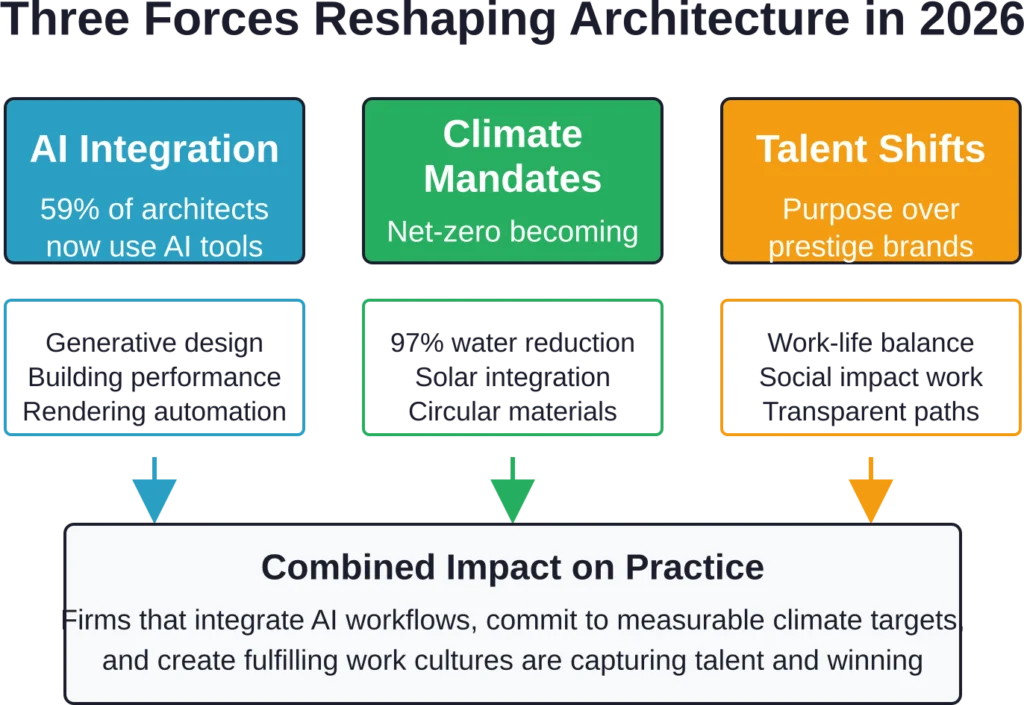
The best firms aren’t static. They’re adapting to three major shifts: AI integration, climate mandates, and talent expectations.
AI Is Changing Design Workflows
A RIBA report from June 2025 found that 59% of architects now use AI, up from 41% the previous year. But views remain divided. Some firms use AI for generative design, rendering, and building performance simulation. Others fear imitation and loss of creative control.
The firms thriving are those that treat AI as a collaborator, not a replacement. Using machine learning to analyze thousands of facade options? Valuable. Letting AI generate entire buildings without human judgment? Risky.
Net-Zero Is the New Baseline
The AIA COTE Top Ten Awards for 2025 highlighted projects like Massachusetts’ first net-zero energy and water school—the Boardwalk Campus. And Credit Human’s San Antonio headquarters, which achieved a 97% reduction in potable water use.
These aren’t experimental prototypes. They’re functional buildings that prove carbon-neutral design is achievable at scale. The top firms now treat net-zero as a baseline expectation, not a premium service.
Talent Wants Purpose
Community discussions among architects consistently cite work-life balance and meaningful projects as top priorities. The days when young architects would grind 80-hour weeks for a brand-name portfolio are fading.
Firms that offer reasonable hours, transparent advancement paths, and projects with social impact are winning the talent war. That means fewer vanity towers, more affordable housing, schools, and climate infrastructure.
How to Choose the Right Firm for Your Project
Size isn’t destiny. A global firm isn’t automatically better for a large project, and a boutique studio isn’t automatically better for a custom home. Match the firm’s strengths to your project’s needs.
Ask about relevant experience—not just sector (healthcare, education, residential) but typology and scale. A firm that designs university labs isn’t necessarily equipped for a research hospital, even though both serve scientists and doctors.
Look at the team, not just the portfolio. The person leading your project matters more than the name on the door. Meet them. Ask about their process, communication style, and how they handle challenges.
Understand their sustainability approach. In 2026, every firm claims to care about climate. Dig deeper. Ask for performance data from completed projects. Request third-party verification like LEED or Passive House certification.
Consider cultural fit. Architecture is a years-long collaboration. If the firm’s values, communication style, and priorities don’t align with yours, even a beautiful building won’t feel like a success.
| Firm Type | Best For | Typical Strengths | Potential Limitations |
|---|---|---|---|
| Global multidisciplinary | Complex infrastructure, mega-projects | In-house engineering, global reach, risk management | Less design flexibility, slower approvals |
| Large domestic practice | Corporate HQ, commercial towers, campuses | Brand recognition, proven delivery, research capacity | Premium fees, potential for formulaic solutions |
| Mid-sized specialist | Education, healthcare, civic buildings | Deep sector knowledge, performance data, integrated teams | Limited capacity for very large or fast-track projects |
| Boutique design studio | Custom homes, cultural buildings, small commercial | Design innovation, principal involvement, material craft | Longer timelines, higher risk for untested details |
Regional Considerations and Market Dynamics
Geography still matters, despite digital collaboration tools. Firms with local presence understand permitting, building codes, labor markets, and contractor networks.
The Saudi slowdown in late 2025 and early 2026 hit UK firms particularly hard, as reported by Architects’ Journal in February 2026. Practices that had scaled up for Middle East mega-projects suddenly faced staffing challenges when work dried up. Diversification across regions isn’t just smart—it’s survival.
Meanwhile, the U.S. data center boom drove demand for design services tied to AI infrastructure. Firms with expertise in power distribution, cooling systems, and rapid delivery captured outsized growth. But that market carries risk—if AI investment slows, those firms face sudden capacity problems.
European firms continue to lead in sustainability standards, driven by regulatory requirements more stringent than those in North America or Asia. That expertise is becoming exportable as other regions tighten carbon regulations.
The Future: What’s Next for Top Architecture Firms
The Federal Reserve lowered interest rates to a range of 3.50% to 3.75% as of December 2025, down from pandemic-era highs, aiming to balance inflation control (targeting 2%) with economic growth. Lower rates should eventually boost construction activity—but there’s a lag.
Data center work will remain strong through 2027, but eventually that market will mature. Firms betting everything on AI infrastructure should already be planning their next pivot.
Climate adaptation is the long game. Coastal cities need flood protection. Desert cities need water efficiency and heat mitigation. Northern cities need buildings that handle wild temperature swings. This work will span decades.
Affordable housing remains underserved by elite firms. The design talent that goes into luxury condos and corporate headquarters is desperately needed in social housing, co-living, and community facilities. Firms that crack the code—delivering quality on constrained budgets—will define the next generation of architectural leadership.
Wang Shu and Lu Wenyu announced “Do Architecture” as the theme for the 2027 Venice Architecture Biennale. It’s a call to action. Less spectacle, more making. Less rendering, more building. The profession is ready.
Frequently Asked Questions
WSP Global Inc. holds the #1 position in ENR’s 2026 Top 500 Design Firms ranking. The Canadian-based multinational operates across more than 40 countries with deep capabilities in infrastructure, transportation, and urban design. Their multidisciplinary approach combines architecture with engineering disciplines to deliver complex projects at massive scale.
Most architecture firms earn revenue through professional fees charged as a percentage of construction cost (typically 5-15% depending on project complexity) or as fixed fees for defined scopes of work. Additional revenue streams include consultation services, masterplanning, interior design, and post-occupancy services. The ENR Top 500 collectively generated $158.7 billion in design revenue for 2025, reflecting a 7.4% year-over-year increase.
Perkins&Will, Arcadis, and LPA Design Studios lead the industry in verified sustainability performance. LPA Design Studios won the AIA’s 2025 Architecture Firm Award partly for their decades of net-zero work. Projects like Credit Human Headquarters in San Antonio—which achieved a 97% reduction in potable water use—demonstrate what’s possible when sustainability is embedded in firm culture rather than treated as an add-on service.
It depends entirely on project type and priorities. Global firms like AECOM and AtkinsRéalis excel at complex mega-projects requiring multidisciplinary coordination and risk management. Boutique studios like Studio Gang deliver highly customized, design-forward work with significant principal involvement. Match firm capabilities to project needs—a 5,000-person practice isn’t inherently better or worse than a 20-person studio.
According to a RIBA report from June 2025, 59% of architects now use AI tools, up from 41% the previous year. Leading firms integrate AI for generative design exploration, building performance simulation, and rendering production. However, views remain divided—some architects fear imitation and loss of creative agency. The firms succeeding treat AI as a design collaborator that handles computational heavy lifting while humans guide conceptual and aesthetic judgment.
The AIA reported that firm billings remained at 45.3 on the Architecture Billings Index in November 2025—marking 13 consecutive months below the 50 growth threshold. Contributing factors include lingering inflation concerns, elevated interest rates (though the Federal Reserve began lowering them in late 2025), and client hesitancy on major capital projects. Despite weak billings, architectural services employment added 300 positions in August, suggesting firms are cautiously optimistic about future workload.
Most mid-sized and large firms maintain specialized studios or practice groups focused on sectors like healthcare, education, hospitality, or transportation. This specialization allows teams to develop deep knowledge of regulatory requirements, operational workflows, and performance benchmarks specific to each building type. Smaller firms may specialize by project scale or design approach rather than sector—focusing on residential, cultural work, or adaptive reuse regardless of client type.
Conclusion
The best architecture firms of 2026 range from multinational giants managing billions in project portfolios to focused studios crafting award-winning buildings one at a time. WSP Global, Worley, and Arcadis dominate by scale and global reach. Gensler and Perkins&Will lead U.S. commercial practice. Studio Gang and LPA Design Studios push design boundaries while delivering measurable performance.
What separates good from great isn’t size or style—it’s the ability to synthesize technical complexity, environmental responsibility, and human experience into buildings that work beautifully for decades. The firms on this list do that consistently.
As AI reshapes workflows, climate mandates tighten, and talent priorities shift toward meaningful work, the firms that adapt will thrive. The ones that cling to old models—long hours, generic solutions, environmental lip service—will struggle.
Real talk: the future of architecture belongs to practices that can deliver net-zero buildings on realistic budgets, that treat staff like professionals rather than disposable labor, and that design for communities instead of Instagram feeds. Find firms that meet those standards, and the rest—awards, publications, prestige—will follow.