

Quick Summary: Looking for trusted quantity takeoff services? The top companies in 2026—including specialized firms like Premier Estimating, Exact Takeoff Solutions, and BuildCalc Estimators—deliver accurate material counts, digital takeoffs, and fast turnaround times for residential and commercial projects. These agencies help contractors avoid costly overruns and win more bids through precise construction estimates.
The construction industry moves fast, and contractors face mounting pressure to submit competitive bids quickly without sacrificing accuracy. That’s where professional quantity takeoff services come in.
A reliable takeoff service counts every board, every yard of concrete, every fixture—turning blueprints into itemized material lists that feed directly into cost estimates. Without that precision, budgets spiral, timelines slip, and profit margins vanish.
Here’s the thing though—not all takeoff companies deliver the same quality or speed. Some specialize in residential framing, others excel at commercial MEP systems, and a few handle everything from sitework to finishes.
This guide breaks down the 11 best quantity takeoff services companies contractors trust in 2026, covering what each firm does well, what project types they serve, and how they help general contractors, subcontractors, and estimators win more work.
Why Quantity Takeoff Services Matter for Contractors
Quantity takeoffs form the backbone of every construction estimate. The process involves measuring and counting materials directly from construction drawings—lumber, drywall, rebar, ductwork, piping, electrical fixtures, and more.
When done manually, takeoffs consume hours or even days. Mistakes creep in. And when a contractor misses a few hundred feet of conduit or underestimates concrete yardage, the project loses money before ground breaks.
Professional takeoff services solve these problems. Dedicated estimators use digital tools to extract quantities from PDF plans, CAD files, and even scanned blueprints. The result? Faster turnarounds, fewer errors, and bids that stand up to real-world conditions.
Industry reports suggest that labor often makes up 35%–55% of total job cost, so miscalculating material waste or installation time directly impacts profitability. Accurate takeoffs protect those margins.
Who Uses Takeoff Services?
These services aren’t just for large commercial contractors. The following groups rely on external takeoff support:
- General contractors bidding multiple jobs simultaneously
- Subcontractors (electrical, plumbing, HVAC, drywall) who need trade-specific counts
- Developers and owners validating budgets before breaking ground
- Estimating departments handling overflow during peak bid seasons
- Small to mid-sized firms without in-house estimating staff
Outsourcing takeoffs frees internal teams to focus on pricing strategy, vendor negotiations, and client relationships—activities that directly win contracts.
Top 11 Quantity Takeoff Services Companies in 2026
The companies below represent the most trusted names in construction takeoff services. Each brings unique strengths, trade expertise, and turnaround capabilities.

1. Powerkh
Powerkh is a UK-based BIM and VDC consultancy with offices in the USA and Ukraine, supporting contractors, developers, and construction teams with BIM-based quantity takeoff and project coordination services. The company works on residential, commercial, and industrial projects, helping teams extract quantities from coordinated BIM models and project documentation during design and preconstruction stages.
Their services include BIM modelling from LOD 100 to LOD 500, quantity takeoff support, clash detection, Scan to BIM, and coordination between architectural, structural, and MEP systems. Powerkh uses Autodesk Revit and Navisworks workflows to improve model accuracy and help teams review project quantities alongside coordinated design information.
The company also supports fabrication workflows, shop drawings, and point cloud-based modelling for renovation and reconstruction projects. Their approach focuses on accurate modelling, coordination between disciplines, and maintaining consistent project information throughout design and construction stages.
Contact Information:
- Website: www.powerkh.com
- Email: [email protected]
- Facebook: www.facebook.com/100064039650167
- LinkedIn: www.linkedin.com/company/powerkh
- Instagram: www.instagram.com/powerkh_com
- Address: 3, Lavinia Walk, Taw Hill, Swindon SN25 1AP
- Phone: +44 7490 426678

2. BidWell Estimates
BidWell Estimates has built a strong reputation among contractors for delivering precise takeoffs across residential and commercial projects. The company handles everything from rough framing to finish carpentry, with specialized teams for concrete, masonry, and sitework.
What sets BidWell apart? Fast turnaround times and detailed material breakdowns that separate waste factors from usable quantities. Contractors receive itemized spreadsheets showing linear feet, square footage, counts, and weights—ready to plug into estimating software or hand to suppliers for quotes.
BidWell also provides bid support, helping contractors structure proposals with clear line items and scope descriptions. That combination of accurate takeoffs and presentation quality makes the service particularly valuable for firms competing on public projects where bid transparency matters.

3. Exact Takeoff Solutions
Exact Takeoff Solutions focuses on digital precision. The company uses advanced software platforms to measure directly from CAD and PDF plans, delivering takeoffs for structural, mechanical, electrical, and plumbing trades.
Their process starts with a detailed scope review—estimators flag missing information, call out drawing conflicts, and request clarifications before counting begins. That upfront diligence catches issues early, reducing change orders and budget surprises later.
Exact Takeoff serves general contractors and trade contractors alike, with dedicated workflows for each discipline. Electrical contractors, for example, receive conduit schedules, fixture counts, and panel loads. Plumbers get pipe runs, fitting counts, and fixture breakdowns.
The company’s strength lies in consistency. Every takeoff follows standardized templates, making it easy to compare bids across multiple projects or track historical material usage.

4. BuildCalc Estimators
BuildCalc Estimators specializes in residential construction, particularly single-family homes, townhomes, and small multifamily developments. The firm understands builder workflows and delivers takeoffs formatted for popular residential estimating software.
BuildCalc covers all divisions—from foundations and framing to roofing, siding, and interior finishes. Estimators account for regional building codes, common construction methods, and typical waste factors, so quantities reflect real-world installation conditions.
Builders working on multiple floor plans appreciate BuildCalc’s template-based approach. Once the company creates a takeoff for a specific plan, updates for similar layouts happen quickly, speeding up bidding for production builders.
The service also includes basic labor estimates based on square footage and complexity, giving builders a head start on total job costing.

5. Precision Quantity Services
Precision Quantity Services targets commercial and industrial projects, especially those involving heavy civil work, tilt-up construction, and large-scale concrete pours. The company employs estimators with field experience, so takeoffs reflect constructability and sequencing realities.
Precision handles complex assemblies—precast panels, structural steel, rebar schedules, formwork, and shoring. Estimators coordinate with engineering drawings, shop drawings, and specifications to ensure counts align with design intent.
For concrete contractors, Precision provides detailed quantity breakdowns by pour—slabs on grade, elevated decks, footings, columns, walls—along with formwork square footage, rebar tonnage, and embed counts. That granularity helps contractors schedule labor, order materials in phases, and manage cash flow.
The firm also supports design-build teams during preconstruction, running conceptual takeoffs from early design documents to inform budgeting and value engineering.

6. Rapid Estimating Group
Rapid Estimating Group lives up to its name, offering 24- to 48-hour turnaround times on standard residential and light commercial takeoffs. The company operates across multiple time zones, allowing overnight processing for next-morning delivery.
Rapid serves remodelers, renovators, and small commercial contractors who bid frequently and need quick, reliable counts. The service covers interior and exterior trades—drywall, painting, flooring, tile, cabinetry, siding, roofing, and decking.
While speed is the headline feature, Rapid doesn’t sacrifice accuracy. Estimators use digital measurement tools and cross-check quantities against typical ratios and industry benchmarks. If a takeoff shows unusually high waste or an improbable square footage, the team flags it for review.
Rapid also offers pay-as-you-go options, making the service accessible to contractors who don’t need monthly subscriptions or high-volume commitments.
7. National Estimating Partners
National Estimating Partners operates as a full-service estimating firm, combining quantity takeoffs with detailed cost databases and labor productivity rates. The company serves mid-sized to large general contractors bidding institutional and government work.
What makes National stand out? Integration. Takeoffs flow directly into cost models, which then feed into proposal documents. Contractors receive not just material counts but complete estimate packages with unit costs, labor hours, and subcontractor allowances.
National maintains regional offices across the country, so estimators understand local market conditions, prevailing wage requirements, and jurisdiction-specific code nuances. That local knowledge improves accuracy on public projects where compliance and documentation standards run high.
The firm also provides bid day support, helping contractors finalize numbers, review subcontractor quotes, and submit proposals on time.

8. Digital Blueprint Takeoffs
Digital Blueprint Takeoffs leverages cutting-edge software and automation to handle high-volume takeoff requests. The company uses AI-assisted measurement tools that recognize plan elements—walls, doors, windows, equipment—and generate preliminary counts for estimator review.
While automation speeds the process, human estimators still verify every quantity, adjust for overlaps and exclusions, and format deliverables to client specifications. The hybrid approach combines speed with accuracy.
Digital Blueprint specializes in multifamily and mixed-use projects, where repetitive floor plans and unit layouts benefit from template-based workflows. Estimators create master takeoffs for typical units, then scale quantities across floors and buildings.
The company also offers takeoff software training, helping contractors build internal estimating capacity over time.
9. Trade-Specific Estimating Co.
Trade-Specific Estimating Co. focuses exclusively on MEP disciplines—mechanical, electrical, and plumbing. The firm employs licensed tradespeople and former field supervisors who understand system design, installation methods, and code requirements.
Electrical takeoffs include panel schedules, circuit counts, conduit and wire runs, device counts, and lighting fixture schedules. Mechanical estimators quantify ductwork, pipe runs, equipment, insulation, and controls. Plumbing teams count fixtures, drain and vent systems, water distribution, and gas piping.
Trade-Specific works directly with subcontractors, delivering takeoffs formatted for specific estimation workflows. Electrical contractors, for example, receive quantities broken out by voltage, circuit type, and installation method—exactly how they price work.
The firm also provides value engineering suggestions, identifying opportunities to reduce material costs or installation time without compromising performance or code compliance.

10. Apex Quantity Surveyors
Apex Quantity Surveyors brings an international perspective to U.S. construction projects, applying quantity surveying principles common in European and Commonwealth markets. The firm provides detailed bill of quantities (BOQ) documents that itemize every material, component, and assembly.
Apex serves design-build firms, developers, and owners who need independent cost validation. The company reviews architect and engineer drawings, extracts quantities, and benchmarks costs against historical data and market trends.
While many takeoff services focus on contractor bidding, Apex supports project budgeting, cost planning, and change order evaluation. Developers use Apex takeoffs to validate contractor proposals, ensuring bid accuracy before signing contracts.
The firm also handles post-award services, tracking actual quantities against estimates and helping owners manage scope changes and cost reconciliation.
11. Pro Construction Takeoffs
Pro Construction Takeoffs rounds out the list with a broad service offering covering residential, commercial, and civil projects. The company handles all construction divisions—sitework, concrete, masonry, metals, wood and plastics, thermal and moisture protection, openings, finishes, and specialties.
Pro emphasizes communication. Estimators schedule kickoff calls to review project scope, clarify drawing details, and understand client preferences for formatting and level of detail. That upfront alignment reduces revisions and ensures deliverables match expectations.
The company offers tiered service levels—basic material counts for simple bids, detailed assemblies for complex projects, and full estimate packages for turnkey proposals. Contractors choose the level that fits their internal capabilities and project requirements.
Pro also maintains a library of historical takeoff data, allowing repeat clients to benchmark new projects against similar past work for sanity checks and pricing validation.
How Quantity Takeoff Services Improve Bidding Outcomes
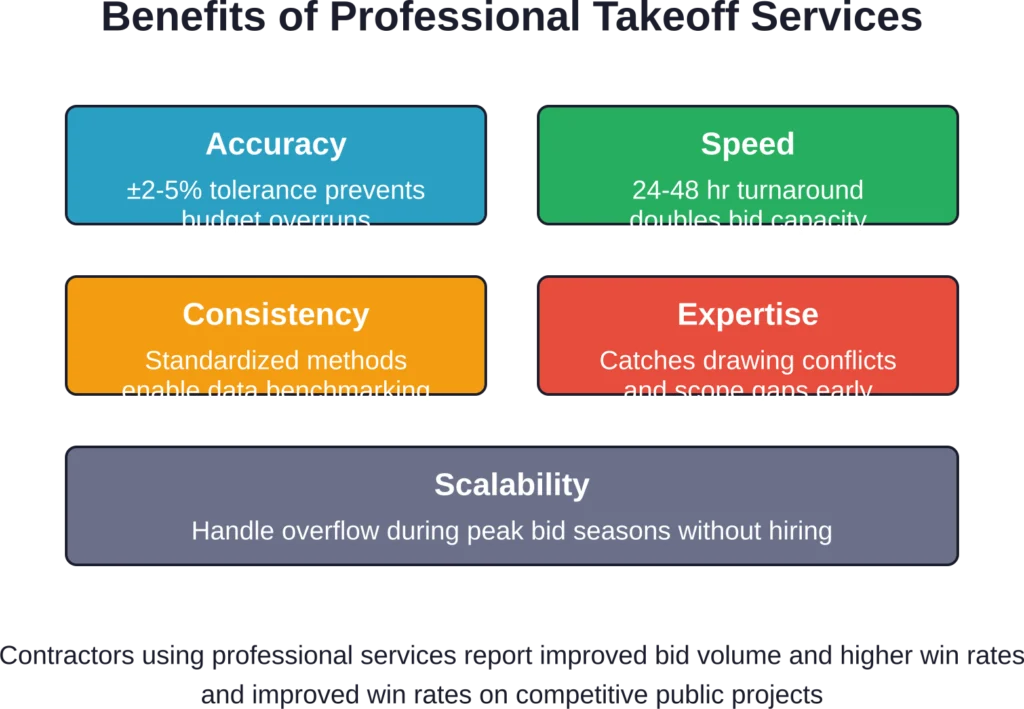
Outsourcing takeoffs delivers measurable benefits beyond time savings. Contractors who use professional services report better bid accuracy, higher win rates, and fewer post-award surprises.
Here’s what drives those outcomes.
Accuracy Reduces Risk
Precise material counts prevent cost overruns. When a takeoff captures every component—down to fasteners, sealants, and miscellaneous items—the estimate reflects true project requirements. Contractors avoid the scramble to cover unexpected material costs mid-construction.
Professional takeoff services typically aim for accuracy within defined tolerances depending on project complexity. That reliability lets contractors bid confidently, knowing quantities won’t balloon once work starts.
Speed Enables More Bids
Fast turnarounds mean contractors can pursue more opportunities. A firm that completes its own takeoffs might bid four projects per month. The same firm using external services could handle eight or ten, doubling bid volume without adding estimating staff.
More bids mean more wins. Even if win rates stay constant, increased volume translates to more contracts and steadier revenue.
Consistency Improves Pricing
Professional estimators follow standardized methods, producing consistent takeoffs across projects. That consistency makes historical cost data more useful—contractors can compare material usage across similar jobs and refine unit pricing over time.
Inconsistent takeoffs, by contrast, muddy the data. One estimator might include waste factors, another might not. One counts finish trim, another overlooks it. Standardization eliminates those variables.
Expertise Catches Errors
Experienced estimators spot drawing conflicts, missing details, and scope gaps that less experienced eyes miss. They flag unusual conditions, ask clarifying questions, and recommend allowances for unresolved items.
That expertise protects contractors from costly assumptions. A professional estimator might notice that structural drawings show steel beams but architectural plans show wood framing—prompting an RFI before bidding rather than discovering the conflict after award.
What to Look for in a Takeoff Service Provider
Not every takeoff company fits every contractor’s needs. The right choice depends on project types, trade specialization, turnaround requirements, and budget.
Consider these factors when evaluating providers.
Trade and Project Type Expertise
Residential framing takeoffs differ fundamentally from commercial MEP work. A service that excels at wood framing might struggle with complex HVAC ductwork or electrical panel schedules.
Look for firms that demonstrate deep knowledge in the trades and project types the contractor typically bids. Ask for sample takeoffs, reference projects, and estimator qualifications.
Some firms employ licensed tradespeople or certified estimators. Others rely on software proficiency and process discipline. Both approaches work—what matters is alignment between the firm’s strengths and the contractor’s needs.
Turnaround Time and Availability
Bid deadlines don’t negotiate. Contractors need services that deliver on time, every time.
Evaluate standard turnaround times, rush options, and capacity during peak seasons. Some companies overcommit and miss deadlines when volume spikes. Others maintain buffer capacity or operate overflow teams to handle surges.
Ask about communication during the takeoff process. Do estimators provide progress updates? Can contractors reach the team with questions or plan revisions? Responsive communication prevents last-minute surprises.
Deliverable Format and Detail
Takeoffs arrive in various formats—spreadsheets, PDF reports, software-specific files. Contractors should verify that deliverables integrate smoothly with internal estimating tools and workflows.
Detail levels matter too. Basic takeoffs provide material quantities by category—concrete, rebar, formwork. Detailed takeoffs break quantities into subcategories, locations, and installation phases—foundation concrete, slab on grade, elevated decks.
More detail enables better pricing, scheduling, and procurement. But it also costs more and takes longer. Contractors should match detail level to project complexity and bid competitiveness.
Quality Control and Guarantees
Mistakes happen. The question is how takeoff companies handle them.
Strong firms implement multi-layer quality control—peer reviews, software cross-checks, and senior estimator sign-off. They also stand behind their work, offering revisions or corrections if errors emerge.
Some companies provide accuracy guarantees or offer partial refunds if quantities miss targets by more than defined thresholds. Those guarantees reflect confidence in process rigor.
Pricing Structure and Transparency
Takeoff services use various pricing models—per-sheet, per-square-foot, hourly, or flat-fee. Each model suits different project types and scopes.
Per-sheet pricing works well for simple projects with standard drawing sets. Per-square-foot rates suit repetitive work like multifamily housing. Hourly billing fits complex or incomplete plan sets where scope remains uncertain.
Whatever the model, pricing should be transparent and predictable. Contractors should understand what’s included, what triggers additional charges, and how revisions or plan changes affect cost.
Common Project Types for Takeoff Services
Takeoff services handle virtually every construction project type, but certain categories dominate the workload.
Residential Construction
Single-family homes, townhomes, and small multifamily buildings represent a huge segment of takeoff demand. Builders need counts for framing lumber, sheathing, roofing, siding, insulation, drywall, flooring, cabinets, and trim.
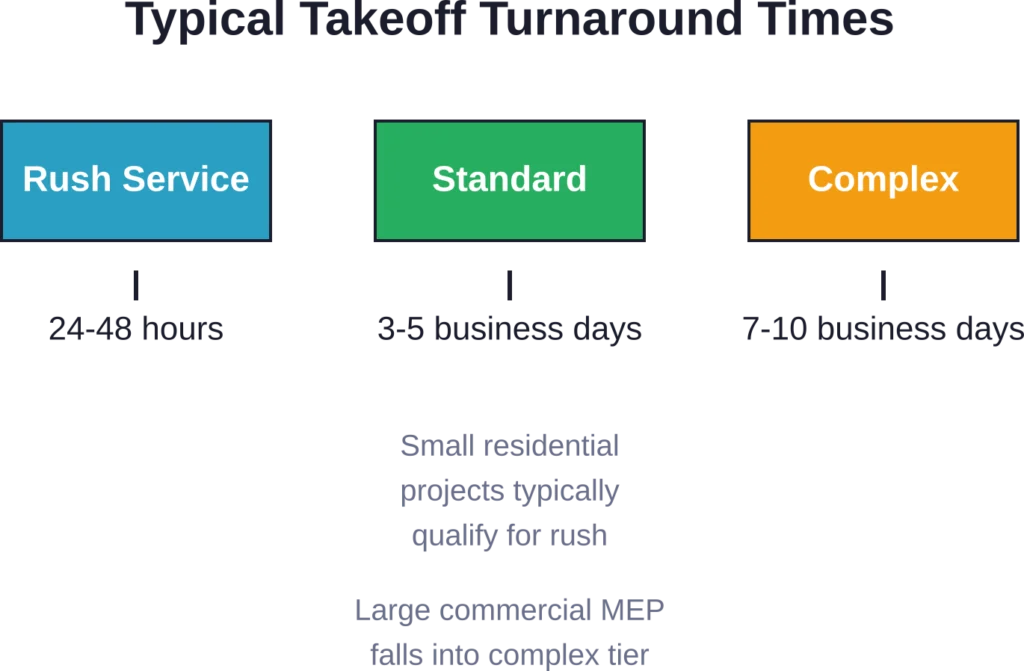
Residential takeoffs typically turn around quickly—24 to 72 hours for standard plans. Repetitive elements (studs, joists, trusses) allow template-based workflows that speed processing.
Builders benefit from consistent formatting across multiple plans, making it easy to compare bids, track material costs, and manage supplier relationships.
Commercial Buildings
Office buildings, retail centers, warehouses, and medical facilities involve more complex systems—structural steel, masonry, curtain walls, mechanical systems, electrical distribution, fire protection, and specialized finishes.
Commercial takeoffs require coordination across multiple drawing disciplines—architectural, structural, mechanical, electrical, plumbing. Estimators cross-reference plans to ensure counts align and scope gaps don’t emerge.
Turnaround times run longer, typically three to seven business days depending on project size. Commercial projects also demand higher detail levels to support competitive bidding and subcontractor quoting.
Renovation and Remodeling
Renovation projects introduce unique challenges—existing conditions, selective demolition, phasing, and coordination with occupied spaces. Takeoffs must account for protection, temporary systems, and unknown conditions.
Estimators often include allowances or contingencies for items hidden behind walls, above ceilings, or underground. They also flag assumptions clearly, so contractors can price risk appropriately.
Renovation takeoffs benefit from site visits or photo documentation, helping estimators understand existing conditions and spot potential conflicts between plans and reality.
Civil and Infrastructure
Roads, utilities, grading, and site development require earthwork calculations, pipe runs, aggregate quantities, and pavement areas. Civil takeoffs often involve survey data, contour maps, and cross-sections.
Estimators use specialized software to calculate cut-and-fill volumes, balance sites, and optimize haul routes. They account for soil conditions, compaction factors, and moisture content—variables that affect material quantities and installation productivity.
Civil projects typically involve large quantities measured in cubic yards, tons, and linear feet. Precision matters, because small percentage errors translate to significant cost swings at scale.
| Project Type | Typical Turnaround | Key Challenges | Common Trades Covered |
|---|---|---|---|
| Residential | 24-72 hours | Repetitive elements, finish selections | Framing, roofing, drywall, flooring, trim |
| Commercial | 3-7 business days | Multi-discipline coordination, MEP systems | Structure, envelope, HVAC, electrical, plumbing |
| Renovation | 3-5 business days | Existing conditions, unknowns, selective demo | Demolition, framing, finishes, systems upgrades |
| Civil/Infrastructure | 5-10 business days | Earthwork volumes, site balancing, utilities | Grading, utilities, paving, drainage, erosion control |
Digital Takeoff Tools and Technologies
Modern takeoff services rely on digital tools that measure quantities directly from electronic plans. These platforms replace manual scaling and counting, dramatically improving speed and accuracy.
Understanding the technology behind takeoff services helps contractors evaluate provider capabilities and deliverable quality.
On-Screen Takeoff Software
On-screen takeoff (OST) software allows estimators to measure PDF plans using point-and-click tools. Estimators trace walls, click doors and windows, and define areas with polygon tools. The software calculates linear feet, square footage, and counts automatically.
OST platforms include built-in assemblies—predefined groups of materials that install together. An estimator might click “interior partition” and the software applies studs, plates, sheathing, insulation, and drywall based on wall type and height.
Popular OST tools include PlanSwift, Bluebeam Revu, and STACK. Each offers different features, user interfaces, and integration options.
BIM-Based Takeoffs
Building Information Modeling (BIM) takes takeoffs to the next level. Instead of measuring 2D drawings, estimators extract quantities directly from 3D models created by architects and engineers.
BIM models contain detailed object data—wall types, material properties, dimensions, manufacturer specifications. Estimators query the model to generate material lists, often with minimal manual measurement.
BIM-based takeoffs excel on complex projects where 3D coordination reveals conflicts and quantity overlaps that 2D plans obscure. The technology works best when design teams provide high-quality models with accurate object properties.
AI and Automation
Artificial intelligence is beginning to automate portions of the takeoff process. Machine learning algorithms recognize plan elements—walls, doors, windows, fixtures—and generate preliminary counts for estimator review.
AI doesn’t replace human estimators yet, but it speeds initial processing and reduces manual measurement time. Estimators verify AI-generated counts, adjust for overlaps and exclusions, and apply construction knowledge to refine quantities.
As AI tools mature, expect faster turnarounds and lower costs, especially on repetitive project types where pattern recognition works well.
How to Choose the Right Takeoff Service for Different Projects
Contractors often work with multiple takeoff providers, selecting the best fit for each project based on scope, deadline, and budget.
Here’s a practical framework for matching services to projects.
Small Residential Projects
For single-family homes, additions, and small remodels, speed and cost matter most. Choose services offering 24- to 48-hour turnarounds at competitive per-sheet or flat-fee rates.
Basic material counts suffice—framing lumber, sheathing, roofing, siding, drywall, flooring. Detailed assemblies aren’t necessary unless the project involves custom millwork or complex finishes.
Services like Rapid Estimating Group or BuildCalc Estimators fit this category, delivering fast, affordable takeoffs for high-volume residential bidding.
Commercial and Institutional Projects
Larger commercial work demands higher detail and multi-discipline coordination. Turnaround times stretch to five to ten business days, and costs run higher to cover the additional complexity.
Look for services that employ trade-specific estimators or provide dedicated teams for mechanical, electrical, and plumbing systems. The ability to cross-reference drawings and flag conflicts adds significant value.
National Estimating Partners, Precision Quantity Services, and Exact Takeoff Solutions excel in this space, offering comprehensive takeoffs for competitive commercial bidding.
Public and Government Projects
Public work often requires detailed quantity breakdowns formatted to match bid forms and standard specifications. Estimators must understand prevailing wage requirements, DBE goals, and procurement rules.
Choose services with public-sector experience and a track record of accurate, compliant takeoffs. Firms like BidWell Estimates and Apex Quantity Surveyors handle public projects routinely and understand agency expectations.
Trade-Specific Subcontracting
Electrical, plumbing, HVAC, and other specialty contractors need trade-focused takeoffs that speak their language—conduit schedules, fixture counts, duct runs, pipe sizes.
Trade-Specific Estimating Co. and similar firms employ licensed tradespeople who understand system design, installation methods, and code requirements. Their deliverables integrate directly into trade contractor workflows.
Frequently Asked Questions
A quantity takeoff is the process of measuring and counting all materials required for a construction project from architectural and engineering drawings. It produces itemized lists showing linear feet, square footage, volumes, and counts for materials like lumber, concrete, piping, ductwork, and finishes. Contractors use these quantities to price projects, order materials, and manage budgets.
Turnaround times vary by project complexity. Simple residential projects often take 24 to 48 hours. Standard commercial projects typically require three to five business days. Large or complex projects with multiple trades and disciplines can take seven to ten business days. Many services offer rush options for urgent deadlines, often delivering within 24 hours for an additional fee.
Most professional takeoff services cover all major construction divisions—sitework, concrete, masonry, structural, envelope, finishes, and MEP systems. Some firms specialize in specific trades (electrical, plumbing, HVAC), while others offer broad coverage. When selecting a service, confirm they have experience with the specific trades and systems relevant to the project being bid.
Reputable takeoff services typically guarantee accuracy within ±2% to ±5%, depending on project complexity and drawing completeness. Digital measurement tools eliminate manual scaling errors, and experienced estimators cross-check quantities against typical ratios and benchmarks. That said, accuracy depends on plan quality—incomplete or conflicting drawings introduce uncertainty that even skilled estimators can’t fully eliminate.
Most services require complete construction drawings—architectural, structural, mechanical, electrical, and plumbing plans, plus specifications. Providing project scope descriptions, specific formatting preferences, and any owner requirements helps estimators deliver takeoffs that match expectations. Some services also request site photos for renovation projects or clarification of existing conditions.
Yes, most professional services deliver quantities in formats compatible with popular estimating software—Excel spreadsheets, CSV files, or direct imports for platforms like Sage Estimating, ProEst, or HeavyBid. Contractors should specify software requirements upfront to ensure seamless integration and avoid manual data entry.
A takeoff quantifies materials only—how many boards, how much concrete, how many fixtures. A full estimate applies unit costs to those quantities, adds labor hours and rates, includes overhead and profit, and produces a total project price. Some services offer both takeoffs and complete estimates, while others focus exclusively on quantity extraction.
Final Thoughts: Choosing the Best Takeoff Partner
The construction industry’s competitive landscape demands precision and speed. Contractors who submit accurate bids quickly win more work and protect profit margins. Professional quantity takeoff services deliver both advantages.
The ten companies profiled here—BidWell Estimates, Exact Takeoff Solutions, BuildCalc Estimators, Precision Quantity Services, Rapid Estimating Group, National Estimating Partners, Digital Blueprint Takeoffs, Trade-Specific Estimating Co., Apex Quantity Surveyors, and Pro Construction Takeoffs—represent the industry’s leading providers, each bringing unique strengths to different project types and contractor needs.
Selecting the right partner starts with understanding internal capabilities and project requirements. Small residential builders benefit from fast, affordable services with standardized deliverables. Large commercial contractors need multi-discipline coordination and detailed assemblies. Trade contractors require specialty expertise that matches their systems and installation methods.
But wait. Before committing to a single provider, consider testing multiple services on similar projects. Compare accuracy, turnaround times, deliverable quality, and communication responsiveness. That real-world evaluation reveals which firms align best with specific workflows and expectations.
Look, takeoff services aren’t just about outsourcing measurement tasks. They’re strategic partners that enable contractors to scale bid volume, enter new markets, and compete on projects beyond internal estimating capacity. The right service becomes an extension of the estimating department, delivering consistent quality that builds confidence in every proposal.
Ready to improve bid accuracy and win more projects? Start by reaching out to two or three firms from this list. Request sample takeoffs, discuss project types and turnaround requirements, and evaluate how each service communicates and collaborates. The investment in finding the right partner pays dividends in better bids, fewer surprises, and healthier project margins.