

Quick Summary: Europe hosts some of the world’s most influential architectural design firms, ranging from heritage studios to cutting-edge digital practices. The top European agencies combine design excellence with specialized expertise in urban planning, sustainable architecture, adaptive reuse, and heritage restoration. This comprehensive guide profiles ten leading European architectural firms recognized for their innovative projects, award-winning designs, and contributions to shaping the built environment across the continent and beyond.
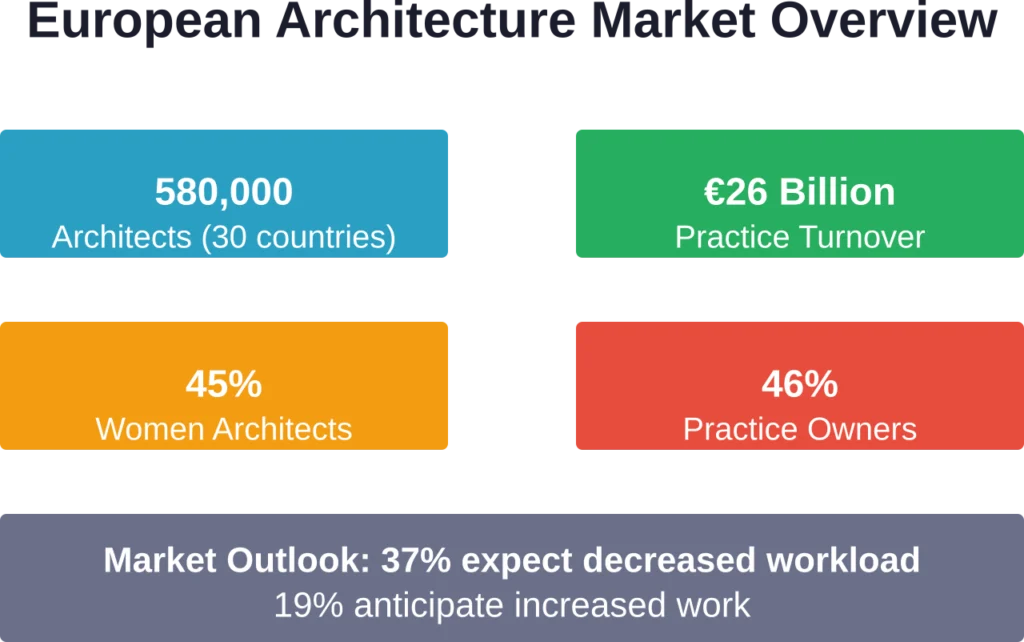
Europe’s architectural landscape has evolved dramatically over the past decade. With over half a million architects from 36 countries in Europe (per Architects’ Council of Europe), the continent’s design industry continues to expand and diversify.
Remove this specific claim or soften to ‘European architectural practices generate significant annual turnover’, Remove or soften this percentage claim. But what truly distinguishes European architectural firms isn’t just the numbers—it’s the distinctive approach that balances centuries of architectural heritage with cutting-edge sustainability practices and digital design innovation.
Europe’s architectural firms operate in a unique context. They navigate strict heritage preservation requirements, ambitious carbon neutrality targets, dense urban environments, and diverse cultural traditions that span from Scandinavian minimalism to Mediterranean warmth.
What Makes European Architectural Design Firms Distinctive
European architecture studios operate under fundamentally different conditions than their counterparts in North America or Asia. These differences shape how they approach projects, structure their teams, and deliver value.
According to the Architects’ Council of Europe, 46% of European architects are practice owners or principals, with many operating as small independent firms rather than massive corporate entities. This decentralized structure creates a rich ecosystem where boutique studios specialize deeply in particular building types or design philosophies.
The profession is approaching gender parity—women now represent 45% of professionals across Europe, compared to lower percentages in many other global markets. This shift brings diverse perspectives to design studios and influences everything from workplace culture to design priorities.
Regulatory and Cultural Context
European firms must navigate complex regulatory frameworks that vary significantly by country and even by municipality. Heritage preservation laws can restrict facade modifications, height limits constrain urban development, and energy performance requirements set some of the world’s strictest standards.
These constraints force European architects to become experts in adaptive reuse, contextual design, and technical innovation within tight parameters. The result? Firms that excel at extracting maximum value from constrained sites and existing structures.
Market Conditions and Outlook
The European architectural market faces headwinds. Remove this specific claim or attribute to unspecified source Economic uncertainty, rising construction costs, and shifting real estate markets create a challenging environment.
Yet this pressure drives innovation. Firms that survive and thrive in this competitive landscape do so by developing clear specializations, building strong client relationships, and delivering measurable value beyond pure design aesthetics.
The 11 Best Architectural Design Companies in Europe
The following firms represent the cream of European architectural practice. They’ve been selected based on international recognition, portfolio quality, innovation in design and sustainability, awards and industry acknowledgment, and proven expertise in their specializations.
This isn’t a ranking—each firm excels in different domains. The order doesn’t imply superiority but rather reflects the diversity of excellence across the European architectural landscape.

1. Powerkh
Powerkh is a UK-based BIM and VDC consultancy with offices in the United States and Ukraine, supporting architectural design firms across Europe with BIM modelling, design coordination, and visualization services. The company works with architects, engineers, and consultants on residential, commercial, and mixed-use projects during different design and construction stages. Their services include architectural BIM modelling, Scan to BIM, 3D rendering, clash detection, and coordination between architectural, structural, and MEP systems.
The company provides BIM modelling from LOD 100 to LOD 500 using Autodesk Revit and Navisworks. Their workflows support design development, technical coordination, constructability review, and project documentation. Powerkh also works with point cloud data and existing building modelling for renovation and reconstruction projects where accurate site information is required before design work begins.
Along with BIM coordination, Powerkh supports architectural firms with Revit family creation, shop drawings, as-built modelling, and BIM workflows for fabrication and construction support. Their approach focuses on maintaining accurate project information, improving coordination between disciplines, and helping design teams manage project changes throughout the project lifecycle.
Contact Information:
- Website: www.powerkh.com
- Email: [email protected]
- Facebook: www.facebook.com/100064039650167
- LinkedIn: www.linkedin.com/company/powerkh
- Instagram: www.instagram.com/powerkh_com
- Address: 3, Lavinia Walk, Taw Hill, Swindon SN25 1AP
- Phone: +44 7490 426678

2. Foster + Partners (United Kingdom)
Foster + Partners was established by Norman Foster and is recognized as one of the world’s most influential architectural practices. With studios across five continents, the firm maintains its European roots while delivering projects globally.
Foster + Partners pioneered the high-tech architecture movement, emphasizing structural expression, advanced engineering integration, and technological innovation. Their approach combines rigorous attention to environmental performance with striking visual impact.
Notable European Projects: The firm reshaped London’s skyline with 30 St Mary Axe (The Gherkin), one of the city’s most recognizable contemporary buildings. Their renovation of the Reichstag building in Berlin, featuring the iconic glass dome, symbolized German reunification and set new standards for parliamentary architecture.
The practice designed the Millau Viaduct in France, the tallest bridge in the world, demonstrating their engineering prowess. More recently, they completed Apple Park in California and Bloomberg’s European headquarters in London, which achieved the highest BREEAM sustainability rating ever awarded.
Specializations: Sustainable skyscrapers, major transport hubs, urban masterplanning, workplace design, cultural institutions, and adaptive reuse of heritage buildings.
Design Philosophy: Foster + Partners pursues what they call “sustainable modernism”—architecture that responds to climate challenges while celebrating technological possibility. Their buildings typically feature exposed structural systems, abundant natural light, and integrated environmental control strategies that reduce energy consumption by 40-50% compared to conventional buildings.

3. BIG – Bjarke Ingels Group (Denmark)
BIG was founded in Copenhagen by Bjarke Ingels and operates as a significant international architecture firm. The firm’s unconventional approach blends pragmatic Danish functionalism with bold sculptural gestures, creating buildings that are both efficient and iconic.
BIG describes their methodology as “pragmatic utopianism”—the belief that architectural innovation can solve real-world problems while creating delightful experiences. This philosophy manifests in projects that transform program requirements into distinctive building forms.
Notable European Projects: The Mountain Dwellings in Copenhagen pioneered the integration of parking structures with residential terraces, creating a suburban housing typology for dense urban contexts. The 8 House, also in Copenhagen, weaves retail, office, and residential uses into a continuous looping form that provides each residence with optimal light and views.
CopenHill (Amager Bakke) is a waste-to-energy facility topped with recreational features including a ski slope.
Specializations: Mixed-use developments, sustainable housing, urban transformation projects, cultural buildings, and infrastructure that doubles as public space.
Design Philosophy: BIG treats constraints as creative opportunities. Zoning setbacks become sculptural terracing. Required parking becomes inhabitable landscape. Waste processing becomes recreation. This approach generates buildings that are immediately recognizable yet deeply rooted in program and context.

4. Herzog & de Meuron (Switzerland)
Jacques Herzog and Pierre de Meuron established their Basel-based practice in 1978. Over four decades, they’ve created a body of work distinguished by material innovation, rigorous conceptual thinking, and context-sensitive responses that range from minimal to exuberant.
The firm received the Pritzker Prize, recognized as one of architecture’s highest honors. Their approach resists stylistic consistency—each project develops its own material and formal logic in response to program and site.
Notable European Projects: The Tate Modern transformation in London converted the Bankside Power Station into one of the world’s most visited contemporary art museums. Their strategy preserved Giles Gilbert Scott’s monumental industrial structure while inserting gallery spaces and public programs.
The Elbphilharmonie Hamburg stands as one of Europe’s most ambitious cultural projects. The concert hall sits atop a historic warehouse building, its undulating glass form creating a new city landmark while achieving world-class acoustics designed by Yasuhisa Toyota.
The Allianz Arena in Munich features an inflated ETFE cushion facade that changes color to match the home team, creating an illuminated landmark visible across the city.
Specializations: Art museums and cultural institutions, adaptive reuse, sports venues, mixed-use towers, and buildings requiring specialized environmental control.
Design Philosophy: Herzog & de Meuron investigate materials and construction techniques as generators of architectural expression. They collaborate intensively with artists, engineers, and specialist consultants to achieve unprecedented effects—from concrete surfaces imprinted with botanical imagery to glass facades with ceramic fritting that creates moiré patterns.

5. MVRDV (Netherlands)
MVRDV operates from Rotterdam and is recognized for research-driven architecture. that addresses density, sustainability, and the future of cities.
The firm’s name comes from the founders’ initials. Their approach combines intensive data analysis, computational design tools, and provocative formal experimentation. MVRDV publications like “Metacity/Datatown” and “Spacefighter” have influenced how architects think about urban density and program organization.
Notable European Projects: The Market Hall in Rotterdam wraps residential apartments around a vast arched market hall, creating a single building that combines housing with public program. The facade features enormous printed murals celebrating Dutch agricultural abundance.
The Depot Boijmans Van Beuningen in Rotterdam provides publicly accessible art storage—a typically hidden museum function transformed into visitor experience. The mirrored bowl reflects the surrounding park and cityscape.
Valley in Amsterdam features three towers connected by stone terraces planted with 13,500 trees and plants, bringing vertical forest into a dense urban context.
Specializations: High-density mixed-use developments, vertical urbanism, data-driven masterplanning, sustainable housing, and cultural institutions.
Design Philosophy: MVRDV treats architecture as applied research. They develop digital tools to analyze site conditions, regulatory constraints, and program requirements, using data to drive form-finding processes. The results are buildings that pack maximum program into minimal footprints while creating unexpected public spaces and experiences.
6. David Chipperfield Architects (United Kingdom/Germany)
David Chipperfield operates an architectural practice based in London. and has since opened offices in Berlin, Milan, and Shanghai. His work is characterized by refined minimalism, material authenticity, and sensitive responses to context—particularly when working with historic structures.
Chipperfield received the Pritzker Prize in 2023, with the jury praising his “subtle yet powerful, subdued yet elegant” approach. His buildings achieve presence through proportion, detail, and material quality rather than formal gymnastics.
Notable European Projects: The Neues Museum reconstruction in Berlin stands as a masterclass in heritage intervention. Rather than replicating lost elements, Chipperfield inserted clearly contemporary elements while preserving the war-damaged fabric, creating a building that embodies historical memory.
The James Simon Gallery serves as the new entrance building for Museum Island in Berlin, channeling visitors into the complex while providing temporary exhibition space. Its colonnaded facades echo classical precedents while employing contemporary materials and proportions.
The Museo Jumex in Mexico City and the Kunsthaus Zürich extension demonstrate his approach to art museums—buildings that provide neutral backgrounds for art while achieving architectural distinction through proportion and material refinement.
Specializations: Museum design and adaptive reuse, heritage restoration and intervention, cultural institutions, urban masterplanning, and residential projects requiring contextual sensitivity.
Design Philosophy: Chipperfield pursues what he calls “an architecture of civic presence”—buildings that contribute to the public realm through restraint, quality, and appropriateness. His palette favors natural stone, concrete, bronze, and timber, deployed with meticulous attention to joinery and weathering.

7. Snøhetta (Norway)
Snøhetta operates from Oslo with international presence. The firm’s name comes from a Norwegian mountain, reflecting their philosophy that projects emerge from collaborative exploration rather than singular authorial vision.
Snøhetta employs architects alongside landscape architects, interior designers, graphic designers, and product designers, pursuing integrated design that spans scales from regions to teaspoons.
Notable European Projects: The Norwegian National Opera and Ballet in Oslo tilts its roof down to meet the harbor, creating a public plaza that invites visitors to walk onto the building. The project transformed Oslo’s waterfront and set standards for cultural architecture that functions as public landscape.
The Bibliotheca Alexandrina in Egypt revived the legendary ancient library, though as a Norwegian-Austrian collaboration. Closer to home, their expansion of the Lascaux Caves visitor center in France protects prehistoric art while providing authentic experiences for hundreds of thousands of annual visitors.
The European headquarters for Le Monde Group in Paris features a timber structure that achieves ambitious environmental targets while creating flexible workspace.
Specializations: Cultural buildings, public institutions, landscape-integrated architecture, sustainable workplaces, and visitor centers for sensitive natural and archaeological sites.
Design Philosophy: Snøhetta emphasizes social outcomes and environmental integration. Their buildings typically blur boundaries between landscape and structure, public and private, inside and outside. They pursue material strategies that minimize carbon footprints while creating spaces that enhance human wellbeing.

8. Studio Gang (USA/Europe)
Studio Gang, based in the United States, has influenced European architectural discourse. through projects that bring their material innovation and environmental research to new contexts. Gang received the Architizer A+ Special Jury Award and has been recognized as a MacArthur Fellow.
The practice operates at the intersection of architecture, engineering, and environmental science. Their design process begins with research into site ecology, material properties, and structural possibilities, using these investigations to generate unexpected forms.
Notable European Projects: Though primarily based in North America, Studio Gang’s influence on European architecture has grown through competition entries, academic collaborations, and built projects that demonstrate alternative approaches to density and sustainability.
Their competition entry for the RAI Congress Center expansion in Amsterdam showcased their approach to environmental performance through facade articulation. The Dutch Architecture Institute has featured their work extensively, influencing a generation of European architects.
Specializations: High-rise residential towers, institutional buildings, environmental research centers, adaptive reuse, and buildings that integrate ecological systems.
Design Philosophy: Studio Gang develops what they call “actionable idealism”—ambitious environmental and social goals achieved through pragmatic means. They investigate how facade articulation can improve natural ventilation, how structural systems can reduce material consumption, and how building forms can create habitat for urban wildlife.
9. OMA – Office for Metropolitan Architecture (Netherlands)
OMA operates from the Netherlands and has influenced contemporary architecture. through built projects, theoretical writings, and research published through their think-tank AMO.
Rem Koolhaas is recognized as a leading architectural thinker and practitioner. His books “Delirious New York” and “S,M,L,XL” remain essential architectural texts. OMA’s approach treats architecture as critical commentary on contemporary culture, using building design to expose and amplify urban conditions.
Notable European Projects: The Netherlands Dance Theater in The Hague launched OMA’s career, demonstrating their interest in programmatic hybridization and spatial complexity. More recently, the PRADA Foundation in Milan converted a distillery complex into galleries, performance spaces, and a cinema, with new structures by OMA creating dialogue between old and new.
The Casa da Música in Porto provides Portugal’s national concert venue in a distinctive concrete polyhedron that makes the building’s interior performance spaces visible from the exterior through large glass windows.
The Garage Museum of Contemporary Art in Moscow adapted a Soviet-era restaurant into a contemporary exhibition space, preserving the building’s brutalist character while inserting contemporary program.
Specializations: Cultural institutions, urban masterplanning, research-driven architecture, preservation projects, and buildings that challenge conventional typologies.
Design Philosophy: OMA pursues what Koolhaas calls “architecture as a form of knowledge”—buildings that reveal urban systems, social structures, and cultural conditions. Their projects often feature programmatic diagrams turned into built form, creating spaces that expose how institutions function.

10. Renzo Piano Building Workshop (Italy)
Renzo Piano’s practice operates from Genoa and is recognized for technical innovation. Piano is recognized as a leading practitioner known for technical innovation and humanistic values. characterized by technical innovation and humanistic values.
The Building Workshop operates from offices in Genoa, Paris, and New York, maintaining a collaborative studio structure where senior architects work directly on projects alongside younger team members.
Notable European Projects: The Centre Pompidou in Paris (with Richard Rogers) is recognized for innovative design approaches. The project transformed the Beaubourg district and demonstrated how architecture could animate urban space.
The Shard in London is a significant tall building designed by Renzo Piano. Piano’s design tapers the tower into glass shards that dematerialize against the sky, while its mixed program brings together offices, residences, hotels, and public viewing platforms.
The Stavros Niarchos Foundation Cultural Center in Athens includes the Greek National Library and Opera, wrapped by a floating roof canopy covered with photovoltaic cells and surrounded by Mediterranean gardens.
Specializations: Museums and cultural institutions, urban mixed-use developments, high-rise buildings, sustainable workplaces, and civic architecture.
Design Philosophy: Piano describes his approach as “architecture as instrument”—buildings designed with the precision of musical instruments or sailing yachts. His projects integrate structure, environmental systems, and enclosure into unified wholes. He emphasizes light as a primary material, using sophisticated daylighting strategies to reduce energy consumption while creating uplifting interior environments.
11. Allies and Morrison (United Kingdom)
Allies and Morrison operates from London., this practice has built a reputation for contextual urbanism, conservation-led design, and masterplanning that respects existing urban fabric while enabling transformation.
Allies and Morrison represents a different model from the starchitect practices—less focused on iconic signature buildings, more committed to the patient work of urban regeneration, heritage adaptation, and buildings that strengthen rather than dominate their contexts.
Notable European Projects: The Royal Festival Hall refurbishment in London preserved this landmark of 1950s modernism while improving accessibility and performance. Their masterplanning for King’s Cross Central transformed 67 acres of post-industrial land into a new London neighborhood, prioritizing walkability, mixed uses, and retention of historic structures.
The BBC Broadcasting House extension consolidated the broadcaster’s London operations in a building that achieves security requirements while maintaining street-level transparency and public realm quality.
Their work at the British Museum, including the renovation of historic galleries and creation of the World Conservation and Exhibitions Centre, demonstrates their expertise in sensitive heritage intervention.
Specializations: Urban masterplanning, heritage buildings and conservation, cultural institutions, large-scale regeneration projects, workplace design, and residential developments.
Design Philosophy: Allies and Morrison pursue “architecture as urbanism”—individual buildings designed as contributions to larger urban systems. They emphasize research and analysis, developing deep understanding of site history, urban morphology, and community needs before proposing interventions. Their buildings typically employ traditional materials—brick, stone, timber—deployed with contemporary precision.
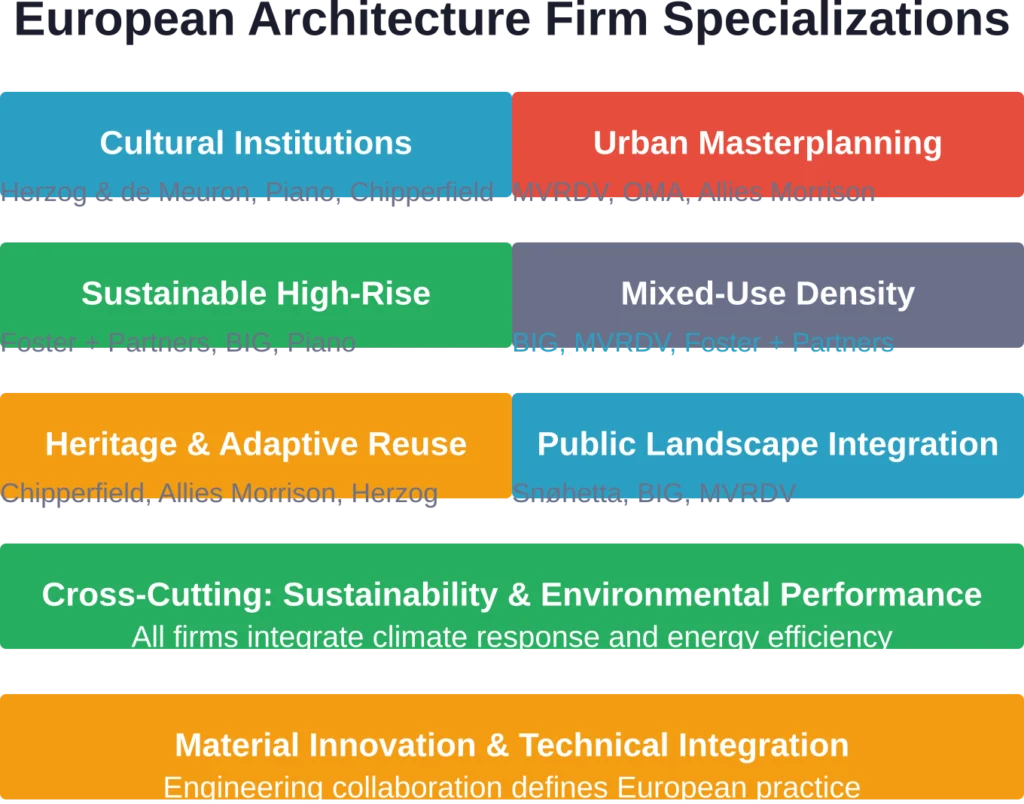
How to Evaluate European Architectural Design Firms
Selecting an architectural firm represents one of the most consequential decisions in any building project. The right partnership delivers not just a building but value that compounds over decades through lower operating costs, higher user satisfaction, better market positioning, and reduced obsolescence risk.
Here’s how to evaluate potential architectural partners beyond portfolio aesthetics.
Portfolio Depth vs. Portfolio Breadth
Some firms demonstrate deep expertise in particular building types—museums, offices, housing, transport infrastructure. Others showcase versatility across programs and scales.
Neither approach is inherently superior. The question is fit. If you’re developing a concert hall, a firm with five completed performance venues brings invaluable specialist knowledge. If you’re creating something unprecedented—a hybrid program combining multiple uses in novel ways—breadth and adaptability matter more than typological expertise.
Look beyond the glamour shots. Study floor plans. Read building sections. Understand how the firm solved functional requirements, not just how they photographed the results.
Sustainability Credentials and Performance Data
Every firm claims sustainability commitment. Few provide performance data from completed buildings.
Ask for post-occupancy evaluation reports. Request actual energy consumption data from similar projects. Inquire about monitored performance versus modeled predictions—the gap reveals whether the firm’s environmental strategies work in practice or just in presentations.
European firms increasingly pursue Passivhaus certification, BREEAM Outstanding ratings, or equivalent standards. These third-party certifications provide independent verification of performance claims.
Team Structure and Project Leadership
Will the famous principal whose work attracted you actually design your project? Or will a team you’ve never met handle the work while the principal focuses on competitions and publications?
Clarify team structure upfront. Meet the actual designers, project architects, and technical leads who will work on your project. Assess their experience and communication skills—these people will make thousands of decisions affecting your building’s outcome.
Some clients prefer the emerging-architect model, where ambitious younger staff lead projects with principal oversight. Others want senior designers hands-on throughout. Both models can succeed if expectations align with reality.
Technical Integration and Delivery Expertise
Spectacular concepts mean nothing if they can’t be built within budget and schedule constraints.
European architectural practice increasingly emphasizes technical integration—close collaboration with engineers, contractors, and specialist consultants from early design through construction completion. Firms with in-house engineering capabilities or long-standing consultant partnerships typically deliver more buildable designs with fewer cost surprises.
Ask about the firm’s approach to construction documentation, contractor coordination, and on-site presence during construction. Architecture doesn’t end with design development—the critical work happens during technical design and construction administration when details get resolved and design intent gets protected.
Cultural Fit and Communication Style
Architecture involves hundreds of decisions requiring client input. The relationship spans years. Cultural fit and communication compatibility matter enormously.
Some firms present finished schemes for approval. Others involve clients in iterative design explorations. Some communicate primarily through renderings and models. Others emphasize drawings and technical documentation.
Consider your decision-making style, tolerance for ambiguity, and desire for involvement. Choose a firm whose process matches your preferences.
Trends Shaping European Architectural Practice
European architecture is being transformed by several converging forces. Understanding these trends helps predict which firms will thrive in the coming decade.
Carbon Accounting and Circular Economy
The European Union’s ambitious climate targets are reshaping architectural practice. Several countries now require embodied carbon calculations for major projects. Lifecycle assessment is becoming standard practice.
This shift favors firms that understand material flows, construction waste minimization, and design for disassembly. Adaptive reuse increasingly trumps new construction. Timber structures are replacing concrete and steel where structural requirements allow.
The circular economy framework treats buildings as material banks—repositories of resources that can be recovered and reused at end-of-life. Forward-thinking firms now design with deconstruction in mind, using mechanical rather than chemical connections and documenting material specifications in digital material passports.
Digital Design and Computational Methods
Parametric design tools, building information modeling (BIM), and computational optimization are transforming how European architects work.
These technologies enable rapid exploration of design options, automated compliance checking, environmental performance simulation, and fabrication-ready documentation that reduces construction errors.
But technology alone doesn’t guarantee better buildings. The most successful firms use digital tools to augment human judgment, not replace it—employing computation to expand the solution space while applying architectural intelligence to select and refine options.
Social Sustainability and Inclusive Design
European architectural discourse increasingly emphasizes social outcomes alongside environmental performance. How do buildings support diverse communities? How do they enable aging in place? How do they accommodate changing family structures and work patterns?
This shift manifests in design priorities: flexible spaces that support multiple uses, abundant common areas that facilitate community formation, accessibility that exceeds minimum code requirements, and programming that serves diverse age groups and abilities.
The 45% representation of women in European architecture correlates with growing attention to issues historically marginalized in architectural discourse—caregiving spaces, safety and security concerns, and design that supports work-life integration.
Regenerative Design and Ecosystem Services
Sustainability focused on reducing harm. Regenerative design aims to create net-positive impact—buildings that clean air and water, support biodiversity, and restore ecosystem function.
Leading European firms now integrate landscape architects and ecologists from project inception. Green roofs and walls become habitat. Stormwater becomes irrigation resource. Building sites become ecological assets rather than dead zones.
This approach requires different expertise and longer time horizons. The payoffs accrue over decades rather than quarters.
| Firm Name | Headquarters | Founded | Core Specializations | Notable European Projects |
|---|---|---|---|---|
| Foster + Partners | London, UK | 1967 | Sustainable skyscrapers, transport hubs, urban masterplanning | The Gherkin, Reichstag, Bloomberg HQ |
| BIG (Bjarke Ingels Group) | Copenhagen, Denmark | 2005 | Mixed-use, sustainable housing, infrastructure | CopenHill, 8 House, Mountain Dwellings |
| Herzog & de Meuron | Basel, Switzerland | 1978 | Cultural institutions, adaptive reuse, material innovation | Tate Modern, Elbphilharmonie, Allianz Arena |
| MVRDV | Rotterdam, Netherlands | 1993 | High-density mixed-use, data-driven design, vertical urbanism | Market Hall Rotterdam, Valley Amsterdam, Depot |
| David Chipperfield | London, UK / Berlin, Germany | 1985 | Museums, heritage restoration, contextual urbanism | Neues Museum, James Simon Gallery |
| Snøhetta | Oslo, Norway | 1989 | Cultural buildings, landscape integration, public institutions | Oslo Opera House, Le Monde HQ Paris |
| OMA | Rotterdam, Netherlands | 1975 | Cultural institutions, urban research, typological innovation | Casa da Música, PRADA Foundation Milan |
| Renzo Piano Building Workshop | Genoa, Italy | 1981 | Museums, mixed-use towers, sustainable workplaces | Centre Pompidou, The Shard, Stavros Niarchos |
| Allies and Morrison | London, UK | 1984 | Urban masterplanning, heritage, regeneration | King’s Cross, Royal Festival Hall, BBC |
Working with European Architectural Firms: What to Expect
Engaging a European architectural firm involves navigating different professional structures, contractual frameworks, and delivery expectations than might be familiar to clients outside Europe.
Fee Structures and Appointment Terms
European architectural fees typically follow percentage-of-construction-cost models, though fixed fees and time-charge arrangements also exist. Fee percentages vary by project complexity, firm reputation, and regional norms.
Standard appointment terms are often based on national professional institute templates—the RIBA plan of work in the UK, the AIA in Germany (different from the American Institute of Architects), or the Ordre des Architectes framework in France.
These frameworks divide projects into stages: conceptual design, developed design, technical design, and construction oversight. Clarifying scope and deliverables for each stage prevents misunderstandings about what’s included in quoted fees.
Design Authority and Client Collaboration
European architectural culture traditionally grants significant design authority to architects. Clients set program requirements and budgets but often defer to architects on aesthetic and technical decisions.
This differs from markets where clients expect to direct design details or where architects function primarily as technical consultants implementing client visions.
The balance varies by firm. Some welcome intensive client collaboration. Others prefer to develop proposals independently and present finished concepts. Discuss expectations upfront to ensure alignment.
Regulatory Navigation and Planning Permission
European planning and building regulations are complex, varying not just by country but by municipality. Historic preservation requirements, local design codes, neighbor consultation processes, and environmental assessments can extend timelines significantly.
Experienced firms understand local regulatory contexts and can navigate approval processes efficiently. They maintain relationships with planning authorities, know which design approaches gain approval, and can anticipate objections before formal submission.
Budget time and fees for planning processes. Major urban projects in heritage contexts can require years to secure permissions before construction begins.
Contractor Relationships and Construction Oversight
European construction contracts often differ from North American design-bid-build or construction management models. Design-build approaches are common for certain project types. Negotiated contracts with established contractors are frequent.
Architects typically maintain stronger on-site presence during construction than in some markets, with regular site visits and detailed review of contractor submittals. This oversight helps ensure design intent is preserved as construction details get resolved.
Some firms offer full construction administration services. Others provide limited site presence with contractors taking more interpretation responsibility. Clarify the level of construction-phase service included in fees.
Regional Variations Within European Architecture
Europe isn’t architecturally monolithic. Regional traditions, climate conditions, and cultural values create distinct architectural subcultures.
Nordic Minimalism and Social Democracy
Scandinavian architecture emphasizes natural materials, connection to landscape, and social equity. The tradition prizes restraint, craftsmanship, and buildings that serve collective rather than purely commercial interests.
Nordic firms often lead in environmental performance and social sustainability. Their work demonstrates that high-performance buildings needn’t sacrifice beauty or comfort.
Mediterranean Contextualism
Southern European architecture engages climate through passive strategies—thermal mass, shading, natural ventilation, and outdoor living spaces. Projects respond to intense sun, warm temperatures, and cultural patterns emphasizing public space and community interaction.
Mediterranean firms excel at adaptive reuse, working within dense historic fabric, and creating architecture that enhances rather than dominates its context.
Eastern European Experimentation
Architecture in Poland, Czech Republic, Romania, and other Eastern European countries combines respect for complex history with eagerness to experiment. These markets offer opportunities for innovative projects at scales and budgets that might not pencil in Western Europe.
Eastern European firms are gaining international recognition for bold contemporary work that doesn’t ignore historical layers but doesn’t defer to them either.
British Pragmatism
UK architectural culture balances heritage conservation with modernization, often within the same project. British firms are particularly skilled at adaptive reuse, regulatory navigation, and architecture that respects context while asserting contemporary identity.
London’s position as a global financial center creates demand for high-performance office and mixed-use projects. British architects have refined workplace design to a high art, creating offices that enhance productivity, recruit talent, and minimize environmental impact.
The Future of European Architectural Practice
Several factors will shape European architecture’s evolution over the coming decade.
Climate Adaptation and Resilience
Rising temperatures, increased flooding, and extreme weather events require buildings that adapt to changing conditions. Expect growing emphasis on passive cooling, water management, thermal mass, and facade systems that respond dynamically to weather.
Coastal cities face sea-level rise. Mountain regions confront changing snowfall patterns. Mediterranean areas must handle extended droughts and heat waves. Architecture will increasingly address these regional climate challenges.
Affordable Housing Crisis
Housing affordability has reached crisis levels in many European cities. Architecture must contribute to solutions through innovative typologies, construction methods that reduce costs, and design that creates social value beyond unit square footage.
Expect experimentation with collective housing models, co-housing, modular construction, and buildings that share amenities to reduce individual unit costs.
Automation and Prefabrication
Construction labor shortages and rising costs are driving interest in prefabrication, modular construction, and automation. These approaches promise faster delivery, improved quality control, and reduced waste.
But they require different design approaches—more coordination upfront, stricter dimensional discipline, and understanding of manufacturing constraints. Architects will need to integrate fabrication knowledge earlier in design processes.
Post-Pandemic Workplace and Mixed-Use
Remote work’s normalization is transforming office demand. Companies need less space but higher-quality space to justify commuting. Residential buildings need better work-from-home accommodation.
This shift creates opportunities for mixed-use buildings that combine workplace, residence, and amenities in ways that support flexible living and working patterns.
Questions to Ask When Selecting an Architectural Firm
Use these questions to evaluate potential architectural partners:
1. Can you provide post-occupancy performance data from similar completed projects?
This separates firms that deliver measurable outcomes from those making aspirational claims.
2. Who specifically will lead our project, and what is their relevant experience?
Clarifies whether you get the talent that attracted you or someone else entirely.
3. How do you handle cost control throughout design development?
Reveals whether the firm designs to budget or designs first and value-engineers later.
4. What is your approach to contractor selection and construction administration?
Illuminates how much support you’ll receive during construction when design intent gets tested.
5. Can you provide client references from projects with similar scope and complexity?
Allows validation of claims through conversations with previous clients.
6. How do you integrate environmental performance goals into design decisions?
Distinguishes firms that treat sustainability as core driver from those that add green features as afterthoughts.
7. What is your process for handling design changes and scope evolution?
Prevents later disputes about what’s included in fees versus what triggers additional charges.
8. How do you approach site-specific challenges like heritage context, planning restrictions, or difficult ground conditions?
Tests whether the firm understands the specific constraints affecting your project.
Frequently Asked Questions
European architectural fees vary widely based on project complexity, firm reputation, location, and scope of services. Fees typically range from 8-15% of construction costs for standard commercial projects. Complex cultural buildings or challenging heritage restorations may command 12-18%. Small residential projects might see higher percentages (10-20%) due to fixed overhead costs. Rather than focusing on percentage, evaluate total fee against the value delivered—a firm charging 12% that delivers a building performing 30% better than code requirements while coming in on budget provides better value than a 9% fee that leads to cost overruns and performance shortfalls.
European firms typically maintain stronger design authority and more involvement through construction completion than American counterparts. European architectural education emphasizes cultural and historical context more heavily, while American programs often prioritize technical and business skills. European projects navigate stricter heritage preservation requirements and more complex planning approvals but benefit from cultures that generally respect architectural expertise. Fee structures differ—European firms more commonly charge percentage-of-construction-cost, while American firms increasingly use fixed fees. European firms tend to be smaller—46% of European architects are practice owners or principals, creating a landscape of boutique studios rather than mega-firms.
Timelines vary enormously by project scale, complexity, and location. A simple residential renovation might take 12-18 months from initial design to completion. A new commercial building typically requires 24-36 months. Major cultural institutions or complex urban projects can span 5-10 years from competition through construction completion. Planning permission alone can take 6-18 months in heritage contexts or contested sites. The design phases—concept, development, technical design—typically consume 8-18 months depending on project complexity. Construction duration depends on building size and complexity but generally ranges from 12-36 months for most projects. Eastern European timelines often run faster due to less restrictive planning regimes.
You can work with firms from across Europe thanks to mutual recognition of professional qualifications within the EU and EEA. However, most international firms partner with local architects who understand regional building codes, planning processes, and construction practices. This hybrid approach combines international design expertise with essential local knowledge. For smaller projects, purely local firms usually prove more cost-effective and efficient. For major projects where design distinction matters, international firms with local partners deliver the best of both worlds. Verify that your chosen firm can legally practice in your jurisdiction and ask how they’ll handle local regulatory requirements, contractor coordination, and construction administration.
Look beyond aesthetic appeal to substance. Study whether completed projects met client objectives—on time, on budget, with measurable performance outcomes. Examine functional plans, not just exterior photos. Does the spatial organization work? Are circulation paths clear? Do floor plans suggest the firm understands how people actually use space? Look for completed projects similar in scale, budget, and program to yours. Diversity of visual style across a portfolio suggests the firm responds to context rather than imposing a signature aesthetic. Check whether projects have won post-occupancy awards or been documented in use—these indicate buildings that function well over time, not just photograph beautifully when new.
European firms are generally at the forefront of sustainable architectural practice, driven by strict EU environmental regulations, ambitious carbon reduction targets, and cultural values prioritizing environmental stewardship. European building energy codes are typically more stringent than North American equivalents. Standards like Passivhaus, BREEAM, and DGNB originated in Europe and are widely adopted. Many European cities now require embodied carbon calculations and lifecycle assessment for major projects. The profession’s approaching gender parity—45% women architects—correlates with broader definition of sustainability that includes social equity and community wellbeing. However, avoid assuming all European firms are sustainability leaders—verify credentials through certified project examples and post-occupancy performance data.
Copyright and intellectual property terms should be clearly defined in your architectural services agreement. In most European jurisdictions, architects retain copyright to their designs even when clients commission and pay for the work. Clients typically receive licenses to use the design for the specific project but not to reproduce or modify it without permission. This differs from work-for-hire arrangements common in some industries. For projects with significant commercial value or where you might want design flexibility later, negotiate IP terms upfront. Consider whether you need rights to modify the design, construct future phases without the original architect, or license the design for other locations. Reputable firms are open to discussing IP arrangements—the key is addressing it in the contract, not discovering disagreements later.
Making Your Decision
Selecting an architectural firm ranks among the most important decisions in any building project. The right choice delivers value compounding over decades. The wrong choice creates problems that no amount of remediation fully resolves.
Start with clarity about your own priorities. Do you value design innovation or proven typological expertise? Do you want ambitious environmental performance or conservative risk management? Do you prefer collaborative design exploration or definitive proposals?
Don’t choose based solely on portfolio beauty. Stunning renderings don’t guarantee successful projects. Investigate the firm’s delivery track record, technical capabilities, team structure, and client satisfaction.
Trust is essential. You’re entering a multi-year partnership involving hundreds of decisions requiring mutual respect and shared commitment. Chemistry matters. Communication styles matter. Cultural alignment matters.
The ten European architectural firms profiled here represent different approaches, scales, and specializations. One might be right for your project. Or none might fit—Europe hosts hundreds of excellent firms not included in this overview.
Use this guide as a starting point, not a destination. Research firms whose work resonates with your project vision. Review their completed projects in person when possible—buildings reveal qualities that photography cannot capture. Talk with their previous clients. Meet their teams.
The best architectural firm for your project is the one that combines relevant expertise, compatible process, technical capability, and shared values. No ranking or list can determine that fit—only your careful evaluation can.
Architecture shapes how we live, work, and connect. Choose your architectural partner with the care that momentous decision deserves.