

Quick Summary: Top architectural rendering studios operate with specialized expertise, combining technical precision with creative storytelling. Companies like DBOX, Neoscape, Brick Visual, The Boundary, and Hayes Davidson consistently deliver photorealistic visualizations for high-profile real estate and architectural projects. These firms stand out through their mastery of lighting, material representation, composition expertise, and ability to translate complex design concepts into compelling visual narratives that win approvals and drive sales.
Architectural rendering has become essential infrastructure for anyone trying to sell, approve, or communicate a building before it exists. The stakes are higher than ever. Real estate developers need visuals that convert investors. Architects need presentations that win competitions. Marketing teams need imagery that stops scrollers mid-swipe.
But here’s the thing—not all rendering companies operate at the same level.
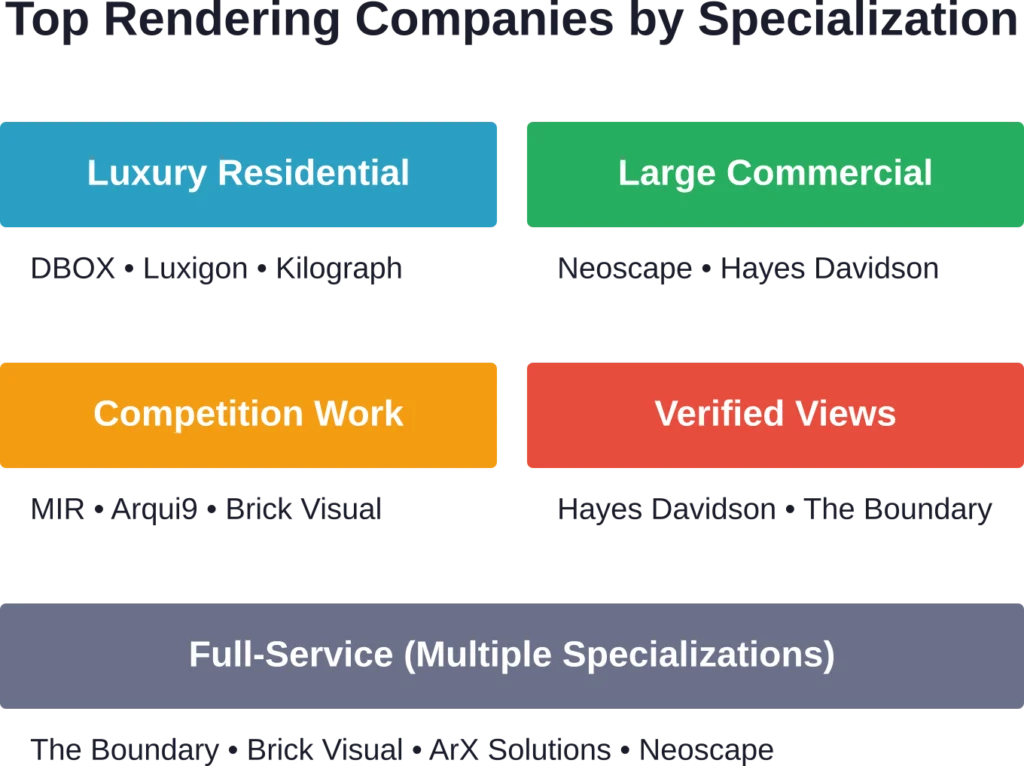
Some studios specialize in hyperrealistic residential interiors. Others focus on massive commercial developments or competition-winning conceptual work. The right choice depends entirely on what the project demands and how the images will be used.
According to ArchDaily reporting from May 2026, AI is transforming the architectural visualization workflow, raising the bar for creative interpretation. The best studios are embedding these tools without sacrificing the craft that separates stunning work from generic output.
This guide breaks down the ten best architectural rendering companies operating today. Each entry includes what the studio specializes in, the type of projects it handles, and what sets it apart from competitors. No fluff. No invented credentials. Just the studios that consistently deliver work worth the investment.
What Makes a Rendering Company Stand Out in 2026
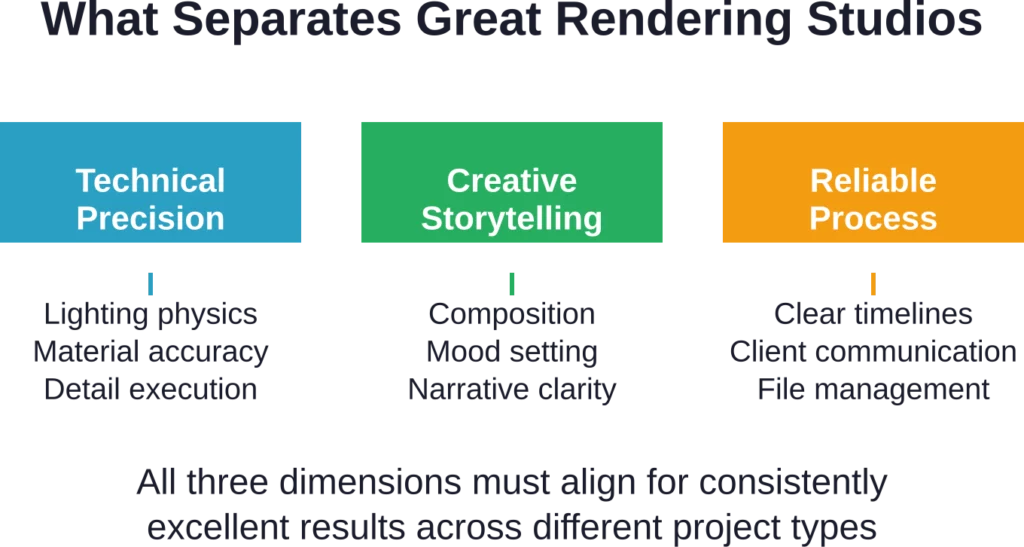
The gap between average and exceptional rendering work comes down to a handful of factors that separate technical competency from visual storytelling that actually moves projects forward.
Photorealism matters, but it’s not the whole game. A render can be technically flawless and still fail to communicate the design intent or evoke the right emotional response. The best companies understand that their job extends beyond matching materials and lighting to real-world physics.
Technical Mastery That Shows in Details
Top studios demonstrate expertise in lighting simulation that accounts for time of day, geographic location, and atmospheric conditions. They handle material representation with nuance—wood grain direction, concrete weathering patterns, metal reflectivity that changes with viewing angle.
These details accumulate into credibility. When a client reviews a rendering, the subconscious reads thousands of small signals that either say “this is real” or “this is computer graphics.”
Composition and camera work separate competent studios from great ones. Knowing where to place the virtual camera, how to frame the shot, what to emphasize and what to let fall into soft focus—these decisions come from understanding photography and visual narrative, not just software proficiency.
Portfolio Diversity and Specialization
Some companies excel at residential work but struggle with large-scale commercial projects. Others thrive on conceptual competition renderings but can’t deliver the production volume needed for a 200-unit development.
The best firms either specialize deeply in one area or demonstrate genuine versatility across multiple building types and visualization styles. Looking at a portfolio should reveal consistent quality across different project scales and architectural approaches.
Process and Communication
Technical skill means nothing if the studio misunderstands the brief or delivers work that requires endless revision cycles. The top companies have refined processes for client communication, iteration management, and file delivery.
They ask the right questions upfront. They provide clear timelines. They deliver files in formats that actually work for the client’s workflow.
Top 11 Architectural Rendering Companies in 2026
These ten companies represent the current leaders in architectural visualization. They’ve earned reputations through consistent delivery on high-stakes projects and maintain portfolios that demonstrate both technical excellence and creative sophistication.

1. Powerkh
Powerkh is a UK-based engineering-led BIM and VDC consultancy working with architects, engineers, contractors, and consultants across the USA and UK. The company supports construction and design teams with BIM coordination, MEP modelling, Scan to BIM, and model-based project support during different stages of design and construction. Their work focuses on maintaining design continuity during coordination and site delivery, helping teams identify and resolve issues before they affect construction.
Powerkh provides BIM modelling services from LOD 100 to LOD 500, along with clash detection, constructability reviews, and coordination using Autodesk Revit and Navisworks. The company also works on point cloud-based Scan to BIM workflows, fabrication-ready models, shop drawings, and Revit family creation. Their services are used across commercial, industrial, and residential projects where coordination between architectural, structural, and MEP systems is required.
Contact Information:
- Website: www.powerkh.com
- Email: [email protected]
- Facebook: www.facebook.com/100064039650167
- LinkedIn: www.linkedin.com/company/powerkh
- Instagram: www.instagram.com/powerkh_com
- Address: 3, Lavinia Walk, Taw Hill, Swindon SN25 1AP
- Phone: +44 7490 426678

2. DBOX
DBOX pioneered the luxury real estate visualization market and remains the benchmark for high-end residential and commercial rendering. The studio has visualized billions of dollars in real estate developments across major global markets.
What sets DBOX apart is the cinematic quality of their compositions and their understanding of lifestyle marketing. These aren’t just building renderings—they’re aspirational narratives that sell a vision of life inside the space.
The studio handles everything from intimate residential interiors to soaring mixed-use developments. Their work appears in marketing campaigns for the most prestigious addresses in New York, Miami, Los Angeles, and international markets.
DBOX also offers motion graphics and animation services, extending their visualization expertise into dynamic media that brings architectural concepts to life through movement and time.

3. Neoscape
Based in New York with an international presence, Neoscape combines architectural visualization with broader branding and marketing services. This integration allows them to create rendering work that fits seamlessly into comprehensive marketing strategies.
The studio specializes in large-scale mixed-use developments, urban planning visualizations, and complex commercial projects. Their portfolio includes major developments across North America and international markets.
Neoscape brings sophisticated aerial perspectives and urban context shots that help stakeholders understand how a project integrates into its surroundings. This wider view makes their work particularly valuable for projects requiring municipal approvals or community presentations.
The team also produces virtual reality experiences and interactive presentations that allow clients to explore designs in immersive formats beyond static images.

4. Brick Visual
Operating from Budapest, Brick Visual has built an international reputation for architectural rendering that balances technical precision with artistic sensibility. The studio serves clients across Europe, North America, and beyond.
Brick Visual’s portfolio demonstrates particular strength in residential and commercial architecture, with a distinctive approach to lighting and atmosphere that gives their work immediate recognizability.
The company maintains a strong focus on sustainable architecture visualization, understanding how to represent green building features and environmental integration in ways that communicate both aesthetic appeal and ecological responsibility.
Their process emphasizes collaboration with architects throughout the design development phase, allowing the visualization work to inform design decisions rather than simply documenting completed concepts.

5. The Boundary
The Boundary operates from London and has established itself as a premier architectural visualization studio with a portfolio spanning residential, commercial, cultural, and institutional projects.
What distinguishes The Boundary is their architectural background—the team includes trained architects who bring deep understanding of spatial relationships, materiality, and design intent to their rendering work.
The studio’s work shows exceptional attention to context and atmosphere. Their urban scenes feel inhabited and authentic, with pedestrian activity, lighting, and environmental details that create believable representations of future spaces.
The Boundary also produces animation and film work for architectural projects, understanding how to use motion, sound, and sequential narrative to communicate design concepts that static images cannot fully capture.

6. Hayes Davidson
Hayes Davidson, based in London, brings over three decades of experience to architectural visualization. The studio has worked on some of the most significant architectural projects in Europe and internationally.
The company excels at verified view renderings—highly accurate visualizations that show proposed developments from specific viewpoints, often required for planning approvals. This work demands extreme precision in camera matching, lighting simulation, and architectural accuracy.
Hayes Davidson’s portfolio includes major infrastructure projects, cultural buildings, commercial developments, and residential schemes. Their client list reads like a directory of leading international architecture firms.
The studio combines traditional visualization craft with emerging technologies, maintaining quality standards while adapting to new tools and client requirements as the industry evolves.
7. Kilograph
Kilograph operates from Los Angeles and Chicago, serving clients across North America with a focus on high-end residential and commercial visualization work.
The studio’s aesthetic leans toward warm, livable imagery that emphasizes natural light and material richness. Their residential work in particular captures the California lifestyle aesthetic that appeals to luxury real estate markets.
Kilograph handles both exterior and interior rendering with equal sophistication, understanding how to create cohesive visual narratives that flow from urban context through building exterior to interior spaces.
The team also offers virtual reality services and interactive presentations, recognizing that different project phases and client needs require different visualization formats beyond traditional still renderings.

8. MIR
MIR, operating from Norway, has built a reputation for architectural visualization that emphasizes atmospheric quality and emotional resonance over pure photorealism.
The studio’s work often features dramatic lighting conditions—dawn, dusk, overcast skies, and night scenes—that create mood and narrative tension in ways that flat midday lighting cannot achieve.
MIR serves an international client base with particular strength in Scandinavian and European markets. Their portfolio includes competition-winning renderings for major cultural and institutional projects.
The company maintains relatively small project volumes compared to some competitors, focusing on quality and creative ambition rather than production throughput.

9. Luxigon
Based in New York, Luxigon specializes in luxury residential and hospitality visualization with a portfolio that includes some of the most exclusive addresses in global real estate.
The studio’s strength lies in interior rendering that captures material luxury—the way light plays across polished marble, the texture of fine fabrics, the reflection in custom metalwork. These details matter enormously in marketing high-end residential developments.
Luxigon works closely with developers and architects to create images that support sales efforts, understanding that their renderings often represent the primary sales tool before physical spaces exist.
The company also produces virtual staging and renovation visualization, helping clients see potential in existing spaces through rendered transformations.
10. Arqui9
Arqui9, based in Portugal, serves European and international clients with architectural visualization that combines technical precision with artistic interpretation.
The studio handles diverse project types including residential, commercial, cultural, and urban planning work. Their portfolio demonstrates adaptability across different architectural styles and visualization approaches.
Arqui9 brings particular expertise to competition renderings—images designed to win over juries in architectural competitions where visual impact and design clarity determine success or failure.
The team understands how to balance artistic expression with architectural accuracy, creating images that push creative boundaries while remaining faithful to design intent.

11. ArX Solutions
ArX Solutions operates from multiple locations serving clients globally with architectural rendering, animation, and virtual reality services.
The company positions itself as a technology-forward studio, early to adopt new tools and workflows that improve efficiency or expand creative possibilities. Leading studios are integrating AI into architectural workflows in 2026, and ArX Solutions represents firms embracing this shift.
Their portfolio spans residential, commercial, hospitality, and institutional work with consistent quality across different project types and scales.
ArX Solutions also offers panoramic renderings and 360-degree visualizations that allow clients to experience spaces from immersive viewpoints rather than fixed camera positions.
Types of Architectural Rendering Services
Architectural visualization encompasses several distinct service categories, each serving different purposes in the design, approval, and marketing process.
Exterior Renderings
Exterior visualizations show the building from outside perspectives, typically including context like surrounding buildings, landscaping, pedestrian activity, and sky conditions. These images communicate how a project sits in its urban or natural environment.
Exterior renders serve multiple purposes. Architects use them for design development and client presentations. Developers need them for marketing materials. Planning authorities often require them for approval processes.
The challenge in exterior rendering is balancing architectural clarity with atmospheric believability. The image needs to clearly show the building design while also feeling like a real place that could exist.
Interior Renderings
Interior visualizations capture spaces from inside, showing room layouts, material finishes, furniture arrangements, and lighting conditions. These images help clients envision lived experience within the space.
For residential projects, interior renders often emphasize warmth, comfort, and lifestyle appeal. For commercial work, they might focus on functionality, brand alignment, or workplace culture.
The best interior renderings solve the problem of showing spatial relationships—how rooms connect, how natural light moves through the day, how different areas relate to one another functionally and visually.
Aerial and Bird’s Eye Views
Aerial perspectives show projects from elevated viewpoints, useful for conveying overall site planning, building massing, and relationship to surrounding context.
These views work particularly well for large developments where understanding the full scope and layout matters more than intimate material detail. Master planning projects, campus developments, and urban renewal schemes often require aerial visualization.
Drone photography has made aerial views increasingly common in real photography, so rendered aerial views now need to match the aesthetic that audiences have come to expect from actual drone footage.
Animation and Virtual Tours
Animated visualizations add the dimension of movement and time, allowing viewers to experience a walk-through of the project or see how light changes throughout the day.
Animation requires significantly more production time than still images but creates engagement that static renders cannot achieve. Clients can experience spatial sequences and transitions between areas.
Virtual reality takes this further, allowing viewers to control their own movement through the space with head-mounted displays or interactive screens.
How to Choose the Right Rendering Company
Selecting a rendering studio requires evaluating several factors beyond just looking at pretty pictures in a portfolio.
Match Studio Expertise to Project Type
A studio that excels at moody competition renderings might struggle with the production volume required for a 150-unit residential development. A company specializing in luxury interiors might not bring the right aesthetic to an industrial warehouse conversion.
Look for portfolio work that matches the project type, scale, and visual approach needed. If the studio hasn’t demonstrated capability in the specific area required, that represents risk.
Evaluate Communication and Process
Technical capability means nothing if the studio misunderstands the brief or requires endless revision cycles. During initial conversations, assess whether the team asks intelligent questions and demonstrates understanding of project requirements.
Clear processes for file exchange, revision tracking, and deliverable formats prevent headaches later. Studios that have worked with similar clients will understand technical requirements without lengthy explanations.
Consider Timeline and Capacity
Some projects need renderings in two weeks. Others can accommodate two-month timelines. Different studios have different capacity and scheduling approaches.
Smaller boutique studios might deliver exceptional quality but have limited throughput. Larger production-oriented companies can handle volume but might assign work to junior artists. Understanding these tradeoffs helps match studio selection to project constraints.
Review Technical Specifications
Renderings need to work for their intended purpose. An image for a billboard requires different resolution than one for a website. Print publications have specific color profile requirements. Presentation formats vary.
Confirm the studio can deliver files in required formats, resolutions, and color spaces. This sounds basic but technical incompatibility wastes time and creates frustration.
| Evaluation Factor | What to Look For | Red Flags |
|---|---|---|
| Portfolio Quality | Consistent excellence across multiple projects in relevant category | Only one or two strong projects mixed with mediocre work |
| Relevant Experience | Multiple completed projects matching your building type and scale | No similar work shown despite claims of expertise |
| Communication | Asks detailed questions, provides clear timelines, confirms understanding | Vague responses, unclear process, poor responsiveness |
| Technical Capability | Delivers in required formats, understands technical specifications | Cannot confirm file format compatibility or resolution requirements |
| Revision Process | Clear policy on included revisions and additional change costs | Unlimited revisions promised or no clear revision structure |
Common Mistakes When Hiring Rendering Companies
Several recurring errors create problems for clients selecting visualization studios.
Choosing Based Only on Portfolio Beauty
Gorgeous portfolio images don’t guarantee the studio can deliver what a specific project needs. A company might show breathtaking work that took months to produce, then struggle with tight deadlines or production volume.
Portfolio quality matters enormously, but it needs to be portfolio quality in the relevant project category, demonstrated across multiple projects rather than one spectacular example.
Inadequate Brief Preparation
Rendering companies cannot read minds. Vague direction like “make it look good” or “something modern” leads to work that misses the mark and requires expensive revision cycles.
Providing clear reference images, specific material information, accurate architectural drawings, and explicit communication about the rendering’s purpose creates better outcomes.
Ignoring Geographic and Time Zone Factors
Working with a studio in a vastly different time zone can complicate communication and slow iteration cycles. This doesn’t mean avoiding international companies—many projects work perfectly well across time zones—but it requires awareness and planning.
Some studios maintain distributed teams across multiple time zones specifically to provide broader coverage. Understanding how a company handles communication across geographic separation prevents surprises.
Unrealistic Timeline Expectations
Quality rendering takes time. Expecting photorealistic images with multiple views in 48 hours sets up failure unless the studio has unusual availability and the project is straightforward.
Better to discuss timeline requirements honestly upfront. Many studios can accommodate rush work when necessary, but it often requires additional resources or premium scheduling.
The Role of AI in Architectural Rendering
Artificial intelligence is reshaping architectural visualization workflows in 2026, though perhaps not in the revolutionary ways some predicted.
ArchDaily reports that AI is transforming the architectural visualization workflow, with architects iterating from concept to photoreal imagery in minutes. The technology excels at specific functions like material generation, style transfer, and rapid iteration of design variations.
But here’s what AI hasn’t replaced: the human judgment about composition, lighting mood, narrative structure, and design intent. The best rendering companies are integrating AI as a tool within their workflows rather than replacing their artists with algorithms.
Gendo is a browser-based generative AI platform developed for architects and designers, enabling creation of presentation-ready visuals from 2D inputs. RunDiffusion offers cloud-based GPU workspaces and pre-configured AI tools for architectural motion graphics and visual storytelling. These platforms augment human capability rather than substituting for it.
Chaos is embedding AI into architectural design workflows through integration of Enscape and Veras, pairing the speed and flexibility of AI with precise control of professional rendering environments, according to Architizer (July 2025).
The practical impact for clients hiring rendering companies: some studios can now deliver certain types of work faster or explore more design variations in the same timeframe. The technology serves as an accelerator for specific workflow stages.
What hasn’t changed is the need for creative direction, quality control, and the craft of creating images that communicate effectively. Those remain human skills that separate exceptional rendering work from mediocre output.
Understanding Rendering Project Timelines
Timeline expectations for architectural rendering projects vary based on image complexity, revision cycles, and studio workload.
Typical Timeline Breakdown
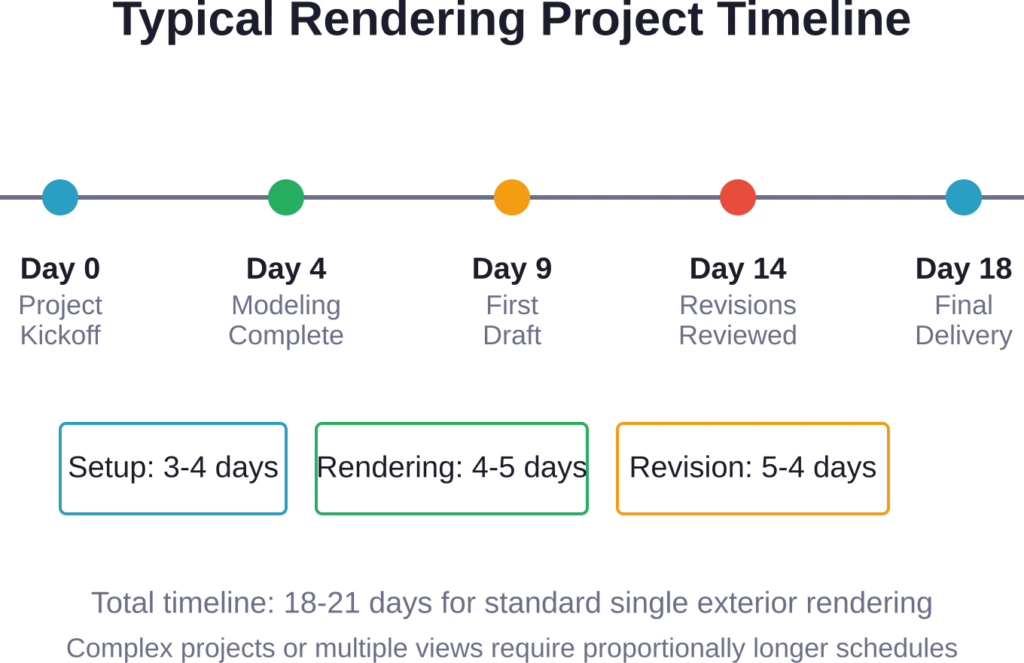
A standard exterior rendering of a mid-sized residential or commercial project typically requires two to three weeks from initial briefing to final delivery. This assumes clear direction, adequate source material, and normal revision cycles.
The timeline breaks down roughly into: initial modeling and camera setup (3-4 days), material application and lighting development (4-5 days), first draft rendering (1-2 days), client review and revision request (2-3 days), final adjustments and delivery (2-3 days).
Interior renderings often follow similar timelines, though complex interiors with custom furniture and intricate material details may require additional time.
Factors That Extend Timelines
Incomplete or unclear source material slows every phase. If architectural drawings lack detail or contain inconsistencies, the rendering team must make assumptions or request clarification repeatedly.
Multiple stakeholder reviews insert delay. When renderings must pass through architect review, developer approval, and investor sign-off, each review cycle adds time.
Scope creep extends timelines significantly. When clients request camera angle changes, significant design modifications, or additional views beyond the original scope, the project timeline extends accordingly.
When Rush Work Makes Sense
Some situations justify expedited timelines despite added cost and complexity. Upcoming investor presentations, immovable planning submission deadlines, or competitive proposal requirements sometimes demand faster delivery.
Studios that can accommodate rush work typically do so by reallocating resources from other projects or adding additional artists to the work. This carries real cost implications even if not explicitly itemized.
Rendering Quality Indicators to Evaluate
When reviewing rendering portfolios or draft work, certain quality indicators separate professional work from amateur output.
Lighting Realism
Light behavior separates believable renderings from obvious computer graphics. Look for accurate shadow softness based on light source size, proper light bounce and color bleeding from surrounding surfaces, and realistic fall-off of light intensity with distance.
Outdoor scenes should show appropriate sky dome illumination for the stated time of day and geographic location. Interior scenes should demonstrate understanding of how daylight and artificial light interact.
Material Authenticity
Materials should respond to light the way their real-world counterparts behave. Concrete should show appropriate surface texture and subtle color variation. Glass should refract and reflect with physical accuracy. Wood grain should follow logical direction based on how the material would be cut and applied.
The best renderings show weathering and imperfection where appropriate. Perfectly pristine materials throughout a scene often look sterile and fake.
Composition and Camera Work
Professional rendering studios understand photography principles. Frame composition should follow rules like the rule of thirds, leading lines, and balanced visual weight—or deliberately break those rules for specific effect.
Camera height, focal length, and depth of field should feel intentional rather than arbitrary. The camera position should clearly communicate the space while creating visual interest.
Context and Atmosphere
Buildings don’t exist in isolation. Quality renderings show appropriate context—surrounding buildings, landscape elements, human activity, vehicles, and atmospheric effects that ground the project in believable reality.
The level of context detail should support rather than compete with the main subject. Background elements provide scale and atmosphere without distracting from the architectural focus.
When to Use Different Rendering Styles
Not every project requires hyperrealistic rendering. Different visualization approaches serve different purposes.
Photorealistic Rendering
Photorealistic work aims for images indistinguishable from photography. This approach works best for marketing materials, client presentations, and situations where the rendering needs to convey exactly how the finished project will appear.
Real estate marketing particularly benefits from photorealism because buyers need to envision themselves in the actual space. The rendering serves as a substitute for photography of a building that doesn’t exist yet.
Conceptual Visualization
Conceptual renderings prioritize design communication over literal accuracy. These images might use atmospheric effects, simplified geometry, or artistic interpretation to convey design intent and spatial experience.
Competition entries often use conceptual visualization because jury members respond to bold visual statements that clearly communicate big ideas. Getting every material detail perfect matters less than conveying the conceptual approach.
Technical Visualization
Some renderings serve primarily technical documentation purposes—showing how building systems integrate, how construction phases sequence, or how complex geometries resolve.
These visualizations might sacrifice atmospheric beauty for clarity of technical communication, using color-coding, transparency, or exploded views to reveal information that photorealistic rendering would obscure.
Future Trends in Architectural Rendering
The architectural visualization industry continues evolving as technology, client expectations, and design approaches change.
Real-Time Rendering Engines
Game engine technology increasingly powers architectural visualization, allowing interactive exploration of spaces rather than fixed camera views. Clients can move through the design in real-time, changing materials, lighting, and design options on the fly.
This shift from pre-rendered images to interactive experiences changes the nature of visualization services from image production to environment creation.
Integration with Design Process
Visualization is becoming more embedded throughout design development rather than appearing only at presentation milestones. Faster iteration times allow architects to visualize options as they explore them, making rendering a design tool rather than just a documentation tool.
According to AIRI Lab’s survey of leading firms including LWK+P, MVRDV, Gensler, and others, AI provides immediate value through speed and the ability to generate options, accelerating decision-making and design exploration. This pattern extends to visualization, which increasingly happens earlier and more frequently in the design process.
Motion and Narrative
Static images increasingly compete with animation, cinematic sequences, and virtual experiences. The 2026 Architizer Vision Awards span four category groups—Architectural Concept, Architectural Rendering & Drawing, Architectural Photography & Video, and Architectural Visionary—recognizing architectural storytelling across multiple media formats.
ArchDaily reports that in 2025, architectural visuals became accountable, with representation becoming political and visuals transitioning from selling futures to defending truths. This shift elevates the importance of visualization quality and authenticity.
Maximizing Value from Rendering Investments
Getting the most from architectural rendering services requires active client participation and clear communication.
Provide Complete Source Material
The rendering team needs comprehensive information: accurate architectural drawings, material specifications, landscape plans, context information, and reference images showing the desired aesthetic direction.
Incomplete information forces the studio to make assumptions or request clarification, extending timelines and increasing revision cycles. Front-loading the project with thorough briefing material saves time and money later.
Consolidate Feedback
When multiple stakeholders review renderings, consolidate comments into unified feedback rather than sending each reviewer’s input separately. Contradictory direction from different stakeholders creates confusion and wasted work.
Appoint one person as the interface with the rendering studio, responsible for gathering internal feedback and communicating coherent direction.
Plan for Multiple Uses
Rendering investments multiply in value when images serve multiple purposes. A rendering created for a planning submission can also appear in marketing materials, investor presentations, and public relations efforts.
Discuss all potential uses upfront so the studio can deliver appropriate file formats, resolutions, and variations. Creating additional versions from an existing scene costs less than commissioning entirely new views later.
Build Ongoing Relationships
Studios that understand a client’s aesthetic preferences, approval processes, and technical requirements become more efficient over multiple projects. Building ongoing relationships with quality rendering companies creates value through familiarity and streamlined communication.
| Best Practice | Benefit | Common Failure |
|---|---|---|
| Comprehensive brief with drawings, materials, references | Fewer revisions, faster delivery, better first drafts | Vague direction requiring multiple clarification rounds |
| Consolidated feedback from single point of contact | Clear direction, faster iterations, less contradictory input | Multiple reviewers sending conflicting comments directly |
| Realistic timeline with buffer for reviews | Reduced stress, better quality, accommodation for unexpected issues | Impossibly tight deadlines forcing rushed work |
| Clear usage rights and file format specifications | Renderings work for all intended purposes without rework | Discovering file format incompatibility after delivery |
| Ongoing relationship with trusted studio | Efficiency gains, better understanding, priority scheduling | Starting from scratch with new vendor each project |
Frequently Asked Questions
A standard exterior or interior rendering typically requires two to three weeks from initial briefing to final delivery. This timeline includes modeling, material application, lighting setup, initial rendering, client review, revisions, and final output. Complex projects with multiple views or intricate details may require four to six weeks. Rush projects can sometimes be accommodated in one week but usually at premium cost and with limitations on revision cycles.
Request high-resolution TIFF or PNG files for print use, ensuring at least 300 DPI at the final printed size. For digital use, JPEG files work well at appropriate resolution for the display medium. If the rendering might require future edits, request layered PSD files. For large-format printing like billboards or building wraps, confirm the studio can deliver files at required dimensions. Always discuss color space requirements—CMYK for print, RGB for digital display.
Choose photorealistic rendering when the audience needs to see exactly how the finished project will appear—real estate marketing, client approvals, planning submissions. Choose conceptual visualization when communicating design ideas matters more than literal accuracy—competition entries, early design presentations, visionary projects. Photorealism serves selling and approval. Conceptual work serves communication and inspiration. Some projects benefit from both approaches for different audiences or purposes.
Geographic location matters less than expertise, quality, and communication capability. Many excellent studios serve international clients seamlessly through digital workflows. Time zone differences can slow communication but often studios maintain hours that overlap with client locations. Local companies offer easier in-person meetings if needed. Evaluate studios based on portfolio quality, relevant experience, and communication effectiveness rather than location alone. Many projects work perfectly well with studios thousands of miles away.
Studios need architectural drawings (floor plans, elevations, sections), material specifications or finish schedules, site context information, landscape plans if applicable, and reference images showing desired aesthetic direction. Provide CAD files, BIM models, or SketchUp files if available. Specify camera angles, views required, and how the renderings will be used. Include any branding guidelines, specific atmospheric requirements, or stakeholder preferences. The more complete the briefing information, the better the first draft will match expectations.
Many studios can develop renderings from sketch-level information, though this requires more interpretation and typically involves additional back-and-forth to ensure the interpretation matches design intent. Working from sketches costs more and takes longer than working from precise CAD drawings because the rendering team must make numerous design decisions. For conceptual projects or early design phases, sketch-based rendering works well. For projects nearing construction or requiring precise accuracy, detailed architectural drawings produce better results.
Most rendering contracts include one or two revision rounds after the initial draft. The first round addresses any misunderstandings or adjustments to camera angle, materials, lighting, or composition. A second round handles minor refinements. Additional revisions beyond the included rounds usually incur extra fees. Scope changes—like moving the camera, changing architectural elements, or adding views—typically fall outside normal revisions. Clarify revision policies before starting to avoid surprise costs and understand what constitutes a revision versus a scope change.
Conclusion
Architectural rendering has moved far beyond simple 3D visualization. The companies leading this industry create visual narratives that win competitions, secure approvals, attract investment, and drive real estate sales.
The ten studios profiled here—DBOX, Neoscape, Brick Visual, The Boundary, Hayes Davidson, Kilograph, MIR, Luxigon, Arqui9, and ArX Solutions—represent different approaches to excellence. Some specialize in luxury residential work. Others focus on large commercial developments or competition renderings. All demonstrate the technical mastery, creative sophistication, and professional process that separate great rendering work from mediocre output.
Choosing the right rendering partner requires matching studio expertise to project requirements. Look beyond portfolio beauty to evaluate relevant experience, communication capability, and process reliability. Provide complete briefing information, consolidate feedback, and build ongoing relationships with studios that understand specific needs.
The rendering industry continues evolving as AI tools, real-time engines, and interactive media reshape what’s possible. The best companies are integrating new technologies while maintaining the craft and judgment that create truly compelling visual communication.
For architects, developers, and anyone needing to visualize buildings before they exist, investing in quality rendering services pays dividends in approvals secured, projects sold, and visions communicated effectively. The images created by top rendering companies become the primary way most people experience architecture in our increasingly digital world.
Start by reviewing portfolios from studios with demonstrated expertise in the relevant project category. Reach out with clear project requirements and evaluate not just the work they show but how they communicate and what questions they ask. The right rendering partner becomes a valuable collaborator in bringing architectural visions to life.