
Quick Summary: The best B2B web design companies combine strategic UX expertise with conversion-focused design to help businesses generate qualified leads and close deals. Top agencies like Lengreo, Gilzor, OSKI Solutions, A-listware, Mobian Studio, ANML, R/GA, DEPT, and Lazarev specialize in creating credible, scalable digital experiences for enterprise clients, SaaS platforms, and complex B2B products. This list highlights 15 leading firms based on their track records, service offerings, and ability to deliver measurable business outcomes.
B2B buyers don’t give second chances. When someone lands on a business website, they form their first impression in seconds. If the experience feels clunky, outdated, or confusing, they’re gone.
The stakes are higher in B2B than in consumer markets. Decision-makers are researching solutions independently, comparing multiple vendors, and building mental shortlists before they ever fill out a contact form. Your website isn’t just a digital brochure anymore—it’s the first touchpoint in a complex sales cycle.
According to Forbes, nearly three-quarters of businesses have a website, and 43% of small businesses plan to invest in their website performance. That’s not surprising. What is surprising is how many B2B companies still treat web design as an afterthought.
This article breaks down the 15 best B2B web design companies in 2026. These agencies understand the unique challenges of B2B digital experiences—long sales cycles, multiple stakeholders, technical products, and the constant pressure to generate qualified leads.
Whether the business needs a full website redesign, a conversion-optimized landing page system, or a scalable design system for an enterprise platform, this list covers agencies with proven track records in B2B web design.
Why B2B Web Design Matters More Than Ever
B2B buyers behave like B2C consumers now. They research independently, form snap judgments, and expect seamless digital experiences. The old playbook—generic corporate sites with stock photos and dense text blocks—doesn’t cut it anymore.
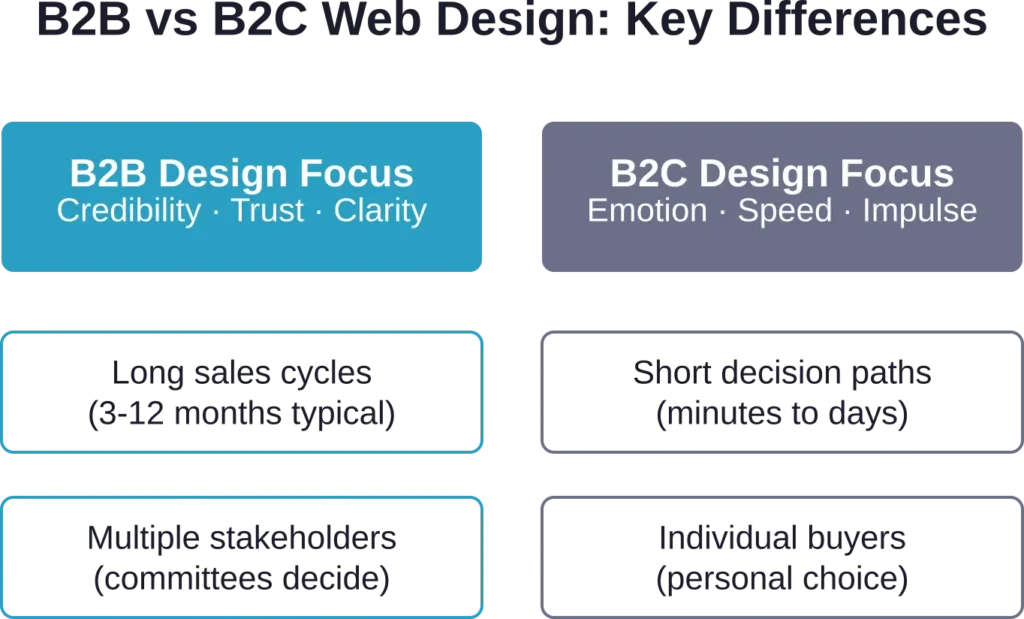
Here’s the thing though—B2B web design is fundamentally different from consumer design. The buying journey is longer, the stakes are higher, and the audience is more skeptical. A B2B website needs to establish credibility, communicate complex value propositions clearly, and guide multiple stakeholders through a decision-making process that can take months.
Poor user experience kills conversions fast. Research shows that 42% of people will leave a website if the functionality isn’t up to scratch or if they can’t quickly find the info they need. That’s not a bounce—that’s a lost deal.
Real talk: mobile matters in B2B too. Studies show that 80% of B2B buyers use mobile devices during the buying process. If the website doesn’t work flawlessly on every screen size, leads are being left on the table.
What Separates Great B2B Web Design From Generic Corporate Sites
Great B2B web design prioritizes clarity over cleverness. It answers the visitor’s core questions fast: What does this company do? Who do they serve? Why should I trust them? What happens next?
The best B2B websites also build trust through proof. Case studies, client logos, testimonials, certifications—these elements aren’t just nice-to-haves. They’re essential credibility signals that help buyers justify their decision to stakeholders.
Navigation needs to be intuitive for different audience segments. A technical evaluator needs access to documentation and specs. A C-level buyer wants high-level outcomes and ROI proof. Smart information architecture accommodates both without creating confusion.
And then there’s the conversion architecture. Great B2B sites don’t just look good—they’re engineered to move prospects through the funnel. Strategic CTAs, lead magnets, demo requests, and progressive profiling all work together to capture and qualify leads at different stages of awareness.
The 15 Best B2B Web Design Companies in 2026
This list isn’t exhaustive—there are hundreds of agencies that can build a decent B2B website. But these 15 firms stand out for their track records with enterprise clients, their understanding of B2B buyer psychology, and their ability to deliver measurable results.
Each agency brings something different to the table. Some excel at brand-level strategy. Others specialize in conversion optimization or technical implementation. The right choice depends on project scope, budget, and specific business needs.
1. Lengreo

Lengreo positions itself as a complete B2B web design and marketing partner that builds high-converting digital experiences for growth-focused companies.
What sets Lengreo apart is their integrated approach that combines strategic web design with performance marketing. They don’t just create websites — they engineer complete digital ecosystems optimized for lead generation, user journeys, and measurable business results.
The agency works with B2B software development companies, professional services firms, event technology providers, sports tech, and IT organizations. Their websites are built to support complex sales cycles and enterprise decision-making processes.
Lengreo’s design work emphasizes clarity, professional authority, and conversion-focused user flows. Clean layouts, intuitive navigation, and strategic CTAs help B2B buyers move smoothly from awareness to action. For companies that need websites that actively generate and nurture high-quality leads while projecting credibility, Lengreo is an excellent choice.
Contact Information:
- Website: Lengreo.com
- Phone: +31 686 147 566
- Email: [email protected]
- Address: Vrijstraat 9 C/D, 5611 AT Eindhoven, Netherlands
- LinkedIn: Lengreo
- Twitter: @Lengreo
- Instagram: @lengreo
2. Gilzor

Gilzor specializes in custom B2B web design and full-cycle digital product development with a strong focus on user-centered interfaces that drive adoption and conversions.
What sets Gilzor apart is their user-centric design philosophy backed by idea validation and rigorous UX research. They create web experiences that reduce cognitive load, improve conversion rates, and clearly communicate complex value propositions to B2B audiences.
The agency serves startups and established businesses across airlines, e-commerce platforms, healthcare, and product studios. Their web projects range from sophisticated corporate websites to complex web applications and client portals.
Gilzor’s design work focuses on functional beauty — thoughtful typography, smooth interactions, and interfaces that feel both modern and trustworthy. For B2B companies that need websites and web platforms where excellent design directly contributes to user engagement and business growth, Gilzor delivers outstanding results.
Contact Information:
- Website: www.gilzor.com
- Email: [email protected]
- Address: Poland, Warsaw, Office 58, street Adama Mickiewicza 37, 01-625
- LinkedIn: www.linkedin.com/company/gilzor-softwaredevelopment
3. Oski

Oski builds smart, enterprise-grade web solutions with exceptional frontend design and user experience at the core. They create digital platforms for tech-forward B2B organizations and ambitious startups.
What sets Oski apart is their ability to combine innovative, aesthetically strong design with robust technical architecture. They deliver intuitive, scalable web experiences that perform flawlessly across devices while maintaining enterprise security and reliability.
The agency works with companies in travel, logistics, e-commerce, education, fintech, and insurance. Their expertise covers complex web portals, booking systems, client dashboards, and digital transformation projects.
Oski’s design approach emphasizes modern interfaces, seamless interactions, and brand-aligned aesthetics that build trust with B2B decision makers. For organizations that require sophisticated B2B websites balancing beauty, usability, and technical excellence, Oski is a powerful partner.
Contact Information:
- Website: oski.site
- Phone: +48571282759
- Email: [email protected]
- Address: Kaupmehe tn 7, 10114 Tallinn, Estonia
- LinkedIn: www.linkedin.com/company/oski-solutions
4. A-listware

A-listware delivers professional B2B web design and development through dedicated teams that act as a seamless extension of their clients’ organizations.
What sets A-listware apart is their full-spectrum capability — combining strategic UX/UI design with deep technical implementation. They create cohesive web experiences that support complex business processes and long sales cycles typical in B2B environments.
The agency serves enterprises, small and medium businesses, and startups across multiple sectors. Their portfolio includes enterprise web applications, SaaS platforms, corporate websites, and large-scale system modernizations.
A-listware’s design work focuses on clarity, usability, and visual authority that reinforces brand credibility. Responsive, accessible, and conversion-oriented interfaces help B2B companies communicate expertise and facilitate smoother client interactions.
Contact Information:
- Website: a-listware.com
- Phone: +1 (888) 337 93 73
- Email: [email protected]
- Address: North Bergen, NJ 07047, USA
- LinkedIn: www.linkedin.com/company/a-listware
- Facebook: www.facebook.com/alistware
5. Mobian
Mobian creates dedicated web and digital product teams that deliver production-ready B2B web solutions with strong emphasis on user experience and scalable design systems.
What sets Mobian apart is their senior-level execution and focus on end-to-end product development that includes thoughtful web design from wireframes to polished interfaces. They build clean, well-architected web experiences that scale with business growth.
The agency specializes in projects for IT, healthcare, fintech, and logistics companies. They handle complex web platforms, client portals, internal tools, and customer-facing digital experiences.
Mobian’s design philosophy prioritizes intuitive navigation, professional aesthetics, and domain-specific user flows that respect B2B buying behavior and compliance requirements. For companies that need reliable, high-standard B2B web design delivered with full technical ownership, Mobian provides consistent excellence.
Contact Information:
- Website: mobian.studio
- Phone: [email protected]
- Address: Harju maakond, Tallinn, Kesklinnalinnaosa, Masina tn 22, 10113
- LinkedIn: www.linkedin.com/company/mobian-studio
6. DD.NYC

DD.NYC is a New York-based agency founded in 2015, with a team ranging from 50 to 249 professionals. They offer comprehensive services including branding, web design, graphic design, and video production.
The agency focuses on creating cohesive brand experiences across all touchpoints. For B2B companies undergoing rebrands or launching new products, DD.NYC’s integrated approach ensures visual consistency from the website through to sales collateral and campaign materials.
DD.NYC’s design aesthetic leans contemporary and bold. They’re not afraid to push boundaries visually while maintaining the credibility and professionalism that B2B brands require. That balance appeals to companies that want to stand out in conservative industries.
The agency’s client roster includes established B2B brands across technology, finance, and professional services. Their work emphasizes storytelling—using design, motion, and content to communicate complex value propositions in compelling ways.
7. Studio Fox Design

Studio Fox Design is a smaller boutique agency, with a team of 2 to 9 people, founded in 2017. Despite their size, they’ve built a reputation for delivering high-quality web design, branding, and UX work for B2B clients.
The advantage of working with a smaller agency is access. Clients work directly with senior designers and strategists, not junior team members or account managers several layers removed from the actual creative work. That leads to more collaborative relationships and faster decision-making.
Studio Fox Design’s client list includes CUBExec, Sorce, and Freshwater Communications. Their work emphasizes clean, user-friendly interfaces with strong visual hierarchy and clear conversion paths.
For B2B companies with more modest budgets or those that value hands-on collaboration over agency pedigree, Studio Fox Design offers a compelling alternative to larger firms. The work quality is professional, and the process is typically more flexible and responsive.
8. Superside

Superside operates differently from traditional agencies. They built a distributed creative team and a platform-based workflow that allows them to deliver design work faster and more affordably than conventional agency models.
For B2B companies, Superside’s subscription model offers predictable monthly costs and flexible capacity. Rather than scoping and quoting individual projects, clients get access to a team that can handle ongoing design needs—web pages, landing pages, digital assets, presentations, and more.
Superside’s approach works particularly well for B2B marketing teams that have continuous design needs but don’t want to hire full-time designers or manage freelancer relationships. The platform handles project management, quality control, and team coordination.
The trade-off is that Superside may not be the right fit for companies that need deep strategic consulting or custom brand development. Their model is optimized for execution—taking briefs and delivering high-quality design work efficiently. For teams that know what they need and want reliable delivery, Superside delivers strong value.
9. Webyansh

Webyansh is a premium UX design and Webflow agency based in India. They specialize in UX/UI design, web development, and SEO for startups and growing B2B companies. Their focus is on building scalable digital brands that drive business growth.
The agency’s work has earned recognition from Awwwards, a prestigious platform for web design excellence. Their portfolio demonstrates strong attention to detail, modern aesthetics, and thoughtful user experience design.
Webyansh’s technical expertise in Webflow makes them particularly valuable for B2B companies that want visually impressive websites without the complexity and cost of custom development. Webflow allows for more design flexibility than template-based platforms while remaining manageable for non-technical teams after launch.
For B2B startups and scale-ups that need to compete visually with larger, established competitors, Webyansh offers a path to premium design quality at more accessible price points than US or European agencies typically offer.
10. OneLittleWeb

OneLittleWeb positions itself as an affordable, SEO-first B2B web design agency. They focus on delivering websites that not only look professional but also rank well in search engines and convert visitors into leads.
The agency’s approach emphasizes the connection between design and organic search performance. They build sites with clean code, fast load times, mobile optimization, and content structure that aligns with SEO best practices from day one.
OneLittleWeb targets B2B companies that recognize the long-term value of organic traffic and want their website to be a lead generation engine, not just a digital brochure. Their pricing is positioned as more accessible than premium boutique agencies while maintaining professional quality.
For B2B companies with limited budgets but clear marketing goals, OneLittleWeb offers a practical option. The focus on SEO integration means the website investment can deliver ongoing returns through improved search visibility and organic lead flow.
11. ANML

ANML positions itself as a boutique agency for mid-market and enterprise B2B companies. Founded in 2012, the firm focuses on creating digital experiences that balance brand storytelling with conversion optimization.
What sets ANML apart is their strategic approach. They don’t just design screens—they map buyer journeys, identify friction points, and build experiences around how B2B buyers actually research and evaluate solutions.
The agency works across industries but has strong expertise in SaaS, professional services, and technology companies. Their client list includes established B2B brands that need sophisticated digital experiences but don’t have the budget for the largest global agencies.
ANML’s design work emphasizes clarity and credibility. Their websites feel modern without being flashy, professional without being boring. For companies that need to elevate their digital presence while maintaining trust and authority, ANML is a solid choice.
12. R/GA
R/GA is a global agency with offices across multiple continents. While they work on consumer brands too, their B2B practice handles some of the most complex digital transformation projects in the enterprise space.
The scale here is different. R/GA brings full-service capabilities—strategy, design, development, content, media, and analytics—all under one roof. For large B2B organizations that need consistent digital experiences across markets, regions, and product lines, that integration is valuable.
R/GA’s approach is deeply rooted in research and testing. They invest heavily in understanding user behavior, mapping customer journeys, and validating design decisions with data. That rigor appeals to enterprise clients who need to justify significant digital investments to boards and shareholders.
The trade-off is size. R/GA operates at a different tier in terms of project scope and budget. Companies looking for nimble execution or hands-on collaboration with senior designers might find better fits elsewhere. But for multinational B2B enterprises that need a strategic partner with global reach, R/GA delivers.
13. DEPT

DEPT grew rapidly through acquisitions, bringing together specialized agencies under one global brand. The result is a firm with deep expertise across disciplines—digital marketing, e-commerce, content production, and of course, web design.
For B2B clients, DEPT’s strength lies in their ability to connect design with performance marketing. They don’t just build beautiful websites—they architect digital ecosystems designed to generate and nurture leads through integrated campaigns.
DEPT works with B2B technology companies, enterprise software platforms, and professional services firms. Their portfolio includes complex projects—multi-brand digital platforms, global website rollouts, and design systems that need to scale across hundreds of product pages.
The agency’s team includes specialists in conversion rate optimization, marketing automation integration, and analytics implementation. That means they can take projects beyond launch, optimizing performance based on real user data and business metrics.
14. Lazarev

Lazarev specializes in AI-driven UX/UI design, product design, and Webflow development. Founded in 2015 with a team of around 40 professionals, they’ve carved out a niche working with B2B technology companies, particularly in the AI and blockchain sectors.
The agency’s design philosophy centers on user research and behavioral psychology. They use data to inform design decisions, creating interfaces that reduce cognitive load and guide users toward conversion actions naturally.
Lazarev’s client work includes energy platforms, fintech products, and enterprise SaaS applications. Their designs feel modern and sophisticated, with careful attention to typography, spacing, and micro-interactions that elevate the overall experience.
One differentiator is their technical implementation capability. Lazarev builds on Webflow, which allows for faster iteration and easier client handoff compared to traditional development approaches. For B2B companies that need design and development under one roof, that integration streamlines the process.
15. Monks

Monks (formerly Media.Monks) operates at a massive scale, with thousands of employees across dozens of countries. They’re part of the S4 Capital group, which gives them resources that few agencies can match.
For B2B clients, Monks brings a combination of creative firepower and production capability. They can handle everything from brand strategy and web design to video production, content creation, and digital campaign execution.
Monks’ 92% client retention rate in 2024 speaks to their ability to maintain long-term relationships with enterprise clients. That’s particularly important for B2B companies that need ongoing support, not just one-off projects.
The agency works with global B2B brands that need consistent digital experiences across multiple markets and languages. Their worldwide footprint allows them to manage complex, multi-region projects with local teams that understand cultural nuances and market differences.
How to Choose the Right B2B Web Design Agency
Choosing an agency is a high-stakes decision. The wrong choice means wasted budget, missed deadlines, and a website that doesn’t deliver business results. The right choice means a strategic partner that understands the business, elevates the brand, and drives measurable growth.
Start by clarifying project goals. Is this a complete rebrand with a new website? A conversion optimization project focused on improving lead quality? A technical migration to a new platform? Different goals require different expertise.
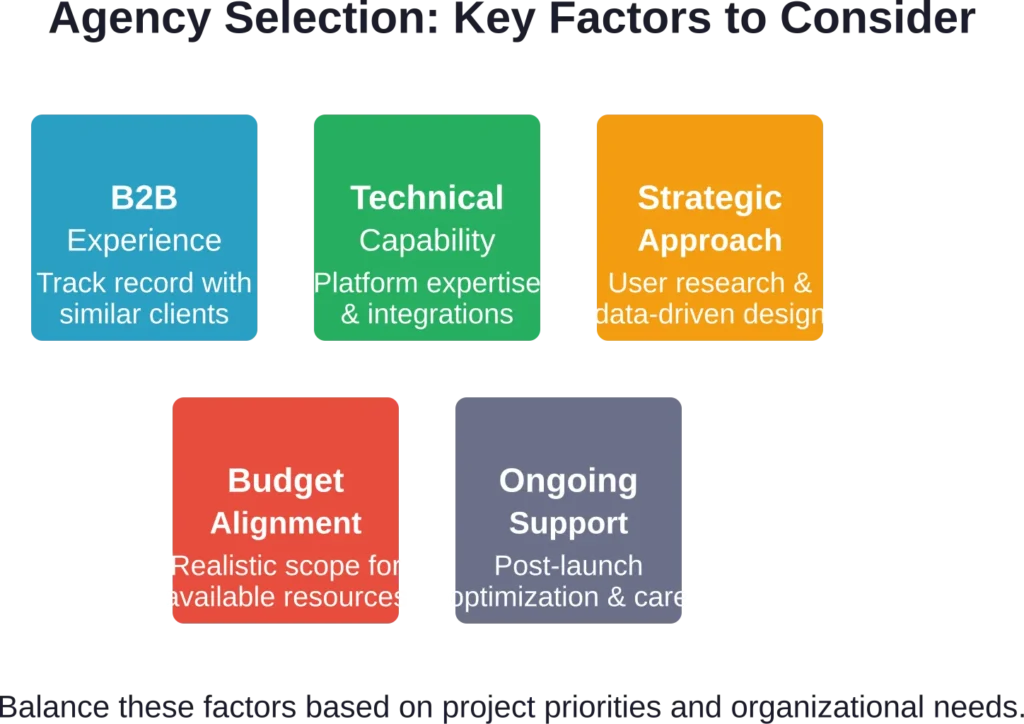
Evaluate B2B-Specific Experience
Agency portfolios reveal a lot. Look for projects similar to the one being planned—similar industries, similar complexity, similar business models. An agency that excels at B2C e-commerce may not understand B2B buyer journeys or enterprise sales cycles.
Ask specific questions during the vetting process. How do they approach multi-stakeholder buyer journeys? What’s their process for communicating complex technical products? How do they balance brand storytelling with conversion optimization?
Request case studies with measurable outcomes. Qualitative metrics like “improved brand perception” are nice, but quantitative results—lead volume increases, conversion rate improvements, reduced sales cycle length—demonstrate real business impact.
Assess Technical Capabilities
The design is only as good as the implementation. Beautiful mockups mean nothing if the final website is slow, buggy, or impossible to update. Technical capability matters.
Understand what platforms and tools the agency specializes in. Do they build on WordPress, Webflow, custom frameworks? Can they integrate with existing marketing automation platforms, CRMs, and analytics tools? Are they capable of building complex functionality like calculators, configurators, or customer portals?
Ask about their development standards. Do they follow accessibility guidelines? How do they approach site speed optimization? What’s their testing process across browsers and devices? These technical details directly impact user experience and business outcomes.
Understand Their Strategic Process
Great agencies don’t just execute—they think. The best B2B web design firms start with strategy, not pixels. They invest time understanding the business model, competitive landscape, target audience, and marketing goals before opening design tools.
During agency conversations, pay attention to the questions they ask. Are they curious about the business? Do they probe into audience needs and pain points? Or do they jump straight to talking about design trends and technology stacks?
The strategic process should include user research, competitive analysis, stakeholder interviews, and data review. Agencies that skip these steps are guessing. The ones that prioritize discovery work produce websites grounded in real insights, not assumptions.
Consider Budget and Value
Budget constraints are real. Boutique agencies typically range from $25,000 to $100,000 for a full website project, while mid-market agencies fall between $75,000 and $250,000.
But price alone doesn’t tell the whole story. A cheaper agency that delivers a website that doesn’t convert is more expensive than a premium agency that drives measurable business results. Value is about outcomes, not just cost.
Be realistic about scope relative to budget. A $10,000 budget won’t get the same deliverables as a $100,000 budget. Trying to squeeze enterprise-level scope into a small-agency budget creates frustration on both sides. Match expectations with reality.
Evaluate Communication and Fit
The best agency relationships feel like partnerships, not vendor relationships. Communication style, responsiveness, and cultural fit all matter—especially on projects that last months and require close collaboration.
During initial conversations, notice how the agency communicates. Do they explain things clearly? Are they responsive to questions? Do they listen, or do they just pitch? These early interactions predict the working relationship.
Ask about their project management approach. Who will be the day-to-day point of contact? How do they handle feedback and revisions? What happens if timelines slip or scope changes? Understanding expectations upfront prevents conflicts later.
What B2B Web Design Projects Actually Cost
Pricing for B2B web design varies dramatically based on scope, complexity, and agency tier. A simple five-page website from a freelancer or small studio might start around $5,000. A comprehensive enterprise website redesign from a top-tier agency can exceed $250,000.
Most B2B companies fall somewhere in the middle. Typical project budgets range from $25,000 to $100,000 for boutique agencies handling mid-market clients. These projects usually include strategy, UX design, visual design, content development, and technical implementation on platforms like WordPress or Webflow.
Larger agencies working with enterprise clients charge more—often $75,000 to $250,000 or higher—but they deliver additional services: extensive user research, design systems, multi-language support, complex integrations, and ongoing optimization programs.
Some agencies offer monthly retainers for ongoing work. These arrangements typically start around $3,000 per month and can scale up significantly for larger clients with continuous design and development needs.
| Project Scope | Typical Agency Tier | Common Budget Range | What’s Included |
|---|---|---|---|
| Simple website (5-10 pages) | Freelancer or small studio | $5,000 – $25,000 | Basic design, template customization, content integration |
| Mid-market B2B site (20-40 pages) | Boutique agency | $25,000 – $100,000 | Strategy, custom design, UX, development, content support |
| Enterprise redesign (50+ pages) | Mid to large agency | $75,000 – $250,000+ | Research, design system, complex integrations, multi-language |
| Ongoing design support | Various | $3,000+ per month | Continuous optimization, landing pages, content updates |
Common Mistakes When Hiring B2B Web Design Agencies
The most expensive mistake is choosing based on price alone. Cheap agencies often cut corners—skipping research, using templates, delivering mediocre design. The result is a website that looks okay but doesn’t perform. That’s false economy.
Another common error is hiring before defining clear goals. Agencies can’t deliver the right solution if the business doesn’t know what problem needs solving. Starting a project without clarity on success metrics leads to scope creep, disagreements, and disappointing outcomes.
Many companies also underestimate the importance of content. Agencies can design beautiful pages, but someone needs to write the copy, source the images, and provide the substance. Treating content as an afterthought creates bottlenecks and delays.
Some businesses expect too much, too fast. Quality web design takes time—discovery, strategy, design iteration, development, testing. Agencies that promise unrealistic timelines either cut corners or miss deadlines. Neither scenario ends well.
And then there’s the expectation gap on maintenance. Websites aren’t one-and-done projects. Technology evolves, content needs updating, security patches require attention. Companies that don’t budget for ongoing maintenance end up with outdated, vulnerable sites that degrade over time.
The Role of Conversion Optimization in B2B Web Design
Beautiful design that doesn’t convert is just expensive art. B2B web design needs to drive business outcomes—qualified leads, demo requests, sales conversations. That requires intentional conversion optimization baked into the design process.
Conversion optimization starts with understanding the audience and their journey. What questions do they have at each stage? What objections need addressing? What proof do they need to take the next step? Great B2B websites answer these questions at exactly the right moment.
Strategic CTAs and Lead Capture
Call-to-action placement isn’t random. The best B2B sites use context-appropriate CTAs based on the content and visitor intent. A blog reader might get a content download offer. A pricing page visitor sees a demo request. A case study page includes client testimonials and a contact form.
Progressive profiling allows companies to gather information over time rather than hitting visitors with long forms on the first interaction. This reduces friction while still capturing qualified lead data for sales teams.
Building Trust Through Proof Elements
B2B buyers are skeptical. They need proof before they commit time to a sales conversation. Smart websites incorporate trust signals throughout—client logos, testimonials, case studies, certifications, awards, security badges.
Case studies are particularly powerful in B2B contexts. They show real companies with real problems getting real results. The more specific the case study, the more credible it is. Generic claims like “increased efficiency” mean nothing. “Reduced manual data entry time by 14 hours per week” tells a story.
Optimizing for Different Buyer Personas
B2B purchases involve multiple stakeholders. A technical evaluator cares about features, integrations, and specifications. A financial decision-maker wants ROI proof and total cost of ownership. An executive sponsor needs high-level strategic value.
The best B2B websites create pathways for each persona. Navigation, content organization, and CTAs should acknowledge that different visitors need different information to move forward.
Mobile Experience and B2B Web Design
There’s a persistent myth that B2B buyers only use desktop computers. The data tells a different story. Studies show that 80% of B2B buyers use mobile devices during the buying process.
Mobile isn’t just about responsive design anymore—though that’s baseline table stakes. It’s about recognizing that B2B buyers research on phones during commutes, between meetings, and outside office hours. The mobile experience needs to be fully functional, not a stripped-down version of the desktop site.
Mobile optimization affects everything—page load speed, navigation patterns, form design, content hierarchy. Buttons need to be thumb-friendly. Text needs to be readable without zooming. Forms need to minimize typing. CTAs need to be obvious without being intrusive.
Performance matters more on mobile. Slow-loading pages kill conversions. If a site takes more than three seconds to load on mobile, visitors leave. Optimizing images, minimizing scripts, and leveraging browser caching aren’t nice-to-haves—they’re requirements.
The Impact of AI on B2B Web Design
Artificial intelligence is changing how agencies approach B2B web design—not by replacing designers, but by augmenting their capabilities and enabling new types of personalization and optimization.
AI-powered design tools can generate layout variations, suggest color palettes, and automate repetitive tasks. That frees designers to focus on strategy, creative problem-solving, and the nuanced decisions that require human judgment.
On the user experience side, AI enables dynamic personalization. Websites can adapt content, messaging, and CTAs based on visitor behavior, industry, company size, or previous interactions. That level of customization was technically possible before, but AI makes it practical and scalable.
Content creation is another area where AI is making an impact. Tools can generate first drafts, suggest headlines, optimize copy for SEO, and even create variations for A/B testing. Human editors still need to refine and approve everything, but the initial heavy lifting happens faster.
Predictive analytics powered by AI help agencies and clients understand what design changes are likely to improve conversion rates. Rather than relying purely on intuition or running months of split tests, machine learning models can analyze patterns and recommend optimizations based on similar sites and industries.
Content Strategy and B2B Web Design
Design and content are inseparable. No amount of beautiful design can save weak content, and great content gets lost in poor design. The best B2B web projects integrate content strategy from the beginning.
Content strategy starts with understanding what information the audience needs at each stage of their journey. Someone in early research mode needs educational content—blog posts, guides, industry insights. Someone evaluating solutions needs detailed product information, comparisons, and proof points. Someone ready to buy needs clear next steps and reassurance.
In 2024, 46% of marketing leaders expected to spend $500,000 or more on content. That investment only pays off if the content is organized, accessible, and presented effectively. Information architecture and content hierarchy are critical design decisions.
Many B2B companies struggle with content creation during web projects. Agencies can design pages, but someone needs to write the copy. The most successful projects involve dedicated content resources—whether internal writers, agency copywriters, or external content specialists—from day one.
SEO and Technical Performance in B2B Web Design
A beautiful website that nobody finds is useless. Search engine optimization needs to be baked into the design and development process, not bolted on afterward.
Technical SEO starts with site architecture. Logical URL structures, clear navigation hierarchy, and proper internal linking help search engines understand content relationships. XML sitemaps, robots.txt configuration, and canonical tags prevent indexing issues.
Page speed is a ranking factor and a user experience issue. Fast sites rank better and convert better. Performance optimization includes image compression, code minification, caching strategies, and content delivery network implementation.
Mobile-first indexing means Google primarily uses the mobile version of sites for ranking. If the mobile experience is compromised, rankings suffer. Responsive design isn’t optional—it’s foundational for SEO success.
On-page SEO requires collaboration between designers, developers, and content creators. Proper heading tag hierarchy, descriptive alt text for images, strategic keyword usage, and compelling meta descriptions all contribute to visibility and click-through rates from search results.
Measuring Success: Metrics That Matter for B2B Websites
What gets measured gets improved. But not all metrics matter equally for B2B websites. Vanity metrics like total traffic or page views tell incomplete stories. The metrics that matter are those tied to business outcomes.
Lead quality is often more important than lead volume. Generating 100 unqualified inquiries creates work for sales teams without revenue impact. Generating 20 qualified opportunities from target accounts drives real business value. Tracking lead source, company size, industry, and role helps assess quality.
Conversion rates at each funnel stage reveal where the website performs well and where it falls short. Top-of-funnel metrics like blog subscription rates indicate content value. Mid-funnel metrics like guide downloads or webinar registrations show engagement. Bottom-funnel metrics like demo requests and contact form submissions directly impact sales pipeline.
Time-on-page and scroll depth metrics help understand content engagement. Are visitors actually reading, or bouncing immediately? Heat maps and session recordings provide qualitative insights into how users interact with pages, where they get confused, and where they lose interest.
For e-commerce B2B sites or self-service platforms, revenue per visitor and customer lifetime value become primary metrics. Understanding which traffic sources and campaigns drive the most valuable customers allows for smarter marketing investment.
| Metric Category | Key Measurements | What It Reveals |
|---|---|---|
| Lead Generation | Form submissions, demo requests, downloads | Top-of-funnel effectiveness |
| Lead Quality | MQL to SQL conversion, deal close rate | Whether traffic matches target audience |
| Engagement | Time on page, scroll depth, pages per session | Content relevance and clarity |
| Technical Performance | Page load speed, Core Web Vitals | User experience quality |
| SEO Performance | Organic traffic, keyword rankings, backlinks | Search visibility and authority |
Post-Launch Optimization and Continuous Improvement
Launch day isn’t the finish line—it’s the starting point. The most successful B2B websites improve continuously based on data, user feedback, and changing business needs.
A/B testing allows for data-driven optimization. Test headline variations, CTA button colors, form lengths, page layouts—any element that might impact conversion. But test strategically. Focus on high-traffic pages and high-impact elements first rather than optimizing low-traffic sections.
User feedback reveals issues that analytics can’t. Customer interviews, sales team input, and support ticket analysis often surface friction points or confusion that aren’t obvious from quantitative data alone. Regular feedback loops between website management and customer-facing teams drive meaningful improvements.
Content freshness matters for SEO and credibility. Outdated blog posts, old case studies, and stale product information make sites feel neglected. Regular content audits identify what needs updating, what can be consolidated, and what should be removed entirely.
Security and technical maintenance prevent serious problems. Software updates, security patches, backup verification, and uptime monitoring aren’t glamorous, but they protect the business from data breaches, downtime, and lost revenue.
Frequently Asked Questions
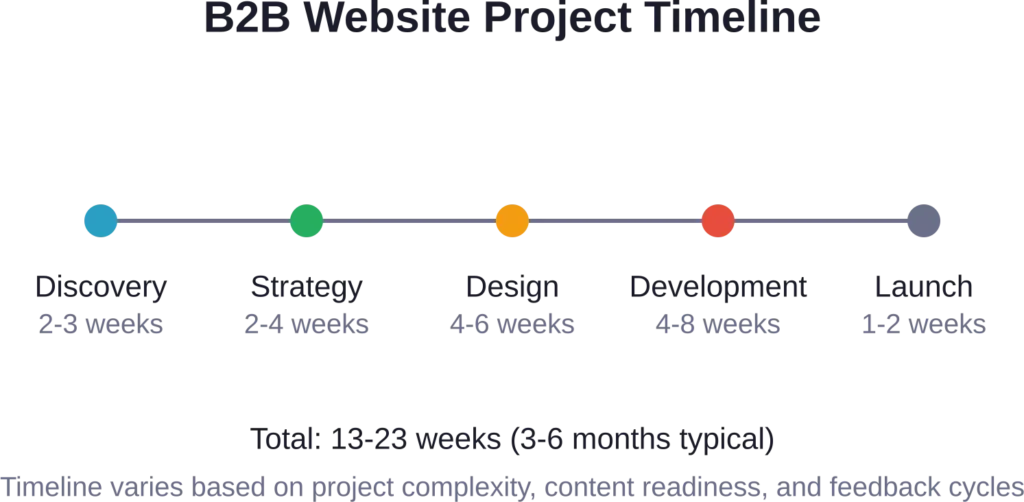
Most B2B web design projects take between three to six months from kickoff to launch. The timeline depends on project scope, content readiness, and feedback cycles. A simple site with existing content might complete in two months, while a complex enterprise redesign with custom functionality can take a year or longer. Typical phases include discovery (2-3 weeks), strategy (2-4 weeks), design (4-6 weeks), development (4-8 weeks), and launch preparation (1-2 weeks).
B2B web design prioritizes credibility, clarity, and lead quality over emotional appeal and impulse purchases. B2B buyers conduct extensive research, involve multiple stakeholders, and have longer decision cycles. B2B sites need detailed product information, proof elements like case studies and testimonials, and content tailored to different buyer personas. B2C sites focus more on visual appeal, simplified checkout processes, and emotional triggers that drive immediate purchases.
Each platform has advantages. WordPress offers flexibility, a massive plugin ecosystem, and familiar interfaces—good for companies that need extensive functionality and want in-house content management. Webflow provides designer-friendly visual editing and clean code output—ideal for marketing teams that want design control without developer dependency. Custom development delivers maximum flexibility and performance but requires larger budgets and ongoing technical resources. The right choice depends on budget, technical capabilities, functionality requirements, and long-term maintenance plans.
Mobile optimization is critical. Research shows that 80% of B2B buyers use mobile devices during the purchasing process. Google’s mobile-first indexing means the mobile experience directly impacts search rankings. Mobile optimization isn’t just about responsive layouts—it includes page speed, touch-friendly navigation, readable text without zooming, and streamlined forms. Companies that ignore mobile experience lose leads and search visibility.
A comprehensive B2B website budget should cover discovery and strategy work, UX and visual design, content creation or migration, development and technical implementation, quality assurance testing, SEO setup, training, and post-launch support. Hidden costs often include photography or video production, premium stock images, third-party integrations, hosting and infrastructure, ongoing maintenance, and continuous optimization. Being realistic about total project costs prevents mid-project budget surprises.
B2B web design ROI is measured through lead generation metrics, lead quality improvements, conversion rate increases, organic search traffic growth, and ultimately revenue impact. Compare metrics before and after the redesign: leads per month, marketing qualified lead percentage, demo request volume, sales pipeline contribution, and customer acquisition cost. The strongest ROI case combines quantitative improvements with qualitative feedback from sales teams and customers about the clarity and credibility of the new digital presence.
Ongoing support is essential for maintaining performance, security, and relevance. Websites need regular software updates, security patches, content updates, and performance optimization. Market conditions change, products evolve, and competitors improve their sites—standing still means falling behind. Many companies establish monthly retainer relationships with agencies or hire in-house resources to manage continuous improvement, A/B testing, content creation, and technical maintenance. Monthly retainers often start around $3,000 and scale based on needs.
Conclusion: Choosing the Right B2B Web Design Partner
The B2B web design landscape offers more options than ever—from boutique agencies with specialized expertise to global firms with comprehensive capabilities. The right choice isn’t about finding the “best” agency in absolute terms. It’s about finding the best fit for specific business needs, budget realities, and project goals.
Great B2B web design balances multiple priorities. It needs to look professional without being boring, communicate clearly without oversimplifying, build trust without relying on hype, and convert visitors without being pushy. That’s a difficult balance, and it requires agencies that understand B2B buyer psychology, not just design trends.
The agencies highlighted in this list—ANML, R/GA, DEPT, Lazarev, Monks, DD.NYC, Studio Fox Design, Superside, Webyansh, and OneLittleWeb—represent different approaches, price points, and specializations. Each brings unique strengths to different types of B2B web design challenges.
The most important step is doing the homework. Review portfolios carefully. Ask detailed questions about process, timeline, and success metrics. Check references. Ensure alignment on goals, budget, and expectations before signing contracts.
A well-executed B2B website becomes a competitive advantage—building credibility, educating buyers, generating qualified leads, and supporting sales teams. Nearly three-quarters of businesses have a website, and 43% of small businesses plan to invest in their website performance. The companies that invest strategically in professional web design position themselves ahead of competitors still relying on outdated, ineffective digital presences.
Ready to elevate the digital presence? Start by defining clear goals, establishing a realistic budget, and reaching out to agencies that specialize in B2B work. The right partnership transforms a website from a necessary expense into a powerful growth engine.