

Quick Summary: Choosing the right bespoke web design company shapes how customers experience your brand online. The top agencies in 2026 blend user-centered design, technical excellence, and strategic thinking to deliver websites that convert visitors into customers. This guide profiles 15 standout firms known for crafting custom, scalable digital experiences without generic templates.
The internet is full of agencies promising “custom” work. But scratch beneath the surface and many deliver templated designs with a fresh coat of paint.
Real bespoke web design means building from the ground up—understanding business goals, user behavior, technical requirements, and brand identity before a single pixel hits the screen. The agencies on this list do exactly that.
Whether you’re launching a new venture or revitalizing an established brand, the right design partner makes the difference between a website that just exists and one that actively drives business results.
What Makes a Web Design Company Truly Bespoke?
Generic templates serve a purpose. They get sites online quickly and affordably. But bespoke design operates at a different level entirely.
A custom web design company starts with research—competitive analysis, user interviews, analytics audits, stakeholder workshops. They map user journeys before touching design tools. Every layout decision, interaction pattern, and visual choice serves a specific strategic purpose.
The build process is equally tailored. Rather than forcing requirements into a theme’s constraints, bespoke agencies architect solutions around unique needs. That might mean custom content management workflows, specialized integrations, performance optimizations, or accessibility features that go beyond baseline compliance.
And the relationship doesn’t end at launch. The best firms treat websites as evolving products, providing ongoing optimization based on real user data.
Top 15 Bespoke Web Design Companies
The agencies below represent the current state of custom digital design. Each brings distinct strengths, from product-focused interfaces to brand-driven storytelling experiences.
1. Gilzor

Gilzor excels at turning ambitious digital ideas into functional, high-performing products with a strong focus on custom development and user-centered design. They partner with startups and established businesses to create digital solutions that drive real growth.
Their process begins with thorough idea validation and business analysis, ensuring every project is grounded in market needs before moving into design and development. This methodical approach helps minimize risk while maximizing product-market fit.
Gilzor places heavy emphasis on clean architecture, intuitive UI/UX design, and scalable solutions. Whether building web platforms, mobile applications, or complex systems, they prioritize performance, security, and seamless user experiences that convert.
The team combines strategic thinking with technical expertise across web and mobile development, quality assurance, and go-to-market strategy, allowing them to deliver complete digital products under one roof.
Contact Information:
- Website: www.gilzor.com
- Email: [email protected]
- Address: Poland, Warsaw, Office 58, street Adama Mickiewicza 37, 01-625
- LinkedIn: www.linkedin.com/company/gilzor-softwaredevelopment
2. A-Listware
A-Listware builds custom software solutions and dedicated teams that empower enterprises, SMEs, and startups with reliable, scalable digital experiences. They specialize in creating technology that seamlessly integrates into business operations.
Their approach centers on deep understanding of client needs, followed by tailored software consulting, architecture planning, and full-cycle development. This ensures every solution is both technically robust and aligned with business objectives.
The agency is known for strong capabilities in cloud solutions, UI/UX design, data analytics, and modern software engineering practices. Their work emphasizes clean code, security, and long-term maintainability across web and enterprise applications.
A-Listware’s structure supports end-to-end delivery through software development, application services, testing, IT consulting, and dedicated teams, making them a comprehensive partner for complex digital initiatives.
Contact Information:
- Website: a-listware.com
- Phone: +1 (888) 337 93 73
- Email: [email protected]
- Address: North Bergen, NJ 07047, USA
- LinkedIn: www.linkedin.com/company/a-listware
- Facebook: www.facebook.com/alistware
3. Lengreo
Lengreo acts as a complete marketing and technology partner, crafting bespoke digital experiences that drive measurable business growth through strategic design and technical implementation. Their work helps B2B companies generate high-quality leads and strengthen online presence.
The process starts with detailed marketing audits and strategy development, followed by hands-on execution across website development, SEO, and targeted campaigns. This integrated approach ensures digital platforms are both visually compelling and commercially effective.
Lengreo focuses on building conversion-oriented websites, landing pages, and eCommerce solutions backed by strong technical foundations. They combine thoughtful design with performance optimization and lead-generation systems that deliver clear ROI.
Their multidisciplinary team covers B2B digital strategy, website development, paid advertising, lead generation, and content marketing, enabling them to manage complex projects from strategy through to sustained results.
Contact Information:
- Website: lengreo.com
- Phone: +31 686 147 566
- Email: [email protected]
- Address: Vrijstraat 9 C/D, 5611 AT Eindhoven, Netherlands
- LinkedIn: www.linkedin.com/company/lengreo
- Instagram: www.instagram.com/lengreo.agency
- Twitter: x.com/Lengreo
4. Mobian
Mobian builds dedicated engineering teams that deliver production-ready digital products with speed and precision. They specialize in creating mobile-first and AI-enhanced solutions for companies in competitive industries.
Their methodology revolves around dedicated teams working exclusively on client projects, with full-cycle delivery from concept and design through development, testing, and post-launch support. This focused model ensures consistency and quality.
Mobian stands out for scalable architecture, clean code practices, and thoughtful integration of AI and automation. Their designs prioritize intuitive interfaces, performance, and future-proof systems that can grow with the business.
The studio brings together expertise in end-to-end product development, mobile solutions, AI systems, cloud infrastructure, and domain-specific knowledge, allowing them to handle sophisticated digital challenges with confidence.
Contact Information:
- Website: mobian.studio
- Phone: [email protected]
- Address: Harju maakond, Tallinn, Kesklinnalinnaosa, Masina tn 22, 10113
- LinkedIn: www.linkedin.com/company/mobian-studio
5. Oski
Oski creates smart, well-engineered digital solutions for forward-thinking enterprises and ambitious startups. They focus on designing and developing software that transforms business operations through innovation and quality execution.
The process emphasizes rapid team deployment, deep technical planning, and iterative development powered by modern practices. Projects are approached with a balance of strategic vision and hands-on engineering excellence.
Oski is particularly strong in cloud architecture, advanced frontend experiences, artificial intelligence, and robust content management systems. Their solutions combine beautiful, intuitive interfaces with powerful backend capabilities.
With specialists across cloud technologies, frontend frameworks, AI/ML, and enterprise systems, Oski delivers comprehensive digital platforms tailored to industries including fintech, e-commerce, logistics, and education.
Contact Information:
- Website: oski.site
- Phone: +48571282759
- Email: [email protected]
- Address: Kaupmehe tn 7, 10114 Tallinn, Estonia
- LinkedIn: www.linkedin.com/company/oski-solutions
6. Code and Theory
Code and Theory operates at enterprise scale, working with global brands that need digital experiences to perform across markets, languages, and platforms.
Their approach is fundamentally strategic. Projects begin with business analysis, customer research, and competitive audits. The resulting digital strategy informs design direction, ensuring that creative decisions align with business objectives.
The agency handles complex technical challenges—omnichannel commerce platforms, personalization engines, content management systems for multinational organizations. Their development capability is as strong as their design capability, which is essential for projects where backend complexity rivals frontend sophistication.
Code and Theory’s client relationships often extend beyond individual projects to become ongoing partnerships, with the agency functioning as an embedded digital product team.
7. Build in Amsterdam
Build in Amsterdam brings a European design sensibility to digital experiences—refined, detail-oriented, with a focus on typography and layout fundamentals.
The agency works primarily with brands that value design as a business differentiator. Their portfolio includes fashion, technology, and cultural organizations where aesthetic quality directly impacts brand perception.
Build’s process emphasizes collaboration. They work closely with internal creative teams rather than operating in isolation, which results in work that feels authentically connected to brand identity rather than externally imposed.
Their technical approach favors progressive enhancement—building core experiences that work universally, then layering enhancements for capable devices and browsers. This philosophy ensures broad accessibility without limiting creative ambition.
8. Area 17

Area 17 specializes in digital experiences for cultural institutions, media organizations, and mission-driven brands. Their work emphasizes content, treating design as a framework that elevates editorial rather than overshadowing it.
The agency’s projects often involve complex information architecture challenges—organizing vast content libraries, creating intuitive navigation for diverse audiences, building systems that accommodate unknown future content.
Area 17’s design language tends toward typographic clarity and structural elegance. Layout systems are flexible but opinionated, guiding content creators toward good design outcomes without requiring design expertise.
Their development work prioritizes longevity. Sites are built to remain maintainable for years, with clean codebases, thorough documentation, and content management interfaces that empower non-technical teams.
9. Locomotive
Locomotive has earned recognition for technically ambitious websites that push browser capabilities while maintaining broad compatibility and accessibility.
The agency excels at motion-rich experiences—parallax scrolling, scroll-triggered animations, interactive storytelling elements that respond to user input. Yet these techniques enhance narrative and usability rather than existing for their own sake.
Locomotive’s work has received industry recognition for technical excellence. The accolades reflect substance as much as style—their projects consistently deliver on business metrics, not just aesthetic criteria.
The agency works across sectors but gravitates toward brands with strong creative ambitions and an appreciation for craft. They’re a good fit for organizations willing to invest in experiences that stand out in crowded digital landscapes.
10. Excited Agency

Excited Agency takes a product-first approach to web design, focusing on clarity, structure, and conversion rather than surface-level aesthetics.
The agency combines UX research, web design, branding, and motion design to create websites that scale with the product and support long-term growth. Their process emphasizes understanding user needs and business objectives before touching design tools.
Excited works primarily with B2B companies and digital product companies that need websites to generate leads and communicate complex value propositions clearly. Their design language favors clean layouts, strategic use of whitespace, and purposeful animation that guides user attention.
The team includes strategists, designers, researchers, and developers who collaborate throughout the project lifecycle. This integrated approach ensures that strategy, design, and technical execution remain aligned from concept through launch and beyond.
11. Clay
Clay has built a reputation for high-impact digital experiences that blur the line between brand expression and functional design. Their work spans established enterprises and ambitious startups, with a portfolio that includes recognizable names across technology, finance, and consumer sectors.
The agency’s process emphasizes conceptual thinking. Projects begin with strategic positioning workshops that define how a brand should feel in digital space. That foundation informs everything from typographic systems to interaction patterns.
Technically, Clay builds for scale. Their development team favors modern frameworks and headless architectures that separate content from presentation, enabling faster performance and easier long-term maintenance. Motion design plays a central role, with carefully choreographed animations that guide attention without feeling gratuitous.
Clay’s team structure includes specialists in brand strategy, visual design, UX research, motion design, and engineering—allowing them to handle complex projects without relying on external partners.
12. Fantasy
Fantasy operates at the intersection of art direction and digital product design. Their work feels editorial—polished, narrative-driven, with strong points of view.
The agency handles high-profile brand launches and redesigns where visual impact matters as much as usability. Their process involves deep collaboration with clients, treating each project as a creative partnership rather than a service transaction.
What stands out is their commitment to craft. Typography, layout, color, imagery—every element receives meticulous attention. Yet the design never sacrifices usability for aesthetics. Navigation remains intuitive, content hierarchies stay clear, and interactions feel natural.
Fantasy typically works with brands that view their website as a primary brand touchpoint, not just an information repository. That mindset shapes projects from the start, resulting in experiences that communicate identity as clearly as they communicate information.
13. Instrument

Instrument brings a systems-thinking approach to digital design. Rather than designing individual pages, they architect flexible design systems that scale across touchpoints and adapt to evolving content needs.
Their client list includes major technology platforms, cultural institutions, and retail brands—organizations with complex digital ecosystems that need coherence across web, mobile, and emerging channels.
The agency’s methodology starts with information architecture and user research. Teams map content relationships, user flows, and interaction patterns before visual design begins. This foundation ensures that the final product isn’t just beautiful but fundamentally sound in structure.
Instrument also emphasizes performance. Their development practices prioritize speed, accessibility, and standards compliance, resulting in sites that work reliably across devices and network conditions.
14. Basic Agency
Basic Agency (now part of DEPT) specializes in brand-driven digital experiences that push creative boundaries while maintaining commercial effectiveness.
Their portfolio includes work for fashion labels, entertainment properties, and lifestyle brands—clients where emotional connection and cultural relevance matter deeply. The agency’s design language tends toward bold typography, generous whitespace, and cinematic imagery.
But the work isn’t just visual spectacle. Basic invests heavily in UX research and conversion optimization. Their projects undergo extensive user testing, with designs refined based on behavioral data rather than subjective preferences.
The agency also offers strategic services beyond design—brand positioning, content strategy, and digital marketing—making them a comprehensive partner for brands building or refreshing their digital presence.
15. Ueno
Ueno has built a distinctive voice in the design community through memorable brand work and a product-focused design philosophy. Their projects range from startups to Fortune 500 companies, with an emphasis on clarity and usability.
The agency’s process combines traditional brand design with modern product thinking. Projects involve prototyping, user testing, and iterative refinement—methods borrowed from software development but applied to brand and marketing websites.
Ueno’s visual style favors clean layouts, strong typography, and strategic use of animation to enhance usability rather than decorate. Their work demonstrates that restraint can be as powerful as embellishment when applied thoughtfully.
The team structure includes brand strategists, product designers, engineers, and illustrators, enabling them to handle projects that require both brand identity development and digital execution under one roof.
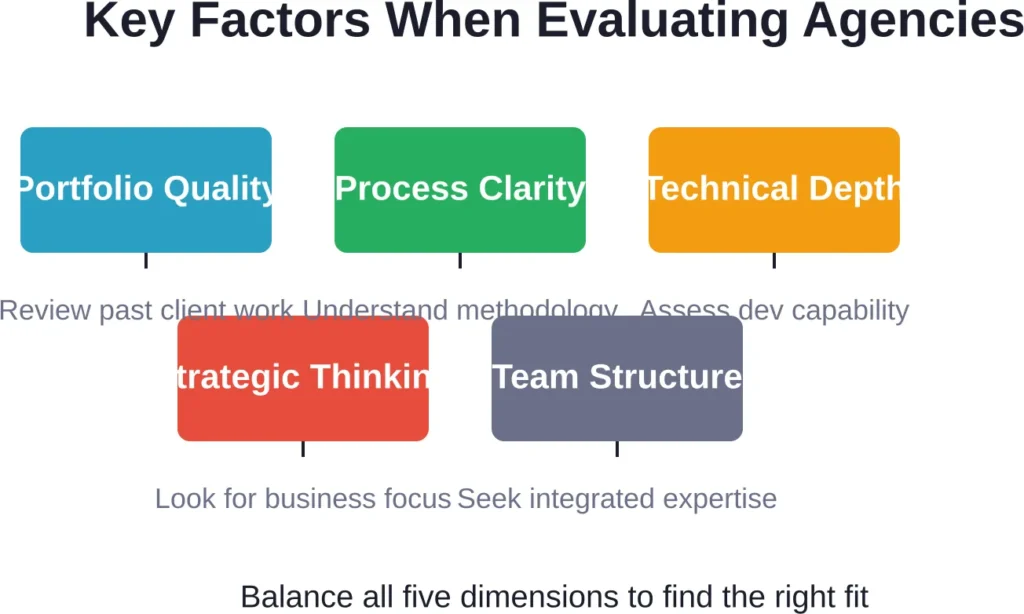
What to Look for When Choosing a Bespoke Web Design Company
Not every custom design agency is the right fit for every project. Here’s what to evaluate when shortlisting partners.
Portfolio Relevance
Past work tells you what an agency can deliver. Look for projects that match your ambition level, industry context, and technical requirements.
But don’t just admire aesthetics. Dig into case studies. What problems did the project solve? What constraints did the team navigate? How did the solution perform against business objectives?
The best portfolios tell stories about process and outcomes, not just visual appeal.
Process Transparency
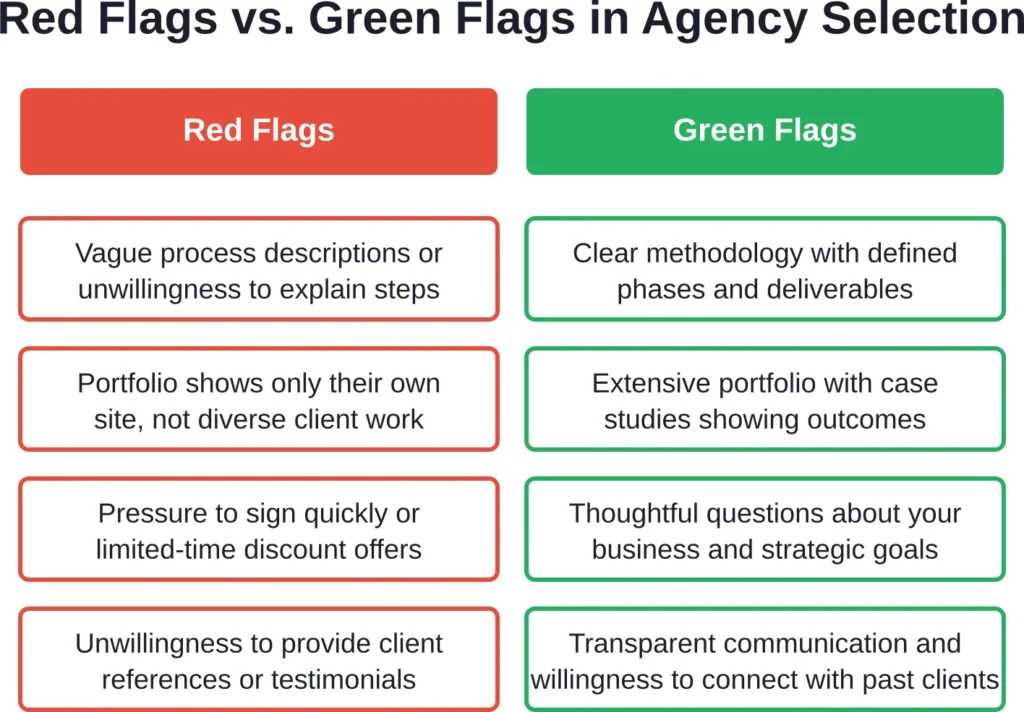
Reputable agencies articulate their methodology clearly. They explain how they approach research, how they structure design phases, how they handle feedback, how they test and refine work.
Vague promises about “collaboration” and “excellence” aren’t enough. You want specifics: What happens in week one? How do you validate design decisions? What does QA involve?
Transparent process documentation indicates organizational maturity and reduces project risk.
Strategic Capability
The strongest agencies don’t just take briefs—they challenge them. They ask questions about business models, competitive positioning, user needs, and success metrics.
This strategic layer separates design service providers from true partners. Agencies that think strategically deliver work that solves business problems, not just aesthetic ones.
During initial conversations, pay attention to the questions they ask. Are they curious about your business? Do they probe assumptions? That intellectual engagement matters.
Technical Expertise
Beautiful designs mean nothing if they can’t be built properly. Assess an agency’s technical depth during the vetting process.
Ask about their development approach. What frameworks do they favor? How do they handle performance optimization? What’s their accessibility testing process? How do they approach responsive design?
Strong technical teams speak knowledgeably about browser compatibility, progressive enhancement, semantic HTML, and modern JavaScript frameworks. They also acknowledge tradeoffs honestly rather than promising everything.
Team Structure
Integrated teams produce better work than siloed specialists. Look for agencies where strategists, designers, and developers collaborate throughout the project, not just during handoffs.
Ask who will actually work on your project. Will you have access to senior practitioners, or will they disappear after the sales process? What’s the ratio of senior to junior team members?
Understanding team structure upfront prevents surprises later.
Understanding the Bespoke Web Design Process
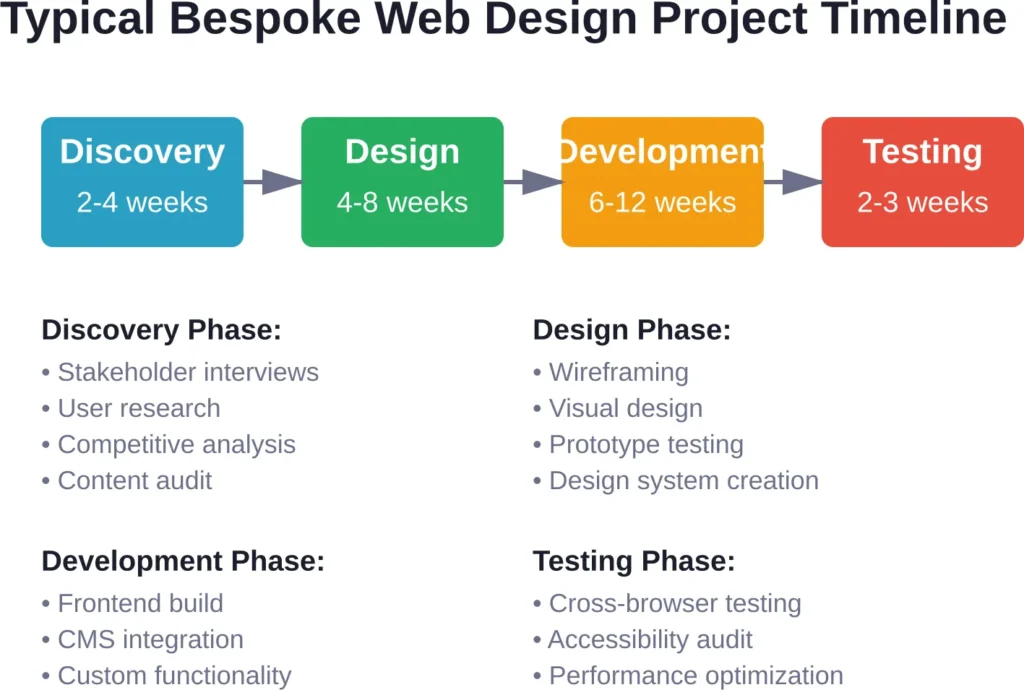
Custom projects follow a structured path from concept to launch. Here’s what each phase typically involves.
Discovery and Research
Projects begin with information gathering. The agency conducts stakeholder interviews to understand business goals, competitive context, and organizational constraints.
User research follows—analyzing existing analytics, conducting user interviews, reviewing support tickets, and mapping current user journeys. For redesigns, this phase includes a thorough content audit.
The output is typically a strategy document that defines project scope, success metrics, user personas, and key design principles that will guide subsequent work.
Information Architecture and Wireframing
Before visual design begins, teams structure content and map user flows. Information architecture defines how content is organized, labeled, and connected.
Wireframes translate that structure into rough layouts. These low-fidelity sketches focus on hierarchy, navigation, and functionality without the distraction of colors, imagery, or typography.
This phase often involves iterative feedback. Stakeholders review wireframes, test flows, and validate assumptions before the team commits to visual design.
Visual Design
With structure validated, designers develop the visual language—color palettes, typography systems, imagery styles, iconography, and interface components.
The process usually starts with style explorations: two or three distinct visual directions that interpret the brand differently. Stakeholders review these, provide feedback, and select a direction to refine.
The chosen direction is then applied across key page templates. Designers create high-fidelity mockups showing exactly how the site will look, including responsive breakpoints for different screen sizes.
Prototyping and Testing
Static designs have limitations. Interactive prototypes let teams test navigation, transitions, and micro-interactions before committing to code.
Usability testing happens here. Real users attempt realistic tasks while teams observe and collect data. Where do people get confused? What do they expect that isn’t there? Which patterns work intuitively?
Insights from testing inform design refinements. This iterative cycle continues until the team has confidence in the user experience.
Development
Developers translate approved designs into functional code. For bespoke projects, this means custom frontend development—writing HTML, CSS, and JavaScript rather than configuring themes.
Backend work happens simultaneously: setting up the content management system, building custom functionality, integrating third-party services, and implementing any specialized technical requirements.
Throughout development, designers and developers collaborate closely. Design systems documentation ensures that the implementation matches design intent precisely.
Quality Assurance and Launch
Before launch, QA teams test exhaustively. They check functionality across browsers and devices, validate accessibility compliance, test performance, and verify that content management workflows operate as intended.
Issues are logged, prioritized, and fixed. Critical bugs must be resolved before launch; minor issues may be addressed post-launch.
Launch itself involves domain configuration, SSL setup, analytics implementation, and content migration. Post-launch monitoring catches any issues that surface under real traffic.
Bespoke vs. Template-Based Design: Understanding the Difference
Template-based solutions have their place. They’re fast, affordable, and perfectly adequate for many use cases.
But they come with constraints. Templates are built for general use, not specific needs. Customizing them beyond surface-level changes often requires wrestling with someone else’s code, leading to fragile implementations and technical debt.
Bespoke design starts without those constraints. Every layout, interaction, and technical decision is made deliberately for the specific project. This flexibility enables solutions that templates can’t accommodate.
| Aspect | Template-Based Design | Bespoke Design |
|---|---|---|
| Timeline | Days to weeks | Weeks to months |
| Flexibility | Limited to theme features | Unlimited customization |
| Visual Identity | Generic, similar to other sites | Unique to your brand |
| Performance | Theme-dependent, often bloated | Optimized for specific needs |
| Scalability | Difficult to extend beyond theme | Built to accommodate growth |
| Technical Debt | Inherits theme limitations | Clean, maintainable codebase |
| Best For | Quick launches, limited budgets | Strategic projects, brand differentiation |
The choice depends on project goals and resource availability. Templates work well for testing ideas quickly. Bespoke design makes sense when the website is a core business asset that needs to perform distinctively.
How Much Does Bespoke Web Design Actually Cost?
This guide intentionally excludes specific pricing because costs vary dramatically based on project scope, technical complexity, and agency positioning.
That said, understanding general investment ranges helps set realistic expectations. Small bespoke projects from boutique agencies might start around the $10,000 range. Mid-size projects with moderate complexity typically fall between $25,000 and $75,000. Large-scale enterprise projects with significant technical requirements can exceed $100,000 and sometimes reach $250,000 or more.
Several factors influence where a specific project lands within these ranges.
Project Scope
A ten-page marketing site costs less than a fifty-page content platform. More pages mean more design work, more development, and more testing.
Custom functionality also drives costs. E-commerce integration, user portals, custom search, API integrations—each specialized feature adds development time.
Design Complexity
Simple, clean layouts are faster to design and build than elaborate interactive experiences. Motion design, custom illustrations, and complex animations all extend timelines.
That doesn’t mean simple is worse. Often, the most effective designs are the most restrained. But if your vision requires high production values, budget accordingly.
Technical Requirements
Performance optimization, accessibility compliance, multilingual support, advanced SEO implementation—these technical considerations add effort even when they’re not visible to users.
Legacy system integrations can be particularly time-consuming. Connecting to older APIs or migrating data from outdated platforms often involves unexpected complexity.
Agency Positioning
Agencies with prestigious client lists and award-winning portfolios command premium rates. You’re paying for talent, experience, and the peace of mind that comes from working with proven practitioners.
Smaller agencies or those in lower-cost markets may offer competitive pricing while still delivering quality work. The key is evaluating capability, not just cost.
Common Mistakes When Hiring a Web Design Agency
Even sophisticated buyers make avoidable errors during the agency selection process.
Choosing Based on Price Alone
The cheapest option rarely delivers the best value. Extremely low bids often indicate inexperience, offshore outsourcing, or corners that will be cut.
Price matters. But it should be evaluated alongside capability, fit, and expected return on investment. A moderately expensive project that achieves business goals outperforms a cheap one that misses the mark.
Skipping the Portfolio Review
An impressive website doesn’t mean an impressive portfolio. Review actual client work, not just the agency’s self-promotion.
Look for projects similar to yours in scope, industry, or technical complexity. If an agency’s portfolio shows only small brochure sites and you need an enterprise platform, that’s a mismatch.
Ignoring Cultural Fit
Design projects require close collaboration over weeks or months. Personality and communication style matter.
During initial calls, assess whether you enjoy talking with the team. Do they listen? Do they ask good questions? Do their values align with yours?
Cultural misalignment causes friction that slows projects and diminishes outcomes.
Unclear Requirements
Agencies can’t quote accurately without understanding what you need. Vague briefs lead to scope creep, budget overruns, and mismatched expectations.
Before reaching out to agencies, document requirements as clearly as possible. What pages do you need? What functionality? What systems need to integrate? Who are your users?
The more clarity you provide upfront, the more accurate proposals will be.
No Post-Launch Plan
Websites aren’t fire-and-forget projects. They require ongoing maintenance, security updates, content refreshes, and optimization based on user data.
Discuss post-launch support during the selection process. What’s included in the project? What ongoing services does the agency offer? If you’re handling maintenance internally, what documentation and training will they provide?
Web Design Trends Shaping Bespoke Work in 2026
Design trends come and go, but several movements are influencing how top agencies approach projects right now.
Performance as a Design Constraint
Fast websites rank better, convert better, and retain users better. Performance is no longer a technical afterthought—it’s a design priority.
Leading agencies are adopting performance budgets during design phases, ensuring that creative ambitions don’t compromise speed. This means optimizing images aggressively, questioning unnecessary animations, and choosing lightweight technical approaches.
Accessibility Beyond Compliance
Accessibility standards like WCAG provide baselines, but the best work goes further. Agencies are investing in inclusive design practices—involving users with disabilities in testing, designing for cognitive accessibility, and building interfaces that work for diverse abilities.
This shift reflects both ethical considerations and business reality: accessible sites reach broader audiences and face lower legal risk.
Design Systems Over One-Off Pages
Rather than designing individual pages, agencies are creating reusable component systems. This approach enables consistency, speeds up future development, and gives clients flexible tools for creating new pages without designer involvement.
Design systems include documentation—explaining when to use each component, how to maintain brand consistency, and how components adapt responsively.
Motion with Purpose
Animation is everywhere, but the best implementations serve functional purposes. Motion guides attention, provides feedback, and helps users understand spatial relationships within interfaces.
Gratuitous animation, on the other hand, slows performance and annoys users. The trend is toward restraint—using motion sparingly but effectively.
Brutalism and Neo-Brutalism
A reaction against overly polished interfaces, brutalist web design embraces raw aesthetics—visible borders, default fonts, generous whitespace, and stark layouts.
Neo-brutalism softens this approach slightly, maintaining the honesty and directness while reintroducing some refinement. These styles work well for brands that want to communicate authenticity or challenge conventional aesthetics.
Questions to Ask During Agency Consultations
Initial conversations with agencies reveal a lot about how they work. Here are questions that elicit useful information.
About Process
- Walk me through your typical project timeline from kickoff to launch
- How do you handle stakeholder feedback and revisions?
- What happens if we disagree about a design decision?
- How do you validate design decisions—gut feeling or user testing?
- What deliverables will we receive at each project phase?
About Team and Communication
- Who specifically will work on this project, and what are their roles?
- How often will we have check-ins, and in what format?
- How do you handle communication across time zones if applicable?
- Will we have a single point of contact, or multiple team touchpoints?
- How do you onboard clients and keep projects organized?
About Technical Approach
- What platforms or CMS do you typically build with, and why?
- How do you approach mobile responsiveness?
- What’s your process for performance optimization?
- How do you ensure accessibility compliance?
- What happens if technical issues arise after launch?
About Business Alignment
- How do you define project success?
- How will you learn about our business and users?
- Can you share a case study where design directly impacted client metrics?
- How do you balance aesthetic goals with business objectives?
The quality of answers matters as much as the answers themselves. Good agencies engage thoughtfully with these questions rather than delivering rehearsed pitches.
Working Effectively With Your Chosen Agency
Selecting the right partner is half the battle. The other half is collaborating effectively throughout the project.
Establish Clear Governance
Define decision-making authority upfront. Who approves designs? Who can request changes? What’s the escalation path for disagreements?
Ambiguous governance leads to delays when stakeholders disagree or when approvals get bottlenecked. Clear roles keep projects moving.
Respect the Process
Agencies structure projects deliberately. Each phase builds on previous work. Skipping steps or rushing through research saves time initially but creates problems later.
Trust the methodology. If something feels unnecessary, ask about its purpose rather than demanding it be skipped.
Provide Constructive Feedback
Feedback quality directly impacts outcome quality. Vague reactions like “I don’t like it” or “Make it pop” don’t give designers actionable direction.
Better feedback is specific: “The hierarchy feels off—the secondary content draws more attention than the primary call-to-action” or “This blue feels too corporate for our brand personality.”
Explain the why behind your reactions. That context helps designers solve the underlying issue rather than just making surface changes.
Consolidate Stakeholder Input
Agencies need to hear one voice, not ten conflicting opinions. If multiple stakeholders are involved, collect their input internally before sharing with the agency.
When feedback conflicts, resolve it before presenting it. Asking an agency to satisfy contradictory requirements wastes time and budget.
Plan for Content Early
Content delays are the most common reason projects run over schedule. Don’t wait until the design is finished to start writing copy or gathering imagery.
Ideally, content development happens parallel to design. Real content makes design decisions easier and eliminates the placeholder-to-real-content transition that often requires layout adjustments.
After Launch: Getting the Most from Your Investment
Launch day isn’t the finish line. It’s the beginning of the website’s working life.
Monitor Performance Metrics
Set up proper analytics before launch. Track metrics that align with business goals—conversion rates, lead generation, engagement, bounce rates, or whatever matters for your objectives.
Review data regularly. Where are users struggling? What pages underperform? Which traffic sources convert best? These insights inform optimization priorities.
Plan Iterative Improvements
No design is perfect on day one. User behavior reveals opportunities that research and testing miss.
Budget for post-launch refinements. A/B test headlines, adjust layouts based on heatmaps, refine navigation based on analytics. Websites that evolve based on data outperform static ones.
Maintain Technical Health
Software requires maintenance. Platforms need updates, security patches must be applied, and backups should be automated.
Neglected websites accumulate technical debt that eventually causes problems. Regular maintenance prevents issues and keeps the site running smoothly.
Keep Content Fresh
Stale content signals neglect. Regular updates—whether blog posts, case studies, product pages, or news—show that the organization is active and engaged.
Fresh content also supports SEO. Search engines favor sites that publish regularly and provide value to visitors.
Frequently Asked Questions
The terms are essentially synonymous. Both refer to websites designed and built specifically for a client rather than adapted from existing templates. Some agencies use “bespoke” to emphasize the tailored, high-touch nature of their service, while “custom” is more common in American English. The key distinction is between these approaches and template-based or theme-based design, where pre-built frameworks constrain customization options.
Most custom web projects span three to six months from kickoff to launch. Small projects with limited pages and functionality might complete in six to eight weeks, while large enterprise sites with complex requirements can extend to nine months or longer. Timeline depends on project scope, technical complexity, stakeholder availability for feedback, content readiness, and how many revision cycles occur during design phases. Agencies can provide more specific estimates once they understand project requirements.
Most web design agencies focus on design and development rather than content creation. Some offer copywriting services as an add-on, while others partner with content specialists or expect clients to provide finished copy. Clarify this during the proposal stage. If you need content support, ask whether the agency provides it internally, can recommend partners, or expects you to handle it separately. Content readiness significantly impacts project timelines, so plan accordingly.
Post-launch support varies by agency and contract terms. Most include a brief warranty period—typically 30 to 90 days—covering bug fixes and technical issues. Additional changes usually fall under separate maintenance agreements or hourly support arrangements. Discuss post-launch expectations during contracting. Some agencies offer ongoing retainer relationships for continued optimization and updates, while others provide training so internal teams can manage the site independently.
Portfolio review is essential. Look for visual consistency across an agency’s work—do they have a recognizable style, or does their work adapt to each client’s brand? Agencies with strong house styles create distinctive work but may not suit brands seeking a different aesthetic. Agencies that adapt their approach offer more flexibility but may lack a signature point of view. During consultations, discuss your vision and ask how they would approach your specific aesthetic goals. Request examples of work that aligns with your preferences.
Bespoke design doesn’t require building everything from zero. Many custom projects use WordPress or other content management systems as a foundation, with fully custom themes built specifically for the project. This approach combines the flexibility of custom development with the content management convenience of established platforms. The key is that the theme is purpose-built for your needs rather than adapted from a marketplace template. Some projects do warrant completely custom systems, but most benefit from leveraging mature CMS platforms with custom frontend development.
Remote collaboration is standard practice in web design. Many successful projects happen entirely remotely using video calls, project management tools, and shared design platforms. That said, some clients prefer local agencies for easier in-person meetings or because they value supporting local businesses. Location matters less than capability, communication skills, and cultural fit. Evaluate agencies based on their work quality and process regardless of geography. If you do prefer local partners, simply add that as a selection criterion, but don’t exclude strong remote candidates without consideration.
Conclusion
Selecting a bespoke web design company is a significant decision that shapes how customers experience your brand for years to come.
The agencies profiled here represent some of the strongest options available in 2026, each bringing particular strengths to different project types. Clay and Fantasy excel at brand-forward experiences. Instrument and Code and Theory handle enterprise complexity. Excited Agency brings product thinking to marketing sites. Ueno and Basic balance creativity with commercial effectiveness.
But the “best” agency isn’t universal—it’s the one that aligns with your specific needs, budget, timeline, and working style.
Start by clarifying your requirements. What business problems should the website solve? Who are your users and what do they need? What technical capabilities matter? What aesthetic approach fits your brand?
With clear requirements, evaluate candidates methodically. Review portfolios critically. Ask probing questions about process and approach. Check references. Assess cultural fit.
And remember that the relationship doesn’t end when the site launches. The best outcomes happen when agencies and clients maintain ongoing partnerships, continuously optimizing based on real user behavior and evolving business needs.
Ready to move forward? Reach out to two or three agencies whose work resonates with your vision. Initial consultations cost nothing and reveal a lot about how teams work and whether the fit is right.
Your website is too important to settle for templates or generic approaches. Invest in bespoke design that serves your unique audience and advances your specific business goals.