

Quick Summary: The top custom ecommerce web development companies in 2026 combine technical expertise, user-centric design, and proven conversion optimization strategies to build high-performing online stores. This guide evaluates 15 leading agencies based on their specializations, client success stories, and ability to deliver scalable ecommerce solutions across platforms like Shopify, WooCommerce, and custom-built systems.
As of 2025, there are 2.77 billion online shoppers globally—around 30% of the world’s population is shopping online. That’s a massive opportunity.
But here’s the thing: your online store needs to do more than just look good. It needs to convert browsers into buyers, handle technical complexity, and scale as your business grows.
Choosing the right custom ecommerce web development company can make or break your online success. The wrong partner delivers a beautiful site that doesn’t convert. The right one builds a revenue-generating machine.
This guide breaks down 15 leading agencies that specialize in custom ecommerce development. No fluff—just the agencies that consistently deliver results for their clients.
What Makes a Top Custom Ecommerce Development Company Stand Out
Not every web development agency can build a high-performing ecommerce platform. The best ones share specific characteristics that separate them from generalists.
Real talk: the difference between a decent ecommerce site and one that drives serious revenue often comes down to who built it.
Technical Expertise Across Multiple Platforms
Top agencies don’t lock themselves into a single platform. They work across Shopify, WooCommerce, Magento, and custom solutions—choosing the right tech stack based on business requirements rather than their own preferences.
According to industry analyses, website design and development costs vary widely, typically coming in between $1,000 and $145,000. Custom websites sit at the higher end of that spectrum for good reason—they’re built specifically for unique business requirements.
The best agencies understand the nuances. They know when Shopify’s ecosystem makes sense for rapid deployment, when WooCommerce’s flexibility serves complex catalogs better, and when a fully custom solution becomes necessary for enterprise requirements.
Conversion-Focused Design Philosophy
Pretty designs don’t pay the bills. Conversions do.
Shopify’s 2024 data shows average ecommerce conversions hover around 2.5–3%, with top-quintile stores above 3.2%. The agencies that consistently hit those higher numbers understand user psychology, mobile-first experiences, and data-driven optimization.
They structure catalogs for discovery, handle product variants intuitively, streamline checkout flows, and obsess over page speed. Every decision serves conversion rate improvement.
Proven Track Record With Real Results
Case studies matter. Agencies that can demonstrate measurable client success—40% conversion increases, 82% traffic growth, 97% retention rates—prove their methodologies work in real market conditions.
Based on data from authoritative sources, conversion improvements and user engagement increases have been reported by clients following site redesigns. These aren’t outliers—they’re the standard for top-tier agencies.
Post-Launch Support and Optimization
The best agencies don’t disappear after launch. They provide ongoing optimization, testing, and refinement based on real user data.
Ecommerce sites need continuous attention. Consumer behavior shifts, new payment methods emerge, and search algorithms change. Agencies that offer sustained partnerships consistently outperform those that treat development as a one-and-done project.
The 15 Best Custom Ecommerce Web Development Companies for 2026
These agencies represent the current leaders in custom ecommerce development. Each brings distinct strengths to different types of ecommerce challenges.
1. Gilzor

Gilzor excels at building custom digital products from idea validation to full-scale deployment, with a strong focus on ecommerce solutions that drive real user engagement and revenue. They combine user-centric design, robust development, and go-to-market strategies to create web and mobile commerce platforms that feel intuitive and perform reliably at scale.
Their work includes complex ecommerce applications such as grocery shopping platforms that aggregate multiple stores, optimize purchasing flows, and solve real-world operational challenges for retailers. Gilzor emphasizes clean architecture, conversion-focused UI/UX, and seamless integration of payment and inventory systems.
Best for: Startups and SMBs looking for custom-built ecommerce platforms with strong product-market fit and rapid time-to-market.
Contact Information:
- Website: www.gilzor.com
- Email: [email protected]
- Address: Poland, Warsaw, Office 58, street Adama Mickiewicza 37, 01-625
- LinkedIn: www.linkedin.com/company/gilzor-softwaredevelopment
2. Oski

Oski delivers smart, scalable software solutions tailored for ambitious businesses, specializing in custom ecommerce development powered by modern frontend frameworks, cloud architecture, and AI-driven personalization. Their teams create seamless shopping experiences that combine beautiful design with high-performance backends.
The agency works across key ecommerce needs — from responsive web stores and mobile commerce to personalized recommendation engines and secure checkout flows. With deep expertise in React, Next.js, cloud infrastructure, and AI, Oski builds platforms that grow effortlessly with business demands.
Best for: Tech-forward enterprises and growth-stage startups needing AI-enhanced, scalable custom ecommerce solutions.
Contact Information:
- Website: oski.site
- Phone: +48571282759
- Email: [email protected]
- Address: Kaupmehe tn 7, 10114 Tallinn, Estonia
- LinkedIn: www.linkedin.com/company/oski-solutions
3. Lengreo

Lengreo acts as a complete marketing and technology partner, building high-converting ecommerce websites and landing pages backed by full-funnel digital strategies. They blend professional website development with SEO, paid acquisition, and lead-generation systems to deliver platforms that both look exceptional and generate measurable sales.
Their ecommerce projects focus on discovery-driven development, conversion rate optimization, and integrated marketing channels that drive qualified traffic directly to product pages. Clients benefit from websites engineered for performance, user experience, and long-term growth.
Best for: B2B and B2C businesses seeking integrated ecommerce development combined with powerful digital marketing and lead-generation capabilities.
Contact Information:
- Website: Lengreo.com
- Phone: +31 686 147 566
- Email: [email protected]
- Address: Vrijstraat 9 C/D, 5611 AT Eindhoven, Netherlands
- LinkedIn: Lengreo
- Twitter: @Lengreo
- Instagram: @lengreo
4. Mobian Studio
Mobian Studio builds dedicated engineering teams that deliver production-ready mobile-first and AI-powered ecommerce solutions for companies that demand speed and quality. They handle full-cycle development — from architecture and design to deployment and ongoing scaling.
Specializing in mobile commerce, AI automation, and complex integrations, Mobian creates shopping experiences that stand out in competitive markets. Their expertise covers Flutter and native mobile apps, intelligent recommendation systems, and enterprise-grade backends for high-traffic ecommerce operations.
Best for: Fintech, logistics, and retail companies needing fast-moving dedicated teams for custom mobile ecommerce and AI-enhanced platforms.
Contact Information:
- Website: mobian.studio
- Phone: [email protected]
- Address: Harju maakond, Tallinn, Kesklinnalinnaosa, Masina tn 22, 10113
- LinkedIn: www.linkedin.com/company/mobian-studio
5. A-Listware

A-Listware provides expert software development and team augmentation focused on building secure, responsive, and scalable custom ecommerce solutions. They offer end-to-end services including UX/UI design, custom development, cloud infrastructure, and ongoing support for high-performance online stores.
The company excels at creating enterprise-grade ecommerce systems with advanced features such as personalization, multi-channel selling, and seamless third-party integrations. Their flexible models allow businesses to either outsource entire projects or extend existing teams with proven talent.
Best for: Enterprises and scaling businesses requiring reliable custom ecommerce development, team augmentation, and long-term technical partnership.
Contact Information:
- Website: a-listware.com
- Phone: +1 (888) 337 93 73
- Email: [email protected]
- Address: North Bergen, NJ 07047, USA
- LinkedIn: www.linkedin.com/company/a-listware
- Facebook: www.facebook.com/alistware
6. P3 Media

P3 Media focuses specifically on performance-driven ecommerce platforms. Their methodology centers on rapid testing, data analysis, and iterative optimization based on actual user behavior.
The agency excels at conversion rate optimization and technical performance tuning. They obsess over page load times, mobile responsiveness, and friction point elimination throughout the purchase journey.
P3’s client relationships typically extend well beyond initial launch. Their ongoing optimization programs continuously refine based on A/B testing results and analytics insights, compounding performance improvements over time.
Best for: Data-driven retailers prioritizing conversion optimization and ongoing performance refinement.
7. 1Digital Agency

1Digital Agency specializes in Shopify and Shopify Plus implementations with deep platform expertise. Their team knows the Shopify ecosystem inside and out—from app integrations to custom liquid development to headless commerce architectures.
For businesses committed to the Shopify platform, 1Digital brings unmatched technical depth. They navigate platform limitations creatively and leverage Shopify’s strengths strategically.
The agency also handles migrations from legacy platforms to Shopify, preserving SEO equity and ensuring smooth data transitions. Their post-launch support includes theme customization, app configuration, and performance monitoring.
Best for: Businesses building on Shopify or Shopify Plus who want specialized platform expertise.
8. Disruptive Advertising

Disruptive Advertising combines ecommerce development with sophisticated paid acquisition strategies. Their unique value proposition lies in building stores optimized specifically for paid traffic conversion.
The agency designs landing experiences, product pages, and checkout flows with paid media economics in mind. They understand customer acquisition costs, lifetime value calculations, and the margin structures that make ecommerce profitable.
Disruptive’s client engagements typically include both platform development and managed advertising services, creating tight feedback loops between campaign performance and site optimization.
Best for: Ecommerce brands relying heavily on paid acquisition channels like Google Ads and Facebook.
9. SmartSites

SmartSites earned a rating of 4.9 based on 353 public reviews, reflecting consistent client satisfaction across diverse ecommerce projects. Their approach balances technical capability with accessible communication and transparent processes.
The agency handles projects across multiple platforms and business models—B2C retail, B2B wholesale portals, subscription commerce, and marketplace models. That versatility makes them particularly valuable for businesses with unique requirements that don’t fit standard templates.
SmartSites emphasizes education and knowledge transfer, ensuring clients understand their platforms and can manage day-to-day operations independently after launch.
Best for: Small-to-midsize businesses seeking versatile development partners with strong communication and support.
10. Funnel Boost Media

Funnel Boost Media earned a rating of 4.9 based on 112 public reviews, establishing their reputation for funnel-optimized ecommerce development. Their specialty lies in building stores that guide customers through deliberate purchase journeys.
The agency excels at businesses with considered purchase cycles—higher ticket items, complex product configurations, or solutions requiring education before purchase. They structure information architecture, content strategy, and conversion points around customer decision-making processes.
Funnel Boost’s work often integrates marketing automation, email sequences, and retargeting strategies directly into site architecture, creating seamless experiences across multiple touchpoints.
Best for: Businesses with complex sales funnels or higher-consideration purchase cycles requiring strategic customer journey design.
11. ZAPTA Technologies

ZAPTA Technologies specializes in user-centric digital experiences powered by modern tech stacks. Their strength lies in blending UI/UX design excellence with robust development capabilities across React Native, Flutter, and MERN stack applications.
The agency targets mid-size to enterprise businesses, particularly in fintech, healthcare, education, and SaaS sectors that need AI-augmented ecommerce platforms. Their approach combines custom development with intelligent automation features that personalize shopping experiences.
ZAPTA’s portfolio demonstrates consistent success in MVP development and dedicated team augmentation, making them particularly valuable for startups scaling into enterprise territory.
Best for: Mid-to-enterprise businesses needing AI-integrated custom platforms with sophisticated user experiences.
12. WebFX

WebFX operates at the intersection of development and marketing, delivering full-stack web experiences that blend design, performance, and measurable growth. Their data-driven methodology sets them apart—every technical decision ties back to conversion metrics and revenue impact.
According to verified sources, WebFX helped Cleveland Brothers grow organic traffic by 82% by consolidating multiple websites into one clean, SEO-optimized platform. That’s the WebFX approach: technical excellence in service of business outcomes.
Their ecommerce work spans Shopify Plus implementations, custom WooCommerce builds, and proprietary platform development. What makes them particularly effective is their integrated digital marketing capability—they don’t just build stores, they drive qualified traffic to them.
Best for: Mid-to-large businesses seeking integrated development and marketing solutions with clear ROI tracking.
13. Lounge Lizard

Lounge Lizard brings a brand-first approach to ecommerce development. They excel at creating shopping experiences that feel like natural extensions of established brand identities.
The agency’s process starts with brand strategy and carries through to every interaction point—from homepage storytelling to checkout micro-copy. Their design work tends toward bold, memorable aesthetics that differentiate clients in crowded markets.
For brands where visual differentiation matters as much as technical performance, Lounge Lizard delivers custom solutions that balance beauty with function. Their portfolio skews toward fashion, lifestyle, and consumer goods brands where brand experience drives purchase decisions.
Best for: Consumer brands prioritizing distinctive visual identity and storytelling-driven commerce experiences.
14. Digital Silk

Digital Silk positions itself at the premium end of custom ecommerce development. Their work emphasizes sophisticated design systems, enterprise-grade architecture, and luxury brand positioning.
The agency handles complex technical requirements—multi-currency support, international shipping logic, advanced personalization engines—while maintaining design coherence across all touchpoints. Their typical client operates at scale with established market presence.
Digital Silk’s process involves extensive discovery and strategy phases before development begins. That upfront investment pays off in platforms that align precisely with business models and customer expectations.
Best for: Enterprise brands and luxury retailers requiring sophisticated, globally scalable ecommerce platforms.
15. Thrive Internet Marketing Agency
Thrive takes an integrated approach that treats ecommerce development as one component of comprehensive digital strategy. Their strength lies in connecting site architecture, SEO fundamentals, and paid acquisition channels into cohesive growth systems.
One Thrive client, Northline Express, earned over $170,000 in revenue with a return on ad spend of 2,053% after optimization efforts. That performance demonstrates Thrive’s ability to drive immediate commercial impact.
The agency also navigates AI-focused SEO strategies, helping ecommerce sites capture visibility in answer engines and LLM-driven search results. Their recent campaigns achieved a 4,302% increase in traffic from AI-driven sources, with an 862% increase in ChatGPT traffic and a 322% increase in Gemini traffic.
Best for: Ecommerce businesses seeking integrated development, SEO, and paid media management under one roof.
Key Features That Separate Good From Great Ecommerce Sites
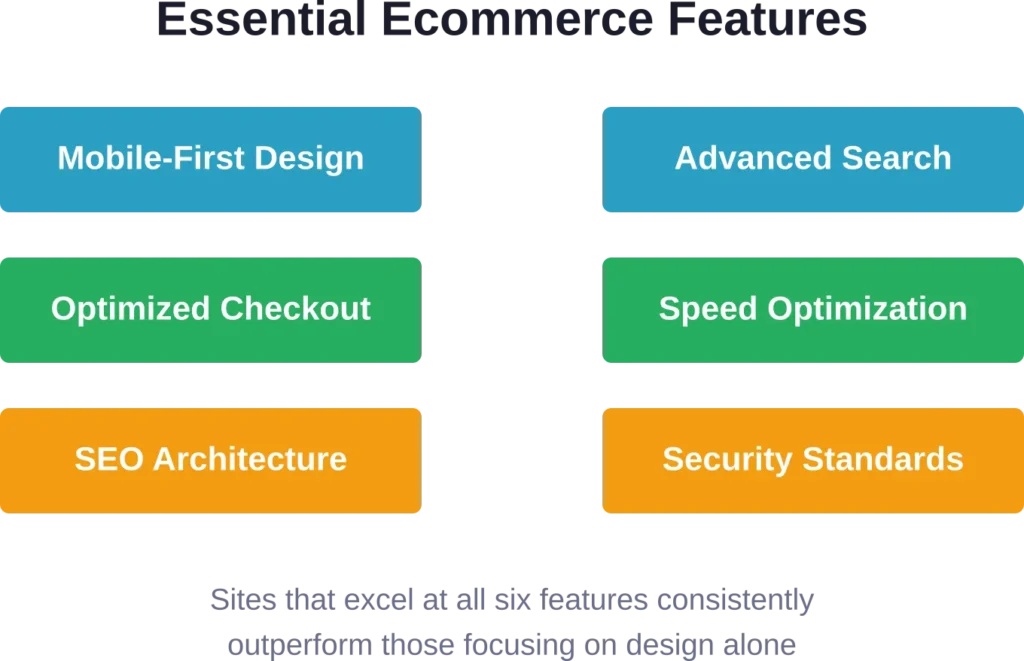
The agencies above consistently implement specific features that transform functional stores into revenue-generating platforms. Understanding these features helps in evaluating potential partners.
Mobile-First Responsive Design
Mobile commerce dominates ecommerce traffic. Sites that treat mobile as an afterthought lose sales immediately.
Top agencies design for mobile screens first, then scale up to desktop. That approach ensures thumb-friendly navigation, legible typography, and streamlined checkout flows on the devices where most shopping happens.
Responsive design isn’t just about screen adaptation—it’s about context-appropriate experiences that account for on-the-go browsing behavior and touch-based interaction patterns.
Advanced Search and Filtering
Large catalogs become unusable without intelligent search and filtering. Customers need to find specific products quickly, whether they’re searching by attribute, price range, brand, or use case.
The best implementations include autocomplete, typo tolerance, synonym recognition, and faceted filtering that dynamically updates based on available inventory. These features dramatically reduce friction in product discovery.
Streamlined Checkout Flows
Cart abandonment kills conversion rates. Every unnecessary field, confusing step, or technical hiccup costs sales.
Leading agencies obsess over checkout optimization—guest checkout options, multiple payment methods, address autocomplete, progress indicators, and mobile-optimized forms. According to verified sources, fully custom, feature-rich websites with eCommerce capabilities can require 150–300+ hours of development time, with much of that investment focused on checkout experience refinement.
Performance Optimization and Speed
Page speed directly impacts conversion rates and SEO rankings. Slow sites lose impatient customers before they ever see products.
Top agencies implement aggressive performance optimization—image compression, lazy loading, content delivery networks, database query optimization, and efficient code architecture. They target sub-two-second load times on mobile connections.
SEO-Friendly Architecture
Ecommerce sites compete in crowded search landscapes. Sites built without SEO fundamentals struggle to attract organic traffic.
The best agencies structure information architecture for both users and search engines—logical category hierarchies, optimized product page templates, schema markup implementation, and clean URL structures. They understand technical SEO requirements like crawl budget management and duplicate content handling.
Security and Compliance Standards
Ecommerce platforms handle sensitive payment and personal information. Security breaches destroy trust and trigger regulatory penalties.
Leading agencies implement PCI compliance standards, SSL certificates, secure payment gateway integrations, and regular security audits. For businesses operating internationally, they also navigate GDPR, CCPA, and other privacy regulations.
How to Choose the Right Custom Ecommerce Development Partner
Selecting an agency isn’t just about browsing portfolios. The right partner aligns with business requirements, communication preferences, and growth timelines.
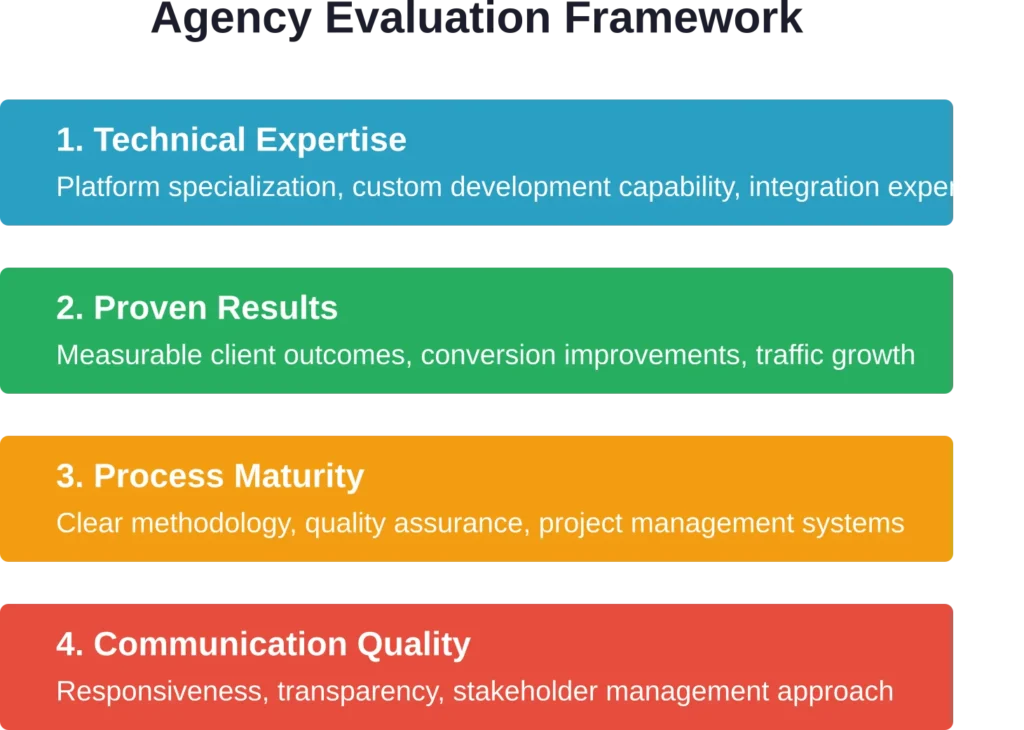
Assess Platform Expertise and Technical Capabilities
Start by clarifying platform requirements. Do business needs demand Shopify’s rapid deployment, WooCommerce’s flexibility, or a fully custom solution?
Once that’s clear, evaluate agencies based on demonstrated expertise with the chosen technology. Review case studies, examine live client sites, and ask specific technical questions about architecture decisions.
The best agencies can articulate why they recommend specific approaches and explain trade-offs between different technical options.
Review Portfolios and Case Studies Critically
Portfolios reveal design sensibilities, technical capabilities, and market experience. Look beyond surface aesthetics—examine site performance, user flows, and technical sophistication.
Case studies matter more than portfolio pieces. They demonstrate problem-solving approaches, measurable outcomes, and the agency’s ability to drive business results rather than just deliver projects.
According to authoritative data, conversion improvements and user engagement increases have been reported by clients following site redesigns. These concrete outcomes matter more than visual appeal alone.
Evaluate Communication and Project Management Approaches
Development projects succeed or fail based on communication quality. Agencies that maintain transparent processes, provide regular updates, and respond promptly prevent the misunderstandings that derail timelines.
Ask about project management methodologies, communication cadences, and how they handle scope changes or technical challenges. The answers reveal whether the partnership will feel collaborative or frustrating.
Consider Post-Launch Support and Optimization Services
Launch day is just the beginning. Ecommerce platforms need ongoing maintenance, security updates, feature enhancements, and performance optimization.
Evaluate what post-launch services agencies provide. Do they offer retainer relationships for continuous improvement? How do they handle emergency issues? What analytics and reporting do they provide?
Agencies that maintain long-term client relationships typically deliver better initial builds because they know they’ll be supporting the platform long-term.
Understand Timeline and Development Process
According to verified sources, simple brochure-style websites require around 40–80 hours of development time, while fully custom, feature-rich websites with eCommerce capabilities need 150–300+ hours.
Realistic timelines prevent rushed launches and technical debt. Agencies that promise unrealistically fast delivery often cut corners that create problems later.
Ask agencies to walk through their development process—discovery, design, development, testing, and launch phases. Understanding the journey helps set appropriate expectations.
Common Ecommerce Development Mistakes to Avoid
Even experienced businesses make predictable mistakes when commissioning custom ecommerce platforms. Awareness prevents these pitfalls.
Prioritizing Design Over Functionality
Beautiful sites that don’t convert waste budgets. Visual appeal matters, but it serves conversion—not the other way around.
The mistake happens when businesses select agencies based primarily on portfolio aesthetics without evaluating technical capabilities, performance track records, or conversion expertise.
Neglecting Mobile Experience
Desktop-first thinking still plagues ecommerce development. Sites that work beautifully on large screens but frustrate mobile users lose the majority of potential customers.
Test mobile experiences ruthlessly during agency evaluation. Browse candidate agency client sites on phones, attempt checkout flows, and assess load times on mobile connections.
Underestimating Content Requirements
Platforms get built on time, but launches delay because product descriptions, category copy, and supporting content aren’t ready. Content creation takes longer than most businesses anticipate.
Start content development parallel to design and development. Placeholder text during development becomes real copy that needs writing, editing, and approval.
Skipping SEO Fundamentals
Sites launched without proper SEO foundations struggle to attract organic traffic. Retrofitting SEO after launch costs more and delivers slower results than building it in from the start.
Ensure chosen agencies understand ecommerce SEO specifics—not just general web development. Product page optimization, category architecture, and technical SEO requirements differ significantly from informational sites.
Inadequate Testing Before Launch
Rushing launches introduces bugs that damage customer trust and cost sales. Thorough testing across devices, browsers, and user scenarios catches problems before customers encounter them.
Insist on comprehensive quality assurance processes, including cross-browser testing, mobile device testing, payment gateway verification, and stress testing under traffic loads.
| Mistake | Consequence | Prevention Strategy |
|---|---|---|
| Design-over-function focus | Low conversion rates despite visual appeal | Prioritize agencies with proven conversion optimization expertise |
| Desktop-first development | Poor mobile experience and lost sales | Require mobile-first design approach and test mobile extensively |
| Delayed content creation | Launch delays and incomplete site experience | Start content development parallel to design phase |
| Ignoring SEO fundamentals | Minimal organic traffic and visibility | Select agencies with ecommerce SEO expertise |
| Insufficient pre-launch testing | Bugs, poor user experience, and technical issues | Demand comprehensive QA across devices and browsers |
Emerging Trends in Custom Ecommerce Development
The ecommerce development landscape evolves continuously. Agencies leading the field stay ahead of emerging trends and implement them strategically.
AI-Powered Personalization
Artificial intelligence enables sophisticated personalization that was previously impossible at scale. Modern ecommerce platforms use AI for product recommendations, dynamic pricing, personalized content, and predictive inventory management.
Leading agencies integrate AI capabilities that learn from customer behavior and continuously optimize experiences. These systems increase average order values and conversion rates by showing each visitor the most relevant products and offers.
Headless Commerce Architectures
Headless commerce decouples frontend presentation from backend commerce functionality, enabling omnichannel experiences across web, mobile apps, voice assistants, and emerging channels.
This architectural approach provides flexibility for brands selling across multiple touchpoints while maintaining consistent commerce logic and data. Agencies skilled in headless implementations future-proof platforms for channel expansion.
Voice Commerce Integration
Voice-activated shopping through smart speakers and virtual assistants grows steadily. Forward-thinking agencies build voice-compatible product catalogs and optimize for voice search queries.
While voice commerce remains a smaller channel, early adoption provides competitive advantages as the technology matures and consumer adoption increases.
Augmented Reality Product Visualization
AR technology addresses the primary limitation of online shopping—inability to physically examine products. AR implementations let customers visualize furniture in their homes, try on accessories virtually, or see products at actual scale.
Agencies incorporating AR capabilities help clients reduce return rates and increase purchase confidence, particularly for categories where physical interaction traditionally drove purchase decisions.
Sustainability and Ethical Commerce Features
Consumers increasingly make purchase decisions based on sustainability and ethical considerations. Modern ecommerce platforms surface carbon footprint data, material sourcing transparency, and ethical certification information.
Agencies that understand this shift help clients communicate values effectively and build features that appeal to conscientious consumers—a growing and valuable segment.
Cost Considerations for Custom Ecommerce Development
Understanding investment requirements helps in budget planning and agency selection. Custom ecommerce development represents significant investment but delivers returns through increased sales and operational efficiency.
Factors That Influence Development Costs
Multiple variables affect total project investment. Platform complexity, custom feature requirements, third-party integrations, and design sophistication all impact budgets.
Simple catalog sites with standard functionality cost less than sophisticated platforms with custom checkout flows, complex product configurators, or enterprise system integrations.
Content volume matters too. Sites with thousands of SKUs require more extensive catalog setup and content entry than boutique stores with curated selections.
Typical Investment Ranges
Industry analyses indicate website design and development costs vary widely, typically coming in between $1,000 and $145,000. Custom ecommerce projects generally fall in the middle-to-upper range of that spectrum.
Simple Shopify implementations might start around $10,000, while fully custom enterprise platforms can exceed $100,000. Most mid-market custom ecommerce projects fall between $25,000 and $75,000.
These ranges reflect initial development only. Ongoing maintenance, hosting, security, and optimization add recurring costs.
Balancing Investment With Expected Returns
Development costs should be evaluated against revenue potential. A $50,000 platform that generates $2 million in annual sales delivers exceptional return on investment.
Calculate customer lifetime value, projected transaction volumes, and profit margins to determine appropriate platform investment. Higher-margin businesses or those with strong customer retention can justify larger upfront investments.
Hidden Costs to Account For
Beyond agency fees, budget for content creation, product photography, hosting infrastructure, payment processing fees, SSL certificates, and third-party app subscriptions.
Also consider internal time costs—project management, stakeholder reviews, content approval, and user acceptance testing all require staff hours that should be factored into total project investment.
Questions to Ask Potential Agency Partners
The right questions reveal whether an agency truly fits project requirements. These queries separate capable agencies from those overselling their capabilities.
About Their Experience and Expertise
How many ecommerce projects have you completed in our industry? Can you show live examples of similar complexity to our requirements? What platforms do you specialize in, and why do you recommend specific technologies for our use case?
These questions reveal relevant experience and whether the agency understands vertical-specific requirements.
About Their Development Process
Walk us through your typical project timeline from kickoff to launch. How do you handle scope changes or unexpected technical challenges? What does your quality assurance process look like? How do you ensure sites perform well under traffic spikes?
Answers demonstrate project management maturity and technical rigor.
About Post-Launch Support
What happens after launch? Do you offer ongoing support retainers? How quickly do you respond to urgent issues? What analytics and reporting do you provide? How do you approach continuous optimization?
These questions clarify the long-term relationship structure.
About Team Structure and Communication
Who will be on our project team? Will we have a dedicated point of contact? How often will we have status meetings? What project management tools do you use? How do you keep projects on schedule?
Communication quality makes or breaks development projects, making these critical questions.
About Results and Measurability
How do you measure project success? Can you share specific performance metrics from past clients? What conversion rate improvements have you achieved? How do you approach A/B testing and optimization?
Results-focused agencies provide concrete answers with specific numbers and methodologies.
Platform Selection: Custom vs. SaaS Solutions
One fundamental decision shapes everything else—building on an established platform like Shopify or developing a fully custom solution.
When SaaS Platforms Make Sense
Shopify, BigCommerce, and similar platforms offer rapid deployment, proven reliability, and extensive app ecosystems. They work brilliantly for straightforward retail models with standard requirements.
These platforms provide excellent value for businesses prioritizing speed-to-market, those without complex custom requirements, or companies wanting predictable monthly costs rather than large upfront development investments.
The trade-off is reduced flexibility. SaaS platforms impose constraints on checkout customization, data access, and architectural decisions.
When Custom Development Becomes Necessary
Custom platforms make sense when business models don’t fit SaaS limitations—complex B2B wholesale pricing, subscription-rental hybrids, marketplace models, or deep integrations with proprietary systems.
Custom development also benefits businesses that view their ecommerce platform as competitive advantage rather than commodity infrastructure. Unique shopping experiences, proprietary recommendation engines, or innovative features require custom builds.
The investment is substantially higher, but the resulting platform aligns precisely with business requirements without platform limitations.
Hybrid Approaches: Headless and Platform Extensions
Headless commerce offers middle ground—using SaaS commerce engines as backends while building custom frontends. This approach combines platform reliability with frontend flexibility.
Platform extensions through custom app development provide another hybrid path, adding unique functionality atop standard platforms without full custom development.
The Role of SEO in Custom Ecommerce Development
Search visibility determines whether custom platforms attract organic traffic or remain dependent on paid acquisition. The best development agencies build SEO fundamentals into every project phase.
Technical SEO Foundations
Ecommerce sites need clean URL structures, proper heading hierarchies, XML sitemaps, robots.txt configuration, and structured data markup for products, reviews, and breadcrumbs.
Site architecture should balance user experience with crawl efficiency—logical category hierarchies, faceted navigation that doesn’t create duplicate content, and internal linking that distributes authority effectively.
Product Page Optimization
Product pages drive ecommerce organic traffic. Each page needs unique descriptions, optimized title tags and meta descriptions, high-quality images with descriptive alt text, and user-generated content like reviews.
Agencies skilled in ecommerce SEO build product templates that make optimization scalable across thousands of SKUs rather than requiring manual optimization for each item.
Content Strategy and Information Architecture
Category pages, buying guides, comparison content, and educational resources attract top-of-funnel traffic and establish topical authority that benefits product page rankings.
The best agencies develop content strategies alongside site architecture, identifying keyword opportunities and mapping content to customer journey stages.
Performance and Core Web Vitals
Page speed and user experience metrics directly impact rankings. Google’s Core Web Vitals—Largest Contentful Paint, First Input Delay, and Cumulative Layout Shift—measure real user experience.
Technical optimization during development ensures sites meet these standards rather than requiring expensive remediation after launch.
Security and Compliance Considerations
Ecommerce platforms handle sensitive data and financial transactions. Security breaches destroy customer trust and trigger regulatory penalties.
PCI Compliance Standards
Payment Card Industry Data Security Standard (PCI DSS) compliance is mandatory for businesses processing credit card payments. Requirements include secure networks, encryption, access controls, and regular security testing.
Most agencies achieve compliance by using hosted payment pages or tokenization services rather than storing card data directly—simpler and safer approaches for most businesses.
Data Privacy Regulations
GDPR in Europe, CCPA in California, and similar regulations worldwide require specific consent mechanisms, data access provisions, and deletion capabilities.
Agencies with international experience build privacy controls into platform architecture—cookie consent management, data export functionality, and user preference centers.
Security Best Practices
SSL certificates, regular security updates, secure authentication, SQL injection prevention, and DDoS protection represent baseline security measures for any ecommerce platform.
Leading agencies implement web application firewalls, conduct penetration testing, and establish security monitoring that alerts teams to suspicious activity.
Frequently Asked Questions
Custom ecommerce development builds platforms specifically for unique business requirements, offering complete control over functionality, design, and integrations. Platforms like Shopify provide pre-built solutions that work excellently for standard retail models but limit customization. Custom development costs more upfront and requires longer timelines but delivers precise alignment with business needs. Shopify and similar platforms offer faster deployment, lower initial costs, and proven reliability but constrain architectural decisions. The choice depends on whether business models fit standard platform capabilities or require unique features.
According to authoritative data, simple brochure-style websites require around 40–80 hours of development time, while fully custom, feature-rich websites with eCommerce capabilities need 150–300+ hours. Translating hours to calendar time, most custom ecommerce projects take 3–6 months from kickoff to launch, depending on complexity, feature requirements, content readiness, and revision cycles. Rush timelines often create technical debt that causes problems post-launch. The best agencies establish realistic timelines that allow for proper discovery, design iteration, development, and thorough testing.
Some agencies like Thrive Internet Marketing Agency and WebFX offer integrated development and marketing services, providing one-stop solutions for businesses preferring unified partnerships. Other specialized agencies focus exclusively on development or marketing. Integrated agencies work well when both capabilities are genuinely strong—verify through case studies and client references. Separate specialists make sense for businesses with established marketing teams needing only development support, or those wanting best-in-class expertise in each discipline. The key is ensuring whoever builds the site understands marketing requirements and optimizes for conversion rather than just visual appeal.
Industry data shows website design and development costs typically range between $1,000 and $145,000, with custom ecommerce projects generally falling in the $25,000–$100,000 range depending on complexity. Simple Shopify customizations might start around $10,000, while sophisticated custom platforms for enterprise businesses can exceed $100,000. Budget considerations should include not just initial development but ongoing costs—hosting, security, maintenance, content updates, and optimization. Calculate expected returns based on projected sales volume and customer lifetime value to determine appropriate investment levels. Higher-margin businesses or those with strong retention can justify larger platform investments.
Launch represents the beginning rather than the end of ecommerce platform management. Post-launch needs include ongoing security updates, performance monitoring, conversion rate optimization, A/B testing, content updates, seasonal promotions, and feature enhancements based on user behavior data. The best agencies offer retainer relationships for continuous improvement rather than disappearing after launch. Clarify post-launch support options during agency selection—response times for urgent issues, optimization processes, reporting cadences, and how enhancement requests are handled. Platforms that receive ongoing attention consistently outperform those treated as finished products.
Review agency portfolios for relevant industry experience—fashion retailers have different requirements than B2B industrial suppliers or subscription box services. Industry-specific case studies demonstrate understanding of vertical challenges, compliance requirements, and customer expectations. Ask agencies about category-specific features they’ve built—virtual try-on for fashion, complex configurators for manufacturing, subscription management for recurring revenue models. Client references from your industry provide valuable insights into how agencies navigate vertical-specific challenges. That said, strong ecommerce fundamentals transfer across industries—conversion optimization, performance tuning, and user experience principles apply universally.
Platform management requirements depend on technical complexity and team capabilities. Content management systems let non-technical teams handle product updates, content changes, and basic site management independently. More complex customizations, integrations, and technical updates typically require developer support. During agency selection, clarify what day-to-day management tasks internal teams can handle versus what requires ongoing agency involvement. Agencies like SmartSites emphasize knowledge transfer and client education, ensuring teams can operate independently for routine tasks while providing support for technical needs. Balance platform flexibility with team capabilities—overly complex systems that require constant developer intervention create expensive dependencies.
Making Your Final Agency Selection
After researching capabilities, reviewing portfolios, and asking questions, the selection decision comes down to alignment—technical fit, communication compatibility, and shared vision for what success looks like.
Trust matters enormously. Ecommerce development requires close collaboration over months, with inevitable challenges and decision points along the way. Choose partners who demonstrate transparency, communicate proactively, and approach problems collaboratively rather than defensively.
The agencies highlighted in this guide represent proven performers with track records of delivering results. But the right agency for your specific requirements depends on business model, budget, timeline, and internal team capabilities.
Reach out to multiple agencies from this list, describe your requirements in detail, and evaluate their responses. The questions they ask reveal as much as the answers they provide—great agencies dig deep into business context before proposing solutions.
Conclusion
Custom ecommerce development represents significant investment, but the right platform drives revenue growth, improves operational efficiency, and creates competitive advantages that justify the cost.
The 15 agencies featured here—ZAPTA Technologies, WebFX, Lounge Lizard, Digital Silk, Thrive Internet Marketing Agency, P3 Media, 1Digital Agency, Disruptive Advertising, SmartSites, and Funnel Boost Media—each bring distinct strengths to ecommerce challenges. Your optimal partner depends on whether you prioritize platform specialization, integrated marketing capabilities, brand-focused design, or performance optimization.
Evaluate agencies based on relevant experience, proven results, process maturity, and communication quality. Ask detailed questions about technical approach, post-launch support, and how they measure success.
Remember that the best ecommerce platforms balance aesthetic appeal with technical performance, user experience with conversion optimization, and immediate functionality with long-term scalability.
Start by clarifying your own requirements—platform preferences, must-have features, budget constraints, and timeline expectations. Then reach out to agencies whose specializations align with those needs.
The ecommerce landscape grows more competitive every year. Around 30% of the world’s population shops online, with 21% of all retail purchases happening through digital channels. That opportunity demands platforms built by specialists who understand both technical complexity and commercial reality.
Choose wisely, invest appropriately, and partner with agencies that view success through revenue metrics rather than just project completion. Your ecommerce platform should be a growth engine, not just a digital brochure.