

Quick Summary: Facebook ads optimization tools automate campaign management, reduce manual work, and improve ROI through AI-powered bidding, creative testing, and attribution tracking. The best tools in 2026 include Extuitive, Ryze AI for autonomous bidding, Madgicx for AI creative insights, Revealbot for rule-based automation, and Cometly for accurate attribution—managing over $500M+ in annual ad spend combined.
Managing Facebook ads manually in 2026 isn’t just time-consuming—it’s leaving money on the table. With over 10 million businesses actively using Facebook advertising, competition has driven CPMs up significantly from 2020 to 2025. The cost increases alone make optimization tools essential rather than optional.
But here’s the thing: choosing the right optimization tool depends entirely on what’s breaking in your campaigns right now. Attribution blind spots? Creative fatigue? Budget misallocation? Each tool tackles different bottlenecks.
This guide covers the optimization tools that matter most in 2026, focusing on platforms managing real money—over $500M+ in annual ad spend—and solving the problems advertisers actually face daily.
Why Facebook Ads Optimization Tools Matter Now
The days of set-it-and-forget-it Facebook campaigns ended years ago. Rising costs, attribution challenges, and audience saturation have created an environment where manual optimization simply can’t keep pace.
Consider the numbers. Accounts spending significant monthly budgets require substantial weekly time investment in manual optimization. That’s not scaling campaigns or testing new strategies—that’s just keeping things from falling apart.
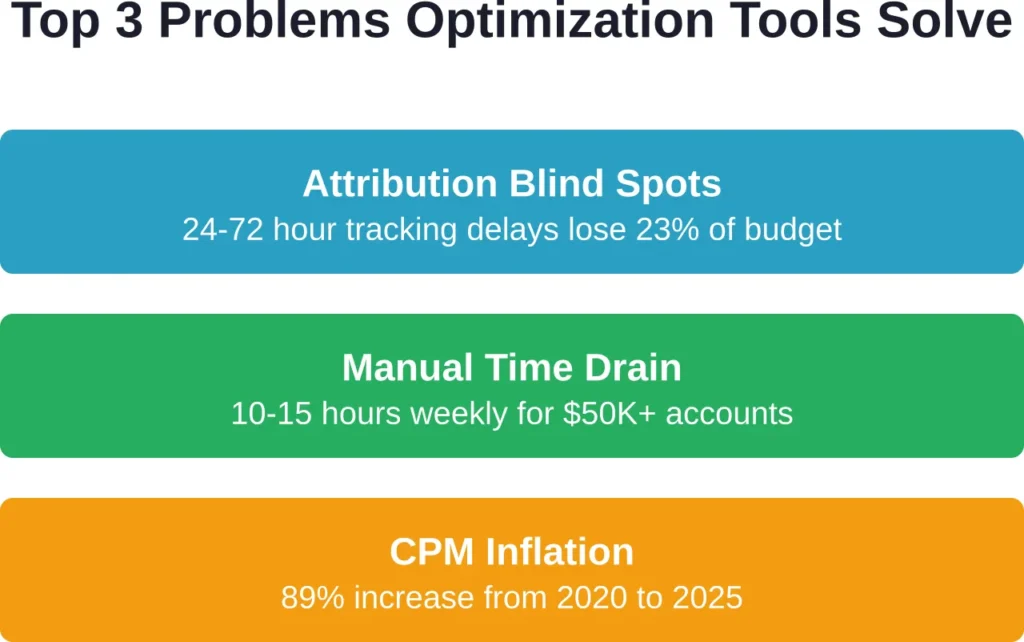
And the attribution problem has gotten worse. Conversion tracking now faces 24-72 hour delays due to cookie restrictions, making real-time optimization decisions nearly impossible without specialized tools. Attribution blind spots and creative fatigue can result in significant budget loss for Facebook advertisers.
Optimization tools solve three core problems that human marketers can’t handle at scale: processing data faster than the learning phase window allows, testing creative variations systematically without fatigue bias, and allocating budgets across campaigns with millisecond precision.
The Best Facebook Ads Optimization Tools for 2026
Not all optimization tools approach the problem the same way. Some focus on autonomous AI decisions, others on rule-based automation, and a few specialize in attribution or reporting.
The tools below represent different optimization philosophies. Pick based on where your campaigns are breaking down right now.
1. Extuitive – Predictive Creative Intelligence
Extuitive is an AI-powered platform that predicts ad performance before launching on Facebook/Meta. It analyzes creatives using brand-specific historical data combined with simulations from 150,000+ modeled real consumer personas to forecast CTR, ROAS, and overall effectiveness.
What sets Extuitive apart is its pre-launch predictive engine. Instead of burning budget on A/B tests and waiting for results, it scores and ranks creatives in minutes, generates or optimizes copy/images/videos, and validates them with AI consumer agents — dramatically reducing wasted spend and speeding up creative iteration.
Best for: Shopify/e-commerce brands and teams running frequent Meta ads who want to kill losers early, scale winning creatives fast, and minimize testing costs while maintaining high-volume output.
Key limitation: As a predictive tool, it relies heavily on the quality and volume of your historical data. New or low-data advertisers may see less accurate forecasts until the model learns their brand.
Contact Information:
- Website: extuitive.com
- Email: [email protected]
- LinkedIn: www.linkedin.com/company/extuitive
- Twitter: x.com/Extuitive_Inc
- Instagram: www.instagram.com/extuitiveinc
2. Ryze AI – Autonomous Campaign Management
Ryze AI takes the autonomous approach—it makes bid adjustments, reallocates budgets, and pauses underperforming ads without requiring manual rules or oversight. The platform manages campaigns across both Google and Meta, making it suitable for cross-platform advertisers.
What sets Ryze apart is the truly hands-off operation. Instead of setting up complex automation rules, the AI analyzes performance data and makes optimization decisions independently. For teams drowning in daily optimization tasks, this cuts management time dramatically.
The platform is used by thousands of marketers across multiple countries managing substantial ad spend volumes. That scale provides the AI with substantial training data to improve decision-making.
Best for: Advertisers spending $10K+ monthly who want to eliminate daily optimization work entirely and trust AI decision-making without constant rule tweaking.
Key limitation: Less transparency into why specific optimization decisions were made compared to rule-based tools. Teams that need to justify every bid change to stakeholders may find the black-box approach challenging.
3. Madgicx – AI Creative Intelligence
Madgicx specializes in creative analysis and audience insights. The platform uses AI to identify which creative elements drive performance, analyze audience segments, and recommend optimization actions based on patterns humans typically miss.
The creative intelligence feature is particularly valuable now that creative fatigue happens faster. Madgicx flags when ad performance drops due to audience oversaturation rather than targeting or bidding issues—a distinction that’s critical but hard to diagnose manually.
The tool also provides unified reporting across campaigns, making it easier to spot performance patterns and share results with clients or stakeholders.
Best for: Agencies and teams running high-volume creative testing who need to understand which specific creative elements drive results and maintain client reporting.
Key limitation: The learning curve is steeper than simpler automation tools. Teams need to invest time understanding the AI recommendations rather than just implementing surface-level suggestions.
4. Revealbot – Rule-Based Automation

Revealbot represents the rule-based automation philosophy. Instead of AI making autonomous decisions, marketers define specific conditions and actions: “If cost per acquisition exceeds $50 for 24 hours, pause the ad set.”
This approach gives complete transparency and control. Every automation action happens because of a rule the marketer explicitly created. For teams that need predictable, explainable behavior—or those managing accounts where compliance matters—this matters immensely.
Revealbot integrates with Facebook, Instagram, Google, Snapchat, and TikTok, making it a solid choice for multi-platform campaigns that need consistent automation logic across channels.
Plans start at $49/month, making it accessible for smaller advertisers testing their way into automation.
Best for: Teams that want transparent automation where they define exact conditions and actions rather than relying on AI judgment. Also ideal for marketers who need to audit and justify optimization decisions.
Key limitation: Requires upfront work to build effective rule sets. Poor rules create poor outcomes, so there’s a learning phase while teams figure out which conditions and thresholds actually improve performance.
5. Cometly – Attribution and Tracking
Cometly tackles the attribution problem directly with cross-device tracking and server-side integration. As cookie restrictions have made browser-based tracking less reliable, attribution tools like Cometly have become essential for understanding true campaign performance.
The platform tracks user journeys across devices and sessions, providing visibility into which ads actually drove conversions even when the attribution path spans days or multiple devices. That visibility is critical when Facebook’s native attribution shows incomplete data due to tracking delays.
For advertisers spending significant budgets, understanding accurate attribution prevents killing campaigns that appear unprofitable but actually drive delayed conversions.
Best for: E-commerce and lead generation businesses with longer customer journeys where accurate attribution is the difference between profitable scaling and budget waste.
Key limitation: Requires technical implementation including server-side tracking setup. Not a plug-and-play solution—expect to involve developers or technical marketers during setup.
6. AdEspresso – Simplified Campaign Management
AdEspresso by Hootsuite focuses on making campaign creation and split testing accessible. The interface simplifies the process of launching multiple ad variations, comparing performance, and identifying winners without needing deep Facebook Ads Manager expertise.
The tool is particularly strong for small businesses and marketers new to Facebook advertising. Instead of wrestling with Ads Manager’s complexity, AdEspresso provides a streamlined workflow for common tasks.
Split testing is built-in and visual, making it easy to test different headlines, images, and audience combinations without manual spreadsheet tracking.
Best for: Small businesses and marketing teams without dedicated Facebook ads specialists who need simplified campaign management and clear split test reporting.
Key limitation: Less powerful for advanced optimization strategies. Teams running complex multi-objective campaigns or requiring granular control may outgrow the simplified interface quickly.
7. Reporting Ninja – Client Reporting Automation

Reporting Ninja solves a different optimization problem: the time sink of creating client reports. The platform automates report generation with customizable templates, white-labeling, and scheduled delivery.
For agencies managing multiple clients, manual report creation easily consumes 5-10 hours per client monthly. Automating this frees time for actual optimization work instead of copying metrics into slides.
The tool integrates with Facebook, Google, Instagram, and other platforms to pull performance data automatically and format it consistently.
Best for: Agencies and consultants managing multiple client accounts who need to deliver professional reports consistently without manual data compilation.
Key limitation: Focused purely on reporting rather than optimization. This tool doesn’t improve campaign performance directly—it just makes performance visible to stakeholders more efficiently.
How to Choose the Right Tool for Your Needs
Picking an optimization tool isn’t about finding the “best” option—it’s about matching the tool to the specific problem breaking your campaigns right now.
Start by diagnosing where time and money are actually being lost. Is it manual optimization taking 10+ hours weekly? Creative fatigue killing performance faster than new ads can be created? Attribution gaps making it impossible to know which campaigns actually work?
Different tools solve different problems. Here’s how to match tool to issue:
If daily optimization work is the bottleneck: Autonomous tools like Ryze AI or rule-based automation like Revealbot cut hands-on time dramatically. Choose autonomous if trusting AI decisions is acceptable; choose rule-based if transparency and control matter more.
If creative performance is unpredictable: Creative intelligence platforms like Madgicx help identify which elements work and flag fatigue before performance tanks. This matters most when running high volumes of creative variations.
If attribution is broken: Tracking tools like Cometly provide the visibility to make informed budget decisions. Critical for any business with customer journeys longer than 24 hours or spanning multiple devices.
If reporting consumes excessive time: Reporting automation tools free 5-10 hours monthly per client. Agencies should evaluate this category even if campaign optimization itself is handled differently.
Budget matters too, obviously. Tools with $49/month entry points like Revealbot make sense for testing automation before committing to enterprise platforms. But on accounts spending $50K+ monthly, even expensive tools pay for themselves quickly if they improve performance by just a few percentage points.
Common Mistakes When Using Optimization Tools
Optimization tools create new ways to fail, not just new ways to succeed. Here are the mistakes that waste money even with good software:
Over-Automating Too Quickly
The biggest mistake is turning on full automation across all campaigns immediately. That approach obscures what’s actually working and makes troubleshooting impossible when performance drops.
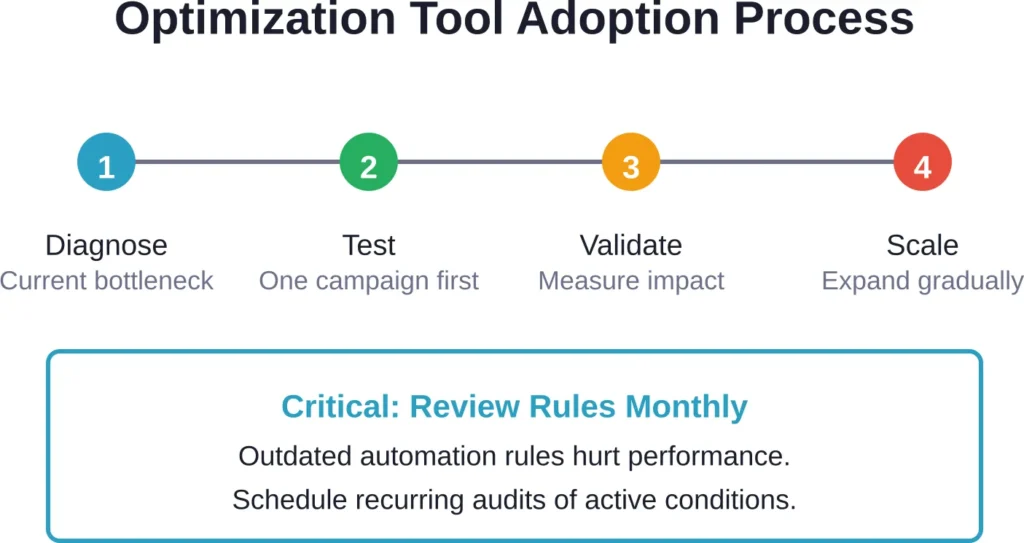
Start by automating one campaign or objective. Learn how the tool makes decisions, verify the results match expectations, then expand gradually. Rushing automation without understanding tool behavior leads to budget waste before problems become obvious.
Ignoring the Learning Phase
Facebook’s algorithm needs 50 conversions per ad set weekly to exit learning phase. Optimization tools don’t change this requirement—they just work within it more efficiently.
Making aggressive changes during learning phase resets progress. Even automated tools can sabotage performance by making too many adjustments too quickly. Configure automation to respect learning phase windows rather than treating every performance dip as signal to change things.
Not Testing Tool Recommendations
AI recommendations aren’t always right. Blindly implementing every suggestion without testing leads to following the tool off a cliff.
Use A/B testing to validate major recommendations. Run one campaign with the suggested change and one control campaign without it. Measure actual impact rather than assuming the tool knows better than baseline performance.
Forgetting to Update Rules and Conditions
Rule-based automation tools execute whatever rules exist—even when those rules become outdated. A rule that made sense three months ago might actively hurt performance now if market conditions changed.
Schedule monthly reviews of active automation rules. Disable or adjust rules that no longer match current campaign objectives or cost targets.
What Makes Facebook Ads Optimization Different in 2026
The optimization landscape has shifted considerably over the past few years. Understanding what’s different helps contextualize why certain tools matter more now.
Attribution Windows Have Compressed
Tracking restrictions mean conversion data arrives 24-72 hours slower than it did three years ago. This delay makes real-time optimization based on Facebook’s native reporting nearly impossible without supplemental tracking.
Tools that provide faster or more complete attribution data—through server-side tracking or predictive modeling—have become essential rather than nice-to-have. Optimizing on incomplete data wastes budget on campaigns that look bad but actually perform, or scales campaigns that look good but actually leak money.
Creative Fatigue Happens Faster
Audience saturation accelerates as more advertisers compete for attention. Creative that performed for 6-8 weeks in 2022 now fatigues in 3-4 weeks. This compression demands faster creative testing cycles and better systems to identify fatigue early.
Creative intelligence tools flag performance drops caused by fatigue versus other issues, helping teams know when to swap creative versus adjust targeting or bidding.
Manual Optimization Can’t Keep Pace
The volume of optimization opportunities has grown beyond human capacity. An account with 10 campaigns, 50 ad sets, and 200 ads generates hundreds of potential optimization actions daily: pause this, scale that, adjust these bids, refresh that creative.
Evaluating all those opportunities manually takes 10-15 hours weekly for moderately-sized accounts. Automation handles the tactical execution so human marketers can focus on strategy: which offers to test, which audiences to explore, which creative angles to develop.
Measuring Optimization Tool ROI
Optimization tools cost money. Justifying that cost requires measuring whether performance actually improves after adoption.
Track these metrics before and after implementing optimization tools:
Time saved: Hours spent on manual optimization work weekly. Most teams see 60-80% reduction once automation handles routine decisions.
Cost per acquisition: Whether CPA decreases after automation. Even 10-15% improvement pays for most tools within a few weeks on accounts spending $10K+ monthly.
Campaign learning phase completion rate: How often campaigns exit learning phase without getting paused or changed. Better optimization discipline typically improves this metric.
Creative refresh cycle time: How quickly fatigued creative gets replaced. Tools that flag fatigue early improve this metric noticeably.
Give tools 30-45 days to show impact. Evaluating after one week misses most benefits since the tool needs time to gather performance data and make informed decisions. But beyond 45 days, patterns become clear whether the tool is helping or just adding cost.
| Metric | Typical Improvement | Measurement Period |
|---|---|---|
| Time saved weekly | 60-80% reduction | After 2 weeks |
| Cost per acquisition | 10-15% decrease | After 30-45 days |
| Learning phase completion | 20-30% increase | After 30 days |
| Creative refresh speed | 40-50% faster | After 30 days |
Facebook Native Features vs Third-Party Tools
Facebook’s native Ads Manager includes basic optimization features: automatic placements, campaign budget optimization, dynamic creative. So when do third-party tools justify their cost?
Native features work well for simple campaigns with clear conversion events and straightforward objectives. Small advertisers spending under $5K monthly can often achieve solid results with just native tools plus careful manual oversight.
But native optimization hits limits quickly as complexity grows. Facebook’s algorithm optimizes within the parameters set by the advertiser—it can’t suggest which campaigns to pause, when creative is fatiguing, or whether attribution is accurate. Those strategic decisions require either human judgment or specialized tools.
Third-party tools add value in four specific areas native features can’t match:
Cross-platform optimization: Native tools optimize within Facebook/Instagram. Third-party tools optimize across Facebook, Google, TikTok, and other platforms simultaneously with unified budget allocation.
Advanced attribution: Native attribution relies on Facebook’s tracking, which has gaps due to privacy restrictions. Third-party attribution tools use server-side tracking and cross-device matching to fill those gaps.
Rule-based automation: Native optimization reacts to performance but can’t execute complex conditional logic like “pause this ad if CPA exceeds target AND spend reaches $500 AND no conversions occurred in 24 hours.”
Creative analysis: Native tools show which ads perform better but don’t identify which creative elements within the ad drive that performance. Creative intelligence tools analyze components—headlines, images, CTAs—to surface insights native reporting can’t provide.
The breakpoint typically happens around $10K monthly spend or 5+ concurrent campaigns. Below that threshold, native tools plus manual oversight often suffice. Above it, the time saved and performance improved by third-party tools usually justify their cost within weeks.
Setting Up Your First Optimization Tool
Implementation matters as much as tool selection. Poor setup wastes the tool’s potential even if the right software was chosen.
Start with these setup priorities:
Define Clear Success Metrics
Before turning on any automation, document what success looks like. Target CPA? Minimum ROAS? Maximum cost per click? The tool needs objective criteria to optimize toward, not vague goals like “better performance.”
Write down specific thresholds. “Pause ads when CPA exceeds $75 for 48 hours” is actionable. “Keep CPA reasonable” isn’t.
Start with One Campaign
Don’t activate automation across all campaigns simultaneously. Pick one campaign—preferably one spending $500-1000 monthly so there’s enough volume to measure impact but not so much that mistakes are expensive.
Run the test campaign with automation enabled and the rest manually for 30 days. Compare performance to verify the tool is helping before expanding to other campaigns.
Configure Conservative Rules Initially
If using rule-based automation, start with conservative triggers. It’s easier to make automation more aggressive after verifying it works than to recover from automation that killed campaigns too quickly.
Example: set pause rules to trigger after 48-72 hours of poor performance rather than 24 hours. This prevents pausing campaigns during normal performance fluctuations.
Review Automated Actions Daily Initially
Even though automation is handling optimization, review what it’s actually doing every day for the first two weeks. This reveals whether the tool is making sensible decisions or executing logic that seemed reasonable in theory but is problematic in practice.
After confirming the tool is behaving correctly, reduce review frequency to weekly or bi-weekly.
Frequently Asked Questions
Both, but the performance improvement is real and measurable. Automation handles optimization faster than humans—making bid adjustments within minutes of performance changes rather than hours or days later. That speed typically improves cost per acquisition by 10-15% on accounts spending $10K+ monthly. Tools also eliminate human inconsistency, making sure optimization happens every day instead of only when someone has time.
Around $5K-10K monthly is the breakpoint for most businesses. Below $5K, the manual optimization workload is manageable and the absolute dollar savings from improved performance may not cover the tool cost. Above $10K, the time saved plus performance improvements typically justify the expense within 2-3 weeks. Agencies managing multiple clients can justify tools at lower spend per client since the time savings compound across accounts.
Yes, but only if configured correctly. Tools that make too many changes too quickly reset learning phase repeatedly, which kills performance. The better tools include learning phase protection—they pause optimization actions on campaigns that haven’t exited learning yet. Rule-based tools require manually configuring this protection by setting conditions like “only optimize campaigns with 50+ conversions in the past 7 days.”
Attribution tools use server-side tracking instead of relying solely on browser pixels. When someone visits the site, the attribution tool logs the visit on the server along with UTM parameters identifying which ad they came from. When they convert—even days later or on a different device—the server matches the conversion back to the original ad click. This works even when browser-based tracking fails due to cookie restrictions or cross-device behavior.
Depends on whether transparency or performance matters more. AI tools like Ryze AI typically achieve slightly better performance because they optimize continuously based on patterns humans might miss. But they’re black boxes—it’s harder to understand why specific decisions were made. Rule-based tools give complete visibility and control but require more upfront work to build effective rule sets. Teams that need to justify every optimization decision to stakeholders should start with rule-based tools. Teams that trust AI and want hands-off management benefit more from AI tools.
Small businesses benefit, but only if they’re spending enough that time saved or performance improved exceeds the tool cost. A local business spending $2K monthly on Facebook ads probably doesn’t need specialized tools—native Ads Manager features and careful manual oversight work fine. But a small e-commerce business spending $8K monthly can often justify a $49-99/month tool since even a 10% performance improvement adds $800+ monthly profit.
Expect 30-45 days for clear patterns to emerge. The first week is implementation and learning as the tool gathers baseline data. Weeks 2-4 show initial optimization impact but performance may be volatile as the tool tests different approaches. By week 6, patterns become clear whether cost per acquisition improved, time saved is significant, or the tool isn’t delivering expected value. Evaluating sooner than 30 days risks mistaking normal variance for tool impact.
Conclusion: Match the Tool to Your Actual Problem
Facebook ads optimization tools aren’t about finding the single “best” platform. They’re about matching software capabilities to the specific bottleneck breaking your campaigns right now.
Spending 10-15 hours weekly on manual optimization? Autonomous tools like Ryze AI or rule-based platforms like Revealbot cut that dramatically. Creative performance unpredictable? Creative intelligence platforms like Madgicx help identify what’s working and flag fatigue early. Attribution broken? Tracking tools like Cometly provide visibility to make informed budget decisions.
Start by diagnosing where time and money are actually being lost. Then choose the tool category that addresses that specific problem. Test on one campaign before rolling out broadly. Measure real impact after 30-45 days to verify the tool is helping.
The tools managing over $500M+ in annual ad spend combined prove optimization software works when matched correctly to campaign needs. But no tool fixes poor creative, weak offers, or undefined target audiences. Software automates and accelerates optimization—it doesn’t replace marketing strategy.
Choose the tool that solves your actual bottleneck, implement it systematically, and measure whether it delivers the time savings or performance improvements promised. That approach turns optimization tools from expensive overhead into profit drivers.