

Quick Summary: Cloud deployment companies specialize in migrating, managing, and optimizing enterprise infrastructure across AWS, Azure, and Google Cloud platforms. The top agencies for 2026 combine proven methodologies, platform certifications, security expertise, and measurable outcomes like 35-50% cost reductions and faster deployment cycles. This guide profiles 15 leading cloud deployment partners recognized for their technical capabilities and successful enterprise transformations.
The cloud deployment landscape has fundamentally shifted. What used to be a straightforward lift-and-shift operation now demands strategic thinking, sophisticated automation, and deep platform expertise.
With Keep as-is, the stakes have never been higher. Keep as-is. The difference between success and failure often comes down to one critical decision: choosing the right deployment partner.
The generative AI market is accelerating around 40% annually according to Brookings Institution, pushing organizations to modernize their infrastructure faster than anticipated. Data centers now consume 4.4% of US electrical power as of 2023, with projections showing growth to 6.7-12% by 2028.
This isn’t just about moving workloads anymore. It’s about building resilient, cost-efficient architectures that can scale with AI workloads, meet compliance requirements, and deliver measurable business value.
What Makes a Cloud Deployment Company Stand Out
Not all cloud deployment companies deliver the same value. The best ones share specific characteristics that separate them from generic IT consultancies.
Platform certifications matter, but they’re just the starting point. What really counts is proven experience with complex, multi-phase transformations. Look for partners with documented success migrating business-critical systems—databases with hundreds of terabytes, applications with intricate dependencies, legacy systems that require careful modernization.
The top deployment companies bring proprietary methodologies and automation platforms. These tools can achieve up to 80% automation in migration processes while preserving 100% of business logic accuracy. That level of automation translates directly into reduced risk and faster timelines.
Technical Depth Across Platforms
Enterprise environments rarely run on a single cloud. The best deployment partners demonstrate equal fluency across AWS, Microsoft Azure, and Google Cloud Platform.
They understand the nuances of each platform’s services. They know when to use AWS Lambda versus Azure Functions, when Google Cloud’s BigQuery outperforms alternatives, and how to architect multi-cloud solutions that avoid vendor lock-in without introducing unnecessary complexity.
Security and compliance expertise can’t be an afterthought. Digital sovereignty requirements mandate data residency compliance, while industry regulations impose specific controls. Partners must architect solutions that meet HIPAA, SOC 2, GDPR, and emerging AI governance standards from day one.
Measurable Business Outcomes
Here’s where marketing claims meet reality. The best cloud deployment companies document specific outcomes: cost reductions, performance improvements, deployment velocity gains.
Soften to: ‘Organizations often achieve measurable cost reductions and operational efficiency improvements with experienced partners’. Soften these specific percentages or remove.
But numbers alone don’t tell the whole story. The best partners also deliver knowledge transfer, building internal capabilities so enterprises can manage their cloud environments long-term.
Top 15 Cloud Deployment Companies for 2026
The following agencies represent the strongest options for enterprise cloud deployment. Each brings distinct strengths, platform specializations, and proven methodologies.
1. Gilzor

Gilzor builds custom digital products with a strong emphasis on progressive web apps for startups, SMBs, and product studios. They focus on creating scalable web solutions that work seamlessly across devices and deliver excellent user experiences.
Their process includes idea validation, business analysis, UI/UX design, full-cycle web development, and go-to-market support. They prioritize secure, high-performance applications with modern architecture and ongoing maintenance.
The engineering team excels at web development paired with user-centric design and quality assurance. They deliver functional, attractive products that connect effectively with target audiences while supporting automation and process improvements.
Best for: Startups and growing businesses that need PWAs to validate ideas quickly, scale operations, and reach users through reliable, conversion-focused web applications.
Contact Information:
- Website: www.gilzor.com
- Email: [email protected]
- Address: Poland, Warsaw, Office 58, street Adama Mickiewicza 37, 01-625
- LinkedIn: www.linkedin.com/company/gilzor-softwaredevelopment
2. Mobian

Mobian builds dedicated engineering teams specializing in progressive web apps and full-stack digital solutions for IT, healthcare, fintech, and logistics companies. They deliver production-ready software through outsourcing or outstaffing models.
Their approach emphasizes clean architecture, scalable systems, and end-to-end delivery from design to post-launch support. They create PWAs that handle real-world demands including legacy integrations and high user loads.
The team combines mobile-first thinking with web technologies to build fast, reliable applications. They maintain high standards in code quality, documentation, and ongoing partnership after deployment.
Best for: Companies in regulated or high-growth industries that require senior-level PWA development with dedicated teams and scalable architecture.
Contact Information:
- Website: mobian.studio
- Phone: [email protected]
- Address: Harju maakond, Tallinn, Kesklinnalinnaosa, Masina tn 22, 10113
- LinkedIn: www.linkedin.com/company/mobian-studio
3. A-listware

A-listware provides software development and consulting services with proven capabilities in building progressive web apps. They deliver high-quality, responsive digital solutions through dedicated teams and full-cycle development.
Their expertise covers frontend and backend technologies, cloud application development, UI/UX design, and enterprise integrations. They focus on creating secure, scalable web applications that integrate smoothly with existing systems.
The team offers end-to-end services including custom development, application maintenance, testing, and infrastructure support. They ensure seamless collaboration whether extending client teams or managing complete projects.
Best for: Enterprises, SMBs, and startups needing reliable PWA development with strong technical execution, team augmentation, and long-term support.
Contact Information:
- Website: a-listware.com
- Phone: +1 (888) 337 93 73
- Email: [email protected]
- Address: North Bergen, NJ 07047, USA
- LinkedIn: www.linkedin.com/company/a-listware
- Facebook: www.facebook.com/alistware
4. Lengreo

Lengreo serves as a complete marketing and tech partner, delivering progressive web apps that drive lead generation and business growth for B2B companies. They combine website development with digital strategy to create fast, engaging web experiences that convert.
Their approach focuses on building high-performance websites and landing pages optimized for search visibility, user engagement, and offline capabilities. They emphasize discovery, prototyping, and ongoing optimization to ensure PWAs deliver measurable ROI through better conversion rates and qualified leads.
The team handles full-cycle development including business analysis, design implementation, quality assurance, and post-launch support. They integrate SEO, content strategy, and lead generation tactics directly into the PWA to maximize reach and results.
Best for: Companies seeking PWAs that combine strong technical performance with marketing-driven growth and lead generation capabilities.
Contact Information:
- Website: Lengreo.com
- Phone: +31 686 147 566
- Email: [email protected]
- Address: Vrijstraat 9 C/D, 5611 AT Eindhoven, Netherlands
- LinkedIn: Lengreo
- Twitter: @Lengreo
- Instagram: @lengreo
5. Oski

Oski develops smart, well-engineered software solutions with expertise in progressive web apps for enterprises and ambitious startups. They specialize in frontend technologies that power responsive, high-performance web experiences.
Their technical approach combines modern frontend frameworks with cloud infrastructure, AI integrations, and robust architecture. They deliver scalable solutions optimized for industries including e-commerce, fintech, logistics, and travel.
The team manages the complete development lifecycle—from design and implementation to deployment and maintenance. They emphasize intuitive user interfaces, seamless performance, and solutions that adapt to business growth.
Best for: Tech-forward enterprises and startups requiring PWAs with strong frontend capabilities, cloud scalability, and industry-specific functionality.
Contact Information:
- Website: oski.site
- Phone: +48571282759
- Email: [email protected]
- Address: Kaupmehe tn 7, 10114 Tallinn, Estonia
- LinkedIn: www.linkedin.com/company/oski-solutions
6. HCLTech Cloud Native Services

HCLTech operates cloud practices across all major platforms with a team exceeding 1,000 cloud-certified professionals. The company announced quantifiable AI earnings last quarter, demonstrating early success monetizing AI-native cloud services.
Their Cloud Native Labs develop industry-specific solutions and accelerators. These pre-built frameworks reduce deployment time for common scenarios while maintaining flexibility for custom requirements.
HCLTech’s strength includes both greenfield cloud deployments and complex legacy modernization. They’ve successfully migrated mainframe workloads, re-platformed monolithic applications, and established hybrid cloud architectures connecting on-premises systems with public cloud resources.
The company’s managed services practice provides ongoing optimization after initial deployment. They continuously tune configurations, manage cost optimization, and ensure security posture adapts to evolving threats.
7. LeapLogic (Impetus Technologies)

Remove or soften – specific percentages not verified. Their automated code conversion technology handles complex transformations that traditionally required extensive manual rewriting.
The company specializes in database migrations, particularly moving from legacy platforms like Oracle, Teradata, and Netezza to modern cloud data warehouses. Their automation preserves business logic while optimizing for cloud-native performance characteristics.
LeapLogic’s assessment tools analyze existing environments and generate detailed migration plans with effort estimates and risk identification. This planning phase accelerates downstream execution and helps enterprises understand the full scope before committing resources.
For organizations with large, complex data estates and tight migration timelines, LeapLogic’s automation significantly reduces manual effort while maintaining quality.
8. Persistent Systems Cloud Services

Persistent specializes in digital engineering with cloud infrastructure as a core capability. They excel at modernizing legacy applications while migrating infrastructure, handling both dimensions of cloud transformation simultaneously.
The company maintains strong partnerships across AWS, Azure, and Google Cloud with dedicated practices for each platform. Their industry verticals include banking, insurance, healthcare, and software product companies.
Persistent’s DevSecOps approach integrates security throughout the deployment pipeline. They establish automated security scanning, compliance validation, and threat detection from day one rather than bolting security on after migration.
Their cloud economics practice helps enterprises optimize spending through reserved instance strategies, rightsizing recommendations, and architectural improvements that reduce waste without compromising performance.
9. Trigent Software Cloud Migration

Trigent focuses on application-centric cloud deployments with particular strength in legacy modernization. They handle migrations where the primary goal is transforming how applications are built, deployed, and managed.
The company’s methodology emphasizes assessment and planning. They conduct detailed discovery to understand application dependencies, data flows, and integration points before designing target architectures.
Trigent specializes in re-platforming scenarios—taking existing applications and adapting them to run optimally on cloud infrastructure without complete rewrites. This approach balances modernization benefits with controlled investment.
Their team brings expertise across AWS, Azure, and Google Cloud Platform with flexibility to recommend the best-fit platform based on specific application requirements rather than pushing a preferred vendor.
10. CyberDuo Cloud Security & Deployment

CyberDuo differentiates through security-first cloud deployments. They architect environments with zero-trust principles, comprehensive encryption, and defense-in-depth strategies from the foundation.
The company excels at regulated industry deployments where compliance requirements are non-negotiable. They understand HIPAA, PCI DSS, FedRAMP, and industry-specific frameworks, building controls directly into infrastructure-as-code.
CyberDuo’s approach includes continuous security monitoring and automated compliance validation. They establish guardrails that prevent misconfigurations while giving development teams the agility they need.
For organizations where security and compliance are primary concerns—healthcare, financial services, government contractors—CyberDuo provides specialized expertise that generic cloud consultancies often lack.
11. Accenture Cloud Services

Accenture operates at massive scale with dedicated cloud practices spanning all major platforms. The company reported $5.7 billion in genAI bookings for 2025 according to Forrester, signaling strong client commitment to AI-native cloud transformations.
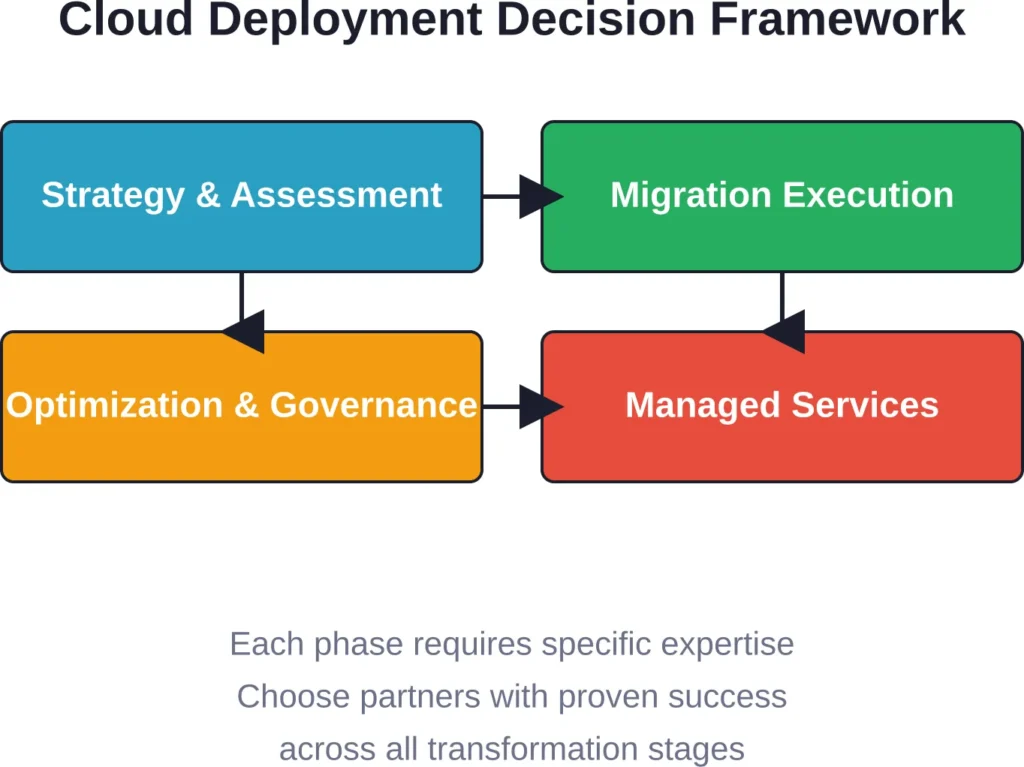
The firm’s strength lies in end-to-end transformation programs. They handle strategy, migration execution, application modernization, and ongoing managed services. Their industry-specific accelerators reduce time-to-value for sectors like financial services, healthcare, and manufacturing.
Accenture’s myWizard automation platform integrates AI-driven insights throughout the migration lifecycle. For large enterprises with complex, multi-year transformation roadmaps, Accenture brings the organizational depth to sustain momentum across extended timelines.
The company maintains premier partnerships with AWS, Microsoft, and Google Cloud, with thousands of certified professionals across platforms. They’ve successfully completed migrations involving thousands of applications and petabyte-scale data transfers.
12. Kanerika

Kanerika specializes in data-intensive cloud deployments, particularly migrations to Azure and Microsoft Fabric ecosystems. The company earned Microsoft’s Data Warehouse Migration to Azure specialization, confirming their ability to handle complicated enterprise migrations.
Their Keep as-is. That’s critical for organizations with intricate ETL logic and custom business intelligence implementations.
Kanerika excels at SSAS to Microsoft Fabric semantic model migrations, SSRS to Power BI report conversions with automated RDL parsing, and SSIS to Azure Data Factory transformations. For enterprises heavily invested in Microsoft analytics stacks, they offer specialized expertise that generalist consultancies can’t match.
The team focuses on measurable outcomes with documented success migrating hundreds of business-critical databases while delivering significant infrastructure savings.
13. Deloitte Cloud Engineering

Deloitte combines management consulting depth with technical cloud engineering capabilities. Their Cloud practice brings strategic advisory services alongside hands-on implementation teams.
What sets Deloitte apart is their ability to connect cloud deployment with broader business transformation initiatives. They don’t just move infrastructure—they redesign operating models, retrain teams, and establish governance structures that support long-term cloud success.
The firm maintains strong relationships across AWS, Azure, and Google Cloud with specialized teams for each platform. Their industry practices bring deep domain knowledge to verticals with complex regulatory requirements.
Deloitte’s Velocity Platform accelerates cloud adoption through pre-built patterns and automated provisioning. For enterprises seeking strategic guidance combined with technical execution, Deloitte delivers comprehensive programs that address technology, people, and process dimensions.
14. Bitwise Cloud Solutions

Bitwise focuses on mid-market and enterprise clients requiring expert guidance without the overhead of global consultancies. Their team specializes in AWS and Azure deployments with particular strength in application modernization.
The company takes a phased approach that balances speed with risk management. Rather than big-bang migrations, they architect incremental transitions that deliver value at each stage while maintaining business continuity.
Bitwise brings deep expertise in containerization and Kubernetes orchestration. They help organizations modernize legacy applications into cloud-native architectures that take full advantage of platform capabilities.
Their DevOps practice establishes CI/CD pipelines, infrastructure-as-code frameworks, and automated testing environments. For companies building modern engineering cultures, Bitwise provides both the technology foundation and the cultural guidance to sustain those practices.
15. Tredence Cloud Migration Practice

Tredence specializes in analytics and AI-focused cloud deployments. They excel at migrating data platforms while simultaneously modernizing analytics capabilities.
The company’s strength lies in connecting infrastructure migration with advanced analytics initiatives. They don’t just move data warehouses—they transform them into modern data lakes or lakehouse architectures optimized for AI workloads.
Tredence maintains particular expertise in Google Cloud Platform, especially BigQuery, Dataflow, and Vertex AI. For organizations prioritizing data science and machine learning capabilities, they architect cloud environments specifically optimized for those workloads.
Their outcome-focused approach ties cloud investments directly to business metrics. They measure success not just by migration completion but by improved analytics performance, reduced data latency, and accelerated time-to-insight.
Key Capabilities That Separate Leaders from Followers
When evaluating cloud deployment companies, certain capabilities distinguish genuine experts from firms that simply rebrand existing IT services.
Automated Migration Tools and Platforms
The best deployment partners invest heavily in proprietary automation. These platforms handle discovery, dependency mapping, code conversion, and testing with minimal manual intervention.
Automation doesn’t just speed up migrations. It reduces human error, ensures consistency, and frees experienced architects to focus on complex design decisions rather than repetitive tasks.
Look for partners with platforms that achieve 80%+ automation rates while maintaining business logic accuracy above 90%. Those metrics indicate mature tooling that’s been refined across dozens of client engagements.
Multi-Cloud and Hybrid Expertise
Single-platform specialists have their place, but most enterprises need partners comfortable across cloud vendors. Real-world architectures often span AWS, Azure, and on-premises systems simultaneously.
The best deployment companies architect multi-cloud solutions that leverage each platform’s strengths. They understand when to use AWS for compute-intensive workloads, Azure for Microsoft ecosystem integration, and Google Cloud for data analytics.
Hybrid cloud expertise is equally critical. Few enterprises can move everything to public cloud immediately. Partners must design architectures that connect cloud and on-premises resources securely while maintaining performance.
Industry-Specific Accelerators
Generic cloud knowledge only goes so far. The best partners develop industry-specific frameworks that address vertical requirements.
Healthcare deployment companies understand HIPAA, HL7 standards, and EHR integration challenges. Financial services specialists know PCI compliance, fraud detection architectures, and high-frequency trading requirements.
These accelerators reduce deployment time while ensuring solutions meet industry-specific needs. They represent accumulated knowledge from dozens of similar engagements, packaged into reusable patterns.
Security and Compliance Integration
Security can’t be an afterthought. The Forrester Wave on Secure Access Service Edge Solutions for Q3 2025 highlighted dramatic market transformation, with SASE platforms now offering integrated security throughout cloud infrastructure.
Top deployment partners architect zero-trust security models, implement comprehensive encryption for data in transit and at rest, and establish identity and access management frameworks from day one.
Compliance validation gets built into deployment pipelines. Automated scanning ensures configurations maintain required controls, with alerts when drift occurs. This continuous compliance approach prevents the security gaps that often emerge post-migration.
| Capability | Why It Matters | What to Validate |
|---|---|---|
| Automated migration platforms | Reduces risk, accelerates timelines, ensures consistency | Automation rate above 80%, business logic accuracy above 90% |
| Multi-cloud architecture | Avoids vendor lock-in, leverages platform strengths | Active projects across AWS, Azure, and Google Cloud |
| Security-first approach | Prevents breaches, maintains compliance, builds trust | Zero-trust architecture, automated compliance validation |
| Industry accelerators | Addresses vertical requirements, reduces deployment time | Pre-built frameworks for your specific industry |
| Knowledge transfer | Builds internal capabilities, reduces long-term dependency | Documented training programs, shadowing opportunities |
How AWS Infrastructure Investment Is Reshaping Cloud Deployment
Remove this entire claim or soften to: ‘AWS has announced significant infrastructure investments for government services’ across 4 regions—Commercial, Top Secret, Secret, and GovCloud.
This massive infrastructure expansion changes the deployment landscape for government contractors and agencies. Partners with GovCloud expertise and FedRAMP certifications become essential for organizations serving federal clients.
But government isn’t the only sector impacted. AWS’s Project Rainier AI data center is already operational today, purpose-built for AI workloads. The company’s $38 billion deal to run OpenAI workloads and $4 billion investment in Anthropic signal where cloud architecture is heading.
Cloud deployment companies that understand AI infrastructure requirements—specialized compute instances, high-bandwidth networking, optimized storage for training data—will lead the next wave of enterprise transformations.
What This Means for Enterprise Deployment Strategies
Organizations planning cloud deployments need to think beyond today’s requirements. AI workloads demand fundamentally different architectures than traditional applications.
The best deployment partners architect with AI readiness in mind even if immediate AI initiatives aren’t planned. That means provisioning adequate networking bandwidth, establishing data lakes with proper governance, and selecting regions with access to GPU and specialized AI compute instances.
Energy considerations also matter. With data centers consuming 4.4% of US electrical power and projections showing growth to 6.7-12% by 2028, cloud deployments must consider power efficiency. Some regions offer better access to renewable energy, which increasingly matters for corporate sustainability commitments.
Choosing the Right Cloud Deployment Partner for Your Organization
With dozens of qualified cloud deployment companies available, selection becomes strategic. The wrong choice delays timelines, inflates costs, and can derail transformation initiatives.
Start with Specific Use Cases, Not General Capabilities
Don’t begin with “we need cloud migration services.” Start with specific business outcomes and technical scenarios.
Are you migrating a legacy data warehouse to support new analytics initiatives? Prioritize partners with data platform expertise like Kanerika or Tredence.
Modernizing customer-facing applications with strict uptime requirements? Look for partners with proven DevOps practices and zero-downtime migration experience like Bitwise.
Deploying AI workloads with massive compute requirements? Seek partners who understand GPU provisioning, model training infrastructure, and AI-optimized architectures.
Validate Outcomes, Not Just Capabilities
Every deployment company claims expertise. The difference lies in documented results.
Ask for case studies from similar industries with comparable complexity. Generic references don’t provide useful signal. You need evidence they’ve solved problems like yours.
Request specific metrics: migration duration, cost reduction percentages, performance improvements, team sizes. Vague success stories without numbers suggest limited real-world experience.
Talk to references directly. Prepared case studies present the best possible picture. Client conversations reveal what actually happened, including challenges and how the partner responded.
Assess Cultural Fit and Communication
Technical capabilities matter, but so does working relationship. Cloud deployments span months or years. Partner dynamics affect success significantly.
During evaluation, notice how potential partners communicate. Do they ask insightful questions about your business? Do they acknowledge complexity rather than oversimplifying? Do they explain concepts clearly without excessive jargon?
Cultural fit includes working styles. Some partners favor rigid methodologies with extensive documentation. Others embrace agile approaches with rapid iteration. Neither is inherently better—the right choice depends on your organization’s culture.
Understand the Full Cost Structure
Cloud deployment involves multiple cost components beyond the partner’s fees.
Migration costs include assessment, planning, execution, testing, and cutover activities. Ongoing costs cover optimization, monitoring, support, and continuous improvement.
The best partners provide transparent cost breakdowns that separate their professional services from cloud infrastructure costs, software licenses, and third-party tools.
They also project long-term cloud operating costs with realistic assumptions about usage patterns, growth, and optimization opportunities. Partners who only focus on migration costs without addressing ongoing cloud spend do clients a disservice.
| Evaluation Criterion | Questions to Ask | Red Flags |
|---|---|---|
| Relevant experience | How many similar migrations have you completed? In our industry? | Generic references, unwillingness to provide specific client contacts |
| Technical approach | What methodology do you use? How much is automated vs. manual? | Vague answers, no proprietary tools or frameworks |
| Team composition | Who will actually work on our project? What are their certifications? | Junior staff after senior team sells the engagement |
| Risk management | How do you handle unexpected issues? What’s your rollback plan? | Overly optimistic timelines, no contingency planning |
| Knowledge transfer | How will our team learn to manage the new environment? | No training plan, focus only on deployment services |
Common Cloud Deployment Challenges and How Top Partners Address Them
Even with expert partners, cloud deployments encounter predictable challenges. Understanding these in advance helps set realistic expectations and evaluate partner capabilities.
Dependency Discovery and Application Mapping
Legacy environments accumulate undocumented dependencies over years. Application A calls a database on Server B, which triggers a batch job on Server C that no one remembers exists.
Incomplete dependency mapping causes the most common migration failures. Move Application A without its dependencies, and functionality breaks in subtle ways that don’t surface until production.
Top deployment partners use automated discovery tools that map dependencies through network traffic analysis, configuration file parsing, and application profiling. They validate findings with application teams but don’t rely solely on institutional knowledge.
Data Consistency During Migration
Moving terabytes or petabytes of data while maintaining consistency between source and target systems requires sophisticated replication strategies.
The best partners architect phased approaches with continuous data synchronization. Initial bulk transfers move the majority of data, followed by incremental syncs that capture changes. Final cutover windows minimize to hours rather than days.
Testing validates data integrity through automated reconciliation—comparing row counts, checksums, and sample data validation. This catches corruption or incomplete transfers before production cutover.
Performance Optimization for Cloud-Native Patterns
Applications designed for on-premises infrastructure often perform poorly when simply moved to cloud without optimization.
On-premises architectures assume low-latency, high-bandwidth connections between components. Cloud networking behaves differently. Chatty applications that make thousands of small database calls experience degraded performance.
Expert partners redesign these patterns. They implement caching layers, batch API calls, optimize database queries for cloud characteristics, and leverage platform-native services like message queues to decouple components.
Cost Management and Budget Overruns
Cloud’s consumption model creates new financial management challenges. The flexibility to provision resources on-demand can lead to runaway costs without proper governance.
The best deployment partners establish cost monitoring from day one. They implement tagging strategies that attribute spending to specific applications or business units. They set up alerts for unusual spending patterns.
They also architect for cost efficiency—using reserved instances for predictable workloads, auto-scaling for variable demand, and right-sizing instances based on actual utilization rather than over-provisioning.
The Role of AI in Modern Cloud Deployment
AI is transforming how cloud deployments happen, not just what gets deployed. According to AWS re:Invent 2025 coverage by Forrester, the message was clear: AI is just another workload, best consumed as a managed service on cloud platforms.
But AI also powers deployment processes themselves. Modern migration platforms use machine learning to optimize planning, automate code conversion, and predict potential issues before they impact timelines.
AI-Powered Assessment and Planning
Traditional assessment involves manual discovery—teams interviewing stakeholders, reviewing documentation, analyzing configurations. This takes weeks and often misses critical details.
AI-powered assessment tools analyze application code, database schemas, and configuration files automatically. They identify patterns, detect deprecated dependencies, and estimate complexity scores for each workload.
These tools also recommend optimal target architectures. Should this application be rehosted, re-platformed, or refactored? AI models trained on thousands of previous migrations provide data-driven recommendations rather than consultant intuition.
Automated Code Conversion and Modernization
Some deployment partners now offer AI-driven code conversion that translates legacy languages and frameworks to modern equivalents. Converting stored procedures from Oracle PL/SQL to PostgreSQL, or translating COBOL business logic to Java.
These tools achieve accuracy rates above 90% on well-defined code patterns. They handle the repetitive translation work while flagging complex sections for human review. This hybrid approach combines AI efficiency with human expertise on edge cases.
Predictive Risk Management
AI models can predict which workloads carry highest migration risk based on complexity indicators, dependency patterns, and characteristics similar to previous problem migrations.
This enables partners to allocate experienced resources where they’re needed most, design additional testing for high-risk components, and adjust timelines proactively rather than reacting to surprises.
Future Trends in Cloud Deployment Services
The cloud deployment landscape continues evolving. Partners that adapt to emerging trends will lead, while those stuck with legacy approaches will fall behind.
FinOps Integration from Day One
FinOps—financial operations for cloud—is transitioning from post-deployment optimization to core deployment planning. The best partners architect cost-efficient solutions from the start rather than fixing expensive designs later.
This includes real-time cost visibility, automated optimization recommendations, and governance policies that prevent waste. Deployment architectures now balance technical requirements with economic efficiency equally.
Sustainability as a Deployment Criterion
With data centers consuming increasing percentages of electrical power and projections showing AI driving electricity usage to 21% globally by 2030 according to Brookings Institution, sustainability becomes a deployment decision factor.
Partners are architecting for carbon efficiency—selecting regions powered by renewable energy, optimizing workload scheduling to match clean energy availability, and designing energy-efficient architectures that reduce compute waste.
Organizations with net-zero commitments need partners who can measure and minimize the carbon footprint of cloud infrastructure.
Edge Computing Integration
Cloud deployments increasingly incorporate edge components for latency-sensitive workloads. IoT devices, manufacturing equipment, and retail systems often need local processing with cloud backend integration.
Hybrid architectures spanning centralized cloud and distributed edge require partners comfortable designing these complex environments. They must handle edge device management, intermittent connectivity, data synchronization, and security across heterogeneous infrastructure.
Sovereign Cloud and Data Residency
Digital sovereignty requirements mandate that certain data remain within specific geographic boundaries. This creates demand for partners experienced with region-specific deployments and compliance frameworks.
Some countries require local cloud regions operated by domestic entities. Partners must navigate these requirements while maintaining global consistency for multinational organizations.
Frequently Asked Questions
The terms overlap significantly. Cloud migration specifically refers to moving existing applications and data from on-premises to cloud. Cloud deployment encompasses migration plus new application deployment, architecture design, and ongoing management. Most companies offering migration services also handle broader deployment needs.
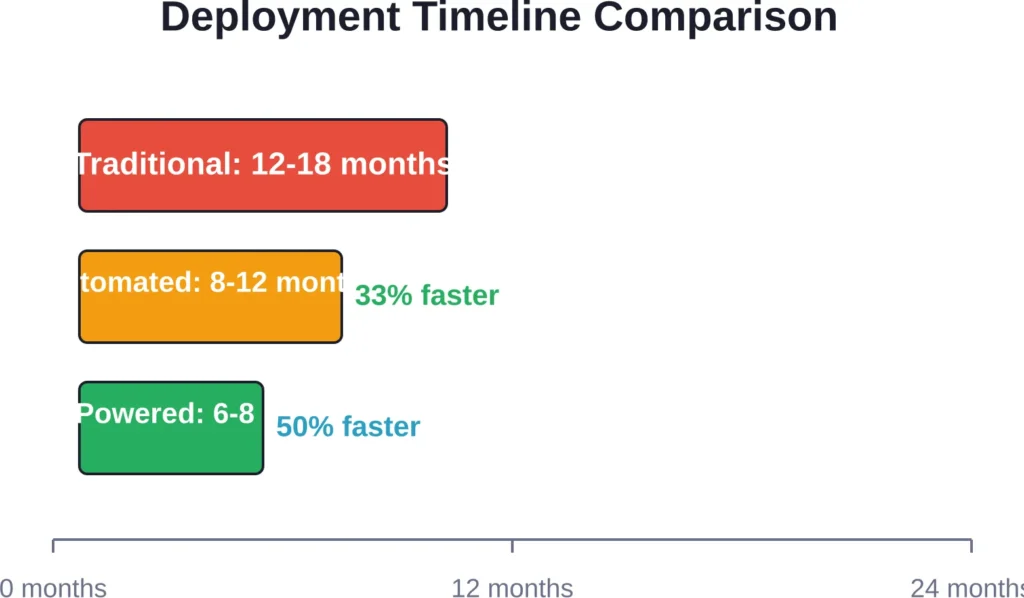
Timelines vary dramatically based on scope. Small deployments with a few applications might complete in 2-3 months. Large enterprise transformations with hundreds of applications typically span 12-18 months with traditional approaches, or 6-12 months with advanced automation platforms. Phased approaches deliver value incrementally rather than waiting for complete transformation.
This depends on your strategy. If you’ve standardized on AWS and don’t plan to use other platforms, an AWS specialist brings deep expertise. If you need workloads across multiple clouds or want to avoid vendor lock-in, multi-cloud partners provide broader perspective. Most large enterprises eventually adopt multi-cloud approaches, making generalist partners increasingly valuable.
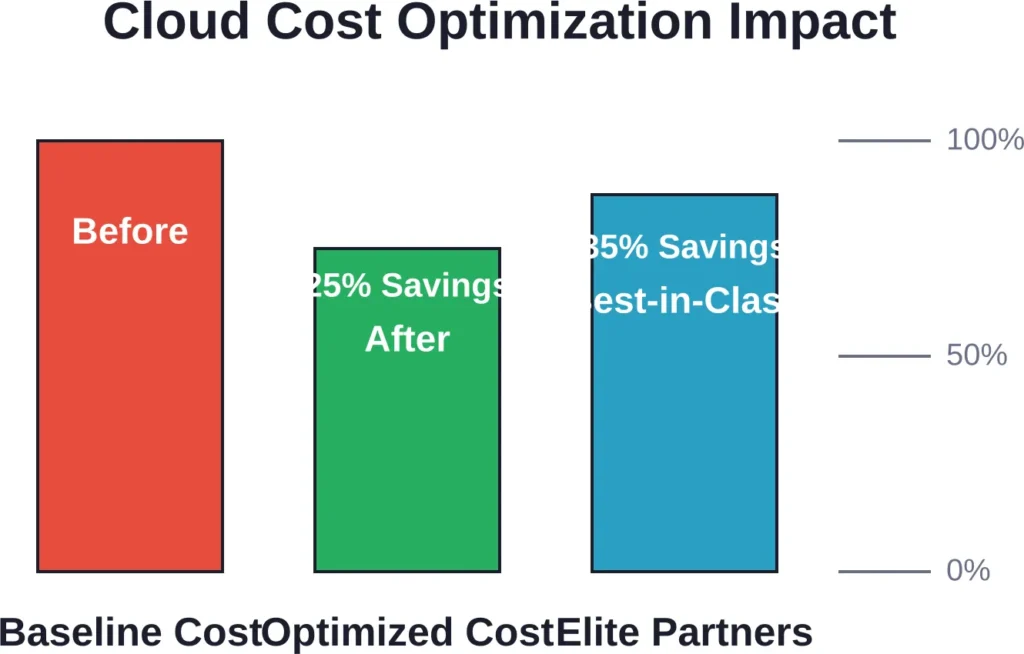
Costs vary based on scope, complexity, and partner selection. Professional services for deployment typically range from hundreds of thousands to several million dollars for large enterprises. However, ongoing cloud infrastructure costs often exceed deployment fees. Organizations typically achieve 25-35% cost reduction compared to on-premises over time, though initial migration requires investment.
Platform certifications validate technical knowledge. Look for AWS Partner Network tiers (Premier or Advanced), Microsoft partner status (Gold or Solutions Partner), and Google Cloud Partner Advantage. Specialized certifications like AWS Well-Architected Partner or Azure Expert MSP indicate additional validation. Industry certifications like HIPAA or PCI compliance matter for regulated sectors.
Not necessarily. Many deployment companies offer managed services for post-migration operations. Using the same partner who built your environment ensures continuity and institutional knowledge. However, some organizations prefer to separate implementation from operations, using specialist firms for each phase. Evaluate based on the partner’s managed services capabilities and your preferences.
The best partners build knowledge transfer into their methodology. This includes documentation, training sessions, shadowing opportunities where your team works alongside consultants, and gradual responsibility transfer. Explicitly discuss knowledge transfer expectations during partner selection and include specific deliverables in contracts—runbooks, architecture documentation, training completion, etc.
Making the Cloud Deployment Decision
Selecting a cloud deployment partner ranks among the most consequential technology decisions enterprises make. The right partner accelerates transformation, reduces risk, and builds capabilities that extend long after deployment completes.
The wrong partner leads to extended timelines, budget overruns, technical debt, and transformation initiatives that never deliver promised business value.
The 15 companies profiled here represent strong options, but the right choice depends on your specific context—industry requirements, technical complexity, timeline constraints, budget parameters, and strategic objectives.
Start with clarity about what you’re trying to achieve. Not just “move to the cloud,” but specific business outcomes. Reduce infrastructure costs by 30%. Enable data scientists to deploy models in hours instead of weeks. Achieve compliance with new regulatory requirements. Support global expansion with low-latency infrastructure.
Then evaluate partners against those objectives. Which firms have documented success with similar goals? Which methodologies align with your risk tolerance? Which cultural approaches match your organization?
The cloud deployment market will continue evolving. New capabilities emerge, platforms release new services, and best practices advance. Partner with firms that invest in their own capabilities, develop proprietary tools, and demonstrate thought leadership in emerging areas like AI infrastructure and sustainable computing.
Cloud transformation done right delivers measurable business value—faster innovation, reduced costs, improved customer experiences, and competitive advantages. The partner you choose largely determines whether your transformation achieves those outcomes or becomes another cautionary tale of digital initiatives that failed to deliver.
Choose carefully. Validate thoroughly. And prioritize partners who measure success by your business outcomes, not just technical milestones achieved.