

Quick Summary: Finding the right CMS development partner transforms how organizations deliver digital experiences. This comprehensive guide profiles 15 leading CMS development agencies across platforms including WordPress, Drupal, Adobe Experience Manager, and headless solutions, highlighting their technical specializations, client success stories, and unique approaches to content management implementation without discussing rates or pricing structures.
Selecting a CMS development partner ranks among the most consequential technology decisions organizations make. The platform powering digital experiences determines everything from time-to-market for new content to conversion rates, scalability, and long-term operational costs.
Yet the landscape has grown tremendously complex. WordPress.org powers approximately 43% of the web, but enterprise organizations increasingly evaluate headless architectures, composable systems, and specialized platforms like Adobe Experience Manager and CoreMedia. Meanwhile, agencies themselves have evolved—some specialize in rapid WordPress implementations, others architect multi-brand global ecosystems.
This guide profiles 15 CMS development agencies that consistently deliver exceptional results across different platform ecosystems and organizational requirements. Each brings distinct technical expertise, proven methodologies, and documented client success.
Understanding CMS Development Agency Specializations
CMS development agencies typically fall into several specialization categories. Some focus exclusively on one platform—WordPress specialists who know every nuance of that ecosystem, including its 50,000+ plugins and themes. Others position themselves as platform-agnostic, recommending and implementing whatever system best fits client requirements.
The distinction matters considerably. A WordPress-focused agency brings deep expertise in that specific ecosystem but may lack experience with enterprise DXP platforms. Conversely, agencies specializing in Adobe Experience Manager or Sitecore understand complex multi-site governance and personalization but might not be the right fit for straightforward content publishing needs.
Platform Expertise Considerations
Technical depth within a specific platform translates directly to implementation quality. Agencies that specialize develop proprietary frameworks, testing methodologies, and deployment processes that general web development firms cannot match.
Consider headless CMS implementations. Agencies experienced with Sanity, Contentful, or Strapi understand how to architect content models that serve multiple channels—websites, mobile apps, IoT devices. According to G2 Data, 85% of users highlighted its ability to scale for large organizations and expansive web presences, a capability that requires specialized implementation knowledge.
Top 15 CMS Development Companies for 2026
The following agencies represent excellence across different platform ecosystems and organizational scales. Each has demonstrated consistent delivery, technical innovation, and client satisfaction.
1. Oski
Oski specializes in enterprise web solutions with dedicated expertise in CMS implementations, particularly Umbraco and WordPress. The company delivers tailored content management systems that combine usability, scalability, and stability for complex digital experiences.
Their approach begins with deep business analysis and discovery to align technical architecture with organizational content workflows and goals. Oski configures CMS platforms to support real editorial needs rather than forcing default structures.
The team excels at building reliable CMS environments for websites, e-commerce, and large-scale enterprise deployments. Projects emphasize seamless frontend integration, performance optimization, and long-term maintainability.
Client work spans travel, logistics, e-commerce, education, fintech, and insurance industries. Notable strengths include custom CMS development, content personalization, and solutions that enhance digital operations while maintaining intuitive editorial interfaces.
Contact Information:
- Website: oski.site
- Phone: +48571282759
- Email: [email protected]
- Address: Kaupmehe tn 7, 10114 Tallinn, Estonia
- LinkedIn: www.linkedin.com/company/oski-solutions
2. Lengreo
Lengreo acts as a complete marketing and tech partner, delivering website development services that include custom CMS-powered platforms for business, e-commerce, and portfolio sites. Their implementations focus on driving measurable growth through optimized digital experiences.
The agency starts with discovery, business analysis, and research before moving into prototyping, design, and full implementation. This ensures every CMS solution aligns with client objectives and supports effective content management.
Lengreo combines website development with integrated SEO, content strategy, and lead generation capabilities. Their CMS projects incorporate strong technical foundations for search performance, conversion optimization, and ongoing support.
They work with software development companies, architecture firms, event tech providers, sports tech, and IT organizations. Key strengths include websites that generate qualified leads, improve conversion rates, and deliver clear ROI through integrated digital marketing layers.
Contact Information:
- Website: Lengreo.com
- Phone: +31 686 147 566
- Email: [email protected]
- Address: Vrijstraat 9 C/D, 5611 AT Eindhoven, Netherlands
- LinkedIn: Lengreo
- Twitter: @Lengreo
- Instagram: @lengreo
3. Gilzor

Gilzor builds custom digital products with strong capabilities in full-cycle web development and content-focused solutions. Their approach supports organizations needing scalable web platforms with robust content management and user experience at the core.
The company follows a structured process beginning with idea validation, business analysis, and UI/UX design before development and QA. This methodology produces web solutions that meet user needs while providing efficient editorial and content delivery capabilities.
Gilzor emphasizes secure, high-performance web applications with ongoing support and maintenance. Their solutions often include custom architectures that facilitate content management alongside business automation and user engagement features.
Projects serve startups, SMBs, product studios, and various industries including airlines and e-commerce. The team delivers functional, attractive web platforms that connect effectively with target audiences while supporting long-term growth and iteration.
Contact Information:
- Website: www.gilzor.com
- Email: [email protected]
- Address: Poland, Warsaw, Office 58, street Adama Mickiewicza 37, 01-625
- LinkedIn: www.linkedin.com/company/gilzor-softwaredevelopment
4. A-listware
A-listware provides software development and consulting with expertise in building enterprise applications, web portals, and content management solutions. Their dedicated teams deliver high-quality, secure digital platforms tailored to complex organizational requirements.
The company offers end-to-end services including custom software development, UX/UI design, and application maintenance. This comprehensive approach ensures CMS and web solutions integrate seamlessly with broader IT ecosystems and business processes.
A-listware supports team augmentation and dedicated development models, allowing clients to extend their capabilities with experienced engineers. Their implementations focus on scalability, performance, and maintainable codebases suitable for enterprise content environments.
They partner with enterprise organizations, small and medium businesses, and startups. Strengths include enterprise software, e-commerce platforms, web portals, and solutions that streamline content delivery alongside operational efficiency.
Contact Information:
- Website: a-listware.com
- Phone: +1 (888) 337 93 73
- Email: [email protected]
- Address: North Bergen, NJ 07047, USA
- LinkedIn: www.linkedin.com/company/a-listware
- Facebook: www.facebook.com/alistware
5. Mobian
Mobian builds dedicated engineering teams specializing in full-stack digital products, including web platforms and content-rich applications for demanding industries. Their delivery model ensures production-ready solutions with clean architecture and strong focus on scalability.
The agency operates through outsourcing and outstaffing models, providing end-to-end development from concept to post-launch support. This flexibility allows seamless integration of web and CMS components into existing systems or new builds.
Mobian emphasizes scalable architecture, legacy integration, and documented, maintainable code. Their solutions support complex content needs while incorporating modern technologies for enhanced user experiences and operational performance.
Client projects target IT, healthcare, fintech, and logistics sectors. Key strengths include full-stack delivery, AI-enhanced web solutions, and architectures designed for sustained growth without major future rebuilds.
Contact Information:
- Website: mobian.studio
- Phone: [email protected]
- Address: Harju maakond, Tallinn, Kesklinnalinnaosa, Masina tn 22, 10113
- LinkedIn: www.linkedin.com/company/mobian-studio
6. Spinutech
Spinutech operates as a full-service digital agency with strong CMS implementation capabilities across WordPress, Kentico, and Sitecore. Their geographic footprint in the American Midwest has built deep relationships with higher education institutions, healthcare organizations, and regional enterprises.
The agency takes an integrated approach, combining CMS development with content strategy, SEO, accessibility compliance, and digital marketing. This breadth means implementations consider discoverability and conversion from initial architecture decisions.
Spinutech emphasizes long-term client relationships. Many clients engage them not just for initial implementation but ongoing optimization, feature development, and strategic consulting. This continuity builds deep institutional knowledge that benefits iterative improvement.
Their WordPress implementations incorporate custom editorial tools, workflow automation, and performance optimization. For Kentico and Sitecore projects, the agency brings expertise in personalization, A/B testing, and marketing automation integration. Team structure includes strategists, UX designers, developers, and dedicated project managers.
7. FFW
FFW describes itself as a global digital agency with particular strength in open-source platforms. The agency works extensively with Drupal and WordPress but has increasingly focused on headless and composable architectures.
Their technical approach emphasizes flexibility and future-proofing. FFW frequently recommends decoupled architectures where content management separates from presentation layer. This pattern enables content reuse across multiple digital properties while providing development teams flexibility in frontend technology choices.
The agency maintains a significant presence in Europe and North America, with delivery teams distributed globally. This structure enables round-the-clock development on large projects while providing geographic diversity in perspective and approach.
FFW client work spans corporate enterprises, government agencies, and international nonprofits. Projects often involve complex requirements including multi-language content, region-specific personalization, and extensive integration with enterprise systems. The agency has documented expertise in content migration, API development, and performance optimization.
8. Metal Toad

Metal Toad focuses on complex web applications and digital experiences built on Drupal, Laravel, and various headless CMS platforms. The agency positions itself at the intersection of enterprise CMS and custom application development.
This technical positioning means Metal Toad excels when projects require significant custom functionality beyond standard CMS capability. They combine CMS platforms with custom-built features, creating solutions that provide editorial ease for content alongside sophisticated application logic.
The agency emphasizes agile methodology and transparent communication. Projects typically proceed in iterative sprints with frequent client review and feedback incorporation. This approach surfaces issues early and ensures solutions align with actual requirements rather than initial assumptions.
Metal Toad works primarily with mid-market and enterprise clients in technology, healthcare, and professional services sectors. Their portfolio demonstrates strength in user portals, content-driven applications, and systems requiring complex business rules. Technical expertise includes API architecture, third-party integrations, and cloud infrastructure.
9. Chromatic

Chromatic specializes in Craft CMS and WordPress implementations, with particular focus on design-forward projects requiring pixel-perfect execution. The agency emerged from the design community and maintains that aesthetic sensibility alongside technical expertise.
Craft CMS remains less widely adopted than WordPress or Drupal, but the platform has passionate advocates for its elegant content modeling and developer experience. Chromatic has become a leading Craft specialist, contributing to the platform ecosystem and training other developers.
Their project approach begins with design and content strategy. Chromatic invests significantly in understanding brand, audience, and content goals before technology implementation begins. This sequence ensures technical decisions serve creative and strategic objectives.
The agency works primarily with creative brands, agencies, and organizations where design quality proves critical to success. Projects emphasize custom editorial experiences, sophisticated content relationships, and smooth editorial workflow. Their team includes designers, content strategists, frontend developers, and backend engineers.
10. Zivtech
Zivtech operates as a Drupal specialist with particular expertise in the nonprofit, education, and government sectors. The agency has built a reputation for accessible, user-centered implementations that serve diverse audiences.
Their commitment to accessibility goes beyond WCAG compliance. Zivtech architects content models and editorial workflows that encourage content teams to create accessible content by default. This systemic approach proves more effective than post-launch remediation.
The agency emphasizes discovery and planning phases. Zivtech projects typically begin with stakeholder interviews, content inventories, and workflow documentation. This research foundation informs architecture decisions and ensures solutions address actual organizational needs.
Client work focuses on mission-driven organizations with complex content requirements and diverse audiences. Projects often involve content migration from legacy systems, custom workflow tools, and extensive user testing. The agency maintains expertise in Drupal multi-site architectures, complex permissions and editorial workflow, and integration with constituent relationship management systems.
11. Oshyn
Oshyn specializes in enterprise-grade digital experience platforms with particular depth in Adobe Experience Manager, Sitecore, and Optimizely implementations. The agency has built a reputation for complex multi-brand, multi-region deployments that require sophisticated content governance.
Their approach emphasizes digital strategy before technology selection. Oshyn typically begins engagements with discovery workshops that map content workflows, identify governance requirements, and assess integration needs. Only then do they recommend specific platform configurations.
The agency maintains partnerships with major enterprise CMS vendors, providing access to early releases, dedicated support channels, and platform roadmap visibility. For organizations committed to platforms like Adobe Experience Manager, this vendor relationship depth proves invaluable during complex implementations.
Client projects span financial services, healthcare, higher education, and retail. Notable strengths include omnichannel personalization, complex taxonomy and metadata architecture, and migration from legacy enterprise systems. Their team includes certified platform developers, UX specialists, and dedicated quality assurance engineers.
12. Bounteous

Bounteous positions itself as a digital experience consultancy rather than purely a development shop. This perspective shapes their CMS implementations—technology serves broader experience and business objectives rather than existing as an end itself.
The agency works across multiple platforms including Adobe Experience Cloud, Sitecore, Contentful, and Drupal. Their platform-agnostic stance means recommendations genuinely align with client requirements rather than agency capability constraints.
Bounteous brings particular strength in analytics integration and conversion optimization. CMS implementations include comprehensive tagging strategies, testing frameworks, and measurement plans from day one. This analytical foundation enables continuous optimization post-launch.
Their client roster includes major consumer brands, B2B enterprises, and nonprofit organizations. The agency has documented success with complex personalization strategies, content performance measurement, and progressive migration approaches that minimize business disruption.
13. Bluecadet
Bluecadet emerged from the cultural sector—museums, universities, and nonprofits—before expanding into corporate digital experience work. This heritage shapes their approach: deep content strategy expertise, accessibility commitment, and emphasis on storytelling through digital channels.
The agency primarily builds on WordPress, Drupal, and custom headless architectures. Their WordPress implementations go far beyond standard themes, developing custom editorial interfaces and workflow tools tailored to specific organizational needs.
Bluecadet excels at projects requiring sophisticated content modeling and editorial experience design. They invest heavily in understanding how content teams actually work, then configure CMS interfaces that support those workflows rather than forcing teams into platform defaults.
Their portfolio demonstrates particular strength in complex content types, media-rich experiences, and accessible design. Many projects involve custom React frontends connected to headless CMS backends, an architecture that provides editorial ease alongside technical flexibility.
14. Elevated Third
Elevated Third focuses exclusively on Drupal, making them one of the deepest specialists in that ecosystem. This single-platform focus has built extraordinary technical depth—the agency contributes actively to Drupal core and maintains several popular contributed modules.
Organizations selecting Drupal gain significant advantages working with Elevated Third. The agency understands not just how to build on Drupal but how to architect solutions that leverage platform strengths while mitigating known limitations.
Their methodology emphasizes discovery and planning. Elevated Third typically invests substantial time in requirements gathering, content modeling, and architecture design before development begins. This front-loaded approach prevents costly mid-project pivots.
Client work concentrates in higher education, government, and large nonprofits—sectors where Drupal’s flexibility, security, and cost model prove advantageous. The agency handles complex requirements including multi-site networks, complex permissions and workflow, and extensive third-party integrations.
15. WP Engine’s Enterprise Services

While WP Engine is primarily known as a managed WordPress hosting provider, their professional services team delivers enterprise WordPress implementations. This combined hosting and development capability provides unique advantages for WordPress-based projects.
The services team builds exclusively on WordPress but focuses on enterprise-scale deployments. Their implementations often involve multi-site networks, complex editorial workflows, headless WordPress architectures, and sophisticated performance optimization.
Because WP Engine controls the hosting infrastructure, they optimize the full stack—application architecture, caching strategy, CDN configuration, and server resources work in harmony. This integrated approach delivers performance that separated agency and hosting relationships struggle to match.
Enterprise Services works primarily with large corporations, media companies, and digital publishers. Projects typically involve high-traffic properties where performance and reliability prove critical. The team has deep expertise in WordPress VIP-level deployments, Gutenberg customization, and REST API implementations.
Evaluation Criteria for CMS Development Agencies
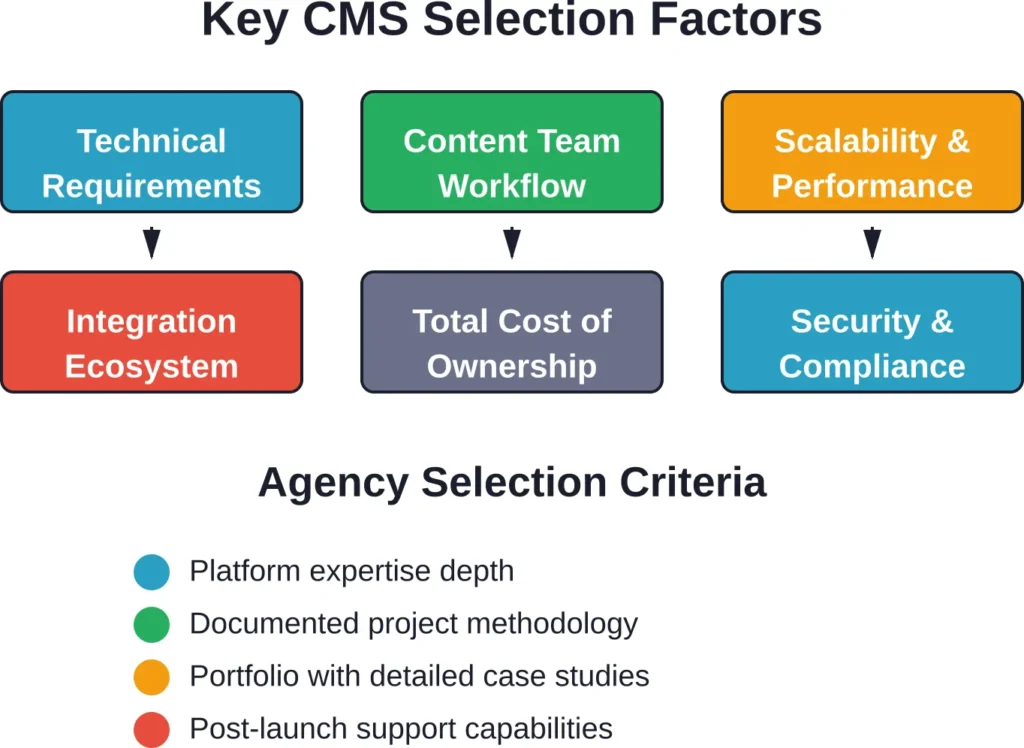
Choosing the right agency requires assessing multiple dimensions beyond platform expertise. Project methodology, communication practices, team structure, and post-launch support all impact outcomes.
Strong agencies demonstrate their process transparently. They explain discovery phases, how they gather requirements, their approach to architecture decisions, and quality assurance practices. Vague promises about “world-class development” mean little without concrete methodology.
Portfolio and Case Study Depth
Examine case studies critically. The best agencies document not just final outcomes but challenges encountered and solutions implemented. Look for specifics: How did they handle complex migration from a legacy platform? What performance optimizations did they implement? How do they approach multi-language content governance?
Generic portfolio pieces with beautiful screenshots but no technical detail suggest surface-level capability. Detailed case studies with architecture diagrams, performance metrics, and specific technical challenges overcome indicate genuine expertise.
Team Structure and Communication
Understanding who actually builds the project matters enormously. Some agencies staff projects entirely with senior developers. Others use a senior-led model where experienced architects guide junior implementers. Still others offshore significant portions of development.
None of these models is inherently superior, but transparency matters. Agencies should clearly explain team composition, who clients interact with, and how they ensure quality across experience levels.
Platform-Specific Considerations
Different CMS platforms present distinct advantages and challenges. Understanding these platform characteristics helps match organizational requirements to appropriate technology and specialist agencies.
WordPress Development Agencies
WordPress remains the most widely adopted CMS globally, powering approximately 43% of all websites. This massive market share means abundant agency expertise, extensive plugin ecosystems, and lower typical implementation costs compared to enterprise platforms.
But WordPress’s flexibility creates fragmentation. Implementations range from simple theme customizations to sophisticated custom applications. Agency capability varies enormously—some barely exceed freelancer sophistication while others architect enterprise-grade solutions.
Strong WordPress agencies move beyond themes and plugins. They develop custom post types, taxonomies, and administrative interfaces. They optimize performance through careful caching strategies and database optimization. They architect security layers that protect against common WordPress vulnerabilities.
The platform works well for content-focused websites, corporate sites, and editorial publishing. WordPress becomes more challenging for complex application logic, though the REST API and headless approaches expand possibilities considerably.
Drupal Development Specialists
Drupal serves organizations with complex content requirements, sophisticated workflows, and extensive customization needs. The platform provides powerful content modeling, granular permissions, and enterprise-grade security.
These capabilities come with steeper learning curves. Drupal requires more technical expertise for both implementation and ongoing content management. Organizations should expect longer development timelines and higher typical costs compared to WordPress.
The platform excels in higher education, government, and large corporations with complex governance requirements. Multi-site networks, complex content relationships, and sophisticated user permissions represent Drupal strengths.
Agencies specializing in Drupal typically demonstrate deep technical expertise. The platform rewards architectural planning and careful implementation but punishes shortcuts. Organizations benefit significantly from working with established Drupal specialists rather than generalist agencies.
Enterprise DXP Implementation Partners
Adobe Experience Manager, Sitecore, and similar enterprise digital experience platforms serve large organizations with substantial budgets and complex requirements. These systems provide sophisticated personalization, content governance, and omnichannel delivery.
Implementation requires significant investment—not just initial development but ongoing licensing, infrastructure, and specialized technical resources. Organizations typically need compelling business cases around personalization value, multi-brand management, or complex compliance requirements.
Agencies implementing enterprise DXPs usually maintain formal partnerships with platform vendors. These relationships provide technical support, training access, and platform roadmap visibility. For organizations committed to enterprise platforms, agency partnership status matters considerably.
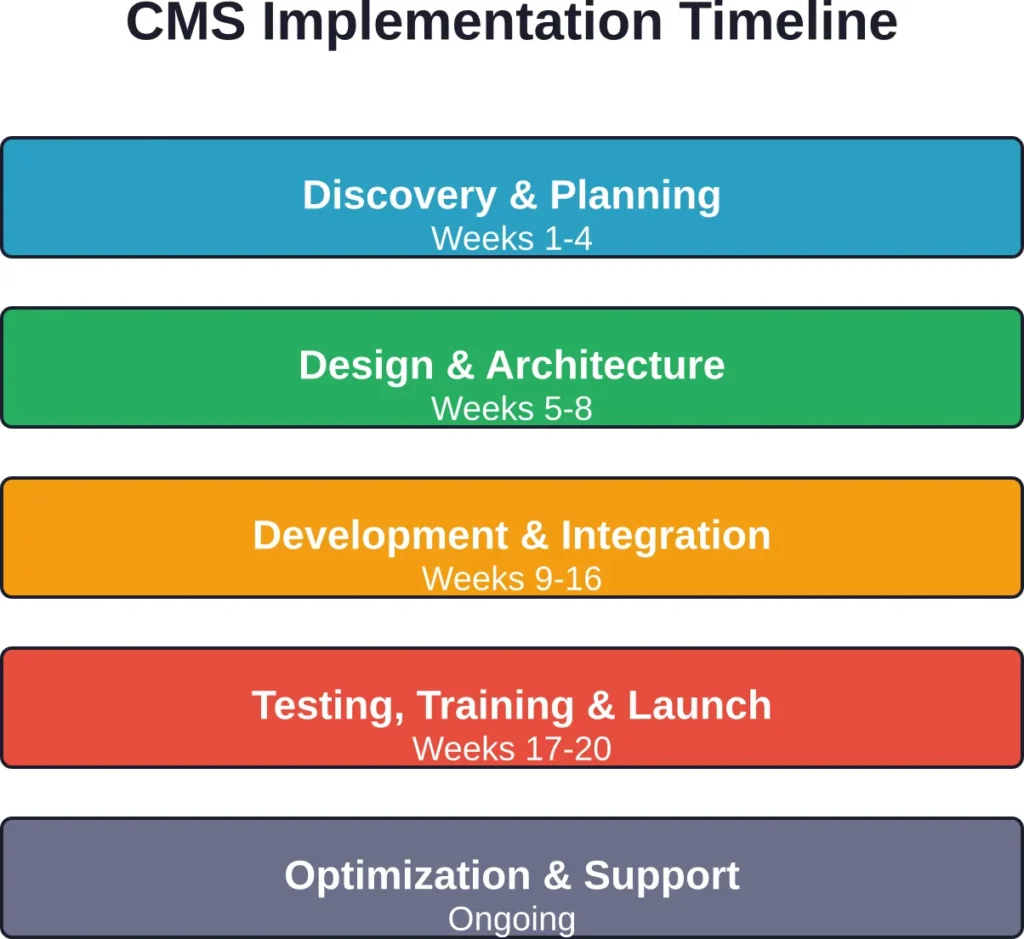
Projects typically span many months and require substantial organizational change management. Content operations, governance models, and technical capabilities all need development alongside platform implementation. Strong agencies provide this holistic support rather than purely technical delivery.
Headless CMS Specialists
Headless CMS architectures decouple content management from presentation, storing content as structured data accessible via APIs. This pattern enables content reuse across websites, mobile apps, digital signage, and emerging channels.
Platforms like Contentful, Sanity, Strapi, and Hygraph provide cloud-based content repositories with modern editorial interfaces. Developers then build custom frontends using frameworks like React, Next.js, or Vue consuming content through APIs.
This architecture provides tremendous flexibility but requires more sophisticated development capability. Organizations need frontend development expertise and API integration skills. Content modeling becomes more critical since structured content must serve multiple presentation contexts.
Agencies specializing in headless implementations typically bring strong JavaScript expertise and experience with modern frontend frameworks. They excel at content modeling, API architecture, and build processes. Projects work best when organizations value flexibility and plan to deliver content across multiple channels.
| Platform Type | Best For | Technical Complexity | Typical Agency Specialization |
|---|---|---|---|
| WordPress | Content-focused websites, corporate sites, blogs | Low to Medium | Broad—many agencies offer WordPress |
| Drupal | Complex content models, multi-site networks, government | Medium to High | Specialized—look for dedicated Drupal shops |
| Enterprise DXP | Large organizations, personalization, omnichannel | High | Highly specialized—vendor partnerships essential |
| Headless CMS | Multi-channel content, modern tech stacks, flexibility | Medium to High | Modern development shops with API expertise |
| E-commerce Platforms | Online retail, transaction-focused | Medium | Commerce specialists with payment integration expertise |
Critical Questions to Ask Potential CMS Partners
Vetting CMS development agencies requires moving beyond marketing claims to substantive technical and process discussions. The following questions surface real capability and cultural fit.
Technical Depth and Approach
Ask agencies to walk through their technical architecture process. How do they assess requirements and translate them into platform configurations? What discovery activities do they conduct? How do they approach performance optimization, security hardening, and accessibility compliance?
Strong agencies articulate clear methodologies. They explain how they gather requirements, document architecture decisions, and validate approaches before significant development investment. Vague responses about “best practices” without specific detail suggest limited depth.
Request information about their development standards, code review processes, and quality assurance practices. Professional agencies maintain documented standards and conduct systematic testing. Ask about their approach to version control, deployment pipelines, and infrastructure management.
Team Structure and Continuity
Understanding who actually delivers the project proves critical. Will senior architects who participate in sales continue through implementation? How do they structure project teams? What experience levels handle different aspects of development?
Agencies should clearly explain team composition and role definitions. Ask about their approach to knowledge transfer and documentation. How do they ensure continuity if team members change mid-project?
For agencies with distributed or offshore teams, understand communication practices. How do they coordinate across time zones? What synchronous and asynchronous communication tools and practices do they employ?
Post-Launch Support and Ongoing Partnership
CMS implementations require ongoing support—bug fixes, security updates, feature enhancements, and strategic evolution. How do agencies structure post-launch relationships?
Some agencies prefer project-based engagements, delivering implementations then transitioning to client teams. Others emphasize long-term partnerships with ongoing retainer relationships. Neither model proves universally superior, but alignment with organizational preferences matters.
Ask about their support response times, escalation procedures, and approach to emergency issues. How do they handle platform updates and security patches? What ongoing optimization do they typically provide?
Red Flags When Evaluating CMS Agencies
Certain agency characteristics suggest problems. Watch for these warning signs during evaluation processes.
Platform Agnosticism Without Depth
Agencies claiming equal expertise across every platform rarely deliver excellence in any. Deep platform knowledge requires focus and specialization. Be skeptical of agencies listing eight different CMSs as core capabilities.
True platform agnosticism—the ability to genuinely recommend the right platform for client needs—comes from thoughtful evaluation frameworks and honest capability assessment. Agencies should articulate why different platforms suit different requirements rather than positioning everything as equivalent.
Reluctance to Share Detailed Case Studies
Strong agencies proudly showcase their work with detailed case studies including challenges, solutions, and outcomes. Vague portfolio pieces with pretty screenshots but no technical detail suggest limited capability or problem-riddled projects.
Ask for case studies relevant to specific requirements. If evaluating a Drupal migration, request examples of similar migrations they’ve completed. Agencies with genuine relevant experience will enthusiastically share details.
Unclear Methodology or Process
Professional agencies articulate clear project methodologies. They explain discovery phases, how they translate requirements into technical architecture, their development and testing approach, and how they handle deployment and training.
Vague responses about “agile development” or “best practices” without specific detail indicate limited process maturity. Strong agencies welcome questions about methodology and explain their approach clearly.
Communication Problems During Sales Process
How agencies behave during sales foreshadows project experience. Slow responses, unclear communication, or reluctance to provide substantive information all suggest future problems.
Pay attention to whether agencies listen carefully and ask thoughtful questions about requirements, or whether they immediately pitch predetermined solutions. The best partners invest time understanding needs before proposing approaches.
The CMS Selection Process
Platform and agency selection work best as integrated decisions rather than sequential ones. The right platform depends partly on available agency expertise and partnership quality.
Requirements Documentation
Begin with thorough requirements documentation. Catalog content types, user roles and permissions, workflow requirements, integration needs, and performance expectations. Document non-functional requirements including accessibility standards, security requirements, and compliance needs.
Strong requirements documentation enables meaningful agency conversations. Agencies can assess fit, identify potential challenges, and propose appropriate solutions when they understand actual needs rather than generic “we need a website” requests.
Platform Evaluation
Research platform options that potentially fit documented requirements. Consider both technical capability and ecosystem factors like community size, plugin availability, and agency expertise depth.
Platform evaluation should consider total cost of ownership beyond initial implementation. Factor in licensing costs (for commercial platforms), hosting requirements, maintenance needs, and typical enhancement costs. Open-source platforms eliminate licensing fees but may require more ongoing technical investment.
Agency RFP and Evaluation
Develop requests for proposal that communicate requirements clearly while allowing agencies to propose approaches. The best RFPs explain what needs to be accomplished while remaining flexible about how.
Evaluate responses on both technical merit and cultural fit. Review proposed team composition, project timelines, and communication approaches alongside technical architecture. Reference checks prove valuable—speak with agencies’ previous clients about their actual experience.
Pilot Projects and Proofs of Concept
For large, complex implementations, consider pilot projects or proofs of concept before full commitment. These smaller engagements test agency capability, validate technical approach, and build confidence before significant investment.
Pilot projects work particularly well when evaluating new platforms or unfamiliar agencies. The relatively small investment surfaces potential issues while relationships and processes remain easy to adjust.
Making the Final Decision
CMS and agency selection ultimately requires balancing multiple considerations. Technical capability matters enormously, but so do cultural fit, communication style, and long-term partnership potential.
Trust matters more than many organizations initially recognize. CMS implementations involve significant organizational change, technical complexity, and strategic importance. Working with partners who communicate transparently, acknowledge challenges honestly, and prioritize client success over short-term revenue proves invaluable.
The best partnerships develop when both sides invest in mutual understanding. Agencies should deeply understand client requirements, constraints, and organizational culture. Clients should appreciate agency expertise, respect their recommendations, and engage collaboratively in problem-solving.
Consider not just initial implementation but long-term evolution. Digital experiences require continuous improvement—content optimization, feature enhancement, performance tuning, and platform updates. Agencies positioned to support ongoing evolution provide substantially more value than those focused purely on initial delivery.
Frequently Asked Questions
Platform-specific expertise ranks as the highest priority. Agencies with deep specialization in relevant platforms deliver superior outcomes compared to generalists. Beyond technical capability, evaluate project methodology, team structure, and communication practices. Review detailed case studies demonstrating relevant experience, and speak with previous clients about their actual project experience. Cultural fit matters—long-term partnerships with agencies who communicate transparently and prioritize client success deliver substantially better results than purely transactional relationships.
WordPress agencies typically emphasize faster timelines and more accessible content management given the platform’s lower learning curve. Strong WordPress specialists move beyond theme customization to develop custom editorial interfaces and sophisticated architectures. Drupal agencies invest more heavily in upfront planning and content modeling given the platform’s complexity. They excel with complex governance requirements, sophisticated workflows, and extensive customization needs. Drupal implementations generally require longer timelines but provide more flexibility for complex requirements than standard WordPress approaches.
Headless architectures make sense when content needs to serve multiple channels—websites, mobile applications, digital signage, or emerging platforms. Organizations planning significant frontend flexibility or frequent design changes benefit from decoupled architectures. The approach requires more sophisticated development capability than traditional CMS implementations and works best when teams include strong JavaScript and API expertise. According to G2 Data, 85% of users highlighted its ability to scale for large organizations and expansive web presences, demonstrating headless platform strengths for multi-channel requirements.
Enterprise digital experience platforms like Adobe Experience Manager and Sitecore provide sophisticated personalization, omnichannel content delivery, and complex governance capabilities. Implementations require substantially larger investments in licensing, infrastructure, and ongoing specialized resources. Projects typically span many months and involve significant organizational change management beyond technical development. Agencies implementing enterprise platforms usually maintain formal vendor partnerships providing technical support and platform expertise. These implementations make sense for large organizations with compelling business cases around personalization value or multi-brand content governance.
Request detailed technical discussions about architecture approach, development standards, and quality assurance practices. Strong agencies articulate clear methodologies for requirements gathering, platform configuration decisions, and validation processes. Ask them to walk through relevant case studies including technical challenges and solutions implemented. Review their code standards, version control practices, and deployment approaches. Request information about team composition and experience levels. Professional agencies welcome these technical conversations and provide substantive detail rather than generic marketing claims.
Post-launch relationships vary by agency and client preference. Minimum expectations include bug fix support, security patch application, and platform updates. Many agencies offer ongoing optimization services including performance tuning, feature enhancements, and strategic consulting. Establish clear support response times, escalation procedures, and emergency issue protocols. Organizations benefit from agencies positioned as long-term partners who understand institutional context and content strategy rather than purely transactional support relationships. Discuss post-launch expectations explicitly during agency selection to ensure alignment.
For enterprise platforms like Adobe Experience Manager, Sitecore, or commercial headless systems, agency vendor partnerships provide significant advantages. Partners gain access to dedicated technical support, training resources, and platform roadmap visibility. They often participate in beta programs for new features and maintain direct vendor relationships for complex issue resolution. These benefits translate directly to implementation quality and problem-solving capability. For open-source platforms like WordPress and Drupal, formal partnerships matter less than community contributions and demonstrated expertise through published code and community participation.
Conclusion
Selecting the right CMS development agency ranks among the most impactful decisions organizations make for their digital presence. The agency partnership shapes not just initial implementation quality but long-term capability to evolve digital experiences, optimize content performance, and adapt to changing requirements.
The 15 agencies profiled here represent excellence across different platform ecosystems and organizational contexts. Some specialize deeply in single platforms like Drupal or WordPress. Others bring breadth across multiple enterprise systems. Still others focus on modern headless and composable architectures.
No single agency proves universally optimal. The right choice depends on platform decisions, technical requirements, organizational culture, and long-term digital strategy. Organizations benefit most from thorough requirements documentation, careful platform evaluation, and substantive technical discussions with potential partners.
Invest time in agency selection. Review detailed case studies, speak with previous clients, and evaluate both technical capability and cultural fit. The best partnerships develop when both sides commit to transparent communication, collaborative problem-solving, and mutual long-term success.
Ready to begin the CMS agency selection process? Start by documenting current challenges, future requirements, and strategic objectives. Research platforms that potentially fit those needs, then engage agencies with proven expertise in relevant technologies. The investment in thoughtful selection pays dividends through successful implementations and sustainable digital experiences.