

Quick Summary: Amazon FBA sellers need a core toolkit covering product research, keyword optimization, inventory management, listing optimization, and profit analytics. While dozens of tools exist, most successful sellers rely on 5-8 essential platforms that handle product discovery, pricing intelligence, competitor tracking, and operational efficiency. The right combination depends on business size, niche, and growth stage.
Running an Amazon FBA business without the right tools is like driving cross-country with a paper map. Sure, it’s possible. But why would you?
The Amazon marketplace generates billions in seller revenue annually, and the sellers who consistently win aren’t necessarily smarter or more experienced. They’re better equipped. They use software that reveals opportunities competitors miss, automates tedious work, and flags problems before they become expensive mistakes.
The challenge? Hundreds of Amazon seller tools compete for attention, each claiming to be essential. Some cost hundreds monthly. Others promise features they can’t deliver. And many overlap so much that paying for three tools means paying twice for the same functionality.
This guide cuts through the noise. It identifies the tools that actually matter, explains what each one does, and helps build a toolkit that fits real business needs rather than inflated marketing promises.
Why Amazon Sellers Need Specialized Tools
Amazon Seller Central provides basic functionality. Listing products, processing orders, viewing sales reports—the essentials work without third-party software. So why do successful sellers consistently invest in additional tools?
The platform’s native features weren’t built for competitive intelligence. Seller Central won’t reveal which products in a niche generate the most revenue, what keywords competitors rank for, or how demand fluctuates seasonally. It shows what happened in your account, not what’s happening in the marketplace.
That information gap creates opportunity cost. Without product research tools, sellers guess at viable products instead of validating demand with data. Without keyword research, listings target phrases nobody searches. Without competitor tracking, pricing strategies operate blind.
Academic research from Florida Institute of Technology (2024) analyzed Amazon fulfillment methods and found Jungle Scout emerged as the preferred product acquisition tool, highlighting the value of data-driven product selection and inventory management approaches than those relying solely on platform-provided tools.
Beyond research, operational tools prevent expensive mistakes. Inventory management software forecasts stock needs and prevents long-term storage fees. Repricing tools adjust automatically instead of requiring manual price checks. Profit dashboards account for all fees, showing true margins rather than surface-level revenue.
The math works out quickly. A product research tool might cost $99 monthly, but finding one winning product can generate thousands in profit. A repricing tool subscription pays for itself if it prevents a single stockout during peak season.
Tools for Amazon Advertising (PPC)
Amazon’s advertising platform drives discovery for new products and maintains visibility for established ones. But PPC management demands constant attention. Manual campaign management works for one product with three campaigns. It collapses under dozens of products with hundreds of campaigns.
Advertising tools automate bid management, campaign creation, keyword harvesting, and negative keyword optimization. They adjust bids based on performance data—raising bids on converting keywords, lowering them on expensive non-converters, and pausing wasteful spend automatically.
These tools excel at scale. Managing 10 campaigns manually takes hours weekly. Managing 100 campaigns manually becomes a full-time job. Advertising software handles hundreds of campaigns simultaneously, applying consistent optimization logic across the entire portfolio.
They also unlock capabilities manual management can’t match. Dayparting (adjusting bids by hour) optimizes for conversion patterns. Dynamic bidding (different bids for top-of-search vs. product pages) maximizes efficiency by placement. Portfolio-level budget optimization shifts spend toward better-performing campaigns automatically.
WisePPC

WisePPC is a powerful Amazon PPC management platform built specifically for serious FBA sellers. It delivers deep advertising analytics, bulk actions for managing thousands of campaigns at once, and long-term historical data storage (far beyond Amazon’s 60–90 day limit). As an official Amazon Ads Verified Partner, WisePPC excels with advanced filtering, placement-level performance insights, multi-metric visualization, and efficient workflow tools. It is especially strong for mid-to-large sellers who need precise control and scalability in their Amazon advertising.
Contact Information:
- Website: wiseppc.com
- Facebook: www.facebook.com/people/Wise-PPC/61573154427547
- LinkedIn: www.linkedin.com/company/wiseppc
- Instagram: www.instagram.com/wiseppc
Helium 10 Adtomic

Helium 10’s Adtomic is a comprehensive PPC management solution integrated directly into the Helium 10 ecosystem. It provides a unified dashboard where sellers can manage all advertising campaigns in one place. The tool uses advanced algorithmic bid strategies that automatically adjust bids based on your target ACoS, product profit margins, and real-time competitive dynamics. In addition, Adtomic offers smart recommendations for improving campaign structure, keyword expansion opportunities, and automated rules to optimize performance across your entire portfolio.
Product Research Tools: Finding What to Sell
Product research determines everything downstream. Pick the wrong product and no amount of optimization, advertising, or operational excellence compensates. Pick the right product and success follows naturally.
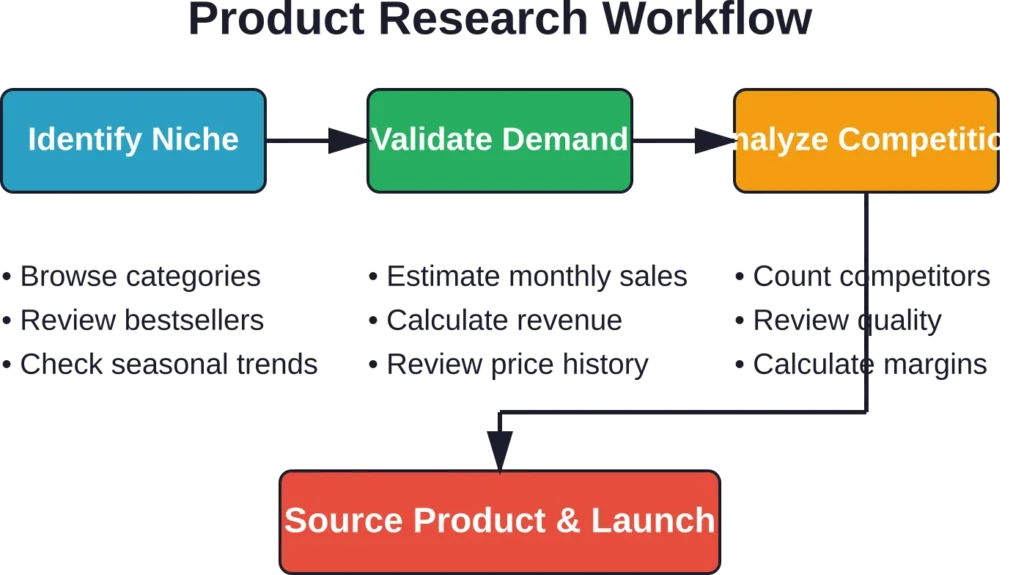
Product research tools analyze Amazon’s catalog to surface opportunities—items with strong demand, manageable competition, and healthy profit margins. They estimate monthly sales volume, track pricing trends, and calculate metrics like revenue and review velocity.

Jungle Scout dominates this category. The platform offers a Chrome extension that overlays sales estimates, revenue projections, and competition metrics directly on Amazon search results. The database function filters Amazon’s entire catalog by criteria like price range, sales volume, review count, and seller type.
According to Empire Flippers’ analysis, Jungle Scout maintains a team of data scientists and offers customer support 20 hours a day, seven days a week, plus extensive free educational resources.
The Chrome extension works like this: search Amazon for “yoga mat” and activate the extension. It displays estimated monthly sales for each result, total market size for the keyword, average price, review counts, and seller types (Amazon vs. third-party). This snapshot reveals whether a niche is worth exploring in under 30 seconds.
The database lets sellers work backward from criteria. Set filters for products selling 300-500 units monthly, priced $25-$45, with fewer than 100 reviews on the top listing. Jungle Scout returns matching opportunities with estimated revenue, competition levels, and historical trends.

Helium 10’s Black Box and Xray offer similar functionality with different interface philosophies. Black Box emphasizes filtering speed, while Xray integrates more deeply with Helium 10’s keyword and listing optimization tools.
Tools in this category typically range from $0-300 monthly depending on features and data limits. Many offer free trials or limited free tiers—enough to validate a few product ideas before committing to subscription costs.
Keyword Research: Getting Found by Buyers
Product research identifies what to sell. Keyword research determines whether buyers will find it.
Amazon functions as a search engine first, marketplace second. Shoppers type phrases like “stainless steel water bottle” or “yoga mat extra thick” into the search bar, and Amazon’s algorithm returns relevant listings. Products that match searched keywords rank. Products that don’t stay buried.
Keyword research tools reveal which phrases shoppers actually use, how often they search them, and how competitive each keyword is. This data informs listing titles, bullet points, descriptions, and backend search terms.
Helium 10’s Cerebro and Magnet handle reverse ASIN lookups and keyword discovery respectively. Cerebro shows all keywords a competitor’s product ranks for, along with search volume and ranking position. Magnet generates keyword ideas based on seed phrases, showing monthly search volume, competition, and suggested bid prices for advertising.
The workflow: Find a successful competitor product, plug its ASIN into Cerebro, and extract the 200+ keywords it ranks for. Filter by search volume (prioritize 500+ monthly searches) and competition (target phrases where top results have fewer than 150 reviews). Export this list and incorporate high-value keywords into listing copy.

SellerSprite offers similar functionality with particularly strong international marketplace support. It tracks keyword trends over time, showing whether search volume grows, declines, or fluctuates seasonally.
Smart keyword research accounts for buyer intent. “Yoga mat” attracts browsers. “Yoga mat extra thick non-slip” attracts buyers who know exactly what they want. Tools help identify these high-intent long-tail keywords that convert better despite lower search volume.
Listing Optimization: Converting Visitors to Buyers
Traffic without conversion wastes opportunity. Listing optimization tools help create product pages that turn visitors into customers.
These tools analyze listing elements—titles, images, bullet points, descriptions—and suggest improvements based on conversion data. Some use AI to grade listing quality. Others A/B test variations to identify what performs best.
Helium 10’s Listing Analyzer scores listings on multiple dimensions: keyword optimization, image quality, content completeness, and competitive positioning. It identifies missing high-value keywords, flags policy violations that risk suppression, and suggests title improvements.
The tool also performs competitive analysis, comparing a listing against category leaders to identify gaps. If the top three competitors all mention “BPA-free” prominently and your listing buries it in the description, the analyzer flags this as an optimization opportunity.

Amazon’s native A/B testing (Manage Your Experiments) deserves mention here. It’s free and built into Seller Central. Sellers can test different main images, titles, or A+ content variations, and Amazon tracks which version generates more sales. Results reach statistical significance in weeks rather than months.
Listing optimization isn’t one-and-done. Seasonal trends shift buyer priorities. Competitors launch better products. Reviews reveal customer concerns worth addressing in listing copy. Regular optimization cycles keep listings competitive.
Price Tracking and Repricing Tools
Amazon’s Buy Box algorithm considers price heavily. Sellers consistently winning the Buy Box capture disproportionate sales. Those who lose it watch revenue evaporate even when stock remains available.
Manual repricing doesn’t scale. Checking competitor prices daily across dozens of SKUs, calculating optimal responses, and updating prices individually consumes hours. Meanwhile, competitors using repricing software adjust automatically.

Keepa tracks historical pricing for every Amazon product. It charts price fluctuations over months or years, showing seasonal patterns, competitor behavior, and demand signals. The data helps inform initial pricing strategy and restocking decisions.
Keepa’s browser extension displays price history graphs directly on Amazon product pages. Considering sourcing a product currently priced at $28? The Keepa chart shows it typically sells for $35 but drops to $22 during Q4 holiday competition. That context prevents overpaying suppliers or launching at uncompetitive price points.
Repricing tools take this further by automating price adjustments based on competition and rules. Set a minimum profitable price, maximum competitive price, and desired margin, and the software adjusts automatically to market conditions.
These tools prevent the race-to-bottom problem where sellers continually undercut each other into unprofitability. Smart repricing rules maintain margins while staying competitive—perhaps matching the lowest FBA price rather than the absolute lowest (which might be a poor-quality FBM offer).
Inventory Management and Forecasting
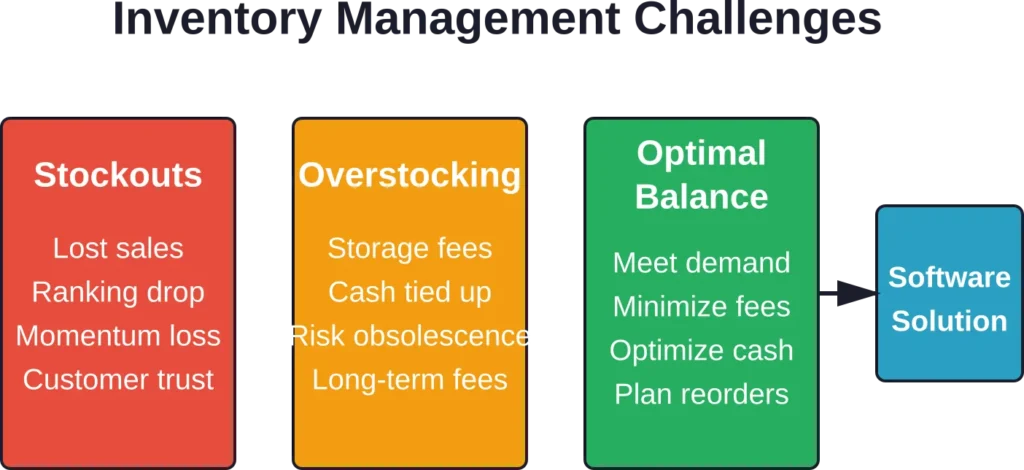
Stockouts kill momentum. Amazon’s algorithm penalizes out-of-stock listings with lower search rankings that persist even after inventory replenishes. Long-term storage fees punish overstocking. Getting inventory levels right matters enormously.
Basic inventory management lives in Seller Central. Advanced inventory management requires dedicated tools that forecast demand, calculate reorder points, and track inventory across multiple warehouses or channels.
These tools factor in lead times, seasonal demand patterns, promotional spikes, and growth trends. They alert sellers when reorder points approach and calculate optimal order quantities that balance storage costs against stockout risk.
For sellers managing international marketplaces, inventory tools track stock levels across regions and recommend allocation strategies. Maybe European inventory runs low while US stock sits excess. Cross-border inventory optimization prevents regional stockouts without air-freighting emergency shipments.
The tools also track aged inventory approaching long-term storage fee dates. Amazon charges substantial fees for inventory stored beyond 365 days. Alerts provide time to liquidate slow-moving stock through promotions before fees hit.
Profit Analytics: Understanding True Margins
Revenue looks impressive until fees get subtracted. Amazon charges referral fees, FBA fulfillment fees, storage fees, advertising costs, and various other expenses that erode margins quickly. Sellers who track revenue instead of profit make poor decisions.
Profit analytics tools connect to Seller Central and calculate true profitability by accounting for all Amazon fees, supplier costs, shipping expenses, and advertising spend. They show which products actually generate profit, which break even, and which lose money despite appearing successful.
The tools typically import order data automatically and categorize expenses. Product costs get assigned manually (the tool doesn’t know what you paid suppliers), but Amazon fees populate automatically from transaction records.
This granular visibility reveals surprising insights. A product generating $10,000 monthly revenue might net $3,000 profit while another with $5,000 revenue nets $2,500. Without profit tracking, sellers double down on the first product because it has higher revenue, even though the second product delivers better ROI.
Analytics tools also track metrics over time, showing whether margins expand or compress. Rising advertising costs might slowly eat into profitability. Supplier price increases might make a product unprofitable. Weight-based fulfillment fee increases might suddenly affect margins. These trends become visible in analytics dashboards long before they become crises.
Building Your Essential Toolkit
Here’s the uncomfortable truth: no single tool does everything well. Each category requires at least one dedicated solution. But sellers don’t need a dozen subscriptions either.
A minimal effective toolkit includes:
- Product research: Jungle Scout or Helium 10’s Black Box
- Keyword research: Helium 10’s Cerebro/Magnet or SellerSprite
- Price tracking: Keepa
- Profit analytics: Dedicated profit tool or comprehensive spreadsheet
- Advertising management: Helium 10’s Adtomic or standalone PPC software
This covers the core functions. Inventory management, repricing, and listing optimization tools add value but aren’t strictly essential when starting out. Manual processes work temporarily for these functions. They don’t work for product research (too much data) or keyword research (can’t see competitor keywords manually).
Many sellers start with Helium 10’s basic plan because it bundles product research, keyword research, listing optimization, and basic advertising tools. That covers 70% of needs in one subscription. Add Keepa for price tracking and a profit calculator, and the toolkit handles most scenarios.
As businesses scale, specialization makes sense. Replace the all-in-one tool with best-in-class point solutions for each function. But in the beginning, consolidation and simplicity beat optimization.
| Tool Category | Primary Function | When to Prioritize |
|---|---|---|
| Product Research | Identify profitable products to source | Before first product launch |
| Keyword Research | Discover high-value search terms | During listing creation |
| Price Tracking | Monitor competitor pricing and trends | Before sourcing inventory |
| Listing Optimization | Improve conversion rates | After initial sales data |
| Inventory Management | Forecast demand and prevent stockouts | After second reorder |
| Profit Analytics | Track true margins after all fees | After first month of sales |
| Advertising Tools | Automate PPC bid management | When managing 3+ campaigns |
Cost Considerations and ROI
Amazon seller tools range from free to several hundred dollars monthly. According to Helium 10, Amazon tools can range anywhere from $0-300 depending on the functionality and whether sellers want a full suite or independent features.
That range creates budget anxiety. How much should a new seller spend on tools before generating revenue?
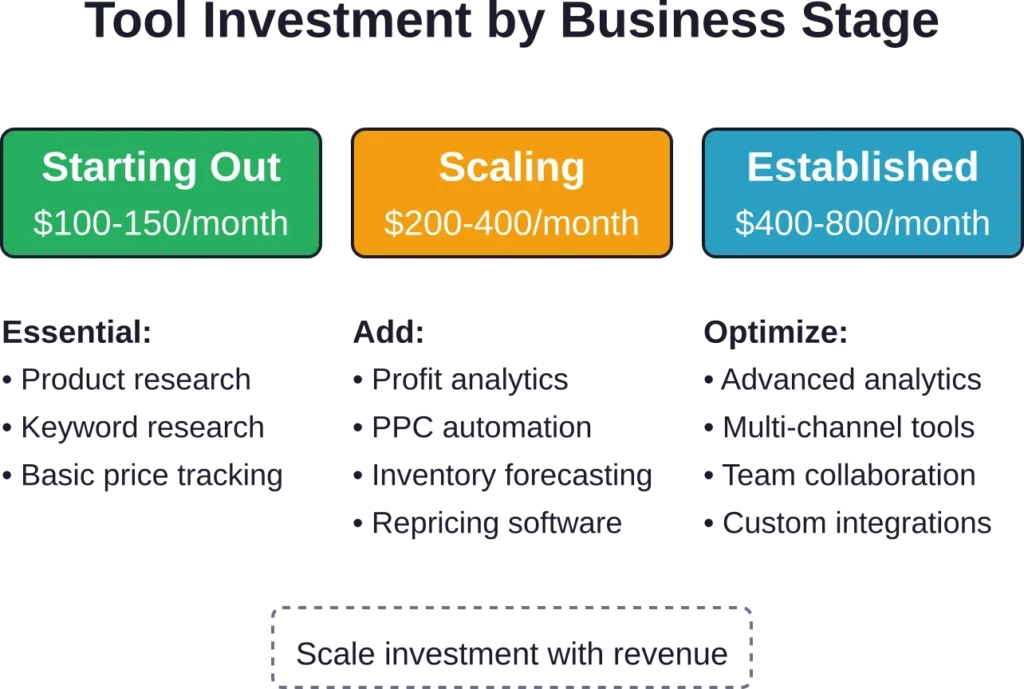
The answer depends on risk tolerance, but a reasonable starting budget sits around $100-150 monthly. That covers Jungle Scout’s basic plan or Helium 10’s entry-level subscription, plus Keepa’s premium features. These tools pay for themselves with one successful product launch.
The ROI calculation matters more than the absolute cost. A product research tool costing $99 monthly generates positive ROI if it helps identify even one product that wouldn’t have been found through manual research. That product might generate $500 monthly profit. The tool pays for itself 5x over.
Conversely, cheap tools that provide inaccurate data cost more than they save. Sales estimates off by 50% lead to inventory disasters. Keyword tools missing high-value search terms leave money on the table. The subscription might be cheaper, but the opportunity cost is expensive.
Free tools deserve mention. Keepa offers basic price tracking free. Amazon provides native keyword data through search term reports. Google Sheets handles profit calculations. These work for validating concepts before investing in paid tools. They don’t scale, but they shouldn’t—sellers should invest in tools after validating product-market fit, not before.
Common Mistakes When Choosing Tools
The first mistake? Buying tools before understanding needs. Sellers subscribe to comprehensive platforms, use 20% of features, and pay for 80% they never touch. Better to identify specific pain points first, then find tools that address them.
The second mistake? Tool hoarding. Subscribing to five tools that all do keyword research doesn’t provide 5x better keywords. It provides 5x subscription costs and decision paralysis about which data to trust.
The third mistake? Chasing features instead of outcomes. A tool with 47 features sounds impressive. But if three features solve actual problems and 44 collect dust, a simpler tool with those three features works better and costs less.
The fourth mistake? Ignoring learning curves. Complex tools require time investment. That’s fine if the functionality justifies it. But simple tools that solve problems immediately deliver faster ROI than feature-rich platforms requiring weeks of tutorials to understand.
The fifth mistake? Forgetting about integrations. Tools that don’t talk to each other create manual data transfer work. Export from one tool, reformat data, import to another tool, repeat daily. Integration matters more than individual tool quality when building a toolkit.
Staying Compliant: Legal and Regulatory Tools
Amazon FBA sellers must navigate various legal requirements depending on their business structure, sales volume, and product categories. The INFORM Consumers Act, effective since June 2023, requires online marketplaces to collect and verify information from high-volume third party sellers.
According to the Federal Trade Commission, the INFORM Consumers Act defines a ‘high-volume third party seller’ with specific thresholds (the law provides specific numerical criteria for this classification).
Sellers meeting these thresholds must provide bank account information, contact details, and tax identification to the marketplace. Amazon handles this collection automatically for Seller Central accounts, but sellers should understand their obligations.
Beyond federal requirements, state and local business licenses, sales tax collection, and product-specific regulations vary widely. Tools that track regulatory requirements and flag compliance issues prevent expensive legal problems.
Sales tax management deserves particular attention. Sellers with inventory stored in multiple Amazon warehouses potentially trigger sales tax nexus in multiple states. Tax calculation software automates collection and remittance rather than requiring manual tracking across jurisdictions.
Free vs. Paid Tools: What Actually Works
Free tools work until they don’t. Keepa’s free tier provides price history graphs sufficient for casual research. But the premium tier adds features that become essential at scale: API access, detailed statistics, and historical data beyond basic price tracking.
Amazon’s native tools deserve credit for capability. Seller Central provides extensive reporting, A/B testing, inventory management, and basic analytics at no additional cost. These work well for sellers willing to invest time in manual analysis.
The paid tool decision comes down to time vs. money tradeoffs. Can a seller manually research 100 product opportunities, estimate demand from review counts and bestseller ranks, and calculate competition levels? Technically yes. Does it make sense to spend 20 hours doing what a tool does in 20 minutes? Usually not.
Free tools make sense for validation. Test product ideas with free resources, confirm the concept works, then invest in paid tools that accelerate growth. Spending $300 monthly on tools before validating market demand inverts the risk equation unnecessarily.
Frequently Asked Questions
Starting sellers need product research software to identify viable products, keyword research tools to optimize listings, and price tracking to understand market dynamics. A basic toolkit costs $100-150 monthly and typically centers on an all-in-one platform like Jungle Scout or Helium 10’s entry-level plan, supplemented with Keepa for price history. Profit tracking can start with spreadsheets before investing in dedicated software. Inventory management and repricing tools become important after establishing initial sales momentum.
Tools generate ROI when they either increase revenue or decrease costs by more than the subscription price. A product research tool costing $99 monthly pays for itself if it helps identify one winning product generating $500+ monthly profit. Keyword tools that improve conversion rates by 10% typically return multiples of their cost. The calculation depends on business size—the same tool delivers different ROI at $5,000 monthly revenue vs. $50,000. Generally tools become cost-effective once sellers commit to FBA as a serious business rather than a side experiment.
Success without paid tools is possible but significantly harder and slower. Amazon provides free data through Seller Central, and manual research using bestseller ranks, review counts, and search results can identify opportunities. But this approach requires substantially more time investment and provides less reliable data than dedicated tools. Sellers who succeed without tools typically either bring deep marketplace expertise or accept slower growth while learning through trial and error. For most sellers, tools accelerate the learning curve and improve decision quality enough to justify their cost.
Both platforms offer comprehensive functionality with different strengths. Jungle Scout emphasizes product research accuracy and maintains a reputation for precise sales estimates backed by extensive data science resources. Helium 10 offers broader feature coverage including listing optimization, PPC management, and operational tools beyond product research. Jungle Scout typically fits sellers focused primarily on product research and launch. Helium 10 suits sellers wanting an all-in-one platform that handles most FBA functions. Both offer free trials—testing each with actual product research tasks reveals which interface and workflow fits individual preferences better than feature comparisons.
Most sellers need 3-5 tools covering core functions: product research, keyword research, profit analytics, and either inventory management or advertising automation depending on business priorities. Starting sellers can consolidate needs into 1-2 platforms—an all-in-one tool like Helium 10 plus Keepa for price tracking covers essential bases. As businesses scale past $10,000 monthly revenue, specialization makes sense. Replace general-purpose tools with best-in-class point solutions for each function. The goal isn’t tool accumulation but ensuring each critical business function has adequate software support without redundant subscriptions.
Most major seller tools support multiple Amazon marketplaces including US, UK, Canada, Germany, France, Italy, Spain, Japan, and Australia. However, data quality and feature coverage vary by marketplace. US marketplace data tends to be most robust since the market is largest and most competitive. International sellers should verify their target marketplaces are supported before subscribing. Some tools like SellerSprite specialize in particular regions or offer especially strong international coverage. Sellers operating across multiple regions benefit from tools with consolidated multi-marketplace dashboards rather than managing separate tools per region.
Basic plans work well while learning the platform and processing limited data. Premium plans become cost-effective when basic plan limits create workflow bottlenecks. Common upgrade triggers include: exceeding product tracking limits, needing historical data beyond the basic timeframe, requiring team collaboration features, or managing enough SKUs that automation features in premium tiers save significant time. Revenue provides a proxy—sellers consistently generating $10,000+ monthly typically benefit from premium features, while those below $5,000 monthly often find basic plans sufficient. The decision should be driven by specific feature needs rather than revenue targets.
Conclusion
The Amazon FBA toolkit isn’t about accumulating software subscriptions. It’s about building capabilities that would otherwise require full-time employees. Product research that would take a team days happens in minutes. Keyword optimization that requires expertise and intuition becomes data-driven and systematic. Inventory forecasting that demands complex spreadsheet modeling happens automatically.
The tools covered here—product research, keyword optimization, pricing intelligence, inventory management, profit analytics, and advertising automation—form the foundation of competitive FBA operations. Not every seller needs every tool immediately. But every scaling seller eventually needs each category represented.
Start with research tools because they inform every downstream decision. Add optimization tools once sales begin because they improve efficiency. Implement operational tools as complexity grows because they prevent expensive mistakes. Build the toolkit as the business grows rather than trying to deploy everything simultaneously.
The sellers who win on Amazon aren’t necessarily the smartest or most experienced. They’re the ones with better information, faster decision cycles, and more automated operations. The right tools provide these advantages. Choose carefully, implement systematically, and the investment returns multiples through improved decisions and captured opportunities that competitors miss.
Ready to build your FBA toolkit? Start by identifying your biggest current challenge—finding products, optimizing listings, or managing inventory. Then find the single tool that addresses that challenge best. Master it completely. Then add the next capability. Methodical tool adoption beats trying to learn five platforms simultaneously