

Quick Summary: The best healthcare web design companies combine HIPAA compliance, patient-focused UX, and accessibility standards to create digital experiences that build trust and convert visitors. Top agencies like Lengreo, Gilzor, OSKI Solutions, A-listware, Mobian Studio Orbix Studio, Kanopi Studios, and Azuro Digital specialize in medical websites with secure booking, mobile optimization, and regulatory expertise that general design firms lack.
Healthcare websites carry responsibilities that standard business sites never touch. Patient data protection. Life-or-death information accuracy. Accessibility for users with disabilities. Compliance with regulations that carry six-figure penalties.
That’s why healthcare organizations need specialized design partners who understand the medical sector’s unique demands. General web design agencies rarely grasp the complexity of HIPAA requirements or WCAG 2.2 accessibility standards that medical providers now face during audits.
Around 78% of patients researching healthcare providers are doing it on a phone, according to industry analyses. Meanwhile, studies show that over 60% of consumers use the web to choose a new healthcare provider or search for services like urgent care or imaging.
The right healthcare web design company transforms a medical practice’s digital presence from a liability into a patient acquisition engine. The wrong one creates compliance headaches and drives potential patients straight to competitors.
What Makes Healthcare Web Design Different
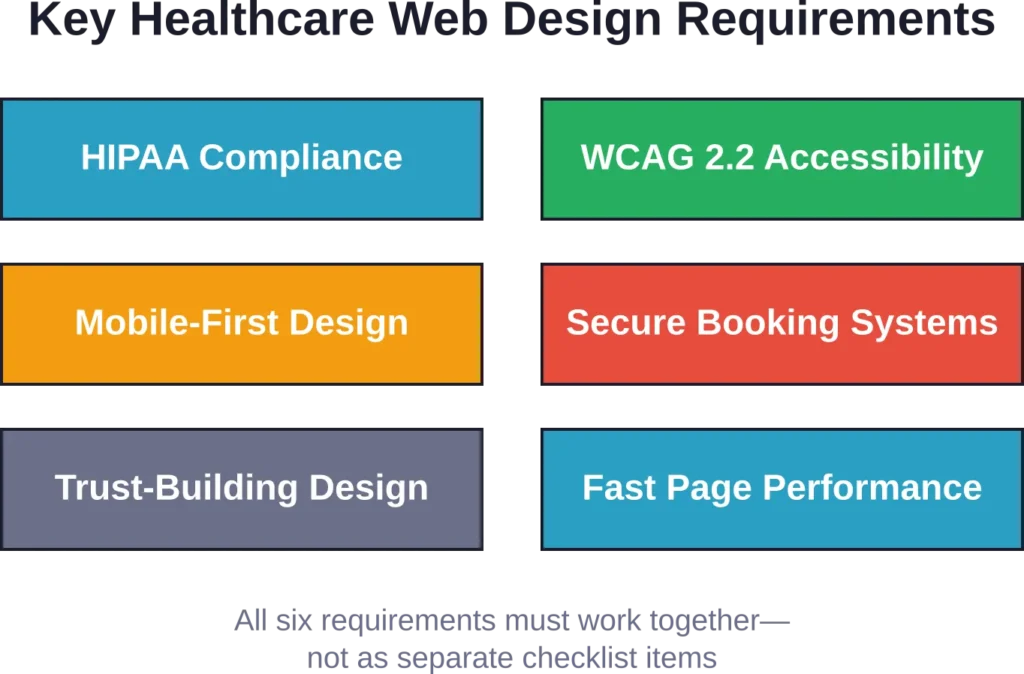
Medical websites operate under constraints that e-commerce sites and corporate portfolios never encounter. These aren’t just nice-to-have features—they’re legal and ethical requirements.
HIPAA compliance forms the foundation. Any patient data collected through contact forms, appointment booking systems, or patient portals must meet federal protection standards. That means encrypted data transmission, secure server infrastructure, and business associate agreements with every third-party service.
But compliance extends beyond HIPAA. WCAG 2.2 compliance is now something healthcare providers are being audited on, and agencies that do not build for it are creating a liability for their clients. Accessibility isn’t optional anymore—it’s a legal mandate that protects practices from discrimination lawsuits.
Then there’s the trust factor. Healthcare decisions involve vulnerability and anxiety. Design elements that work for retail brands—aggressive CTAs, flashy animations, pushy popups—erode confidence in medical contexts. Healthcare web design companies understand how to balance conversion optimization with the calm, authoritative presence that patients need.
Specialized Features Healthcare Websites Require
Over 70% of healthcare searches happen on mobile devices, which makes mobile-first development non-negotiable. But mobile optimization in healthcare means more than responsive layouts.
It means thumb-friendly tap targets for anxious patients. Clear typography for users with vision impairments. Fast load times for people searching in emergencies. Simplified navigation for elderly users unfamiliar with complex web interfaces.
Appointment booking integration presents another specialized challenge. Systems must sync with practice management software, send HIPAA-compliant confirmation messages, handle cancellations and rescheduling, and provide clear confirmation—all while maintaining security standards.
Insurance information, provider directories, service descriptions, and educational content all require careful information architecture. Healthcare web design companies build these structures daily. General agencies stumble through them.
Top 15 Healthcare Web Design Companies in 2026
The following agencies have demonstrated expertise in medical website design through portfolio work, client results, and specialized healthcare knowledge. Each brings different strengths to the table.
1. Gilzor

Gilzor delivers custom software development and UI/UX design that helps healthcare businesses launch and scale digital solutions patients and clinicians actually use.
Location: Limassol, Cyprus
Best for: Healthcare startups, medical product studios, and specialized clinics
Core strength: User-centric design and full-cycle development for healthcare applications
Their team focuses on building web and mobile platforms, validating ideas, and creating intuitive interfaces that enhance patient engagement and streamline medical processes.
Contact Information:
- Website: www.gilzor.com
- Email: [email protected]
- Address: Poland, Warsaw, Office 58, street Adama Mickiewicza 37, 01-625
- LinkedIn: www.linkedin.com/company/gilzor-softwaredevelopment
2. A-listware

A-listware provides reliable software development and dedicated teams for healthcare organizations that need secure, compliant digital platforms and system integrations.
Location: London, UK
Best for: Hospitals, medical enterprises, and healthcare service providers
Core strength: Enterprise-grade development and team augmentation for complex healthcare projects
They deliver custom software, UX/UI design, cloud solutions, and infrastructure services that support secure patient data handling and efficient digital operations in demanding medical environments.
Contact Information:
- Website: a-listware.com
- Phone: +1 (888) 337 93 73
- Email: [email protected]
- Address: North Bergen, NJ 07047, USA
- LinkedIn: www.linkedin.com/company/a-listware
- Facebook: www.facebook.com/alistware
3. Lengreo

Lengreo excels as a full-cycle B2B digital marketing and web development partner for healthcare organizations seeking to grow patient acquisition and professional visibility. They combine strategy, SEO, and conversion-focused website development tailored to medical practices.
Location: Kyiv, Ukraine
Best for: Medical practices, clinics, biotech companies, and healthcare SaaS
Core strength: Data-driven lead generation and conversion-optimized healthcare websites
Lengreo helps healthcare providers boost qualified leads and improve online patient engagement through personalized outreach, SEO, website development, and performance marketing that delivers measurable results in competitive medical markets.
Contact Information:
- Website: Lengreo.com
- Phone: +31 686 147 566
- Email: [email protected]
- Address: Vrijstraat 9 C/D, 5611 AT Eindhoven, Netherlands
- LinkedIn: Lengreo
- Twitter: @Lengreo
- Instagram: @lengreo
4. Mobian Studio
Mobian Studio builds dedicated engineering teams that deliver secure, scalable digital products for healthcare organizations. They specialize in mobile and AI solutions designed for clinical workflows and patient-facing platforms.
Location: New York, USA
Best for: Healthcare tech, medical startups, fintech-health intersections, and clinical platforms
Core strength: End-to-end product development with healthcare domain expertise
Mobian Studio creates production-ready mobile apps, AI systems, and integrated platforms that help healthcare providers improve efficiency, patient experience, and regulatory compliance without compromising on speed or quality.
Contact Information:
- Website: mobian.studio
- Phone: [email protected]
- Address: Harju maakond, Tallinn, Kesklinnalinnaosa, Masina tn 22, 10113
- LinkedIn: www.linkedin.com/company/mobian-studio
5. Oski

Oski creates smart, well-engineered digital solutions that help healthcare organizations modernize their online presence and internal systems with modern web technologies.
Location: Tallinn, Estonia
Best for: Healthcare enterprises, clinics, and medical education platforms
Core strength: Robust web development combined with AI and cloud solutions for healthcare
Oski designs and develops secure, high-performance websites, patient portals, and digital tools that support better user experiences across clinical and medical environments.
Contact Information:
- Website: oski.site
- Phone: +48571282759
- Email: [email protected]
- Address: Kaupmehe tn 7, 10114 Tallinn, Estonia
- LinkedIn: www.linkedin.com/company/oski-solutions
6. Design de Plume

Design de Plume specializes in boutique medical practices and specialty clinics that need distinctive branding alongside technical functionality. Their aesthetic approach suits cosmetic practices, wellness centers, and concierge medicine.
Best for: Boutique practices, specialty clinics, medical spas
Core strength: High-end design for premium medical services
When brand differentiation matters as much as compliance, Design de Plume delivers visual sophistication that doesn’t compromise on accessibility or security standards.
7. CardioDesign

CardioDesign focuses exclusively on cardiovascular practices and cardiac care facilities. That vertical specialization means they understand cardiology workflows, terminology, and patient concerns better than generalist agencies.
Best for: Cardiology practices, cardiac care centers
Core strength: Vertical expertise in cardiovascular medicine
Vertical specialization has real advantages. CardioDesign’s team knows which service lines cardiology patients search for, how to structure educational content about heart conditions, and which booking flows work for cardiology appointments.
8. WebFX Healthcare Division

WebFX operates a dedicated healthcare division within their larger digital agency. That structure provides healthcare-specific expertise backed by the resources of a large agency.
Best for: Practices wanting full-service digital marketing alongside web design
Core strength: Integrated web design, SEO, PPC, and marketing automation
WebFX offers their proprietary MarketingCloudFX platform for patient lead generation. For practices that want everything—web design, search optimization, paid advertising, and analytics—under one roof, their healthcare division delivers.
9. Thrive Agency
Thrive Agency combines medical web design with comprehensive digital marketing services. Their team includes healthcare marketing specialists who understand patient acquisition funnels.
Best for: Medical practices, wellness centers, healthcare startups
Core strength: Healthcare marketing strategy combined with web development
Thrive’s approach treats website design as one component of broader patient acquisition strategy. For practices without internal marketing teams, that strategic guidance adds value beyond visual design.
10. G-Co Agency

G-Co Agency stays current with healthcare web design trends and emerging technologies. Their May 2026 healthcare agency analysis demonstrates thought leadership in the medical digital space.
Best for: Forward-thinking practices adopting new healthcare technologies
Core strength: Innovation and emerging healthcare technology integration
G-Co positions itself at the intersection of healthcare and technology innovation. Practices exploring AI patient support, advanced telehealth features, or next-generation patient engagement tools benefit from their forward-looking approach.
11. Orbix Studio

Orbix Studio leads in patient experience design for clinics and telehealth platforms. Their work focuses on conversion-optimized interfaces that don’t sacrifice the trust signals medical practices need.
Location: New York, USA
Best for: Clinics, telehealth startups, medical SaaS products
Core strength: Patient UX combined with modern web design that actually converts visitors into booked appointments
Orbix Studio maintains a Clutch rating and specializes in healthcare alongside SaaS and MVP development. Their design process emphasizes user research with actual patients—something many agencies skip in favor of generic templates.
12. Kanopi Studios

Kanopi Studios takes a high-touch, mission-driven approach that resonates with university medical departments and health foundations. Their partnership model involves deep collaboration rather than transactional project delivery.
Best for: University medical departments, health foundations, specialized health networks
Core strength: Mission-aligned partnerships with complex healthcare organizations
Kanopi’s client list includes academic medical centers and nonprofit health organizations that need both technical excellence and strategic guidance. They excel at large-scale website migrations and complex content management systems.
13. Azuro Digital

Azuro Digital brings technical precision to healthcare web development. Their team handles the backend complexity of patient portals, appointment systems, and HIPAA-compliant data handling that many design-focused agencies outsource.
Core strength: Technical implementation of secure patient systems
Best for: Practices needing custom patient portals or complex integrations
Azuro doesn’t just design interfaces—they build the secure infrastructure underneath them. For medical practices with existing EMR systems or specialized workflow requirements, that technical depth matters.
14. Forefrontweb

Forefrontweb focuses on hospitals and large healthcare organizations that need enterprise-scale solutions. Their experience with multi-location providers and hospital systems sets them apart from boutique agencies.
Best for: Hospitals, multi-location medical groups, healthcare enterprises
Core strength: Enterprise healthcare digital platforms
When a healthcare organization needs to coordinate digital experiences across dozens of locations, multiple departments, and varied service lines, Forefrontweb’s systematic approach prevents the chaos that typically results.
15. ThrillX

ThrillX emphasizes measurable growth outcomes. Clients report significant traffic and conversion growth after redesigns due to their audit-driven approach that identifies specific bottlenecks.
Best for: Practices focused on patient acquisition and conversion optimization
Core strength: Data-driven redesigns that improve traffic and conversions
ThrillX combines analytics with healthcare design expertise. Their process starts with comprehensive audits that quantify exactly where current websites lose potential patients—then systematically fixes those leaks.
How to Choose the Right Healthcare Web Design Company
Selecting a healthcare web design partner requires different evaluation criteria than choosing a general web agency. Portfolio aesthetics matter less than regulatory knowledge and patient outcome results.
Start by verifying actual healthcare experience. Ask for client references from medical practices similar in size and specialty to yours. Generic design agencies sometimes claim healthcare expertise based on one dental office website—that doesn’t count.
Essential Questions to Ask Potential Agencies
How do they handle HIPAA compliance? The answer should include specific technical details about encryption, server security, business associate agreements, and form data handling. Vague reassurances aren’t enough.
What accessibility standards do they follow? WCAG 2.2 compliance should be built into their design process from wireframing through launch—not added as an afterthought. Ask for examples of accessibility audits they’ve conducted.
How do they approach patient journey mapping? Healthcare website success depends on understanding the anxious, often confused mental state of people seeking medical care. Agencies should describe their user research methods with actual patients.
What’s their experience with appointment booking integrations? They should name specific practice management systems they’ve integrated with and explain how they handle common scheduling edge cases.
Can they show conversion rate improvements? Ask for before-and-after metrics from previous healthcare clients. Traffic numbers matter less than whether more visitors become booked appointments.
Red Flags to Watch For
Agencies that claim HIPAA compliance is simple are either ignorant or dishonest. Proper implementation requires technical expertise and ongoing maintenance.
Template-based approaches rarely work well for healthcare. Medical practices have too many unique requirements—service mix, provider credentials, insurance acceptance, locations—for cookie-cutter templates to handle gracefully.
Lack of post-launch support signals trouble ahead. Healthcare websites need ongoing security updates, compliance monitoring, and optimization based on patient behavior data. Agencies that disappear after launch leave practices vulnerable.
Unrealistic timelines indicate an agency doesn’t understand healthcare complexity. Custom healthcare websites with booking integration, proper security, and accessibility typically require 2-4 months minimum.
| Evaluation Criteria | What to Look For | Red Flags |
|---|---|---|
| Healthcare Portfolio | Multiple medical clients in similar specialties; detailed case studies with metrics | One or two healthcare projects mixed with unrelated industries |
| Compliance Knowledge | Specific technical details about HIPAA and WCAG implementation | Vague assurances; claims compliance is simple |
| Design Process | Patient research and journey mapping; iterative testing with actual users | Template selection as primary methodology |
| Technical Capabilities | In-house developers experienced with healthcare integrations | Outsourced development; no technical staff on calls |
| Post-Launch Support | Ongoing maintenance plans; security monitoring; optimization services | Project ends at launch; no continued relationship |
Healthcare Web Design Cost Considerations in 2026
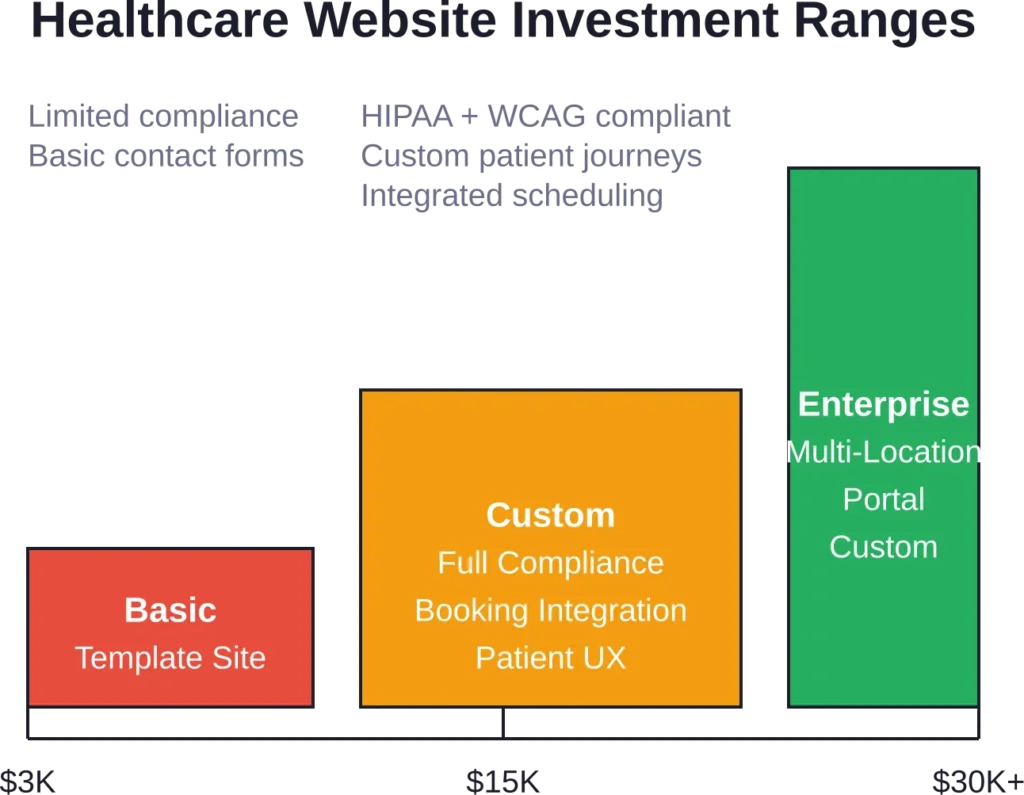
Healthcare website costs vary dramatically based on complexity, customization, and compliance requirements. Understanding typical investment ranges helps set realistic budget expectations.
Basic informational websites vary significantly in cost depending on features and customization. Templated solutions with minimal customization differ greatly from fully custom implementations with proper compliance.
Custom healthcare websites with proper UX, mobile optimization, and appointment booking vary in cost based on complexity. That variation reflects significant differences in scope—single location versus multi-location, basic forms versus integrated patient portals, standard design versus custom branding.
Here’s the thing though—focusing solely on upfront cost misses the bigger picture. A poorly designed healthcare website costs far more through lost patient acquisitions, compliance penalties, and eventual complete redesign.
What Drives Healthcare Website Costs
Compliance implementation requires specialized expertise. Proper HIPAA-compliant infrastructure costs more than standard shared hosting. Accessibility compliance demands additional design and development time. Agencies with healthcare expertise charge accordingly because they’re delivering value beyond visual design.
Custom booking integration represents a significant cost driver. Simple contact forms are cheap. Sophisticated scheduling systems that sync with practice management software, handle insurance verification, send automated reminders, and provide patient self-service require substantial development.
Content strategy and creation often get underestimated. Healthcare websites need service descriptions, provider bios, educational content, insurance information, and location details—all written for patient comprehension while maintaining medical accuracy. Quality medical content creation adds cost but dramatically improves patient conversion.
Ongoing maintenance and optimization should factor into total cost of ownership. Healthcare websites need regular security updates, compliance monitoring, performance optimization, and iterative improvements based on patient behavior data.
Essential Features Every Healthcare Website Needs
Certain features separate functional healthcare websites from those that actively drive patient acquisition and retention. These aren’t optional extras—they’re baseline requirements for 2026.
Mobile-Optimized Patient Experience
Mobile-first design means more than responsive layouts. It means designing the entire patient journey for thumb navigation on a 6-inch screen.
That includes large, tappable phone numbers and appointment buttons. Simplified navigation with clear hierarchy. Fast-loading pages that don’t burn through mobile data. Forms designed for mobile keyboards with appropriate input types.
Real talk: if patients can’t easily book appointments from their phones, they’ll book with competitors who make it frictionless.
Appointment Booking and Scheduling
Online scheduling has shifted from nice-to-have to patient expectation. Modern booking systems should show real-time availability, accommodate new and existing patients differently, collect necessary intake information, handle insurance verification, and send automated confirmations and reminders.
The system must integrate with practice management software. Standalone booking calendars that require manual data entry create more work instead of less.
Clear Service and Provider Information
Patients need to quickly understand what services are offered, which providers deliver them, what insurance is accepted, and where services are located. Sounds basic, but many healthcare websites bury this critical information behind poor navigation.
Provider profiles should include credentials, specialties, languages spoken, and availability. Service pages should explain what patients can expect, how to prepare, and what insurance typically covers.
HIPAA-Compliant Contact and Forms
Every form that collects patient information must use encrypted transmission. That means SSL certificates at minimum, but proper implementation requires secure form handling, encrypted database storage, and business associate agreements with any third-party services that touch patient data.
Contact forms should never ask for detailed medical information. Save those questions for secure patient portals accessed behind authentication.
Educational Content and Trust Signals
Healthcare decisions involve trust under uncertainty. Educational content demonstrates expertise while addressing patient concerns.
Trust signals include provider credentials prominently displayed, affiliations with respected medical institutions, patient testimonials (with proper permissions), quality certifications and awards, and clear privacy policies.
But authenticity matters. Stock photos of models in lab coats erode trust. Real provider photos and genuine patient testimonials (video when possible) build it.
Healthcare Web Design Trends Shaping 2026
Several trends are reshaping how healthcare organizations approach digital presence. Not all trends deserve following, but these reflect genuine shifts in patient expectations and technology capabilities.
AI-Powered Patient Support
Intelligent chatbots and virtual health assistants now handle routine questions, appointment scheduling, and symptom triage. When implemented well, they improve patient experience while reducing administrative burden.
The key phrase is “implemented well.” Poorly designed chatbots that can’t answer basic questions or trap users in frustrating loops damage patient relationships. Healthcare web design companies increasingly build AI support into websites, but quality varies dramatically.
Telehealth Integration
Telehealth transformed from emergency pandemic solution to permanent care delivery channel. Modern healthcare websites integrate video visits directly into booking workflows.
That means patients can choose in-person or telehealth appointments during the same booking process, receive visit links and instructions automatically, access secure video platforms without separate software downloads, and view visit recordings and notes in patient portals.
Personalized Patient Portals
Generic patient portals are giving way to personalized dashboards that adapt to individual patient needs. That might include customized health content based on conditions, appointment reminders timed to patient preferences, prescription refill workflows, test result notifications, and billing and insurance information.
Personalization requires sophisticated backend systems, but the patient experience improvement justifies the investment for larger practices.
Voice Search Optimization
Voice search changes how patients find healthcare providers. Instead of typing “orthopedist near me,” they ask “Where can I see a knee specialist today?”
That linguistic shift requires different content strategies. Healthcare websites need conversational content that answers natural language questions, structured data markup for rich search results, and FAQ sections that target question-based queries.
Common Healthcare Website Mistakes to Avoid
Even with professional design help, healthcare organizations sometimes make strategic mistakes that undermine website effectiveness. Awareness helps avoid them.
Prioritizing Aesthetics Over Function
Beautiful design matters, but not at the expense of usability. Trendy layouts with hidden navigation, fancy animations that slow load times, or artistic typography that’s hard to read all sacrifice patient experience for designer preference.
Healthcare websites should be attractive in a way that builds confidence—clean, professional, accessible. Not cutting-edge artistic statements.
Neglecting Content Quality
Many practices invest in design but populate sites with hasty, generic content. That’s backwards. Content communicates expertise, answers patient questions, and drives search visibility.
Quality healthcare content requires medical accuracy, patient-friendly language, search optimization, and regular updates as services and information change.
Ignoring Analytics and Optimization
Launch isn’t the finish line—it’s the starting line. Healthcare websites need ongoing optimization based on patient behavior data.
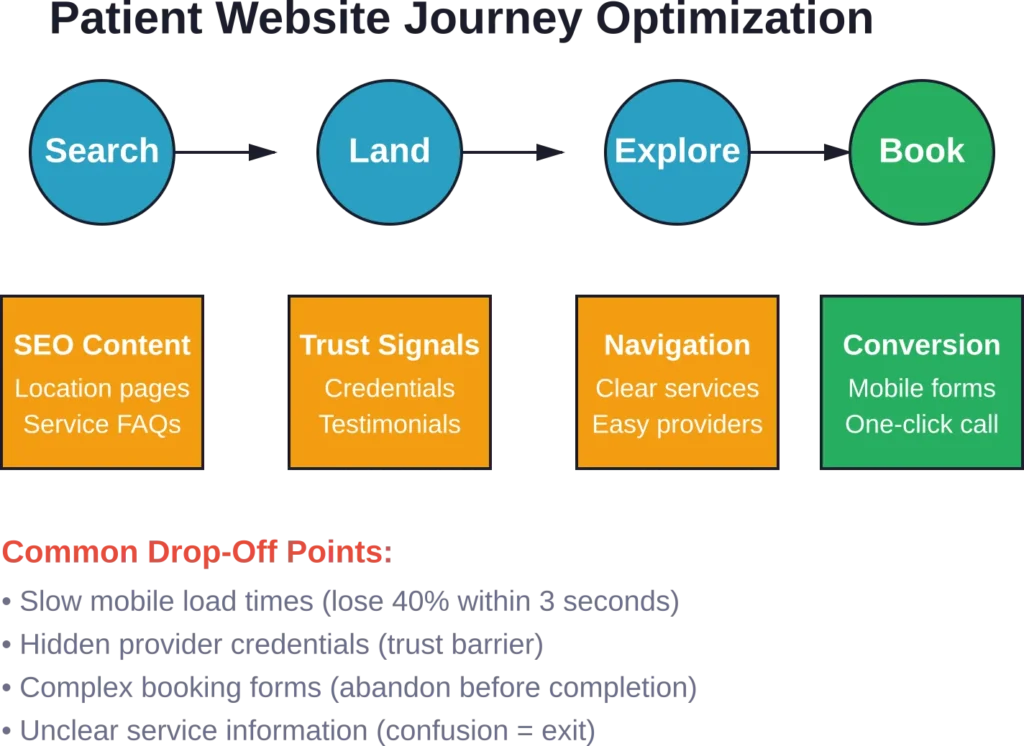
Where do patients drop off in the booking process? Which service pages get traffic but don’t convert? What questions keep coming to phone staff that the website should answer? Analytics reveal these opportunities.
Skipping Accessibility Testing
Accessibility compliance isn’t something to check off during design. It requires testing with actual assistive technologies—screen readers, keyboard navigation, voice control—and real users with disabilities.
Automated accessibility checkers catch some issues, but miss others that create real barriers for patients with disabilities.
The Future of Healthcare Web Design
Looking beyond 2026, several technological and regulatory shifts will continue reshaping healthcare digital experiences.
Interoperability standards will increasingly allow patient data to flow between healthcare providers, insurance companies, and patients themselves. Healthcare websites will need to accommodate these data exchanges while maintaining security and privacy.
Regulatory scrutiny of digital health tools will intensify. The FDA already regulates certain health apps as medical devices. That regulatory lens will expand to cover more digital health tools, requiring healthcare web design companies to navigate approval processes.
Patient expectations will continue rising. The gap between healthcare digital experiences and consumer tech experiences (banking, retail, travel) will narrow as patients demand the same convenience and personalization from medical providers.
AI will handle increasingly complex patient interactions. But the human element—empathy, judgment, complex decision-making—will remain central to healthcare delivery. The best healthcare websites will blend technological efficiency with human connection.
Frequently Asked Questions
Healthcare web design companies understand HIPAA compliance requirements, WCAG accessibility standards, patient journey psychology, and medical sector regulations that general designers don’t encounter. They know how to build secure patient data handling, integrate with practice management systems, and create trust signals specific to medical contexts. Regular web designers rarely grasp the legal liability and patient safety considerations that healthcare websites require.
Custom healthcare websites typically require 2-4 months from kickoff to launch, depending on complexity. That timeline includes discovery and strategy, design and user testing, development and integration, content creation and migration, compliance testing, and staff training. Rushing this process to meet arbitrary deadlines usually results in compliance gaps or poor patient experience that requires expensive fixes later.
Yes, if the website collects any protected health information through forms, patient portals, or appointment booking systems. HIPAA compliance protects patient trust and practice reputation. Beyond legal requirements, compliance is essential for safeguarding patient data. Even basic contact forms that ask health-related questions require secure, compliant handling.
Mobile-responsive design scales desktop layouts down to fit smaller screens. Mobile-first design starts by creating the optimal experience for phone users, then scales up for larger screens. The distinction matters because around 78% of patients are doing it on phones when researching healthcare providers. Mobile-first design prioritizes the patient journey most people actually use, rather than adapting a desktop experience that was never optimized for thumb navigation and small screens.
Track these key metrics: appointment booking conversion rate (percentage of visitors who book), time to complete booking process, mobile versus desktop usage and conversion, top landing pages and their conversion rates, form abandonment rates, phone calls from website visitors, and patient acquisition cost compared to other channels. Analytics platforms should integrate with practice management systems to connect website behavior to actual booked appointments and patient lifetime value.
Healthcare-specific agencies offer deeper regulatory knowledge and patient journey expertise. General agencies with healthcare divisions provide that specialization backed by broader resources. Either can work, but verify actual healthcare portfolio work, ask detailed compliance questions, and request references from medical practices similar to yours. The agency’s process matters more than their positioning—do they demonstrate real understanding of healthcare’s unique requirements?
Healthcare websites need regular security updates and patches, compliance monitoring as regulations evolve, performance optimization based on patient behavior data, content updates for new services and providers, backup and disaster recovery testing, accessibility audits as standards advance, and integration maintenance as connected systems update. Plan for ongoing monthly maintenance rather than treating the website as a one-time project. The digital landscape and regulatory environment change too quickly for launch-and-forget approaches.
Taking the Next Step
Selecting a healthcare web design company ranks among the most important marketing decisions a medical practice makes. The right partner transforms digital presence from a basic requirement into a patient acquisition engine.
Start by clarifying what success looks like for the practice. Is the priority more new patient appointments? Better patient experience for existing patients? Compliance with new regulations? Different goals require different agency strengths.
Reach out to multiple agencies from the list above. Most offer discovery calls to discuss specific needs and assess fit. Pay attention not just to what they promise, but how they ask questions. Great healthcare web design agencies act as strategic partners who understand medical practice operations—not just vendors executing designs.
Request detailed proposals that outline timeline, deliverables, compliance approach, and ongoing support. Compare not just on price, but on demonstrated healthcare expertise and cultural fit with the practice’s values.
The healthcare digital landscape will continue evolving. Patient expectations will keep rising. Regulatory requirements will grow more stringent. Having a specialized healthcare web design partner who stays ahead of these changes provides lasting competitive advantage.
Medical practices that invest in properly designed, compliant, patient-focused websites now will capture market share from competitors still relying on outdated digital presence. The question isn’t whether to prioritize healthcare web design, but which specialized agency to partner with for that transformation.