

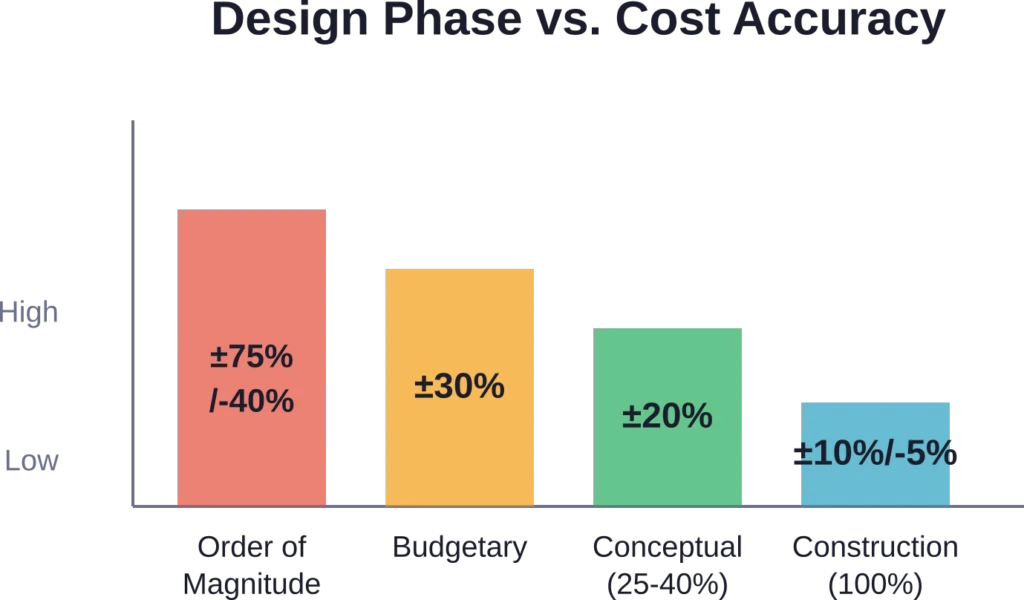
Quick Summary: Architectural engineering costs typically range from $2,000 to $80,000+ depending on project scope and complexity. Fees are commonly structured as a percentage of construction costs (7-10% for commercial, 8-15% for residential), hourly rates, or fixed fees, with accuracy improving from ±30% at budgetary stage to +10%/-5% at construction phase with 100% complete drawings.
Planning a construction project means wrestling with a fundamental question: how much will design and engineering actually cost? The answer shapes budgets, timelines, and whether projects move forward at all.
Architectural engineering sits at the intersection of creative design and structural reality. These professionals ensure buildings don’t just look good—they stand up, function properly, and meet code requirements. But that expertise comes at a price that varies wildly based on project type, complexity, and how fees are structured.
Here’s what actually drives architectural engineering costs and what to expect when budgeting for your project.
Understanding Architectural Engineering Fee Structures
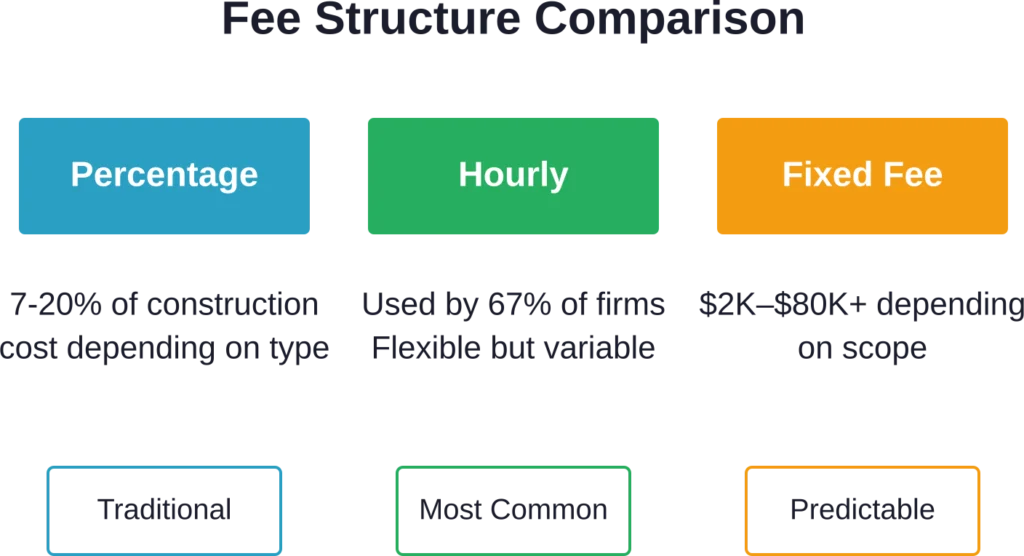
Most architectural and engineering firms use one of three pricing models, and the choice significantly impacts final costs.
Percentage of Construction Costs
This traditional approach ties design fees directly to the total construction budget. Private sector architecture typically ranges from 7-10% of construction costs for general commercial work, while residential commands 8-15%, with renovations at 15-20% due to added complexity.
Infrastructure and civil projects follow a sliding scale averaging approximately 6.8% for $1-2M projects, 5.9% for $5-10M projects, and 5.4% for larger undertakings. High-end residential can justify 10-20% when design complexity warrants it.
The percentage model creates alignment between project scale and compensation, but it also means design fees fluctuate with construction cost changes—even when design scope remains constant.
Hourly Billing
In fact, 67% of A&E firms use hourly billing as their primary pricing mechanism. It’s particularly appropriate for projects with undefined scope, phased work, or when clients request frequent revisions.
Hourly rates vary by professional level, geographic location, and firm specialization. This model provides transparency and flexibility but can make total project costs harder to predict upfront.
Fixed Fee Arrangements
Fixed fees establish a set price for defined deliverables. This approach works best when scope is crystal clear and both parties agree on expectations upfront.
Basic drawing sets for permit approval might run $2,000 to $20,000, while full-service design and oversight spans $15,000 to $80,000+. Large or complex projects, such as high-rise buildings or hospitals, push costs well into six figures.
Fixed fees transfer risk from client to firm—if the project takes longer than anticipated, the firm absorbs the cost.
Cost Ranges by Project Type
Project category fundamentally shapes what architectural engineering services cost. Residential work differs markedly from commercial, and infrastructure projects follow their own logic entirely.
Residential Projects
Single-family homes typically see architectural fees of 8-15% of construction costs. A $300,000 home build might carry $24,000 to $45,000 in design and engineering fees.
Renovations push that range to 15-20% because working within existing structures adds complexity. Structural assessments, code compliance reviews, and coordination with existing systems require additional engineering time.
Custom high-end residential projects can justify fees at the upper end of the range when design intricacy demands it.
Commercial and Industrial Buildings
General commercial work settles at 7-10% of construction costs. A $2 million office building might budget $140,000 to $200,000 for architectural and engineering services.
Specialized facilities—hospitals, laboratories, manufacturing plants—require more intensive engineering for mechanical systems, structural loads, and regulatory compliance. These projects often exceed standard percentage ranges.
Infrastructure and Civil Projects
Civil engineering for bridges, roads, water systems, and other infrastructure follows a declining percentage as project scale increases. The sliding scale reflects economies of scale in design work.
Smaller projects at $1-2M carry approximately 6.8% in engineering fees, while $5-10M projects average 5.9%, and larger projects settle around 5.4%.
| Project Type | Typical Fee Range | Notes |
|---|---|---|
| Residential New Build | 8-15% | Higher end for custom/complex |
| Residential Renovation | 15-20% | Complexity of existing conditions |
| Commercial General | 7-10% | Standard office, retail, warehouse |
| High-End Residential | 10-20% | Justified by design complexity |
| Infrastructure ($1-2M) | ~6.8% | Civil engineering average |
| Infrastructure ($5-10M) | ~5.9% | Scale economies apply |
Get Architectural Engineering Support for Project Delivery
Powerkh provides engineering-led BIM and coordination support for structural and MEP projects. Its services include modelling, technical coordination, constructability reviews, and site-related verification workflows.
Need Architectural Engineering Support?
Talk with Powerkh to:
- support structural and MEP coordination
- prepare models and technical documentation
- review constructability before construction starts
- improve continuity between design and site teams
Speak with Powerkh about engineering coordination support for your project.
Factors That Influence Architectural Engineering Costs
Beyond project type and fee structure, several variables push costs up or down.
Project Complexity and Scope
Complex geometries, unusual materials, innovative structural systems, and custom solutions all demand more engineering time. A straightforward rectangular office building costs less to design than a curved-roof auditorium with complex acoustics.
The number of disciplines involved matters too. Projects requiring structural, mechanical, electrical, plumbing, and civil engineering coordination cost more than simple structural work alone.
Design Phase Accuracy Requirements
Cost estimate accuracy improves as design develops, and fees reflect the level of detail required. According to GSA cost management standards, order of magnitude estimates for initial budgeting carry +75%/-40% accuracy ranges and require minimal engineering.
Budgetary estimates at ±30% accuracy follow scope definition and need more engineering input. Conceptual design estimates at 25-40% design completion tighten to ±20% accuracy but require substantially more design work.
Construction estimates at construction phase with 100% complete drawings deliver +10%/-5% accuracy—the most precise range, demanding full engineering documentation.
Geographic Location
Regional cost of living and local demand shape what firms charge. Engineering services in major metropolitan areas typically cost more than in smaller markets, though remote collaboration has begun blurring these lines.
Firm Experience and Specialization
Established firms with specialized expertise command premium rates. A firm known for seismic design or sustainable buildings brings value that justifies higher fees for projects requiring those skills.
Additional Services and Associated Costs
Base architectural engineering fees often cover schematic design, design development, construction documents, and basic construction administration. But many projects need supplementary services.
Site surveys, geotechnical investigations, environmental assessments, and specialized testing add separate costs. Building Information Modeling (BIM) coordination, energy modeling, LEED certification support, and extensive rendering packages may carry additional fees depending on contract terms.
Code analysis for unusual occupancies, peer review for complex structural systems, and post-construction commissioning represent other potential add-ons.
Clarifying what’s included in base fees versus what costs extra prevents budget surprises mid-project.
Tax Treatment and Accounting Considerations
Architectural and engineering fees aren’t simply operating expenses—they require specific accounting treatment.
These costs must be capitalized and added to the basis of the building or improvement being constructed. For example, if construction costs $500,000 and architectural fees run $50,000, the total capitalized cost becomes $550,000.
Recovery happens through depreciation over the building’s useful life rather than as an immediate expense. This affects cash flow planning and tax strategy, particularly for commercial property owners and developers.
Protecting Project Budgets
Several practices help keep architectural engineering costs aligned with budgets.
Define scope clearly upfront. Vague requirements lead to scope creep and fee disputes. Document deliverables, revision limits, and approval processes in writing.
Request detailed fee breakdowns by phase—schematic design, design development, construction documents, bidding support, construction administration. This transparency reveals where money goes and identifies potential savings.
Build contingency into budgets. Design changes, unforeseen site conditions, and regulatory requirements can necessitate additional engineering work. A 10-15% contingency on soft costs provides buffer room.
Consider phase-based agreements. Contracting for schematic design first, with later phases contingent on satisfactory progress, reduces commitment risk on undefined projects.
Frequently Asked Questions
Architects focus on design, aesthetics, space planning, and overall building concept. Architectural engineers emphasize the technical systems—structural, mechanical, electrical—that make buildings function. Large projects typically involve both, with architects leading design and engineers ensuring systems work.
Fees are often negotiable within limits. Firms must cover costs and maintain profitability, but scope adjustments, fee structure changes, or phased approaches can reduce initial outlays. Competitive bidding among qualified firms also provides leverage, though selecting solely on price risks quality issues.
Not always. Minimum fees exist because even small projects require code research, permitting, liability insurance, and professional oversight. A $50,000 garage addition might carry 15-20% engineering fees because the absolute dollar amount barely covers basic services.
It depends on contract terms. Fixed-fee agreements typically include a defined number of revision rounds, with additional changes billed hourly. Percentage-based fees may absorb reasonable revisions but charge for major scope changes. Clarify revision policies before signing.
Under percentage-based fee structures, engineering fees increase proportionally with construction costs—even if the design didn’t change. This can feel unfair but reflects the original agreement. Fixed-fee contracts avoid this issue, keeping engineering costs stable regardless of construction cost fluctuations.
Both approaches work. Integrated firms offering architecture and engineering streamline coordination but may lack specialized depth. Separate consultants provide expertise but require more coordination effort. Project complexity and your management capacity should guide the decision.
Payment schedules vary but commonly follow project phases: a portion at contract signing, payments at milestone completions (schematic design, design development, construction documents), and final payment after construction administration concludes. Monthly billing is standard for hourly arrangements.
Making Informed Decisions
Architectural engineering costs represent a significant project investment, but they’re not arbitrary. Fee structures, project characteristics, scope definition, and design phase all drive what firms charge.
Understanding these factors helps set realistic budgets and evaluate proposals effectively. The cheapest option rarely delivers the best value—professional expertise prevents costly construction errors, ensures code compliance, and creates buildings that function properly for decades.
Request detailed proposals from multiple qualified firms, compare scope and deliverables carefully, and choose based on value rather than price alone. Clear communication about expectations, documented scope, and transparent fee structures protect both parties and set projects up for success.