
Quick Summary: Architectural lighting costs range from $3,000 to over $10,000, depending on project size, fixture quality, and design complexity. Professional lighting designers typically charge $125–$250 per hour, with typical project costs ranging from $2,000 to $10,000. Energy-efficient LED systems reduce long-term operating costs, with some commercial installations saving thousands annually.
Pricing architectural lighting feels like navigating a maze blindfolded. One contractor quotes $4,000, another says $12,000 for what seems like the same scope.
The confusion makes sense. Architectural lighting isn’t a commodity purchase—it’s a custom integration that depends on space characteristics, design intent, fixture specifications, and installation complexity.
This guide breaks down what architectural lighting actually costs in 2026, what drives those numbers, and how to evaluate quotes without getting burned.
What Architectural Lighting Actually Includes
Before diving into numbers, understanding scope matters. Architectural lighting encompasses more than screwing in fixtures.
Professional architectural lighting integrates design consultation, photometric calculations, fixture specification, control system programming, installation coordination, and post-completion adjustments. That’s different from buying Home Depot fixtures and hiring an electrician.
The scope typically includes:
- Lighting design consultation and space analysis
- Photometric modeling and rendering
- Fixture selection and specification
- Control system design (dimmers, sensors, smart integration)
- Installation coordination with electrical contractors
- Programming and scene setting
- Final adjustments and commissioning
Each component adds cost. But skipping steps creates problems—fixtures in wrong locations, inadequate light levels, glare issues, or systems that don’t integrate with building automation.
Typical Architectural Lighting Price Ranges
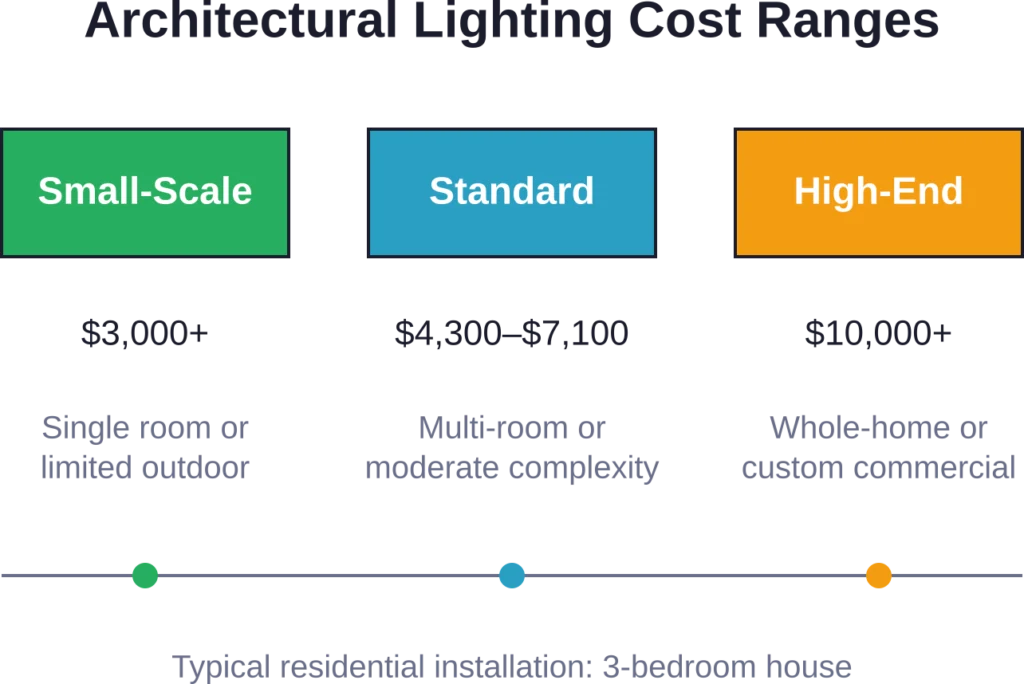
National pricing data shows consistent ranges across residential and commercial projects. The typical project cost falls between $4,300 and $7,100 for standard installations.
Small-scale projects start around $3,000, covering basic consultation, fixture specification, and installation oversight for single rooms or limited outdoor areas.
High-end custom projects exceed $10,000, particularly for whole-home integration, complex commercial spaces, or installations requiring specialized fixtures and sophisticated control systems.
But here’s the thing—those ranges mean nothing without context. Two $5,000 projects can deliver vastly different results depending on what’s included.
Residential vs. Commercial Pricing
Residential projects typically cost less per fixture but require more design time for aesthetic integration. A three-bedroom house lighting design runs $400 to $5,000, while four-bedroom complete plans range from $5,000 to $9,000.
Commercial projects face different cost drivers—higher fixture counts, specialized performance requirements, code compliance complexity, and coordination with other building systems.
Commercial landscape lighting installations show this clearly. Professional commercial-grade systems use line-voltage configurations (120V) for high-intensity applications, costing 30–50% more in labor than comparable low-voltage residential installations.
How Lighting Designers Structure Their Fees
Understanding fee structures helps evaluate proposals and budget appropriately. Lighting designers use four primary pricing models.
| Pricing Model | Rate/Range | Best For | Potential Issues |
|---|---|---|---|
| Hourly Rate (Experienced) | $125–$250/hour | Undefined scopes, exploratory consultation | Unpredictable total cost |
| Hourly Rate (Apprentice/Standard) | $50–$85/hour | Simple consultations, minor adjustments | Limited expertise |
| Flat Rate | $2,000–$10,000 | Standard projects with clear scope | Scope creep requires change orders |
| Percentage of Construction Cost | 8–15% of lighting budget | Large projects, new construction | Incentivizes higher fixture costs |
Experienced professionals charge between $125 and $250 per hour. That rate covers design expertise, photometric modeling, fixture research, and coordination time.
Standard consultations cost $50 to $85 per hour, suitable for basic guidance but lacking the technical depth complex projects require.
Flat rates give predictable costs between $2,000 and $10,000 for standard projects. This works when scope is clearly defined—specific room count, fixture budget range, and control system parameters established upfront.
Percentage-based fees tie designer compensation to project budget, common in new construction where lighting integrates with architectural development. The 8–15% range applies to the lighting portion of construction costs, not the entire building budget.
Get BIM Support for Architectural Lighting Coordination
Powerkh supports project teams with BIM modelling and coordination for architectural and MEP design workflows. Its services include lighting coordination support, clash detection, technical modelling, and construction documentation.
Need Support with Lighting Coordination?
Talk with Powerkh to:
- coordinate lighting layouts with MEP and architectural models
- prepare BIM models and technical drawings
- identify clashes before construction starts
- support design and construction-stage coordination
Review your lighting coordination requirements with Powerkh.
What Actually Drives Architectural Lighting Costs
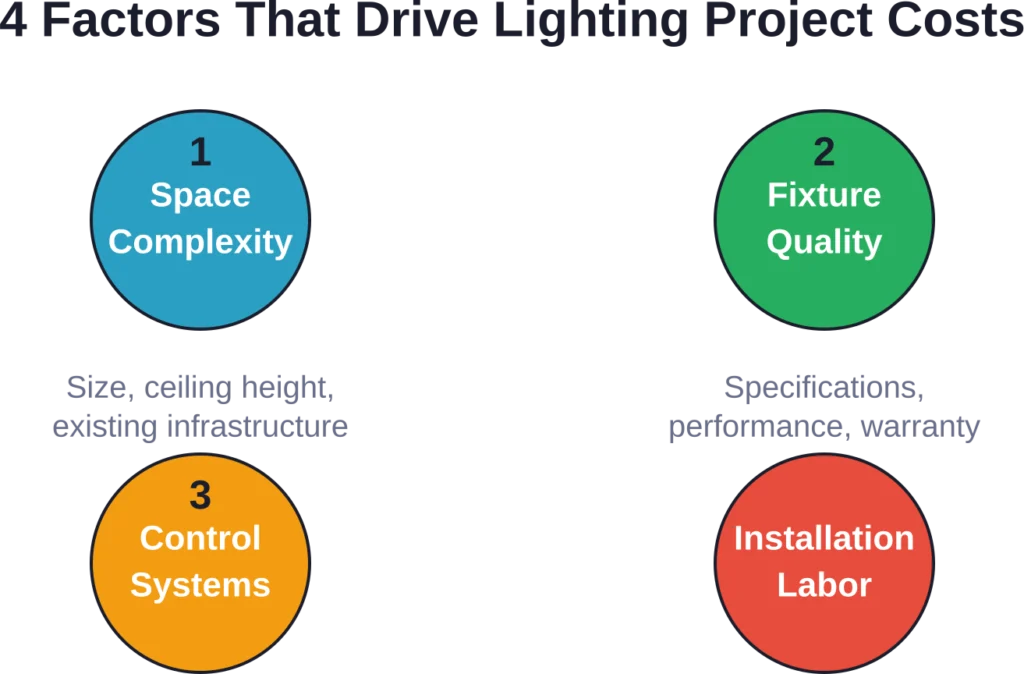
Four primary factors determine final project cost: space characteristics, fixture specifications, control system complexity, and installation requirements.
Space Size and Complexity
Square footage matters, but complexity matters more. A 2,000-square-foot loft with open ceilings and minimal obstructions costs less than a 1,500-square-foot traditional home with eight rooms, varied ceiling heights, and architectural details requiring accent lighting.
Ceiling height significantly impacts labor. Recessed lighting installation costs vary significantly based on ceiling complexity and existing infrastructure. Standard installations may cost less than complex jobs involving cathedral ceilings, limited access, or structural modifications.
Existing infrastructure affects installation costs. New wiring makes costs shoot up quickly. Older homes often need electrical panel upgrades, new circuits, or wall modifications to accommodate modern lighting loads and control systems.
Fixture Quality and Specifications
Fixture costs range from $30 for basic LED cans to $2,000+ for architectural-grade linear systems or custom fabrications. The difference isn’t just aesthetics—it’s performance, longevity, color rendering, dimming compatibility, and warranty coverage.
Entry-level LED landscape lights cost significantly less in materials than commercial-grade fixtures from professional manufacturers. But lifespan and reliability differences mean the cheap fixtures get replaced twice in the time commercial-grade units still perform.
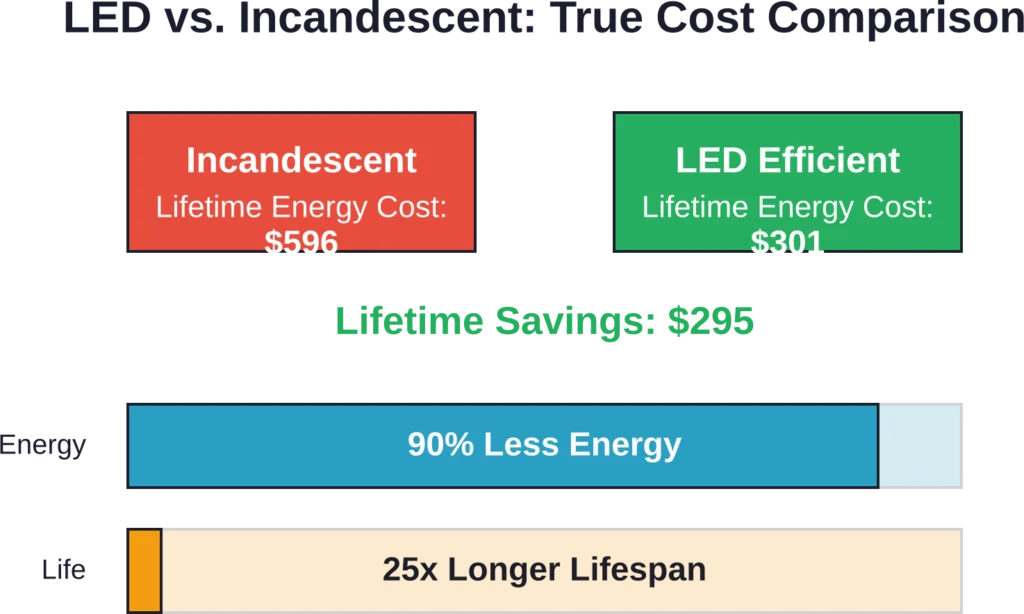
According to the Department of Energy, LEDs use up to 90% less energy and last up to 25 times longer than traditional incandescent bulbs. That energy efficiency delivers real savings—residential LED upgrades save households about $225 annually in energy costs.
Commercial installations show significant savings. Mt. Washington Elementary School in Kentucky saved $28,000 annually from HVAC, lighting, and air quality renovations over an 18-month project.
Control System Integration
Basic on/off switching costs almost nothing. Smart dimming, scene control, occupancy sensing, and building automation integration add $500 to $5,000+ depending on system sophistication.
Equipping exterior luminaires with advanced controls saves more energy and operating costs than only improving luminaire efficiency. According to Department of Energy data. The Federal Energy Management Program (FEMP) calculated cost-effectiveness of efficient exterior luminaires with controls, with a $295 lifetime savings comparison reducing annual energy costs from $56 to $28.
Smart lighting systems allow granular control—different scenes for different times, automatic adjustments based on daylight availability, remote access, and integration with security or HVAC systems. That functionality costs more upfront but delivers operational flexibility and energy savings.
Installation Labor and Complexity
Electrical contractors charge $85 to $105 per hour, which makes installation the largest cost component for many projects.
Simple installations—replacing existing fixtures, adding basic landscape lighting with accessible wiring paths—require fewer hours. Complex jobs involving structural modifications, extensive new wiring, or coordination with other trades consume more labor hours.
Professional lighting design prevents rework costs. When fixtures are specified correctly and placement is modeled before installation, contractors work efficiently without backtracking. Electricians must remove and reinstall fixtures that aren’t positioned correctly, costing between $65 and $400 per fixture.
Landscape and Outdoor Architectural Lighting Costs
Outdoor lighting follows similar cost drivers but adds weather resistance, burial-depth wiring requirements, and transformer sizing to the equation.
Professional landscape lighting installations typically use low-voltage systems (12V or 24V), safer for DIY maintenance and more forgiving during installation. Line-voltage systems (120V) appear in commercial-grade applications requiring high-intensity output—large tree uplighting on estate properties, security lighting, or architectural facade illumination. They cost 30–50% more in labor than a comparable low-voltage installation.
| System Component | Typical Cost Range | Notes |
|---|---|---|
| Starter Kit (6-8 path lights) | $60–$150 | Includes transformer and wire |
| Mid-Range Kit (10-15 fixtures) | $150–$300 | LED, adjustable heads |
| Professional Installation (labor) | $85–$105/hour | Licensed electrician rates |
| Low-Voltage Transformer | $100–$400 | Sized to total wattage |
| Commercial-Grade LED Fixture | $150–$600 each | Architectural-quality construction |
| Control System (smart/timer) | $200–$2,000 | Basic timer to full automation |
Fixture count drives material cost directly. Every additional pathway light, spotlight, or accent fixture adds to both equipment and installation expenses.
Professional installations account for proper transformer sizing—underpowered transformers cause voltage drop and dim, flickering lights at the end of runs. Correctly sized systems maintain consistent brightness across all fixtures.
Hidden Costs That Catch People Off Guard
Several costs don’t appear in initial quotes but emerge during or after installation.
Design Changes During Installation
Professional design upfront prevents change orders. Photometric modeling shows exactly what the lighting will look like before any wire gets pulled.
Electrical Panel Upgrades
Older homes often lack capacity for modern lighting loads, especially when adding smart controls, under-cabinet lighting, and landscape systems simultaneously. Some jurisdictions require bringing the entire electrical system to current code when panels are replaced.
Permit and Inspection Fees
Many municipalities require electrical permits for new lighting circuits, particularly for exterior work. Permit costs vary significantly depending on jurisdiction and project scope. Inspections add time to project schedules—figure an extra week for inspection scheduling and any corrections required.
Ongoing Maintenance and Replacement
Even LED fixtures eventually fail. Budgeting for fixture replacement—particularly for exterior lights exposed to weather—prevents surprises.
Energy Efficiency: The Long-Term Cost Equation
Energy costs over fixture lifetime often exceed initial purchase and installation costs. That’s why efficiency matters more than upfront price for any lighting that operates significant hours.
The Department of Energy notes that LEDs emit very little heat compared to incandescent bulbs (which release 90% of their energy as heat) and CFLs (which release about 80% as heat). That thermal efficiency translates directly to lower cooling costs in conditioned spaces.
Lighting accounts for around 15% of an average home’s electricity use. Switching to energy-efficient lighting cuts that consumption by up to 90%, delivering annual savings of approximately $225 for typical households.
Smart dimming and automation provide additional energy control. Occupancy sensors prevent lights from running in empty spaces. Daylight harvesting systems dim artificial lights when natural light is sufficient. Those controls add upfront cost but deliver measurable operating savings.
How to Evaluate Lighting Design Proposals
Not all quotes are structured the same way. Comparing proposals requires understanding what’s included at each price point.
Look for these components in comprehensive proposals:
- Detailed scope description—exactly which spaces, how many fixtures, what performance targets
- Fixture specifications—manufacturer, model number, warranty terms, not just generic descriptions
- Photometric analysis—calculated light levels, not just fixture placement on a floor plan
- Control system details—what functionality is included, what’s optional
- Installation scope—what’s included in labor, what requires separate electrical work
- Timeline with milestones—design approval, procurement, installation, commissioning
- Payment structure—deposit, progress payments, final completion holdback
Proposals missing those details leave room for scope creep and change orders. The lowest price often becomes the highest cost when critical components aren’t included.
Ask specific questions during evaluation:
- Are photometric calculations included or is placement based on rules of thumb?
- Who coordinates with the electrical contractor—designer or property owner?
- How many revision rounds are included before additional fees apply?
- What happens if specified fixtures are discontinued before installation?
- Who programs scenes and makes post-installation adjustments?
Those answers reveal whether the designer provides comprehensive service or just fixture selection.
When Professional Lighting Design Pays for Itself
Professional lighting design costs money. But poor lighting decisions cost more—in energy waste, rework charges, and spaces that don’t function properly.
Professional lighting designers typically charge $125–$250 per hour, with typical project costs ranging from $2,000 to $10,000. That investment prevents common costly mistakes.
Avoiding Rework and Change Orders
Electricians removing and reinstalling incorrectly placed fixtures charge $65 to $400 per fixture. Three rework fixtures equal $200 to $1,200 in unplanned costs—a substantial portion of design fees.
Photometric modeling shows exactly what the lighting will deliver before installation starts. Adjustments on paper cost nothing. Adjustments after drywall is closed cost plenty.
Proper Fixture Selection
Generic LED cans from big-box retailers seem cost-effective until the color rendering makes everyone look sick, the dimming creates annoying flicker, or half the fixtures fail within 18 months.
Professional designers specify fixtures based on application requirements—color temperature for the space use, CRI for accurate color rendering, dimming compatibility with the specified controls, and warranty coverage appropriate for installation location.
The price difference between adequate and inappropriate fixtures is often $20 to $50 per unit. But replacing 30 failed fixtures costs $600 to $1,500 in materials alone, plus installation labor to swap them out.
Energy Optimization
Overlighting wastes energy. Underlighting creates dark, unusable spaces. Both represent poor return on investment.
Professional designers calculate required illumination levels for each space based on function, then design systems delivering those levels efficiently. The result uses fewer fixtures, lower wattages, and strategic placement—reducing both installation cost and operating expense.
Integrating daylight reduces artificial lighting needs. Professional designers model natural light availability throughout the day and design artificial systems to supplement rather than replace daylight. That integration cuts energy consumption and extends fixture life by reducing operating hours.
Budgeting for Your Architectural Lighting Project
Setting realistic budgets prevents mid-project surprises and value engineering that compromises results.
For residential projects, allocation for comprehensive interior and exterior lighting when building new or doing major renovations should account for project-specific variables. Renovation projects working with existing infrastructure can reduce costs, particularly when reusing properly located junction boxes and adequate wiring.
For commercial projects, lighting represents a significant portion of total construction budget for office and retail spaces, more for specialized applications like galleries or showrooms where lighting is critical to function.
Break the budget into categories:
- Design fees: 15–25% of total lighting budget
- Fixtures and controls: 40–50% of total lighting budget
- Installation labor: 30–40% of total lighting budget
- Contingency: 10% for unforeseen conditions or changes
That structure provides realistic allocation across project components and prevents running out of money before completion.
Frequently Asked Questions
Professional lighting designers charge $125 to $250 per hour for experienced designers, or $50 to $85 per hour for standard consultations. Flat-rate projects typically cost $2,000 to $10,000 depending on scope. Simple lighting design plans run $1,780 to $2,158 per project, while complete plans for four-bedroom homes cost $5,000 to $9,000.
Comprehensive architectural lighting costs include design consultation, photometric calculations, fixture specification, control system design, installation coordination, programming, and final adjustments. Basic projects may include only fixture selection and placement guidance, while full-service projects provide complete design through commissioning.
Recessed lighting installation costs vary significantly based on ceiling complexity and existing infrastructure. Standard installations may cost less than complex jobs involving cathedral ceilings, limited access, or structural modifications. New construction installations cost less since access is open before drywall installation.
LED systems save $295 in lifetime energy costs compared to less efficient models, according to Department of Energy data. LEDs use up to 90% less energy and last up to 25 times longer than incandescent bulbs. Residential LED upgrades save approximately $225 annually in energy costs, typically recovering higher upfront costs within 2–3 years.
Professional landscape lighting installation costs vary by system size and fixture quality. Starter kits with 6–8 path lights run $60 to $150 including transformer and wire. Mid-range kits with 10–15 LED fixtures cost $150 to $300. Professional installation labor adds $85 to $105 per hour. Complete professional systems with commercial-grade fixtures typically cost $2,000 to $8,000 depending on property size and fixture count.
Low-voltage systems (12V or 24V) are safer, easier to install, and more forgiving during DIY maintenance. Line-voltage systems (120V) deliver higher intensity for commercial applications and large-scale installations, but require licensed electrician installation and cost 30–50% more in labor than comparable low-voltage installations.
DIY lighting design saves designer fees but risks costly mistakes. Incorrect fixture placement requiring rework costs $65 to $400 per fixture to correct. Poor fixture selection leads to early failure, inadequate light levels, or excessive energy consumption. Professional design typically pays for itself by preventing rework charges, optimizing energy efficiency, and ensuring proper fixture specification the first time.
Making Smart Decisions About Architectural Lighting Investment
Architectural lighting costs range from modest to substantial, but the investment shapes how spaces look and function for years.
Cheap fixtures and guesswork placement deliver cheap results. Professional design and quality fixtures create environments that enhance productivity, safety, aesthetics, and property value.
The numbers tell a clear story. Energy-efficient systems save hundreds to thousands annually. Proper design prevents rework costs. Quality fixtures last decades rather than years.
Start with clear objectives—what each space needs to accomplish, how it will be used, what atmosphere matters. Get specific about budget—what’s allocated for design, fixtures, installation, and contingency. Then evaluate designers and contractors based on demonstrated expertise, not just lowest price.
Real talk: architectural lighting isn’t the place to cut corners. But it’s also not necessary to overspend on features that don’t deliver value. The right approach balances initial investment against long-term performance, energy costs, and functionality.
Ready to move forward with architectural lighting? Request detailed proposals from at least three qualified professionals, compare what’s included at each price point, and ask the specific questions outlined in this guide. The answers reveal who delivers comprehensive value versus who’s just selling fixtures.