

Quick Summary: BIM design costs vary widely depending on project complexity, software licensing, hardware requirements, and consulting services. Typical ranges include $0.15–$0.75 per square foot for modeling, $3,000 per BIM workstation, $262/month for Autodesk Revit licenses, and $5,000–$10,000 for consultant services. The global BIM market is projected to reach $15.42 billion by 2030, with 74% of contractors reporting better constructability and measurable ROI from strategic BIM investment.
Building Information Modeling has transformed how construction projects are designed, coordinated, and delivered. But when firms start exploring BIM adoption, the first question is always about cost.
The answer isn’t simple. BIM costs depend on multiple layers—software subscriptions, hardware capability, training programs, consultant expertise, and the scope of modeling services your project needs.
This guide breaks down every cost component with 2026 pricing data, real project examples, and insights into what drives BIM investment decisions across architecture, engineering, and construction firms.
The BIM Market in 2026: Growth and Demand
The global BIM market is projected to reach $15.42 billion by 2030, driven by government mandates expanding across the UK, EU, Singapore, and parts of India. Demand for BIM expertise has surged, with firms of all sizes needing BIM expertise.
Real talk: BIM isn’t optional anymore for most firms. It’s become a competitive requirement.
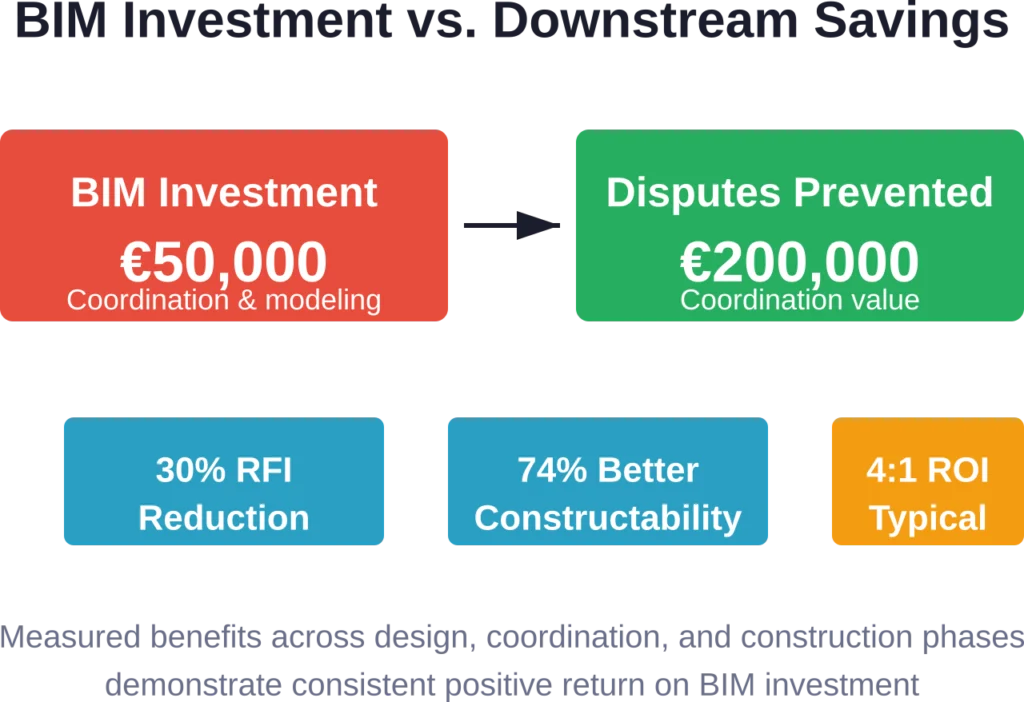
The measurable benefits back up the investment. According to recent industry data, 74% of contractors report better constructability of final designs, while 73% of owners gain clearer understanding of proposed design solutions. Engineers see improved quality and functionality (71%), and owners benefit from enhanced construction documentation (70%) and better planning and logistics (70%).
Documented projects show significant benefits such as reduction in RFIs through BIM coordination. Case studies demonstrate how BIM coordination investments prevent costly construction disputes.
So the question isn’t whether BIM delivers value—it’s how to budget for it properly.
BIM Software Costs: Licensing and Subscriptions
Software represents the foundation of any BIM operation. Pricing varies dramatically based on tool category, vendor, and subscription model.
Authoring Software
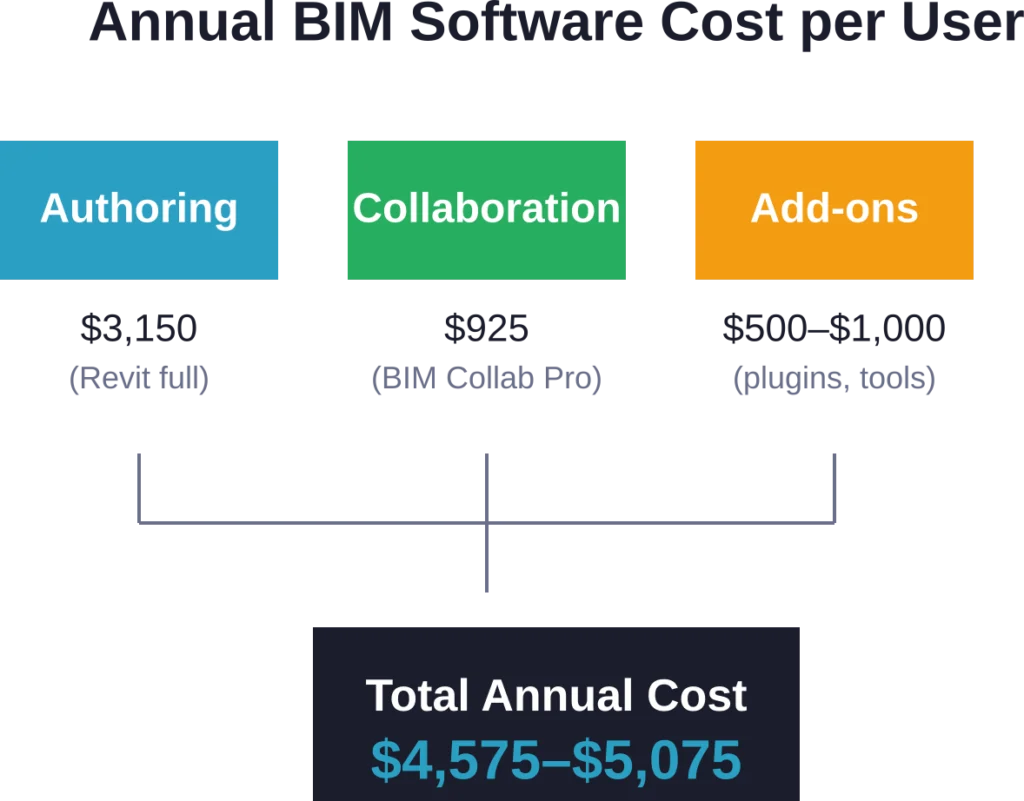
Autodesk Revit is the industry-standard BIM authoring software. As of 2026, the full version costs $262 per month or $3,150 annually. Revit LT, a lighter version with reduced functionality, runs $70 monthly or $560 annually.
Graphisoft Archicad offers architecture-focused BIM capabilities. Other authoring tools like Vectorworks and ArchiCAD provide specialized capabilities for specific workflows.
| Software | Vendor | Monthly Cost | Annual Cost | Notes |
|---|---|---|---|---|
| Autodesk Revit | Autodesk | $262 | $3,150 | Full version, industry standard |
| Revit LT | Autodesk | $70 | $560 | Limited features |
| Graphisoft Archicad | Graphisoft | Contact vendor | ~$3,000-$4,000 | Architecture-focused |
| Snaptrude Individual | Snaptrude | $60 | $720 | Cloud-based, collaborative |
| Snaptrude Organization | Snaptrude | $100 | $1,200 | Team features included |
Collaboration and Coordination Platforms
Beyond authoring, teams need collaboration platforms for model coordination, clash detection, and document management. These tools run separately from your core modeling software.
Autodesk Docs is available as part of BIM collaboration platforms. BIM Collaborate Pro is available through subscription-based pricing. Autodesk Build is oriented toward construction workflows with monthly subscription pricing.
Trimble Connect Pro offers a more affordable entry point for model coordination. BIMcollab Cloud focuses on issue management and clash coordination.
| Platform | Vendor | Monthly Cost | Annual Cost | Primary Use |
|---|---|---|---|---|
| Autodesk Docs | Autodesk | $62 | ~$400 | Document management |
| BIM Collaborate Pro | Autodesk | $78 | $925 | Design collaboration |
| Autodesk Build | Autodesk | $188 | $2,251 | Construction management |
| Trimble Connect Pro | Trimble | $19 | $149 | Model coordination |
| BIMcollab Cloud | BIMcollab | $19 | $149 | Issue tracking, BCF |
Here’s the thing though—most firms need multiple tools. A typical setup might include Revit for authoring, BIM Collaborate Pro for coordination, and a specialized clash detection tool. Annual software costs per seat easily reach $4,000–$6,000 once the full stack is assembled.
Hardware Requirements and Costs
BIM software demands capable workstations. Modeling complex projects with large file sizes requires robust processors, dedicated graphics cards, substantial RAM, and fast storage.
A typical BIM workstation setup runs around $3,000 per unit. That includes a multi-core processor (Intel i7/i9 or AMD Ryzen equivalent), 32-64GB RAM, NVIDIA RTX or similar professional graphics card, and SSD storage.
Cloud-based solutions reduce local hardware requirements but shift costs to monthly cloud computing fees. Some firms adopt hybrid approaches—local workstations for daily work, cloud resources for rendering and heavy processing tasks.
Laptops capable of running BIM software start around $2,000 but sacrifice performance compared to desktop workstations. For teams working on-site or traveling frequently, mobile capability matters despite the performance trade-off.
Training and Enablement Costs
Software licenses mean nothing if teams can’t use the tools effectively. Training represents a critical but often underestimated cost component.
Formal training courses range from $200 to $1,500 per course, depending on depth and delivery format. Multi-day workshops typically fall at the higher end. Online self-paced courses offer more affordable options but require strong self-discipline.
Larger firms often bring in trainers for on-site sessions. Custom training tailored to firm-specific workflows and standards costs more but delivers better practical outcomes than generic courses.
Ongoing learning matters too. BIM software updates regularly, adding features and changing workflows. Annual refresher training or continuous learning subscriptions add to long-term budgets.
Get BIM Design Support for Your Project
Powerkh works with architects, engineers, and contractors that need BIM design support during planning, coordination, and technical delivery stages. Its services include BIM modelling, coordination, detailing, and construction documentation for live building projects.
Need BIM Design Support?
Talk with Powerkh to:
- develop BIM models for design and coordination
- support structural and MEP project delivery
- prepare drawings and technical documentation
- improve collaboration across project teams
Contact Powerkh for a project review and consultation.
BIM Modeling Services: Project-Based Costs
Many firms outsource BIM modeling rather than building full in-house capacity. Service costs depend on project complexity, level of development required, building type, and timeline.
Cost Per Square Foot Pricing
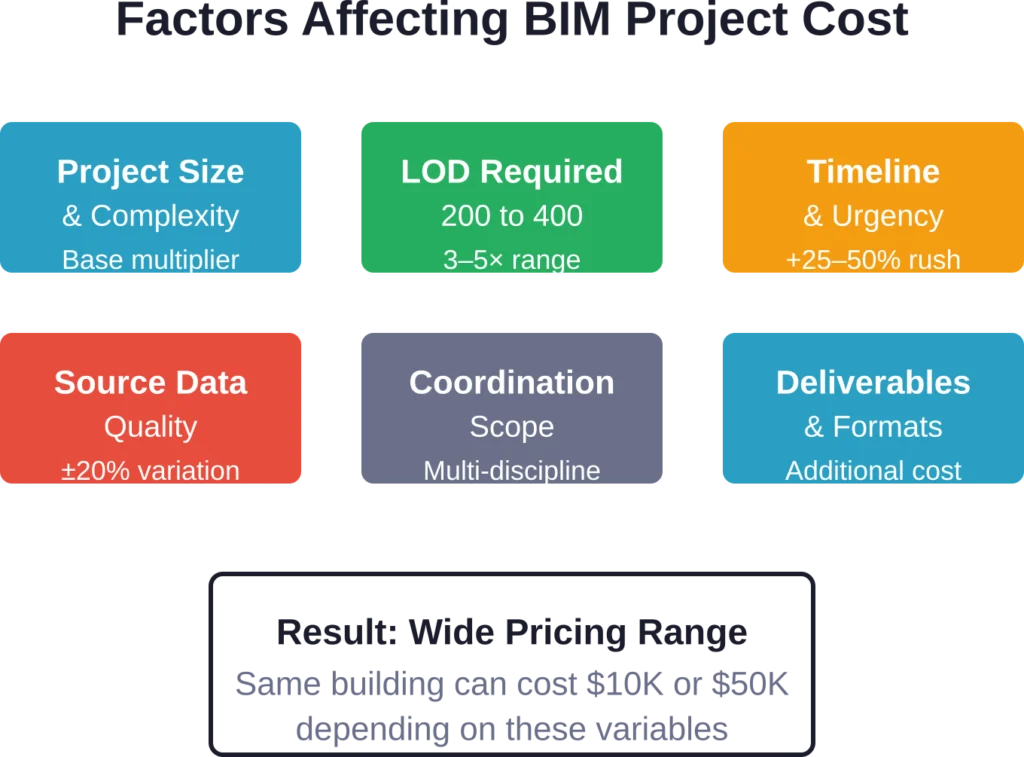
BIM modeling services typically price by square footage, with rates varying by LOD (Level of Development). A typical 50,000 square foot commercial building costs $7,500–$37,500 for BIM modeling, depending on detail level.
LOD 200 (generic elements for space planning and basic coordination) runs $0.15–$0.25 per square foot. LOD 300 (specific assemblies with accurate geometry) costs $0.25–$0.40 per square foot. LOD 350 (detailed elements for coordination and fabrication) ranges $0.40–$0.60 per square foot. LOD 400 (fabrication-ready with complete details) reaches $0.60–$0.75 per square foot.
The minimum project cost for most providers sits around $2,500 regardless of building size. Small projects don’t scale down proportionally—the base effort for project setup, coordination, and quality control remains constant.
| LOD Level | Cost Per Sqft | Example (50,000 SF) | Detail Level | Primary Use Case |
|---|---|---|---|---|
| LOD 200 | $0.15–$0.25 | $7,500–$12,500 | Generic elements | Space planning, basic coordination |
| LOD 300 | $0.25–$0.40 | $12,500–$20,000 | Specific assemblies | Design coordination, quantities |
| LOD 350 | $0.40–$0.60 | $20,000–$30,000 | Detailed coordination | Clash detection, MEP routing |
| LOD 400 | $0.60–$0.75 | $30,000–$37,500 | Fabrication-ready | Shop drawings, prefabrication |
Scan-to-BIM Projects
Scan-to-BIM services convert 3D laser scan data into intelligent BIM models for renovation, retrofit, or as-built documentation projects. Pricing includes both scanning and modeling components.
For a typical 50,000 square foot commercial building, 3D scanning costs $5,000–$15,000 depending on complexity and access constraints. BIM modeling from that scan data follows the per-square-foot rates above.
Total project cost combines both: scanning plus modeling. A 50,000 SF building at LOD 300 would cost approximately $5,000–$15,000 for scanning plus $12,500–$20,000 for modeling, totaling $17,500–$35,000.
Factors That Affect BIM Modeling Services Cost
Beyond square footage and LOD, several factors drive pricing variation:
Building type complexity: Industrial facilities with complex MEP systems cost more than simple office buildings. Healthcare facilities require extensive coordination. Residential projects tend toward the lower end of pricing ranges.
Timeline and urgency: Rush projects command premium rates, often 25–50% above standard pricing. Conversely, flexible timelines sometimes allow negotiated discounts.
Existing documentation quality: Clean, complete CAD drawings cost less to convert than poor-quality PDFs or hand sketches. Missing information requires assumptions and iterations.
Coordination requirements: Multi-discipline coordination (architectural + structural + MEP) requires more effort than single-discipline models. Clash detection and resolution add to project scope.
Deliverables and formats: Standard native Revit files represent the baseline. Additional formats (IFC, DWG exports, custom schedules, rendering views) add to scope and cost.
BIM Consultant and Specialist Rates
Consultants and freelance specialists help firms with BIM strategy, implementation, standards development, and specialized modeling tasks. Rates vary by role, expertise, and engagement type.
Typical Consultant Roles and Pricing
BIM consultants focusing on strategic planning, BIM Execution Plan development, and standards implementation typically charge $8,000–$10,000 for project engagements. These roles address process and standards rather than hands-on modeling.
BIM managers handling team coordination, quality control, and clash resolution oversight run $5,000–$8,000 per project or engagement. This role bridges strategy and execution.
BIM modelers performing actual 3D modeling, family creation, and documentation typically price by the hour or project scope rather than flat engagement fees. Rates depend heavily on specialization and complexity.
Freelance BIM professionals with coordination and cost estimating skills command premium rates compared to basic modeling skills. Specialized expertise in MEP coordination, structural detailing, or parametric design drives higher rates.
| Role | Primary Responsibilities | Typical Project Cost |
|---|---|---|
| BIM Consultant | Strategic planning, BEP development, standards implementation | $8,000–$10,000 |
| BIM Manager | Team coordination, quality control, clash resolution oversight | $5,000–$8,000 |
| BIM Modeler | 3D modeling, family creation, documentation, detailing | Varies by scope |
| BIM Coordinator | Clash detection, discipline coordination, issue resolution | Premium rates |
Implementation and Long-Term Costs
Beyond direct software, hardware, and service costs, BIM adoption involves implementation effort and ongoing expenses that firms sometimes overlook during initial budgeting.
Standards and Template Development
Effective BIM requires firm-specific standards, templates, families, and content libraries. Developing these assets takes time—either internal team effort or consultant engagement.
Template development, including view templates, sheet templates, annotation standards, and typical details, represents weeks of work for experienced users. Firms either invest internal time or hire consultants for this foundational work.
Family libraries—custom parametric components matching firm standards and common project requirements—require ongoing development and maintenance. Many firms underestimate the effort required to build quality content libraries.
Process Change and Workflow Integration
BIM changes how teams work. Process redesign, workflow documentation, and change management require investment beyond software and hardware.
Pilot projects test workflows and identify issues before full adoption. These projects typically take longer and cost more than traditional delivery as teams learn new tools and processes.
Integration with existing systems—document management, project management platforms, accounting software—requires configuration effort and sometimes custom development.
Ongoing Support and Maintenance
Annual software subscriptions continue indefinitely. Most firms also need ongoing IT support for BIM workstations, network infrastructure, and file management systems.
Content library maintenance, template updates for new software versions, and standards evolution require continuous attention. Firms either dedicate internal resources or maintain consultant relationships for periodic updates.
Cost-Saving Strategies
Smart firms reduce BIM costs without sacrificing capability or quality. Several proven approaches lower total cost of ownership.
Start with essential tools: New BIM users don’t need every software package immediately. Begin with core authoring software and basic coordination tools. Add specialized capabilities as specific project needs arise.
Leverage cloud-based options: Cloud platforms reduce upfront hardware investment and provide flexible scaling. Teams pay for what they use rather than maintaining excess capacity for peak periods.
Invest heavily in training: Counterintuitively, spending more on training reduces overall costs. Well-trained teams work faster, make fewer errors, and require less support. Poor training leads to inefficient workflows and wasted software licenses.
Outsource strategically: Build internal capacity for routine work but outsource specialized tasks or overflow work. This avoids maintaining full-time specialists for occasional needs.
Standardize and document: Firm standards and documented workflows reduce rework and training time for new team members. The upfront investment in standardization pays back quickly.
Use educational or startup licenses: Students and some startups qualify for reduced-cost or free licenses. Check vendor programs for eligibility—legitimate discounts can cut software costs by 90% during early growth phases.
Return on Investment: When BIM Pays Off
BIM costs money, but it also delivers measurable returns that justify the investment for most firms and projects.
The statistics show consistent benefits. With 74% of contractors reporting better constructability, 73% of owners gaining clearer design understanding, and 71% of engineers seeing improved quality, BIM delivers value across all project stakeholders.
Specific project outcomes demonstrate ROI. Documented projects show significant benefits such as reduction in RFIs through BIM coordination that translate directly to time and cost savings during construction. Case studies demonstrate how BIM coordination investments prevent costly construction disputes, showing how coordination catches expensive conflicts before they reach the field.
Beyond individual projects, BIM builds organizational capability. Firms develop libraries, templates, and expertise that reduce costs on subsequent projects. The learning curve is steep but front-loaded—later projects capture benefits without repeating initial setup costs.
Market positioning matters too. Clients increasingly expect or require BIM delivery. Firms without BIM capability lose access to certain project opportunities, regardless of technical merit in other areas.
Planning Your BIM Budget
So how should firms approach BIM budgeting? Start by identifying your specific needs and implementation path.
Small firms or individual practitioners: Budget $5,000–$8,000 for first-year software and training, plus $3,000 for hardware if upgrading. Consider cloud-based tools to reduce upfront costs. Outsource specialized modeling initially while building internal skills.
Mid-sized firms: Plan $15,000–$30,000 per seat for comprehensive first-year costs including software, hardware, training, and implementation support. Factor template development and standards creation. Build internal capability for common tasks but maintain consultant relationships for specialized needs.
Large firms or enterprise deployment: Budget comprehensively across software licensing (negotiated enterprise agreements), hardware refresh cycles, dedicated BIM management roles, ongoing training programs, and consultant support. Expect $50,000+ per year ongoing after initial implementation.
Project-specific modeling services: For owners or developers without in-house BIM teams, budget modeling services at $0.25–$0.50 per square foot for typical projects at LOD 300. Add 3D scanning costs ($0.10–$0.30 per square foot) for existing building projects requiring Scan-to-BIM conversion.
Frequently Asked Questions
Autodesk Revit, the market leader, costs $3,150 annually for the full version or $560 annually for Revit LT. Adding collaboration platforms like BIM Collaborate Pro ($925/year) and other tools brings total software costs to $4,000–$6,000 per user annually for a complete BIM software stack.
BIM modeling services typically range from $0.15 to $0.75 per square foot depending on Level of Development. LOD 200 runs $0.15–$0.25/sqft, LOD 300 costs $0.25–$0.40/sqft, LOD 350 ranges $0.40–$0.60/sqft, and LOD 400 reaches $0.60–$0.75/sqft. Project complexity, building type, and timeline affect final pricing within these ranges.
A typical BIM workstation costs around $3,000, including a multi-core processor, 32-64GB RAM, professional graphics card (NVIDIA RTX or similar), and SSD storage. High-end workstations for complex projects or rendering can reach $5,000–$7,000. Laptops capable of running BIM software start around $2,000 but offer less performance than desktop configurations.
BIM consultant rates vary by role and scope. Strategic consultants handling BIM Execution Plan development and standards implementation charge $8,000–$10,000 per engagement. BIM managers providing coordination and quality control oversight run $5,000–$8,000 per project. Specialized skills like MEP coordination and cost estimating command premium rates over basic modeling rates in 2026.
Industry data shows consistent positive ROI from BIM investment. 74% of contractors report better constructability, 73% of owners gain clearer design understanding, and documented projects show outcomes like 30% RFI reduction and dispute prevention worth 4× the coordination investment. The global BIM market is projected to reach $15.42 billion by 2030, reflecting widespread industry adoption driven by measurable value delivery.
Scan-to-BIM projects combine 3D scanning and modeling costs. For a 50,000 square foot commercial building, expect $5,000–$15,000 for scanning plus $12,500–$20,000 for LOD 300 modeling, totaling $17,500–$35,000. Minimum project costs typically start around $2,500 regardless of building size due to base setup and coordination effort.
The six primary cost drivers are project size and complexity (base scope), required Level of Development (3–5× range from LOD 200 to LOD 400), timeline urgency (rush projects cost 25–50% more), source data quality (±20% variation), coordination scope (multi-discipline coordination requires more effort), and deliverables format requirements (additional exports and custom outputs add cost).
Conclusion: Investing in BIM Strategically
BIM costs vary dramatically based on implementation scope, project requirements, and organizational context. But the pricing patterns are consistent and predictable once the key variables are understood.
Software subscriptions run $4,000–$6,000 per user annually. Workstations cost around $3,000 each. Training requires $200–$1,500 per course. Modeling services price at $0.15–$0.75 per square foot depending on detail level. Consultants charge $5,000–$10,000 for strategic engagements.
These investments deliver measurable returns. The statistics show it: 74% better constructability, 73% clearer design understanding, 30% fewer RFIs, and documented examples of coordination preventing costs worth 4× the BIM investment.
The key is strategic budgeting. Match BIM capability to actual project needs rather than over-buying capacity. Invest heavily in training to maximize software value. Build internal expertise for routine work while outsourcing specialized tasks. Develop standards and templates that reduce costs on future projects.
BIM isn’t cheap. But for firms and projects of sufficient scale and complexity, it pays for itself through coordination value, error reduction, and improved project outcomes.
Ready to implement BIM or expand your current capabilities? Start with clear requirements, realistic budgets, and a phased implementation plan that builds capability progressively rather than attempting everything at once.