

Quick Summary: Building Information Modeling services typically cost between $0.30 and $0.90 per square foot, with total project costs ranging from $5,000 for small residential projects to over $100,000 for complex commercial builds. Pricing depends on factors like project complexity, level of detail required, model type, software licenses, and whether services include clash detection or coordination. Most providers offer per-square-foot, fixed-project, or hourly billing models.
Building Information Modeling has shifted from a luxury to a necessity in construction and design workflows. But one question keeps coming up: what does it actually cost?
The answer isn’t simple. BIM pricing varies wildly based on project scope, complexity, deliverables, and provider expertise. Some residential projects start around $5,000, while large-scale commercial developments can push past six figures.
This guide breaks down typical cost ranges, pricing structures, and the factors that drive BIM service expenses. Whether you’re an architect budgeting for a small renovation or a contractor planning a major commercial build, you’ll find actionable insights to estimate costs accurately.
What Are Building Information Modeling Services?
Building Information Modeling services create digital representations of physical buildings and infrastructure. These aren’t just 3D visualizations—they’re data-rich models containing detailed information about materials, dimensions, systems, and construction sequences.
A BIM model includes architectural elements, structural components, mechanical systems, electrical layouts, and plumbing networks. Everything exists in a coordinated digital environment where changes in one discipline automatically affect related elements.
According to buildingSMART’s June 2025 publication ‘Valuing BIM Data: Accounting for Digital Assets’, BIM data is increasingly recognised for its role in reducing operational costs and improving efficiency in facility management. The value extends beyond initial design into long-term building operation.
Services typically include model creation from architectural drawings, clash detection between different building systems, construction documentation, and coordination across multiple disciplines. Some providers offer specialized services like scan-to-BIM conversion, where existing buildings are laser scanned and converted into accurate digital models.
Typical BIM Service Cost Ranges
Pricing structures vary significantly based on project scale and complexity. Here’s what the market data shows for 2026.
Per Square Foot Pricing
Most BIM providers charge between $0.30 and $0.90 per square foot for standard 3D modeling services. This range reflects different levels of detail and complexity.
Lower rates around $0.30 per square foot typically apply to basic residential models with straightforward geometry and minimal systems coordination. Higher rates near $0.90 per square foot cover detailed commercial projects requiring extensive MEP coordination, advanced clash detection, and construction-level documentation.
The per-square-foot model works well for projects where building area is clearly defined and scope remains relatively stable throughout the modeling process.
Total Project Costs
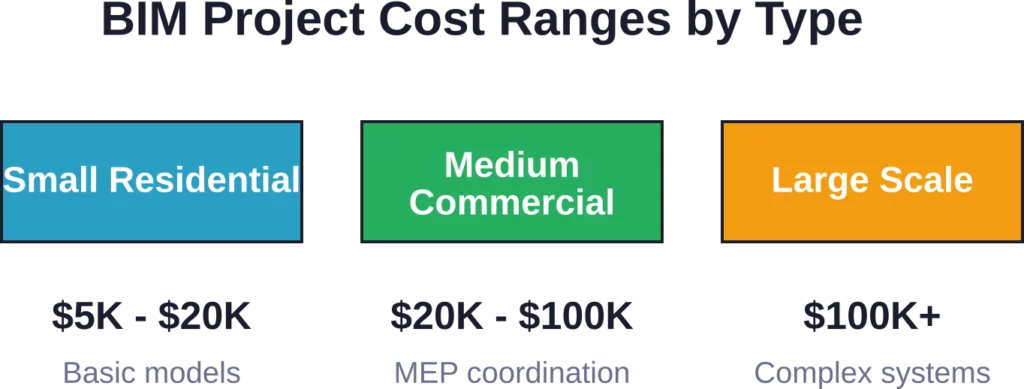
When looking at complete project budgets, typical ranges fall into these categories:
- Small residential projects: $5,000 to $20,000 for basic models with lower complexity
- Medium commercial projects: $20,000 to $100,000 or more depending on systems integration and coordination requirements
- Large-scale developments: Can exceed $100,000 when multiple buildings, complex MEP systems, and extensive coordination are involved
These figures represent U.S. market data and can vary significantly by geographic region, provider expertise, and specific project requirements.
Common BIM Pricing Models
Providers structure their fees in several ways. Understanding these models helps you evaluate quotes and compare options effectively.
Per-Square-Foot Billing
This model charges a fixed rate multiplied by the building’s total square footage. It’s transparent and easy to calculate, making it popular for straightforward projects with well-defined scope.
The approach works best when project complexity is relatively uniform across the entire building area. It becomes less accurate for buildings with dramatically different zones—say, a luxury hotel with both simple guest rooms and complex public spaces.
Fixed Project Fee
A flat fee covers all modeling work regardless of hours spent. This structure provides budget certainty but requires careful scope definition upfront.
Fixed fees work well when both parties clearly understand deliverables, level of detail, revision rounds, and coordination requirements. Ambiguity in scope often leads to disputes or change orders that inflate the final cost.
Hourly or Time-Based Rates
Some providers bill by the hour, typically ranging from $75 to $200 per hour depending on expertise level and project complexity. Senior BIM specialists and coordination experts command higher rates.
This model suits projects where scope evolves during development or when extensive coordination and problem-solving are anticipated. The downside? Final costs remain uncertain until work completes.
Hybrid Approaches
Many firms combine models—perhaps a fixed fee for initial modeling with hourly rates for coordination meetings, clash detection reviews, and design changes. This balances predictability with flexibility.
| Pricing Model | Best For | Pros | Cons |
|---|---|---|---|
| Per Square Foot | Standard projects with uniform complexity | Easy to calculate, transparent | May not reflect actual complexity variations |
| Fixed Project Fee | Well-defined scope and deliverables | Budget certainty, predictable costs | Requires detailed scope agreement upfront |
| Hourly Rate | Evolving scope, extensive coordination needs | Flexible, pays for actual work performed | Final cost uncertain until completion |
| Hybrid | Projects needing both structure and flexibility | Balances predictability with adaptability | More complex contract terms to negotiate |
Key Factors That Drive BIM Service Costs
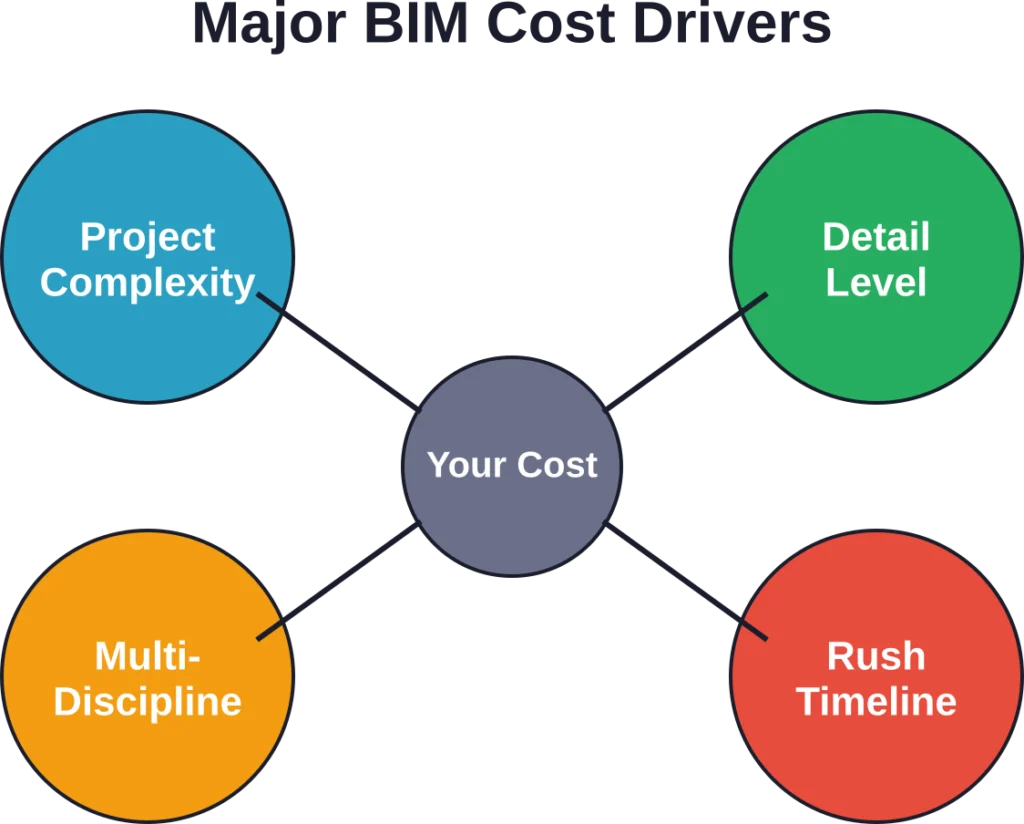
Several variables influence what you’ll pay for building information modeling services. Understanding these helps you anticipate expenses and make informed decisions.
Project Complexity and Size
A simple rectangular warehouse requires far less modeling effort than a hospital with intricate MEP systems, specialized equipment, and strict regulatory requirements. Complex geometry, curved surfaces, and unique architectural features increase modeling time substantially.
Building size matters, but it’s not the only factor. A 50,000-square-foot data center with dense mechanical systems often costs more to model per square foot than a 100,000-square-foot warehouse with minimal systems.
Level of Detail Required
BIM models exist at different development levels, from conceptual massing to construction-ready documentation with fabrication details. Higher detail levels demand more time and expertise.
A conceptual model showing basic building volumes and spatial relationships requires minimal effort. A construction-level model with exact dimensions, connections, fabrication details, and shop-drawing-ready information multiplies the workload several times over.
Model Type and Disciplines
An architectural model alone costs less than a fully coordinated multi-discipline model. When structural, mechanical, electrical, plumbing, and fire protection systems all need modeling and coordination, costs rise accordingly.
Clash detection between disciplines adds value but increases fees. Identifying conflicts between ductwork and structural beams before construction prevents costly field changes, but the coordination process requires specialized expertise and time.
Software and Licensing
BIM software like Revit, ArchiCAD, and Navisworks requires substantial investment. Core BIM licenses represent recurring fixed costs that providers factor into their pricing.
Analysis of operational expenses shows software licenses can reach several thousand dollars annually per seat. These costs get distributed across projects, affecting overall service pricing.
Existing Documentation Quality
Starting from well-organized CAD drawings costs less than working from poor-quality scans or hand sketches. If existing documentation contains errors, inconsistencies, or gaps, modelers spend extra time clarifying and correcting information.
Scan-to-BIM projects starting from laser scan data involve specialized processing and interpretation, typically commanding premium rates compared to CAD-to-BIM conversions.
Timeline and Turnaround
Standard turnaround times fit normal production schedules. Rush projects requiring overtime or pulled resources from other work typically incur premium charges of 25-50% or more above standard rates.
Get BIM Services Support for Design and Construction
Powerkh works with architects, engineers, contractors, and developers that need BIM support during project delivery. Its services include modelling, coordination, detailing, Scan to BIM, and technical documentation.
Need BIM Services Support?
Talk with Powerkh to:
- develop BIM models for coordination and delivery
- support structural and MEP workflows
- prepare construction-ready documentation
- improve coordination before construction starts
Review your BIM delivery requirements with the Powerkh team.
Hidden Costs and Unexpected Expenses
Beyond base modeling fees, several additional expenses can surprise those budgeting BIM services for the first time.
Revision Cycles
Most contracts include a limited number of revision rounds—often two or three. Beyond that, changes trigger additional fees. Design teams that iterate extensively or change direction mid-project see costs escalate.
Establishing clear approval processes and decision-making protocols minimizes unnecessary revision cycles.
Coordination Meetings
Weekly or biweekly coordination sessions where BIM specialists review models with design teams often bill separately from base modeling work. A complex project might require 20-30 hours of meeting time throughout development.
Specialized Add-Ons
Services like 4D construction sequencing, 5D cost estimation integration, energy analysis, or daylighting studies typically cost extra. These specialized analyses require additional software tools and expertise beyond standard 3D modeling.
File Format Conversions
Delivering models in multiple formats—Revit, IFC, DWG, PDF—might incur additional charges, particularly for less common export formats requiring manual cleanup or verification.
Model Hosting and Collaboration Platforms
Cloud-based collaboration platforms like BIM 360 or Trimble Connect facilitate model sharing and coordination. Some providers include hosting costs in their fees; others bill separately or expect clients to provide platform access.
Running Costs for BIM Service Businesses
Understanding provider operational expenses helps contextualize the rates they charge. Industry analysis reveals the typical cost structure behind BIM services.
Staff Wages
Payroll represents the largest expense category. Core teams typically include lead BIM specialists, senior modelers, and support staff. Fixed payroll costs can represent significant monthly overhead that must be covered regardless of project volume.
Software Licensing
Core BIM software subscriptions constitute major recurring fixed costs. Enterprise licenses for teams of 10-20 users can reach thousands of dollars monthly, distributed across project fees.
Office and Infrastructure
Office space rent represents consistent fixed overhead. Analysis shows dedicated co-working or office space for BIM teams often runs around $3,500 per month in many U.S. markets.
High-performance workstations capable of handling large BIM models require substantial investment—often $2,000-4,000 per seat for hardware that needs replacement every 3-4 years.
Marketing and Client Acquisition
Customer acquisition costs in the BIM services market can be substantial. Industry data suggests CAC figures around $2,500 per client, with annual marketing budgets translating to roughly $2,083 monthly for growing firms.
Variable Project Costs
Analyses indicate variable costs are typically estimated at 20% of total revenue. If revenue hits $50,000, variable costs add approximately $10,000 to operational budgets.
How to Budget for BIM Services
Smart budgeting starts early in project planning. Here’s how to approach cost estimation effectively.
Define Your Requirements Clearly
The more precisely you specify deliverables, detail levels, disciplines, and coordination needs, the more accurate quotes will be. Ambiguous scope leads to cost surprises later.
Create a detailed scope document outlining building size, complexity, systems to be modeled, level of detail required, file formats needed, revision rounds included, and coordination meeting frequency.
Get Multiple Quotes
Request proposals from at least three providers with relevant experience. Compare not just pricing but qualifications, portfolio work, turnaround times, and service inclusions.
Beware of quotes significantly below market rates—they often signal inexperience, offshore teams with quality control issues, or scope gaps that lead to change orders later.
Build in Contingency
Add 15-20% contingency to your BIM budget for inevitable design changes, additional coordination needs, or scope clarifications. Projects rarely proceed exactly as initially planned.
Consider Phased Approaches
For large projects, phasing BIM work can spread costs and align expenses with project milestones. Start with conceptual modeling, then add detail as design develops and funding becomes available.
Evaluate Long-Term Value
According to buildingSMART’s June 2025 publication ‘Valuing BIM Data: Accounting for Digital Assets’, BIM data is increasingly recognised for its role in reducing operational costs and improving efficiency in facility management. Don’t focus solely on upfront modeling costs—consider the downstream benefits.
Clash detection saving even one major field conflict can justify entire BIM expenditures. Accurate as-built models reduce facility management costs for decades. Factor total lifecycle value into budget decisions.
Selecting the Right BIM Service Provider
Cost matters, but choosing the lowest bidder often backfires. Evaluate providers holistically.
Experience and Portfolio
Review completed projects similar to yours in size, complexity, and building type. A provider experienced in healthcare facilities brings specialized knowledge that justifies premium pricing over generalists.
Technical Capabilities
Verify software proficiency, particularly in tools your project requires. Check capabilities in specialized areas like clash detection, 4D scheduling, or energy modeling if needed.
Communication and Collaboration
BIM work requires ongoing dialogue between modelers and design teams. Assess responsiveness, clarity of communication, and willingness to participate in coordination meetings.
Time zone differences matter for offshore providers. Real-time collaboration becomes challenging when teams work opposite schedules.
Quality Assurance Processes
Ask about internal quality control procedures. How do they verify accuracy? What review processes catch errors before delivery? Strong QA protocols prevent costly rework.
References and Track Record
Request client references and follow up. Ask about communication quality, adherence to schedules, handling of revisions, and overall satisfaction.
| Evaluation Criteria | Questions to Ask | Red Flags |
|---|---|---|
| Relevant Experience | Have you completed projects of this type and size? | No similar projects in portfolio |
| Technical Expertise | Which software platforms do you use? What specialized capabilities do you offer? | Limited to basic modeling, no coordination experience |
| Team Structure | Who will work on my project? What are their qualifications? | Unwilling to share team credentials |
| Timeline Realism | What’s your typical turnaround? How do you handle rush requests? | Promises unrealistic delivery schedules |
| Contract Terms | What’s included in base fee? How are changes handled? | Vague scope definition, no revision policy |
BIM Market Growth and Future Trends
The building information modeling market continues expanding rapidly. According to MarketsandMarkets, the global Building Information Modeling market was valued at USD 8.0 billion in 2024 and is expected to grow to USD 9.04 billion in coming years.
Several trends are shaping pricing and service offerings:
Cloud-based collaboration is becoming standard, reducing software infrastructure costs while enabling distributed teams. This may gradually lower service costs as providers leverage global talent pools more efficiently.
Artificial intelligence and automation tools are beginning to streamline repetitive modeling tasks. As these technologies mature, they could reduce labor requirements and potentially lower costs for standard projects.
Government mandates requiring BIM on public projects continue expanding. Building information services are available through the GSA’s Multiple Award Schedule (MAS) program, which provides federal, state, local, and tribal governments with access to commercial products and services. Increased demand from mandates may support current pricing levels or even push costs higher in the short term.
Integration with other technologies like laser scanning, drones, and IoT sensors creates new service categories. These specialized offerings command premium pricing but deliver enhanced value.
Real Talk: Is BIM Worth the Cost?
For most projects above a certain complexity threshold, yes—but not universally.
Simple projects with minimal systems coordination may not justify BIM expenses. A straightforward residential addition or small renovation often works fine with traditional 2D documentation.
But for commercial construction, multi-story buildings, projects with complex MEP systems, or developments requiring coordination among multiple contractors, BIM typically pays for itself through:
- Reduced field conflicts and change orders
- Faster construction timelines from better coordination
- More accurate material takeoffs and cost estimates
- Improved communication among project stakeholders
- As-built documentation supporting efficient facility management
Community discussions among construction professionals consistently emphasize that catching a single major clash during coordination can save tens of thousands in field corrections—often justifying the entire BIM investment.
The key is matching BIM scope and detail to actual project needs. Don’t over-invest in unnecessary detail, but don’t skimp on coordination for projects where conflicts are likely.
Frequently Asked Questions
Generally speaking, projects above 5,000 square feet with multiple building systems start seeing clear ROI from BIM. Smaller residential projects under 3,000 square feet with simple systems often don’t justify the cost unless specific coordination challenges exist or jurisdictions require digital submissions.
Timeline depends on project complexity and size. A simple residential model might take 1-2 weeks, while a large commercial building with full MEP coordination can require 8-12 weeks or more. Rush projects are possible but typically incur premium charges of 25-50% above standard rates.
Absolutely. Well-organized, accurate CAD drawings or high-quality laser scan data significantly reduce modeling time. Conversely, poor documentation with errors, inconsistencies, or missing information forces modelers to spend extra time clarifying details, increasing costs. Investing in quality source material pays dividends in lower modeling fees.
It depends on project volume. If your firm consistently works on projects requiring BIM coordination, an in-house specialist makes sense despite the fixed salary, software, and equipment costs. For occasional projects or firms with variable workload, outsourcing offers flexibility without fixed overhead. Many mid-size firms maintain lean in-house BIM capabilities and outsource overflow or specialized work.
Offshore providers in countries like India and the Philippines often charge 30-50% less than U.S.-based firms. However, consider trade-offs including time zone differences that complicate real-time communication, potential quality variations requiring more review time, and occasional language barriers. For projects requiring extensive coordination meetings, domestic providers may deliver better value despite higher rates.
A basic or conceptual BIM model includes primary building geometry, major spaces, and general system layouts—sufficient for design development and preliminary coordination. Construction-level models add precise dimensions, connection details, fabrication information, and extensive clash detection across all disciplines. Construction models typically cost 2-3 times more than basic models due to increased detail and coordination requirements.
Request detailed breakdowns showing what’s included in quoted prices. Compare quotes using a common scope document so you’re truly comparing apples to apples. Ask providers to specify level of detail, number of revision rounds, disciplines included, coordination meeting allowances, and file formats delivered. Quotes missing these specifics likely hide scope gaps that surface as change orders later.
Making Your BIM Investment Work
Building information modeling services represent a significant investment, with costs ranging from several thousand dollars for small residential projects to well over $100,000 for complex commercial developments.
The typical range of $0.30 to $0.90 per square foot provides a useful starting point for budgeting, but actual costs depend heavily on project complexity, detail requirements, multi-discipline coordination needs, and timeline constraints.
Smart buyers define scope clearly, get multiple competitive quotes, and evaluate providers on experience and capabilities—not just price. Building 15-20% contingency into budgets prevents surprises when inevitable design changes or coordination needs arise.
Most importantly, view BIM as an investment rather than an expense. The technology’s ability to identify conflicts before construction, improve coordination among trades, and create valuable as-built documentation typically delivers returns that dwarf upfront modeling costs.
Ready to move forward with BIM services? Start by documenting your project requirements in detail, then reach out to qualified providers with relevant experience in your building type. Request detailed proposals that clearly specify deliverables, and don’t hesitate to ask questions until you fully understand what you’re buying.
The construction industry’s digital transformation continues accelerating. Projects that leverage BIM effectively enjoy smoother construction processes, fewer costly surprises, and better long-term facility management. The question isn’t whether to invest in BIM—it’s how to invest wisely.