
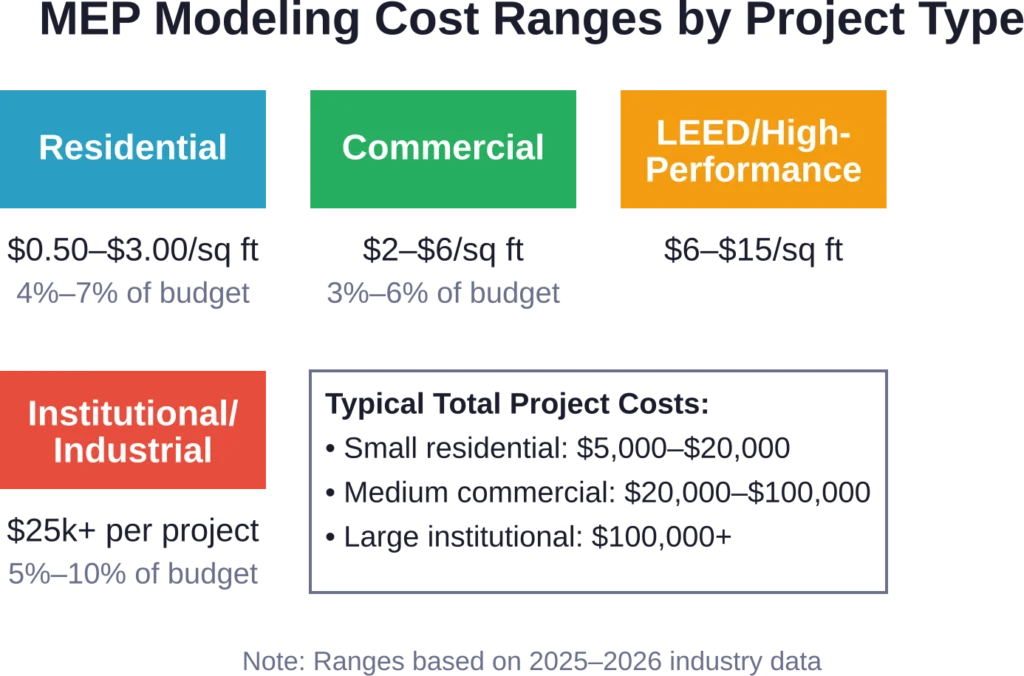
Quick Summary: MEP modeling costs typically range from $0.50 to $3.00 per square foot for residential projects, with design services representing a percentage of total construction budgets depending on project complexity. Commercial projects often fall within $2–$6/sq ft for standard services, while high-performance or LEED projects can reach $6–$15/sq ft. The final cost depends on building type, level of detail required, and whether hourly billing or per-square-foot pricing is used.
Planning a construction or renovation project means budgeting for mechanical, electrical, and plumbing systems—and that means understanding MEP modeling costs. Whether working on a small residential retrofit or a large commercial facility, the price tag for MEP design and BIM modeling services varies dramatically based on project scope, complexity, and deliverables.
Here’s the thing though—there’s no single number that fits every project. Instead, pricing follows clear patterns based on building type, system complexity, and the level of detail required in the final model.
This guide breaks down the real costs, pricing models, and factors that drive MEP modeling expenses in 2026.
Understanding MEP Modeling and Design Services
MEP modeling refers to the creation of digital representations of mechanical, electrical, and plumbing systems within a building. These models serve as the blueprint for installation, coordination, and maintenance throughout the building’s lifecycle.
An experienced MEP engineering company typically provides HVAC design and load calculations, electrical system layouts with power distribution and lighting plans, plumbing design for water supply and drainage, energy modeling, and BIM coordination services.
The models themselves can range from basic schematic layouts to highly detailed, construction-ready documents that include every valve, fixture, duct fitting, and conduit run. That range in detail directly correlates with cost.
Typical Cost Ranges for MEP Modeling in 2026
Industry data from 2025 and early 2026 reveals clear pricing patterns across different project types. These numbers provide a starting point for budget planning, though actual quotes will vary based on specific requirements.
Residential Projects
For residential projects in California, MEP design services typically cost between $0.50 to $3.00 per square foot, according to data published in September 2025. A 5,000 square foot residential project might see total MEP design expenses ranging from $2,500 to $15,000.
Real talk: simpler single-family homes with standard HVAC and plumbing land at the lower end. Custom homes with radiant heating, complex lighting control systems, or high-efficiency mechanical systems push toward the upper range.
Commercial Buildings
Commercial projects show different pricing dynamics. For large commercial buildings or repeatable layouts, rates typically range from $0.50 to $3.00 per square foot for standard projects.
A small office building around 10,000 square feet at LOD 300 (Level of Development 300, which includes specific sizes, shapes, and locations) might budget between $6,000 and $10,000 for a complete MEP model.
High-Performance and LEED Projects
Projects pursuing LEED certification or other high-performance standards require additional analysis, documentation, and coordination. These projects typically cost $6–$15 per square foot for MEP design services in 2025.
The premium reflects energy modeling requirements, daylighting studies, water use calculations, and the additional coordination needed to meet sustainability targets.
Institutional and Industrial Facilities
Hospitals, laboratories, data centers, and manufacturing facilities represent the most complex MEP environments. These projects often start around $25,000 for detailed models and can extend well beyond $100,000 for large facilities.
Medical facilities require specialized ventilation, redundant power systems, medical gas distribution, and infection control measures. Data centers demand precision cooling, massive electrical infrastructure, and backup systems. That complexity drives costs upward.
Common Pricing Models for MEP Services
MEP design and modeling firms use several pricing structures. Understanding these models helps compare quotes and budget effectively.
Per Square Foot Pricing
This model bases fees on building area. It works well for straightforward projects with clear scope and provides easy budget estimation.
For large commercial buildings or repeatable layouts, rates typically range from $0.50 to $3.00 per square foot for standard projects. Complex facilities like hospitals can reach higher per-square-foot rates.
The advantage? Simplicity. The limitation? It doesn’t always capture true complexity—a 10,000 square foot laboratory costs far more per square foot than a 10,000 square foot warehouse.
Percentage of Construction Cost
Some firms price services as a percentage of the total construction budget. This approach scales fees proportionally to project size and inherently accounts for project complexity, since more complex projects typically have higher construction costs.
MEP design services constitute a percentage of overall construction cost. Typical percentages for residential, commercial, and institutional projects vary based on scope and complexity.
Hourly Billing Rates
Hourly billing provides maximum flexibility for projects with uncertain scope or phased work. Typical hourly rates for MEP engineering services range from approximately $75–$125 for junior engineers, $150–$250 for senior engineers, and $200–$300+ for principal engineers or consultants, though rates vary by location and firm.
Professional engineering sources note that engineers of record charge $200+ per hour.
Hourly billing works best for consulting, troubleshooting, design review, or projects where scope evolves during design.
Fixed-Fee Contracts
Fixed fees provide cost certainty for both parties. The firm quotes a lump sum for defined deliverables. This approach requires clear scope definition upfront and works well when project parameters are stable.
Changes to scope typically trigger additional fees, so clarity on what’s included matters enormously.
Get MEP Modelling Support for Complex Projects
Powerkh supports project teams with MEP BIM modelling, coordination, and technical documentation during developed and technical design stages. Its services help teams manage coordination and delivery across mechanical, electrical, and plumbing systems.
Need MEP Modelling Support?
Talk with Powerkh to:
- develop coordinated MEP BIM models
- support plant room and riser coordination
- prepare technical drawings and documentation
- identify clashes before construction begins
Discuss your MEP coordination requirements with Powerkh.
Key Factors That Drive MEP Modeling Costs
Several variables influence final pricing. Understanding these helps explain quote variations and identifies opportunities to control costs.
Level of Detail (LOD)
BIM models use standardized LOD classifications ranging from 100 (conceptual) to 500 (as-built). Higher LOD means more detailed geometry, more accurate specifications, and more time.
LOD 200 provides generic representations suitable for early design. LOD 300 includes specific assemblies with accurate sizes and locations—this is common for construction documents. LOD 400 adds fabrication-level detail with connection specifics.
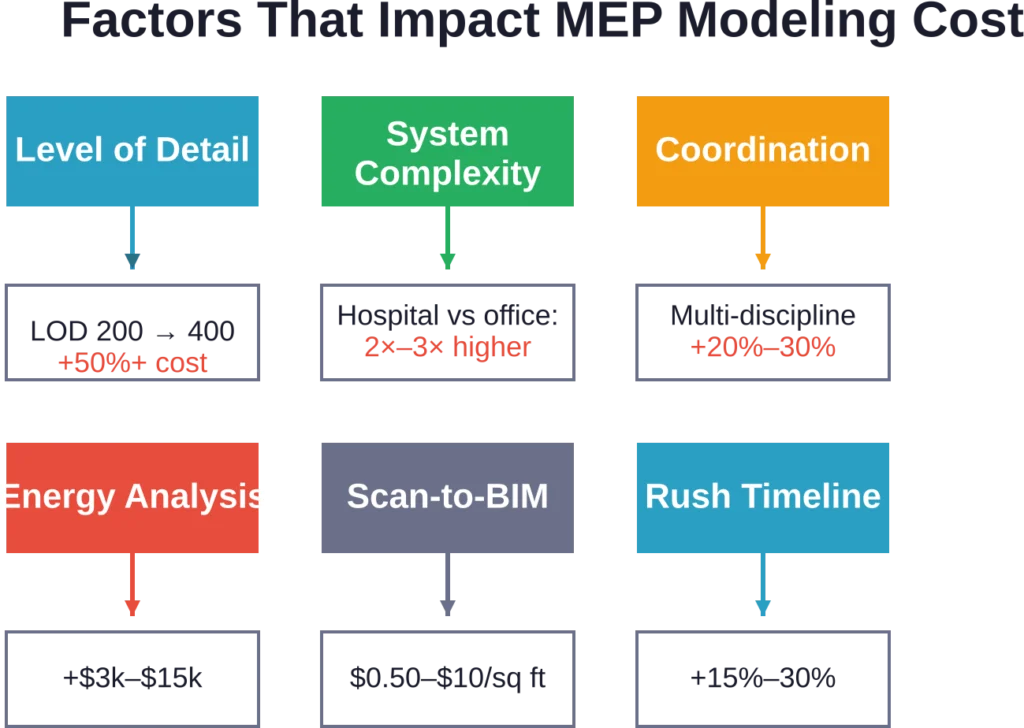
The jump from LOD 300 to LOD 400 can increase modeling costs by 50% or more, but provides shop-drawing-ready information.
Building Type and System Complexity
A simple office with VAV HVAC, standard electrical service, and conventional plumbing requires far less engineering than a hospital with multiple air handling systems, emergency power, medical gas distribution, and specialized drainage.
Data centers, laboratories, cleanrooms, and industrial facilities all demand specialized MEP knowledge and more extensive coordination—factors that increase both time and cost.
Coordination Requirements
Projects requiring coordination with structural and architectural models add time. Clash detection, coordination meetings, and iterative model updates all consume hours.
Multi-discipline coordination is essential for avoiding costly field conflicts, but it represents a significant portion of total modeling effort.
Energy Modeling and Analysis
Projects pursuing energy code compliance beyond minimum requirements, LEED certification, or utility incentives require energy modeling. This involves creating thermal models, running simulations, and optimizing system selections.
Energy analysis can add $3,000 to $15,000 or more to project costs depending on building size and certification goals.
Existing Conditions and Scan-to-BIM
Renovation and retrofit projects require documenting existing conditions. Laser scanning captures spatial data, then modelers convert point clouds into BIM geometry—a process called scan-to-BIM.
Scan-to-BIM modeling fees can range from $0.50 up to $10+ per square foot depending on complexity and detail level. On a project basis, small residential projects might cost $5,000 to $20,000 for basic models, while medium commercial projects can reach $20,000 to $100,000 or more.
A typical 50,000 square foot commercial building costs $7,500–$37,500 for BIM modeling, plus $5,000–$15,000 for the 3D scanning that provides source data.
Software and Deliverable Format
Most MEP modeling uses Autodesk Revit as the native platform. However, deliverables might include Revit files, IFC files for interoperability, Navisworks coordination models, or 2D drawing sets extracted from the model.
Each additional format or deliverable type requires processing time and quality control, potentially adding to costs.
Timeline and Expediting
Compressed schedules require more simultaneous staff resources or overtime hours. Rush projects typically carry premium fees—15% to 30% above standard rates isn’t uncommon.
Cost Breakdown by MEP Discipline
Sometimes MEP services are priced by individual discipline rather than as a package. Understanding typical splits helps evaluate detailed quotes.
Mechanical Systems
Mechanical design typically represents the largest portion of MEP costs—often 40%–50% of total MEP fees. This covers HVAC equipment selection, ductwork layouts, load calculations, ventilation analysis, and control systems.
Complex mechanical systems like those in healthcare or laboratory environments require specialized knowledge and extensive calculation, justifying the higher proportion.
Electrical Systems
Electrical design usually accounts for 30%–40% of MEP costs. This includes power distribution, lighting design, equipment connections, emergency power systems, and fire alarm layouts.
For example, electrical modeling alone may cost anywhere from $3,000 to $8,000 depending on system density and project requirements.
Plumbing and Fire Protection
Plumbing typically represents 20%–30% of total MEP costs. This covers domestic water distribution, sanitary and storm drainage, natural gas piping, and fire protection systems.
Fire protection can be quoted separately in some cases, particularly for complex suppression systems or when specialized fire protection engineers handle the design.
Real Project Examples and Budget Benchmarks
Abstract ranges help, but real scenarios provide context. Here are typical budget benchmarks based on industry data:
| Project Type | Size | LOD | Typical Cost Range |
|---|---|---|---|
| Small Residential | 2,500 sq ft | 300 | $1,250–$7,500 |
| Medium Residential | 5,000 sq ft | 300 | $2,500–$15,000 |
| Small Office | 10,000 sq ft | 300 | $6,000–$10,000 |
| Mid-Size Office | 50,000 sq ft | 300 | $25,000–$100,000 |
| Retail Space | 15,000 sq ft | 300 | $7,500–$45,000 |
| Hospital/Lab | 30,000 sq ft | 400 | $75,000–$300,000+ |
These ranges assume complete MEP design and coordination services at the indicated LOD. Basic schematic design costs less; construction administration and commissioning support add more.
Hidden Costs and Budget Considerations
Several expenses don’t always appear in initial quotes but can affect final project costs:
Revisions and Scope Changes
Design changes after initial modeling is complete require rework. Major revisions can consume significant additional hours, particularly if they affect coordinated systems.
Clear scope definition and disciplined change management minimize revision costs.
Permitting and Code Compliance Documentation
Some jurisdictions require specific calculations, reports, or drawing formats for permit submission. Creating these deliverables takes time beyond basic model development.
California projects, for example, must comply with Title 24 energy standards, which requires specific documentation and compliance calculations.
Construction Administration Support
Many design contracts include limited construction administration hours. Extended CA support—answering contractor questions, reviewing submittals, attending coordination meetings—adds costs.
Typical CA fees might add 10%–20% to base design costs.
As-Built Documentation
Updating models to reflect as-built conditions requires field verification and model updates. This creates a valuable record for facility management but represents additional scope beyond design services.
How to Get Accurate Quotes and Control Costs
Several strategies help secure accurate quotes and avoid budget overruns.
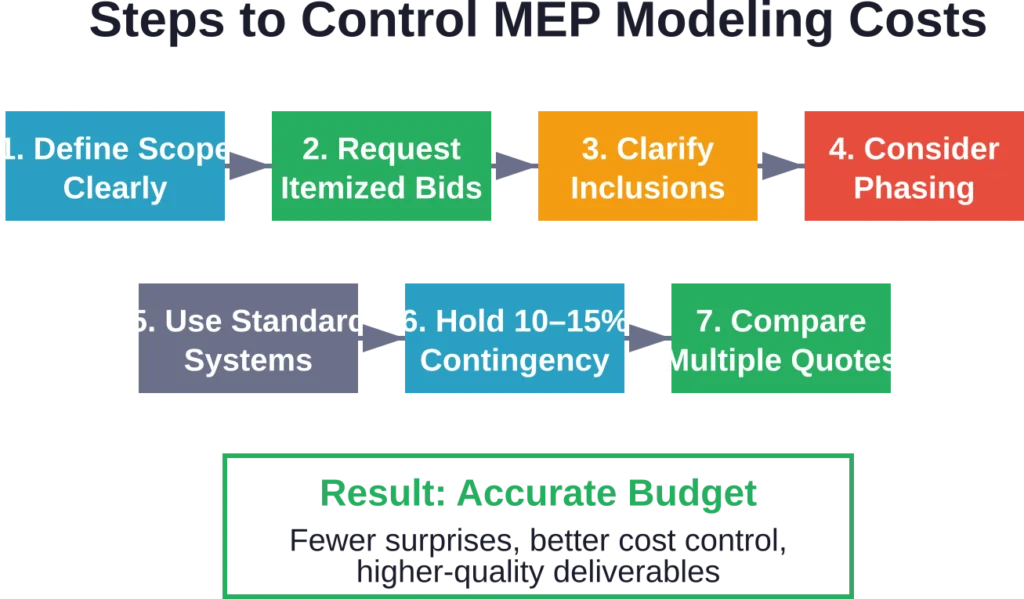
Define Scope Clearly
The more specific the scope, the more accurate the quote. Provide building type, square footage, system types, LOD requirements, and deliverable formats.
Vague requests yield vague estimates. Detailed RFPs yield competitive, accurate proposals.
Request Itemized Proposals
Ask firms to break down costs by discipline, by deliverable, or by phase. This reveals where budget goes and allows selective scope adjustment if needed.
Itemization also makes comparing proposals easier since different firms might bundle services differently.
Understand What’s Included
Does the quote include energy analysis? Coordination meetings? Permitting support? How many review cycles? How many site visits?
Clarifying inclusions prevents surprise bills later.
Consider Phased Approaches
For uncertain projects, consider phased contracts. Start with schematic design at LOD 200, then contract separately for detailed design once scope solidifies.
This approach limits early exposure and allows course correction based on initial findings.
Leverage Standard Systems Where Possible
Custom solutions cost more to engineer than standard approaches. When performance requirements permit, selecting proven, conventional systems reduces design time.
That said, don’t compromise critical performance requirements just to save on design fees—poor system selection costs far more over the building lifecycle.
Budget Contingency
Industry practice suggests holding 10%–15% contingency for design fees. Unforeseen conditions, code interpretations, or stakeholder-driven changes consume contingency quickly.
Comparing Quotes: What to Look For
When evaluating proposals from multiple firms, comparing apples-to-apples requires digging into the details.
Experience and Qualifications
Does the firm have experience with similar building types? Do they hold relevant professional engineering licenses? Have they completed projects of similar scale and complexity?
The lowest bidder might lack the specialized knowledge needed for complex systems.
Software Capabilities
Does the firm work in the required software platform? Can they deliver files in needed formats? Do they have experience with coordination workflows?
Mismatched software capabilities create downstream problems.
Team Composition
Who actually performs the work? What’s the ratio of senior engineers to junior staff? Will a principal remain engaged throughout the project?
Some firms quote low rates but staff projects with inexperienced personnel who take longer and produce lower-quality work.
References and Portfolio
Ask for references from similar projects. Review completed project models if possible. Check online reviews and professional reputation.
Past performance predicts future results more reliably than any proposal language.
Regional Cost Variations
Geographic location affects MEP modeling costs due to differences in labor rates, cost of living, and market competition.
California, particularly major metro areas, tends toward the higher end of national ranges due to elevated labor costs and strict energy codes. Projects in California must comply with Title 24 energy standards, which adds documentation requirements.
Rural areas or regions with lower costs of living typically see rates 15%–30% below major metropolitan markets.
Offshore modeling services offer substantially lower rates—sometimes 40%–60% below U.S. rates—but come with communication challenges, time zone differences, and potential quality control concerns.
Value Beyond Cost: Why MEP Modeling Pays Off
Focus on cost alone misses the bigger picture. Quality MEP modeling delivers tangible value that offsets design fees.
Clash Detection and Coordination
Identifying conflicts digitally before construction prevents costly field rework. Finding a duct-beam conflict in the model costs hours; finding it in the field costs days and thousands of dollars.
Studies consistently show that BIM coordination reduces RFIs and change orders.
Construction Efficiency
Coordinated models enable better fabrication planning, more accurate material takeoffs, and clearer installation sequencing. Contractors work faster with fewer surprises.
Energy Performance
Proper mechanical system design and optimization reduces operating costs for the building’s entire lifecycle. Energy savings over just a few years can exceed the entire design fee.
Maintenance and Operations
As-built BIM models serve as facilities management tools, documenting equipment locations, specifications, and maintenance requirements. This supports efficient building operations for decades.
The Bottom Line on MEP Modeling Costs
MEP modeling costs vary widely, but they follow predictable patterns based on building type, system complexity, and detail requirements. Residential projects typically fall in the $0.50–$3.00 per square foot range, commercial projects span $2–$6 per square foot for standard services, and specialized facilities command premium rates.
Budgeting for MEP design services as a percentage of total construction cost provides a reasonable starting point, with the specific percentage depending on project type and complexity.
But here’s what matters most: MEP design and modeling is an investment, not merely an expense. Quality engineering prevents construction problems, optimizes system performance, and delivers long-term operational value that far exceeds design fees.
The lowest quote rarely delivers the best value. Instead, focus on finding qualified engineers who understand the specific building type, work efficiently with modern tools, and deliver coordinated, construction-ready models.
Frequently Asked Questions
MEP modeling costs typically range from $0.50 to $3.00 per square foot for residential projects and $2–$6 per square foot for standard commercial projects. High-performance buildings pursuing LEED or other certifications may reach $6–$15 per square foot. The wide range reflects differences in building type, system complexity, and the level of detail required in the model.
MEP design services constitute a percentage of overall construction cost. Typical percentages for residential, commercial, and institutional projects vary based on scope and complexity.
Comprehensive MEP modeling services typically include HVAC system design with load calculations, electrical distribution and lighting layouts, plumbing design for water supply and drainage, fire protection systems, BIM model development at the specified LOD, coordination with architectural and structural models, and clash detection. Additional services like energy modeling, commissioning support, or construction administration are often separate scope items.
Scan-to-BIM services typically cost between $0.50 and $10+ per square foot depending on building complexity and required detail level. On a project basis, small residential projects might range from $5,000 to $20,000, while medium commercial projects can reach $20,000 to $100,000 or more. The total cost includes both the 3D laser scanning itself and the modeling work to convert point cloud data into BIM geometry.
The most significant cost drivers are building type and system complexity, level of detail required, coordination requirements with other disciplines, energy analysis needs, and project timeline. A hospital with specialized HVAC, emergency power, and medical systems costs substantially more per square foot than a simple office building. Similarly, increasing from LOD 300 to LOD 400 can add 50% or more to modeling costs due to the additional detail required.
Per-square-foot pricing works well for projects with clear scope and standard building types, providing budget certainty upfront. Hourly billing offers more flexibility for projects with uncertain scope, phased work, or significant expected changes. Many projects use hybrid approaches—fixed fees for defined deliverables with hourly rates for additional services. The best approach depends on project characteristics and how well scope can be defined at the outset.
Offshore services can offer rates 40%–60% below U.S.-based firms, potentially reducing modeling costs. However, communication challenges, time zone coordination, and quality control concerns can offset savings. Most successful approaches use offshore resources for routine drafting tasks while keeping design engineering and coordination work with domestic engineers who understand local codes, construction practices, and project requirements. Pure cost comparison without considering these factors often leads to disappointing results.
Moving Forward with MEP Modeling
Understanding MEP modeling costs equips project teams to budget realistically, evaluate proposals effectively, and make informed decisions about service providers. While costs vary significantly based on project specifics, the patterns and benchmarks outlined here provide a foundation for planning.
Start by clearly defining project scope, building type, and deliverable requirements. Request detailed proposals from multiple qualified firms. Compare not just total cost but what’s included, who performs the work, and each firm’s relevant experience.
Remember that MEP systems represent a substantial portion of construction cost and dramatically affect building performance and operating expenses. Quality engineering and coordinated models deliver value that extends far beyond initial design fees.
Ready to move forward with an MEP project? Begin by documenting project parameters—building size, type, system requirements, and timeline. Then reach out to qualified MEP engineering firms with BIM capabilities for detailed proposals. The investment in proper planning and qualified design services pays dividends throughout construction and across the building’s operational life.