

Quick Summary: Rebar shop drawing costs typically range from $75 to $250 per sheet depending on project complexity, structural requirements, and turnaround time. Simple residential projects with standard reinforcement patterns cost less, while commercial high-rises with complex structural systems and tight deadlines command premium rates. Most contractors budget $0.15 to $0.50 per square foot of concrete area for rebar detailing services.
When it comes to building strong, safe, and durable concrete structures, reinforcement bars—commonly known as rebar—play a vital role. These steel bars give concrete the tensile strength it needs to withstand loads and stresses over time.
But before any rebar is fabricated or installed on-site, detailed plans are required to ensure everything fits perfectly and functions as intended. That’s where rebar shop drawings come in.
The cost question isn’t straightforward, though. Pricing varies wildly based on project scope, complexity, turnaround requirements, and the level of detail required.
Understanding Rebar Shop Drawings and Their Value
Rebar shop drawings transform structural blueprints into detailed, install-ready instructions that streamline the fabrication process and guarantee structural integrity for every pour. These technical documents specify exactly how reinforcement steel should be cut, bent, and placed within concrete forms.
Professional rebar detailing drawings contain detailed information required for reinforcement fabrication and installation. They define reinforcement bar sizes, bending shapes, spacing, lap lengths, and placement details with precision.
Without accurate shop drawings, construction teams face costly delays, material waste, and potentially dangerous structural deficiencies. Field crews depend on these documents to know exactly where each bar goes, how it’s configured, and how it connects to adjacent reinforcement.
Typical Cost Ranges for Rebar Shop Drawings
So what’s the actual number?
Most rebar shop drawing services charge on a per-sheet basis. For standard residential and light commercial projects, costs typically fall between $75 and $150 per sheet. Mid-rise commercial buildings with more complex structural systems run $150 to $200 per sheet.
Large-scale infrastructure projects, high-rise towers, and specialty structures with intricate reinforcement patterns can push costs to $200-$250 per sheet or higher.
| Project Type | Complexity Level | Cost Per Sheet |
|---|---|---|
| Residential foundations | Low | $75-$100 |
| Commercial buildings | Medium | $125-$175 |
| High-rise structures | High | $175-$250 |
| Infrastructure projects | Very High | $200-$300+ |
Another common pricing model uses square footage of concrete area. Contractors typically budget $0.15 to $0.50 per square foot of concrete requiring reinforcement detailing. This method works well for estimating total project costs early in the planning phase.
What Drives Rebar Shop Drawing Costs Higher
Several factors push pricing toward the upper end of the range—or beyond it entirely.
Structural Complexity and Density
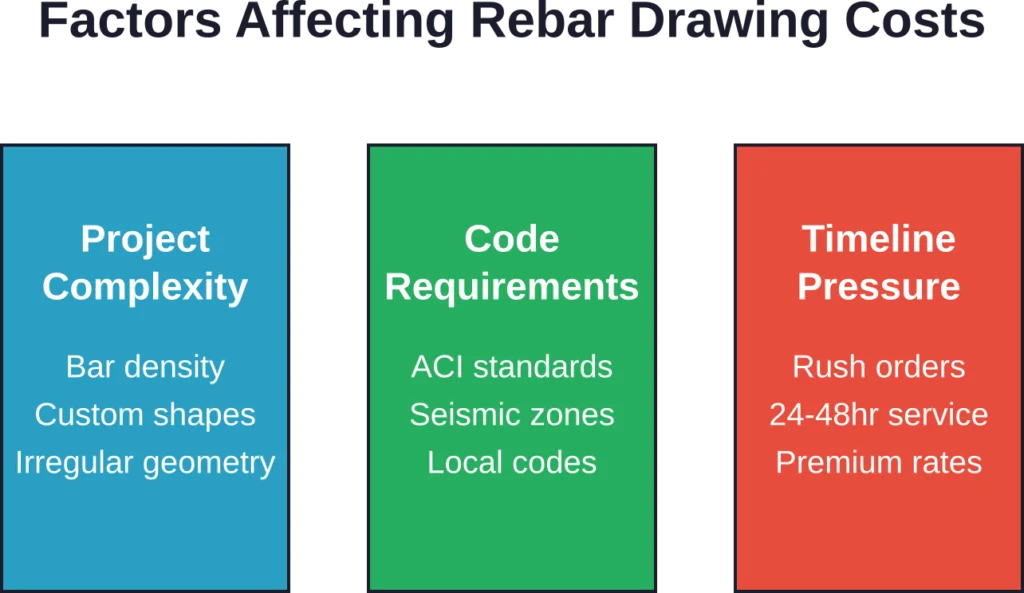
Simple slab-on-grade foundations with uniform reinforcement patterns cost less to detail than multi-level transfer slabs with varying bar sizes, complex lapping requirements, and congested reinforcement zones. The more complicated the structural system, the more hours a detailer invests in creating accurate drawings.
Buildings with irregular shapes, curved elements, or unique architectural features require custom detailing solutions. Standard templates don’t apply, forcing detailers to work from scratch.
Code Compliance Requirements
Rebar shop drawings must comply with ACI, CRSI, and AISC standards. Projects in high-seismic zones or areas with stringent building codes require additional checks, calculations, and documentation. This compliance work adds time and cost.
Some jurisdictions mandate specific submission formats, stamping requirements, or review processes that increase the administrative burden on detailing firms.
Turnaround Time Demands
Standard turnaround for rebar shop drawings runs 5-7 business days. Rush services with 24-48 hour initial turnaround often carry premium charges of 25-50% above standard rates.
Construction schedules don’t always accommodate normal lead times. When a contractor needs drawings yesterday to keep the project moving, expedited services become necessary—at a higher price point.
Revisions and Site Condition Changes
Initial drawings represent the design intent. Real-world construction often reveals conflicts, interferences, or field conditions that demand modifications.
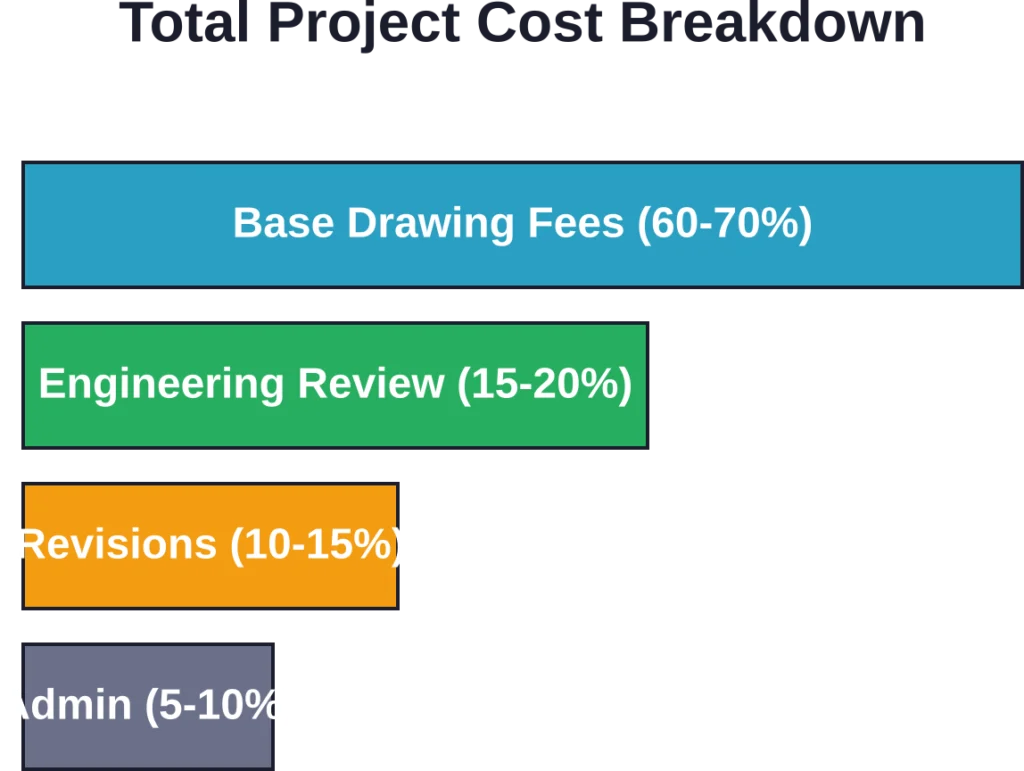
Most detailing services include one or two revision rounds in their base pricing. Beyond that, additional changes trigger supplementary charges. Lightning-fast revisions when site conditions shift unexpectedly add value but also cost.
Get Rebar Shop Drawings Prepared for Fabrication
Rebar shop drawing costs are often influenced by project scale, reinforcement complexity, and technical coordination requirements. Powerkh supports structural teams with fabrication-ready reinforcement drawings and BIM coordination services.
Need Rebar Shop Drawing Support?
Talk with Powerkh to:
- prepare detailed reinforcement drawings
- support fabrication and site workflows
- coordinate rebar with structural models
- improve documentation accuracy before construction
Talk with Powerkh about rebar shop drawing support for your project.
What’s Included in Professional Rebar Shop Drawing Services
Understanding what contractors receive for their investment helps contextualize the cost.
Comprehensive rebar shop drawings specify bar marks, quantities, sizes, grades, bending dimensions, placement locations, spacing requirements, lap splice lengths, and connection details. Bar bending schedules accompany the placement drawings, listing every unique bar shape with cutting and bending dimensions.
Professional services also provide coordination with architectural and MEP drawings to identify potential clashes before fabrication begins. Zero-clash rebar modeling catches conflicts digitally rather than on the job site where fixes cost exponentially more.
Some firms offer both AutoCAD 2D workflows and advanced BIM modeling with Revit or Tekla. AutoCAD drawing services ensure 100% compatibility with client-specific templates, architectural backgrounds, and existing drawing libraries. BIM approaches integrate perfectly with modern coordination workflows.
Cost Comparison: In-House vs. Outsourced Detailing
Many construction firms wrestle with whether to maintain in-house detailing staff or outsource to specialized rebar shop drawing companies.
In-house detailers provide direct control and immediate communication but require full-time salaries, benefits, software licenses, training, and overhead. A skilled rebar detailer’s annual compensation is typically in the range of $60,000-$80,000 or higher before considering workspace, equipment, and support costs.
Outsourced services convert fixed costs to variable expenses. Contractors pay only for drawings they need, when they need them, without maintaining staff during slow periods.
| Approach | Pros | Cons |
|---|---|---|
| In-House Team | Direct control, instant communication, company knowledge | High fixed costs, training burden, utilization gaps |
| Outsourced Services | Variable costs, scalability, specialized expertise | Less direct control, potential communication delays |
| Hybrid Model | Flexibility, core capacity with overflow support | Coordination complexity, dual management |
For firms with consistent, high-volume rebar detailing needs, in-house teams make economic sense. Contractors with variable workloads or occasional large projects often find outsourcing more cost-effective.
Regional Pricing Variations Across North America
Geographic location influences rebar shop drawing costs, though less dramatically than many construction services.
Metropolitan areas with high living costs—New York, San Francisco, Boston—tend toward the upper end of pricing ranges. Detailing firms in these markets face higher overhead and labor costs that pass through to clients.
Secondary markets and rural areas sometimes offer lower rates, though the availability of experienced detailing services may be limited. Many contractors in these regions already work with remote detailing providers regardless of location.
The rise of distributed work arrangements has somewhat flattened regional pricing differences. A detailing firm can operate from anywhere while serving clients nationwide, reducing the geographic premium.
Hidden Costs and Budget Considerations
The per-sheet or per-square-foot rate doesn’t tell the complete financial story.
Engineering Review and Approval
Structural engineers must review and stamp shop drawings before fabrication proceeds. Some detailing services include engineering review in their pricing; others quote it separately. Clarify this upfront to avoid surprise charges.
Resubmissions and Approval Cycles
Many jurisdictions require formal submittal processes with plan check agencies. Each resubmission cycle takes time and may incur additional fees from the detailing firm for formatting, responding to review comments, or making required changes.
Software Compatibility and File Formats
Contractors working with specific software platforms or requiring particular file formats may face surcharges if their needs fall outside the detailing firm’s standard deliverables. Confirm deliverable formats match internal systems and fabricator requirements.
How to Reduce Rebar Shop Drawing Costs
Smart planning and clear communication help control detailing expenses without compromising quality.
Provide complete, coordinated design documents upfront. Incomplete structural drawings force detailers to make assumptions, request information, or work around gaps—all of which add time and cost. Clean input documents enable efficient detailing.
Plan adequate lead time whenever possible. Standard turnaround rates run significantly lower than rush charges. Building detailing time into the project schedule from the start avoids premium pricing.
Establish clear scope and deliverable expectations before work begins. Misunderstandings about what’s included lead to change orders and supplemental fees. A detailed scope agreement prevents scope creep and associated cost overruns.
Consider package pricing for multi-phase projects. Detailing firms often offer volume discounts when contractors commit to an entire project rather than bidding each phase separately. This approach provides cost savings and ensures consistency across the work.
Questions to Ask Detailing Service Providers
Before selecting a rebar shop drawing company, get clarity on several critical points.
What’s included in the base per-sheet price? Does it cover engineering review, a certain number of revisions, specific file formats, or coordination services? Understanding the baseline deliverable prevents surprise charges later.
What turnaround time does standard pricing provide, and what do expedited services cost? Knowing the time-cost tradeoff helps with project planning and budget allocation.
How does the firm handle revisions—are some included, and what triggers additional charges? Revision policies vary widely among providers.
What software platforms and file formats can they deliver? Compatibility with internal systems and fabricator requirements matters for smooth project execution.
The Real Cost of Skipping Professional Shop Drawings
Some contractors consider eliminating or minimizing shop drawing investment to reduce project costs. This approach backfires dramatically.
Field errors from inadequate reinforcement details cost exponentially more than professional drawings would have. Discovering placement conflicts after concrete forms are set requires emergency redesigns, material reorders, schedule delays, and sometimes partial demolition of completed work.
Field experience and industry practice suggest inadequate rebar detailing frequently contributes to construction rework in concrete structures. The cost of fixing placement errors on-site easily exceeds ten times the investment in proper shop drawings.
Beyond direct costs, poor reinforcement installation creates potential structural deficiencies that may not manifest until the building is occupied—creating liability exposure that dwarfs any initial savings.
Frequently Asked Questions
Standard turnaround for rebar shop drawings typically runs 5-7 business days for most commercial projects. Simple residential work may be completed in 3-4 days, while complex structural systems can require 10-14 days. Rush services offering 24-48 hour initial turnaround are available at premium rates, usually 25-50% above standard pricing. Project size, complexity, and the completeness of design documents all affect timeline.
Detailing firms need structural drawings showing reinforcement requirements, project square footage, number of structural elements requiring detailing, building type and occupancy, applicable building codes and seismic design category, desired turnaround time, and required deliverable formats. More complete information enables more accurate pricing. Structural plans with complete bar callouts and details allow the most precise estimates.
Most rebar shop drawing services include one or two revision rounds in their base pricing for minor adjustments or corrections. Significant design changes, scope additions, or extensive rework typically trigger supplementary charges. Clarify the revision policy and what constitutes included versus billable changes before authorizing work. Some firms offer revision packages or charge hourly rates for changes beyond the included allowance.
Many detailing firms establish minimum charges to cover setup time, document review, and administrative overhead. Minimums commonly range from $500 to $1,500 depending on the provider. Very small projects like single-foundation pads may hit these minimums even though the actual sheet count would calculate lower. Ask about minimums when requesting quotes for smaller scopes.
Professional rebar detailing companies typically offer both traditional 2D AutoCAD drawings and modern 3D BIM modeling with platforms like Revit or Tekla Structures. Some contractors prefer 2D workflows for compatibility with existing processes and template libraries. Others value BIM for coordination and clash detection. Many firms can deliver both formats from the same model, though dual deliverables may carry additional costs. Specify format requirements when requesting pricing.
Compare quotes from multiple providers, but look beyond just the per-sheet rate. Consider turnaround time, revision policies, deliverable formats, engineering review inclusion, and reputation for accuracy. The cheapest option often lacks the quality controls and experience that prevent costly field errors. Request samples of completed work and references from similar projects. A fair price delivers accurate, complete, code-compliant drawings that install without issues.
Some offshore rebar detailing providers offer lower per-sheet rates, sometimes 30-40% below domestic firms. However, time zone differences can slow communication and revision cycles. Code knowledge varies, particularly for US-specific standards like ACI requirements. Language barriers occasionally create misunderstandings. Quality control processes differ. Many contractors find that apparent savings disappear when accounting for coordination time, revision cycles, and occasional errors requiring rework. Others successfully use offshore services with proper project management and clear documentation.
Making the Investment Decision
Rebar shop drawing costs represent a fraction of total concrete construction expenses—typically well under 1% of structural costs—while providing outsized value in preventing errors and ensuring structural integrity.
The question isn’t whether to invest in professional shop drawings, but rather which service provider offers the best combination of accuracy, turnaround time, and value for specific project needs.
Budget $75-$250 per sheet depending on project complexity, or $0.15-$0.50 per square foot of concrete area, and adjust based on specific factors like structural complexity, code requirements, and schedule demands.
Get quotes from multiple providers, clarify exactly what’s included in pricing, and verify that deliverables match project requirements and fabricator expectations. Check references and review sample work to assess quality standards.
The right rebar shop drawings eliminate field conflicts, accelerate installation, reduce material waste, and ensure structural performance. That’s worth paying for.