

Quick Summary: Shop drawing costs vary widely based on project complexity and scope. Basic shop drawings for simple components typically range from $500–$2,000, while comprehensive commercial project sets can cost $5,000–$25,000 or more. Hourly rates span $40–$200 depending on expertise level, with experienced firms charging $75–$200/hr including quality assurance and project management.
Construction projects live or die on documentation. And when contractors, fabricators, and subcontractors need precise, coordination-ready drawings for installation and fabrication, shop drawings become the critical link between design intent and physical reality.
But here’s the question everyone asks: what does that precision actually cost?
The answer isn’t simple. Shop drawing pricing depends on project scope, complexity, trade specialization, turnaround requirements, and provider expertise. A single HVAC component drawing costs vastly different than a complete structural steel package for a high-rise.
This guide breaks down real 2026 shop drawing costs across residential, commercial, and industrial projects with verified pricing data from professional drafting services, industry sources, and construction documentation providers.
What Are Shop Drawings and Why They Matter for Cost Estimation
Shop drawings translate architectural and engineering designs into fabrication-ready technical documents. They’re created by contractors, subcontractors, or specialized drafting services—not the architect—and show exactly how specific building components will be manufactured, assembled, and installed.
These drawings include precise dimensions, materials, connection details, fabrication methods, and installation instructions. For steel fabricators, MEP contractors, or curtain wall installers, shop drawings become the actual manufacturing blueprint.
The level of detail distinguishes shop drawings from construction drawings. Where architectural plans show design intent, shop drawings specify every bolt size, weld type, and installation sequence. That precision directly impacts cost estimation accuracy.
Shop drawings are designed to reduce field conflicts, prevent rework, and minimize change orders through improved documentation and coordination. When fabricators work from accurate shop drawings, they can estimate material quantities, labor hours, and fabrication costs with significantly tighter margins.
The accuracy range matters here. Construction estimates can achieve +10%, -5% accuracy when supported by complete documentation. Shop drawings push that precision further by resolving coordination issues before fabrication begins.
Shop Drawing Cost Ranges by Project Type
Pricing structures vary dramatically across residential, commercial, and specialty construction projects. Here’s what the current market looks like across different scales.
Residential Shop Drawings
For residential projects—custom homes, renovations, additions—shop drawing needs tend to focus on specific trades rather than comprehensive packages.
Basic floor plan modifications or simple cabinet shop drawings typically cost $500–$1,500. These cover straightforward residential components without complex coordination requirements.
Full residential drawing sets that include all essential drawings for permits and construction range from $3,000–$8,000 according to corroborated industry data. This includes structural details, framing plans, and key fabrication drawings for custom elements.
Large or custom homes with complex architectural features, steel components, or specialized systems push costs to $8,000–$15,000. High-detail projects with extensive custom millwork, structural steel, or complex MEP coordination fall into this range.
Commercial and Industrial Projects
Commercial construction shop drawings operate on entirely different scales. The coordination complexity, trade specialization, and liability considerations drive costs substantially higher.
Small commercial projects—tenant improvements, retail fit-outs, simple office renovations—typically see shop drawing costs from $3,000–$10,000 depending on trade complexity and document volume.
Mid-sized commercial buildings, multi-story structures, or projects with specialized systems (curtain walls, complex HVAC, structural steel) commonly run $10,000–$50,000 for complete shop drawing packages across all trades.
Major commercial and infrastructure projects—high-rises, hospitals, industrial facilities—can exceed $100,000 in total shop drawing costs when accounting for structural steel, MEP systems, facade engineering, specialty equipment, and extensive coordination requirements.
The University of Missouri classifies major projects as those with construction contracts exceeding $500,000, typically with professional fees exceeding $200,000.
Trade-Specific Shop Drawing Costs
Different construction trades have vastly different shop drawing requirements and associated costs.
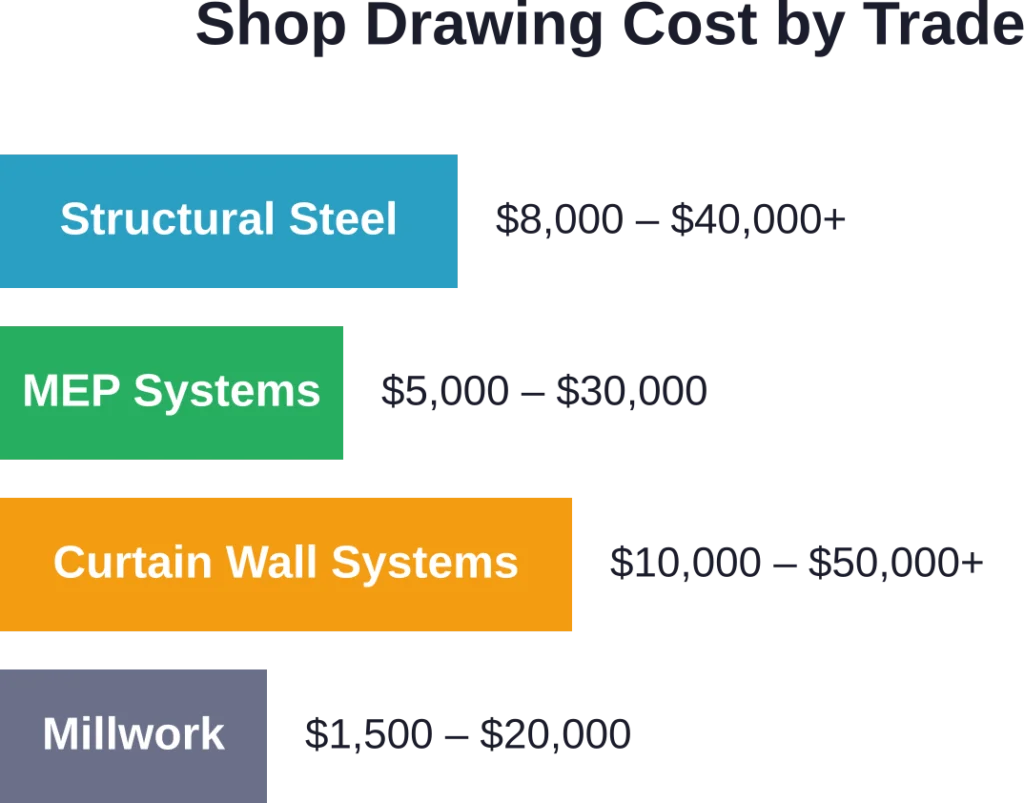
Structural Steel: One of the most expensive categories. Complete structural steel shop drawings for a commercial building typically cost $8,000–$40,000+ depending on tonnage, connection complexity, and project size. Complex steel structures with intricate connections and heavy coordination requirements push toward the higher end.
MEP Systems: HVAC, plumbing, and electrical shop drawings for commercial projects typically range $5,000–$30,000 depending on building size and system complexity. Large facilities with extensive ductwork coordination, multiple mechanical systems, and tight ceiling spaces require more detailed drawings.
Architectural Millwork: Custom cabinetry and millwork shop drawings typically cost $1,500–$8,000 for residential projects and $5,000–$20,000 for commercial installations with extensive custom elements.
Curtain Wall and Facades: Building envelope shop drawings, especially for glass curtain wall systems, typically run $10,000–$50,000+ for commercial buildings due to the engineering complexity, thermal calculations, and structural interface requirements.
Hourly Rates vs. Fixed Project Pricing
Shop drawing services bill using two primary models: hourly rates or fixed project fees. Understanding both helps budget more accurately.
Hourly Rate Structures
Hourly billing offers flexibility for projects with uncertain scope or phased development. Current market rates break down like this:
Freelance CAD draftsmen (entry-level): $20–$40/hr. These are typically newer professionals or overseas providers. Quality varies significantly, and coordination experience may be limited.
Experienced freelancers (mid-level): $40–$100/hr. Skilled drafters with solid track records, efficient turnaround, and trade-specific expertise fall into this range. This represents the sweet spot for many small-to-midsize contractors.
Agency or specialist drafting firms: $75–$200/hr. This includes quality assurance, project management, professional liability coverage, and coordination support. Larger firms with specialized expertise in complex trades (structural steel, curtain wall) command the higher end.
The hour count for a project depends entirely on complexity. A simple cabinet shop drawing might take 4-8 hours. A complete structural steel package for a commercial building could require 200-500+ hours.
Fixed Project Pricing
Fixed-fee arrangements provide budget certainty but require well-defined scope. Most drafting services prefer this model for standard project types.
Residential clients and small contractors usually pay flat project rates since budgeting becomes simpler. The provider assumes scope risk, so clear upfront communication about deliverables, revision rounds, and coordination requirements prevents disputes.
Commercial projects with repetitive elements—multifamily housing, warehouse developments, standard tenant improvements—also work well with fixed pricing once the provider understands the template.
Complex commercial projects often use a hybrid: fixed fees for defined phases with hourly billing for revisions, coordination changes, or scope additions.
| Provider Type | Typical Rate or Cost | Notes |
|---|---|---|
| Freelance CAD draftsman (beginner) | $20 – $40/hr | Entry-level or overseas professionals |
| Experienced freelancer / mid-level | $40 – $100/hr | Skilled, efficient, reliable turnaround |
| Agency/specialist drafting firm | $75 – $200/hr | Includes QA, project management, coordination |
| Basic residential package | $500 – $1,500 | Simple components, limited coordination |
| Full residential set | $3,000 – $8,000 | Complete permit and construction drawings |
| Small commercial project | $3,000 – $10,000 | Tenant improvements, simple fit-outs |
| Mid-sized commercial | $10,000 – $50,000 | Multi-story, specialized systems |
Key Factors That Drive Shop Drawing Costs
Several variables push shop drawing pricing up or down. Understanding these helps estimate costs more accurately and identify potential savings.
Project Complexity and Detail Level
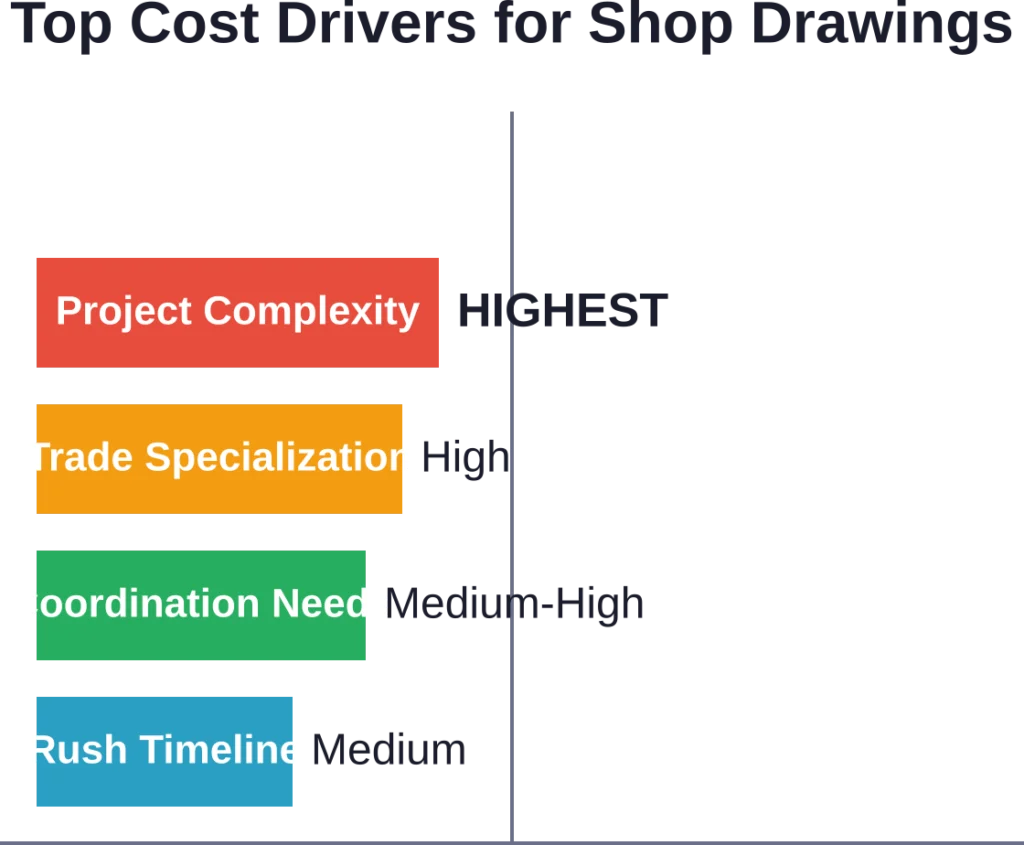
Complexity is the single biggest cost driver. A simple rectangular steel connection requires minimal drafting time. A complex multi-member connection with skewed angles, stiffener plates, and field-welded elements could take 10-20 times longer.
The level of detail required also matters. Basic shop drawings showing overall dimensions and standard connections cost less than fully-detailed fabrication drawings specifying every weld size, bolt grade, surface preparation requirement, and quality control checkpoint.
Historic preservation and renovation projects typically involve additional field verification requirements and coordination with existing conditions that may increase shop drawing costs.
Trade Specialization and Engineering Requirements
Some trades require specialized knowledge that commands premium rates. Structural steel shop drawings need understanding of connection design, load paths, and fabrication methods. Curtain wall shop drawings require facade engineering expertise, thermal analysis, and structural interface coordination.
When shop drawings require engineering calculations, stamped approvals, or professional engineer review, costs increase substantially. A structural engineer’s review and stamp might add $2,000–$10,000+ depending on project scope and liability.
Coordination Complexity
Projects with extensive coordination between trades—tight mechanical rooms, congested ceiling spaces, complex building cores—require more drafting time. The shop drawing preparer must coordinate with other trades, resolve conflicts, and often produce multiple revision rounds.
Building Information Modeling coordination requires additional technology overhead and coordination time compared to traditional 2D CAD approaches.
Turnaround Time Requirements
Standard turnaround for shop drawings typically runs 2-4 weeks depending on scope. Rush projects requiring 1-week or faster delivery often carry 25-50% premium charges.
The construction schedule drives this. When fabrication has long lead times (structural steel, curtain wall, specialty equipment), rushed shop drawings become critical path items. Contractors often pay premium rates to avoid project delays that would cost far more.
Revision and Coordination Rounds
Initial shop drawing submissions rarely get approved without comments. Most projects go through 2-4 review and revision cycles as the architect, engineer, and general contractor provide feedback.
Fixed-price agreements typically include 2-3 revision rounds. Additional revisions beyond that scope often bill hourly or at per-revision rates ($500–$2,000+ depending on extent of changes).
Poor upfront coordination drives revision counts higher and costs up. Projects with unclear design intent, incomplete construction documents, or inadequate design development generate excessive shop drawing revisions.
How Shop Drawings Impact Overall Project Costs
Shop drawing costs represent a relatively small percentage of total construction budgets—typically 0.5%-2% for most commercial projects. But their impact on cost certainty and schedule adherence far exceeds their direct cost.
Reducing RFIs and Change Orders
Accurate shop drawings resolve constructability issues during the documentation phase rather than in the field. When fabricators identify conflicts, missing information, or design errors during shop drawing preparation, those issues get resolved through the submittal review process.
The alternative—discovering problems during installation—triggers requests for information, change orders, schedule delays, and cost overruns. Field changes typically cost 5-10 times more than resolving the same issue during shop drawing review.
Enabling Accurate Fabrication Estimates
Fabricators can’t provide firm pricing without shop drawings. Preliminary estimates based on architectural drawings carry significant uncertainty—often in the ±20% to ±30% range according to GSA budgetary estimate standards.
Complete shop drawings push estimate accuracy further by resolving coordination issues and clarifying fabrication requirements. Material quantities become precise. Fabrication complexity is fully understood. Labor hours can be estimated reliably.
That precision matters enormously for project budgeting. On a $5 million structural steel package, improvements in estimate accuracy represent hundreds of thousands of dollars in budget risk reduction.
Schedule Certainty and Fabrication Lead Times
Shop drawings drive fabrication schedules. Steel mills, curtain wall manufacturers, and MEP fabricators can’t order materials or begin production without approved shop drawings.
Delays in shop drawing preparation or excessive revision cycles directly extend project schedules. When long-lead items like structural steel have 12-16 week fabrication periods after shop drawing approval, every week of shop drawing delay pushes project completion further out.
The cost of schedule delay often dwarfs shop drawing costs. Construction financing, extended general conditions, liquidated damages, and delayed revenue can cost tens or hundreds of thousands per week on commercial projects.
Get Shop Drawings Prepared for Construction and Fabrication
Shop drawing costs can vary depending on fabrication scope, coordination complexity, technical detailing requirements, and project timelines. Powerkh supports fabrication workflows with shop drawings, BIM coordination, and technical documentation services.
Need Shop Drawing Support?
Talk with Powerkh to:
- prepare detailed shop drawings for site and fabrication
- support structural and MEP coordination
- improve drawing accuracy before construction
- update documentation based on project changes
Review your fabrication and shop drawing requirements with Powerkh.
Comparing In-House vs. Outsourced Shop Drawings
Contractors face a decision: develop shop drawings with in-house staff or outsource to specialized drafting services.
In-House Shop Drawing Capabilities
Large contractors and fabricators often maintain internal drafting teams. This approach offers several advantages.
Direct communication between fabrication and drafting teams improves accuracy. The drafters understand the company’s fabrication capabilities, standard practices, and quality requirements. Coordination happens faster without external back-and-forth.
Scheduling flexibility improves. In-house teams can prioritize urgent projects, adjust resource allocation, and respond quickly to changes.
But the costs are substantial. A skilled CAD drafter’s fully-loaded cost (salary, benefits, software, overhead) typically runs $60,000–$90,000+ annually. Specialized BIM coordinators or engineers cost significantly more.
Small-to-midsize contractors often can’t justify full-time drafting staff. Project volume fluctuates. Specialization requirements vary. Keeping drafters busy and current on multiple software platforms becomes challenging.
Outsourcing to Drafting Services
Specialized shop drawing services offer scalability, specialized expertise, and cost flexibility.
Contractors pay only for actual project needs rather than carrying fixed overhead. During slow periods, there’s no underutilized staff cost. During busy periods, outsourced services scale up without hiring and training delays.
Specialized services maintain expertise across multiple trades, software platforms, and coordination workflows. They invest in training, technology, and quality systems that individual contractors might not justify.
The tradeoff: less direct control and potential communication challenges. Clear scope definition, detailed specifications, and regular coordination calls become essential.
Many contractors use a hybrid model: in-house staff for core work and standard projects, outsourced services for specialized trades, overflow capacity, or rush projects.
Regional Cost Variations
Shop drawing costs vary by geographic region, primarily driven by labor rates and market competition.
Major metropolitan areas—New York, San Francisco, Los Angeles, Boston—typically see 20-40% higher rates than smaller markets. An experienced drafter charging $80/hr in Dallas might command $110/hr in New York.
International outsourcing offers substantial cost savings. According to industry analysis of 2026 architectural drafting costs for projects in the U.S. and Canada, outsourcing to India saves 40–60%.
But lower rates don’t automatically mean lower total costs. Communication challenges, time zone differences, quality inconsistencies, and revision cycles can erode savings. Projects requiring tight coordination, rapid turnaround, or extensive local code knowledge often fare better with domestic providers despite higher rates.
How to Get Accurate Shop Drawing Cost Estimates
Smart budgeting starts with accurate estimates. Here’s how to get reliable shop drawing cost projections.
Define Scope Clearly
Vague scope descriptions generate unreliable estimates. Provide specific information:
- Project type, size, and complexity level
- Specific trades requiring shop drawings
- Drawing format requirements (2D CAD, 3D BIM, specific software)
- Level of detail needed (schematic, fabrication-ready, installation details)
- Coordination requirements and number of interfacing trades
- Expected revision rounds
- Schedule and turnaround requirements
The more detail provided upfront, the more accurate the estimate and the fewer surprises during execution.
Request Multiple Quotes
Shop drawing pricing varies significantly between providers. Request quotes from at least three services spanning different provider types—local firms, national services, specialized trade shops.
Compare not just price but scope interpretation, deliverables, revision policies, turnaround commitments, and quality assurance processes. The lowest bid often comes with scope gaps or quality compromises.
Review Sample Work
Request samples of previous shop drawings for similar project types. Quality, completeness, and drafting standards vary enormously. Samples reveal whether the provider truly understands the trade requirements and coordination complexity.
Check References
Talk to previous clients, particularly for large or complex projects. Ask about accuracy, responsiveness, revision turnaround, coordination effectiveness, and how the provider handled issues.
Clarify Revision Policies
Understand exactly what’s included in the base price. How many revision rounds? What constitutes a revision versus a scope change? What happens if design changes require redrafting? Clear upfront agreements prevent disputes later.
Ways to Reduce Shop Drawing Costs
Several strategies can lower shop drawing expenses without sacrificing quality.
Invest in Complete Design Development
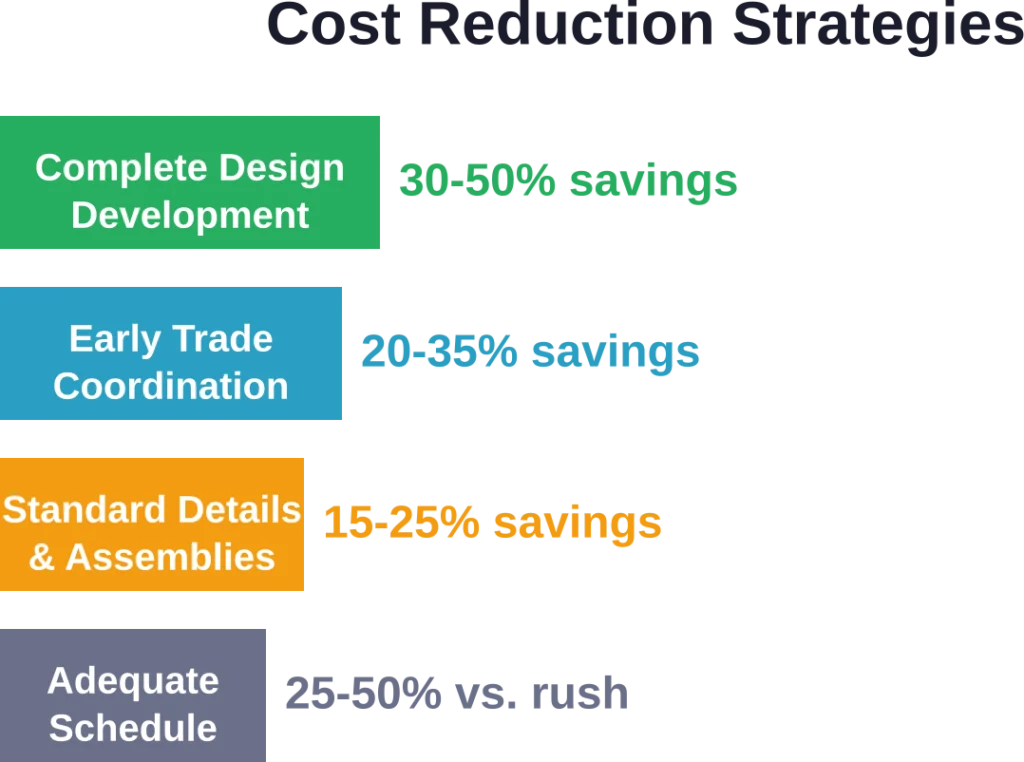
The single most effective cost control: provide complete, well-coordinated construction documents. When architectural and engineering drawings are thorough, consistent, and well-coordinated, shop drawing preparation becomes straightforward.
Incomplete design development creates expensive problems. Shop drawing preparers must make assumptions, request clarifications, and produce multiple revisions as design issues surface. Design completion levels impact estimate accuracy and documentation quality.
Front-Load Coordination
Early coordination between trades reduces conflicts that drive shop drawing revisions. When mechanical, electrical, plumbing, structural, and architectural systems are coordinated during design, shop drawing conflicts decrease dramatically.
BIM coordination during design phase prevents problems that would otherwise emerge during shop drawing preparation. The upfront investment in design coordination returns multiples in reduced shop drawing, fabrication, and field costs.
Standardize Where Possible
Custom details require custom shop drawings. Standard connections, typical assemblies, and repeated elements cost less to document.
When design allows standardization—repeating column connections, typical duct transitions, standard millwork assemblies—shop drawing costs decrease through reuse and reduced complexity.
Provide Clear Specifications
Ambiguous specifications drive revisions. When performance requirements, material standards, fabrication methods, or quality criteria are unclear, shop drawing preparers must interpret intent, which generates review comments and revisions.
The submittal process requires clear specifications and coordination between project stakeholders. Specificity upfront reduces back-and-forth later.
Bundle Projects
Contractors with multiple projects can often negotiate better rates by bundling shop drawing services. Providers offer volume discounts when assured of steady workflow.
Allow Adequate Schedule
Rush charges add 25-50% to costs. When possible, provide 3-4 weeks for shop drawing preparation rather than demanding 1-week turnaround. The cost savings often exceed any carrying cost of the extended schedule.
Common Mistakes That Increase Shop Drawing Costs
Certain missteps reliably drive costs higher. Avoiding these pitfalls protects budgets.
Waiting Too Long to Start
Delaying shop drawing initiation until fabrication becomes critical path forces rush charges and limits provider options. Starting shop drawings immediately after construction document completion allows standard turnaround and competitive bidding.
Inadequate Design Coordination
Uncoordinated construction documents generate shop drawing conflicts, extensive RFIs, and multiple revision rounds. The cost of poor design coordination gets multiplied through every downstream activity.
Unclear Scope Definition
Ambiguous scope agreements lead to disputes, scope creep, and unexpected costs. What’s included in the base package? What level of detail? How many revisions? What format and deliverables? Defining these upfront prevents problems.
Choosing Based Solely on Price
The lowest bid often comes from inexperienced providers, overseas services with communication challenges, or scope gaps. Quality problems, extensive revisions, and coordination failures can cost far more than the initial savings.
Poor Communication
Inadequate coordination between designer, contractor, fabricator, and shop drawing preparer generates errors and revisions. Regular communication, clear feedback, and timely responses keep projects moving efficiently.
Frequently Asked Questions
Construction drawings are prepared by architects and engineers showing design intent. Shop drawings are prepared by contractors, fabricators, or drafting services showing exactly how specific components will be manufactured and installed. Shop drawings include precise fabrication details, materials, connection methods, and installation instructions that construction drawings don’t typically specify.
Contractors, subcontractors, and fabricators typically pay for shop drawings as part of their scope of work. The cost is built into their bid prices. Owners pay indirectly through the contractor’s bid, but shop drawing preparation is generally the contractor’s responsibility, not the architect’s or owner’s direct cost.
Timeline depends on project scope and complexity. Simple residential components might take 3-7 days. Complete commercial trade packages typically require 2-4 weeks. Large, complex projects with extensive coordination can take 6-8+ weeks. Rush services can compress timelines but carry premium charges of 25-50%.
Basic CAD software can create simple drawings, but professional shop drawings require trade-specific knowledge, fabrication expertise, coordination skills, and understanding of standards and codes. DIY shop drawings often contain errors, omissions, or constructability issues that cause expensive field problems. For anything beyond the simplest projects, professional services deliver better value despite higher upfront cost.
Yes, typically. Standard construction contracts require contractors to submit shop drawings for architect and engineer review. The design team checks for conformance with design intent, though they’re not responsible for means, methods, or fabrication details. Approval process usually takes 2-3 weeks per submission, and most projects require 2-4 revision rounds.
For contractors and developers, shop drawing costs are ordinary business expenses fully deductible in the year incurred. For homeowners, shop drawings for personal residence construction or renovation are not separately deductible, though they’re part of the property’s cost basis. Consult a tax professional for specific situations.
Request samples of similar previous work. Check references from past clients. For large projects, consider milestone-based payment: deposit at start, progress payment at substantial completion, and final payment after architect review and approval. Many services offer limited revisions within the base price, providing built-in quality incentive.
Conclusion
Shop drawing costs span a wide range—from $500 for simple residential components to $100,000+ for complex commercial projects—but the investment delivers outsized value through improved cost certainty, reduced change orders, and schedule reliability.
The key variables: project complexity, trade specialization, coordination requirements, and turnaround time. Understanding these factors enables accurate budgeting and identifies opportunities for cost control.
Smart strategies reduce costs without sacrificing quality. Complete design development, early trade coordination, adequate schedule, and clear scope definition deliver the biggest savings. Avoiding common mistakes—late starts, poor communication, choosing solely on price—protects budgets from avoidable overruns.
For contractors and developers, shop drawings aren’t optional expenses but essential investments in project success. The cost represents a small fraction of total construction budgets while directly impacting fabrication accuracy, installation efficiency, and overall project outcomes.
Getting accurate estimates starts with clear scope definition and competitive quotes from qualified providers. Whether using in-house staff, specialized services, or hybrid approaches, the goal remains the same: coordination-ready drawings that support efficient fabrication and installation.
Ready to plan your project’s shop drawing budget? Define your scope, identify required trades, and request quotes from providers with relevant experience. The upfront investment in quality shop drawings returns multiples through reduced conflicts, accurate fabrication, and on-schedule project delivery.