

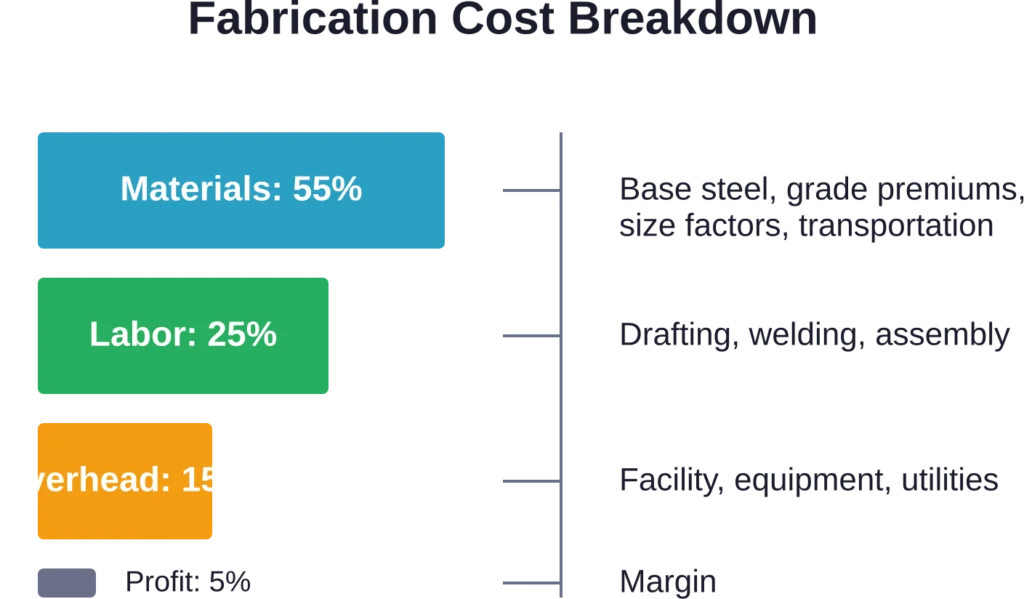
Quick Summary: Steel fabrication drawing costs typically range from $50 to $300 per sheet depending on complexity, project size, and drawing type. Material costs typically represent 55% of total fabrication costs, with direct labor at 25%, overhead at 15%, and profit at 5%. Understanding these cost components and hidden triggers helps contractors, architects, and engineers plan budgets accurately and avoid costly delays.
Steel fabrication drawings form the backbone of every construction project involving structural steel, yet the cost of producing these critical documents remains one of the most misunderstood aspects of project budgeting.
Whether managing a commercial building, bridge infrastructure, or industrial facility, accurate cost estimation for fabrication drawings prevents budget overruns and project delays. The reality is that drawing costs vary dramatically based on project complexity, drawing type, and market conditions.
This guide breaks down the real numbers behind fabrication drawing costs and shows exactly where money goes in the process.
What Are Steel Fabrication Drawings
Steel fabrication drawings translate architectural and engineering designs into detailed instructions that fabrication shops use to manufacture steel components. These technical documents specify exact dimensions, materials, connections, and assembly sequences.
Three primary drawing types serve different purposes in the fabrication process. Shop drawings provide detailed fabrication instructions for individual components. Erection drawings guide field installation and assembly. As-built drawings document the final installed configuration.
Each drawing type requires different levels of detail and expertise, which directly impacts cost. Shop drawings typically demand the most time and precision since fabricators rely on them for cutting, welding, and assembly operations.
Primary Cost Drivers for Fabrication Drawings
Several interconnected factors determine the final price tag for steel fabrication drawings. Understanding these variables helps predict costs before committing to a project.
Project Complexity and Scale
Simple warehouse structures require straightforward drawings with repetitive details. Complex architectural features, curved members, and custom connections multiply drafting hours significantly.
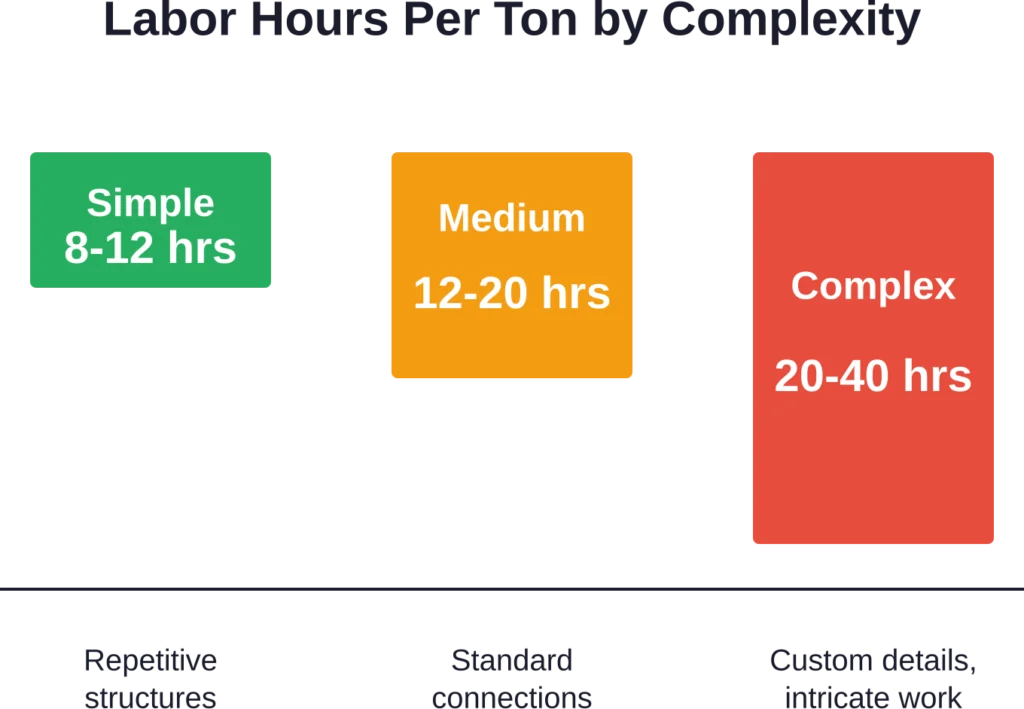
Complexity affects labor time differently across project types. Simple structures typically require 8-12 hours per ton of steel. Medium complexity projects need 12-20 hours per ton. Complex structures with intricate connections and custom details demand 20-40 hours per ton.
The total tonnage also influences per-ton rates. Larger projects benefit from economies of scale as setup time and standard details get distributed across more components.
Drawing Type Requirements
Different drawing types carry distinct cost implications. Preliminary fabrication sketches cost less than fully detailed shop drawings with complete connection details and bolt lists.
Erection drawings typically cost 15-30% of shop drawing expenses since they show overall assembly rather than fabrication details. Structural steel detailing for connections adds premium costs when connections involve complex moment frames or seismic requirements.
Material Specifications and Standards
Standard ASTM materials with common connections reduce drafting time. Specialized alloys, heavy plate requirements, or unusual grade specifications require additional research and documentation.
The American Institute of Steel Construction provides standardized details that streamline common connections. Projects following these standards cost less than those requiring custom engineered solutions throughout.
Get Steel Fabrication Drawings Prepared for Production
Steel fabrication drawing costs are often influenced by structural complexity, fabrication scope, coordination requirements, and detailing level. Powerkh supports steel workflows with fabrication drawings, BIM coordination, and technical detailing services.
Need Steel Fabrication Drawing Support?
Talk with Powerkh to:
- prepare fabrication-ready steel drawings
- support coordination with structural BIM models
- improve detailing accuracy before production
- support project delivery from design to fabrication
Discuss steel fabrication drawing requirements with Powerkh.
Typical Drawing Cost Ranges
Market rates for fabrication drawings vary by region, shop capacity, and project urgency. But certain ranges hold consistent across the industry.
Per-Sheet Pricing Models
Most detailing firms charge per sheet, with rates reflecting drawing complexity. Basic shop drawings for simple beams and columns typically range from $50 to $100 per sheet.
Medium complexity drawings involving standard connections and moderate detail fall between $100 and $200 per sheet. Complex drawings with intricate connections, multiple details, and extensive notes can reach $200 to $300 per sheet or higher.
Rush projects command premium rates, often 25-50% above standard pricing depending on timeline compression.
Tonnage-Based Pricing
Some fabricators quote based on total project tonnage rather than sheet count. This method works well for repetitive structures where tonnage correlates closely with drafting effort.
Industry rates typically range from $50 to $150 per ton of fabricated steel for complete drafting packages. Simple structures with repetitive members hit the lower end. Architecturally exposed steel with custom details pushes toward the upper range.
Hourly Rate Structures
Hourly billing provides flexibility for projects with undefined scope. Experienced steel detailers typically charge $60 to $120 per hour depending on expertise level and location.
Senior detailers with specialized knowledge of complex connections command rates at the higher end. Junior detailers handling routine work cost less but may require more hours to complete the same scope.
| Drawing Type | Complexity Level | Typical Cost Range | Turnaround Time |
|---|---|---|---|
| Shop Drawings | Simple | $50 – $100/sheet | 1-2 weeks |
| Shop Drawings | Medium | $100 – $200/sheet | 2-3 weeks |
| Shop Drawings | Complex | $200 – $300/sheet | 3-5 weeks |
| Erection Drawings | Standard | $40 – $80/sheet | 1 week |
| Connection Details | Custom | $150 – $250/detail | 2-4 weeks |
Hidden Costs in Fabrication Drawing Projects
Beyond the base drawing fees, several less obvious expenses inflate final project costs. Recognizing these early prevents budget surprises during execution.
Revision and Change Order Cycles
Design changes after initial drawing approval trigger costly revision cycles. Each round of revisions typically costs 30-50% of the original drawing fee since detailers must update multiple interconnected sheets.
Late-stage changes prove especially expensive when fabrication has already begun. Coordinating field modifications, updating documentation, and managing communication between teams adds substantial overhead.
Quality Inspection and Coordination
Quality inspection and contingency typically add approximately 5% to fabrication costs. This includes checking dimensional accuracy, verifying material specifications, and ensuring drawing clarity.
Coordination between structural engineers, architects, and MEP consultants requires dedicated time for clash detection and resolution. Projects without proper coordination budgets face delays and rework.
Transportation and Logistics
Loading, freight, unloading, and crane support typically represent 5% of total project costs. These logistics expenses often get overlooked during initial budgeting but directly impact delivered component costs.
Remote project sites or locations with limited fabrication shop access face premium transportation charges. Oversized components requiring special permitting and escort vehicles add thousands to shipping costs.
Cost Estimation Methods
Accurate cost estimation requires systematic approaches that account for all project variables. Several proven methods help develop reliable budgets.
Parametric Estimation Using Historical Data
Parametric models use historical project data to predict costs based on key parameters like tonnage, connection count, and building type. This approach works best when historical projects closely match current scope.
Fabrication shops maintain databases tracking hours per ton for different project types. Applying these benchmarks to new projects provides quick preliminary estimates with reasonable accuracy.
Bottom-Up Detailed Takeoffs
Bottom-up estimation involves counting every beam, column, connection, and detail from contract documents. This method delivers the most accurate results but requires significant upfront effort.
Detailers estimate hours required for each component type, multiply by appropriate rates, and sum across the entire project. The granular approach identifies cost drivers and helps optimize designs before fabrication begins.
Analogous Project Comparison
Comparing similar completed projects provides reasonable cost targets when detailed takeoffs aren’t feasible. Adjustments for scope differences, complexity variations, and market conditions refine the baseline estimate.
This method works well during conceptual design phases when final details remain undefined. Accuracy improves as projects progress and more information becomes available.
Regional Cost Variations
Geographic location significantly impacts fabrication drawing costs through labor rates, market competition, and local construction activity.
Major metropolitan areas with high construction demand typically see premium pricing. Detailing firms in cities like New York, San Francisco, and Chicago charge 20-40% above national averages due to higher overhead and strong demand.
Rural areas with limited local fabrication capacity may also face elevated costs despite lower base labor rates. The scarcity of qualified detailers and longer coordination times offset lower wage structures.
Offshore detailing services from countries with lower labor costs offer potential savings of 30-50% compared to domestic rates. However, coordination challenges, time zone differences, and quality control concerns require careful management.
Cost Reduction Strategies
Smart planning and design optimization reduce fabrication drawing expenses without compromising quality or safety. Several approaches deliver meaningful savings.
Standardization and Repetition
Designing with standard member sizes and repetitive connection details dramatically cuts drafting time. Each unique connection requires custom detailing, while repeated connections get detailed once and replicated.
Limiting the variety of beam depths, column sizes, and connection types simplifies the drawing set. The fabricator benefits through reduced setup time and faster production, often passing savings back through lower shop costs.
Early Fabricator Involvement
Engaging fabricators during design development identifies cost-efficient connection types and member selections before drawings begin. This design-assist approach prevents costly redesigns later.
Fabricators provide practical insights about shop capabilities, preferred details, and material availability. Incorporating this knowledge upfront optimizes both drawing costs and fabrication efficiency.
Complete and Coordinated Design Documents
Well-coordinated contract documents with minimal errors reduce revision cycles and change orders. Each revision cycle costs time and money while delaying project schedules.
Building Information Modeling software detects clashes between structural, architectural, and MEP systems before fabrication drawings begin. Resolving conflicts during design costs far less than fixing them during construction.
Appropriate Level of Detail
Specifying the right level of detail for project requirements avoids unnecessary expenses. Not every project needs fully detailed assembly drawings with every bolt called out.
Simple structures with experienced erection crews may only need basic erection plans with key dimensions. Complex architectural features require comprehensive documentation. Matching detail level to actual field needs controls costs.
Technology Impact on Drawing Costs
Software advances and automation tools reshape fabrication drawing economics. Modern technology both reduces costs and enables capabilities impossible with manual methods.
3D Modeling and BIM Integration
Three-dimensional modeling software automates many tedious manual tasks. Automatic dimensioning, bill of material generation, and connection libraries reduce hours required per drawing.
BIM integration allows structural models to flow directly into detailing software. This seamless data transfer eliminates manual re-entry and reduces errors that trigger revision cycles.
Automated Detailing Tools
Advanced detailing software includes intelligent connection libraries that automatically generate details based on member sizes and loading conditions. These tools cut routine detailing time by 40-60% compared to manual methods.
Parametric modeling features let detailers create template connections that automatically adjust to different member configurations. One template serves dozens of similar connections throughout a project.
Cloud-Based Collaboration Platforms
Cloud platforms enable real-time collaboration between engineers, detailers, and fabricators regardless of location. Instant access to current drawings prevents coordination errors from outdated information.
Integrated project management tools track revision history, approval status, and outstanding issues. This transparency streamlines communication and reduces administrative overhead.
Selecting a Fabrication Drawing Provider
Choosing the right detailing firm balances cost, quality, experience, and communication capabilities. Price alone rarely indicates the best value.
Experience with Similar Projects
Firms with relevant project experience complete work faster and produce higher quality results. A detailer familiar with similar building types knows common connection solutions and potential issues.
Request portfolio examples matching project complexity and building type. Review sample drawings for clarity, completeness, and adherence to standards.
Quality Control Processes
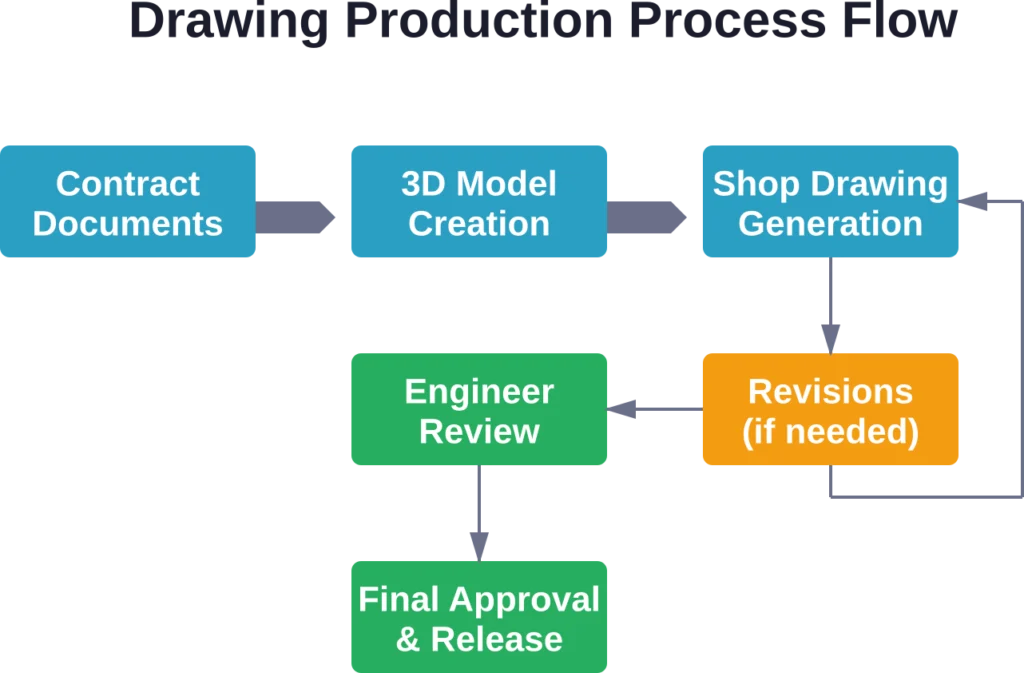
Established quality control procedures catch errors before drawings reach the engineer for review. Multi-level checking by senior detailers reduces revision cycles and prevents field problems.
Ask about internal review processes, checking procedures, and how the firm handles corrections. Firms with documented QA systems typically deliver more reliable work.
Technology and Software Capabilities
Current software and BIM capabilities enable efficient workflows and seamless coordination. Firms using outdated methods take longer and produce less accurate results.
Verify compatibility between the detailer’s software and the project’s overall technology stack. Incompatible systems create data conversion headaches and coordination issues.
Communication and Responsiveness
Clear communication prevents misunderstandings that lead to errors and delays. Responsive detailers address questions promptly and provide regular project updates.
Evaluate communication style during initial discussions. Detailers who struggle to answer basic questions during bidding likely won’t improve during execution.
| Evaluation Factor | Key Considerations | Red Flags |
|---|---|---|
| Experience | Relevant project portfolio, similar building types, proven track record | No comparable examples, vague references, limited history |
| Quality Control | Documented QA process, multi-level checking, revision tracking | No formal process, single-person review, defensive about errors |
| Technology | Current software versions, BIM capabilities, file compatibility | Outdated tools, manual processes, incompatible systems |
| Communication | Prompt responses, clear explanations, proactive updates | Slow replies, vague answers, defensive attitude |
| Pricing | Detailed scope breakdown, clear deliverables, reasonable rates | Vague scope, extremely low bids, hidden fees |
Budgeting Best Practices
Effective budgeting for fabrication drawings requires realistic contingencies and proper scope definition from project start.
Allocate 10-15% contingency for drawing costs on projects with typical complexity. Complex projects with custom details warrant 15-20% contingency to cover unforeseen complications.
Define deliverable scope clearly in contracts. Specify drawing types, revision limits, file formats, and coordination responsibilities upfront. Ambiguous scope agreements inevitably lead to disputes and cost overruns.
Track actual costs against estimates throughout the project. Early identification of budget deviations allows corrective action before problems compound.
Front-load spending on quality engineering and coordination. Money spent preventing problems costs far less than fixing issues during fabrication or construction.
Common Cost Estimation Mistakes
Several recurring errors plague fabrication drawing budgets. Avoiding these pitfalls improves estimate accuracy and prevents surprises.
Underestimating Complexity
Treating architecturally exposed steel like hidden structural members ignores the additional detailing required for aesthetic appeal. Exposed connections need clean appearance, which requires extra design time and custom solutions.
Complex geometry involving curved members, skewed connections, or non-orthogonal layouts multiplies drafting effort. Simple rectangular structures shouldn’t serve as proxies for estimating unique designs.
Ignoring Coordination Requirements
Failing to budget adequate time for multi-discipline coordination leads to clashes discovered late in the process. Resolving conflicts after fabrication drawings are complete costs multiples of addressing them during design.
Dense MEP systems, complex facades, and tight tolerances all increase coordination intensity. Projects in these categories need explicit coordination budgets beyond base drawing costs.
Overlooking Revision Allowances
Assuming zero revisions sets unrealistic expectations. Even well-coordinated projects experience some changes as design intent gets translated into fabrication details.
Budget for at least one revision cycle on simple projects, two cycles for medium complexity work, and three or more cycles for complex custom projects. Each cycle typically costs 30-50% of the original drawing fee for affected sheets.
Using Outdated Cost Data
Steel industry costs fluctuate with market conditions, labor availability, and material prices. Estimates based on projects completed years earlier miss current market realities.
Validate historical data against current market conditions. Contact fabricators for preliminary budgets rather than relying solely on old project records.
Future Trends Affecting Drawing Costs
Emerging technologies and industry changes will reshape fabrication drawing economics over coming years.
Artificial intelligence and machine learning tools promise to automate routine detailing tasks further. Early-stage AI detailing assistants already handle simple connection selection and standard details with minimal human oversight.
As these tools mature, base detailing costs for simple projects should decline. However, complex custom work requiring engineering judgment will retain value and may see relative cost increases.
Digital twin technology and sensor-enabled construction monitoring create demand for richer as-built documentation. Projects incorporating these capabilities need more comprehensive drawing packages to support long-term facility management.
Modular construction and off-site fabrication growth emphasizes manufacturing-focused drawings over traditional field-assembly documentation. This shift requires different detailing expertise and may alter cost structures.
Real Project Cost Example
Looking at a concrete example clarifies how theoretical cost factors translate into actual expenses.
Consider a medium-complexity commercial office building with 200 tons of structural steel. The structure features standard wide-flange beams and columns with moment connections at major frames and simple shear connections elsewhere.
The fabricator estimates 15 hours per ton for complete shop and erection drawings, totaling 3,000 hours. At $85 per hour for detailing services, the base drawing cost reaches $255,000.
One revision cycle at 40% of base cost adds $102,000. Quality control and coordination efforts add 5%, or $12,750. The total drawing package costs approximately $369,750, or roughly $1,849 per ton of steel.
Material costs for the steel itself total approximately $1.1 million based on typical market rates. Combined material and drawing costs reach $1.47 million before fabrication labor, transportation, and erection.
This breakdown shows drawing costs representing roughly 25% of material costs or about 16% of the combined material and drawing subtotal. These proportions align with typical industry ranges for medium-complexity projects.
Frequently Asked Questions
Fabrication drawings typically represent 2-5% of total structural steel package costs including materials, fabrication, and erection. Simple projects with repetitive details fall toward the lower end. Complex projects with extensive custom detailing reach the higher end. The percentage varies based on project complexity, size, and local market conditions.
Timeline depends on project size and complexity. Small projects under 50 tons may complete in 2-3 weeks. Medium projects from 100-300 tons typically require 6-8 weeks. Large complex projects exceeding 500 tons can take 12-16 weeks or longer. Rush schedules compress timelines by 25-40% but add premium costs of similar magnitude.
Offshore detailing from countries with lower labor costs can reduce base drawing expenses by 30-50% compared to domestic rates. However, coordination challenges, time zone differences, communication gaps, and quality control concerns require careful management. Successful offshore relationships need clear standards, detailed specifications, and experienced oversight. Total project savings often fall below the headline rate reduction once coordination overhead gets factored in.
Common cost overrun triggers include incomplete or poorly coordinated contract documents requiring extensive clarifications, design changes after drawing production begins, underestimated project complexity, excessive revision cycles from unclear design intent, tight schedules demanding overtime work, and scope creep where deliverable expectations expand beyond initial agreements. Proper planning and clear communication prevent most overruns.
BIM requirements can increase initial costs by 10-20% when firms need to develop 3D models beyond traditional 2D shop drawings. However, BIM models often reduce overall project costs through better coordination, fewer field conflicts, and streamlined fabrication. The investment in richer modeling typically pays returns through reduced change orders and construction delays. Projects with complex geometry or tight coordination needs benefit most from BIM approaches.
Material prices don’t directly impact drawing costs since detailers charge based on time rather than material values. However, market conditions indirectly influence costs through project volume. During construction booms when fabrication shops run at full capacity, drawing costs increase due to high demand. Slower periods see more competitive pricing as detailing firms compete for limited work.
Most projects benefit from fabricators handling shop drawing production since fabricators understand their own shop capabilities, preferred connection types, and manufacturing processes. Fabricator-produced drawings align with actual fabrication methods and equipment. However, general contractors sometimes procure separate detailing services for design-assist projects or when fabricators lack in-house detailing capacity. Clear responsibility assignment in contracts prevents confusion regardless of procurement path.
Conclusion
Steel fabrication drawing costs vary widely based on project complexity, drawing type, and market conditions, but understanding the underlying cost drivers enables accurate budgeting and informed decision-making.
Material costs typically represent 55% of total fabrication costs at the structural level, but the 25% allocated to direct labor including drafting work significantly impacts both budget and schedule. Ignoring hidden costs like revisions, coordination, and logistics leads to unpleasant surprises during execution.
Smart strategies including standardization, early fabricator involvement, and appropriate technology adoption reduce costs without compromising quality. The key lies in matching detail level and documentation scope to actual project needs rather than applying one-size-fits-all approaches.
Looking forward, automation and AI tools will continue reshaping the economics of routine detailing work. But complex projects requiring engineering judgment and custom solutions will retain value as the industry evolves.
For contractors, architects, and engineers planning steel fabrication projects, accurate cost estimation starts with clear scope definition, realistic complexity assessment, and proper contingency allocation. Contact experienced fabricators early in design for preliminary budgets and constructability input that prevents costly surprises later.