

Quick Summary: When you unmatch someone on Hinge, the conversation disappears immediately from both users’ chat lists, and neither person receives a notification about the unmatch. The other person won’t know you specifically unmatched them—the conversation simply vanishes as if it never existed. Unmatching is permanent and irreversible, meaning you cannot restore the conversation or rematch with that person again.
Dating apps can feel complicated, especially when managing connections. Hinge, designed to be deleted according to its official branding, gives users control over their matches—including the ability to unmatch.
But what actually happens behind the scenes? Does the other person get a notification? Can they tell it was intentional? And what if it was an accident?
Here’s everything about unmatching on Hinge, based on how the platform currently works.
What Happens When You Unmatch Someone on Hinge
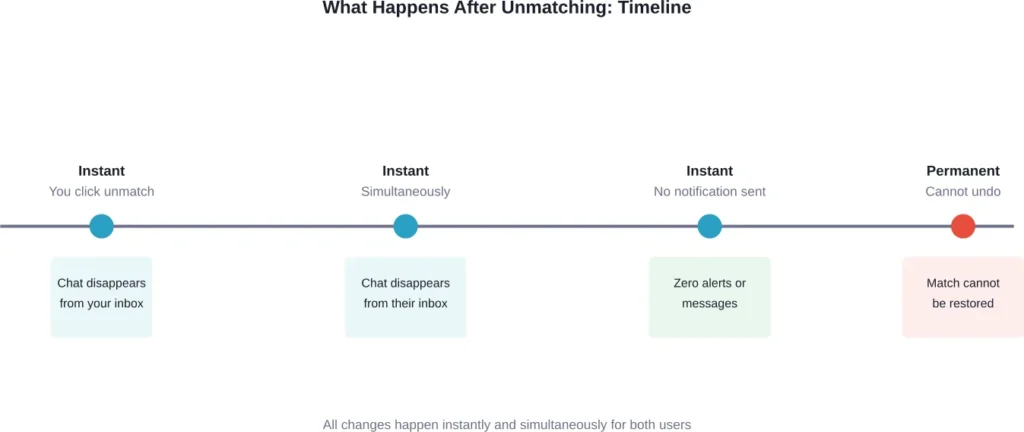
Unmatching on Hinge is straightforward but permanent. Once the action completes, several things happen immediately.
The conversation disappears from both users’ chat lists. The other person loses access to the entire message history, just like it vanishes from the person who initiated the unmatch.
No notification gets sent. Hinge doesn’t alert the other person that they’ve been unmatched. According to community discussions on Reddit, the conversation simply disappears without any indication of who ended it or why.
What the Other Person Sees
From the other person’s perspective, the match and conversation vanish completely. They won’t see a message saying “This person unmatched you” or anything similar.
The chat simply disappears from their inbox. If they try to search for the conversation, they won’t find any trace of it.
This design choice means they can’t definitively know whether the person unmatched them, deleted their entire Hinge account, or experienced some technical issue. That ambiguity is intentional—Hinge doesn’t want to create negative experiences by explicitly calling out unmatches.
Does Hinge Notify When You Unmatch Someone
No notification system exists for unmatching. Unlike some other features where apps send push notifications or in-app alerts, Hinge keeps unmatches silent.
The conversation simply ceases to exist for both parties. This protects privacy and reduces potential confrontation or awkwardness.
According to community discussions on Reddit and user experiences shared on social platforms, the process remains completely discreet.
Can You Rematch With Someone After Unmatching
Unfortunately, once the unmatch happens, it’s permanent. Hinge doesn’t allow rematching with someone after unmatching them.
The person won’t appear in the feed again. Even if someone would normally show up based on preferences and location, Hinge filters out previous unmatches.
According to discussions on Reddit, this creates problems for users who accidentally unmatch someone. There’s no “undo” button and no way to restore the connection.
Why Hinge Doesn’t Allow Rematching
The design philosophy centers on respecting user decisions. When someone unmatches, Hinge interprets that as a clear signal of disinterest.
Allowing rematches could enable harassment or unwanted repeated contact. By making unmatches permanent, the platform protects users who want a clean break from a connection.
That said, the lack of an undo function frustrates users who make genuine mistakes.
What Happens If You Accidentally Unmatch Someone
Accidental unmatches happen more often than people expect. The conversation disappears immediately, and there’s no built-in recovery option.
According to community discussions on Reddit and user experiences shared on social platforms, users who accidentally unmatch someone have limited options. The conversation, including any phone numbers or social media handles shared, vanishes completely.
Some users report trying to find the person again by adjusting their discovery preferences, but Hinge’s algorithm won’t show someone who’s been unmatched.
Possible Workarounds for Accidental Unmatches
Real talk: the options aren’t great. If contact information was exchanged before the unmatch, that’s the only reliable way to reconnect.
Some people try creating a new Hinge account with different credentials, hoping the person will appear in their feed again. This violates Hinge’s terms of service and may result in getting banned.
Another approach involves reaching out to Hinge support, though based on user experiences shared online, the company typically doesn’t restore unmatched connections even for confirmed accidents.
| Scenario | Can You Recover? | Best Action |
|---|---|---|
| Accidentally unmatched before exchanging contact info | No | No reliable recovery method available |
| Accidentally unmatched after exchanging phone/social media | Yes | Contact them directly through the shared information |
| Intentionally unmatched, now regret it | No | Cannot rematch; connection is permanently removed |
| Other person unmatched you | No | Conversation disappears; no way to restore from your end |
How to Unmatch Someone on Hinge
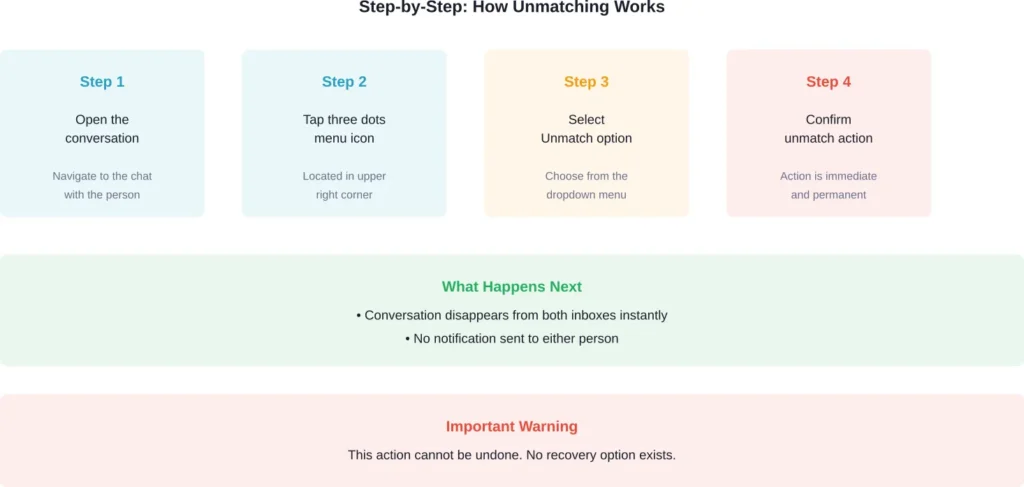
The process itself is straightforward. Open the conversation with the person, tap the three dots in the upper right corner, and select “Unmatch.”
Hinge will ask for confirmation. Once confirmed, the action completes immediately and cannot be reversed.
The simplicity of the process makes accidental unmatches possible, especially when quickly scrolling through conversations or tapping near the menu button.
How to Report Someone After Unmatching
Here’s where things get tricky. Hinge allows reporting, but the process differs after unmatching.
According to the official Hinge help resources, users can still report someone even after unmatching, but they need to contact Hinge support directly since the conversation no longer appears in the app.
The report option typically found in the conversation menu won’t be accessible once the unmatch completes. Users who need to report concerning behavior should reach out to Hinge’s support team with as much information as possible about the person and the incident.
When to Consider Reporting
Safety concerns, harassment, or violations of Hinge’s community guidelines warrant reporting. Even if the conversation no longer exists in the app, the platform can investigate based on the report.
Hinge takes reports seriously, particularly those involving threatening behavior, hate speech, or attempts to scam users.
Differences Between Unmatching and Deleting Your Account
Some confusion exists about what the other person sees in different scenarios. Unmatching affects one specific connection, while deleting an account removes everything.
When someone deletes their entire Hinge account, all their conversations disappear for their matches. From the other person’s perspective, this looks identical to being unmatched.
There’s no way to distinguish between these scenarios from the outside. The conversation simply vanishes.
| Action | What Happens to One Conversation | What Happens to All Conversations | Account Status |
|---|---|---|---|
| Unmatch one person | That specific conversation disappears for both people | All other conversations remain intact | Account remains active |
| Delete Hinge account | All conversations disappear | Every match loses access to conversations with you | Account completely removed |
| Pause account | Conversations remain but profile hidden | Cannot send/receive new messages while paused | Account temporarily inactive |
Why People Unmatch on Hinge
Understanding the motivations helps contextualize the feature. According to community discussions on Reddit and user experiences shared on social platforms, several common reasons emerge.
Lack of response or engagement tops the list. When someone doesn’t reply after several messages, unmatching cleans up the inbox.
Mismatched expectations or discovering incompatibility through conversation leads to many unmatches. Someone might realize the connection isn’t what they wanted.
Conversations that feel uncomfortable, pushy, or inappropriate result in immediate unmatches. Hinge users employ the feature as a boundary-setting tool.
The Psychology Behind Unmatching
Dating apps create unique social dynamics. The ease of unmatching reduces the pressure of awkward goodbyes or explicit rejections.
For some, unmatching feels less harsh than explaining why they’re ending the conversation. The ambiguity—whether it was an unmatch, account deletion, or technical issue—softens the rejection.
Others view unmatching as digital housekeeping. Clearing out inactive or uninteresting conversations keeps their inbox manageable.
Managing Your Hinge Conversations Effectively
Understanding how unmatching works helps users make informed decisions about their connections. Taking a moment to confirm before unmatching can prevent accidental deletion of promising conversations.
Conversations that haven’t progressed in weeks can be unmatched to focus energy on more promising connections. This isn’t cruel—it’s practical.
Alternatives to Unmatching
Sometimes other options make more sense. Hinge allows hiding conversations without unmatching, which archives the chat without deleting it permanently.
Simply not responding achieves a similar result without burning bridges. The conversation remains accessible if circumstances change.
For situations involving genuinely problematic behavior, reporting before unmatching ensures Hinge can investigate appropriately.
Frequently Asked Questions
No, the other person cannot tell with certainty that they were unmatched. The conversation simply disappears from their inbox without notification. From their perspective, it could be an unmatch, account deletion, or technical issue. Hinge doesn’t send any alert or message indicating that someone unmatched them.
All messages in the conversation disappear immediately for both people. The entire chat history gets deleted, and neither person can access it afterward. This includes any photos, comments, or other content shared within that specific conversation. The deletion is permanent and affects both users simultaneously.
No, Hinge doesn’t allow rematching with someone after unmatching them. The person won’t appear in the discovery feed again, even if they match the search preferences. There’s no undo function or recovery option. The only way to reconnect is through contact information that was shared before the unmatch occurred.
No notification gets sent when someone unmatches. The action happens silently, and the conversation disappears without any alert. Hinge designed this intentionally to avoid creating negative experiences or confrontations. The other person will only notice when they check their inbox and the conversation is missing.
Unfortunately, there’s no official recovery method for accidental unmatches. The action is immediate and permanent. Contacting Hinge support typically doesn’t result in restoration of the match, based on community discussions. The only reliable recovery option is using contact information that was exchanged before the unmatch happened.
Yes, but the process requires contacting Hinge support directly. The in-app report button becomes inaccessible once the conversation disappears. Users who need to report concerning behavior after unmatching should reach out to Hinge’s support team with as much detail as possible about the person and the incident.
Hinge’s unmatch function serves as both an unmatch and a block. When someone unmatches, the connection ends permanently, and the person won’t appear in the feed again. Hinge doesn’t have a separate blocking feature—unmatching achieves the same result by preventing future matches with that person.
Making Informed Decisions About Unmatching
Understanding the mechanics helps with decision-making. Unmatching is permanent, silent, and immediate.
The feature serves legitimate purposes: ending uncomfortable conversations, managing inbox clutter, and setting boundaries. But the irreversibility requires careful consideration.
For users concerned about accidental unmatches, exchanging contact information earlier in conversations provides a safety net. Phone numbers or social media handles offer a way to reconnect if technical issues or accidental unmatches occur.
The lack of transparency—neither person knowing definitively why a conversation disappeared—reflects Hinge’s approach to softening rejection in digital dating. Whether that’s helpful or frustrating depends on perspective and situation.
Conclusion
When someone gets unmatched on Hinge, the conversation vanishes instantly for both people without notification. The action is permanent, cannot be undone, and prevents future rematching.
The other person won’t receive an alert or know with certainty what happened. From their view, the chat simply disappears—possibly an unmatch, possibly an account deletion, possibly something else entirely.
This design protects privacy and reduces confrontation, but it also eliminates recovery options for genuine accidents. Users should approach the unmatch button with awareness of its finality.
Managing dating app connections requires balancing openness with boundaries. Hinge’s unmatch feature provides a clean exit when needed, but that convenience comes with permanent consequences.