
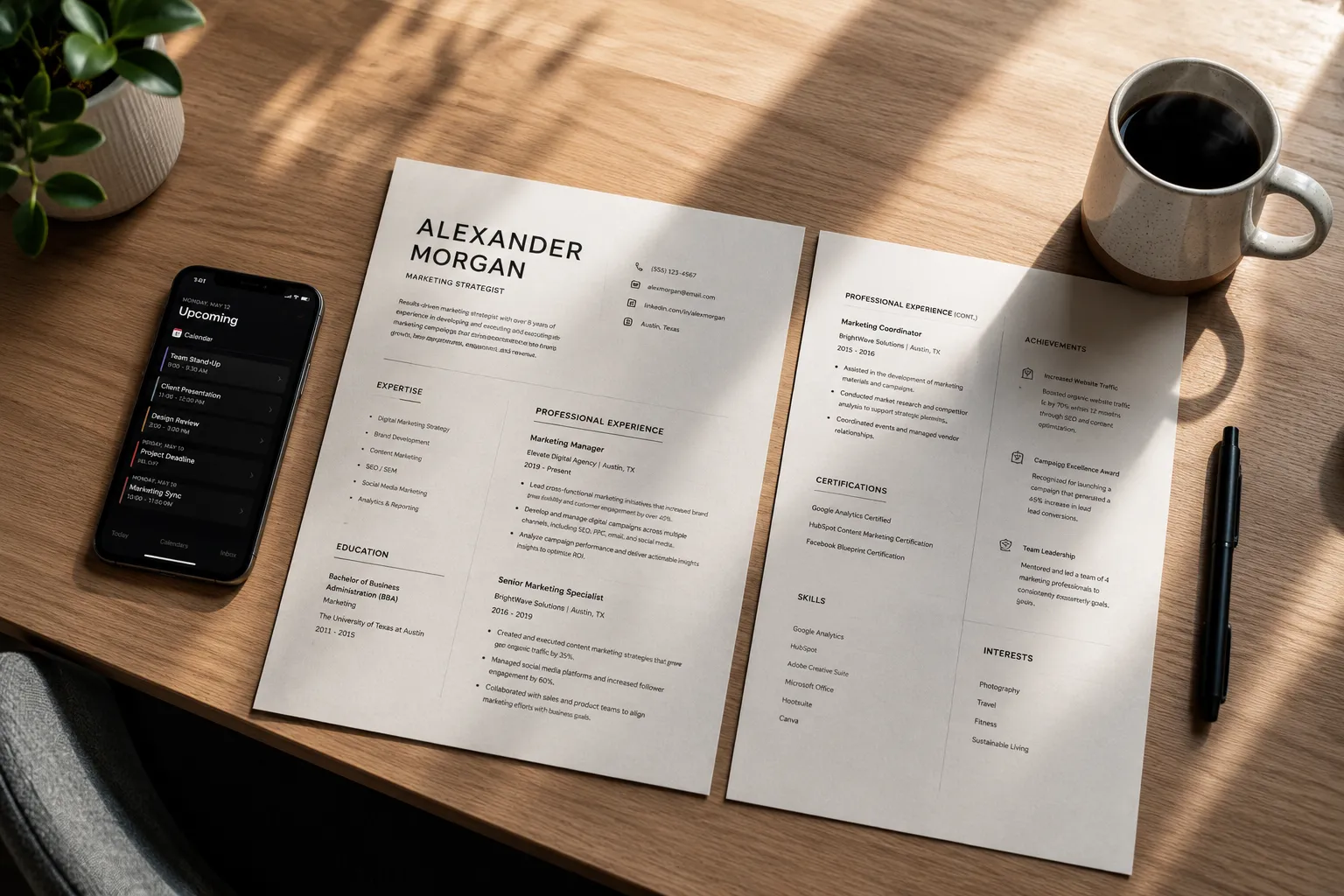
Quick Summary: Yes, a two-page resume is absolutely acceptable for most professionals with more than five years of experience. Federal agencies and many private employers now prefer resumes that provide full context over artificially compressed one-pagers, and modern applicant tracking systems handle multi-page documents without issue. The key is ensuring every line adds value—length matters less than relevance.
The one-page resume rule is one of those career myths that refuses to die.
Somewhere along the line, job seekers got the message that crossing onto a second page meant automatic rejection. But here’s the thing: that advice was always oversimplified, and in 2026, it’s downright misleading.
Hiring managers and recruiters care about one thing above all—whether your resume shows you can do the job. If cramming two decades of leadership experience into a single page means cutting the context that proves your value, you’re doing yourself a disservice.
So is it okay to have a two-page resume? Absolutely. But only when those two pages are working for you.
What Hiring Managers Actually Think About Resume Length
According to recent industry data, nearly 99% of Fortune 500 companies use applicant tracking systems regularly. These systems don’t penalize longer resumes—they scan for keywords and relevant experience regardless of page count.
In fact, 70% of large companies currently use ATS platforms that process multi-page documents without issue. The old fear that a second page would confuse scanning software is outdated.
Here’s what matters more than length: completion rates. Research from recruitment company Appcast tracking 500,000 job seekers found that recruiters can boost conversion rates by up to 365 percent by reducing the length of the application process to five minutes or less. The lesson? Recruiters want efficiency, not brevity for its own sake.
Federal hiring guidelines make this explicit. The U.S. Department of Labor and USAJOBS now limit federal resumes to two pages maximum—not one. They recognize that experienced professionals need space to demonstrate qualifications thoroughly.
The shift reflects a broader understanding: context matters. A resume that provides measurable accomplishments, relevant keywords, and clear career progression will always outperform a stripped-down version that sacrifices substance for arbitrary length limits.

When a Two-Page Resume Makes Sense
Not everyone needs two pages. But for certain professionals, trying to fit everything onto one page actively hurts their chances.
Experience Level Matters
If you have more than 7-10 years of professional experience, a two-page resume is not just acceptable—it’s expected.
Trying to compress a decade or more of progressively responsible roles, major projects, and measurable achievements into a single page forces you to cut exactly the details that differentiate you from other candidates.
For executives and senior leaders with 15-20 years of experience, two pages provides the space to demonstrate strategic impact without sacrificing specificity.
Career Complexity Requires Space
Some careers simply involve more moving parts. Technical roles with certifications, security clearances, and specialized skills need room to document qualifications thoroughly.
Federal resumes explicitly require detailed documentation—the USAJOBS platform builds resumes up to two pages precisely because government positions demand comprehensive qualification evidence.
Academic and research positions often require sections for publications, presentations, grants, and teaching experience that don’t fit traditional one-page formats.
Industry Expectations Vary
Certain industries have their own norms. Technology, healthcare, engineering, and academic fields typically expect and accept longer resumes that detail technical competencies and project portfolios.
Creative fields might include portfolio links and project descriptions that benefit from additional space. Legal, consulting, and financial services often feature multi-page resumes for experienced professionals.
Meanwhile, early-career professionals in retail, hospitality, or entry-level roles usually stick with one page—not because of a hard rule, but because they genuinely don’t have enough relevant experience to fill two pages meaningfully.
When One Page Is Still the Right Call
Let’s flip it around. When should you stick with a single page?
The clearest case: you’re early in your career. If you have fewer than five years of work experience, you probably don’t have enough substantial accomplishments to justify a second page yet.
Recent graduates and entry-level candidates benefit from tight, focused resumes that highlight education, internships, and relevant coursework without padding.
Another scenario: career changers. When you’re pivoting industries, a concise resume that emphasizes transferable skills often works better than a chronological deep-dive that highlights irrelevant experience.
If you’re applying to startups or smaller companies where hiring managers personally review every resume, brevity can work in your favor—but only if you’re not sacrificing important context.
The real test isn’t page count. It’s value per line. Can you articulate your impact, quantify your results, and demonstrate relevant skills without filler? Then use whatever space that takes.
How to Structure a Two-Page Resume Effectively
Having permission to use two pages doesn’t mean you should fill them carelessly. Structure matters.
Front-Load the Critical Information
Page one must hook the reader immediately. Start with a strong summary or professional profile that captures your core value proposition in 3-4 lines.
Follow with your most recent and relevant experience. Recruiters spend an average of 6-8 seconds on an initial resume scan—they need to see your qualifications before they flip pages.
Place your most impressive, quantifiable achievements on page one. If a hiring manager only reads the first page, they should still understand why you’re qualified.
Use the Second Page Strategically
Page two is for depth, not filler. Continue with earlier roles that provide relevant context but don’t need the same detail as recent positions.
Include your education section, certifications, technical skills, and any additional categories like publications or professional affiliations on page two.
Avoid orphaned headers—if a section starts on page one, don’t let a single line carry over to page two. Adjust formatting to keep sections intact.
Maintain Visual Consistency
Both pages should use identical formatting: same fonts, same margins, same header style. Include your name and page number in the header of page two.
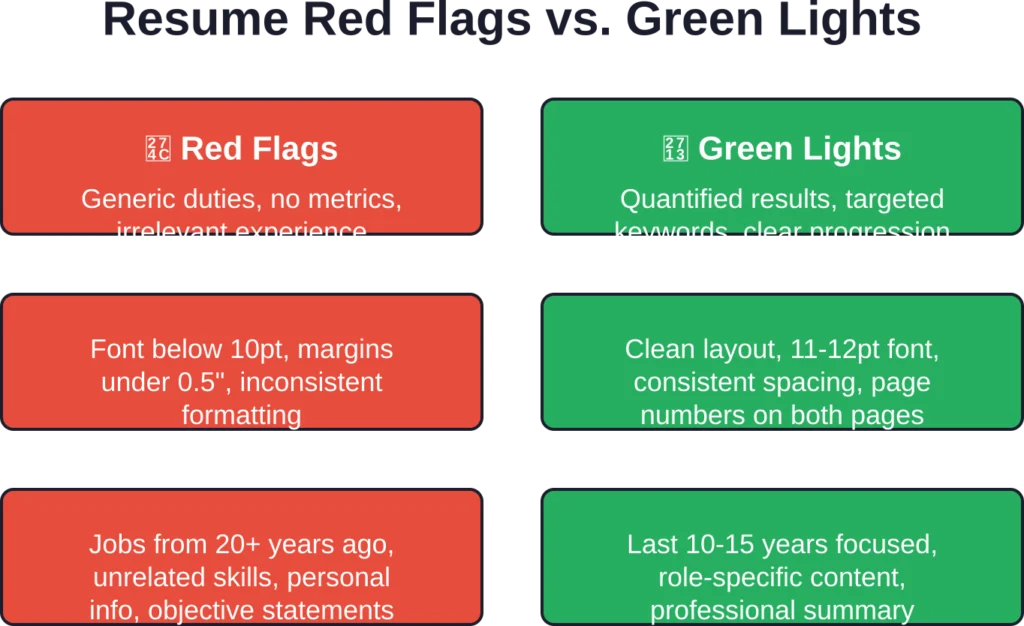
Resist the urge to shrink margins below 0.5 inches or reduce font size below 10 points just to squeeze in more content. Readability trumps compression.
White space is your friend. A clean, scannable two-page resume beats a cramped one-pager every time.
| Page Section | Essential Content | Avoid |
|---|---|---|
| Page 1 Top | Name, contact info, professional summary, most recent 2-3 roles | Objective statements, outdated skills, personal hobbies |
| Page 1 Bottom | Key achievements with metrics, relevant technical skills | Long paragraphs, generic duties, references |
| Page 2 Top | Earlier relevant roles, continued accomplishments | High school info (if you have a degree), unrelated jobs |
| Page 2 Bottom | Education, certifications, professional development | “References available upon request”, full street address |
Common Mistakes That Make Two Pages Work Against You
A poorly executed two-page resume can absolutely hurt your chances. Here’s what to avoid.
Filler Content and Fluff
The biggest mistake? Padding. If you’re adding generic responsibilities, redundant bullet points, or irrelevant experience just to fill space, you’re undermining your credibility.
Every line should earn its place. If a bullet point doesn’t demonstrate a skill, quantify an achievement, or provide context that matters for the target role, cut it.
Poor Formatting and Readability Issues
Tiny fonts, narrow margins, and dense text blocks make your resume hard to scan—and recruiters simply won’t bother.
Inconsistent formatting between pages signals carelessness. Missing page numbers or headers on page two creates confusion if pages get separated.
Including Outdated or Irrelevant Information
Just because you have two pages doesn’t mean you should include your college retail job from 2008 or that unrelated certification you never used.
Focus on the last 10-15 years of experience unless earlier roles are directly relevant to the position. Older experience can be summarized briefly or omitted entirely.
ATS Compatibility and Two-Page Resumes
One persistent myth: applicant tracking systems can’t handle multi-page documents. That’s simply false.
Modern ATS platforms parse two-page resumes without issue. According to recent data, 75% of recruiters use ATS or tech-driven recruiting tools.
What matters for ATS compatibility isn’t page count—it’s formatting. Use standard section headers like “Work Experience,” “Education,” and “Skills.” Avoid tables, text boxes, headers, and footers for critical content (though simple headers with your name and page number are fine).
Save your resume as a .docx or PDF file. Most modern ATS platforms handle both, but check the job posting for specific requirements.
Focus on keyword optimization. ATS systems scan for terms from the job description. A well-optimized two-page resume with relevant keywords will consistently outrank a one-page resume missing those terms.
Making Keywords Work for You
Incorporate exact phrases from the job posting naturally throughout your resume. If the posting mentions “project management,” use that exact phrase rather than “managed projects.”
Include both acronyms and spelled-out versions of technical terms the first time they appear: “Search Engine Optimization (SEO)” or “Applicant Tracking System (ATS).”
Place your most relevant keywords in context within your accomplishment statements—don’t just list them. ATS systems reward contextual usage over keyword stuffing.
Industry-Specific Guidelines
Resume expectations vary significantly by field. Understanding your industry’s norms helps you make smarter decisions about length.
Technology and Engineering
Technical fields typically accept and expect two-page resumes for experienced professionals. Detailed technical skills sections, project portfolios, and certifications require space.
Emphasis on measurable technical achievements—system performance improvements, code contributions, architecture decisions—benefits from the expanded format.
Business and Finance
Corporate roles, especially at senior levels, commonly feature two-page resumes. Demonstrating strategic impact, financial results, and team leadership requires context that one page can’t provide.
Quantified business outcomes are essential: revenue growth, cost reductions, efficiency gains, market share improvements.
Creative and Marketing
Creative professionals often supplement resumes with portfolio links, but the resume itself still benefits from showcasing campaign results, brand impact, and measurable engagement metrics.
For senior marketing roles, demonstrating cross-channel expertise and strategic thinking justifies two pages when backed by concrete results.
Federal and Government
Federal resumes follow different rules entirely. The USAJOBS system explicitly requires detailed documentation of duties, accomplishments, and qualifications—two pages is the maximum allowed, not a stigma.
Federal hiring relies heavily on matching specific keywords and qualification requirements, making comprehensive documentation essential.
Making the Final Decision
So how do you decide whether your resume should be one page or two?
Ask yourself these questions: Can you demonstrate relevant, recent accomplishments that directly support the role you’re targeting? Do you have more than five years of progressive experience? Are you omitting important context just to stay on one page?
If the answer to those questions is yes, use two pages without guilt.
But also ask: Is every bullet point pulling its weight? Could you cut this section without losing anything important? Are you adding content just to fill space?
If you’re padding, scale back—even if that means landing at 1.5 pages or a strong single page.
The real question isn’t about page count. It’s about value. Every line should demonstrate capability, quantify impact, or provide context that makes you a stronger candidate.
That’s the standard. Not a number.
Frequently Asked Questions
Yes, if the content is relevant and well-organized. Recruiters spend limited time on initial scans, but if your first page hooks them with strong accomplishments and clear qualifications, they’ll absolutely read page two. The key is front-loading your most impressive credentials and maintaining scannable formatting throughout.
Ideally, yes. Tailor your resume for each role by emphasizing the most relevant experience and keywords. For some positions, that might mean a tight one-page version focused on specific skills; for others, a comprehensive two-page resume demonstrating breadth makes sense. Customization always beats a one-size-fits-all approach.
Review each bullet point on page two critically. Does it quantify an achievement, demonstrate a relevant skill, or provide context that strengthens your candidacy? If you can’t clearly explain why a line matters for the role you’re targeting, cut it. A strong 1.5-page resume beats a padded two-pager.
Rarely, but it depends on the field. If you’re a recent PhD graduate with publications, research, and teaching experience, two pages might be appropriate. But for most entry-level roles, you won’t have enough relevant professional experience to justify the space. Focus on a strong one-page resume highlighting internships, projects, and skills instead.
Hiring managers care about relevance, not arbitrary page limits. Research and industry discussions consistently show that decision-makers prefer comprehensive, well-organized information over artificially compressed content. If you have substantial experience and present it clearly, length becomes irrelevant—they’ll read what demonstrates you can do the job.
Be intentional about page breaks. Don’t split a job description across pages—keep each role intact. Place your page break at a natural section boundary, like between work experience and education. Include your name and “Page 2” in the header of the second page so pages don’t get separated or confused.
Stick with traditional formats for ATS compatibility unless you’re certain a human will review your resume first. Creative industries might accept more visual resumes as supplements, but your primary resume should remain cleanly formatted and ATS-friendly. Save the creativity for your portfolio, not the document that needs to pass automated screening.
Your Resume Should Work for You, Not Against You
The one-page resume rule is a relic of a different hiring era—one before applicant tracking systems, before digital applications, and before most professionals built careers spanning multiple decades.
In 2026, the question isn’t whether two pages are acceptable. They are. The question is whether your resume—whatever its length—effectively demonstrates your value.
If you’re an experienced professional with relevant accomplishments, strategic impact, and measurable results, use the space you need to tell that story clearly. Don’t compress decades of experience into a cramped, underselling format just to satisfy an outdated rule.
But also don’t pad. A weak two-page resume isn’t better than a strong one-page version.
Focus on relevance, clarity, and results. Make every line count. Keep your formatting clean and consistent. Optimize for both humans and ATS systems.
Do that, and the page count takes care of itself.
Now take an honest look at your current resume. Does it sell your qualifications effectively, or are you sacrificing substance for an arbitrary length target? If it’s time for an update, you know what to do.