

Quick Summary: Mixing different oil brands with the same viscosity and specifications is technically acceptable and won’t immediately harm your engine. However, different brands use proprietary additive packages that may not work optimally together, so it’s best reserved for emergency top-ups rather than regular practice. Always match the viscosity grade and API/ILSAC specifications listed in your owner’s manual.
You’re checking your dipstick before a long drive and notice the oil level is a quart low. The problem? Last time you got an oil change, the shop used Mobil 1, but all you have in the garage is a bottle of Castrol. Or maybe you bought oil on sale at different times and now have a mismatched collection.
So the question hits: is it actually okay to mix oil brands?
The short answer is yes, you can mix different brands of engine oil without immediately destroying your engine. But here’s the thing—just because you can doesn’t mean you should make it a regular habit.
Let’s break down what really happens when you mix oil brands, when it’s acceptable, and when you should stick with one brand.
Understanding Engine Oil Basics
Before diving into the mixing question, it helps to understand what’s actually in that bottle of motor oil.
Engine oil consists of two main components: base oil (typically 70-95% of the formula) and an additive package (5-30%). The base oil provides lubrication, while additives handle everything else—cleaning, rust prevention, viscosity stability across temperature ranges, and more.
What Makes Oil Brands Different
Every major oil manufacturer uses similar base stocks. Conventional oils use refined petroleum. Synthetic oils use chemically engineered molecules. Synthetic blends combine both.
But the additive packages? That’s where brands differentiate themselves.
Each company formulates proprietary additive blends that include detergents, dispersants, anti-wear agents, viscosity modifiers, antioxidants, and friction modifiers. These recipes are closely guarded trade secrets.
That’s the core issue with mixing brands. When you combine two different additive packages, you’re creating a cocktail that neither manufacturer tested or intended.
Can You Mix Different Oil Brands?
Real talk: mixing oil brands is common and rarely causes immediate problems.
If you’re topping off with a different brand that has the same viscosity rating (say, both are 5W-30) and meets the same industry specifications (API, ILSAC), your engine will run normally in the short term.
According to community discussions in automotive forums and among car owners, the practice is widespread enough that most people have done it at some point without catastrophic results.
The key phrase there is “short term.”
When Brand Mixing Works Fine
Some scenarios carry minimal risk:
- Emergency roadside top-ups when your oil level is critically low
- Adding less than one quart to an engine that already has four or more quarts of another brand
- Both oils match viscosity (5W-30 to 5W-30, for example) and meet your vehicle’s required specifications
- You plan to do a complete oil change at your next scheduled interval
In these situations, the dilution effect means the mixed additive package represents a small percentage of the total oil volume. Your engine will function normally.
When Mixing Becomes a Problem
Now, this is where it gets interesting.
While one-time mixing rarely causes issues, repeatedly mixing different brands creates cumulative effects that can compromise oil performance over time.
The Additive Conflict Issue
Different additive packages are designed to work as complete systems. When you mix brands, certain additives might interact in ways that reduce their effectiveness.
For example, one brand might use a specific type of detergent that works optimally at certain concentrations. Diluting it with another brand’s formula can reduce cleaning efficiency.
Antioxidants from different manufacturers might not complement each other, potentially reducing the oil’s ability to resist thermal breakdown.
These aren’t dramatic failures. Your engine won’t seize. But the mixed oil might not protect as well as either brand would alone.
Viscosity Stability Concerns
Viscosity modifiers are additives that help oil maintain proper thickness across temperature ranges. Different brands use different polymers and formulations for this purpose.
When mixed, these modifiers might not work synergistically, potentially leading to faster viscosity breakdown under high temperatures or heavy loads.
Again, this is a gradual degradation rather than an immediate problem. But it matters if you’re pushing your oil change intervals or operating in extreme conditions.
What About Mixing Synthetic and Conventional Oil?
This question comes up constantly, especially when someone switches oil types mid-ownership.
The reality? Synthetic and conventional oils are fully compatible and can be mixed without causing chemical reactions or immediate damage.
Many “synthetic blend” oils are literally mixtures of synthetic and conventional base stocks. So mixing them yourself isn’t creating something unprecedented.
That said, mixing defeats the purpose of using synthetic oil in the first place.
Why You Paid Extra for Synthetic
Synthetic oils offer superior performance: better flow at cold temperatures, better stability at high temperatures, longer service intervals, and improved fuel economy.
When you dilute synthetic oil with conventional oil, you lose some of these benefits. The mixed oil will perform somewhere between the two—better than pure conventional, but not as good as pure synthetic.
If you paid extra for synthetic, why compromise its performance?
Modern Vehicle Requirements
Many newer vehicles require low-viscosity oils like 0W-20 or 0W-30. These specifications are only available in synthetic formulations—conventional oil simply cannot be refined to these viscosity grades.
If your vehicle specifies 0W-XX oil, you must use synthetic. Mixing in conventional oil (even if it’s the closest available grade like 5W-30) means you’re no longer meeting manufacturer specifications.
That could potentially void warranty coverage if an engine problem occurs.
Common Oil Mixing Scenarios Explained
Let’s look at specific situations and assess the actual risk level.
| Scenario | Risk Level | Short-Term Effect | Recommendation |
|---|---|---|---|
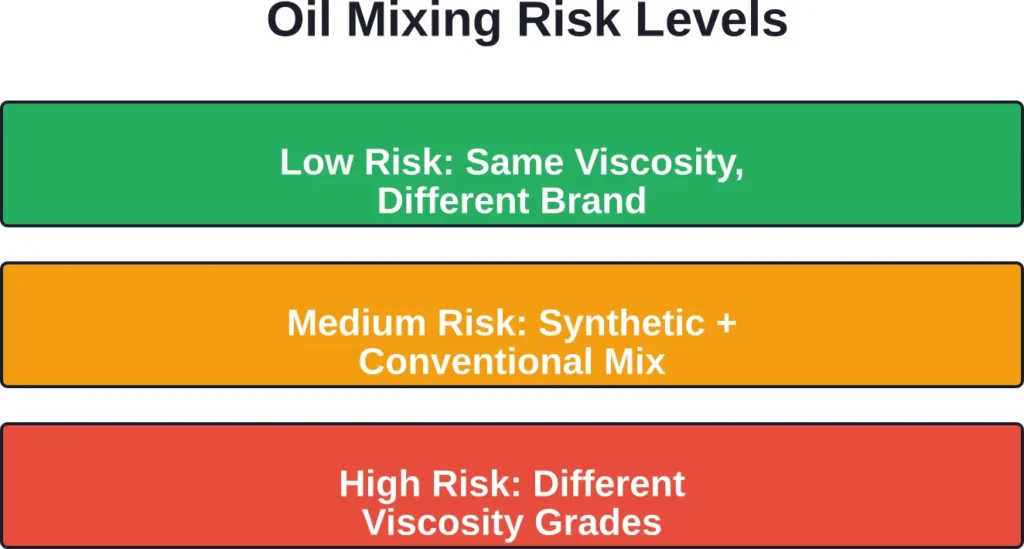
| Same viscosity, different synthetic brands (5W-30 Mobil 1 + 5W-30 Castrol) | Low | Engine runs normally | Acceptable for emergency top-up; change at next interval |
| Synthetic + conventional (same viscosity) | Medium | Reduced synthetic benefits | Avoid if possible; plan oil change soon |
| Different viscosity grades (5W-30 + 10W-40) | High | Unpredictable viscosity behavior | Do not mix; drain and refill with correct grade |
| Different oil types (diesel oil + gasoline oil) | Very High | Additive incompatibility | Never mix; wrong additives for engine type |
| Adding small amount (less than 1 quart) different brand, same spec | Very Low | Minimal dilution effect | Acceptable; monitor oil level |
The Emergency Top-Up Exception
Look, if your oil light comes on during a road trip and the only gas station for fifty miles carries a different brand than what’s in your engine, buy it and use it.
Running your engine with critically low oil is far worse than mixing brands.
Low oil levels mean reduced lubrication, increased friction, higher temperatures, and potential engine damage. In that scenario, any oil is better than no oil.
Just make a note to do a complete oil change sooner rather than later.
What Mechanics Actually See
In automotive forums and mechanic discussions, accounts suggest brand mixing rarely causes obvious problems in regular passenger vehicles in regular passenger vehicles.
What does cause problems is mixing the wrong viscosity, using oil that doesn’t meet specifications, or extending change intervals too far—especially with mixed oils.
The consensus among professionals: mixing brands occasionally won’t kill your engine, but it’s not a best practice.
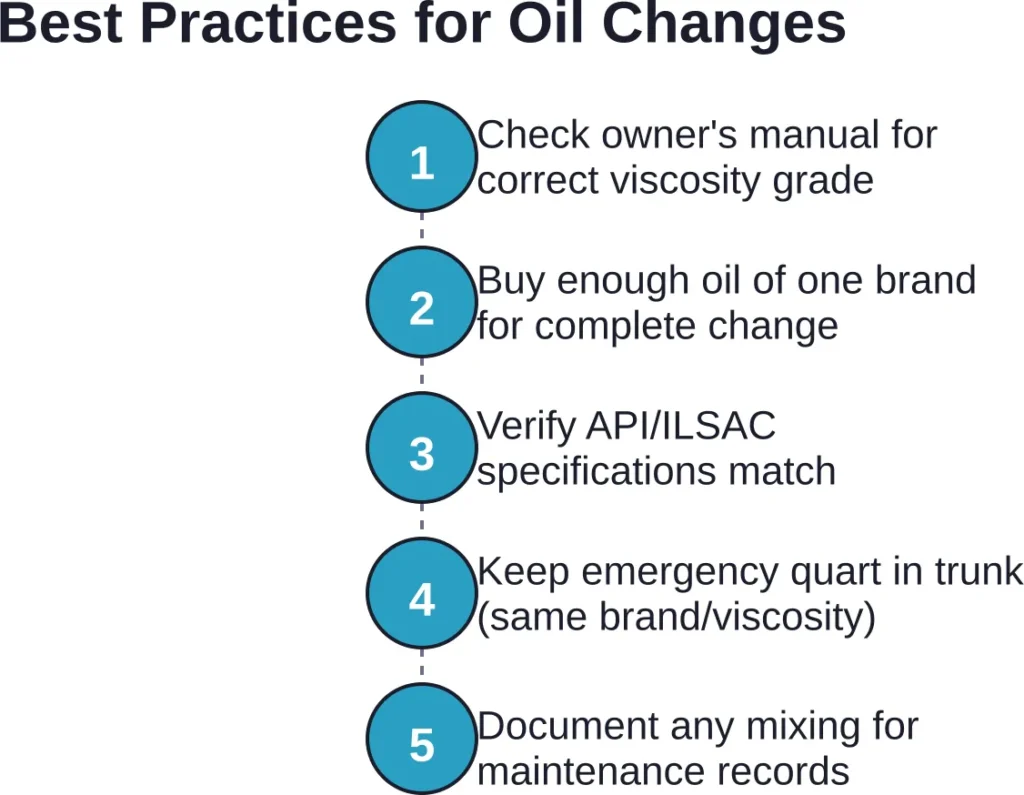
Plan your oil purchases so you have enough of one brand to complete changes. If you do mix, document when and why, and consider shortening your next change interval by 10-20%.
Viscosity: The Non-Negotiable Factor
Here’s where we draw a hard line.
Mixing different brands with the same viscosity is one thing. Mixing different viscosity grades is another entirely.
Your owner’s manual specifies viscosity for a reason. Engine clearances, oil pump capacity, and bearing designs all assume oil of a certain thickness.
What Happens When You Mix Viscosities
If you mix 5W-30 with 10W-40, you end up with something in between—but you cannot predict the exact viscosity of that mixture without lab testing.
The resulting oil might be too thick for cold starts, causing increased wear during the critical first moments after startup. Or it might be too thin at operating temperature, reducing protection under load.
Viscosity modifiers from different oils might also interact unpredictably, potentially causing faster breakdown.
Bottom line: never mix different viscosity grades. If you must add oil and only have the wrong viscosity available, add the minimum needed to reach safe levels, drive gently, and change the oil as soon as possible.
Reading Your Owner’s Manual
Your owner’s manual contains specific oil recommendations for a reason. These specifications come from extensive engine testing by the manufacturer.
Most manuals specify:
- Required viscosity grade (e.g., 5W-30)
- Required performance standards (API SN, ILSAC GF-6, etc.)
- Whether synthetic is required or recommended
- Alternative viscosity grades for extreme temperatures
When choosing oil—whether mixing or not—meeting these specifications matters more than brand name.
A quality oil from a lesser-known brand that meets your vehicle’s specs is better than a premium brand that doesn’t.
API and ILSAC Specifications Explained
The American Petroleum Institute (API) and International Lubricant Standardization and Approval Committee (ILSAC) establish minimum performance standards for engine oils.
These certifications—visible as symbols on oil bottles—indicate the oil has passed standardized testing for wear protection, deposit control, fuel economy, and emissions compatibility.
When mixing oils, ensuring both meet at least the same API/ILSAC level helps maintain baseline protection. Mixing an API SN oil with an older API SJ oil means the overall protection drops to the lower standard.
The Truth About Oil Change Intervals
Conventional wisdom says change your oil every 3,000 miles. Modern oils and engines have extended recommended intervals—manufacturers may recommend different intervals depending on vehicle specifications.
But here’s the catch: those intervals assume you’re using the specified oil consistently.
If you’ve mixed brands, viscosities, or oil types, playing it safe means shortening your next change interval.
Why? Because you cannot be certain how well that mixed oil cocktail is performing. The additive package might be degrading faster than designed. Viscosity might be breaking down sooner.
A conservative approach: if you mixed oils, reduce your next change interval by 20-25%.
What About High-Mileage Oils?
High-mileage oils contain extra seal conditioners and additives designed for engines with over 75,000 miles. These formulations help reduce oil consumption, minimize leaks, and clean accumulated deposits.
Can you mix high-mileage oil with regular oil?
Technically yes, but you’ll dilute those beneficial seal conditioners and lose some of the high-mileage benefits you’re paying extra for.
If your engine needs high-mileage oil, stick with it exclusively to get the full benefit.
Diesel vs. Gasoline Engine Oils
This deserves special mention because the consequences are more serious.
Diesel engine oils contain higher levels of detergents and anti-wear additives to handle soot and the higher compression loads in diesel engines. They’re formulated differently than gasoline engine oils.
Mixing diesel oil into a gasoline engine might seem harmless—after all, it’s “stronger” protection, right?
Not quite. Diesel oil additives can damage catalytic converters in gasoline engines. The extra detergents can also be too aggressive for gasoline engine components.
Conversely, putting gasoline engine oil in a diesel engine provides inadequate protection against soot and compression loads.
The rule here is absolute: never mix diesel and gasoline engine oils. Always use the type specified for your engine.
Storing Oil Properly
If you buy oil on sale and stock up—smart move for saving money—proper storage matters.
Motor oil can degrade when stored in unsealed containers or in extreme temperature conditions. Heat, cold extremes, and moisture can degrade oil even in unopened bottles.
Store oil in a garage or basement where temperatures stay moderate. Keep bottles sealed until use. Check for expiration dates if the manufacturer includes them.
Old oil might still be usable, but its additive package can degrade over time. If you’re mixing old stored oil with fresh oil, you’re potentially combining degraded additives with fresh ones—not ideal.
When to Stick with One Brand
Some driving conditions and vehicle types benefit from brand consistency more than others.
Consider sticking with a single brand if:
- You have a high-performance vehicle with tight tolerances
- Your vehicle is under warranty (documentation matters)
- You operate in extreme conditions (very hot, very cold, heavy towing)
- You’re pushing extended oil change intervals
- Your engine has turbochargers or other high-stress components
In these cases, the optimized additive package from a single manufacturer provides measurable benefits worth preserving.
For a typical daily driver used in normal conditions with regular oil changes? Occasional brand mixing is unlikely to cause problems.
What About Oil Additives?
Some car owners add aftermarket oil additives—friction modifiers, seal conditioners, engine flushes, or performance boosters.
If you’re already mixing oil brands, adding third-party additives creates an even more complex chemical mixture that no one has tested.
Modern oils already contain comprehensive additive packages. Generally speaking, aftermarket additives are unnecessary and can potentially interfere with the carefully balanced formulation already in your oil.
If you’re mixing brands, skip the aftermarket additives entirely.
The Bottom Line: Practical Recommendations
So where does all this leave us?
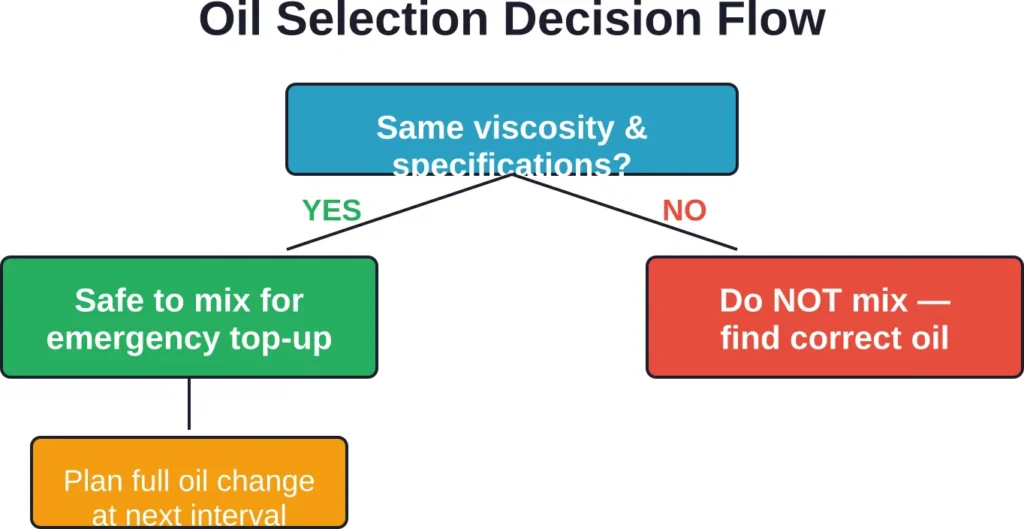
Mixing oil brands with identical viscosity and specifications is acceptable for emergency situations or occasional top-ups. Your engine will not suffer immediate damage.
However, making it standard practice compromises the carefully engineered additive systems both manufacturers designed. Over time and repeated mixing, oil performance can degrade faster than intended.
Best practices:
- Buy enough oil of one brand to complete each change
- Keep one quart of your preferred oil as emergency backup
- If you must mix, ensure identical viscosity and specifications
- Document any mixing in your maintenance records
- Plan to change mixed oil slightly sooner than normal intervals
- Never mix different viscosity grades
- Never mix diesel and gasoline oils
For typical drivers doing regular maintenance, occasional brand mixing won’t ruin your engine. But consistency serves your engine better in the long run.
Frequently Asked Questions
Yes, synthetic and conventional oils are fully compatible and can be mixed without causing chemical reactions. However, mixing them reduces the performance benefits of synthetic oil. The resulting mixture will perform somewhere between the two types—better than pure conventional but not as good as pure synthetic. Many “synthetic blend” products are exactly this mixture. If you mix them, plan a complete oil change at your next service interval to restore full synthetic benefits.
Mixing different viscosity grades (like 5W-30 and 10W-40) creates unpredictable oil thickness that might not properly protect your engine. The mixture could be too thick for cold starts, causing wear, or too thin at operating temperature, reducing protection under load. Viscosity modifiers from different oils may also interact unpredictably. Avoid mixing viscosities whenever possible. If unavoidable in an emergency, add only enough to reach safe levels, drive cautiously, and change the oil immediately.
Topping off with a different brand that matches the same viscosity and API/ILSAC specifications is acceptable, especially in emergency situations. Adding one quart of a different brand to an engine that already contains four or more quarts creates minimal dilution of the additive package. Your engine will run normally. Just document the mixing and consider changing oil slightly earlier than your normal interval. Keep emergency oil in your trunk that matches your regular brand to avoid this situation.
Mixing oil brands alone typically does not void vehicle warranties, as long as all oils used meet the manufacturer’s specified viscosity and performance standards (API, ILSAC). What can affect warranty coverage is using oil that fails to meet specifications or neglecting recommended maintenance intervals. Keep receipts and documentation showing any oil used meets required specifications. If engine problems occur and warranty coverage is questioned, documentation proves you used appropriate oil.
Mixing leftover oil from previous changes is possible if all the oil is the same viscosity and specification, but it’s not recommended. Oil exposed to air can begin oxidizing, and partially used bottles may have collected moisture or contaminants. Additionally, oil formulations change over time as manufacturers update additive packages. Mixing old and new formulations from the same brand might create minor compatibility issues. If the oil has been sealed and stored properly for less than five years, it’s generally usable, but fresh oil is always preferable.
While technically compatible, mixing high-mileage oil with regular oil dilutes the specialized seal conditioners and extra detergents that make high-mileage formulas effective. If your engine is consuming oil or showing minor leaks—the main reasons for using high-mileage oil—stick with high-mileage exclusively to maintain full benefits. Mixing defeats the purpose of paying extra for the specialized formula. If you must top off between changes, use the same high-mileage brand and viscosity you used during your last full oil change.
If you mixed brands with matching specifications as an emergency top-up, plan your next oil change at the normally scheduled interval or slightly sooner—reducing the interval by 10-20% is conservative and safe. If you mixed different types (synthetic with conventional) or had to use a slightly different viscosity, change the oil within 1,000-2,000 miles or at your next scheduled maintenance, whichever comes first. Document what you mixed and when, so you can make informed decisions about change timing based on your specific situation and driving conditions.
Making Your Oil Choice
At the end of the day, motor oil is critical to engine longevity, but it’s also a practical commodity. Perfect consistency is ideal but not always possible in real-world situations.
Emergency situations happen. You find yourself low on oil with limited options available. In those moments, getting the right viscosity matters far more than the brand name on the bottle.
But when you have a choice—when you’re shopping for your next oil change or stocking your garage—consistency pays off. Your engine will reward you with smoother operation, better protection, and potentially longer life.
Check your owner’s manual. Buy quality oil that meets specifications. Stick with one brand when practical. And when you must mix, do so intelligently by matching viscosity and planning your next full change accordingly.
Your engine is a significant investment worth protecting properly.