

Quick Summary: Running every day can be beneficial for cardiovascular health and consistency, but it significantly increases injury risk, particularly overuse injuries. Most runners—especially beginners—should aim for 3-5 running days per week with rest days in between. Experienced runners may handle daily running if they vary intensity, incorporate active recovery, and listen to their body’s signals.
Running has become one of the most popular forms of exercise worldwide. It requires minimal equipment, burns significant calories, and delivers measurable health benefits. But as enthusiasm builds, many runners start wondering: can I run every single day?
The answer isn’t as simple as yes or no. It depends on experience level, training intensity, recovery practices, and individual physiology. While some elite athletes run daily without issue, research shows that most people—particularly beginners—face increased injury risk when running without rest days.
Here’s what the science actually says about daily running, who should do it, and how to make the decision that’s right for your body.
The Benefits of Running Every Day
Before diving into the risks, it’s worth acknowledging why so many people are drawn to daily running. The benefits are real and well-documented.
Cardiovascular Health and Longevity
Even short daily runs deliver measurable cardiovascular benefits. Research published in the Journal of the American College of Cardiology found that just five to 10 minutes of running every day at a slow pace (less than six miles per hour) is associated with reduced risk of death from all causes.
Regular aerobic exercise reduces blood pressure by 5-7 mmHg among individuals with hypertension, according to the American College of Sports Medicine. These reductions translate to a 20-30% reduction in cardiovascular disease risk. And here’s the thing: the benefits follow the “law of initial values”—people with higher baseline blood pressure experience even greater reductions from exercise training.
For heart and lung health, consistency matters more than intensity. Daily moderate running strengthens the cardiovascular system progressively over time.
Building Unshakeable Consistency
One of the strongest arguments for daily running is habit formation. When running becomes a non-negotiable part of the daily routine—like brushing teeth—motivation becomes less of a barrier.
Many runners report that daily running eliminates the mental negotiation of “should I run today?” The answer is always yes, which paradoxically makes it easier to maintain long-term adherence.
Mental Health and Stress Relief
Running provides documented mental health benefits. Regular physical activity reduces symptoms of depression and anxiety, enhances brain function, and improves overall well-being, according to the World Health Organization.
For many people, the daily endorphin release and meditative quality of running become essential stress management tools. Missing a day can feel destabilizing when running has become a primary coping mechanism.
The Drawbacks and Risks of Daily Running
Now for the reality check. Despite the benefits, running every day carries significant risks that many enthusiasts underestimate.
Overuse Injuries: The Primary Concern
Here’s where the data gets sobering. More than 70% of musculoskeletal injuries in running are due to overuse, according to medical research published in Arthroscopy, Sports Medicine, and Rehabilitation. The majority of these injuries occur in the lower leg, primarily in the knee and ankle.
A large cohort study of 5,200+ runners analyzed training-related exposures and injury risk across multiple sessions. The research identified specific injury triggers related to sudden increases in running distance.
When a single running session exceeded 10% of the longest run undertaken in the previous 30 days, injury risk increased significantly. The hazard ratios tell the story:
- Small spike (>10-30% increase): 1.64x injury risk
- Moderate spike (>30-100% increase): 1.52x injury risk
- Large spike (>100% increase): 2.28x injury risk
Running daily without variation often leads to repetitive stress on the same muscles, tendons, and joints. Without adequate recovery time, microdamage accumulates faster than the body can repair it.
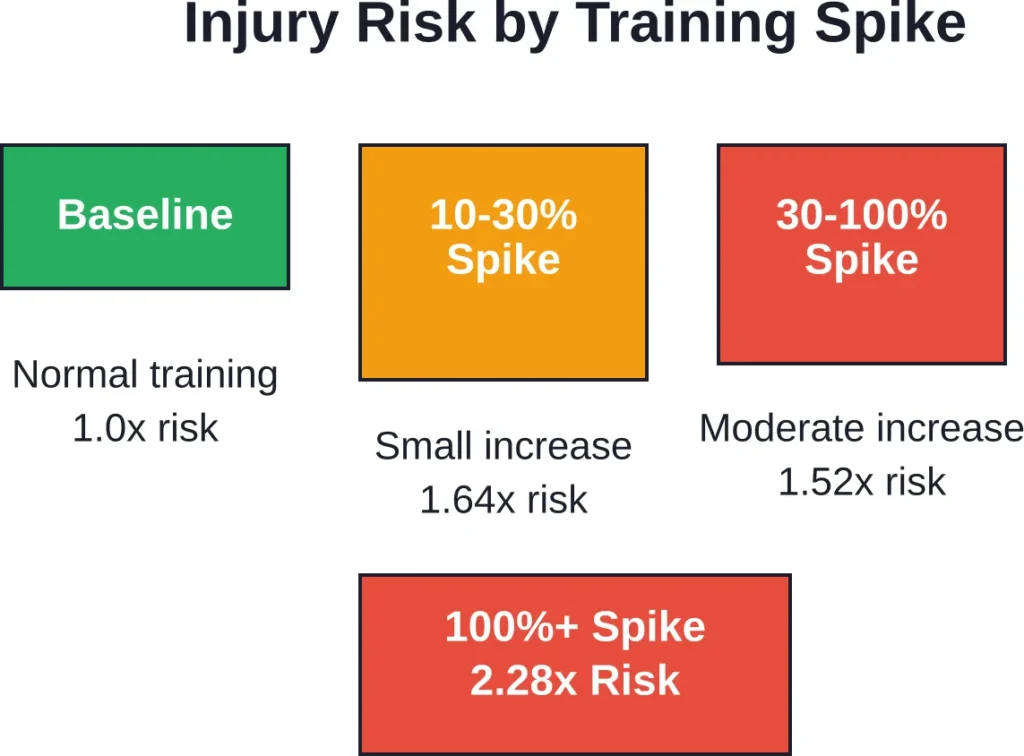
The message is clear: sudden increases in training load—which daily running often encourages—substantially raise injury risk.
Reduced Immune Function
Intense daily exercise without adequate recovery can suppress immune function. While moderate exercise generally strengthens immunity, excessive training stress has the opposite effect.
Athletes who train intensely every day report higher rates of upper respiratory infections and longer recovery times from illness. The body needs rest to maintain optimal immune surveillance and inflammatory response.
Less Motivation for Cross-Training
When running consumes all available exercise time, runners often neglect strength training, flexibility work, and other forms of movement. This creates muscular imbalances and increases injury risk.
Strength training, in particular, plays a crucial injury-prevention role. The American College of Sports Medicine recommends that all adults engage in resistance training at least two days per week, targeting all major muscle groups.
Daily runners frequently skip this critical component, which leads to weaker stabilizing muscles and poor biomechanics under fatigue.
Overtraining Syndrome
Though less common, overtraining syndrome represents the extreme end of inadequate recovery. This condition involves maladapted physiology in the setting of excessive exercise without adequate rest.
Research shows that overreaching has an incidence ranging from 5% to 60%. Symptoms include persistent fatigue, mood disturbances, sleep disruption, elevated resting heart rate, and paradoxical performance decline despite continued training. The primary trigger is always the same: training volume exceeding recovery capacity.
How Often Should You Actually Run?
So if daily running isn’t ideal for most people, what’s the optimal frequency?
The answer depends heavily on experience level, goals, and individual recovery capacity. Here’s how to think about it.
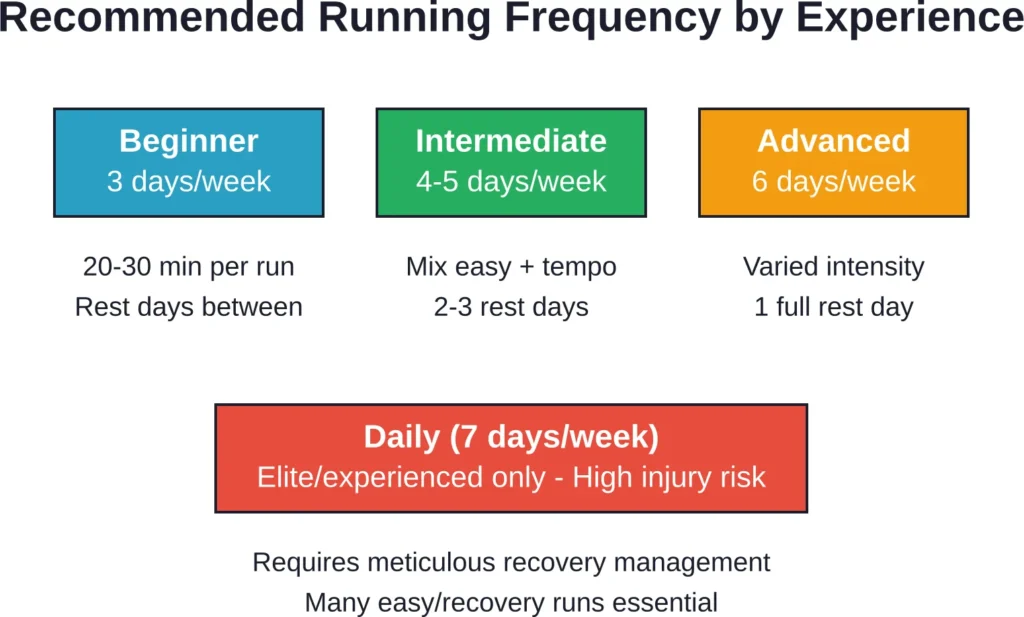
For Beginners: Start with 3 Days Per Week
New runners benefit most from three running days per week with rest or cross-training days in between. This schedule provides adequate stimulus for cardiovascular adaptation while allowing recovery time for connective tissues that adapt more slowly than cardiovascular systems.
Each run should last at least 20 minutes to stimulate fitness-boosting changes in the cardiovascular system. Three 20-30 minute runs per week totals 60-90 minutes of running—enough to produce measurable health benefits without overwhelming the body’s adaptation capacity.
Intermediate Runners: 4-5 Days Works Well
Once running becomes comfortable and injury-free for several months, adding a fourth or fifth running day makes sense. This frequency allows for varied training stimuli—easy runs, tempo work, and longer efforts—while still preserving recovery days.
The key is varying intensity. Not every run should be hard. In fact, most shouldn’t be. The majority of weekly running should occur at conversational pace, with only one or two harder efforts per week.
Advanced and Competitive Runners: 6 Days Is the Sweet Spot
Experienced runners training for races often run six days per week with one complete rest day. This schedule provides high training volume while ensuring at least one day for full physiological recovery.
Elite runners sometimes run twice per day, but even they typically take one full rest day per week. The rest day isn’t optional—it’s when adaptation actually occurs.
Seven Days Per Week: Only for Select Individuals
Running every single day works for some people, but they’re the exception. Runners who successfully maintain daily running typically:
- Have years of consistent running experience
- Vary intensity significantly, with many easy recovery runs
- Keep some runs very short (20-30 minutes)
- Pay meticulous attention to recovery: sleep, nutrition, stress management
- Have no history of recurring injuries
Even then, many experienced runners benefit from occasional down weeks or complete rest days to prevent accumulated fatigue.
Official Physical Activity Guidelines
It helps to contextualize running frequency within broader physical activity recommendations.
The American College of Sports Medicine recommends that healthy adults aged 18-65 engage in:
- At least 30 minutes of moderate-intensity aerobic activity on 5 days per week, OR
- At least 20 minutes of vigorous-intensity aerobic activity on 3 days per week
Running typically qualifies as vigorous-intensity activity. According to these guidelines, three days per week of 20+ minute runs meets minimum recommendations.
The World Health Organization provides similar guidance: adults should engage in 150 minutes per week of moderate-intensity physical activity, or 75 minutes per week of vigorous-intensity activity. Additional health benefits occur with 300 minutes per week of moderate-intensity activity.
For children, recommendations differ: at least 60 minutes of moderate-to-vigorous physical activity daily. But even for young people, variety matters more than running exclusively every day.
How to Build Up Running Frequency Safely
If the goal is to run more frequently, progression matters enormously. Sudden jumps in running days per week cause exactly the training load spikes associated with injury.
Increase Gradually
Add one additional running day every 3-4 weeks. If currently running three days per week, maintain that for at least a month before adding a fourth day. Let the body adapt to each new load before adding more.
When adding a new running day, make it short and easy. The new day shouldn’t add significant training stress—it’s simply providing more frequent movement stimulus.
Prioritize Recovery Fundamentals
Recovery isn’t passive. Active recovery strategies include:
- Adequate sleep (7-9 hours for most adults)
- Proper nutrition, including post-run refueling within 20 minutes
- Hydration throughout the day
- Stress management
- Stretching and mobility work
Post-run nutrition deserves special attention. Research suggests consuming a snack with a 3:1 to 4:1 carbohydrate-to-protein ratio within 20 minutes of finishing helps speed recovery. The body uses this window to replenish glycogen stores and initiate tissue repair.
Monitor Warning Signs
The body provides clear signals when recovery is inadequate. Pay attention to:
- Persistent muscle soreness lasting more than 48 hours
- Declining performance despite maintained or increased effort
- Elevated resting heart rate
- Mood changes, irritability, or lack of motivation
- Sleep disruption
- Frequent minor illnesses
These symptoms indicate accumulated fatigue. The solution is reducing training volume and adding rest days—not pushing through.
Include Cross-Training
Non-running days don’t have to be sedentary. Cross-training activities provide cardiovascular benefits without the repetitive impact stress of running.
Excellent cross-training options include cycling, swimming, rowing, and elliptical training. These activities use different movement patterns and muscle recruitment, giving running-specific tissues a break while maintaining fitness.
Strength training is particularly valuable. Two to three weekly strength sessions targeting legs, core, and upper body create muscular balance and improve running economy.
When Daily Running Might Work
Despite the general recommendation for rest days, some situations make daily running more viable.
Run Streaks with Intelligence
Some runners maintain “run streaks”—running at least one mile every day for extended periods. The key to successful streaking is making some runs extremely short and easy.
A streak that includes several 10-15 minute recovery jogs per week alongside regular training runs distributes impact more evenly than seven hard efforts. The short runs serve as active recovery rather than additional training stress.
Two-A-Day Training with Caution
Elite runners sometimes run twice per day, which technically means running every day. But this approach requires significant experience and careful management.
The second run of the day is typically short (20-30 minutes) and very easy. The purpose is enhancing recovery through increased blood flow, not adding training stress.
This strategy is inappropriate for recreational runners and even most competitive amateurs. The injury risk outweighs any marginal fitness benefit.
Comparing Running Frequency Approaches
| Days Per Week | Best For | Injury Risk | Key Considerations |
|---|---|---|---|
| 3 days | Beginners, injury-prone runners | Low | Adequate recovery; meets minimum health guidelines |
| 4-5 days | Intermediate runners, general fitness | Moderate | Balance training variety with recovery; most versatile schedule |
| 6 days | Competitive runners, experienced athletes | Moderate-High | Requires disciplined easy days; one full rest day essential |
| 7 days | Elite athletes, experienced streakers | High | Many runs must be short/easy; meticulous recovery needed |
The Bottom Line on Daily Running
Real talk: running every day sounds appealing in theory but works poorly in practice for most people.
The research is clear. Overuse injuries account for more than 70% of running-related problems, and inadequate recovery is the primary driver. Running frequency that doesn’t allow for tissue repair and adaptation substantially increases injury risk.
For beginners, three days per week provides sufficient stimulus for cardiovascular improvement while minimizing injury risk. Intermediate runners typically thrive on four to five days weekly. Even competitive runners usually cap frequency at six days, preserving one full rest day.
The rare individuals who successfully run every day share common traits: years of consistent training, varied intensity with many easy runs, exceptional attention to recovery practices, and absence of recurring injury. They’re the exception, not the rule.
But here’s the thing: optimal running frequency isn’t about maximizing days per week. It’s about balancing training stimulus with adequate recovery to produce long-term, sustainable improvement.
The best running schedule is the one that keeps someone running for years—injury-free, motivated, and progressively improving. For the vast majority, that means rest days are features, not bugs.
Frequently Asked Questions
Yes, daily running significantly increases injury risk for beginners. New runners should start with three days per week, allowing rest days for connective tissue adaptation. Beginners who run daily often develop overuse injuries in the knees, ankles, and shins because their bodies haven’t adapted to repetitive impact stress. Starting conservatively and building gradually produces better long-term results than aggressive daily training.
Not necessarily. While daily running burns calories, the injury risk and fatigue accumulation often backfire. Many people who run every day without adequate recovery experience elevated cortisol, disrupted sleep, and increased appetite—all of which can hinder weight loss. A schedule of 4-5 running days weekly combined with strength training typically produces better body composition changes than daily running alone. Consistency over months matters more than daily frequency.
Warning signs include persistent muscle soreness lasting beyond 48 hours, declining performance despite consistent effort, elevated resting heart rate, mood changes, poor sleep quality, and lack of motivation. If legs feel heavy during easy runs or heart rate is elevated at usual paces, the body needs rest. Ignoring these signals leads to overtraining and injury. Rest days are when adaptation occurs—they’re essential training components, not optional extras.
Rest days don’t require complete inactivity. Light cross-training like walking, easy cycling, swimming, or yoga maintains movement without adding impact stress. Strength training two to three times weekly prevents muscular imbalances that contribute to running injuries. Focus on recovery fundamentals: adequate sleep, proper nutrition, hydration, and stress management. Complete rest (no structured exercise) one day per week benefits most runners, allowing full physiological recovery.
Some elite runners train daily, but they’ve built enormous training capacity over years and follow meticulous recovery protocols. Even elites typically include one full rest day weekly or schedule down weeks with reduced volume. Their daily runs vary dramatically in intensity—many are short, easy recovery efforts rather than hard training. Elite runners also have access to professional coaching, sports medicine support, and nutrition guidance. What works for professionals rarely translates directly to recreational runners.
No. Cardiovascular fitness maintains well with 3-5 running days per week. In fact, adequate recovery between runs often produces better fitness gains than daily training because adaptation occurs during rest. Research shows that training load spikes—which daily running encourages—increase injury risk far more than they improve fitness. Consistent training over months with appropriate rest days builds more fitness than aggressive daily running that leads to injury and forced time off.
If choosing to run daily despite recommendations otherwise, many runs must be short (15-20 minutes) and very easy—purely for active recovery. Only one or two weekly runs should be longer or harder. The total weekly mileage matters more than daily distribution. Most recreational runners achieve better results running 4-5 days with varied distances and intensities than running the same moderate distance seven days straight. Duration and intensity must decrease if frequency increases to prevent accumulated fatigue.
Moving Forward with Your Running
The question “is it OK to run every day?” doesn’t have a universal answer. It depends on individual factors: training history, injury susceptibility, recovery capacity, and goals.
But the weight of evidence points clearly toward rest days for most runners. Three to five running days per week with rest or cross-training days between sessions provides optimal stimulus-to-recovery balance. This approach minimizes injury risk while maximizing long-term improvement.
The runners who enjoy decades of injury-free running rarely do so by running every single day. They do it by respecting recovery, listening to their bodies, and understanding that rest days are when fitness actually improves.
Start where appropriate for current fitness and experience level. Increase frequency gradually. Pay attention to warning signs. And remember: the best training plan is the one that keeps someone running healthy and motivated for years to come.