
Quick Summary: Taking 1,000 mcg of vitamin B12 daily is considered safe for most people, as no tolerable upper intake level has been established by medical authorities. This dose is commonly used to treat deficiency and is far higher than the recommended daily allowance of 2.4 mcg for adults, but the body absorbs only what it needs and excretes the rest through urine.
If you’re staring at a bottle of vitamin B12 supplements and wondering whether 1,000 mcg is too much, you’re not alone. This dose appears everywhere—on pharmacy shelves, in prescription bottles, and in online health forums. But is it actually safe?
The short answer? Yes, for most people. But the full picture is more nuanced than that.
Understanding Vitamin B12 Dosage
Vitamin B12, also called cobalamin, plays essential roles in forming red blood cells, maintaining nerve cells, and synthesizing DNA. The body needs it, but can’t make it—meaning we rely entirely on food sources or supplements.
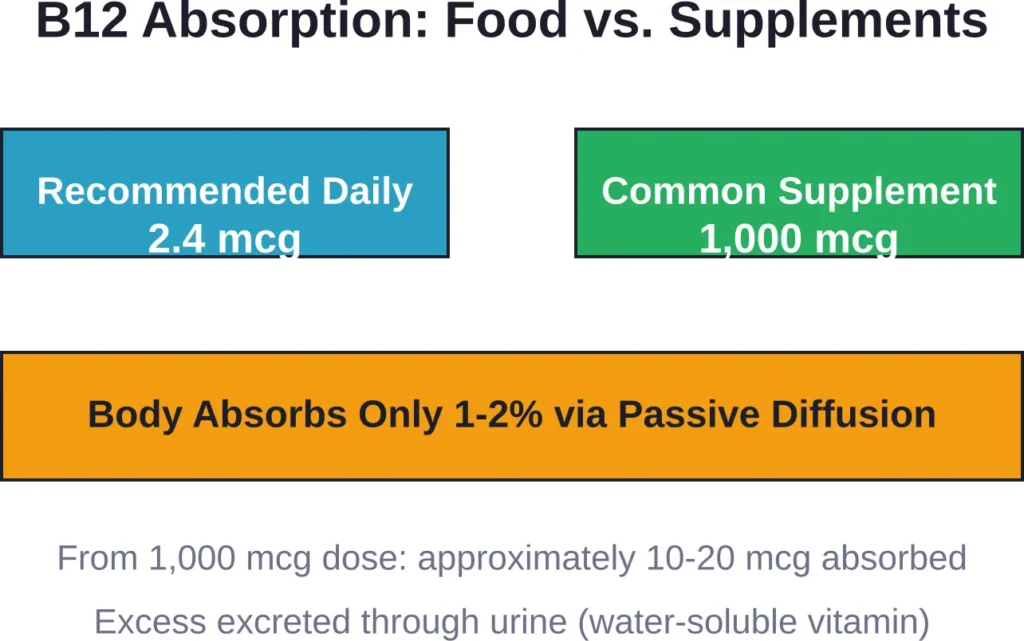
According to the National Institutes of Health, the Recommended Dietary Allowance for adults is 2.4 μg (micrograms) per day. That’s drastically lower than the 1,000 mcg (which equals 1,000 μg) found in many supplements.
Here’s the thing though—recommended intake and therapeutic dosing are two different conversations entirely.
Why Such a Huge Gap?
The RDA reflects what healthy people need to maintain normal bodily functions. Therapeutic doses like 1,000 mcg target specific problems: deficiency, malabsorption issues, or conditions that drain B12 stores.
Medical research demonstrates that daily supplementation with either 1,000 μg or 2,000 μg of vitamin B12 can improve symptoms in patients with diabetic peripheral neuropathy and low serum B12 levels.
How B12 Absorption Actually Works
Your body has two pathways for absorbing vitamin B12. Understanding them explains why high doses are both safe and sometimes necessary.
The primary route involves intrinsic factor, a protein produced in the stomach that binds to B12 from food. This complex travels to the terminal ileum, where receptors absorb it—but only in the presence of calcium supplied by the pancreas.
But wait. There’s a backup system.
According to research from the Linus Pauling Institute at Oregon State University, vitamin B12 can also be absorbed by passive diffusion, though this process is very inefficient—only about 1% to 2% of an oral dose gets through this way.
That’s precisely why therapeutic doses are so high. When you take 1,000 mcg, passive diffusion absorbs roughly 10-20 mcg even if the intrinsic factor pathway is completely broken.
What Happens to the Rest?
B12 is water-soluble. The body doesn’t store excess amounts the way it hoards fat-soluble vitamins like A or D. Instead, kidneys filter out what isn’t needed and send it packing through urine.
This mechanism is why medical authorities haven’t established a Tolerable Upper Intake Level for vitamin B12. There isn’t sufficient scientific evidence of toxicity even at very high doses.
Who Actually Needs 1,000 mcg Daily?
Not everyone requires therapeutic doses. Most people get adequate B12 from food—meat, poultry, fish, dairy products, and fortified cereals provide plenty.
The average intake of an individual in the United States is approximately 3.4 micrograms per day, according to medical sources.
Real talk: certain groups face significantly higher deficiency risk.
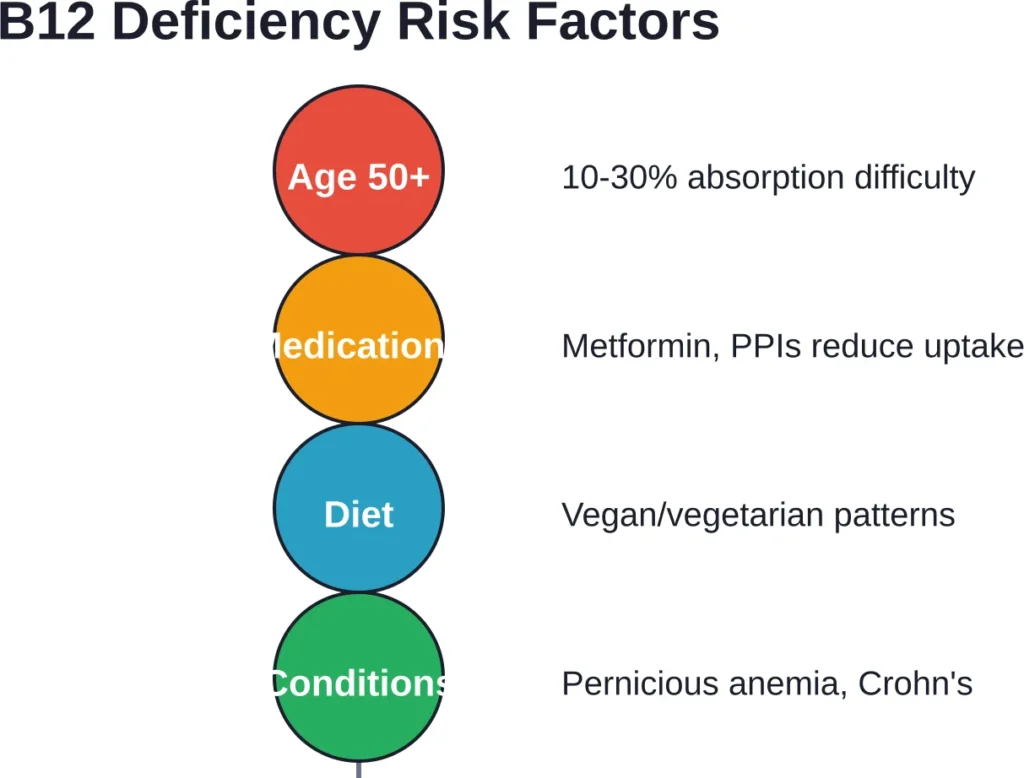
| Population Group | Why High-Dose May Help | Absorption Issue |
|---|---|---|
| Adults over 50 | 10-30% have difficulty absorbing B12 from food | Reduced stomach acid production |
| Metformin users | Medication decreases B12 absorption | Impaired intestinal uptake |
| Vegans/vegetarians | Plant foods contain virtually no B12 | Inadequate dietary intake |
| PPI/antacid users | Medications reduce stomach acid | Cannot release B12 from food |
| Pernicious anemia patients | Autoimmune destruction of intrinsic factor | Primary absorption pathway blocked |
It is estimated that up to 15% of the general population has a vitamin B12 deficiency.
The Safety Profile of High-Dose B12
Decades of research haven’t identified significant adverse effects from oral B12 supplementation, even at doses far exceeding 1,000 mcg.
Medical research demonstrates that daily supplementation with either 1,000 μg or 2,000 μg of vitamin B12 can improve symptoms in patients with diabetic peripheral neuropathy and low serum B12 levels.
Sound familiar? That pattern repeats across clinical trials.
The liver takes up approximately 50 percent of the B12 carried in the blood. But even with supplementation, these stores remain within normal ranges because the body self-regulates.
When to Talk to Your Doctor
Despite the safety profile, certain situations warrant medical supervision before starting high-dose B12.
People with Leber’s disease (a rare hereditary eye condition) should avoid cyanocobalamin supplements. Those with kidney disease need monitoring, since impaired kidney function affects how the body processes water-soluble vitamins.
Anyone experiencing persistent fatigue, numbness, tingling, or cognitive changes shouldn’t self-diagnose with B12 supplements. These symptoms overlap with numerous conditions that require proper medical evaluation.
And here’s something important: B12 supplementation can mask the symptoms of folate deficiency while allowing neurological damage to progress. A healthcare provider can order the right tests to distinguish between these issues.
Getting the Most from Your B12 Supplement
If you’re taking 1,000 mcg daily, timing and formulation matter more than most people realize.
The NHS recommends taking cyanocobalamin tablets on an empty stomach—at least 2 hours after a meal and at least 30 minutes before eating again. Don’t chew or break them.
Why? Food can interfere with passive diffusion absorption. When the intrinsic factor pathway is compromised, maximizing that 1-2% absorption rate becomes critical.
Forms of B12 include cyanocobalamin (most common and stable), methylcobalamin (active form), and adenosylcobalamin (another active form). Research shows all work effectively when absorption pathways function properly.
Frequently Asked Questions
For practical purposes, no. Medical authorities haven’t established a tolerable upper intake level because excess B12 is excreted through urine. Extremely high doses administered via injection have rarely caused side effects like skin rash or acne, but oral supplementation at 1,000 mcg daily has an excellent safety record.
Blood levels typically rise within days, but symptom improvement varies by severity and cause. Neurological symptoms may take weeks to months of consistent supplementation to resolve. Research on diabetic neuropathy showed meaningful improvements after 12-16 weeks of daily 1,000 mcg doses.
That depends on why you’re taking it. For treating diagnosed deficiency or malabsorption conditions, daily dosing is standard. For people over 50 or those on medications that impair absorption, ongoing supplementation often makes sense. Otherwise, getting B12 from fortified foods may be sufficient once levels normalize.
True toxicity is exceptionally rare with oral B12. Some people report mild side effects like headache, anxiety, or nausea, but these aren’t well-documented in clinical literature. If symptoms occur after starting supplementation, they’re more likely related to other ingredients in the supplement or unrelated health issues.
Yes. 1,000 micrograms equals 1 milligram. Labels use mcg (μg) because B12 doses are typically measured in micrograms. The recommended daily amount of 2.4 mcg would be 0.0024 mg—much easier to express in micrograms.
In most countries, including the United States and UK, vitamin B12 supplements up to 1,000 mcg are available over-the-counter. Prescription cyanocobalamin tablets exist in some regions, but the same doses are widely available without prescription. Injections typically require medical supervision.
B12 has few documented drug interactions. However, certain medications reduce B12 absorption: metformin, proton pump inhibitors (Prilosec, Protonix, Prevacid), H2 blockers (Zantac, Pepcid), and some antibiotics. If you’re taking these long-term, higher B12 doses may be necessary to maintain adequate levels.
The Bottom Line
Taking 1,000 mcg of vitamin B12 daily is safe for most people and serves a legitimate therapeutic purpose for many—particularly older adults, people with absorption issues, and those on medications that deplete B12.
The body’s elegant self-regulation system ensures that excess gets filtered out rather than building to toxic levels. Decades of clinical use support this dosage as both effective and well-tolerated.
That said, supplements aren’t a substitute for proper diagnosis. If you’re experiencing symptoms that might indicate B12 deficiency—persistent fatigue, neurological changes, or unexplained anemia—get your levels tested before assuming supplementation will solve the problem.
For those who do need it, 1,000 mcg daily offers a research-backed approach to maintaining healthy B12 status without the risks associated with many other supplements.