

Quick Summary: The best legal web design companies combine technical expertise with deep understanding of attorney-client trust dynamics, compliance requirements, and lead conversion optimization. Top agencies deliver mobile-responsive designs, ABA-compliant accessibility, secure client portals, and strategic SEO implementation that converts site visitors into retained clients.
Most law firm websites fail at the moment that matters most. They look professional enough in screenshots, but when a stressed potential client lands on the homepage at 11 PM searching for help, the site either builds instant trust or sends them to a competitor.
The difference rarely comes down to aesthetics. It’s about understanding how legal consumers make decisions under pressure.
Recent industry data from CallRail shows over 60% of initial legal inquiries happen on mobile devices. If a site requires pinching and zooming, those cases evaporate before the first call. And poor digital performance carries real costs—over 64% of law firms report that their website delivers the highest ROI compared to all other marketing efforts.
The agencies on this list understand these stakes. They build websites that convert traffic into consultations, handle compliance requirements specific to legal advertising, and create digital experiences that communicate competence before a single conversation happens.
What Separates Elite Legal Web Design from Generic Agencies
General web design agencies approach legal projects like any other B2B site. They prioritize visual polish and feature lists. That approach misses what actually drives retention decisions in legal services.
Elite legal web design agencies start with client psychology. Someone searching for a criminal defense attorney operates under completely different stress triggers than someone researching estate planning. The site architecture, messaging hierarchy, and conversion pathways must reflect those differences.
Here’s the thing though—legal websites operate under regulatory constraints that don’t apply to most industries. State bar associations impose strict rules about testimonials, case results, and advertising claims. An agency unfamiliar with these requirements can expose a firm to ethics complaints.
The best agencies also understand legal SEO as a distinct discipline. Competition for terms like “personal injury lawyer [city]” reaches levels rarely seen in other verticals. Without sophisticated technical SEO implementation and local search optimization, even beautifully designed sites languish on page four of results.
Core Capabilities That Matter for Law Firm Websites
Effective legal web design requires several non-negotiable technical capabilities:
- Mobile-first responsive design that maintains full functionality on devices from 320px width upward
- ADA and WCAG 2.1 AA compliance to prevent accessibility-based litigation and ensure inclusive access
- Secure client intake forms with SSL encryption and proper data handling protocols
- Schema markup implementation for legal practice areas, attorney credentials, and local business data
- Page speed optimization targeting sub-2-second mobile load times
- Integration capabilities with practice management software, CRM systems, and legal-specific tools
But technical chops only get an agency halfway. The other half requires understanding conversion psychology specific to legal services purchasing decisions.
The 15 Best Legal Web Design Companies for 2026
These agencies represent the current leaders in legal-specific web design, selected based on specialization depth, verifiable client results, technical capabilities, and understanding of attorney-client trust dynamics.
1. Gilzor

Gilzor specializes in custom software development and digital product creation for startups and growing businesses. The company excels at turning ideas into functional, scalable products with strong emphasis on UI/UX design, quality assurance, and go-to-market strategy.
Their process covers the full product lifecycle — from idea validation and business analysis to mobile and web development, R&D, and post-launch support. Gilzor focuses on delivering high-performance solutions that improve conversion rates and help businesses scale efficiently.
Contact Information:
- Website: www.gilzor.com
- Email: [email protected]
- Address: Poland, Warsaw, Office 58, street Adama Mickiewicza 37, 01-625
- LinkedIn: www.linkedin.com/company/gilzor-softwaredevelopment
2. Lengreo
Lengreo operates as a complete marketing and technology partner, with strong expertise in B2B lead generation, digital strategy, and technical implementation. The agency delivers measurable growth through integrated campaigns that combine SEO, paid advertising, and personalized outreach.
Their approach focuses on data-driven optimization and clear ROI. Lengreo builds strategies around client acquisition metrics — from reducing cost per lead to increasing qualified business opportunities and conversion rates. Projects often include full-funnel solutions: website development, demand generation, and ongoing performance optimization.
Contact Information:
- Website: lengreo.com
- Phone: +31 686 147 566
- Email: [email protected]
- Address: Vrijstraat 9 C/D, 5611 AT Eindhoven, Netherlands
- LinkedIn: www.linkedin.com/company/lengreo
- Instagram: www.instagram.com/lengreo.agency
- Twitter: x.com/Lengreo
3. Oski
Oski builds smart, well-engineered software solutions for tech-forward enterprises and ambitious startups. The company combines deep expertise in cloud architecture, frontend development, artificial intelligence, and modern CMS platforms.
Their development approach emphasizes speed, quality, and innovation. Oski delivers scalable cloud solutions, intuitive user experiences, and AI-powered systems that help businesses reimagine operations and accelerate digital transformation across multiple industries.
Contact Information:
- Website: oski.site
- Phone: +48571282759
- Email: [email protected]
- Address: Kaupmehe tn 7, 10114 Tallinn, Estonia
- LinkedIn: www.linkedin.com/company/oski-solutions
4. Mobian Studio
Mobian Studio builds dedicated engineering teams that deliver production-ready mobile and AI solutions for companies in IT, Healthcare, Fintech, and Logistics. They operate through both outsourcing and outstaffing models with a focus on senior-level execution.
Their strength lies in end-to-end product development, scalable architecture, and complex integrations. Mobian delivers clean, documented code and maintains long-term partnership through post-launch support, helping clients ship faster without compromising quality.
Contact Information:
- Website: mobian.studio
- Phone: [email protected]
- Address: Harju maakond, Tallinn, Kesklinnalinnaosa, Masina tn 22, 10113
- LinkedIn: www.linkedin.com/company/mobian-studio
5. A-Listware

A-Listware is a software development and consulting company focused on providing dedicated development teams and high-quality technical solutions. They excel at team augmentation, software development outsourcing, and full-scale project delivery.
The company offers end-to-end services including application development, UX/UI design, testing & QA, IT consulting, data analytics, and cybersecurity. A-Listware structures engagements to ensure seamless integration with client teams and consistent delivery of secure, responsive digital solutions.
Contact Information:
- Website: a-listware.com
- Phone: +1 (888) 337 93 73
- Email: [email protected]
- Address: North Bergen, NJ 07047, USA
- LinkedIn: www.linkedin.com/company/a-listware
- Facebook: www.facebook.com/alistware
6. Foster Web Marketing

Foster Web Marketing pioneered content-driven approaches to legal web design, emphasizing educational resources that build authority and trust before potential clients make contact. The agency particularly excels with elder law, estate planning, and specialized litigation practices.
Their sites typically feature extensive resource libraries—downloadable guides, video explainers, and detailed practice area content that answers common client questions. This content serves both SEO and trust-building purposes.
Foster also provides ongoing content production services, creating blog posts, newsletter content, and social media material that drives traffic back to optimized conversion pathways on the site.
7. Legalmade
Legalmade focuses specifically on modern, conversion-optimized designs for plaintiff-side practices. The agency brings a data-driven approach, using heat mapping, session recording, and conversion funnel analysis to identify friction points in user journeys.
Their design aesthetic skews contemporary—generous white space, large hero imagery, and bold typography. This creates differentiation in a vertical where many sites still rely on traditional layouts and stock imagery of handshakes and gavels.
Legalmade projects include detailed performance benchmarks and ongoing reporting. Clients receive monthly analytics showing consultation request volume, mobile conversion rates, and traffic source performance.
8. Gladiator Law Marketing

Gladiator Law Marketing serves primarily criminal defense and DUI practices, with deep understanding of the unique client psychology in these practice areas. Their sites prioritize immediate trust signals—attorney credentials, case results where ethically permissible, and prominent availability messaging.
The agency emphasizes speed and mobile optimization, recognizing that criminal defense inquiries often happen in urgent, high-stress situations where users won’t tolerate slow-loading pages or complex navigation.
Gladiator also integrates reputation management into web projects, featuring review aggregation, testimonial management systems, and strategic placement of social proof throughout conversion pathways.
9. Consultwebs

Consultwebs operates primarily in the personal injury vertical with significant specialization in plaintiff-side litigation marketing. The agency understands the competitive dynamics of PI marketing and designs sites to compete in saturated local markets.
Their approach emphasizes comprehensive local SEO integration, competitor analysis, and ongoing optimization. Sites launch with foundational SEO work complete—technical optimization, schema markup, and content architecture aligned with target search queries.
Consultwebs also provides extensive analytics and reporting, with dashboards showing not just website metrics but downstream business outcomes like consultation show rates and case acceptance rates.
10. WebTek
WebTek serves firms across practice areas, with particular strength in corporate law, litigation boutiques, and multi-office practices requiring complex site architectures. The agency excels at information architecture—organizing large content volumes into intuitive navigation systems.
Their design process involves extensive wireframing and prototyping before visual design begins. This ensures conversion pathways and user flows work logically before aesthetic decisions get made.
WebTek also provides ongoing technical support and maintenance, handling security updates, plugin management, and technical troubleshooting so firm staff never touch WordPress backend systems.
11. Juris Digital

Juris Digital operates exclusively in the legal vertical, with particular strength in personal injury, criminal defense, and family law practices. The agency emphasizes conversion rate optimization, running continuous A/B tests on intake form placement, call-to-action copy, and mobile navigation patterns.
Their approach integrates web design with broader legal marketing strategy. Sites launch with pre-configured local SEO foundations, Google Business Profile optimization, and analytics tracking calibrated for legal-specific KPIs like consultation request rates and qualified lead volume.
The team includes former legal marketers who understand firm economics. They structure projects around metrics that matter to managing partners—cost per acquired client, not just vanity metrics like page views.
12. PaperStreet Web Design

PaperStreet brings deep experience across nearly every practice area, from boutique immigration firms to mid-sized corporate litigation practices., creating pattern recognition for what converts across different legal specializations.
Their design philosophy prioritizes clarity over cleverness. Navigation structures follow intuitive hierarchies that match how potential clients think about legal problems, not how attorneys organize practice areas internally.
PaperStreet also maintains a content studio that produces practice area pages, attorney bios, and blog content optimized for legal search queries. This integrated approach ensures design and content strategy align from project inception.
13. Digital Silk

Digital Silk operates at the premium end of legal web design, serving established firms and legal tech companies requiring sophisticated digital experiences. The agency excels at complex projects—multi-office firm sites with attorney directories, client portals, and custom resource libraries.
Their process emphasizes discovery and strategy phases before any design work begins. Teams conduct stakeholder interviews, competitive analysis, and user research to map client journeys specific to each firm’s target clientele.
Digital Silk projects typically involve custom development rather than template-based approaches. This allows for unique functionality like intake form logic that routes inquiries based on case type, conflict checking integration, and secure document upload portals.
14. Scorpion Legal

Scorpion built its reputation on integrated legal marketing, with web design as the hub connecting SEO, paid advertising, and conversion optimization. The agency serves primarily plaintiff-side practices—personal injury, workers’ compensation, and mass tort firms.
Their platform approach means websites launch with built-in analytics, call tracking, and lead management tools. Everything connects to a unified dashboard showing which marketing channels drive consultations and signed cases.
Scorpion also provides ongoing optimization services post-launch. Teams monitor site performance, identify conversion bottlenecks, and implement iterative improvements based on actual user behavior data.
15. Comrade Digital Marketing

Comrade specializes in design and development for small to mid-sized firms, with particular expertise in local SEO integration. Their sites launch with comprehensive local search optimization—Google Business Profile setup, local citation building, and location-specific content architecture.
The agency emphasizes fast turnaround times without sacrificing strategic foundations. Projects typically complete in 6-8 weeks, appealing to firms that need to replace underperforming sites quickly.
Comrade also offers flexible engagement models, from fixed-scope website projects to ongoing retainer relationships that include content production, technical SEO, and conversion rate optimization.
How to Evaluate Legal Web Design Companies for Your Firm
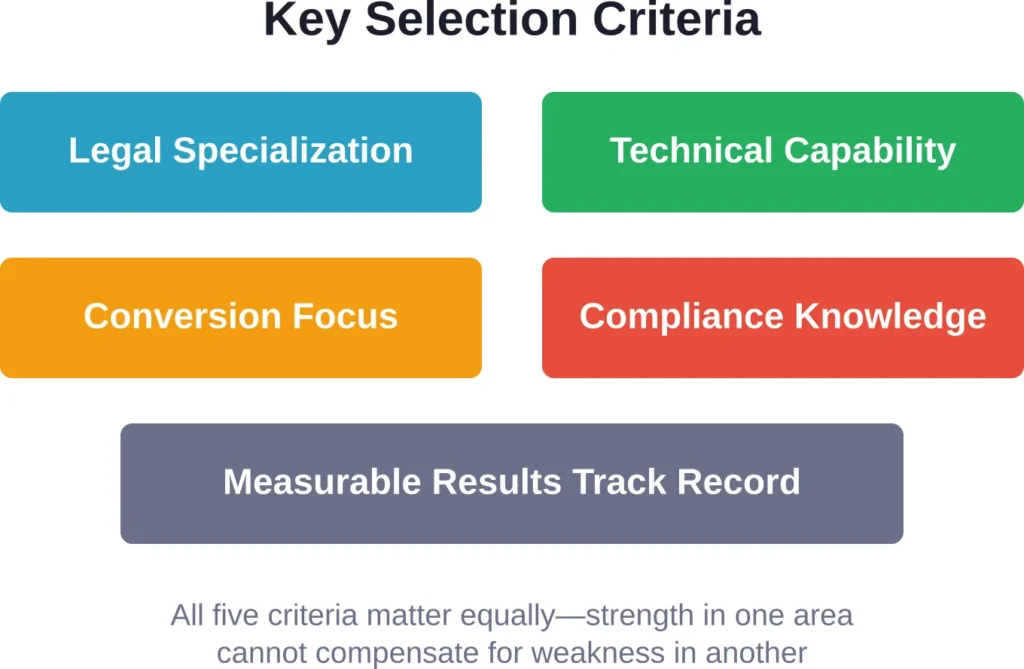
Choosing the right agency requires more than reviewing portfolios. Most legal websites look reasonably professional in static screenshots. The differences that drive business outcomes only become apparent through deeper evaluation.
Portfolio Analysis Beyond Aesthetics
When reviewing agency portfolios, look past visual design to evaluate strategic decisions. Does the homepage immediately communicate what the firm does and who it serves? Can someone identify the primary call-to-action within three seconds of landing?
Navigate portfolio sites on a mobile device. Check if forms remain usable on a phone, if tap targets meet minimum size requirements, and if page load times stay reasonable on slower connections.
Real talk: many portfolio pieces showcase initial launch versions. Ask agencies for case studies showing how sites performed six or twelve months post-launch, after real user data allowed for optimization.
Questions That Reveal Agency Depth
During agency evaluations, these questions separate legal specialists from generalists:
- How do you approach compliance with state bar advertising rules?
- What’s your process for optimizing intake forms based on conversion data?
- How do you structure site architecture differently for personal injury versus estate planning practices?
- What technical SEO elements do you implement before launch?
- How do you handle ongoing optimization after the initial launch?
- What analytics do you track beyond standard Google Analytics metrics?
Agencies with deep legal experience answer these questions with specific frameworks and past examples. Generalist agencies give vague responses or fall back on generic best practices.
Understanding Different Agency Models
Legal web design agencies operate under several business models, each with tradeoffs:
All-inclusive platform providers offer web design bundled with hosting, analytics, call tracking, and ongoing optimization. This creates simplicity but often involves long-term contracts and less flexibility for firms wanting to change providers later.
Design-build agencies create custom websites then hand off completed sites to clients for hosting and management. This provides ownership and flexibility but requires firms to handle technical maintenance or hire separate support.
Design-and-marketing agencies bundle web design with ongoing SEO, content production, and digital advertising. This ensures design and marketing strategy align but increases monthly costs beyond just the initial website investment.
The right model depends on internal capabilities. Firms with dedicated marketing staff may prefer design-build approaches. Smaller practices without marketing resources often benefit from all-inclusive platforms despite higher long-term costs.
What Legal Websites Actually Cost in 2026
Website pricing for law firms varies wildly based on requirements. A basic template site from a local agency might cost around $5,000. A highly customized marketing machine from a top-tier agency can range from $20,000 to $50,000 or more.
But focusing solely on upfront costs misses the bigger picture. A $5,000 site that generates two new cases per month delivers far better ROI than a $40,000 site that looks impressive but produces minimal inquiries.
Investment Tiers and What They Include
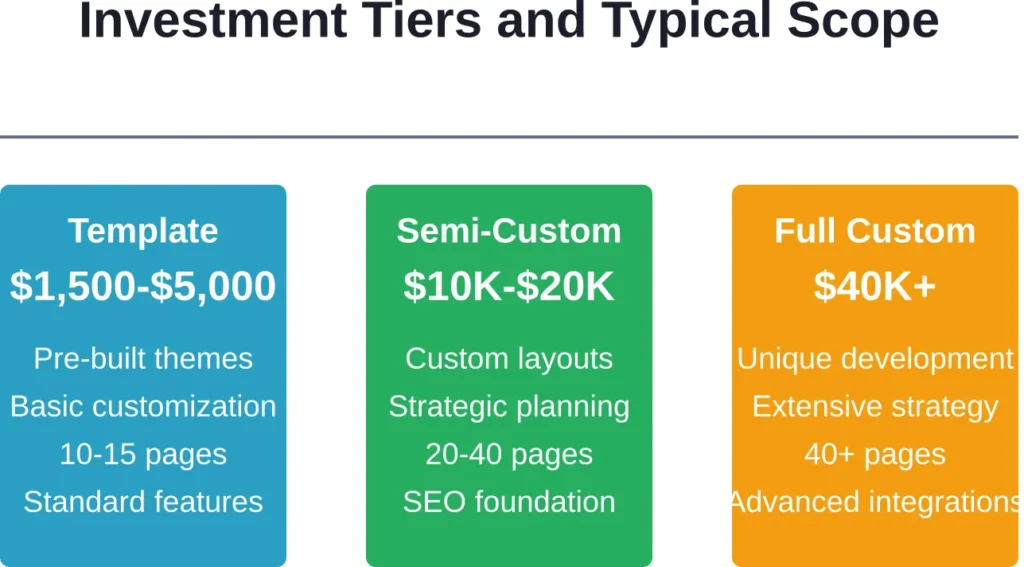
Template-based designs typically range from $1,500 to $5,000. These use pre-built themes customized with firm branding, content, and imagery. They work for very small practices or attorneys launching new firms with limited budgets.
Semi-custom designs generally fall between $10,000 and $20,000. These start with proven frameworks but allow significant customization of layouts, features, and functionality. Most small to mid-sized firms find this tier meets their needs.
Fully custom designs typically start at $40,000 and scale upward based on complexity. These involve custom development, unique functionality, and extensive strategy work. Large firms, multi-office practices, and firms in extremely competitive markets often require this investment level.
Ongoing Costs Beyond Initial Development
Website launches represent just the beginning of costs. Ongoing expenses include:
- Hosting and security (typically $50-300 monthly depending on performance requirements)
- Content updates and technical maintenance ($200-500 monthly for basic support)
- SEO services ($1,000-5,000+ monthly depending on market competitiveness)
- Conversion rate optimization and ongoing improvements ($500-2,000 monthly)
Agencies offering all-inclusive packages often bundle these into single monthly fees, while design-build agencies require firms to source these services separately.
Critical Features Every Modern Legal Website Needs
Certain technical and strategic elements separate effective legal websites from digital brochures that generate minimal business impact.
Mobile-First Responsive Design
This goes beyond making desktop sites work on phones. True mobile-first design starts with the mobile experience, then scales up to larger screens. Navigation simplifies, forms streamline, and content hierarchies prioritize what matters most to users on the go.
Testing mobile experiences requires using actual devices, not just resizing browser windows. Tap target sizes, form field usability, and page speed all perform differently on real phones than in desktop browser emulators.
Intake Form Optimization
Contact forms represent the critical conversion moment where interested visitors become leads. Yet most legal websites use generic contact forms asking for name, email, phone, and a message box.
Optimized intake forms balance information gathering with conversion rate protection. Ask for a name and phone number first. Gather complex details during actual consultations, not through web forms where every additional field reduces completion rates.
Smart forms use conditional logic, showing different questions based on practice area or case type. This allows firms to route inquiries appropriately without overwhelming users with irrelevant questions.
Trust Signals and Social Proof
Legal consumers make decisions based on perceived competence and trustworthiness. Websites must communicate both immediately. This happens through:
- Attorney credentials and bar admissions prominently displayed
- Case results and verdicts where ethically permissible
- Client testimonials and reviews aggregated from multiple platforms
- Professional photography of actual attorneys, not stock imagery
- Association memberships and professional recognition
- Clear explanations of experience and approach
The placement of these elements matters as much as their presence. Trust signals should appear above the fold on key landing pages, not buried in footer content or secondary pages users never visit.
Local SEO Architecture
For practices serving specific geographic markets, local SEO implementation determines whether websites generate business or languish in obscurity. Key elements include:
- Location-specific practice area pages optimized for geo-targeted queries
- Schema markup identifying firm name, address, phone, practice areas, and service regions
- Embedded Google Maps showing office locations
- NAP (name, address, phone) consistency across all pages
- Integration with Google Business Profile
Firms serving multiple locations need separate pages for each office, with unique content and optimization for local search terms in each market.
Performance and Speed Optimization
Page speed affects both user experience and search rankings. Google’s Core Web Vitals metrics now directly influence rankings, making technical performance a competitive factor.
Target mobile load times under two seconds. This requires image optimization, efficient code, browser caching, and content delivery network implementation for larger sites.
Performance optimization continues post-launch. As content accumulates and plugins get added, sites slow down without ongoing technical maintenance.
Common Mistakes When Hiring Legal Web Design Agencies
Several predictable errors cause law firms to end up with underperforming websites despite substantial investments.
Choosing Based on Price Alone
Website pricing varies for legitimate reasons. Agencies offering $2,000 sites can’t provide the same strategic depth, custom development, and ongoing optimization as agencies charging $20,000. The cheaper option often proves more expensive when it fails to generate business and requires replacement within a year.
But the inverse also applies. High prices don’t automatically mean superior results. Some agencies charge premium rates while delivering template-based work that doesn’t justify the investment.
Evaluate based on expected return, not upfront cost. A site costing $15,000 that generates five new cases monthly provides better value than a $5,000 site generating zero inquiries.
Neglecting Ongoing Optimization
Many firms treat websites as one-time projects. They launch a new site then ignore it for years, wondering why it stops generating leads.
Effective websites require ongoing attention—content updates, conversion optimization based on user behavior data, technical maintenance, and SEO adjustments as search algorithms evolve and competitors improve their own sites.
Plan for ongoing investment from the start. Budget for monthly SEO services, quarterly conversion audits, and annual major updates or redesigns.
Focusing on Features Instead of Strategy
Firms often request specific features without understanding whether those features serve strategic goals. They want chat widgets because competitors have them, or blog sections because someone said content marketing matters.
Features only matter if they support conversion pathways or address specific user needs. A live chat widget adds value if someone monitors it during business hours and responds within minutes. Otherwise it frustrates visitors who type questions that go unanswered.
Start with goals—more consultations, better-qualified leads, expanded service area reach—then implement features that serve those goals.
Ignoring Compliance Requirements
State bar advertising rules impose restrictions that don’t apply to other industries. Claims about results, testimonials from clients, and comparative statements all trigger specific requirements or prohibitions depending on jurisdiction.
Agencies unfamiliar with these rules create sites that violate ethics regulations, exposing firms to bar complaints. Some common violations include:
- Stating case results without required disclaimers
- Using testimonials in states that prohibit them
- Making claims of specialization without proper certification
- Failing to include required attorney advertising disclosures
Verify that prospective agencies understand the rules in your jurisdiction and can provide examples of compliant implementations.
The Role of AI in Modern Legal Website Development
Artificial intelligence tools have rapidly expanded capabilities in both legal practice and website development. Understanding current applications helps firms evaluate whether agencies leverage modern tools effectively.
AI-Powered Personalization
Some advanced legal websites now use AI to personalize content based on visitor behavior. The system might show different messaging to someone who visited multiple criminal defense pages versus someone researching estate planning services.
This technology remains relatively early-stage in legal applications, but adoption is accelerating. By May 2026, Anthropic announced 20+ connectors linking Claude to legal industry software, along with 12 plugins for practice-area-specific applications.
Chatbots and Automated Response Systems
AI-powered chatbots handle initial visitor questions, gather basic case information, and route inquiries to appropriate attorneys. When implemented well, these systems improve response times and capture leads outside business hours.
But many implementations frustrate users with scripted responses that don’t address actual questions. Effective chatbot deployment requires ongoing training, regular content updates, and clear escalation pathways to human staff when automated systems can’t help.
Content Generation and Optimization
AI writing tools like ChatGPT and Claude now assist with content creation for practice area pages, blog posts, and FAQ sections. The latest default ChatGPT model, GPT-5.5 Instant, was released May 5, 2026, with improved legal reasoning capabilities.
However, these tools generate generic content without the specific expertise and strategic positioning that differentiate law firms. Content still requires substantial human editing, fact-checking, and customization to serve both SEO and conversion purposes effectively.
Some firms have learned this lesson the hard way. In 2025, a plaintiff submitted 74 filings drafted with ChatGPT in litigation against a major corporation, resulting in sanctions for fabricated case citations and procedural errors.
Maintenance and Long-Term Website Management
Website launches represent beginnings, not endpoints. The ongoing work determines whether sites continue performing or gradually decline into irrelevance.
Security and Technical Updates
WordPress sites require regular updates to core software, themes, and plugins. Neglecting these updates creates security vulnerabilities that hackers exploit to inject malware, steal data, or deface sites.
Professional maintenance includes weekly backups, monthly security scans, immediate patching of critical vulnerabilities, and uptime monitoring to catch outages quickly.
Content Freshness and Expansion
Search engines favor websites with regularly updated content. This doesn’t mean rewriting practice area pages monthly, but it does require ongoing addition of new content—blog posts answering client questions, updates reflecting changes in law or firm services, and expansion into new practice area pages as the firm’s focus evolves.
Plan for at least monthly content additions, whether through internal staff or agency content services.
Conversion Rate Optimization
Initial website designs make assumptions about what messaging, layouts, and calls-to-action will resonate with target audiences. Real user behavior data allows for testing those assumptions and iterating toward better performance.
Quarterly conversion audits should examine form completion rates, bounce rates on key pages, mobile versus desktop performance differences, and traffic source quality. This data drives ongoing improvements that compound over time.
How Long Does Legal Web Design Take?
Timeline expectations vary based on project complexity and agency process. Understanding typical durations helps with planning and vendor evaluation.
Template-Based Projects
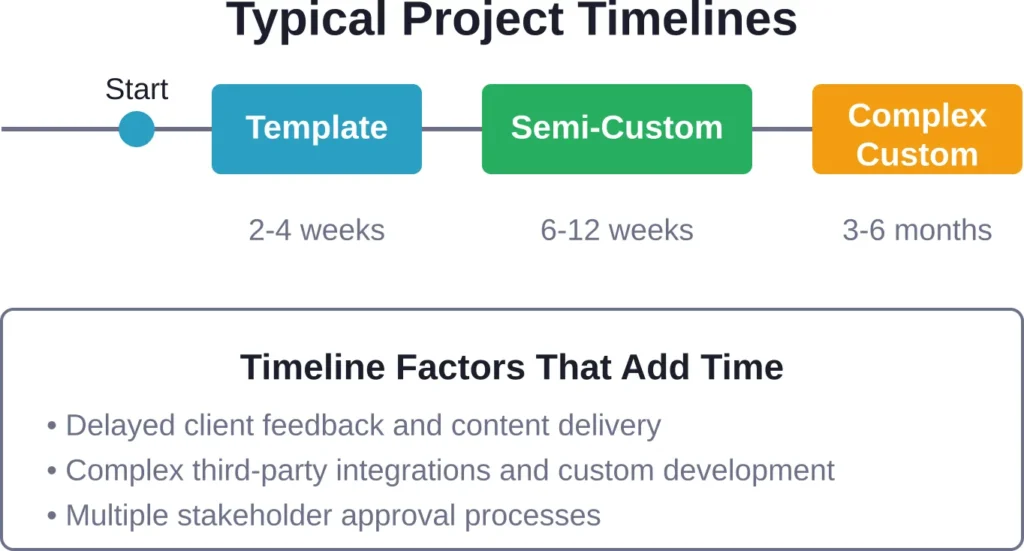
Simple template customizations typically complete in 2-4 weeks. The short timeline reflects limited customization—primarily swapping in firm content, adjusting colors and fonts, and configuring basic settings.
These rapid deployments work for firms needing to replace broken sites quickly or launching new practices on tight budgets. But the speed comes at the cost of strategic depth and customization.
Semi-Custom Designs
Projects involving custom layouts, strategic planning, and original content development typically require 6-12 weeks from kickoff to launch. This includes discovery and planning, design rounds with client feedback, development and content creation, and testing before going live.
Timelines extend when clients delay feedback cycles or content delivery. Firms should plan to actively participate in the process, providing timely input and materials as the agency requests them.
Complex Custom Builds
Large multi-office sites with custom functionality, extensive content development, and complex integrations often require 3-6 months or more. These projects involve substantial strategy work, custom development, and thorough testing before launch.
The extended timeline allows for proper planning, quality execution, and iterative refinement. Rushing complex projects leads to technical debt, usability problems, and incomplete functionality that requires expensive fixes post-launch.
Red Flags When Evaluating Legal Web Design Vendors
Certain warning signs indicate agencies likely to deliver disappointing results or create ongoing problems.
Guarantees of Specific Rankings or Case Volume
No agency can guarantee first-page Google rankings or specific numbers of new cases. Too many variables outside agency control affect these outcomes—competitor activity, budget allocation, geographic market dynamics, and firm reputation all play roles.
Agencies making concrete guarantees either don’t understand digital marketing realities or deliberately mislead prospects to close sales. Either scenario should disqualify them from consideration.
Exclusively Template-Based Approaches for Complex Needs
Template solutions work fine for very small practices with straightforward needs. But larger firms, competitive markets, or specialized practice areas require customization that templates can’t provide.
If an agency only offers template solutions regardless of project requirements, they lack the technical capabilities to serve sophisticated clients effectively.
Poor Communication During Sales Process
Agency communication quality during the sales process predicts how they’ll communicate during actual projects. Slow email responses, missed meetings, or vague answers to specific questions signal problems that will worsen once contracts are signed.
Work with agencies that respond promptly, answer questions directly, and demonstrate genuine interest in understanding firm needs rather than pushing standardized packages.
No Clear Process or Timeline
Professional agencies follow documented processes with defined phases, deliverables, and timelines. If an agency can’t articulate their process or provide timeline expectations, they likely operate chaotically with poor project management.
Request process documentation and sample project timelines before signing contracts. This protects against scope creep and sets clear expectations for both parties.
Legal Website Design Trends Shaping 2026
Several emerging trends are influencing how leading legal websites approach design, functionality, and user experience.
Video Integration and Attorney Introductions
Video content increasingly appears on legal websites, particularly on homepage hero sections and attorney bio pages. Short introduction videos humanize attorneys and build trust faster than text alone.
Effective legal video keeps things brief—30 to 60 seconds maximum. Longer videos see dramatic drop-off in completion rates. The goal is creating connection, not comprehensively explaining services.
Simplified Navigation and Reduced Cognitive Load
Modern legal sites trend toward simpler navigation structures with fewer menu options. Rather than exposing every practice area and service in main navigation, leading sites focus menus on primary user pathways—practice areas, attorney directory, contact—and move secondary content to footer navigation.
This reduces decision paralysis and focuses visitor attention on conversion pathways.
Interactive Tools and Calculators
Some practice areas lend themselves to interactive tools that provide value while capturing lead information. Estate planning sites might offer will templates or estate tax calculators. Personal injury sites could provide settlement estimators.
These tools serve both marketing and qualification purposes. Users who engage with interactive content often become more serious prospects than passive site visitors.
Advanced Accessibility Implementation
Website accessibility has evolved from occasional consideration to standard requirement. This reflects both ethical imperatives and legal risk—website accessibility lawsuits have increased significantly in recent years.
Modern legal sites implement WCAG 2.1 AA standards, including proper heading hierarchy, alt text for images, keyboard navigation support, sufficient color contrast, and screen reader compatibility. Some agencies now use automated accessibility testing tools and manual audits to verify compliance.
Frequently Asked Questions
Investment levels depend on firm size, practice area competitiveness, and growth goals. Solo practitioners and small firms often find semi-custom designs in the range of $10,000-$20,000 meet their needs effectively. Mid-sized firms in competitive markets typically invest $20,000-$50,000 for comprehensive custom solutions. Large multi-office practices may spend significantly more for complex builds with custom functionality. Focus on expected return rather than absolute cost—a site that generates consistent new clients justifies higher investment than one that serves primarily as a digital brochure.
Legal web design requires understanding client psychology specific to legal services purchasing, compliance with state bar advertising rules, conversion optimization for high-consideration services, and SEO strategies for extremely competitive local markets. General web design agencies lack this specialized knowledge and often create sites that look professional but violate ethics rules or fail to convert visitors into consultations. Legal specialists understand trust signals that matter to potential clients, proper testimonial implementation, case result disclaimers, and strategic approaches to different practice areas.
Templates work for brand-new solo practices with very limited budgets or firms in non-competitive rural markets. For established practices, competitive urban markets, or firms serious about growth, templates prove insufficient. They lack strategic customization, convert poorly compared to custom designs, provide limited differentiation from competitors, and restrict functionality as needs evolve. The incremental investment in semi-custom or custom design typically pays for itself within months through improved lead generation.
Well-designed sites with ongoing optimization typically remain effective for three to five years before major redesigns become necessary. However, this assumes continuous content updates, conversion optimization, technical maintenance, and incremental improvements. Sites that receive no attention post-launch decline rapidly—typically showing performance deterioration within 12-18 months as competitors improve their sites and search algorithms evolve. Plan for annual minor updates and major redesigns every three to four years.
Building legal websites in-house rarely proves cost-effective unless the firm employs dedicated marketing staff with web development, design, and legal SEO expertise. The specialized knowledge required—compliance understanding, legal consumer psychology, competitive SEO implementation, and conversion optimization—takes years to develop. Most firms achieve better results and lower total costs by hiring specialized agencies then maintaining sites with either agency support or lighter-touch internal resources.
The metrics that matter most are business outcomes, not vanity metrics. Track consultation requests and form submissions as the primary conversion indicator. Monitor qualified lead percentage—what portion of inquiries represent cases the firm actually wants. Measure mobile conversion rates separately since mobile user behavior differs significantly from desktop. Track traffic sources to understand which channels drive the most valuable visitors. Measure bounce rates and time on page for key landing pages to identify content that fails to engage. Avoid obsessing over total traffic volume—10,000 monthly visitors with 1% conversion rate delivers worse results than 2,000 visitors with 5% conversion.
Mobile optimization has evolved from nice-to-have to absolutely critical. Recent industry data shows over 60% of initial legal inquiries happen on mobile devices. Poor mobile experiences directly translate to lost cases. Mobile optimization means more than responsive layouts—it requires fast load times, simplified navigation optimized for touch, streamlined forms that work on small screens, click-to-call functionality, and readable text without zooming. Test sites on actual mobile devices, not just resized desktop browsers, since real-world performance differs substantially from development environment testing.
Final Thoughts on Choosing Legal Web Design Partners
The right web design agency becomes a strategic partner in firm growth, not just a vendor delivering a discrete project. This relationship works best when agencies genuinely understand legal services marketing and firms actively participate in the process.
Start the selection process by clarifying goals. Are you launching a new practice and need basic digital presence? Replacing an underperforming site that generates few leads? Expanding into new practice areas or geographic markets? Differentiating from competitors in a saturated market? Clear goals guide agency selection and project scope decisions.
Evaluate agencies based on legal specialization depth, not just portfolio aesthetics or price points. The firms getting the best results work with agencies who understand client psychology, compliance requirements, and competitive dynamics specific to legal services.
Plan for ongoing investment beyond initial launch. Websites require continuous optimization, content updates, technical maintenance, and strategic adjustments to remain effective. The most successful firms treat web presence as ongoing marketing infrastructure, not one-time projects.
The legal services market continues shifting toward digital channels for client acquisition. Firms with sophisticated web presence and strategic digital marketing capture disproportionate market share, while those relying on outdated sites and traditional marketing struggle increasingly to compete.
Choosing the right web design partner now positions firms for sustainable growth as this shift accelerates. The agencies on this list represent proven specialists who understand what it takes to build legal websites that generate real business results.
Ready to transform your firm’s digital presence? Start by requesting proposals from two or three agencies whose specializations align with your practice areas and goals. Compare their strategic approaches, not just their pricing. And remember—the goal isn’t the prettiest website, but the one that converts the most visitors into retained clients.