

Quick Summary: Looking for the best Magento web design companies? This guide highlights 15 top-tier agencies specializing in Adobe Commerce, including Magebit, Scandiweb, and Vaimo. Each company brings unique strengths in custom development, Hyvä Theme implementation, enterprise solutions, and eCommerce transformation—helping businesses scale their online stores effectively.
Choosing the right Magento web design company can make or break an eCommerce project. Adobe Commerce (formerly Magento) powers some of the world’s most sophisticated online stores, but the platform’s flexibility means implementation quality varies wildly between agencies.
Some agencies treat Magento as just another CMS. Others understand it as the enterprise-grade commerce engine it really is.
Based on analysis of leading Magento development companies across technical certifications, Adobe partnership status, client portfolios, and platform mastery, several standout agencies emerged. The agencies that consistently deliver exceptional Magento solutions share certain traits: deep technical expertise, proven track records with complex implementations, and commitment to staying current with Adobe Commerce’s rapid evolution.
Here’s the thing though—not every top agency fits every project. An agency brilliant at B2B transformations might not be the right match for a D2C fashion brand. An enterprise-focused partner might be overkill for a mid-market retailer.
This guide breaks down 15 leading Magento web design companies, what makes each one exceptional, and which types of projects they excel at handling.
What Makes a Magento Agency Stand Out in 2026
The Magento landscape shifted dramatically over the past few years. Adobe Commerce introduced composable architecture, headless capabilities expanded, and Hyvä Theme emerged as a game-changing frontend solution.
Agencies stuck in legacy approaches fell behind. The ones that thrived adapted quickly.
Top Magento agencies in 2026 demonstrate mastery across several critical areas. First, they maintain current Adobe Commerce certifications—not just from years ago, but renewed regularly as the platform evolves. Second, they show strong portfolios with recent implementations, not just projects from 2020 or earlier.
Third, and increasingly important, they understand modern frontend approaches. The days of bloated, slow Magento stores are over. Leading agencies now implement Hyvä Theme, progressive web apps, or headless architectures that deliver the performance today’s consumers expect.
Partnership status matters, too. Adobe’s partner tiers—Bronze, Silver, Gold, and Platinum—reflect actual capability and commitment. A Silver or Gold Commerce Specialized partner has proven expertise specifically in eCommerce, not just general Adobe products.
But wait. Certifications and badges don’t tell the whole story.
The best agencies also bring strategic thinking. They ask tough questions about business goals, customer journeys, and growth plans before diving into technical specs. They challenge assumptions when a standard Magento feature won’t actually solve the real problem.
The Top 15 Magento Web Design Companies for 2026
These agencies represent the best Magento talent across different specializations, regions, and project types. Some excel at enterprise transformations. Others specialize in mid-market growth. A few lead the charge in emerging technologies like Hyvä Theme.
All of them deliver consistently excellent Magento implementations.
1. Lengreo – Complete B2B Marketing & Tech Partner

Lengreo stands out as a full-service partner that combines deep technical website development with performance-driven B2B marketing. They help companies generate qualified leads, optimize conversion rates, and build professional digital presence that delivers measurable business growth.
What sets Lengreo apart is their results-focused approach. They don’t offer template solutions — instead, they listen to client needs and craft tailored strategies across digital marketing, SEO, paid advertising, lead generation, and custom website development. Their team has consistently delivered strong outcomes for clients in software development, architecture, event technology, sports tech, and IT services.
Lengreo excels at both building high-converting websites (e-commerce, business, portfolio, and landing pages) and running complex lead-generation campaigns through LinkedIn outreach, email, cold calling, and appointment setting. They handle the full cycle: strategy, execution, optimization, and ongoing support.
With strong expertise in B2B environments, Lengreo helps clients scale client acquisition, reduce cost per lead, and improve conversion rates while maintaining clear communication and dedicated account success focus.
Best for: B2B companies and service providers seeking an integrated partner for website development, lead generation, and performance marketing that drives real business opportunities and ROI.
Contact Information:
- Website: Lengreo.com
- Phone: +31 686 147 566
- Email: [email protected]
- Address: Vrijstraat 9 C/D, 5611 AT Eindhoven, Netherlands
- LinkedIn: Lengreo
- Twitter: @Lengreo
- Instagram: @lengreo
2. Gilzor – Custom Digital Product Development

Gilzor builds custom web and mobile applications from idea validation to production launch. They specialize in turning complex product visions into functional, user-friendly digital solutions for startups, SMBs, and product companies.
Their strength lies in full-cycle development: business analysis, UI/UX design, web and mobile development (iOS & Android), quality assurance, and go-to-market strategy. Gilzor maintains an extremely high client retention rate and has helped projects achieve significant early traction and growth.
The team focuses on scalable architecture, clean code, and user-centric design that improves conversion and engagement. They deliver everything from startup MVPs and investor-ready products to process automation tools and complex e-commerce-style grocery platforms.
Gilzor’s practical approach includes idea validation, Product-Market Fit testing, legacy integration, and post-launch support, making them a reliable long-term technology partner.
Best for: Startups and product companies that need custom web and mobile development with strong emphasis on user experience, rapid validation, and scalable solutions that support business growth.
Contact Information:
- Website: www.gilzor.com
- Email: [email protected]
- Address: Poland, Warsaw, Office 58, street Adama Mickiewicza 37, 01-625
- LinkedIn: www.linkedin.com/company/gilzor-softwaredevelopment
3. Oski – Smart Software Solutions for Enterprises & Startups

Oski designs, develops, and maintains well-engineered software solutions for tech-forward enterprises and ambitious startups. With deep expertise across cloud, frontend, AI, and CMS technologies, they help businesses reimagine operations through digital innovation.
Their solutions cover cloud architecture (serverless, hybrid, multi-cloud), modern frontend frameworks (React, Vue, Angular, Next.js), Artificial Intelligence integrations, and robust CMS implementations. Oski delivers 3× faster development through AI-accelerated engineering while maintaining high quality and security standards.
The agency brings particular strength in building scalable systems for industries including travel, logistics, e-commerce, education, fintech, and insurance. They focus on seamless user experiences, automation, predictive capabilities, and future-proof architecture.
Oski’s end-to-end approach — from initial consultation to deployment and ongoing maintenance — ensures solutions are not only technically excellent but also aligned with real business objectives.
Best for: Enterprises and growth-stage startups requiring reliable, scalable software solutions with expertise in cloud, AI, modern frontend, and industry-specific digital transformation.
Contact Information:
- Website: oski.site
- Phone: +48571282759
- Email: [email protected]
- Address: Kaupmehe tn 7, 10114 Tallinn, Estonia
- LinkedIn: www.linkedin.com/company/oski-solutions
4. A-listware – Trusted Software Development & Team Augmentation

A-listware provides high-quality software development, dedicated teams, and IT consulting services to enterprises, SMBs, and startups. They excel at delivering cost-effective, secure, and responsive digital solutions through outsourcing and team augmentation.
Their offering includes custom software development, application services, UX/UI design, testing & QA, data analytics, infrastructure management, and cybersecurity. A-listware acts as a seamless extension of client teams, ensuring smooth collaboration and consistent delivery quality.
With strong capabilities in cloud solutions, machine learning, intelligent platforms, embedded software, and enterprise applications (ERP, CRM, HR, eLearning), they help companies modernize legacy systems, build new products, and maintain robust IT ecosystems.
Clients value their rapid team ramp-up, 24/7 expert access, and focus on secure, high-performance solutions tailored to specific business needs.
Best for: Companies looking for reliable software development outsourcing, dedicated development teams, or technical augmentation to accelerate projects without compromising quality or security.
Contact Information:
- Website: a-listware.com
- Phone: +1 (888) 337 93 73
- Email: [email protected]
- Address: North Bergen, NJ 07047, USA
- LinkedIn: www.linkedin.com/company/a-listware
- Facebook: www.facebook.com/alistware
5. Mobian Studio – Dedicated Engineering Teams for Mobile & AI
Mobian Studio builds dedicated engineering teams that deliver production-ready mobile and AI solutions on time and on budget. They specialize in end-to-end product development for companies in IT, Healthcare, Fintech, and Logistics.
Operating through both full outsourcing and outstaffing models, Mobian provides senior-level execution with clean architecture, excellent documentation, and clear English communication. Their teams focus exclusively on client projects, eliminating context switching and ensuring deep ownership.
Core expertise includes mobile apps (iOS, Android, Flutter), AI & automation systems, scalable backend architecture, legacy integration, and domain-specific solutions such as regulatory compliance, payment flows, and operational optimization. They support projects from discovery through post-launch scaling and maintenance.
Mobian’s practical, delivery-focused approach helps clients ship faster while maintaining high technical standards and long-term partnership reliability.
Best for: Companies in healthcare, fintech, logistics, and IT that need dedicated mobile development, AI solutions, or full-stack engineering teams to deliver complex digital products without hiring risks.
Contact Information:
- Website: mobian.studio
- Phone: [email protected]
- Address: Harju maakond, Tallinn, Kesklinnalinnaosa, Masina tn 22, 10113
- LinkedIn: www.linkedin.com/company/mobian-studio
6. The Commerce Shop – Custom Solution Architects

The Commerce Shop built their reputation on tackling unusual Magento requirements—the projects where standard approaches don’t work and custom architecture becomes necessary.
Their team includes senior Magento architects who can design solutions for complex scenarios: subscription models with unusual billing rules, rental and booking systems, configurator tools for custom products, or integrations with proprietary internal systems.
The agency doesn’t chase volume. They focus on challenging projects where technical excellence matters more than speed. This selective approach means they work with fewer clients but deliver highly customized solutions.
The Commerce Shop also emphasizes code quality and maintainability. Custom development that becomes impossible to maintain is worse than useless—it becomes a liability. Their development standards ensure custom modules remain upgradeable as Adobe Commerce evolves.
The agency holds Adobe certifications and maintains active GitHub repositories with open-source contributions to the Magento ecosystem. Their technical team regularly presents at Magento conferences.
Project timelines tend to run longer than standard implementations, but clients get solutions precisely tailored to their business models rather than compromising on functionality.
Best for: Merchants with unique business models requiring custom Magento development, complex integrations, or sophisticated commerce logic beyond standard features.
7. Tigren Solutions – Migration and Modernization

Tigren Solutions specializes in Magento migrations and platform modernizations—helping merchants move from Magento 1 to Magento 2, upgrade from outdated Magento 2 versions, or migrate from other platforms to Adobe Commerce.
Migration projects carry unique risks. Data must transfer cleanly. SEO rankings can’t drop. Customizations need rebuilding for the new platform. Downtime must stay minimal. One mistake and years of eCommerce history could be damaged.
Tigren’s team has refined migration methodologies that minimize these risks. They use automated tools for data migration, maintain extensive pre-launch checklists, and implement rollback plans in case issues emerge.
The agency also helps merchants modernize during migration—not just lifting-and-shifting old functionality, but reimagining workflows with current best practices. Often a migration project becomes an opportunity to streamline checkout, improve mobile experience, or implement features that weren’t possible on the old platform.
Tigren works primarily with mid-market merchants and offers competitive engagement models. Their experience across dozens of migrations means they’ve encountered most edge cases and built solutions proactively.
The agency maintains Adobe Commerce certifications and focuses specifically on the technical aspects of migration rather than trying to be full-service for all commerce needs.
Best for: Merchants needing to migrate from Magento 1, upgrade legacy Magento 2 installations, or move from other platforms to Adobe Commerce with minimal risk.
8. Emizen Tech – Multi-Platform Expertise

Emizen Tech differentiates itself through expertise across multiple eCommerce platforms—not just Magento, but also Shopify, BigCommerce, and custom commerce solutions.
This multi-platform knowledge helps during platform selection. Emizen can objectively assess whether Magento truly fits a merchant’s needs or if another platform might serve better. They’re not locked into recommending Magento regardless of requirements.
When Magento is the right choice, Emizen brings perspective from other platforms. They understand what Shopify does well (and where Magento needs custom work to match that experience). They know BigCommerce’s strengths in B2B features (and how to implement similar capabilities in Magento).
The agency works across diverse verticals—fashion, electronics, home goods, B2B, and services. Their portfolio demonstrates adaptability to different business models and customer types.
Emizen also offers ongoing support and optimization services, not just initial implementation. Many clients engage them for monthly retainers covering updates, feature additions, performance monitoring, and troubleshooting.
The agency maintains Adobe Commerce certifications alongside credentials for other platforms, positioning them as true eCommerce generalists rather than single-platform specialists.
Best for: Merchants evaluating multiple platforms and wanting an objective partner, or businesses needing a single agency that can support varied eCommerce technology across different brands or divisions.
9. Elogic Commerce – Growth-Focused Development
Elogic Commerce positions itself as a growth partner, not just a development agency. Their engagement model emphasizes ongoing collaboration and continuous improvement rather than one-time project delivery.
The agency’s approach starts with understanding growth constraints. Is conversion the bottleneck? Checkout abandonment? Mobile experience? Site speed? International expansion? They diagnose the actual limiting factor before proposing solutions.
Elogic’s development work focuses on incremental improvements that drive measurable business results. They favor hypothesis-driven development—building features based on data about what will impact revenue, not just what seems like a good idea.
Their team includes conversion optimization specialists alongside Magento developers, enabling them to approach projects with both technical and marketing perspectives. This cross-functional approach often uncovers opportunities pure development teams miss.
Elogic works primarily with mid-market merchants in growth phases—past startup stage but not yet enterprise scale. Their engagement models suit companies that need consistent development support without the overhead of hiring full in-house teams.
The agency maintains Adobe Commerce certifications and emphasizes modern development practices including automated testing, continuous integration, and performance monitoring.
Best for: Growing mid-market merchants needing ongoing development and optimization focused on measurable business outcomes rather than just feature delivery.
10. Ziffity – Mid-Market Enterprise Focus

Ziffity operates in the space between mid-market and full enterprise—working with companies that have outgrown basic Magento implementations but don’t need the massive scale of Fortune 500 commerce.
This sweet spot represents a large segment of the market. Companies generating $50-500 million annually need sophisticated commerce capabilities but must remain cost-conscious. They require scalability but can’t justify six-month implementations.
Ziffity brings enterprise-grade expertise with mid-market pragmatism. Their solutions incorporate best practices from large-scale implementations but sized appropriately for mid-market budgets and timelines.
The agency emphasizes platform stability and performance. Their implementations prioritize reliable, fast, secure stores over cutting-edge features that might introduce complexity. For many merchants, this conservative approach makes perfect sense.
Ziffity also offers managed services including hosting, monitoring, security patching, and ongoing optimization. Merchants can essentially outsource their entire Magento operation, freeing internal teams to focus on marketing and merchandising.
The agency maintains Adobe Commerce certifications and works across retail, consumer goods, and B2B verticals. Their client roster includes several well-known brands in the $100-300 million revenue range.
Best for: Mid-to-large companies needing enterprise-grade Magento capabilities at mid-market engagement models, or businesses wanting to outsource platform management entirely.
11. Magebit – Enterprise Engineering Excellence

Magebit earned recognition as the #1 Adobe Commerce agency worldwide in Adobe’s Partner Finder—a remarkable achievement for a team that started as two developers in Latvia.
What sets Magebit apart? Technical depth and modern architecture expertise. They’re a Platinum partner in the Hyvä Partner network with the largest pool of Hyvä-certified developers globally. That expertise shows in projects like the Helen of Troy migration, where Magebit delivered four major D2C brand stores in just five months using Hyvä Theme.
Founded in 1968, Helen of Troy is a global consumer products company with over $2 billion in annual revenue. The fact that they trusted Magebit with a complex multi-brand migration ahead of peak season speaks volumes about the agency’s capabilities.
Magebit specializes in large-scale commerce transformations where performance and scalability aren’t negotiable. Their engineering team tackles the toughest technical challenges—complex integrations, custom module development, and enterprise-grade architecture.
The agency maintains Adobe Silver Commerce Specialized partnership status alongside their Platinum Hyvä credentials, positioning them uniquely for projects requiring both enterprise Magento expertise and cutting-edge frontend performance.
Best for: Enterprise merchants needing top-tier engineering, complex custom development, or Hyvä Theme implementations at scale.
12. Scandiweb – Full-Service Commerce Innovation

Scandiweb built their reputation as one of the world’s most recognized Magento agencies through consistent delivery across hundreds of projects spanning two decades.
Based in Stockholm, Scandiweb operates as a full-service digital commerce agency. They don’t just build Magento stores—they provide strategy, design, development, optimization, and ongoing support as a comprehensive package.
Their client roster includes major international brands across fashion, beauty, home goods, and B2B sectors. Industry reports suggest Scandiweb consistently ranks among the top three Magento agencies globally by project volume and client satisfaction.
What makes Scandiweb stand out is their end-to-end approach. Many agencies excel at one phase—maybe design or development—but hand off other pieces to partners. Scandiweb keeps the entire project in-house, which streamlines communication and ensures consistent quality.
They’ve also invested heavily in proprietary tools and accelerators that speed up common Magento tasks without sacrificing customization. These frameworks help them deliver faster than typical agency timelines while maintaining quality.
The agency holds multiple Adobe Commerce certifications and actively contributes to the Magento community through extensions, thought leadership, and conference participation.
Best for: Mid-to-large enterprises wanting a single partner for strategy, design, development, and growth—particularly international brands needing multi-market expertise.
13. Vaimo – Global Commerce Transformation
Vaimo operates as a global Adobe Commerce specialist with offices across Europe, Asia, and Australia. Their scale enables them to handle massive, multi-region implementations that smaller agencies can’t support.
The agency focuses exclusively on digital commerce—no side ventures into general web development or marketing. This specialization means their entire team lives and breathes eCommerce strategy, not just Magento technical implementation.
Vaimo’s strength lies in complex business transformations where commerce technology intersects with organizational change. They work with enterprises migrating from legacy systems, consolidating multiple storefronts, or expanding into new markets.
Their consulting approach emphasizes business outcomes over technical features. Before recommending solutions, Vaimo teams spend significant time understanding customer data, operational workflows, and growth constraints.
The agency maintains Adobe Gold Commerce Specialized status and partners with major systems integrators for ERP, CRM, and PIM integrations that enterprise clients typically require.
Vaimo also invests in their own innovation lab, testing emerging commerce technologies and developing points of view on where the industry is headed. Clients benefit from this forward-looking perspective during planning phases.
Best for: Large enterprises undertaking major commerce transformations, multi-region rollouts, or complex system integrations alongside Magento implementation.
14. Atwix – B2B Commerce Specialists

Atwix carved out a distinct niche focusing specifically on Magento B2B implementations. While they handle B2C projects, their real expertise shines in the complex requirements that B2B commerce demands.
B2B eCommerce differs fundamentally from consumer retail. Custom pricing by customer, quote workflows, purchase order integration, credit terms, complex product configurations, bulk ordering—these requirements need specialized knowledge.
Atwix brings that knowledge. Their team understands B2B buyer journeys, procurement processes, and the back-office systems B2B merchants rely on. They’ve built dozens of custom B2B features that address scenarios standard Magento doesn’t handle out of the box.
The agency also maintains a strong technical blog sharing B2B implementation patterns, custom module tutorials, and solutions to tricky Magento challenges. This content demonstrates their depth and helps the broader Magento community.
Atwix holds Adobe Commerce certifications and actively participates in B2B-focused eCommerce forums and conferences. Their team includes certified developers who’ve passed Adobe’s rigorous technical exams.
Real talk: if you’re a B2B merchant, Atwix should be on your shortlist. Their focused expertise means they anticipate B2B requirements that generalist agencies often miss until midway through implementation.
Best for: B2B manufacturers, distributors, and wholesalers needing Magento implementations that handle complex B2B scenarios without extensive custom development.
15. Rave Digital – Strategic Commerce Consulting

Rave Digital approaches Magento projects differently than most agencies. They lead with strategy and consulting, positioning technology implementation as the execution of a broader commerce vision.
This approach resonates with merchants who’ve outgrown their current platform but aren’t certain Magento is the right next step. Rave Digital’s team assesses business requirements, customer data, growth plans, and operational capabilities before recommending solutions.
Sometimes that means Magento. Sometimes it doesn’t.
When Magento is the right fit, Rave Digital’s strategic foundation ensures the implementation aligns with actual business needs rather than becoming a technology project disconnected from outcomes.
The agency brings particularly strong expertise in omnichannel commerce—connecting online stores with physical retail, marketplaces, mobile apps, and emerging channels. Their architects design systems that share inventory, customer data, and order management across all touchpoints.
Rave Digital maintains Adobe partnership status and works primarily with mid-market to enterprise clients across retail, consumer goods, and lifestyle verticals.
Their consulting engagements often uncover optimization opportunities beyond the initial project scope—improving conversion, streamlining fulfillment, or enhancing customer experience in ways pure development agencies might miss.
Best for: Growing retailers needing strategic guidance alongside implementation, particularly those building omnichannel experiences or unsure if Magento fits their needs.
How to Choose the Right Magento Agency for Your Project
With hundreds of Magento agencies claiming expertise, how do you actually identify the right partner?
Start by understanding what type of project you’re undertaking. New implementation? Platform migration? Redesign of existing store? Ongoing optimization? Each scenario requires different agency strengths.
For new implementations, look for agencies with strong discovery and planning processes. Building on a solid foundation matters more than rushing to launch. Agencies that ask tough questions about business requirements, customer personas, and integration needs during sales conversations signal mature methodology.
For migrations, prioritize agencies with specific migration experience and proven methodologies. Ask how they handle data migration, URL redirects, custom feature rebuilding, and rollback plans. Generic Magento expertise doesn’t automatically translate to migration competence.
For redesigns or frontend work, examine recent portfolio examples closely. Do their designs look modern? How do their stores perform on mobile? Use tools to check page speed on their client sites—slow stores indicate the agency hasn’t mastered performance optimization.
Now, this is where it gets interesting.
Partnership status and certifications matter, but they’re table stakes. Any serious Magento agency should have Adobe Commerce certifications and reasonable partnership tier. Beyond that, dig deeper.
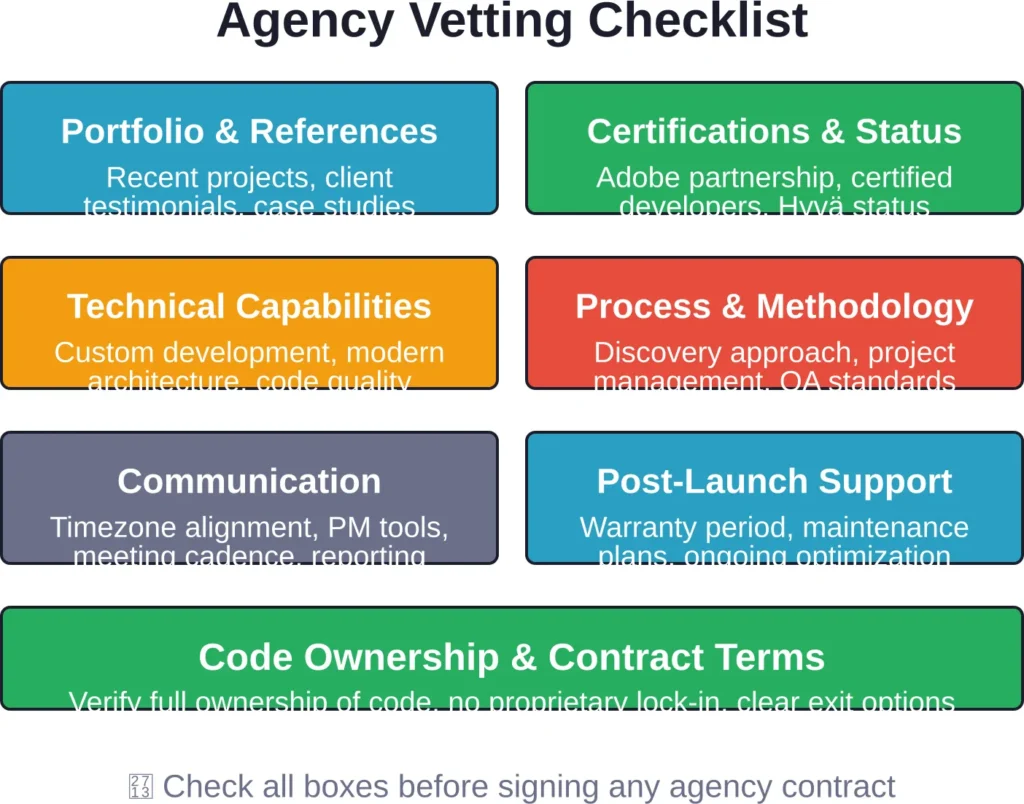
Key Vetting Questions
Ask potential agencies these specific questions:
About their team: How many certified Magento developers do they employ? What’s their developer retention rate? Can you meet the actual team who’ll work on your project, not just the sales team?
About their approach: What does their typical discovery process involve? How do they handle scope changes mid-project? What project management methodology do they use?
About their code: Do they follow Magento coding standards? Will you own all custom code? How do they ensure code remains upgradeable? Do they use automated testing?
About their work: Can they provide references from similar projects? Will they walk through their repository structure and deployment process? How do they handle staging and production environments?
The agencies that answer these questions confidently and specifically demonstrate real expertise. The ones that dodge, generalize, or promise everything are red flags.
Agency Structure Considerations
Agency size creates tradeoffs. Large agencies bring resources, established processes, and ability to scale teams quickly. But you might be a small fish in a big pond, assigned to junior developers while senior talent works on bigger accounts.
Smaller specialized agencies offer more attention and often assign senior developers directly to projects. But their smaller teams mean less redundancy if key people leave or get sick. They might also lack resources for truly large-scale implementations.
Mid-sized agencies often offer the best balance—experienced enough to have proven processes, small enough that principals stay involved in projects.
Location matters less than it used to. Most Magento work happens remotely now. That said, timezone alignment improves communication. An agency eight hours ahead or behind creates scheduling friction for calls and launches.
What Magento Web Design Actually Encompasses
“Web design” might sound like it’s just about visual appearance. For Magento projects, the scope runs much deeper.
A complete Magento web design engagement typically includes:
Information architecture and user experience: How products are organized, how navigation works, how customers find what they need. Poor IA tanks conversion even with beautiful visuals.
Visual design: The look and feel—colors, typography, imagery, layout. This is what most people think of as “design,” but it’s just one component.
Frontend development: Converting designs into functional Magento themes. This requires both design sensibility and technical Magento expertise. Compatible with Adobe Commerce (cloud) 2.3, 2.4 and other recent versions ensures themes work properly.
Responsive and mobile optimization: Ensuring stores work flawlessly across devices. Over half of eCommerce traffic comes from mobile now. Mobile-optimized design isn’t optional.
Performance optimization: Making stores load fast. Slow stores lose customers. Top agencies achieve sub-2-second page loads through optimization techniques and modern approaches like Hyvä Theme.
Accessibility: Ensuring stores work for users with disabilities. Beyond being the right thing to do, accessibility impacts SEO and reduces legal risk.
The best Magento agencies treat design as a technical discipline, not just an aesthetic one. Pretty designs that perform poorly are worse than plain designs that convert well.
Emerging Trends Shaping Magento Agency Selection
Several shifts are changing what separates leading Magento agencies from the rest.
Hyvä Theme Adoption
Hyvä Theme represents the biggest frontend innovation for Magento in years. It replaces Magento’s default Luma and Blank themes with a modern, lightweight foundation that delivers dramatically better performance.
Traditional Magento themes often struggle with page weight and JavaScript complexity. Hyvä strips out unnecessary code, resulting in faster load times and better Core Web Vitals scores.
Agencies that invested in Hyvä expertise early—like Magebit as a Platinum Hyvä partner—now deliver stores that outperform traditional Magento implementations significantly. As more merchants prioritize speed, Hyvä knowledge is becoming essential agency capability.
Composable Commerce Architecture
Adobe Commerce increasingly supports composable architecture—using best-of-breed services connected via APIs rather than monolithic all-in-one platforms.
In composable models, Magento might handle commerce logic while separate services manage CMS, search, personalization, or customer data. This requires agencies to think beyond just Magento implementation toward system architecture and API orchestration.
Leading agencies now help merchants evaluate when composable makes sense versus traditional unified commerce. They architect integrations between Magento and complementary services, ensuring everything works as a cohesive system.
Headless and PWA Implementations
Headless commerce decouples the frontend from Magento’s backend, allowing completely custom user interfaces while Magento handles catalog, cart, and order processing behind the scenes.
Progressive Web Apps (PWAs) deliver app-like experiences through web browsers—installable to home screens, working offline, sending push notifications.
Both approaches require specialized expertise beyond traditional Magento development. Agencies need JavaScript framework knowledge (React, Vue), API expertise, and understanding of PWA technologies.
The strongest agencies now offer these modern architecture options alongside traditional Magento implementations, recommending the approach that actually fits each merchant’s needs.
AI and Personalization Integration
Adobe’s acquisition of Magento brought AI capabilities from Adobe’s broader Experience Cloud into reach for commerce merchants.
Leading agencies help merchants leverage these tools: AI-powered product recommendations, personalized search, automated merchandising, predictive analytics.
They also integrate third-party AI services for features Adobe doesn’t provide: chatbots, virtual try-on, visual search, dynamic pricing.
As AI becomes table stakes for competitive commerce experiences, agency ability to implement and optimize these capabilities grows more critical.
Red Flags When Evaluating Magento Agencies
Some warning signs indicate an agency might not deliver quality work:
Outdated portfolio: If their most recent case studies are from 2022 or earlier, they might not be actively working on Magento anymore. The platform evolved significantly—agencies that stopped keeping up can’t deliver modern implementations.
No certifications: Any legitimate Magento agency should have at least some Adobe Commerce certified developers. Zero certifications suggests they’re generalists dabbling in Magento, not specialists.
Impossibly low quotes: Quality Magento development costs real money. Quotes far below market rate mean either offshore teams with communication challenges, inexperienced developers, or hidden costs that appear later.
Vague methodology: Professional agencies have defined processes for discovery, development, testing, and launch. If they can’t articulate their methodology, they’re probably winging it.
No maintenance plan: Magento requires ongoing updates, security patches, and optimization. Agencies that only want to build and disappear leave merchants struggling with technical debt.
Ownership ambiguity: You should own all code, designs, and data. Agencies that claim ownership of custom code or try to lock you into proprietary systems are bad news.
Trust your instincts. If something feels off during sales conversations, it probably is.
The True Cost of Working with Top Magento Agencies
While this guide focuses on agency capabilities rather than specific pricing, understanding general cost structures helps set realistic expectations.
Magento implementations vary dramatically in scope. A basic store build for a small retailer might run in the $20,000 to $40,000 range, while a full enterprise transformation can reach several hundred thousand dollars.
According to industry reports, developer rates vary significantly by region and experience. Senior developers in North America might charge $100-$200+ per hour, while developers in Eastern Europe could be in the $60-$100 range. Hourly rates vary significantly by region and experience level.
But hourly rates tell only part of the story.
The real cost driver is how efficiently an agency works. An expensive agency that delivers a project in three months might cost less total than a cheap agency that takes nine months and requires constant fixes.
Top agencies often charge premium rates because their experience means faster delivery, fewer bugs, and solutions that scale. Merchants often save money long-term by paying more upfront for quality.
Beyond initial implementation, budget for ongoing costs: hosting, SSL certificates, security monitoring, regular updates, feature additions, and optimization. Many merchants spend 15-20% of their initial implementation cost annually on maintenance and improvements.
Questions to Ask Before Signing an Agency Contract
Before committing to an agency partnership, get clear answers to these critical questions:
Project specifics: What exactly is included in the quoted price? What constitutes additional scope? How are change requests handled? What’s the payment schedule?
Timeline: What’s the realistic timeline? What dependencies exist? What happens if deadlines slip? Are there penalties for delays?
Team: Who specifically will work on the project? What are their qualifications? Can you talk to them before signing? What happens if key people leave mid-project?
Communication: How often do you meet? Who’s the main point of contact? What project management tools do they use? How do they handle urgent issues?
Deliverables: What exactly will you receive? Source code? Design files? Documentation? Training? What format?
Post-launch: What support is included after launch? How do bugs get fixed? What’s the warranty period? What do ongoing services cost?
Exit strategy: What happens if you want to switch agencies later? Can you take everything with you? Are there any proprietary dependencies?
Get all answers in writing. Verbal promises during sales calls don’t matter if they’re not in the contract.
Making the Final Decision
After researching agencies, reviewing portfolios, and conducting interviews, how do you actually decide?
Create a scoring matrix. List your top priorities—maybe technical expertise, specific vertical experience, communication style, and budget. Weight each priority by importance. Score each agency candidate against your criteria.
This structured approach removes some emotion from the decision. The agency with the slickest sales presentation might not actually score highest on what matters for your project.
That said, don’t ignore gut feel entirely. You’ll work closely with this agency for months. If something about the team dynamics feels off, that matters.
Consider starting with a smaller engagement before committing to a full implementation. Many agencies offer discovery phases, audits, or optimization projects that let you evaluate their work before betting your whole replatform on them.
Once you select an agency, move quickly to formalize the partnership. The best agencies book up months in advance. Delays in contracting might push your project timeline or lose your slot entirely.
Frequently Asked Questions
Look for current Adobe Commerce certifications, recent portfolio work showing modern implementations, transparent methodology, and expertise matching your specific needs—whether that’s B2B, migrations, custom development, or enterprise scale. Check that they have certified developers on staff and can show successful projects similar to yours. Partnership status with Adobe and complementary technologies like Hyvä Theme indicates serious platform commitment.
Timelines vary dramatically based on scope. A basic store implementation might take 3-4 months. Mid-complexity projects with custom features typically run 4-6 months. Enterprise implementations with complex integrations can take 9-12 months or longer. Agencies that promise extremely fast timelines often cut corners or underestimate complexity. The Helen of Troy project with four stores in five months was exceptional, not typical.
While technically any agency could work with open-source Magento, Adobe Commerce partners bring specific advantages: access to Adobe’s technical resources, established relationships for complex escalations, proven expertise validated by Adobe, and commitment to staying current as the platform evolves. For anything beyond a basic implementation, working with a recognized Adobe Commerce partner significantly reduces risk.
Magento is now called Adobe Commerce after Adobe acquired Magento in 2018. The free open-source version is still called Magento Open Source. The premium commercial version with additional features, cloud hosting, and support is Adobe Commerce. Most enterprise merchants use Adobe Commerce, while smaller businesses might use Magento Open Source. Top agencies work with both versions.
Both can work well depending on your needs. Local agencies offer easier communication, timezone alignment, and potential for in-person meetings. Overseas agencies, particularly in Eastern Europe, often provide strong technical capabilities at lower rates. The key is finding an agency with proven processes for remote collaboration, clear communication, and compatible working hours. Many merchants successfully work with distributed teams across time zones.
Hyvä Theme delivers significantly better performance than traditional Magento themes—often 2-3x faster page loads. This improves conversion rates, SEO rankings, and customer experience. Agencies specializing in Hyvä, like Magebit as a Platinum partner, have deep expertise in this modern approach and can leverage it for competitive advantage. As performance becomes more critical for commerce success, Hyvä expertise is increasingly valuable.
Budget depends entirely on scope. Basic implementations for small retailers might start around $20,000 to $40,000. Mid-market projects typically range from $50,000 to $150,000. Enterprise transformations can reach several hundred thousand dollars. Beyond initial build, budget for ongoing costs: typically 15-20% of the initial investment annually for maintenance, hosting, updates, and improvements. The lowest-cost option rarely delivers the best value—focus on total cost of ownership over 3-5 years.
Conclusion: Choose Your Magento Partner Wisely
The Magento agency you select will significantly impact your eCommerce success. A skilled partner builds a platform that scales with your business, performs reliably during peak traffic, and adapts as your needs evolve. A poor choice leaves you with technical debt, performance problems, and limited ability to compete.
The 15 agencies highlighted here represent genuinely strong Magento capabilities across different specializations. Magebit brings enterprise engineering excellence and Hyvä Theme leadership. Scandiweb offers full-service innovation. Atwix specializes in B2B complexity. Each has earned their reputation through consistent delivery.
But the “best” agency for your specific project depends entirely on your unique requirements, budget, timeline, and business goals. An agency perfect for one merchant might be completely wrong for another.
Take time to properly vet candidates. Review portfolios. Check references. Ask tough questions. Start with a smaller engagement if possible. The weeks invested in proper selection pay dividends over years of partnership.
The Magento ecosystem continues evolving rapidly. Adobe Commerce adds new capabilities. Technologies like Hyvä Theme and composable architecture open new possibilities. AI and personalization become table stakes. The agencies that thrive are those that invest in learning, adapt quickly, and maintain technical excellence through all these shifts.
Ready to start your Magento project? Reach out to agencies that match your specific needs. Most offer free initial consultations to discuss your requirements and assess fit. Use those conversations to evaluate not just technical capability, but also communication style, strategic thinking, and whether you can work together effectively.
Your commerce platform is too important to leave to chance. Choose a Magento partner with proven expertise, modern capabilities, and commitment to your success.