

Quick Summary: Finding the right marketing web design company can transform your online presence and drive measurable business results. This comprehensive guide profiles 15 top agencies known for exceptional marketing-focused web design, from full-service digital firms to specialized SaaS and eCommerce experts, helping you match your project needs with the agency best equipped to deliver strategic, conversion-optimized websites.
Your website isn’t just digital real estate anymore. It’s a revenue engine, a trust signal, and often the first impression that determines whether a prospect becomes a customer or clicks away forever.
The stakes have never been higher. Statistics show that nearly three-quarters of businesses have a website, and 43% of small businesses plan to invest in their website performance. That’s not surprising when design quality directly influences credibility—research indicates that 75% of users judge organizational credibility based on website design quality and visual presentation.
But here’s where it gets tricky: not all web design agencies understand marketing. Many can build beautiful sites that win design awards but fail to generate leads. Others optimize for conversions but deliver visually forgettable experiences.
The best marketing web design companies bridge that gap. They combine strategic marketing thinking with exceptional design execution, creating websites that look stunning and perform even better.
This guide profiles 15 agencies that consistently deliver on both fronts. No fluff, no fabricated rankings—just straightforward assessments based on verified client reviews, documented case studies, and proven track records.
What Makes a Marketing Web Design Company Different?
Before jumping into the agency profiles, it’s worth understanding what separates marketing-focused web design from purely aesthetic work.
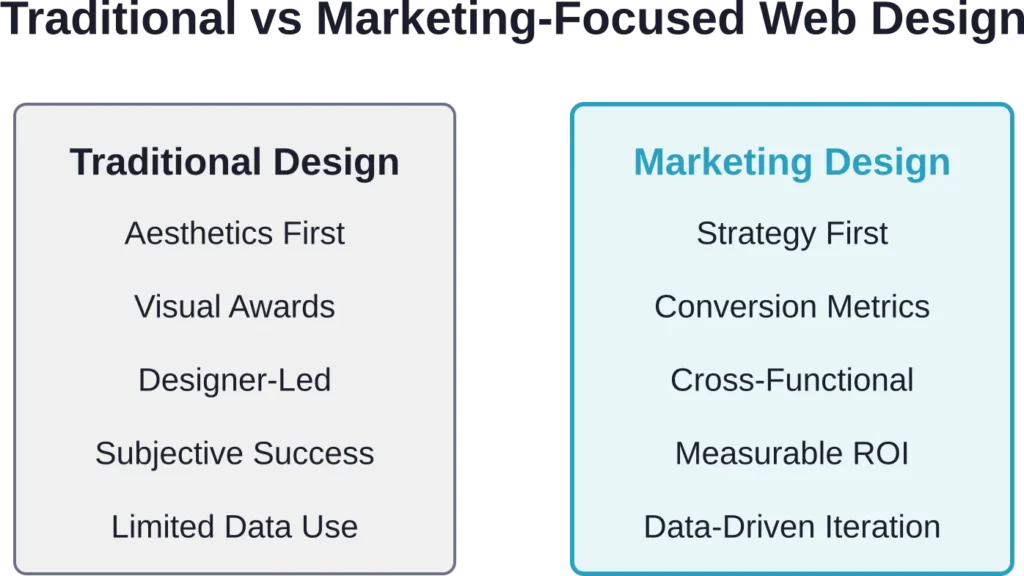
Traditional web designers often start with visual concepts—color palettes, typography systems, layout grids. That’s fine for portfolio sites or artistic projects, but marketing websites need a different foundation.
Marketing web design companies start with strategic questions:
- Who’s the target audience, and what objections do they have?
- What specific actions should visitors take, and where in their journey?
- How does the website support broader marketing and sales processes?
- What metrics define success—lead volume, conversion rate, average order value?
The design decisions flow from those answers. Visual hierarchy guides attention to conversion points. Messaging addresses specific buyer concerns. Page structure supports SEO strategy. Load speed optimization prevents revenue loss—Amazon found that even a 100-millisecond delay reduces sales 1%.
Real talk: this approach requires different expertise. The best agencies combine designers, marketers, UX researchers, and developers who work together from project kickoff, not in siloed handoffs.
How to Choose the Right Agency for Your Project
Not every great agency is the right fit for every project. Here’s what matters when making your decision.
Industry Specialization
Some agencies are true specialists. They’ve built dozens of SaaS product sites or eCommerce stores, and they understand the unique challenges of those sectors inside and out.
That depth shows up in subtle ways—knowing which SaaS onboarding patterns convert best, understanding eCommerce checkout friction points, anticipating compliance requirements for healthcare or finance sites.
Other agencies are deliberate generalists with cross-industry experience. The advantage? Fresh perspectives and pattern recognition from different sectors.
Neither approach is inherently better. But if your industry has specific technical requirements or regulatory constraints, specialist experience becomes more valuable.
Project Complexity and Team Size
A boutique 15-person studio and a 500-person digital agency both have strengths, but they’re suited for different projects.
Smaller agencies typically offer more direct access to senior talent, faster decision-making, and personalized attention. They’re often ideal for focused projects with clear scope.
Larger firms bring deeper benches, specialized departments, and the capacity to handle complex enterprise projects with multiple workstreams running in parallel.
Consider your project scope realistically. A complete digital ecosystem overhaul with custom integrations might overwhelm a small team. Meanwhile, a straightforward marketing site redesign might get lost in a large agency’s enterprise-focused pipeline.
Process and Communication Style
Some agencies follow rigid stage-gate processes with formal approval milestones. Others prefer iterative collaboration with continuous client involvement.
Neither is wrong, but mismatched expectations cause friction. If your team wants weekly working sessions and rapid iteration, an agency with monthly milestone reviews will frustrate everyone.
Look for process transparency during discovery calls. Strong agencies clearly explain their methodology, typical timelines, and collaboration touchpoints before contracts are signed.
Portfolio Evidence
Portfolio pieces prove capability, but look beyond surface aesthetics. Ask questions:
- What was the strategic challenge, not just the design brief?
- What measurable outcomes resulted—traffic growth, conversion lift, lead volume?
- How did research and testing inform the final design?
- What happened post-launch? Did the client continue the relationship?
The best case studies tell strategic stories, not just showcase pretty screenshots.
Top 15 Marketing Web Design Companies
Now, here’s the main event. These agencies have demonstrated consistent excellence in marketing-focused web design through verified client work and documented results.
1. Oski
Oski creates smart, well-engineered software solutions for tech-forward enterprises and ambitious startups.
They deliver comprehensive digital experiences through expertise in cloud architecture, modern frontend development, artificial intelligence, and robust content management systems, helping businesses reimagine operations and customer interactions.
Strong points: cloud and scalable solutions, advanced frontend and UI/UX development, AI integration capabilities, enterprise-grade software architecture.
Best for: enterprises and growth-stage companies needing sophisticated web platforms, businesses looking to integrate AI and modern technologies into their digital presence, organizations requiring reliable and scalable digital solutions.
Contact Information:
- Website: oski.site
- Phone: +48571282759
- Email: [email protected]
- Address: Kaupmehe tn 7, 10114 Tallinn, Estonia
- LinkedIn: www.linkedin.com/company/oski-solutions
2. Lengreo
Lengreo positions itself as a complete marketing and technology partner, delivering integrated solutions that combine strategic consulting with hands-on execution.
The agency excels at driving measurable B2B growth through full-funnel approaches, including SEO, website development, paid advertising, and sophisticated lead generation systems. Their work consistently shows strong results in client acquisition, conversion rate improvement, and cost-efficient lead delivery across multiple industries and geographies.
Strong points: comprehensive B2B marketing strategy, website development with conversion focus, multi-channel lead generation, data-driven performance optimization.
Best for: B2B companies seeking an end-to-end marketing and web development partner, businesses focused on lead generation and client acquisition, companies that want measurable ROI from their digital presence.
Contact Information:
- Website: lengreo.com
- Phone: +31 686 147 566
- Email: [email protected]
- Address: Vrijstraat 9 C/D, 5611 AT Eindhoven, Netherlands
- LinkedIn: www.linkedin.com/company/lengreo
- Instagram: www.instagram.com/lengreo.agency
- Twitter: x.com/Lengreo
3. Mobian Studio
Mobian Studio builds dedicated engineering teams that deliver production-ready digital products, with particular strength in mobile and AI-powered solutions.
They focus on end-to-end product development, combining clean architecture, intuitive UI/UX, and scalable systems that help companies ship faster and more reliably. Their expertise spans mobile applications, AI systems, and complex integrations tailored for demanding industries.
Strong points: dedicated product development teams, mobile-first solutions, AI and automation systems, scalable architecture design.
Best for: companies needing reliable technical execution for digital products, businesses in healthcare, fintech, and logistics looking for mobile and AI-enhanced web experiences, organizations that require fast and high-quality delivery.
Contact Information:
- Website: mobian.studio
- Phone: [email protected]
- Address: Harju maakond, Tallinn, Kesklinnalinnaosa, Masina tn 22, 10113
- LinkedIn: www.linkedin.com/company/mobian-studio
4. Gilzor
Gilzor specializes in custom software development and digital product creation, helping startups and growing businesses turn ideas into functional, user-friendly solutions.
Their approach emphasizes user-centric UI/UX design, thorough idea validation, and full-cycle development of web and mobile applications that drive real business outcomes and user adoption.
Strong points: custom web and mobile development, user-centric UI/UX design, product idea validation, go-to-market support.
Best for: startups launching new digital products, small and medium businesses building additional sales channels, companies seeking high-quality custom web and mobile solutions with strong user experience focus.
Contact Information:
- Website: www.gilzor.com
- Email: [email protected]
- Address: Poland, Warsaw, Office 58, street Adama Mickiewicza 37, 01-625
- LinkedIn: www.linkedin.com/company/gilzor-softwaredevelopment
5. A-listware
A-listware provides software development and consulting services focused on building high-quality, secure, and responsive digital solutions.
The company delivers full-spectrum development capabilities, including custom software, UX/UI design, team augmentation, and infrastructure services, acting as a seamless extension of client teams.
Strong points: custom software development, UX/UI design expertise, dedicated development teams, comprehensive IT solution delivery.
Best for: businesses seeking reliable software development partners, companies needing flexible team augmentation for web and digital projects, enterprises looking for end-to-end digital transformation support.
Contact Information:
- Website: a-listware.com
- Phone: +1 (888) 337 93 73
- Email: [email protected]
- Address: North Bergen, NJ 07047, USA
- LinkedIn: www.linkedin.com/company/a-listware
- Facebook: www.facebook.com/alistware
6. Bop Design
Bop Design specializes in B2B marketing websites and has refined a methodology specifically for longer, more complex sales cycles. They understand that B2B buying decisions involve multiple stakeholders, extended evaluation periods, and sophisticated content needs.
Their websites typically emphasize thought leadership, detailed product education, and lead nurturing pathways. Rather than optimizing for immediate conversions, they design for progressive engagement that matches B2B buying behavior.
The agency combines website design with content strategy and ongoing digital marketing support, recognizing that B2B sites require continuous content development to remain effective.
Strong points: B2B marketing expertise, complex sales cycle understanding, integrated content strategy, thought leadership positioning.
Best for: B2B companies with enterprise sales models, professional services firms, technology companies selling to business buyers.
Team size: focused team with deep B2B marketing and website specialization.
7. Lounge Lizard
Lounge Lizard brings nearly 25 years of experience to web design, having evolved through multiple digital eras while maintaining relevance. That longevity demonstrates adaptation capability—they’ve navigated Flash-era design, mobile revolution, responsive frameworks, and current component-based architectures.
The agency offers comprehensive digital capabilities including web design, mobile app development, and digital marketing. This breadth allows them to handle complex projects requiring coordination across multiple digital touchpoints.
Their portfolio spans numerous industries with particular strength in eCommerce, healthcare, and professional services. That diversity provides cross-pollination of ideas and approaches.
Strong points: extensive track record, full-service digital capabilities, cross-industry experience, technical depth across platforms.
Best for: established businesses seeking experienced partners with proven staying power, projects requiring mobile and web coordination, companies valuing agency stability.
Team size: established agency with comprehensive digital team across disciplines.
8. Ruckus
Ruckus positions itself at the intersection of marketing strategy and creative execution. They’re not purely a web design shop—they’re a brand and marketing agency where web design serves broader strategic objectives.
This positioning means website projects typically include substantial brand strategy, messaging development, and marketing planning components. The website becomes one expression of a larger brand system rather than an isolated deliverable.
Their client roster includes notable brands across multiple sectors, and their work demonstrates consistent attention to brand personality and distinctive visual identity.
Strong points: integrated brand and marketing approach, strategic positioning expertise, distinctive creative execution, comprehensive brand system thinking.
Best for: companies undergoing significant brand evolution, businesses where brand personality drives differentiation, projects requiring integrated marketing and design thinking.
Team size: full-service agency with brand strategy, creative, and digital capabilities.
9. Dotlogics Inc.
Dotlogics emphasizes technical sophistication alongside design excellence. They handle complex web applications, custom integrations, and technical requirements that stretch beyond typical marketing websites.
The agency works extensively with eCommerce platforms, building sophisticated online stores with advanced functionality—inventory management integration, complex product configurations, personalization engines, and multi-channel selling capabilities.
Their technical depth makes them valuable for projects where backend complexity matters as much as frontend polish. They can architect solutions that scale with business growth rather than requiring platform migrations.
Strong points: technical development expertise, eCommerce platform mastery, complex integration capabilities, scalable architecture planning.
Best for: eCommerce businesses with complex requirements, companies needing custom functionality, projects requiring sophisticated technical integrations.
Team size: development-strong team with balanced design and engineering capabilities.
10. Azuro Digital
Azuro Digital brings a growth marketing perspective to web design. Rather than viewing websites as one-time projects, they approach them as marketing assets requiring continuous optimization and evolution.
Their methodology includes post-launch testing, analytics implementation, and iterative improvement based on real user behavior. This ongoing optimization approach recognizes that the best websites evolve through learning rather than launching perfectly.
The agency particularly excels with startups and growth-stage companies where rapid iteration and data-driven decision making align with company culture. They’re comfortable with ambiguity and adjustment as products and positioning evolve.
Strong points: growth marketing integration, continuous optimization approach, startup-friendly processes, data-driven iteration methodology.
Best for: startups and growth-stage companies, businesses embracing continuous improvement culture, companies with in-house marketing teams wanting collaborative partners.
Team size: lean team optimized for speed and flexibility.
11. Thrive Internet Marketing Agency
Thrive represents the full-service digital marketing model done right. Based in Texas with team members nationwide, they’ve built their reputation on integrated campaigns where web design works in lockstep with SEO, content marketing, and paid media.
What sets Thrive apart is measurable performance orientation. They achieved substantial growth in referral traffic from AI platforms during 2025, with total traffic from generative AI sources growing by a staggering +4,302%, including a +32% increase from January to October—demonstrating forward-thinking AI SEO strategies.
Their web design approach starts with conversion architecture. Before visual design begins, they map user journeys, identify friction points, and establish clear conversion goals. The design execution then supports those strategic foundations.
Strong points: comprehensive digital marketing integration, proven AI SEO strategies, measurable performance tracking, multi-location expertise.
Best for: businesses wanting an integrated marketing partner, not just a design vendor. Companies that value data-driven optimization and ongoing performance improvement.
Team size: 100+ digital marketing professionals across multiple specialties.
12. Excited Agency
Excited Agency approaches web design through a product-first lens that particularly resonates with tech companies and SaaS platforms. Rather than surface-level aesthetics, their focus centers on clarity, structure, and conversion optimization.
The agency combines UX research, web design, branding, and motion design into cohesive experiences that scale alongside product growth. This integrated methodology ensures websites support long-term business evolution rather than requiring complete rebuilds as companies mature.
Their process emphasizes understanding complex products and translating technical capabilities into clear value propositions that resonate with target buyers. That skill proves particularly valuable for B2B tech companies struggling to communicate differentiation.
Strong points: product-focused design thinking, technical complexity simplification, scalable design systems, strong UX research foundation.
Best for: SaaS companies, B2B tech platforms, product-led growth businesses needing websites that clearly communicate complex value propositions.
Team size: 30-50 employees with concentrated expertise in product and digital experience design.
13. Digital Silk
Digital Silk has carved out a reputation for high-end custom website experiences that balance visual sophistication with marketing performance. They work primarily with established brands and growth-stage companies that need enterprise-quality execution.
Their methodology emphasizes custom development over template-based approaches, giving clients complete ownership and flexibility. This matters for companies with unique functionality requirements or brands that need distinctive digital expressions.
The agency’s portfolio demonstrates versatility across industries—from healthcare to finance to eCommerce—while maintaining consistently high production values. That cross-sector experience brings valuable perspective to each project.
Strong points: custom development capabilities, brand-focused design, enterprise-level project management, cross-industry experience.
Best for: established companies with substantial budgets seeking custom, brand-centric websites rather than template-based solutions. Businesses needing complex functionality or unique user experiences.
Team size: 100+ employees spanning strategy, design, development, and digital marketing disciplines.
14. Clay
Clay has built a remarkable portfolio working with high-profile brands and funded startups. Their design work tends toward the bold and distinctive—these aren’t conservative corporate websites, but memorable brand experiences.
What makes Clay particularly interesting is their contribution to client fundraising success. Their designs have directly contributed to clients raising serious funding: $3.6M for Datawisp, $2.3M for Floret, and a whopping $18M for Aampe.
The agency combines brand strategy, UI/UX design, and digital product thinking. They’re especially strong at helping companies establish or evolve brand identity alongside website development, ensuring cohesive market positioning.
Strong points: distinctive brand-forward design, startup ecosystem experience, integrated brand strategy, investor-appealing presentation.
Best for: funded startups preparing for growth stages, companies undergoing rebranding, businesses where brand differentiation provides competitive advantage.
Team size: mid-sized team with concentration in brand strategy and digital design.
15. Huemor
Huemor differentiates through a conversion-obsessed approach grounded in behavioral psychology and user research. They don’t just build attractive websites—they architect experiences designed to guide specific user actions.
Their process includes detailed competitive analysis, user research, and conversion rate optimization planning before design begins. This upfront investment pays off in sites that perform immediately upon launch rather than requiring months of post-launch optimization.
The agency particularly excels with eCommerce and lead generation websites where conversion performance directly impacts revenue. Their work often includes sophisticated personalization, behavioral triggers, and progressive disclosure patterns that increase conversion rates.
Strong points: conversion rate optimization expertise, behavioral psychology application, eCommerce specialization, data-driven design decisions.
Best for: eCommerce companies, B2B businesses with complex sales cycles, companies where marginal conversion improvements generate significant revenue impact.
Team size: specialized team focused on conversion-centric design and development.
Key Evaluation Criteria When Vetting Agencies
Beyond the agencies profiled above, knowing how to evaluate any potential partner helps you make confident decisions. Here’s what actually matters.
Verified Client Reviews and Ratings
Clutch reviews have become the industry standard for verified client feedback. Unlike testimonials that agencies curate, Clutch conducts structured interviews with actual clients who verify their identity and project details.
Look for patterns across multiple reviews rather than individual outliers. Consistent praise for communication, strategic thinking, or technical execution tells you more than perfect 5-star averages with vague comments.
Pay attention to how agencies handle criticism in lower-rated reviews. Thoughtful responses that acknowledge issues and explain improvements demonstrate maturity and client commitment.
Case Study Depth
Surface-level case studies that show finished designs without context provide limited signal. Strong case studies explain:
- The business challenge and project objectives
- Research and discovery process
- Strategic decisions and rationale
- Measurable outcomes post-launch
- Client relationship continuation
Agencies confident in their strategic value share this depth. Those focused primarily on visual output may present only screenshots.
Technical Capabilities
Modern web design requires more than visual polish. Essential technical capabilities include:
- Responsive design that works flawlessly across devices
- Performance optimization for fast load times
- Accessibility compliance meeting WCAG standards
- SEO-friendly architecture and technical implementation
- Security best practices and maintenance planning
- CMS selection and customization appropriate to client needs
Ask specific technical questions during discovery. Vague answers or dismissive responses to technical concerns reveal capability gaps.
Strategic Marketing Integration
The best marketing web design companies don’t just execute design—they contribute strategic thinking. During discovery conversations, they should ask probing questions about:
- Target audience segments and buyer personas
- Competitive positioning and differentiation
- Marketing funnel stages and content mapping
- Conversion goals and success metrics
- Integration with existing marketing technology
If the conversation stays focused on visual preferences and favorite websites, that’s a warning sign. Strategic partners dig into business objectives before discussing design execution.
Common Mistakes When Selecting a Web Design Agency
Businesses often stumble on predictable issues when choosing agency partners. Avoiding these saves time, money, and frustration.
Prioritizing Cost Over Value
Website development costs vary widely depending on complexity and requirements. More affordable options using templates differ fundamentally from custom strategic websites in both investment and capability.
The right question isn’t “what’s the cheapest option?” but “what level of investment matches our business objectives and growth stage?”
Early-stage startups validating product-market fit have different needs than established companies pursuing enterprise customers. Match investment to business context rather than choosing arbitrarily.
Neglecting Post-Launch Support
Many businesses treat web design as a one-time project with a clear endpoint. But websites require ongoing attention—content updates, security patches, performance optimization, and continuous improvement based on user behavior.
Ask explicitly about post-launch support during agency evaluation. What’s included in the initial project? What ongoing services are available? How do they approach website evolution over time?
Agencies offering maintenance retainers, performance monitoring, and optimization services demonstrate long-term thinking aligned with client success.
Insufficient Internal Stakeholder Alignment
Web design projects often touch multiple internal departments—marketing, sales, product, customer success, IT. When these groups aren’t aligned on objectives and priorities, projects stall in revision cycles and competing feedback.
Before engaging an agency, establish internal consensus on:
- Primary business objectives for the website
- Success metrics and how they’ll be measured
- Decision-making authority and approval process
- Timeline expectations and internal resource availability
Strong agencies help facilitate this alignment during discovery, but starting with internal clarity accelerates everything.
Overlooking Cultural Fit
Process compatibility matters. Some agencies thrive on structured methodologies with formal milestones. Others prefer fluid collaboration and rapid iteration.
Neither approach is superior, but mismatched expectations create friction. A corporate team accustomed to formal processes may find a casual startup-style agency disconcerting. Meanwhile, a fast-moving startup might feel constrained by enterprise-style governance.
Assess working style during initial conversations. How do they describe their process? What does collaboration look like? How do they handle disagreements or changing requirements?
| Evaluation Factor | What to Look For | Red Flags |
|---|---|---|
| Client Reviews | Verified Clutch reviews with specific details, consistent patterns across multiple projects, thoughtful responses to criticism | Only unverified testimonials, vague praise without specifics, no reviews despite years in business |
| Case Studies | Business context and objectives, strategic rationale, measurable outcomes, ongoing relationships | Only visual screenshots, no performance data, no explanation of strategic decisions |
| Discovery Process | Deep business questions, audience and competitive inquiry, technical requirements assessment | Jumping immediately to visual preferences, minimal business discussion, premature proposals |
| Technical Capability | Specific methodology explanations, performance and accessibility emphasis, security awareness | Vague technical answers, dismissing technical concerns, focus only on visual design |
| Communication Style | Clear process explanation, responsive communication, appropriate questions, realistic timelines | Poor initial responsiveness, unrealistic promises, unclear methodology, avoiding direct questions |
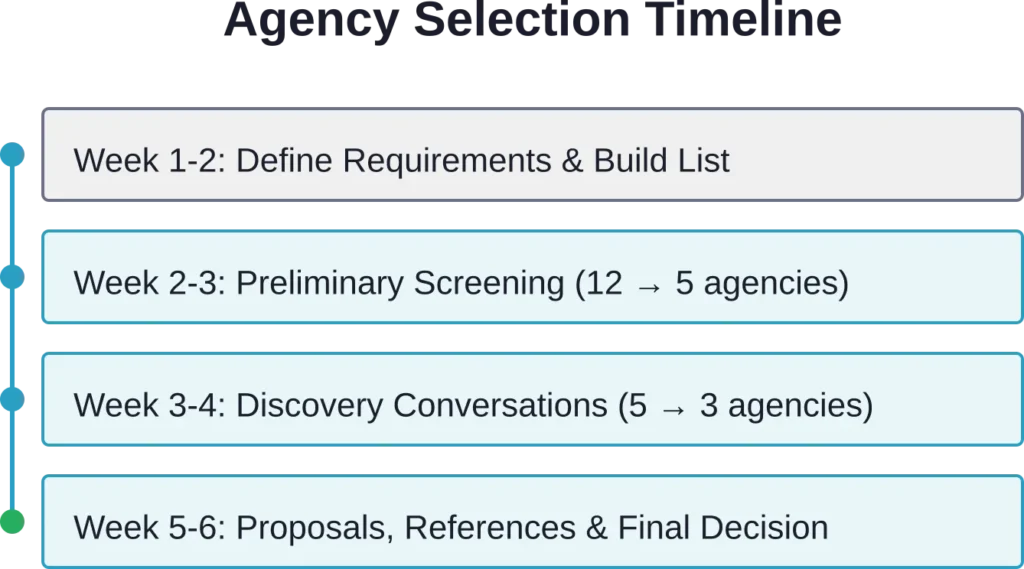
The Web Design Selection Process: Step-by-Step
Here’s a practical framework for moving from long list to signed contract.
Step 1: Define Your Requirements
Start with clarity on what success looks like. Document:
- Primary business objectives for the website
- Specific functionality requirements
- Target audience segments
- Integration needs with existing systems
- Timeline constraints and flexibility
- Budget parameters (realistic range, not wishful thinking)
This internal document becomes your evaluation rubric throughout the selection process.
Step 2: Build Your Long List
Identify 8-12 agencies that seem potentially appropriate. Sources include:
- Peer recommendations from non-competitive businesses
- Industry directories like Clutch, DesignRush, or The Manifest
- Portfolio sites showcasing work in your sector
- Agency websites found through organic search
Cast a relatively wide net initially—you’ll narrow quickly.
Step 3: Preliminary Screening
Review each agency’s website and portfolio, looking for:
- Relevant industry experience or transferable work
- Appropriate team size for your project scope
- Evidence of strategic thinking in case studies
- Technical capabilities matching your requirements
- Geographic considerations if in-person collaboration matters
This screen should reduce your list to 4-6 agencies worth deeper conversation.
Step 4: Discovery Conversations
Schedule introductory calls with remaining agencies. Come prepared with:
- Your requirements document
- Specific questions about their process and approach
- Examples of work you admire (theirs or others’)
- Timeline and budget parameters
Pay attention to both what they say and how they listen. Strong partners ask clarifying questions rather than launching into generic pitches.
Step 5: Proposals and Evaluation
Request detailed proposals from 2-3 finalists. Compare:
- Strategic approach and methodology
- Scope interpretation and deliverables
- Team composition and time allocation
- Timeline and milestone structure
- Investment and payment terms
- Post-launch support options
The lowest price rarely represents the best value. Look for the proposal that best addresses your specific requirements with appropriate strategic depth.
Step 6: Reference Checks
Ask finalists for references from similar projects. When calling references, ask:
- How did the agency handle unexpected challenges?
- Were timeline and budget commitments honored?
- How was communication throughout the project?
- What measurable outcomes resulted?
- Would you work with them again?
References provide insight into actual working relationships beyond polished proposals.
Emerging Trends in Marketing Web Design
The digital landscape continues evolving rapidly. These trends are shaping how leading agencies approach marketing web design in 2026.
AI-Powered Personalization
Static one-size-fits-all websites are giving way to dynamic experiences that adapt to individual visitor behavior, referral source, company size, or previous interactions.
Sophisticated agencies now implement personalization engines that adjust messaging, content priority, and calls-to-action based on visitor characteristics. This moves beyond simple location-based customization to meaningful behavioral adaptation.
The technical implementation has become more accessible through platforms offering built-in personalization capabilities, making this approach viable for mid-market companies, not just enterprises.
Voice and Conversational Interfaces
As voice search and AI assistants proliferate, forward-thinking agencies design for multiple interaction modes. This includes:
- Content structure optimized for voice queries and featured snippets
- Conversational UI patterns that feel natural in chat contexts
- Progressive disclosure that works for scanning and deep reading
The shift toward conversational search through AI platforms demonstrated by Thrive’s substantial AI-driven growth signals fundamental changes in how people discover and consume web content.
Performance as Competitive Advantage
Page speed has always mattered, but tolerance for slow sites continues decreasing. Amazon’s finding that even a 100-millisecond delay reduces sales 1% remains relevant—if anything, expectations have intensified.
Leading agencies now treat performance as a core design constraint, not an afterthought. This means:
- Image optimization and modern format adoption
- Strategic JavaScript loading and code splitting
- CDN implementation and edge computing
- Core Web Vitals optimization as design requirement
Performance-conscious design requires collaboration between designers and developers from project start, not cleanup afterward.
Accessibility as Standard Practice
Web accessibility has moved from nice-to-have to essential requirement. Beyond moral imperatives and legal compliance, accessible design simply reaches more people.
Strong agencies integrate accessibility throughout design and development:
- Semantic HTML structure for screen reader navigation
- Color contrast meeting WCAG AA or AAA standards
- Keyboard navigation for all interactive elements
- Alternative text and ARIA labels where appropriate
- Focus management in single-page applications
This requires expertise beyond checking compliance boxes—it means understanding diverse user needs and designing accordingly.
Questions to Ask During Agency Discovery Calls
Coming prepared with specific questions helps you assess capabilities and fit. Here are essential inquiries for discovery conversations:
Strategic Approach Questions
- How do you approach understanding our business objectives before design begins?
- What research and discovery activities are included in your process?
- How do you incorporate competitive analysis and market positioning?
- What role does user research play in your design decisions?
- How do you prioritize conversion optimization versus brand expression?
Process and Collaboration Questions
- Walk me through your typical project timeline and major milestones.
- What does client collaboration look like week-to-week?
- How do you handle feedback and revision cycles?
- What happens if we need to adjust scope or priorities mid-project?
- How do you ensure projects stay on timeline and budget?
Technical Capability Questions
- What platforms and content management systems do you recommend, and why?
- How do you approach performance optimization?
- What accessibility standards do you design and develop to?
- How do you handle responsive design across device types?
- What’s your approach to SEO-friendly architecture?
Post-Launch and Support Questions
- What’s included in post-launch support?
- What ongoing services do you offer—maintenance, optimization, updates?
- How do you measure and report on website performance?
- What does the handoff process look like for our team?
- Do you provide training for our team to manage content?
Red Flags to Watch For
Certain warning signs during evaluation suggest potential problems. Watch for these:
Immediate Proposals Without Discovery
Agencies that send proposals after brief conversations without substantial discovery work are essentially guessing at your needs. Thoughtful proposals require understanding business context, technical requirements, and strategic objectives.
Quality discovery takes time—expect 1-3 hours of conversation before receiving a detailed proposal.
Portfolio Without Results
Case studies showcasing only visual design without business context or measurable outcomes suggest agencies focused primarily on aesthetics rather than marketing performance.
Ask explicitly about results. If agencies can’t share performance metrics, conversion improvements, or business outcomes, that reveals their actual priorities.
Generic Marketing Speak
Watch for vague claims without substance: “We create engaging experiences that drive results” tells you nothing. Strong agencies articulate specific methodologies, tools, and approaches.
Generic language often masks thin capabilities.
Unrealistic Timelines or Promises
Complex websites require substantial time for research, strategy, design, development, and testing. Agencies promising complete custom websites in 2-3 weeks either work with templates despite claiming custom work, or rush through essential steps.
Similarly, promises of specific traffic or conversion results (“we’ll increase your leads by 300%”) without understanding your business represent either inexperience or dishonesty. Ethical agencies discuss realistic expectations, not guaranteed outcomes.
Poor Communication During Sales Process
How agencies behave during the sales process previews the working relationship. Slow responses, missed meetings, or unclear communication during courtship won’t improve after contracts are signed.
If getting answers during evaluation feels difficult, imagine managing a complex project together.
Frequently Asked Questions
Timeline varies significantly based on scope and complexity. Simple marketing websites with template customization might complete in 4-6 weeks. Custom-designed marketing websites typically require 8-12 weeks. Complex projects with custom functionality, integrations, or large content volumes often extend to 4-6 months. Realistic timelines include discovery, design, development, content creation, testing, and revision cycles. Rush projects that skip strategic steps usually require expensive rebuilds sooner.
Geographic proximity matters less than it once did. Many successful projects happen entirely remotely with video calls and collaborative tools replacing in-person meetings. Local agencies offer easier face-to-face interaction if that’s important to your team, but remote agencies often provide access to specialized expertise unavailable locally. Focus on capability fit and communication style rather than location. That said, if you strongly prefer in-person collaboration, local partners make sense. Just don’t limit your options unnecessarily if remote work feels comfortable.
Web design focuses on user experience, visual presentation, and interface design—how the website looks and feels. Web development implements that design through code, building the functional website with proper architecture, integrations, and technical performance. Strong projects require both disciplines working together. Some agencies offer integrated teams where designers and developers collaborate throughout. Others separate design and development into sequential phases. Either can work, but coordination between disciplines matters more than organizational structure.
Templates work well for straightforward needs with limited budget—simple business sites, portfolios, or basic eCommerce stores. Custom development makes sense when you need distinctive brand expression, unique functionality, specific integrations, or scalable architecture for complex requirements. Consider your competitive landscape, differentiation strategy, and growth plans. Companies where website serves as primary sales channel or core marketing asset typically benefit from custom work. Those using websites primarily for credibility and basic information may find templates sufficient.
Define success metrics before project start, aligned with business objectives. Common metrics include conversion rate improvements, lead volume increases, reduced bounce rates, improved time-on-site, higher engagement with key content, better mobile performance, improved search rankings, and faster page load speeds. The best metrics tie directly to revenue impact—qualified leads generated, online sales completed, demo requests received. Establish baseline measurements before launch, then track consistently post-launch. Allow 60-90 days of data collection before drawing conclusions, as traffic patterns need time to stabilize.
Beyond initial development, websites require ongoing investment. Essential costs include domain registration and renewal, web hosting and server resources, SSL certificates for security, content management system updates, security monitoring and patches, regular backups, and plugin or theme updates. Additionally, consider content updates, performance optimization, conversion rate optimization, SEO maintenance, and analytics monitoring. Many agencies offer monthly retainers covering technical maintenance and strategic optimization. Budget roughly 15-20% of initial development cost annually for proper website maintenance and evolution.
Content responsibility varies by project and capability. Agencies can create content, but internal teams often understand product details and brand voice better. Common approaches include agencies handling content strategy and structure while clients provide actual content, agencies drafting content for client review and refinement, or hybrid models where agencies create foundational content and clients handle ongoing updates. Consider internal writing capability, available time, and subject matter complexity. Technical or specialized content often requires internal expertise, while agencies excel at marketing copy and persuasive messaging.
Moving Forward: Making Your Decision
Choosing the right marketing web design company represents a significant investment and strategic decision. But analysis paralysis helps no one.
Here’s the thing: you won’t find perfect certainty. Every agency relationship involves some calculated risk. The goal isn’t eliminating all uncertainty—it’s reducing risk through diligent evaluation while moving forward with confidence.
Trust the structured process outlined above. Define requirements clearly, evaluate systematically, ask probing questions, check references thoroughly. Then make a decision based on the best available information.
The agencies profiled in this guide have demonstrated consistent capability through verified client work. They represent different specializations, approaches, and price points—but all bring serious strategic and execution capabilities to marketing web design.
Your website is too important to leave to chance, but it’s also too important to postpone indefinitely. The competitive landscape continues evolving. Customer expectations keep rising. Businesses prioritizing their digital presence gain advantages that compound over time.
Start your evaluation process today. Reach out to 2-3 agencies that align with your needs. Schedule discovery conversations. Ask tough questions. Review proposals carefully.
Then commit. Partner with an agency that understands your objectives, brings relevant expertise, and demonstrates strategic thinking alongside design excellence.
Your next website could be the marketing asset that transforms business results. But only if you move from research to action.