

Quick Summary: The best resell web design companies in 2026 combine technical expertise with white-label flexibility, enabling agencies and consultants to deliver professional websites under their own brand. This curated list highlights 15 agencies that excel in reseller partnerships, from full-service digital studios to specialized platforms offering scalable design systems and developer-friendly workflows.
The resell web design model has matured significantly. What started as simple white-labeling has evolved into sophisticated partnerships where agencies and consultants deliver enterprise-grade websites without maintaining in-house design teams.
For agencies managing multiple client verticals, partnering with a resell web design company offers speed, specialized expertise, and cost predictability. But not all partners are built the same.
Some excel at rapid turnaround for small business sites. Others bring deep SaaS product experience or complex CMS implementations. The right partner depends entirely on your client portfolio and delivery model.
This guide breaks down 15 agencies that have proven track records in reseller relationships, with transparent processes, consistent quality, and partnership structures that scale.
What Makes a Great Resell Web Design Company?
Before diving into the list, it’s worth establishing what separates a true reseller partner from a standard agency that happens to take referrals.
Great resell partners operate with complete brand invisibility. They don’t require logo placement, portfolio credits, or client-facing communication unless explicitly requested. The work is delivered under your brand, in your voice, through your project management systems.
They also offer process transparency. You get access to design files, developer handoff documentation, and staging environments. No black boxes. No proprietary systems that lock you in.
Scalability matters too. The best partners can handle a single project or a steady monthly pipeline without quality degradation. They staff appropriately and communicate capacity constraints early.
Key Criteria for Evaluation
When vetting potential partners, focus on these dimensions:
- White-label integrity: Do they keep your brand front and center, or do they push for co-branding?
- Technical range: Can they handle WordPress, Webflow, Shopify, and custom builds, or are they single-platform specialists?
- Communication cadence: Do they provide weekly updates, design review cycles, and revision protocols?
- Developer handoff: Are design files structured for clean code implementation, with component libraries and style guides?
- Portfolio depth: Do they show work across industries and complexity levels, or only templated sites?
Agencies that score high on all five tend to retain reseller relationships for years. Those that fall short on even one dimension create friction that compounds over multiple projects.
Top 15 Resell Web Design Companies
The following agencies represent the strongest options for reseller partnerships in 2026, based on partner feedback, portfolio quality, and operational maturity.

1. Mobian
Mobian Studio builds dedicated engineering teams specializing in mobile and AI solutions for IT, Healthcare, Fintech, and Logistics companies. They offer both full outsourcing and outstaffing models with end-to-end product development.
Their focus on clean architecture, scalable systems, and post-launch partnership makes them ideal for resellers working on ambitious digital products. For agencies whose clients need mobile apps, AI features, or complex web platforms delivered on time with senior-level execution, Mobian provides reliable, production-ready delivery that supports long-term client relationships.
Contact Information:
- Website: mobian.studio
- Phone: [email protected]
- Address: Harju maakond, Tallinn, Kesklinnalinnaosa, Masina tn 22, 10113
- LinkedIn: www.linkedin.com/company/mobian-studio

2. Lengreo
Lengreo operates as a complete marketing and tech partner with strong capabilities in B2B lead generation and digital performance. They combine website development with full-funnel marketing execution, making them an excellent white-label choice for agencies that want to deliver both design and measurable growth results.
Their strength lies in building conversion-focused websites, landing pages, and ecommerce platforms while running LinkedIn outreach, paid campaigns, SEO, and demand generation programs. For resellers working with B2B clients who need websites that don’t just look good but actively generate qualified leads and appointments, Lengreo provides a seamless end-to-end solution.
Contact Information:
- Website: lengreo.com
- Phone: +31 686 147 566
- Email: [email protected]
- Address: Vrijstraat 9 C/D, 5611 AT Eindhoven, Netherlands
- LinkedIn: www.linkedin.com/company/lengreo
- Instagram: www.instagram.com/lengreo.agency
- Twitter: x.com/Lengreo

3. A-listware
A-listware provides dedicated development teams and comprehensive software development outsourcing. They deliver custom software, application services, UX/UI design, testing, and IT consulting with seamless team integration.
This structure works exceptionally well for resellers who need flexible capacity to handle complex web and software projects without expanding their own staff. Agencies can position A-listware’s teams as an extension of their own, offering enterprise-grade development, modernization, and support services under their brand.
Contact Information:
- Website: a-listware.com
- Phone: +1 (888) 337 93 73
- Email: [email protected]
- Address: North Bergen, NJ 07047, USA
- LinkedIn: www.linkedin.com/company/a-listware
- Facebook: www.facebook.com/alistware

4. Gilzor
Gilzor specializes in full-cycle custom software development with a focus on web and mobile products. They support everything from idea validation and UI/UX design to development, QA, and go-to-market strategy.
This makes them particularly valuable for resellers whose clients need more than a standard website — whether it’s complex web applications, mobile apps, or platforms requiring custom functionality. Gilzor delivers production-ready solutions with strong emphasis on user-centric design, performance, and long-term support that agencies can confidently white-label.
Contact Information:
- Website: www.gilzor.com
- Email: [email protected]
- Address: Poland, Warsaw, Office 58, street Adama Mickiewicza 37, 01-625
- LinkedIn: www.linkedin.com/company/gilzor-softwaredevelopment

5. Oski
Oski builds smart, well-engineered software solutions for enterprises and ambitious startups. They excel in cloud architecture, frontend development, AI integrations, and CMS platforms like WordPress and Umbraco.
Their full-stack approach allows resellers to offer advanced digital solutions including scalable web applications, AI-powered features, and robust content management systems. For agencies serving tech-forward clients who demand performance, security, and modern architecture, Oski serves as a reliable backend partner for both new builds and ongoing development.
Contact Information:
- Website: oski.site
- Phone: +48571282759
- Email: [email protected]
- Address: Kaupmehe tn 7, 10114 Tallinn, Estonia
- LinkedIn: www.linkedin.com/company/oski-solutions

6. Ruckus
Ruckus positions itself as a branding and digital agency, and their web work reflects that dual focus. They excel at projects where brand identity and web design need to evolve in tandem.
For resellers working with rebranding clients or startups launching their first market presence, Ruckus can handle the full spectrum—logo, visual identity, messaging framework, and website—in a cohesive engagement.
Their design aesthetic skews modern and minimal, with strong typography and generous whitespace. They’re less suited for information-dense sites or complex enterprise UIs, but for marketing sites and brand showcases, they consistently deliver high-impact work.

7. Burst Digital
Burst Digital operates with a focus on small-to-midsize businesses, which makes them a practical partner for agencies managing high volumes of clients in the $10,000–$30,000 project range.
They’ve optimized their process for efficiency without sacrificing customization. Expect structured timelines, clear milestones, and predictable delivery.
They work primarily in WordPress and offer hosting and maintenance as add-ons, which simplifies the post-launch relationship. For resellers who want to focus on client acquisition and leave execution to a reliable partner, Burst provides operational consistency.

8. Top Notch Dezigns
Top Notch Dezigns has carved out a niche in healthcare, finance, and professional services—industries where compliance, accessibility, and trust signals matter more than avant-garde design.
They understand WCAG standards, HIPAA considerations, and the UX patterns that convert risk-averse users. For resellers serving regulated industries, Top Notch Dezigns brings the domain expertise that generic agencies lack.
Their sites prioritize clarity, trust-building content hierarchy, and conversion paths that respect user caution. They’re also experienced with ADA compliance audits and remediation, which is increasingly table-stakes for enterprise clients.

9. Azuro Digital
Azuro Digital focuses on product-led companies, particularly SaaS and B2B tech. Their websites emphasize product storytelling, feature differentiation, and lead capture.
They’re skilled at translating complex technical capabilities into user-friendly narratives, which is critical for clients selling to non-technical buyers or multi-stakeholder buying committees.
Their design approach is clean and conversion-focused, with strong CTAs, benefit-driven copy frameworks, and intuitive navigation. They also integrate with tools like HubSpot, Salesforce, and Marketo, ensuring seamless lead routing and attribution tracking.

10. Bend Marketing
Bend Marketing combines web design with content strategy and SEO, making them a strong fit for resellers whose clients need integrated digital marketing rather than standalone websites.
They approach every project with a content-first mindset: keyword research, content architecture, on-page optimization, and editorial calendars. The websites they build are optimized for organic search from launch, not as an afterthought.
For agencies that bundle web design with inbound marketing services, Bend provides the technical and editorial infrastructure to make that offering credible.

11. Lounge Lizard
Lounge Lizard operates as a full-service digital agency with a dedicated white-label division. They’ve been in the space since 1998, which shows in their process documentation and partner onboarding.
Their strength lies in custom WordPress and Shopify builds that don’t look like template work. They maintain an in-house team of developers and designers who specialize in ecommerce and lead-generation sites for B2B brands.
For resellers managing mid-market clients who need custom functionality—membership portals, advanced filtering, multi-currency support—Lounge Lizard delivers without the overhead of hiring specialists.
They also offer post-launch maintenance packages that can be white-labeled, which simplifies long-term client retention.

12. Huemor
Huemor positions itself as a growth-focused agency, and that philosophy extends to their reseller program. They don’t just design sites; they map user journeys, audit conversion paths, and implement analytics tracking from day one.
This makes them particularly valuable for agencies whose clients expect measurable ROI from web projects. The sites they build aren’t just visually strong—they’re instrumented for optimization.
Their team works primarily in Webflow and WordPress, with a notable emphasis on responsive design and Core Web Vitals performance. If your clients care about search engine visibility and load speed, Huemor bakes those priorities into every build.
They also provide design systems and component libraries for clients who need brand consistency across multiple properties or future in-house development.

13. Digital Silk
Digital Silk specializes in enterprise-level projects, which makes them a strong fit for resellers working with Fortune 500 brands or fast-growth startups preparing for scale.
They handle complex requirements: headless CMS architectures, multi-site instances, internationalization, and integration with CRMs, marketing automation platforms, and analytics suites.
What sets them apart is their strategic layer. They don’t just execute briefs—they challenge assumptions, run stakeholder workshops, and build roadmaps that extend beyond launch.
For resellers who position themselves as strategic partners rather than order-takers, Digital Silk provides the depth that justifies premium positioning.

14. Clay
Clay has built a reputation for brand-forward digital experiences. Their work leans heavily on custom animation, art direction, and storytelling—ideal for clients in fashion, culture, and consumer brands where differentiation is visual.
They’re not the fastest or the most cost-efficient, but for projects where the website is a brand statement, Clay delivers work that wins industry recognition.
Their reseller model is selective. They prefer long-term partnerships with agencies that share their design philosophy rather than one-off projects. But for the right fit, they offer deep collaboration and portfolio-worthy results.

15. Dotlogics
Dotlogics focuses on ecommerce, particularly Shopify Plus and BigCommerce builds for brands doing serious transaction volume.
They understand the nuances of cart optimization, checkout flow testing, and conversion rate improvement. For resellers with clients in retail, direct-to-consumer, or wholesale, Dotlogics brings proven ecommerce architecture.
They also offer ongoing optimization retainers, which create recurring revenue opportunities for resellers who can bundle design, development, and conversion optimization into a single package.
Their team is distributed but well-coordinated, with project managers who provide clear timelines and proactive risk communication.
How to Structure a Reseller Partnership
Finding the right agency is half the equation. Structuring the relationship correctly ensures long-term success.
Start with a pilot project. Even if confident in a partner, running one mid-sized engagement before committing to a master services agreement reveals communication patterns, revision processes, and quality consistency.
Define roles explicitly. Who owns client communication? Who presents design concepts? Who handles feedback consolidation? Ambiguity here creates duplicated effort and client confusion.
Contract Considerations
Your reseller agreement should address:
- Intellectual property: Ensure all work product transfers to you (and subsequently to your client) without restriction.
- Confidentiality: The partner should never disclose the relationship or contact your clients directly.
- Capacity commitments: Define expected turnaround times and how the partner communicates when they’re at capacity.
- Revision limits: Clarify how many design rounds are included and how additional revisions are billed.
- Termination terms: Establish how in-progress projects are handled if the relationship ends.
These provisions protect both parties and prevent the friction that erodes partnerships over time.
Communication Protocols
Establish a regular cadence: weekly status calls for active projects, design review meetings at defined milestones, and a shared project management tool (Asana, ClickUp, or similar).
Use a single point of contact on each side. When multiple people from your team and theirs interact directly with no coordination, timelines slip and details get lost.
Document everything. Meeting notes, design decisions, client feedback, scope changes—if it’s not written down, it didn’t happen. This discipline prevents disputes and provides clarity when projects span months.
Reseller vs. Referral: Understanding the Models
It’s worth distinguishing between true reseller relationships and simple referrals, because agencies often conflate the two.
In a referral model, you introduce a client to the design agency, and the agency manages the relationship directly. You might receive a finder’s fee or commission, but you’re not the client’s primary point of contact.
In a reseller model, you remain the client’s sole contact. The design partner is invisible. You present the work, you manage revisions, you handle billing. The design agency is a subcontractor, not a co-vendor.
The reseller model requires more operational overhead but offers better margins and client retention. The referral model is simpler but limits your ability to package services or build recurring revenue.
Which Model Fits Your Agency?
Choose reseller if:
- You want to maintain client relationships and upsell additional services
- Your brand positioning depends on being a full-service provider
- You have project management capacity to coordinate subcontractors
- You’re comfortable with margin-based pricing rather than pass-through
Choose referral if:
- You prefer transactional relationships with lower operational burden
- Your clients specifically request specialist introductions
- You lack the bandwidth to manage detailed design projects
- You’re content with smaller one-time fees rather than project margins
Neither is inherently better. The right choice depends on your agency’s business model and growth strategy.
Common Pitfalls in Reseller Relationships
Even with strong partners, reseller arrangements can stumble. Here are the patterns that cause most failures.
Scope creep without change orders. Clients request “small tweaks” that accumulate into significant additional work. If you don’t formalize scope changes and get approval from your design partner, you’ll either eat the cost or damage the relationship.
Feedback bottlenecks. When you consolidate client feedback before passing it to the design partner, delays compound. A two-day internal review becomes a four-day round trip. Build buffer time into timelines or establish faster feedback loops.
Misaligned expectations. Your client expects three design concepts; your partner’s standard process includes one concept with two rounds of revisions. If you don’t clarify this upfront, you’re stuck mediating disappointed clients and frustrated designers.
Platform assumptions. You assume the partner can build in any CMS, but they specialize in WordPress. Halfway through discovery, you realize the client’s IT team requires Drupal. Always confirm platform capabilities before signing.
Mitigation Strategies
Create detailed project briefs. Include technical requirements, platform preferences, timeline constraints, budget, and examples of design styles the client likes and dislikes.
Conduct kickoff calls with the client, your team, and the design partner (positioned as your “technical lead” or similar). This surfaces misunderstandings early.
Use a change request form. Anytime scope expands, document the request, estimate the impact, and get written approval before proceeding. This protects margins and sets professional boundaries.
The Economics of Reselling Web Design
Understanding the financial model helps evaluate whether a given partner makes sense for your client mix and pricing structure.
Most resell web design companies operate on fixed-bid or milestone-based pricing. You pay a set amount for a defined scope, and you bill your client at a markup.
Typical markup ranges are 30–50%, though this varies based on how much value you add (strategy, content creation, project management, post-launch optimization).
Sample Economics
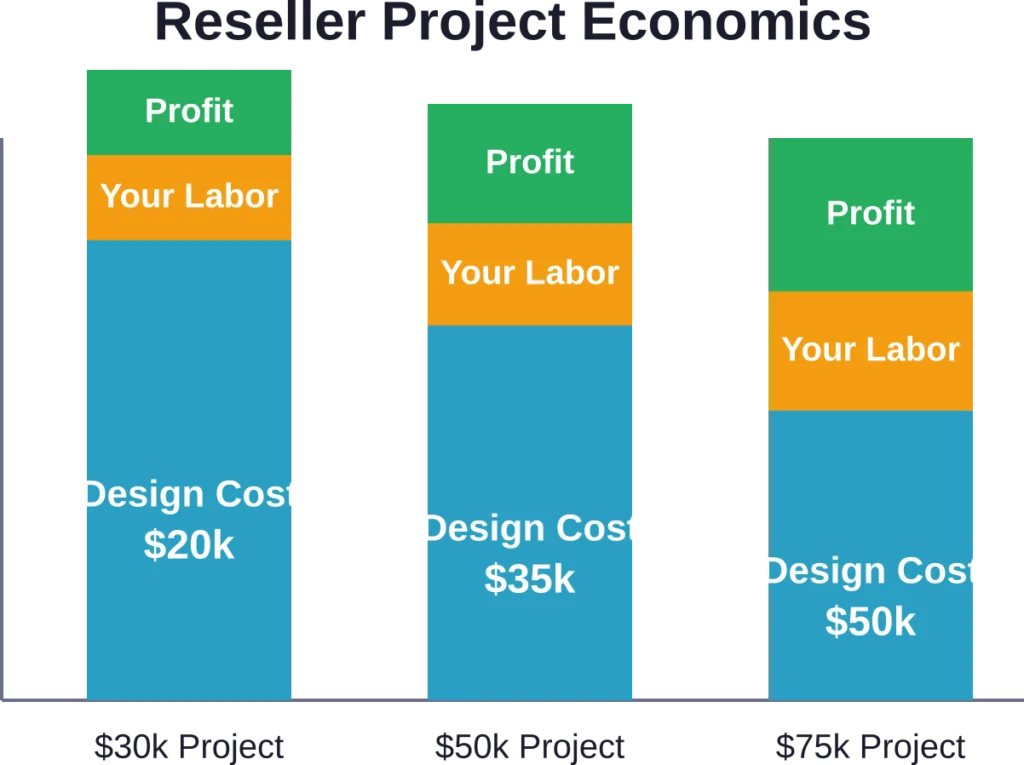
Here’s a simplified model:
| Client Project Value | Design Partner Cost | Your Markup | Gross Margin |
|---|---|---|---|
| $30,000 | $20,000 | 50% | $10,000 |
| $50,000 | $35,000 | 43% | $15,000 |
| $75,000 | $50,000 | 50% | $25,000 |
These margins need to cover your internal labor (project management, client communication, strategy, content), overhead, and profit.
If your internal costs for managing a $30,000 project run $5,000, your net margin is $5,000, or roughly 17%. That’s healthy for a reseller model, but only if your labor estimate is accurate.
Underestimate internal effort, and you quickly erode profitability. Track time religiously for the first few projects to understand your true cost structure.
Pricing Strategy
Some agencies use value-based pricing and charge clients based on business outcomes rather than cost-plus markups. In this model, the design partner’s cost becomes less relevant, and your margin can expand significantly.
For example, if a client expects the new website to generate $500,000 in additional annual revenue, a $75,000 project investment is easily justified—even if your design partner cost is only $35,000.
This approach requires strong discovery and positioning skills, but it decouples your pricing from the partner’s rates and improves profitability.
Choosing the Right Partner for Your Client Portfolio
Not every agency on this list will suit your needs. The right partner depends on the types of clients you serve and the capabilities you need to complement.
If your clients are primarily small businesses with straightforward needs—brochure sites, local service providers, single-product stores—prioritize partners who offer efficiency and cost predictability. Burst Digital and Bend Marketing excel here.
If you work with mid-market B2B companies or SaaS startups, look for partners with strong product storytelling and conversion optimization skills. Azuro Digital, Huemor, and Lounge Lizard fit this profile.
For enterprise clients or high-visibility brands, you need partners who can handle complexity and deliver work that reflects the brand’s market position. Digital Silk and Clay operate at this level.
Assessment Framework
Use this simple matrix to evaluate fit:
| Partner | Best Client Segment | Primary Strength | Potential Limitation |
|---|---|---|---|
| Lounge Lizard | Mid-market, ecommerce | Custom functionality | Turnaround speed |
| Huemor | Growth-focused B2B | Conversion optimization | Creative differentiation |
| Digital Silk | Enterprise, SaaS | Strategic depth | Project minimums |
| Clay | Consumer brands | Brand storytelling | Timeline flexibility |
| Dotlogics | Ecommerce, retail | Platform expertise | Non-commerce projects |
| Burst Digital | SMB, local services | Volume efficiency | Custom complexity |
Match your client base to the partner’s strengths, and you’ll build a relationship that scales.
What to Ask During Partner Evaluation
When you’re vetting potential resell partners, these questions reveal operational maturity and cultural fit.
How do you handle scope changes mid-project? The answer should include a formal change request process, impact assessment, and approval workflow.
What happens if we’re not happy with the first design concept? Look for willingness to iterate and explore alternative directions, not defensiveness or rigid processes.
How do you manage capacity when you’re at maximum load? Great partners communicate early and decline work they can’t deliver well. Red flag: partners who say yes to everything and then miss deadlines.
Can we see examples of work done under white-label arrangements? If they refuse or don’t have examples, they may not have real reseller experience.
What’s your typical timeline for a 10-page marketing site? Answers vary, but consistency across projects is more important than speed. A partner who says “four weeks” for one project and “twelve weeks” for a similar scope likely has unpredictable processes.
How do you handle hosting and ongoing maintenance? Some partners include it; others expect you to manage it. Know this upfront so you can plan client support accordingly.
Building Long-Term Reseller Success
The agencies that thrive with reseller models treat partnerships as strategic relationships, not transactional vendor arrangements.
Invest in the relationship. Share your roadmap, introduce the partner to your team, and create feedback loops that help them improve. Partners who understand your business deliver better work.
Provide detailed feedback, even on successful projects. What went well? What could be smoother next time? This continuous improvement mindset strengthens the partnership and improves outcomes.
Consider volume commitments. If you can guarantee a certain number of projects per quarter, many partners will offer preferential pricing or dedicated capacity. This benefits both parties: you get predictable costs and faster turnaround; they get revenue stability.
The Role of Retainers in Reseller Models
Some agencies shift from project-based engagements to retainer arrangements with their design partners. This works well when you have steady client demand and want priority access to partner capacity.
Retainer arrangements vary based on scope and partner capabilities. For agencies managing multiple ongoing client relationships, this model creates predictable costs and simplifies budgeting.
The trade-off is commitment. You’re paying whether or not you use the full allocation, so this model only makes sense when project volume is consistent.
Frequently Asked Questions
The terms are often used interchangeably, but technically white-label refers to the branding model (the work is delivered under your brand), while resell refers to the business model (you purchase services wholesale and sell them at a markup). In practice, most white-label web design services operate as reseller partnerships.
It varies by partner. Some agencies work on a project-by-project basis with no ongoing commitment. Others offer discounted rates in exchange for retainer agreements or minimum monthly commitments. Clarify this during initial conversations to ensure alignment with your business model.
Many resell web design companies offer design-only services, delivering final design files and specifications that your developers implement. Others prefer to handle both design and development to ensure quality and simplify accountability. Confirm capabilities and preferences early in the vetting process.
Most partners include a set number of revision rounds in their base pricing (commonly two to three rounds). Additional revisions beyond this scope are billed separately, either at an hourly rate or as a fixed add-on. Establish these terms upfront and communicate them clearly to your clients to avoid budget surprises.
In a true white-label arrangement, the design partner remains invisible and all client communication flows through you. However, some partners are willing to join client calls if positioned as part of your team (using titles like “Technical Lead” or “Senior Designer”). Discuss this scenario during onboarding to establish protocols that protect the partnership structure.
Your contract with the resell partner should specify that all work product—design files, code, documentation—transfers to you upon payment. You then own the work and can transfer it to your client as part of your agreement with them. Never proceed without explicit IP transfer terms in your partner contract.
Strong partners communicate proactively when delays are likely and work with you to mitigate client impact. Your contract should include provisions for timeline management, including how delays are communicated, what remedies are available (expedited delivery, partial refunds, credit toward future work), and how you’ll jointly manage client expectations. Build buffer time into client-facing deadlines to absorb minor delays without breaking commitments.
Conclusion
The resell web design model offers agencies a scalable path to deliver high-quality websites without the overhead of in-house design teams. The 15 companies highlighted here represent proven partners across different client segments and project types.
Success in reseller relationships depends on clear communication, well-defined processes, and alignment between your agency’s positioning and the partner’s capabilities. Start with a pilot project, document expectations thoroughly, and invest in building a collaborative partnership that extends beyond transactional engagements.
As digital ecosystems continue to evolve, agencies that can deliver sophisticated digital experiences through strategic partnerships will outpace those trying to build every capability internally. Research on business model evolution in the digital era continues to demonstrate the importance of collaborative business models.
Choose partners who complement your strengths, serve your client base effectively, and operate with transparency and professionalism. The right reseller relationship doesn’t just expand your service offering—it becomes a competitive advantage that drives growth and client retention.
Ready to explore reseller partnerships? Start by reaching out to two or three agencies from this list, share details about your client portfolio, and request initial consultations to assess fit and process alignment.