

Quick Summary: The best roofer web design companies in 2026 specialize in high-converting websites that drive local leads and booked jobs for roofing contractors. Top agencies include Built-Right Digital, Hook Agency, Roofing Webmasters, Webrunner Media Group, Thrive Internet Marketing Agency, and others that combine custom design with local SEO, Google Maps optimization, and lead tracking systems built specifically for the roofing industry.
Roofing contractors face a harsh reality: a website that looks like a digital brochure from 2015 won’t cut it anymore. Homeowners decide within seconds based on what they see in Google search results, and if the site doesn’t scream professionalism and trustworthiness, they’re gone.
Whether the focus is retail roof replacements, commercial flat roofs, or emergency storm damage repair, one fact remains absolute. The website is the hardest-working salesperson on the team, responsible for making first impressions, establishing credibility, and converting visitors into booked estimates.
But here’s the thing though—not every web design agency understands the roofing industry. Generic designers miss the nuances of local search optimization, lead tracking, and the specific trust signals homeowners look for when choosing a contractor to climb on their roof.
This comprehensive guide breaks down the 15 best roofer web design companies that specialize in building high-converting websites for roofing contractors. These agencies don’t just create pretty designs—they engineer lead generation systems that turn website traffic into booked jobs.
What Makes a Great Roofing Web Design Company
Not all web design agencies are created equal. Some build beautiful websites that win design awards but generate zero leads. Others create clunky platforms that rank well in Google but look like they were built in someone’s basement.
The best roofing web design companies strike a balance. They understand that a roofing website needs to accomplish three critical goals simultaneously: establish trust within seconds, rank in local search results, and convert visitors into phone calls or form submissions.
Real talk: roofing is a high-trust, high-consideration purchase. Homeowners aren’t clicking “buy now” on a $15,000 roof replacement. They’re researching contractors, comparing options, reading reviews, and looking for signals that this company won’t disappear halfway through the project.
The design has to communicate professionalism, showcase completed projects with high-quality photos, display certifications and manufacturer partnerships prominently, and make the phone number impossible to miss. At the same time, the site needs to load fast on mobile devices, rank for local search terms like “roof replacement near me,” and capture leads through strategically placed contact forms.
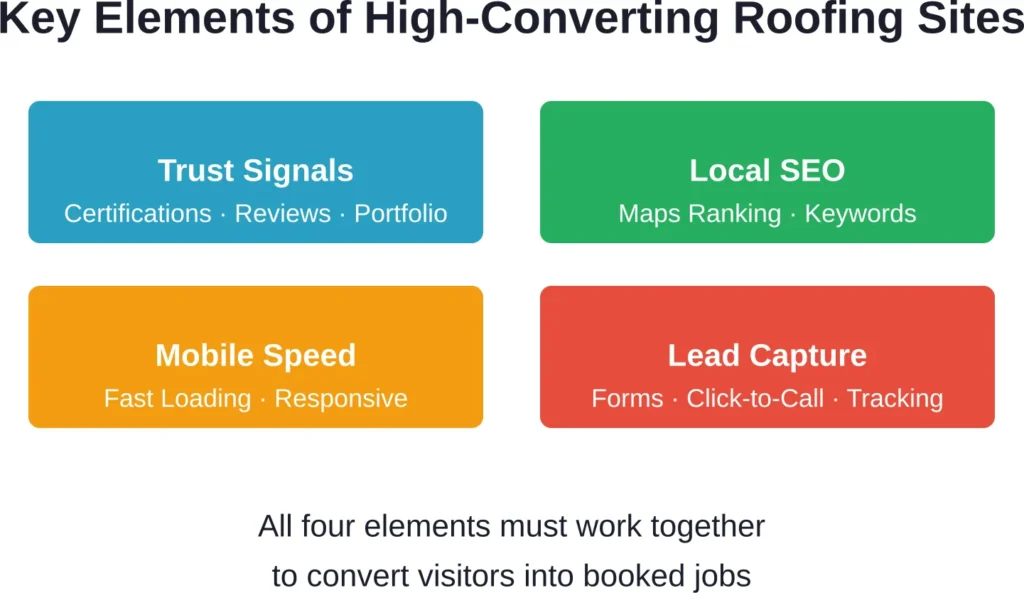
Another critical factor: industry specialization. Agencies that work exclusively with roofing contractors understand the seasonal cycles, emergency repair dynamics, and the difference between residential and commercial roofing sales processes. They’ve already figured out what messaging converts, which page layouts drive calls, and how to structure service pages for maximum local search visibility.
Top 15 Roofer Web Design Companies
The following agencies represent the best options for roofing contractors looking to build or rebuild their digital presence. Each brings unique strengths to the table, from proprietary technology to deep industry experience.
1. Lengreo
Lengreo positions itself as a complete marketing and technology partner for roofing contractors looking to scale lead generation and online presence. The agency combines data-driven digital strategies with technical execution to deliver measurable growth in a competitive local market.
The team specializes in building high-converting websites, implementing strong local SEO, managing paid advertising campaigns, and running hyper-personalized lead generation systems. Their approach focuses on lowering cost per lead while increasing qualified opportunities through optimized funnels, strategic outreach, and continuous performance optimization.
Lengreo handles the full stack — from website development and SEO to LinkedIn and Meta advertising, appointment setting, and demand generation — creating a unified system designed to turn more homeowners into booked appointments.
Best for: Roofing contractors who want a true end-to-end marketing and tech partner focused on ROI and lead volume.
Contact Information:
- Website: lengreo.com
- Phone: +31 686 147 566
- Email: [email protected]
- Address: Vrijstraat 9 C/D, 5611 AT Eindhoven, Netherlands
- LinkedIn: www.linkedin.com/company/lengreo
- Instagram: www.instagram.com/lengreo.agency
- Twitter: x.com/Lengreo
2. Oski

Oski builds smart, well-engineered software solutions for tech-forward roofing companies and ambitious contractors ready to differentiate through technology. The company focuses on cloud architecture, modern web development, and AI-powered tools.
They deliver scalable websites, customer portals, and internal systems using cutting-edge technologies including React, cloud infrastructure, and artificial intelligence. Oski’s solutions help roofing businesses automate processes, enhance online booking experiences, and create more professional digital first impressions.
Their approach combines strong frontend design with robust backend systems to ensure fast, secure, and reliable performance for both customers and internal teams.
Best for: Roofing contractors who want modern, high-quality web and software solutions powered by current technologies.
Contact Information:
- Website: oski.site
- Phone: +48571282759
- Email: [email protected]
- Address: Kaupmehe tn 7, 10114 Tallinn, Estonia
- LinkedIn: www.linkedin.com/company/oski-solutions
3. Gilzor

Gilzor delivers custom software development and digital product solutions that help roofing companies modernize operations and strengthen their customer-facing presence. The company builds web and mobile applications that improve efficiency and create additional revenue channels.
Their expertise covers full-cycle website and application development, UI/UX design focused on conversion, and go-to-market strategies tailored for service businesses. Gilzor helps roofing contractors create professional online booking systems, service portals, and internal tools that reduce manual work and enhance customer experience.
The team emphasizes clean architecture, quality assurance, and scalable solutions that grow together with the business.
Best for: Roofing contractors seeking custom software and web solutions to streamline operations and improve customer acquisition.
Contact Information:
- Website: www.gilzor.com
- Email: [email protected]
- Address: Poland, Warsaw, Office 58, street Adama Mickiewicza 37, 01-625
- LinkedIn: www.linkedin.com/company/gilzor-softwaredevelopment
4. Mobian Studio
Mobian Studio builds dedicated engineering teams that deliver production-ready digital solutions for roofing companies that want to move faster than their competitors. The agency specializes in mobile applications, AI systems, and full-stack development.
They work in two models — full outsourcing or outstaffing — helping roofing businesses create mobile-friendly websites, customer apps, AI-powered tools, and scalable backends. Mobian emphasizes clean architecture, clear documentation, and senior-level execution.
The team has domain experience in building reliable digital products for service industries, including systems that support field operations and customer engagement.
Best for: Roofing contractors who need fast, high-quality development of mobile apps, websites, and custom software solutions.
Contact Information:
- Website: mobian.studio
- Phone: [email protected]
- Address: Harju maakond, Tallinn, Kesklinnalinnaosa, Masina tn 22, 10113
- LinkedIn: www.linkedin.com/company/mobian-studio
5. A-listware

A-listware is a software development and consulting company that provides dedicated teams and technical solutions for roofing businesses looking to strengthen their digital infrastructure.
The company offers full software development services, team augmentation, UX/UI design, and IT consulting tailored to service-based industries. They help roofing contractors build custom applications, modernize existing systems, and create efficient digital workflows that support business growth.
A-listware focuses on delivering secure, responsive, and high-quality digital solutions that integrate smoothly with existing operations.
Best for: Roofing contractors who need reliable software development support and dedicated technical teams.
Contact Information:
- Website: a-listware.com
- Phone: +1 (888) 337 93 73
- Email: [email protected]
- Address: North Bergen, NJ 07047, USA
- LinkedIn: www.linkedin.com/company/a-listware
- Facebook: www.facebook.com/alistware
6. Contractor Dynamics
Contractor Dynamics specializes in home improvement contractors with particular strength in roofing, siding, and exterior remodeling businesses. The agency understands the overlap between these services and designs websites that effectively showcase multiple service lines without creating navigation confusion.
The team builds websites on platforms optimized for contractor needs—fast loading speeds, mobile responsiveness, easy content management, and integration with lead tracking systems. The design aesthetic balances professional polish with approachability, avoiding the sterile corporate look that can feel impersonal for local service businesses.
Contractor Dynamics also handles ongoing website maintenance, security updates, and performance optimization, taking the technical burden off contractors who’d rather focus on running jobs than managing hosting and plugins.
Best for: Multi-service exterior contractors who need websites showcasing roofing alongside complementary services.
7. Contractor Gorilla

Contractor Gorilla focuses specifically on home service contractors and brings deep expertise in lead generation mechanics. The agency doesn’t just design attractive websites—they engineer conversion funnels that guide visitors from landing page to contact form with minimal friction.
The design process emphasizes clarity over complexity. Navigation structures are streamlined, service descriptions are concise and benefit-focused, and contact elements appear consistently across every page. The goal is eliminating every possible barrier between “I need a roofer” and “I’m requesting an estimate.”
Contractor Gorilla also provides marketing automation integration, allowing contractors to set up automated email follow-up sequences, SMS reminders, and lead nurturing campaigns that run in the background without manual effort.
Best for: Contractors who want conversion-focused design with built-in marketing automation capabilities.
8. Blue Corona (Ryno Strategic Solutions)
Blue Corona, operating under the Ryno Strategic Solutions brand, brings an analytics-obsessed approach to contractor marketing. The agency’s philosophy centers on tracking everything—not just website visitors and form submissions, but actual booked jobs and revenue generated from digital marketing efforts.
The web design services integrate with comprehensive call tracking and lead attribution systems. This means contractors can see exactly which marketing channels, keywords, and campaigns are driving real revenue, not just traffic or clicks.
Blue Corona’s reporting goes deeper than typical marketing agencies. Monthly reports break down cost per lead, conversion rates from lead to booked job, and return on investment for each marketing channel. This level of transparency helps contractors make informed decisions about where to invest marketing budgets.
Best for: Data-driven contractors who demand detailed performance tracking and ROI measurement.
9. WISE Digital Partners

WISE Digital Partners approaches roofing web design with emphasis on long-term growth strategy rather than quick fixes. The agency builds websites as foundational assets that appreciate in value over time through consistent content additions, technical optimizations, and authority building.
The design process includes competitive analysis of top-ranking roofing companies in the contractor’s market, identifying gaps and opportunities in both design and content. WISE then builds sites engineered to outrank and outperform local competition in organic search results.
The agency also provides strategic consulting on brand positioning, service line pricing, and market differentiation—helping contractors clarify not just how their website looks but what it communicates about their unique value proposition.
Best for: Growth-minded contractors looking for strategic partnership beyond just web design execution.
10. CinchLocal

CinchLocal specializes in local service businesses with strong emphasis on Google Business Profile optimization and local search visibility. The agency’s web design services are built around the reality that most roofing leads come from Google Maps and local search results, not organic rankings or social media.
The design approach prioritizes Google’s local ranking factors—fast mobile page speed, location-specific service pages, schema markup for business information, and integration with Google Business Profile for review display and NAP consistency.
CinchLocal also handles review generation and reputation management, helping contractors systematically collect positive reviews that boost both Google Maps rankings and conversion rates. The website design incorporates review widgets and testimonials strategically placed to reinforce credibility at key decision points.
Best for: Contractors whose primary lead source is Google Maps and local search results.
11. Built-Right Digital

Built-Right Digital positions itself as an ROI-focused growth partner for roofing contractors who want more than just a website. The agency combines high-converting design with local SEO and paid advertising management under one roof.
What sets Built-Right apart is the focus on measurable results rather than vanity metrics. The team builds websites engineered specifically to drive phone calls and form submissions, with strategic placement of contact elements, mobile-optimized layouts, and trust signals positioned where homeowners expect to find them.
The agency handles the full digital marketing stack—website design, Google Maps optimization, paid search campaigns, and ongoing performance tracking. This integrated approach means the website isn’t built in isolation but as part of a comprehensive lead generation system.
Best for: Contractors who want an all-in-one growth partner and care more about leads than winning design awards.
12. Hook Agency

Hook Agency brings serious credibility to the roofing marketing space. Founded by Tim Brown, who wrote a best-selling book on contractor marketing and speaks at major industry events like Roofcon, the agency runs a 55+ person team dedicated to home service contractors.
The agency’s approach prioritizes websites that sell rather than just look good. The design philosophy centers on clear calls to action, streamlined navigation that gets visitors to contact forms quickly, and mobile-first layouts that work flawlessly on smartphones.
Hook Agency’s ongoing marketing services keep sites fresh, optimized, and visible in Google Maps and organic search. The team understands that launching a website is just the beginning—consistent optimization and content updates are what maintain and improve rankings over time.
For contractors already generating significant revenue, Hook Agency offers tiered service packages that scale with business size. Companies in the $1M–$2M range get Google Ads, Maps SEO, Lead Tracking, and Monthly Reports, while larger operations access custom web design and expanded services.
Best for: Established roofing companies prioritizing professional design backed by proven marketing expertise.
13. Roofing Webmasters
Roofing Webmasters operates exclusively in the roofing industry. That 100% specialization since the company’s founding means every design template, every SEO strategy, and every conversion optimization tactic has been tested specifically on roofing contractor websites.
The agency built proprietary technology called DataPins—a system that lets contractors tag completed jobs with photos, descriptions, and geo-coordinates directly on their websites. This creates automatically generated project portfolios with location-specific pages that rank in local search results for neighborhoods where work was completed.
The industry-exclusive focus means Roofing Webmasters understands nuances other agencies miss. The team knows which manufacturer certifications matter most to homeowners, how to structure emergency repair pages for maximum conversions, and what trust signals move the needle in high-ticket roofing sales.
Best for: Contractors who want deep roofing industry expertise and proprietary tools built specifically for the trade.
14. Webrunner Media Group

Webrunner Media Group brings a data-driven approach to roofing web design. The agency doesn’t rely on guesswork or generic best practices—they test, measure, and optimize based on actual conversion data from roofing contractor websites.
The design process starts with understanding the specific services, geographic markets, and competitive landscape each contractor faces. From there, Webrunner builds custom sites optimized for the specific keywords and search terms that drive qualified leads in that market.
The agency combines web design with comprehensive digital marketing services, including content creation, local SEO, and reputation management. This full-service approach means the website integrates seamlessly with ongoing marketing efforts rather than existing as a standalone project.
Best for: Contractors looking for data-driven design backed by comprehensive marketing support.
15. Thrive Internet Marketing Agency
Thrive Internet Marketing Agency operates as a full-service digital marketing company that works across multiple industries but maintains strong expertise in contractor marketing, including roofing.
What makes Thrive particularly relevant in 2026 is the focus on AI-driven search and generative engine optimization. As platforms like ChatGPT, Google AI Overviews, Gemini, and Bing Chat reshape how people discover businesses, Thrive has evolved its visibility strategies to include dedicated AI SEO methods alongside traditional search optimization.
The agency validates these tactics on its own brand before deploying them for clients—a test-on-ourselves approach that provides real-world proof of concept. Thrive’s roofing web design services integrate with broader marketing campaigns that include paid search, social media, and content marketing.
Best for: Contractors interested in cutting-edge AI search optimization alongside traditional web design and SEO.
What to Look for When Choosing a Web Design Agency
Selecting the right web design partner makes the difference between a website that generates consistent leads and one that sits idle collecting digital dust. Several critical factors separate agencies that deliver results from those that just deliver websites.
Industry Experience in Roofing
Agencies that have built dozens of roofing websites understand what works and what doesn’t. They’ve tested different layouts, messaging approaches, and conversion elements specifically on roofing contractor sites. They know that homeowners researching roof replacement care about manufacturer certifications, warranty details, and before-after project photos—not generic stock images of hard hats and blueprints.
Look for agencies that can show a portfolio of roofing websites they’ve built, with real client examples and measurable results. Generic web design agencies might build beautiful sites, but they’re learning roofing industry nuances on the contractor’s dime.
Local SEO Capabilities
A gorgeous website that doesn’t rank in Google search results won’t generate leads. The agency needs to demonstrate expertise in local SEO—the specific tactics that help contractor websites appear in “near me” searches and Google Maps results.
This includes technical elements like schema markup, local keyword optimization, Google Business Profile integration, location-specific service pages, and mobile site speed optimization. Ask potential agencies about their approach to local search and request case studies showing ranking improvements for contractor clients.
Conversion Rate Optimization Knowledge
Traffic means nothing without conversions. The agency should understand conversion rate optimization—the science of turning website visitors into phone calls and form submissions.
This includes strategic placement of contact forms, click-to-call buttons that work seamlessly on mobile devices, trust signals positioned at key decision points, service pages structured to address buyer objections, and clear calls to action that guide visitors toward the next step.
Ask agencies about their conversion optimization process. Do they A/B test different layouts? Do they analyze user behavior with heat mapping tools? Do they track form abandonment and optimize accordingly?
Ongoing Support and Optimization
Launching a website is the beginning, not the end. Google’s algorithm changes constantly, competitors update their sites, and technology evolves. The best agencies provide ongoing support—content updates, technical maintenance, security patches, and continuous optimization based on performance data.
Understand what happens after the website launches. Is there a monthly retainer for ongoing optimization? What’s included in that service? How often does the agency review performance metrics and make improvements?
Transparent Performance Tracking
Agencies should provide clear visibility into website performance—not just vanity metrics like page views, but actionable data like lead volume, conversion rates, and traffic sources. The best agencies set up comprehensive tracking systems that show exactly where leads come from and which marketing channels drive the highest quality prospects.
Ask about reporting cadence and what metrics are tracked. Monthly reports should include organic search rankings for target keywords, Google Maps position, website traffic broken down by source, leads generated, and conversion rate trends over time.
| Evaluation Factor | What to Ask | Red Flags |
|---|---|---|
| Roofing Portfolio | Can you show 5+ roofing sites you’ve built with results? | Generic contractor examples or no specific roofing experience |
| Local SEO Expertise | What’s your process for ranking in Google Maps? | Vague answers about “SEO best practices” without local specifics |
| Conversion Strategy | How do you optimize for phone calls and form submissions? | Focus only on design aesthetics, not conversion mechanics |
| Ongoing Support | What happens after launch? How often do you optimize? | One-time build with no maintenance or optimization plan |
| Performance Tracking | What metrics do you track and how often do I see reports? | No clear tracking system or reports focused only on traffic |
Common Mistakes When Hiring a Web Design Agency
Roofing contractors make predictable mistakes when selecting web design partners. Avoiding these pitfalls saves time, money, and frustration.
Choosing Based on Price Alone
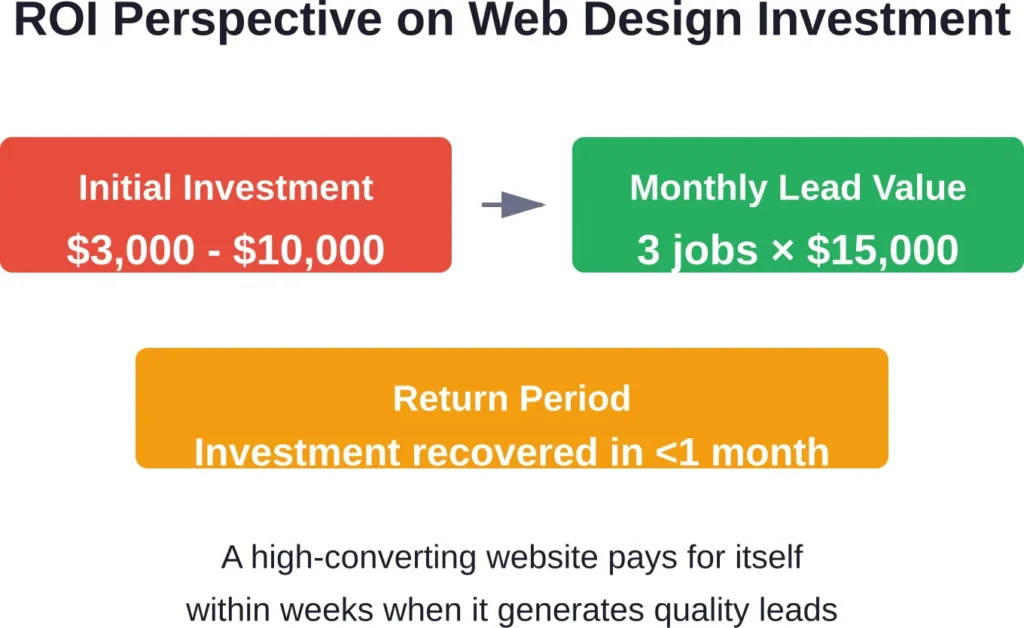
The cheapest option is rarely the best value. Professional design services for a roofing company typically cost between $3,000 and $10,000 depending on project scope. Agencies charging significantly less are either cutting corners on design quality, using generic templates with minimal customization, or skipping critical elements like SEO optimization and conversion tracking.
A website that costs $2,000 but generates zero leads is infinitely more expensive than a $7,000 site that drives 20 quality leads per month. Focus on expected return on investment, not just upfront cost.
Ignoring Mobile Performance
The majority of roofing searches happen on mobile devices—homeowners searching “roof repair near me” from their driveway after noticing a leak or storm damage. If the website doesn’t load fast and function flawlessly on smartphones, those leads are lost immediately.
Insist on seeing mobile versions of sample sites. Test them on actual phones. Check page load speed using Google’s PageSpeed Insights tool. A beautiful desktop site that’s clunky on mobile is a lead generation disaster.
Overlooking Content Strategy
Design is only half the equation. The content—service descriptions, project galleries, blog articles, FAQ sections—determines whether visitors convert and whether the site ranks in search results.
Many contractors assume they’ll write their own content, then never get around to it. The site launches with placeholder text or thin, generic descriptions that don’t convince homeowners or satisfy Google’s content quality standards. Ask agencies about content creation services and whether copywriting is included in the project scope.
Failing to Discuss Lead Tracking
Without proper tracking, there’s no way to know if the website is working. Call tracking systems show which marketing channels drive phone calls. Form tracking reveals which service pages generate the most inquiries. Google Analytics integration provides visibility into traffic sources and user behavior.
Confirm the agency will set up comprehensive tracking systems and train the contractor’s team on how to access and interpret the data. Without this visibility, marketing decisions are based on guesses rather than evidence.
The Investment Required for Professional Roofing Web Design
Understanding typical investment levels helps contractors budget appropriately and set realistic expectations.
As mentioned earlier, professional design services for a roofing company typically cost between $3,000 and $10,000 depending on the project scope. Basic sites on the lower end of that range include essential pages, mobile responsiveness, and fundamental SEO setup. Custom, high-converting platforms with deep SEO integration, proprietary features, and comprehensive content creation require higher investment.
Beyond the initial website build, many contractors invest in ongoing digital marketing services. Industry analyses indicate monthly retainers commonly range from $2,500 to $5,000 per month for smaller operations, with larger companies allocating $5,000 to $10,000 monthly for comprehensive marketing that includes the website plus paid advertising, content creation, and continuous optimization.
The key question isn’t “How much does it cost?” but rather “What return can I expect?” A roofing website that generates three additional $15,000 jobs per month pays for itself many times over. The investment should be evaluated based on customer acquisition cost and lifetime value, not just the monthly service fee.
How Roofing Websites Differ from Generic Business Sites
Roofing contractor websites have unique requirements that generic business websites don’t address. Understanding these differences explains why industry-specialized agencies often deliver better results than general web designers.
Emergency Service Prominence
Roof emergencies happen. Storm damage, sudden leaks, and wind-blown shingles require immediate attention. Roofing websites need emergency service messaging and contact options prominently displayed—not buried three clicks deep in the navigation.
The best roofing sites include emergency contact buttons in the header that persist across every page, dedicated emergency service pages optimized for urgent search terms like “emergency roof repair,” and click-to-call functionality that connects visitors to after-hours phone lines instantly.
Project Gallery with Specific Details
Homeowners want to see real completed projects, not stock photos. The project gallery needs to showcase before-and-after comparisons, specific details about materials used, manufacturer partnerships, and location information that builds local credibility.
Generic business sites might include a few sample images. Roofing sites need comprehensive galleries organized by project type, location, and roofing material. The best implementations include geo-tagged projects that create location-specific landing pages for SEO.
Certification and Partnership Display
Manufacturer certifications, insurance coverage, licensing information, and industry association memberships matter enormously in roofing. These credentials should be displayed prominently, with logos and badges that homeowners recognize and trust.
GAF Master Elite certification, CertainTeed SELECT ShingleMaster status, Owens Corning Platinum Preferred badges—these aren’t just nice-to-have decorations. They’re powerful trust signals that influence homeowner decisions. The website design needs to showcase them strategically without creating visual clutter.
Warranty and Financing Information
Roof replacement is expensive. Homeowners need clear information about financing options, warranty coverage, and payment terms before they’ll seriously consider booking an estimate.
Dedicated pages explaining manufacturer warranties, workmanship guarantees, and available financing programs remove major barriers to conversion. The best roofing sites make this information easy to find and simple to understand, with clear calls to action guiding visitors to the next step.
Future Trends in Roofing Web Design
The digital landscape evolves constantly. Forward-thinking contractors should understand emerging trends that will shape roofing web design in the coming years.
AI Search Optimization
As generative engines like ChatGPT, Google AI Overviews, Gemini, and Bing Chat reshape how people discover businesses, roofing websites need optimization strategies that go beyond traditional SEO. These AI systems pull information from websites to answer user questions directly, meaning contractors need content structured to feed these algorithms effectively.
Agencies like Thrive Internet Marketing Agency are already implementing generative engine optimization tactics—structured data markup, FAQ content formatted for AI extraction, and authoritative content that AI systems trust and cite when answering roofing-related questions.
Interactive Estimate Tools
Homeowners increasingly expect instant information. Interactive tools that provide preliminary cost estimates based on square footage, roof pitch, and material selection improve user experience and capture leads earlier in the research process.
These calculators don’t replace professional inspections, but they engage visitors, provide value, and collect contact information in exchange for detailed estimates. The best implementations integrate with CRM systems to trigger automated follow-up sequences.
Video Content Integration
Video dominates digital content consumption. Roofing websites increasingly incorporate drone footage of completed projects, video testimonials from satisfied customers, and educational content explaining different roofing materials and installation processes.
Video content serves dual purposes—it engages website visitors more effectively than text alone, and it provides content for YouTube and social media platforms that drive additional traffic back to the website.
Hyper-Local Content
Generic service area pages no longer cut it for competitive local SEO. The trend is toward hyper-local content—dedicated pages for specific neighborhoods, subdivisions, and even individual zip codes, each optimized for ultra-specific local search terms.
Agencies like Roofing Webmasters pioneered this approach with their DataPins technology, creating automatically generated location pages for every completed project. This hyper-local strategy helps contractors rank for “roofer in [specific neighborhood]” searches that generic service area pages miss.
Frequently Asked Questions
Typical timelines range from four to eight weeks for a complete custom website. This includes discovery and planning, design mockups and revisions, content creation, development and technical implementation, and testing before launch. Rush projects can be completed faster, but quality work requires adequate time for each phase. The contractor’s responsiveness in providing materials, photos, and feedback significantly impacts timeline.
Most agencies build sites on content management systems like WordPress that allow contractors to make updates independently. Training is typically included to show how to add blog posts, update service descriptions, and upload project photos. However, technical changes, design modifications, and SEO optimization should still be handled by professionals to avoid breaking functionality or harming search rankings.
Reputable agencies include revision rounds in their contracts—typically two to three rounds of design changes based on client feedback. The key is providing specific, actionable feedback rather than vague reactions. Most agencies present initial mockups for approval before proceeding to full development, allowing course corrections early in the process when changes are less costly and time-consuming.
Basic SEO setup—proper page titles, meta descriptions, heading structure, image optimization, and mobile responsiveness—should be included in any professional web design project. However, ongoing SEO requires continuous effort including content creation, link building, technical optimization, and performance monitoring. Many agencies offer web design as a one-time project and SEO as an ongoing monthly service. Some bundle both together.
Comprehensive tracking systems are essential. Call tracking software assigns unique phone numbers to the website so every call can be attributed and recorded. Form submission tracking captures every inquiry with timestamp and source information. Google Analytics shows where website traffic comes from and how visitors behave on the site. Monthly reports should clearly show lead volume, conversion rates, and which marketing channels drive the best results.
Location matters less than industry expertise. An agency three states away that specializes in roofing contractor websites will likely deliver better results than a local generalist designer. That said, some contractors prefer in-person meetings and local relationships. The best approach is evaluating agencies based on roofing portfolio, proven results, and industry knowledge rather than geographic proximity. Most agency communication happens via phone, email, and video calls regardless of location.
Template builders like Wix or Squarespace offer pre-designed layouts that can be customized with the contractor’s branding and content. They’re faster and less expensive but limited in functionality, customization options, and SEO optimization. Custom design means building from scratch based on the contractor’s specific needs, market, and goals. Custom sites offer unlimited design flexibility, advanced features, superior performance, and deeper SEO integration. For contractors serious about lead generation, custom design delivers significantly better results despite higher upfront investment.
Making the Final Decision
Choosing a web design agency is ultimately about finding the right partner for the business’s current stage and growth goals. A contractor just starting out might prioritize affordability and quick launch. An established company generating seven figures might demand sophisticated marketing integration and proprietary technology.
The agencies listed here represent the best options across different priorities—from all-in-one growth partners like Built-Right Digital to industry-exclusive specialists like Roofing Webmasters to cutting-edge innovators like Thrive implementing AI search optimization.
But here’s the reality that matters most: the best website in the world won’t generate leads if the contractor doesn’t follow up quickly, provide excellent service, and ask satisfied customers for reviews. The website is a tool—a powerful one—but it works best when integrated with operational excellence, strong customer service, and systematic business processes.
Start by clarifying specific goals. Is the priority increasing overall lead volume? Improving lead quality to reduce time wasted on tire-kickers? Expanding into new service areas or markets? Establishing authority to command premium pricing? Different goals require different strategies, and the right agency partner will tailor their approach accordingly.
Request consultations from three to five agencies. Ask about their roofing experience, review their portfolio, discuss their approach to local SEO and conversion optimization, and evaluate their communication style and responsiveness. The best partnerships feel collaborative rather than transactional—working with an agency that listens, asks good questions, and provides strategic guidance beyond just executing design tasks.
Finally, remember that the website is never “finished.” The digital landscape changes, Google’s algorithm evolves, competitors update their sites, and new opportunities emerge. The best contractor websites are living assets that grow and improve continuously through ongoing optimization, fresh content, and strategic updates based on performance data.
The contractors winning online in 2026 aren’t necessarily those with the biggest budgets—they’re the ones who invested wisely in professional web design, partnered with agencies that understand roofing, and committed to continuous improvement based on real performance metrics.
Ready to transform your roofing company’s digital presence? Start by reaching out to the agencies on this list that align with your priorities, budget, and growth goals. The right partnership can turn your website from a digital brochure into your most effective lead generation machine.