

Quick Summary: The best SaaS web design agencies in 2026 combine specialized expertise in software-as-a-service product design with proven conversion optimization strategies. Top agencies like Clay, Taqwah, and Huemor deliver product-led growth through user-centric design systems, conversion-focused landing pages, and scalable interfaces that reduce churn and increase demo requests.
Finding the right SaaS web design agency isn’t about browsing pretty portfolios anymore. With nearly three-quarters of businesses having a website and 43% of small businesses planning to invest in website performance, the stakes have never been higher. SaaS companies need design partners who understand subscription models, user onboarding flows, and conversion psychology—not just visual aesthetics.
Most generic web design agencies miss the mark when working with SaaS products. They treat software interfaces like brochure websites. But SaaS design demands a different approach: product-led growth strategies, conversion-focused landing pages, and design systems that scale with rapid feature development.
This list cuts through the noise. The agencies featured here specialize in SaaS website design, with verified portfolios, published case studies, and proven results in reducing churn while increasing demo requests. No generic digital agencies that happen to have one SaaS client. Only specialized partners who understand the unique challenges of designing for subscription-based software products.
What Makes SaaS Website Design Different
SaaS website design operates under fundamentally different constraints than traditional web design. The primary goal isn’t just traffic or brand awareness—it’s converting visitors into trial users and trials into paying subscribers.
A well-designed SaaS website addresses three distinct user journeys simultaneously: cold traffic learning about the product category, warm leads comparing solutions, and existing users seeking support or upgrades. Each journey demands tailored messaging, visual hierarchy, and conversion paths.
The technical requirements differ too. SaaS sites need integration with product analytics tools, dynamic content based on user segments, and seamless handoffs between marketing pages and the application interface. Design systems must accommodate rapid iteration cycles—B2B SaaS companies ship features weekly, and the website needs to adapt without complete redesigns.
Conversion optimization plays an outsized role. According to conversion optimization research, a well-designed SaaS website can increase conversion rates by 200% or more. That means moving from abstract imagery to concrete product screenshots, replacing generic copy with specific use cases, and designing signup flows that reduce friction without sacrificing qualification.
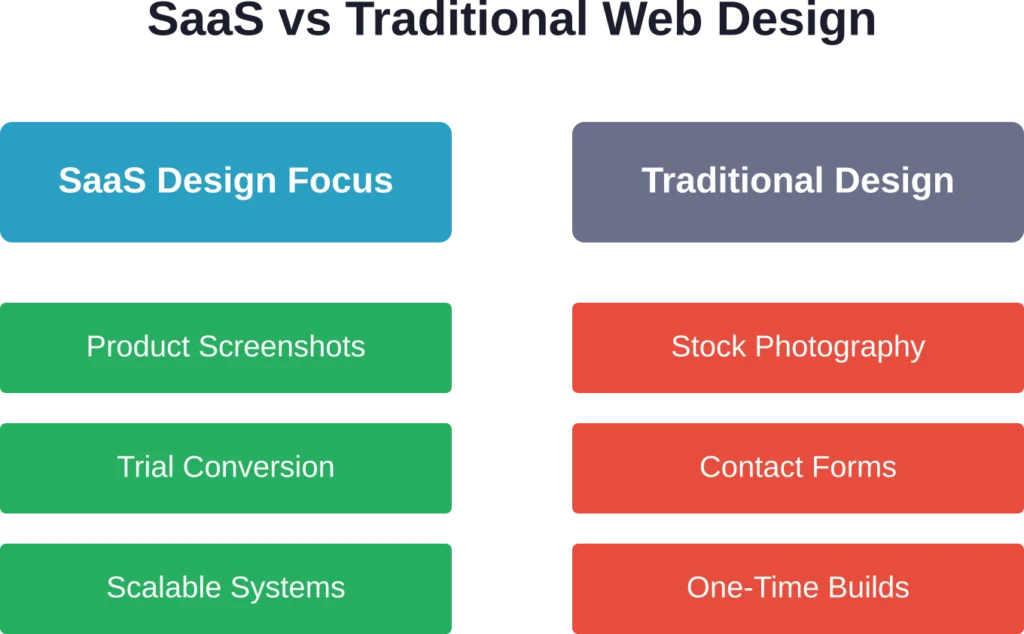
The best SaaS design agencies understand these nuances. They bring experience with subscription business models, familiarity with product-led growth frameworks, and portfolios demonstrating measurable impact on trial signups and customer retention.
The 15 Best SaaS Web Design Agencies in 2026
This ranking considers portfolio quality, client results, specialization in SaaS products, and execution speed. Each agency has published case studies with B2B SaaS companies and demonstrates expertise in conversion-focused design.

1. Gilzor
Gilzor operates as a custom digital product studio specializing in UI/UX design, web and mobile development for startups and growing SaaS companies. The agency focuses on turning product ideas into polished, user-friendly digital solutions that support both user adoption and business growth.
Their approach centers on full-cycle product development with strong emphasis on user-centric design. Gilzor combines thorough idea validation, business analysis, and UI/UX design to create intuitive interfaces that improve conversion rates and user satisfaction. They deliver complete solutions from initial research through development, testing, and go-to-market support.
Gilzor’s strength lies in building functional and attractive digital products across various industries. They excel at creating seamless web and mobile experiences that balance sophisticated functionality with clean, accessible design—particularly valuable for SaaS platforms and marketplace solutions.
Contact Information:
- Website: www.gilzor.com
- Email: [email protected]
- Address: Poland, Warsaw, Office 58, street Adama Mickiewicza 37, 01-625
- LinkedIn: www.linkedin.com/company/gilzor-softwaredevelopment
2. Mobian
Mobian operates as a European software development partner specializing in mobile-first and AI-powered solutions for SaaS companies in healthcare, fintech, logistics, and IT. The studio focuses on building dedicated engineering teams that deliver production-ready digital products with strong emphasis on user experience and scalable architecture.
Their approach centers on end-to-end product development with deep attention to UI/UX quality. Mobian combines dedicated teams with full-stack delivery to create intuitive interfaces that support complex workflows while maintaining clean, modern design. They excel at turning ambitious product requirements into polished, user-friendly applications.
Mobian’s strength lies in creating seamless digital experiences that balance sophisticated functionality with exceptional usability. They particularly shine in designing and developing mobile and web platforms where intuitive interfaces directly impact user adoption and operational efficiency.
Contact Information:
- Website: mobian.studio
- Phone: [email protected]
- Address: Harju maakond, Tallinn, Kesklinnalinnaosa, Masina tn 22, 10113
- LinkedIn: www.linkedin.com/company/mobian-studio

3. Oski
Oski positions itself as a strategic software development partner that delivers well-engineered digital solutions with strong focus on frontend and UI/UX design for ambitious startups and tech-forward enterprises. The company combines deep technical expertise with thoughtful design to create scalable SaaS and enterprise platforms.
What sets Oski apart is their ability to integrate advanced technologies with excellent user experiences. Their frontend solutions emphasize innovative design, seamless performance, and intuitive interfaces built with modern frameworks. This technical-design balance enables them to deliver digital products that are both visually compelling and highly functional.
Oski’s strength lies in developing sophisticated web solutions for complex industries including fintech, logistics, e-commerce, and healthcare. They excel at creating digital experiences that support business transformation while maintaining exceptional usability and performance standards.
Contact Information:
- Website: oski.site
- Phone: +48571282759
- Email: [email protected]
- Address: Kaupmehe tn 7, 10114 Tallinn, Estonia
- LinkedIn: www.linkedin.com/company/oski-solutions

4. Lengreo
Lengreo stands out as a full-service B2B marketing and tech partner that combines strategic digital marketing with high-converting website development for SaaS and technology companies. The agency specializes in end-to-end solutions that drive lead generation, improve conversion rates, and accelerate client acquisition.
What sets Lengreo apart is their integrated approach to marketing and web development. Rather than treating website design as a standalone deliverable, they build digital experiences that directly support lead generation and sales processes. Their team handles everything from marketing strategy and SEO to custom website development and performance optimization.
Lengreo’s strength lies in delivering measurable business results through data-driven web solutions. They excel at creating websites and landing pages that turn complex B2B offerings into clear value propositions, with particular expertise in SaaS lead generation funnels, conversion optimization, and personalized outreach integration.
Contact Information:
- Website: lengreo.com
- Phone: +31 686 147 566
- Email: [email protected]
- Address: Vrijstraat 9 C/D, 5611 AT Eindhoven, Netherlands
- LinkedIn: www.linkedin.com/company/lengreo
- Instagram: www.instagram.com/lengreo.agency
- Twitter: x.com/Lengreo

5. A-Listware
A-Listware functions as a software development and consulting partner specializing in custom solutions, UX/UI design, and dedicated development teams for enterprises, SMEs, and startups. The company delivers comprehensive digital products with strong focus on quality, security, and business-aligned interfaces.
Their approach emphasizes seamless integration between design and technical implementation. A-Listware combines UX/UI expertise with full-cycle software development to create intuitive enterprise applications, CRM systems, and custom platforms that enhance user productivity and operational efficiency.
The agency demonstrates consistent strength in building scalable and user-friendly digital solutions. They excel at modernizing legacy systems and developing new platforms where clear information architecture and thoughtful interface design are critical for complex B2B environments.
Contact Information:
- Website: a-listware.com
- Phone: +1 (888) 337 93 73
- Email: [email protected]
- Address: North Bergen, NJ 07047, USA
- LinkedIn: www.linkedin.com/company/a-listware
- Facebook: www.facebook.com/alistware

6. OneLittleWeb
OneLittleWeb positions itself as an affordable option for premium, SEO-first SaaS website design. The agency combines design expertise with technical SEO knowledge, delivering sites optimized for both conversion and organic search visibility.
Their SEO-first approach differentiates them in a field where many design agencies treat search optimization as an afterthought. OneLittleWeb builds SEO considerations into information architecture, content strategy, and technical implementation from project inception.
This approach particularly benefits early-stage SaaS companies without large advertising budgets. Organic search provides sustainable customer acquisition, but only when websites rank for relevant queries and convert that traffic effectively. OneLittleWeb designs for both requirements simultaneously.
The agency’s portfolio demonstrates work across various SaaS categories with consistent emphasis on fast-loading, mobile-optimized sites that perform well in search results. Their process includes keyword research, competitor analysis, and content strategy alongside traditional design deliverables.

7. Awesomic
Awesomic offers a subscription model providing SaaS companies with on-demand design services, vetting designers rigorously and starting projects within 24 hours. Rather than project-based engagements, clients pay monthly fees for unlimited design requests with fast turnaround times.
The subscription approach suits SaaS companies with ongoing design needs—landing pages for new features, marketing collateral, product interface improvements, and website updates. Having design capacity on retainer eliminates project scoping overhead and enables rapid response to market opportunities.
Awesomic vets designers rigorously, with talent vetting focused on top applicants. Clients work with senior designers who can start projects within 24 hours and provide unlimited daily updates. This speed and flexibility prove valuable for SaaS companies running continuous experimentation programs.
Communication happens through app, Slack, email, and calls—whichever channels fit the client’s workflow. The agency reports working with over 4,000 companies globally, demonstrating scalability and process maturity despite the flexible engagement model.

8. ParallelHQ
ParallelHQ specializes in conversion-focused SaaS website design with particular emphasis on B2B products selling to enterprise customers. The agency understands the longer sales cycles and multiple stakeholder dynamics that characterize enterprise SaaS.
Their design approach addresses the reality that enterprise buyers conduct extensive research before engaging sales teams. Websites must answer technical questions, demonstrate security and compliance capabilities, and provide social proof relevant to similar organizations—all while maintaining clarity and avoiding overwhelming detail.
ParallelHQ brings expertise in designing for multiple personas simultaneously. Enterprise SaaS purchases involve executives focused on ROI, technical evaluators assessing capabilities, and end users concerned with usability. Effective design serves all three audiences without diluting messages.
The agency’s case studies demonstrate measurable improvements in qualified lead generation and demo request rates. Their systematic approach to conversion optimization produces consistent results across different product categories and target markets.
9. WeGrowth
WeGrowth combines SaaS web design with broader growth marketing services, positioning itself as a full-funnel partner rather than a design vendor. The agency designs websites within the context of comprehensive customer acquisition strategies.
This integrated approach ensures design decisions align with marketing channel strategies, customer segmentation, and business model economics. Landing pages reflect the specific value propositions emphasized in ad campaigns. Signup flows account for the qualification level of traffic from different sources.
WeGrowth’s methodology emphasizes rapid testing and iteration. They launch initial designs quickly, then systematically improve performance through A/B testing, user research, and analytics analysis. This empirical approach produces better long-term results than attempting perfect designs upfront.
The agency suits SaaS companies treating design as one component of systematic growth programs. Companies wanting isolated design projects may find the strategic emphasis excessive, but those seeking growth partners benefit from the holistic perspective.

10. Brights
Brights focuses on growth-stage SaaS companies that have achieved initial traction and need design that supports scaling. The agency understands the unique challenges that emerge as SaaS products expand into new markets, add features, and serve larger customers.
Their design systems approach enables consistency across expanding product surfaces. As SaaS products add features, platforms, and user types, maintaining coherent experiences becomes challenging. Brights creates component libraries and design principles that guide distributed teams.
The agency brings particular expertise in redesigning legacy SaaS products. Many successful SaaS companies accumulate design debt over years of rapid development. Brights specializes in modernizing interfaces while preserving the workflows power users depend on—a delicate balance requiring deep understanding of both design and user behavior.
Their process includes extensive user research with existing customers before redesigning established products. This research-first approach minimizes the risk of alienating the user base that generated initial success while still achieving meaningful design improvements.

11. Clay
Clay stands out as a New York-based UI/UX design agency founded in 2013 that specializes in SaaS web design, digital product design, and conversion-focused landing pages for B2B companies. The agency combines strategic positioning with interface design and full-cycle development support.
What sets Clay apart is their focus on MVPs and Series A product launches. They work primarily with venture-backed SaaS startups that need to move from concept to market quickly without sacrificing design quality. The team handles everything from brand identity through product interface design and technical implementation.
Clay’s process emphasizes rapid prototyping and user testing. They validate design decisions with real users before committing to full builds, reducing the risk of expensive redesigns after launch. Their portfolio includes successful launches for B2B SaaS products across fintech, healthcare, and enterprise software categories.
The agency’s strength lies in translating complex software functionality into intuitive interfaces. They excel at information architecture for products with multiple user roles, robust permission systems, and sophisticated feature sets that need to remain accessible to non-technical users.
12. Taqwah
Taqwah operates as a specialized B2B SaaS UI/UX design and product design agency with locations in Bangladesh, the USA, and the UK. The agency focuses exclusively on SaaS startups and B2B platforms, bringing deep expertise in subscription product design patterns.
Their approach centers on product-led growth strategies. Rather than treating the website as separate from the product, Taqwah designs cohesive experiences that guide users from initial awareness through onboarding and activation. This integrated approach helps reduce the disconnect many SaaS companies face between marketing promises and product reality.
The agency offers custom project-based engagements tailored to each client’s growth stage. Early-stage startups get lean MVPs focused on core value propositions, while growth-stage companies receive comprehensive design systems that support rapid feature development without visual inconsistency.
Taqwah’s portfolio demonstrates particular strength in complex B2B workflows—CRM systems, project management tools, and enterprise dashboards. They understand how to present dense information without overwhelming users, using progressive disclosure and contextual guidance.

13. Huemor
Huemor positions itself in the premium segment with project-based engagements that deliver comprehensive brand and web experiences for established SaaS companies. The agency works with clients who’ve achieved product-market fit and need design that matches their market position.
The Huemor approach combines brand strategy, web design, and conversion optimization into cohesive projects. They don’t just redesign websites—they reposition companies through visual identity, messaging frameworks, and user experience improvements that differentiate in crowded markets.
Their client roster includes recognized SaaS brands across various categories. The agency demonstrates consistent ability to elevate brand perception through design while maintaining or improving conversion metrics. This balance between aesthetic ambition and commercial performance sets them apart from agencies that prioritize one over the other.
Project timelines typically span several months, reflecting the comprehensive nature of their engagements. Companies working with Huemor should expect significant strategic input alongside design execution—the agency challenges positioning and messaging when they believe changes will improve market performance.
14. Thunderclap
Thunderclap operates as a premium Webflow growth partner founded in 2019, headquartered in Bangalore with a team of over 50 specialists. The agency focuses on website strategy, Webflow development, conversion rate optimization, and SEO for SaaS companies.
Their specialization in Webflow as a development platform enables faster iteration cycles than traditional code-based approaches. SaaS marketing teams can update content, test new messaging, and launch landing pages without developer involvement—a significant advantage for companies running continuous experimentation programs.
Thunderclap’s methodology emphasizes data-driven design decisions. They combine qualitative user research with quantitative analytics to identify conversion bottlenecks, then design and implement solutions that address root causes rather than symptoms. This systematic approach produces measurable improvements in trial signups and demo requests.
The agency’s ongoing partnership model suits SaaS companies treating their website as a growth engine rather than a static asset. Monthly retainers include continuous optimization, A/B testing, and strategic consultation alongside design and development work.

15. Zoolatech
Zoolatech brings a product development perspective to SaaS web design, combining interface design with full-stack development capabilities. The agency works primarily with companies needing both design vision and technical implementation.
Their experience includes delivering multiple full interface redesigns over multi-year engagements. This continuity allows them to understand products deeply and design improvements that account for technical constraints, user behavior patterns, and business model evolution.
Zoolatech’s technical expertise proves valuable when SaaS companies need sophisticated integrations between marketing websites and application interfaces. They design and build seamless experiences where users move from marketing content into product trials without jarring transitions or redundant data entry.
The agency’s approach suits SaaS companies at various stages but proves particularly valuable for products with complex technical requirements—API-first platforms, developer tools, and infrastructure software where design must communicate technical sophistication to knowledgeable audiences.
How to Choose the Right SaaS Design Agency
Selecting a design partner requires aligning agency strengths with current business needs. A pre-seed startup building an MVP has different requirements than a Series B company redesigning an established product.
Start by assessing current stage and primary design challenge. Early-stage companies need speed and cost efficiency—getting viable designs to market quickly matters more than perfection. Growth-stage companies need scalable systems that support rapid feature development without accumulating design debt.
Portfolio Evaluation
Look beyond visual polish to examine strategic thinking and business results. The best portfolios explain the problems clients faced, the design approach taken, and the measurable outcomes achieved. Pretty screenshots without context reveal little about an agency’s ability to solve business problems.
Pay particular attention to case studies featuring SaaS products similar in complexity and business model. An agency that excels at simple productivity tools may struggle with complex enterprise platforms. Design patterns that work for horizontal SaaS products often fail for vertical-specific solutions.
Examine information architecture and user flow design, not just visual aesthetics. SaaS success depends on users understanding capabilities and completing key workflows. Surface-level visual redesigns that don’t improve information architecture rarely move business metrics.
Process and Communication
Understand how agencies work before committing. Some operate as pure service providers executing client specifications. Others position as strategic partners who challenge assumptions and drive design decisions. Neither approach is inherently better—they suit different client preferences and organizational dynamics.
Clarify expectations around involvement and feedback cycles. Design requires iteration, but excessive revision rounds indicate unclear requirements or misaligned expectations. The best agency relationships establish clear decision-making frameworks upfront.
Communication patterns matter significantly in distributed work environments. Agencies accustomed to asynchronous communication through tools like Slack and Figma work smoothly with remote teams. Those expecting frequent video calls may create friction for teams across many time zones.
Technical Capabilities
Determine whether design handoff or implementation is included. Some agencies deliver design files for internal development teams to implement. Others handle front-end development, ensuring designs render correctly across devices and browsers.
For agencies offering implementation, assess their technical stack. Webflow-based agencies enable fast iteration but may create challenges migrating to custom platforms later. Agencies coding in modern frameworks provide more flexibility but require longer development timelines.
Consider integration requirements between marketing websites and product interfaces. Seamless experiences require technical coordination. Agencies experienced with APIs, authentication systems, and data synchronization prevent common pitfalls that create disjointed user experiences.
| Evaluation Criteria | Early-Stage Priority | Growth-Stage Priority |
|---|---|---|
| Timeline | Speed to market (weeks) | Strategic thoroughness (months) |
| Deliverables | MVP interface + landing page | Design system + documentation |
| Research Depth | Lean validation | Comprehensive user studies |
| Investment Level | Minimize upfront cost | Optimize for long-term ROI |
| Agency Structure | Small team, direct access | Specialized roles, processes |
Key Design Elements That Drive SaaS Conversions
Certain design patterns consistently improve conversion metrics across different SaaS products and target markets. The best agencies understand these patterns and adapt them to specific contexts rather than applying generic templates.
Product Screenshots Over Abstract Imagery
Concrete product screenshots outperform abstract illustrations and stock photography. Users want to see actual interfaces before committing to trials. Screenshots answer implicit questions about feature completeness, interface complexity, and aesthetic alignment.
Effective screenshots highlight specific capabilities relevant to target user pain points. Generic dashboard views provide little value. Focused captures demonstrating how the product solves specific problems drive stronger engagement and conversion.
Annotated screenshots perform even better, combining visual evidence with explanatory text that guides attention to key elements. This approach helps users understand sophisticated features without requiring video tutorials or lengthy text descriptions.
Value-First Information Architecture
SaaS websites should lead with outcomes and value propositions, not feature lists or company history. Users arrive with problems seeking solutions. Sites that immediately address those problems outperform those requiring navigation to find relevant information.
Structure content around user workflows rather than product architecture. Internal product organizations often structure sites by modules or features. But users think in terms of jobs they need to accomplish. Reorganizing content around these jobs improves comprehension and conversion.
Progressive disclosure prevents overwhelming visitors with comprehensive information upfront. Present core value propositions and primary capabilities first. Provide paths to detailed technical documentation, security compliance information, and pricing details for users who need them without cluttering primary conversion paths.
Friction-Optimized Signup Flows
Signup form optimization balances two competing priorities: reducing friction to maximize conversion rates and gathering qualification information to improve sales efficiency. The optimal balance varies by business model and customer acquisition economics.
High-velocity, low-price SaaS products benefit from minimal friction—email and password only. Qualification happens through product usage behavior rather than form fields. This approach maximizes trial signups at the cost of lower-quality leads.
Enterprise-focused, sales-assisted products justify more comprehensive signup forms. Gathering company size, use case details, and contact information upfront enables appropriate trial configurations and timely sales follow-up. The conversion rate drops but lead quality increases significantly.
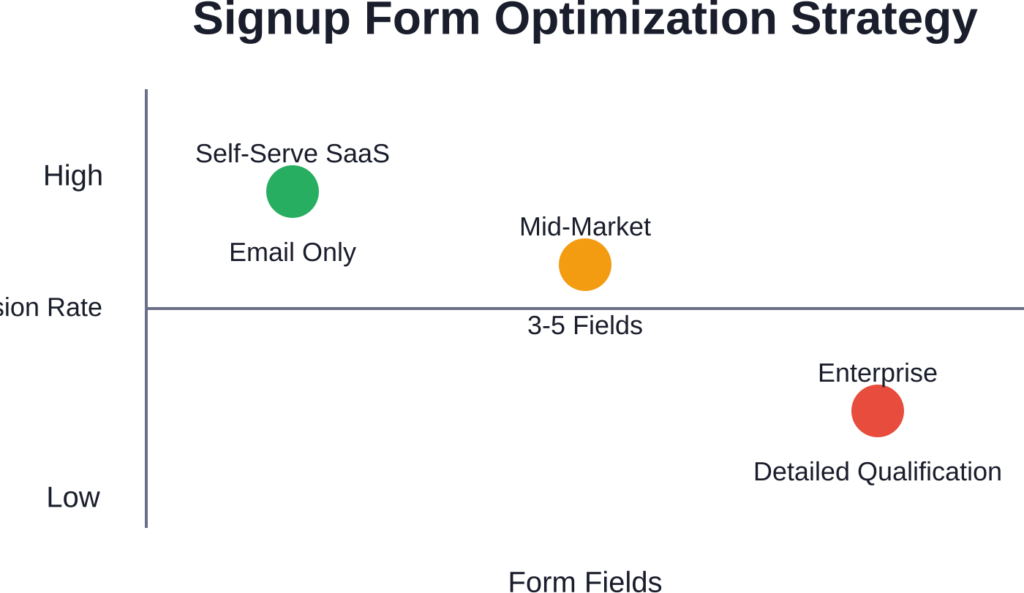
Optimal signup form complexity varies by target market and sales model
Social Proof and Trust Signals
Strategic placement of customer logos, testimonials, and case study previews increases conversion rates by reducing perceived risk. But generic social proof provides little value. Effective trust building requires specificity and relevance.
Customer logos work best when recognizable to the target audience. Showing Fortune 500 brands to small business buyers can backfire, suggesting the product isn’t designed for their segment. Show customers similar to target prospects.
Quantified testimonials outperform generic praise. “Increased productivity” means little. “Reduced report generation time from 4 hours to 15 minutes” provides concrete evidence of value. The best agencies train clients to gather specific, measurable testimonials.
Common Mistakes When Hiring SaaS Design Agencies
Several patterns reliably predict unsuccessful agency engagements. Avoiding these mistakes increases the probability of productive partnerships and successful outcomes.
Prioritizing Cost Over Value
Selecting agencies primarily on cost rather than capability produces predictable results: mediocre design that fails to move business metrics. The difference in outcomes between skilled and unskilled design far exceeds the difference in fees.
Consider that a well-designed SaaS website can increase conversion rates by 200% or more. An agency costing twice as much that delivers this improvement produces exponentially better return on investment than a cheaper option that delivers marginal improvements.
That said, expensive doesn’t guarantee quality. Some agencies command premium fees based on brand reputation rather than superior results. Evaluate based on demonstrated capability with similar products and target markets, not fee level alone.
Insufficient Context Sharing
Agencies produce better work when they understand business context deeply: target market dynamics, competitive positioning, unit economics, and growth constraints. Many clients provide minimal briefings then expect agencies to intuit critical context.
Share analytics data, user research findings, support ticket trends, and sales feedback. This information reveals where current designs fail and what improvements would generate the most value. Agencies working without this context resort to generic best practices rather than targeted solutions.
Include agencies in customer conversations when possible. Hearing users describe frustrations and needs directly produces better insights than secondhand summaries. The best agencies request customer access as part of their process.
Treating Design as a One-Time Project
SaaS companies evolve continuously. Products add features, positioning shifts as markets mature, and competitors force differentiation. Treating website design as a one-time project rather than ongoing capability creates drift between design and reality.
Consider engagement models that support continuous improvement rather than periodic redesigns. Some agencies offer retainer arrangements for ongoing optimization, A/B testing, and incremental improvements. This approach produces better long-term results than infrequent complete overhauls.
Alternatively, invest in internal design capability while using agencies for specialized expertise. This hybrid approach enables continuous minor improvements while accessing external perspective and specialized skills for major initiatives.
Emerging Trends in SaaS Web Design
Several design trends are reshaping how successful SaaS companies present themselves online. The best agencies stay current with these evolutions and help clients adopt relevant approaches.
Product-Led Design
The boundaries between marketing websites and product interfaces continue blurring. Product-led growth strategies emphasize getting users into actual product experiences as quickly as possible rather than describing capabilities through marketing content.
This shift manifests in interactive demos, embedded product experiences, and reduced separation between marketing and application environments. Users can explore actual functionality before creating accounts, reducing the commitment required for initial evaluation.
Implementing this approach requires tight coordination between marketing and product teams. Design systems must span both environments. Authentication needs to accommodate anonymous exploration followed by seamless conversion to authenticated usage. Few agencies have experience with these requirements yet.
Authentic Visual Content
SaaS companies are moving away from illustration-heavy designs toward authentic product imagery and real customer content. This trend reflects user preferences for concrete evidence over abstract representation.
Video content plays an expanding role, particularly short-form product demonstrations and customer testimonial clips. But authenticity matters more than production quality. Overly polished marketing videos feel disconnected from actual product experiences.
User-generated content from customer communities provides particularly compelling trust signals. Screenshots, configuration examples, and use case descriptions from real users outperform company-created marketing materials for many audiences.
Personalization and Dynamic Content
Sophisticated SaaS websites increasingly deliver personalized experiences based on industry, company size, use case, or traffic source. Rather than showing identical content to all visitors, dynamic pages emphasize relevant features and use cases.
Implementation typically relies on URL parameters from advertising campaigns, reverse IP lookup for company identification, or progressive profiling through interactive elements. The technical requirements exceed capabilities of basic content management systems.
Effectiveness depends on quality of personalization logic. Superficial personalization—simply inserting industry names into generic copy—provides little value. Meaningful personalization requires distinct content addressing specific segment needs and pain points.
Frequently Asked Questions
SaaS website design investments vary widely based on project scope, agency positioning, and complexity requirements. Based on industry data, projects can range significantly in cost. Early-stage companies working with specialized agencies might invest in the lower ranges for MVP designs, while established companies undertaking comprehensive redesigns work at higher investment levels. Subscription-based agency models offer alternative pricing structures with monthly fees rather than project-based billing.
Project timelines depend on scope and approach. Lean MVP designs for early-stage startups can complete in 4-6 weeks when working with agencies experienced in rapid delivery. Comprehensive redesigns including research, strategy, design system development, and implementation typically require 3-4 months. Ongoing optimization relationships operate continuously rather than on project timelines. Agencies using Webflow or similar platforms generally deliver faster than those custom-coding implementations.
This decision depends on design maturity, volume of needs, and available budget. Early-stage companies benefit from agency expertise and speed, avoiding the overhead of full-time employees before design needs justify dedicated resources. Growth-stage companies often adopt hybrid approaches—internal designers handle continuous product work while agencies provide specialized expertise for major initiatives. Enterprise SaaS companies typically build comprehensive internal design organizations, using agencies only for exceptional projects requiring outside perspective or specialized capabilities.
SaaS-specialized agencies understand subscription business models, product-led growth strategies, and the unique conversion challenges software companies face. They design with trial-to-paid conversion, user onboarding, and feature adoption in mind—metrics that matter little to traditional businesses. Technical requirements differ too: SaaS sites need integration with product analytics, dynamic content based on user segments, and design systems that accommodate rapid feature development. General agencies can produce visually appealing sites, but they often miss the strategic and technical nuances that drive SaaS business results.
Success metrics should align with business objectives and user journey stages. Primary metrics include trial signup conversion rate, demo request volume, and qualified lead generation. Secondary metrics examine user engagement: time on site, pages per session, and interaction with key content. Technical performance matters too—page load speed, mobile usability, and search rankings. The best measurement approaches establish baseline metrics before redesign, then track changes over sufficient time periods to account for normal variance. A/B testing during rollout provides cleaner attribution than simple before-after comparisons.
Website builders like Wix, Webflow, and Squarespace enable SaaS companies to create functional sites without agencies. This approach suits very early-stage companies with minimal budgets and simple requirements. However, limitations emerge as needs become sophisticated: custom integrations with product environments, personalized content delivery, complex conversion funnels, and scalable design systems exceed most builder capabilities. Many successful SaaS companies start with builders then migrate to custom solutions as growth justifies the investment. Some agencies specialize in builder platforms, particularly Webflow, offering professional expertise within those constraints.
Effective design briefs provide context agencies need to deliver relevant solutions. Include business background: target market segments, competitive positioning, and unique value propositions. Describe the product: core capabilities, key workflows, and user types. Define objectives: specific metrics the redesign should improve and how success will be measured. Share existing data: analytics showing current performance, user research findings, and customer feedback. Specify constraints: technical requirements, brand guidelines, and timeline expectations. The best briefs also acknowledge what the company doesn’t know—areas where agency expertise should guide decisions rather than executing predetermined solutions.
Making the Final Decision
Choosing among qualified agencies ultimately depends on alignment between agency strengths and current business priorities. The best agency for one SaaS company may poorly suit another, even within the same product category.
Start by clarifying primary objectives. Is speed most critical, or strategic thoroughness? Does the current challenge center on conversion optimization, brand positioning, or technical implementation? Different agencies excel at different aspects.
Conduct focused conversations with shortlisted agencies. Present the actual business challenge and evaluate how they approach it. Strong agencies ask probing questions about context, challenge assumptions, and outline strategic approaches before discussing visual aesthetics. Agencies that jump immediately to discussing visual styles probably lack strategic depth.
Request relevant case studies and speak with references at similar companies. Generic portfolios reveal less than specific examples of agencies solving problems similar to current challenges. References provide candid perspectives on working relationships, communication patterns, and results achieved.
Consider chemistry and communication compatibility alongside capability. Effective design requires collaboration, iteration, and mutual challenge. An agency with perfect credentials but poor communication fit will produce worse outcomes than a slightly less experienced agency with strong working relationships.
Sound decision-making balances multiple factors rather than optimizing for any single criterion. The goal isn’t finding the “best” agency in abstract terms—it’s identifying the optimal partner for current needs, constraints, and organizational dynamics.
Conclusion
The SaaS web design landscape in 2026 offers sophisticated specialized agencies that understand subscription business models and product-led growth strategies. The agencies featured in this list bring proven expertise in conversion-focused design, scalable design systems, and the technical requirements unique to software products.
Selecting the right partner requires honest assessment of current stage, primary challenges, and organizational needs. Early-stage companies prioritize speed and cost efficiency. Growth-stage companies need scalable systems that support rapid evolution. Enterprise organizations require agencies capable of managing complexity and stakeholder coordination.
The best outcomes result from clear communication, appropriate context sharing, and collaborative relationships. Treating agencies as strategic partners rather than execution vendors produces better results. Share business challenges openly, provide access to data and customers, and engage with agency recommendations even when they challenge initial assumptions.
Remember that website design for SaaS companies is not a one-time project but an ongoing capability. Markets evolve, products develop new features, and competitive landscapes shift. Building relationships with design partners who can support continuous improvement produces better long-term results than periodic complete overhauls.
The agencies listed here represent various approaches, specializations, and engagement models. Evaluate based on demonstrated capability with similar products and target markets. Prioritize strategic thinking and business results over pure visual aesthetics. And choose partners who challenge thinking while respecting organizational context and constraints.
Ready to transform how the market perceives and interacts with your SaaS product? Start conversations with agencies whose specializations align with your current priorities. The right design partner doesn’t just improve websites—they accelerate growth and strengthen competitive positioning in increasingly crowded markets.