

Quick Summary: Agile web development companies specialize in iterative, flexible project delivery using Agile methodologies like Scrum and Kanban. This list features 15 top agencies recognized for rapid prototyping, continuous delivery, client collaboration, and adaptive planning. These firms excel at building scalable web solutions through sprint-based development cycles while maintaining transparency and responsiveness throughout the project lifecycle.
Selecting the right development partner can make or break a web project. Traditional waterfall approaches lock teams into rigid timelines and inflexible requirements. But agile methodologies flip that script entirely.
Agile development brings people to the fore and places them over any process. It provides shorter, more flexible cycles that adapt to changing requirements and user feedback. The approach was born out of disdain for prescriptive methods that often lead to high levels of risk and a lack of productive collaboration.
Real talk: 88% of users are less likely to return to a website after a bad experience. That statistic alone explains why agile’s iterative testing and continuous improvement matter so much. Teams can identify issues early and pivot before investing months into the wrong solution.
What Makes an Agile Web Development Company Stand Out
Not every agency that claims to be “agile” actually practices the methodology properly. Authentic agile companies share specific characteristics that separate them from traditional development firms.
True agile practitioners prioritize working software over comprehensive documentation. They embrace changing requirements even late in development. Sprint-based workflows allow for rapid iteration, typically in one to four-week cycles.
Daily stand-ups, retrospectives, and continuous integration form the backbone of genuine agile practice. Cross-functional teams collaborate directly with stakeholders rather than working in isolated silos. Transparency becomes non-negotiable—clients see progress in real-time through demo sessions and burndown charts.
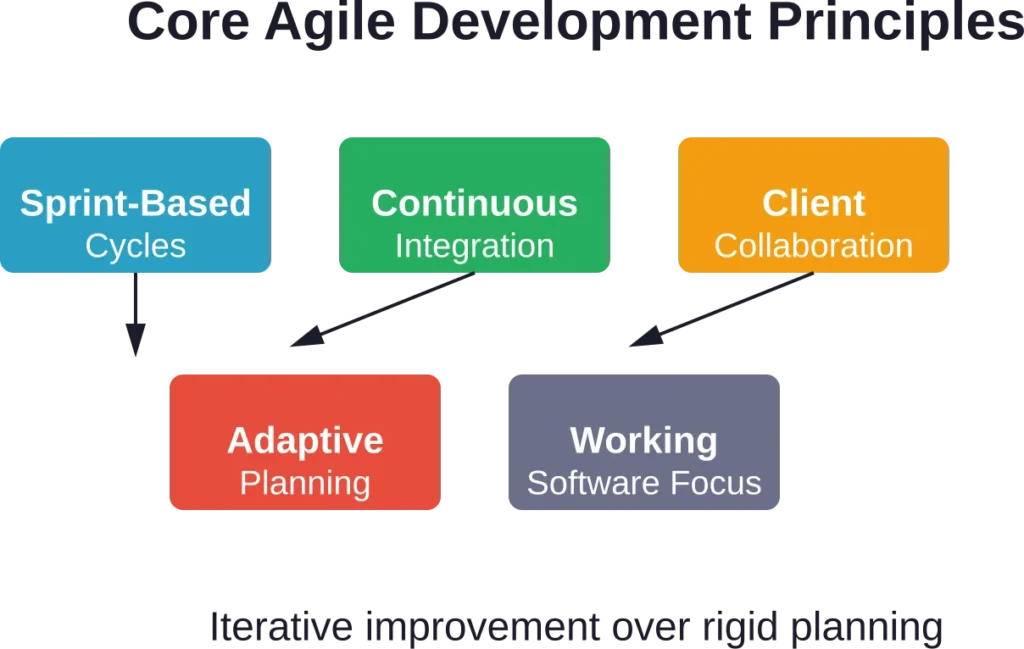
According to MIT Sloan Management Review, traditional AI adoption has reached 72% over the past eight years, while generative AI achieved 70% adoption in just three years. This rapid technology shift demands the kind of flexibility only agile methodologies can provide.
Top 15 Agile Web Development Companies in 2026
These agencies have demonstrated consistent expertise in agile methodologies, delivering scalable solutions through iterative development cycles.
1. Lengreo
Lengreo acts as a complete marketing and tech partner, delivering custom website development alongside B2B digital strategies. The company builds eCommerce, business, and portfolio websites plus landing pages that drive real business growth.
Their approach combines discovery workshops, business analysis, prototyping, and iterative development with ongoing quality assurance and support. Cross-functional teams focus on agile delivery to optimize conversion, user experience, and measurable marketing results for clients worldwide.
Contact Information:
- Website: Lengreo.com
- Phone: +31 686 147 566
- Email: [email protected]
- Address: Vrijstraat 9 C/D, 5611 AT Eindhoven, Netherlands
- LinkedIn: Lengreo
- Twitter: @Lengreo
- Instagram: @lengreo
2. Gilzor

Gilzor specializes in full-cycle custom web and mobile development using agile practices to turn ideas into production-ready digital products. The company delivers scalable web applications from initial validation through design, development, testing, and post-launch maintenance.
Teams emphasize iterative refinement based on user feedback, business analysis, and continuous improvement. This structured yet flexible workflow helps startups and growing businesses achieve product-market fit and sustainable scaling through rapid, high-quality delivery.
Contact Information:
- Website: www.gilzor.com
- Email: [email protected]
- Address: Poland, Warsaw, Office 58, street Adama Mickiewicza 37, 01-625
- LinkedIn: www.linkedin.com/company/gilzor-softwaredevelopment
3. Oski
Oski builds smart, well-engineered web solutions for enterprises and ambitious startups using modern frontend frameworks and agile methodologies. The company excels at cloud-enabled web applications, CMS platforms, and AI-integrated digital experiences that enhance business operations.
Their process prioritizes rapid team ramp-up, iterative development cycles, and seamless deployment. Cross-functional squads focus on clean architecture, user-centric design, and continuous optimization to deliver scalable, high-performance websites and portals.
Contact Information:
- Website: oski.site
- Phone: +48571282759
- Email: [email protected]
- Address: Kaupmehe tn 7, 10114 Tallinn, Estonia
- LinkedIn: www.linkedin.com/company/oski-solutions
4. A-listware
A-listware provides dedicated software development teams and custom web solutions through agile outsourcing and team augmentation. The company delivers enterprise web applications, cloud solutions, and digital platforms with strong emphasis on quality, scalability, and seamless integration.
Teams operate with clear collaboration, iterative delivery, and full-cycle management — from UX/UI design and development to testing and ongoing support. This approach ensures responsive, secure web solutions that align closely with client business goals and technical requirements.
Contact Information:
- Website: a-listware.com
- Phone: +1 (888) 337 93 73
- Email: [email protected]
- Address: North Bergen, NJ 07047, USA
- LinkedIn: www.linkedin.com/company/a-listware
- Facebook: www.facebook.com/alistware
5. Mobian
Mobian builds dedicated engineering teams for end-to-end web and mobile product development with a strong agile focus. The company specializes in scalable digital solutions for IT, Fintech, Healthcare, and Logistics, covering everything from architecture to production deployment.
Their workflow includes dedicated squads, iterative full-stack delivery, legacy integration, and post-launch partnership. Emphasis on clean architecture, documented processes, and continuous feedback enables fast, reliable shipping of production-ready web and digital products.
Contact Information:
- Website: mobian.studio
- Phone: [email protected]
- Address: Harju maakond, Tallinn, Kesklinnalinnaosa, Masina tn 22, 10113
- LinkedIn: www.linkedin.com/company/mobian-studio
6. N-iX

N-iX brings enterprise-scale agile capabilities to complex web development projects. The company maintains certified Scrum Masters and Agile Coaches across distributed teams.
Their methodology combines Scrum, Kanban, and SAFe frameworks depending on project requirements. N-iX emphasizes technical excellence through pair programming, continuous integration, and test-driven development. Sprint planning sessions involve both technical and business stakeholders to ensure alignment.
7. Duck Design
Duck Design applies lean startup principles to agile web development. The agency helps companies validate ideas quickly through minimum viable products and iterative enhancement.
Sprint cycles focus on building the smallest deployable feature set that delivers value. Teams conduct user interviews and usability testing between sprints to inform the next iteration. This approach minimizes waste and accelerates time-to-market.
8. Instrument

Instrument combines brand strategy with agile development for digital experiences. The agency’s process integrates design sprints with engineering sprints to maintain creative quality while shipping fast.
Cross-disciplinary teams include designers, developers, and strategists working in parallel rather than sequential handoffs. Daily standups ensure all disciplines stay synchronized. Continuous deployment allows for releasing improvements multiple times per sprint.
9. Basic Agency (DEPT)
Basic Agency, now part of DEPT, specializes in agile development for consumer brands and direct-to-consumer businesses. The team uses two-week sprints with weekly client check-ins.
Their agile practice emphasizes working prototypes over static mockups. Developers join discovery workshops from day one to identify technical constraints early. This prevents the common disconnect between design ambition and engineering reality.
10. Clay
Clay brings UI/UX design expertise into agile development workflows. The agency’s process involves rapid design iterations validated through user testing before development begins.
Sprint zero focuses on design system creation and component libraries. Subsequent sprints build features incrementally using established patterns. This approach maintains design consistency while enabling fast development cycles.
11. Prismetric
With 14+ years of industry experience, Prismetric builds highly scalable websites and portals using agile frameworks. The company maintains in-house expertise across Python, PHP, Laravel, ReactJS, and Angular.
Prismetric excels at crafting 360-degree end-to-end solutions through sprint-based delivery. The team provides customized website development for clients worldwide, emphasizing eCommerce, enterprise portals, and SaaS platforms. Cross-functional squads handle everything from discovery workshops to post-launch support.
12. Excited Agency
This product-first agency approaches web design through a lens of clarity, structure, and conversion rather than surface aesthetics. Excited combines UX research, web design, branding, and motion design into cohesive agile workflows.
The agency creates websites that scale with the product and support long-term growth. Sprint cycles focus on user needs validated through testing rather than assumptions. Excited’s process emphasizes rapid prototyping followed by iterative refinement based on real user behavior data.
13. Code and Theory
Code and Theory operates at the intersection of design, technology, and business strategy. The agency leverages agile methodologies to deliver digital products for enterprise clients across multiple industries.
Teams work in two-week sprints with continuous stakeholder engagement. The company’s agile practice includes dedicated product owners, scrum masters, and cross-functional development pods. This structure enables rapid delivery without sacrificing quality or strategic alignment.
14. Riseup Labs
Riseup Labs specializes in custom software development using agile and DevOps practices. The company blends technical expertise with business domain knowledge to deliver solutions that meet client requirements and budget expectations.
Their agile approach centers on continuous delivery pipelines and automated testing. Sprint retrospectives drive constant process improvement. Teams maintain close collaboration with stakeholders through daily communication channels and bi-weekly sprint reviews.
15. Parallel

Parallel focuses on strategic product and AI design for early-stage startups. The agency specializes in helping founders define and build their core product through agile discovery and development sprints.
The team prioritizes intuitive navigation, clear feedback mechanisms, and accessibility from the start. Parallel’s agile workflow includes rapid wireframing, user testing, and iterative development cycles that adapt to changing market conditions and user feedback.
Why Agile Methodologies Matter for Web Development
Traditional waterfall development follows a linear path: requirements, design, development, testing, deployment. Each phase must complete before the next begins. This approach worked fine when requirements stayed stable and technology changed slowly.
But that world doesn’t exist anymore. According to research from MIT Sloan, generative AI achieved 70% adoption in just three years. Organizations are rapidly adopting agentic AI, with 76% of respondents viewing it as more like a coworker than a tool. Technology landscapes shift faster than waterfall projects can adapt.
Agile solves this through iterative cycles. Teams build small increments, test with real users, gather feedback, and adjust direction. Requirements evolve as teams learn what actually works versus what seemed like a good idea in a planning document.
Here’s the thing though—agile isn’t just about speed. It’s about reducing risk. Waterfall projects often fail spectacularly because issues hide until late-stage testing. Agile surfaces problems early when they’re cheaper to fix.
The Financial Case for Agile
Cost predictability improves under agile frameworks despite their reputation for flexibility. Fixed-scope waterfall projects frequently run over budget when late-stage discoveries force rework.
Agile’s iterative nature allows teams to adjust scope based on budget realities. If funding runs tight, stakeholders can pause after any sprint with a working product rather than being stuck mid-phase with nothing deployable.
Time-to-market advantages compound over project lifecycles. Agile teams ship features incrementally rather than waiting for a big-bang launch. Users get value faster, and feedback informs subsequent development priorities.
How to Choose the Right Agile Development Partner
Not all agile companies deliver the same experience. Some have embraced the methodology deeply, while others slap “agile” on traditional practices with minimal change.
Ask potential partners about their sprint cadence. Genuine agile shops work in consistent cycles—typically one, two, or four weeks. Be wary of companies that claim “flexible” sprint lengths that shift based on client pressure.
Request examples of sprint retrospectives and how they’ve improved processes. Retrospectives drive continuous improvement. Agencies that skip them or treat them as checkbox exercises miss the point entirely.
| Selection Criteria | What to Look For | Red Flags |
|---|---|---|
| Sprint Structure | Fixed sprint length, consistent ceremonies, defined roles | “Agile-ish” workflows, skipped retrospectives, no daily standups |
| Client Involvement | Sprint reviews, direct access to team, product owner collaboration | Quarterly check-ins only, no demo sessions, communication through account managers only |
| Technical Practices | Continuous integration, automated testing, code reviews | Manual deployments, testing only at end, siloed developers |
| Transparency | Real-time project tracking, burndown charts, open backlog | Status reports instead of live data, hidden velocity metrics |
| Adaptability | Welcome changing requirements, pivot based on data | Change requests require formal approval, resistance to mid-sprint feedback |
Inquire about technical practices beyond process ceremonies. Continuous integration, automated testing, and code reviews aren’t optional—they’re fundamental to sustainable agile development.
Client involvement levels tell you everything. Agile requires active stakeholder participation. If an agency promises to “handle everything” without regular input, they’re not practicing genuine agile collaboration.
Industry-Specific Considerations
Different sectors demand different agile adaptations. eCommerce projects benefit from rapid A/B testing and feature flagging that allow testing in production. Enterprise software requires more extensive documentation and compliance checkpoints within sprints.
Startups need agencies comfortable with pivoting based on market feedback. The ability to throw away work that isn’t gaining traction matters more than perfect execution of a questionable plan.
Regulated industries like healthcare and finance need agile teams experienced with compliance requirements. Sprints must accommodate security reviews and audit trails without grinding to a halt.
Common Agile Pitfalls and How Top Companies Avoid Them
Even experienced agile teams fall into predictable traps. Recognizing these patterns helps distinguish truly skilled practitioners from those going through motions.
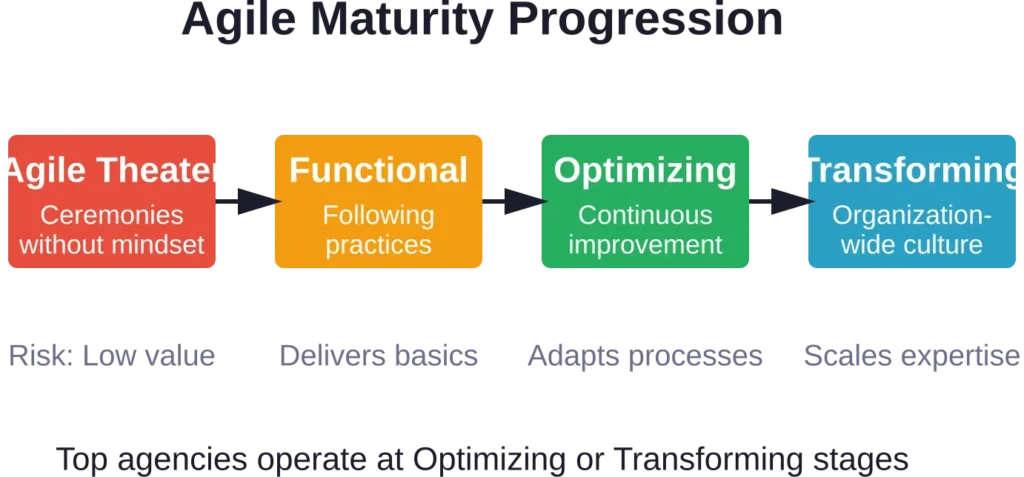
“Agile theater” describes teams that perform agile ceremonies without embracing agile principles. They hold standups but don’t address blockers. They run retrospectives but never implement improvements. The rituals become overhead rather than value-adding practices.
Top companies combat this by empowering teams to modify processes. If a ceremony isn’t adding value, they experiment with alternatives rather than mindlessly continuing.
Scope Creep in Agile Projects
Agile’s flexibility can enable endless scope expansion if not managed properly. “Just one more sprint” becomes a pattern that delays launch indefinitely.
Successful agencies set sprint budgets or timeline caps upfront. They work within those constraints by prioritizing ruthlessly. Features get ranked by value and effort, then built in sequence until time or budget runs out.
Product owners play a critical role here. They must say no to low-value features even when stakeholders push. Top agile companies train their product owners to make these tough calls based on data rather than politics.
Distributed Team Challenges
Remote and distributed teams face unique agile challenges. Time zones complicate daily standups. Digital collaboration lacks the bandwidth of in-person communication.
Leading agencies address this through asynchronous documentation and overlapping working hours for key ceremonies. They invest in collaboration tools that maintain visibility and transparency across locations.
Video-first communication becomes non-negotiable. Text-only updates hide context and nuance that agile collaboration requires. Cameras stay on during sprint ceremonies to maintain human connection.
Agile vs. Other Development Methodologies
Understanding how agile compares to alternatives helps clarify when it’s the right choice—and when it isn’t.
Waterfall works well for projects with fixed requirements and regulatory constraints. Building a system to comply with specific government standards might benefit from waterfall’s documentation-heavy approach. But web development rarely fits this profile.
Kanban offers continuous flow without fixed sprints. Work moves through stages as capacity allows. This works for maintenance and support teams handling unpredictable incoming requests. Development teams building new features typically need Scrum’s sprint structure for planning and commitment.
When Agile Isn’t the Answer
Platform markets present unique challenges for agile. These complex ecosystems require coordination across multiple stakeholders with competing interests. Quick independent decisions at the front lines can create systemic problems.
Similarly, projects with hard external deadlines and zero flexibility might struggle with agile’s emergent planning. If missing a launch date means regulatory penalties or contractual damages, waterfall’s predictability might outweigh agile’s adaptability benefits.
Hardware-software integration projects face constraints from hardware development cycles that don’t align with agile’s rapid iteration. Waiting six weeks for custom circuit boards doesn’t mesh with two-week sprints.
Emerging Trends in Agile Web Development
Agile methodologies continue evolving to address new challenges and opportunities. Several trends are reshaping how top companies practice agile in 2026.
AI-assisted development tools are accelerating sprint velocity. Code generation, automated testing, and intelligent debugging reduce time spent on routine tasks. This allows developers to focus on complex problem-solving and architecture decisions.
According to MIT Sloan Management Review research, 76% of respondents view agentic AI as more like a coworker than a tool, indicating significant organizational interest. These autonomous agents will participate in development workflows, handling tasks like code reviews, documentation generation, and performance optimization.
But this raises questions about how agile ceremonies adapt. Do AI agents join daily standups? Who’s accountable when an agent introduces a bug? Leading companies are experimenting with hybrid workflows that maintain human oversight while leveraging AI capabilities.
Scaling Agile Beyond Single Teams
Enterprise organizations need coordination across multiple agile teams. Frameworks like SAFe (Scaled Agile Framework) and LeSS (Large Scale Scrum) provide structures for this complexity.
These approaches introduce program increments, architectural runways, and synchronized planning events. The goal is maintaining agile benefits while ensuring teams don’t build incompatible components.
Top agencies skilled in scaled agile can work within enterprise structures without imposing their preferred framework. They adapt to client methodologies while introducing improvements where appropriate.
Measuring Success in Agile Projects
Traditional metrics like on-time and on-budget delivery don’t fully capture agile project success. The methodology explicitly embraces changing requirements, so finishing exactly what was originally planned might actually indicate failure to adapt.
Velocity tracks how much work teams complete per sprint. But velocity alone doesn’t indicate quality or value delivered. High velocity producing unusable features is worse than low velocity building exactly what users need.
Cycle time measures how long features take from idea to production. Reducing cycle time accelerates learning and feedback loops. Top agencies track cycle time trends to identify bottlenecks in their delivery pipeline.
| Metric | What It Measures | Why It Matters |
|---|---|---|
| Sprint Velocity | Story points completed per sprint | Indicates team capacity and helps predict completion timelines |
| Cycle Time | Days from work start to deployment | Shorter cycles mean faster feedback and learning |
| Defect Escape Rate | Bugs found in production vs. testing | Measures quality of development and testing practices |
| Customer Satisfaction | User feedback and NPS scores | Ultimate measure of whether product meets needs |
| Technical Debt | Accumulated shortcuts and compromises | Predicts future velocity decline if not addressed |
Customer satisfaction metrics matter most. Net Promoter Score, user retention, and engagement analytics reveal whether all that agile iteration actually produced something valuable. Measuring satisfaction after each major release provides rapid feedback on product-market fit.
Technical debt tracking prevents long-term velocity decline. Agile’s speed can tempt teams to cut corners. Disciplined agencies allocate sprint capacity to refactoring and paying down debt before it becomes crippling.
Questions to Ask During Agency Selection
The right questions separate genuine agile practitioners from those using agile as marketing buzzwords. Here’s what to ask potential partners.
“Walk me through a typical sprint from planning to retrospective.” Listen for specific details about ceremonies, roles, and artifacts. Vague answers indicate shallow agile understanding.
“Tell me about a time you had to pivot mid-project based on new information.” Real agile teams have concrete examples of adapting to change. If they struggle to provide one, they’re probably not embracing agile’s core value of responding to change.
“How do you handle technical debt within sprints?” Teams that never allocate sprint capacity to refactoring will accumulate debt until velocity collapses. Good agencies build debt reduction into regular sprint planning.
“What’s your approach when clients want to change requirements mid-sprint?” There’s no single right answer, but the response reveals their philosophy. Some teams have hard sprint boundaries and defer changes to the next cycle. Others maintain flexibility for truly urgent pivots.
“How do you measure project success beyond on-time and on-budget?” Listen for discussion of user outcomes, business value, and qualitative factors rather than just schedule adherence.
Frequently Asked Questions
Agile is an umbrella philosophy encompassing multiple methodologies. Scrum is a specific framework within Agile featuring sprints, daily standups, sprint reviews, and retrospectives. Other Agile frameworks include Kanban, XP (Extreme Programming), and Lean. Most web development companies use Scrum because its structure works well for feature development projects with evolving requirements.
Agile projects don’t have fixed timelines in the traditional sense. Teams work in sprints (typically two weeks) and deliver incremental value each sprint. A minimum viable product might launch after 3-5 sprints (6-10 weeks), with continued enhancement over subsequent sprints. The key difference is that agile produces working software throughout the project rather than only at the end.
Not necessarily. Agile’s iterative nature can actually reduce total cost by catching issues early when they’re cheaper to fix. Waterfall projects often experience expensive late-stage rework when problems surface during final testing. Agile also allows stopping development once sufficient value is delivered, avoiding gold-plating features that users don’t need. However, agile requires ongoing client involvement which has a time cost.
Yes, but they require different structuring than traditional fixed-price contracts. Instead of fixing scope, time, and budget, agile fixed-price contracts typically fix time and budget while allowing scope to flex based on priorities. Alternatively, some agencies offer fixed-price sprints where clients purchase a set number of sprints with defined team capacity. The work completed depends on how efficiently the team and client collaborate.
Agile demands significant client participation compared to waterfall. Product owners should attend sprint planning, reviews, and be available for questions throughout sprints. This typically means 10-15 hours per two-week sprint for sprint ceremonies plus availability for ad-hoc clarifications. Teams with less available clients can adapt with asynchronous communication, but some minimum involvement is essential for agile to function properly.
Agile values working software over comprehensive documentation, but that doesn’t mean no documentation. Teams create documentation that serves clear purposes: technical documentation for future maintenance, user guides for end users, and decision records for future reference. The difference is agile teams don’t create documentation for its own sake or produce extensive specs before coding. Documentation happens just-in-time and focuses on necessity rather than completeness.
Agile’s iterative structure provides natural exit points. After any sprint, stakeholders can assess whether the partnership is delivering value. Unlike waterfall projects where you’re committed until completion, agile allows pausing or transitioning to another team with working software from completed sprints. Retrospectives should surface problems early so teams can address issues before they become critical. If fundamental misalignment exists, the frequent feedback loops reveal it quickly rather than months into development.
Making the Final Decision
Selecting an agile web development partner ultimately comes down to alignment—technical capabilities matter, but cultural fit and communication style matter equally.
The best agencies challenge assumptions and push back when client requests don’t align with user needs. This can feel uncomfortable, but it’s exactly what agile collaboration requires. Teams that simply say yes to everything aren’t truly partnering.
Start with a small engagement before committing to a large project. A discovery sprint or design phase reveals how teams work together without major risk. Chemistry becomes apparent quickly during intensive collaborative work.
The companies on this list represent proven expertise in agile methodologies across different specializations. Whether building an enterprise portal, consumer app, or eCommerce platform, agile’s iterative approach delivers better outcomes than traditional methods for most web development projects.
Check official websites for current service offerings and capabilities. The right partner combines technical excellence with genuine agile mindset—teams that embrace change, collaborate intensively, and deliver value iteratively rather than all at once.