

Quick Summary: This guide reviews 15 leading HTML5 web development companies known for building responsive, interactive websites using modern standards. Each agency brings specialized expertise in HTML5 technologies, from startups to enterprise-level clients, covering animation, progressive web apps, and cross-platform compatibility.
HTML5 transformed how the web works. It brought semantic markup, native video support, canvas rendering, and API integrations that simply didn’t exist before. But here’s the thing—not every development shop truly understands how to leverage these capabilities.
Plenty of agencies claim HTML5 expertise. Some genuinely architect semantic, standards-compliant sites that load fast and work across every device. Others slap together divs and call it modern.
This list highlights agencies with proven HTML5 track records. Companies that build responsive layouts, leverage HTML5 APIs, optimize for mobile-first experiences, and deliver clean, maintainable code.
No fluff. No invented metrics. Just agencies worth considering when you need serious HTML5 development work.
What Makes HTML5 Development Different
HTML5 isn’t just another version number. It fundamentally changed web architecture.
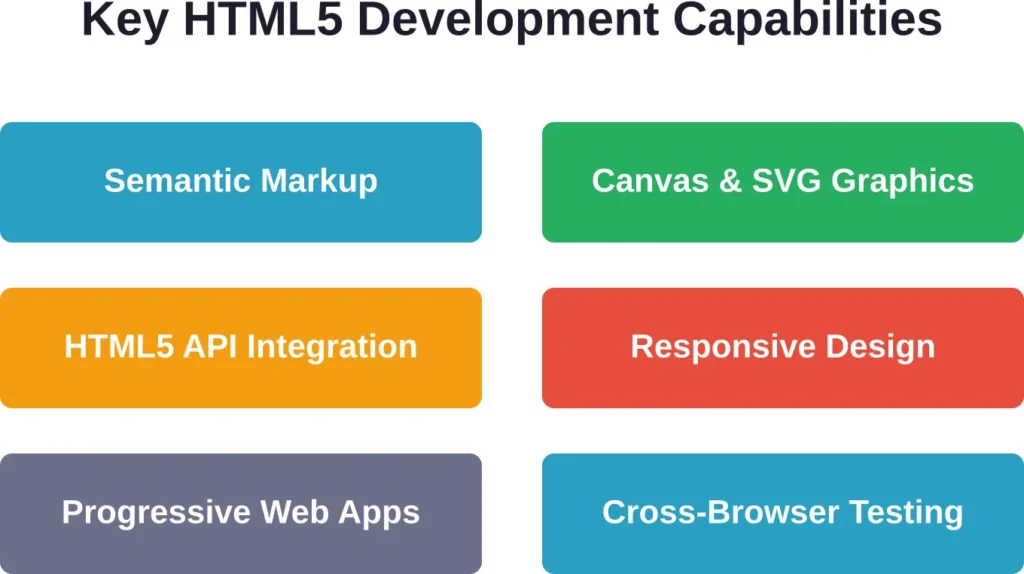
Before HTML5, developers needed Flash for video, clunky workarounds for offline storage, and third-party plugins for basic interactivity. HTML5 brought semantic elements like <article>, <section>, and <nav> that make markup meaningful. It introduced the <canvas> element for graphics rendering and <video> for native media playback.
The real power lies in the APIs. Geolocation, local storage, web workers, drag-and-drop, and service workers all came with HTML5. These features enable progressive web apps, offline functionality, and app-like experiences—all without leaving the browser.
Strong HTML5 development means understanding these capabilities and knowing when to use them. It’s about building sites that degrade gracefully, maintain accessibility standards, and perform consistently across browsers and devices.
Here’s what separates competent HTML5 work from average development:
- Semantic markup that improves SEO and screen reader compatibility
- Responsive layouts that adapt naturally without breakpoint hacks
- Form validation using native HTML5 attributes before JavaScript
- Canvas and SVG implementation for scalable graphics
- Progressive enhancement strategies that prioritize core functionality
- Proper use of ARIA roles where HTML5 semantics fall short
The agencies below consistently deliver on these fronts. They don’t just write HTML5—they architect experiences that take advantage of everything modern web standards offer.
Top 15 HTML5 Web Development Companies
These agencies represent the strongest options for HTML5-focused projects. Each brings different strengths, specializations, and approaches to web development.
1. Gilzor

Gilzor is a custom software development company specializing in full-cycle web development. They build scalable web applications from concept to post-launch maintenance, serving startups, SMBs, and product studios.
Their HTML5 work focuses on modern, user-centric interfaces with clean semantic structure, high performance, and excellent user experiences. Projects often feature responsive layouts, dynamic interactions, and integration with backend systems, while maintaining accessibility and code quality standards. The team applies progressive enhancement and modern web technologies to deliver functional and attractive digital products.
Gilzor’s portfolio includes e-commerce solutions, service platforms, and interactive web apps where solid HTML5 foundations support complex features and future scalability. They emphasize quality assurance and long-term maintainability in every front-end implementation.
Best for: Startups and product companies seeking reliable, full-cycle HTML5 web development with strong UI/UX integration and scalable architecture.
Contact Information:
- Website: www.gilzor.com
- Email: [email protected]
- Address: Poland, Warsaw, Office 58, street Adama Mickiewicza 37, 01-625
- LinkedIn: www.linkedin.com/company/gilzor-softwaredevelopment
2. Lengreo
Lengreo operates as a full-service digital marketing and tech partner with a strong focus on website development. The agency builds eCommerce, business, portfolio websites, and high-converting landing pages that drive measurable business growth.
Their HTML5 development emphasizes semantic markup, responsive structures, and performance-optimized code that supports SEO and conversion goals. Projects typically include clean, accessible front-end implementations paired with backend integration, prototyping, and ongoing QA. The team applies modern web standards to ensure fast loading, mobile-first experiences, and strong technical foundations for marketing-driven sites.
Lengreo’s work shines in B2B contexts where websites serve as lead-generation engines. They combine technical HTML5 execution with strategy, resulting in platforms that are both visually effective and search-engine friendly. Their process prioritizes business outcomes through well-structured, maintainable code.
Best for: B2B companies and service providers needing marketing-focused HTML5 websites with strong conversion optimization and SEO performance.
Contact Information:
- Website: Lengreo.com
- Phone: +31 686 147 566
- Email: [email protected]
- Address: Vrijstraat 9 C/D, 5611 AT Eindhoven, Netherlands
- LinkedIn: Lengreo
- Twitter: @Lengreo
- Instagram: @lengreo
3. Oski
Oski delivers expert web development and frontend solutions for enterprises and ambitious startups. The agency focuses on building well-engineered, scalable digital platforms with modern technologies.
Their HTML5 development prioritizes innovative design, semantic structure, and seamless performance across devices. Projects leverage HTML5 alongside frameworks like React, Vue, and Angular, while maintaining clean markup for accessibility, SEO, and maintainability. The team excels at creating intuitive user experiences backed by robust, standards-compliant code.
Oski’s work spans industries such as e-commerce, travel, logistics, and fintech, where reliable frontend foundations power complex user flows and content-heavy platforms. Their approach combines flexibility with technical excellence for long-term value.
Best for: Tech-forward enterprises and startups needing high-quality HTML5 frontend development with strong focus on user experience and modern web standards.
Contact Information:
- Website: oski.site
- Phone: +48571282759
- Email: [email protected]
- Address: Kaupmehe tn 7, 10114 Tallinn, Estonia
- LinkedIn: www.linkedin.com/company/oski-solutions
4. A-listware

A-listware is a software development and consulting company offering custom web solutions, UX/UI design, and dedicated development teams. They provide end-to-end services for enterprise applications, web portals, and digital platforms.
Their HTML5 expertise includes responsive web design, semantic markup, and modern frontend architectures that support complex enterprise needs. Projects feature clean HTML5 structures paired with technologies like React, Angular, and Vue, ensuring accessibility, performance, and seamless integration with backend systems. The agency emphasizes maintainable code and user-centered interfaces.
A-listware delivers solutions across e-commerce, ERP/CRM integrations, and custom web portals where solid HTML5 foundations enable scalability and excellent user engagement. Their team-augmentation model ensures consistent technical quality.
Best for: Enterprises and mid-sized businesses requiring professional HTML5 web development with robust architecture, UX/UI focus, and scalable digital solutions.
Contact Information:
- Website: a-listware.com
- Phone: +1 (888) 337 93 73
- Email: [email protected]
- Address: North Bergen, NJ 07047, USA
- LinkedIn: www.linkedin.com/company/a-listware
- Facebook: www.facebook.com/alistware
5. Mobian
Mobian builds dedicated engineering teams specializing in full-stack and frontend development for digital products. They focus on production-ready software with clean architecture and modern web technologies.
Their HTML5 development supports end-to-end product creation, including responsive, accessible interfaces for mobile-first and complex web applications. Projects emphasize semantic structure, performance optimization, and integration with AI, backend systems, and scalable cloud infrastructure. The team delivers maintainable code that supports long-term growth.
Mobian works with companies in healthcare, fintech, logistics, and IT, where reliable HTML5 foundations power user-facing platforms and internal tools. Their outsourcing and outstaffing models ensure high execution standards.
Best for: Companies in regulated industries needing senior-level HTML5 web development as part of dedicated teams for scalable, production-ready digital products.
Contact Information:
- Website: mobian.studio
- Phone: [email protected]
- Address: Harju maakond, Tallinn, Kesklinnalinnaosa, Masina tn 22, 10113
- LinkedIn: www.linkedin.com/company/mobian-studio
6. Blue Fountain Media

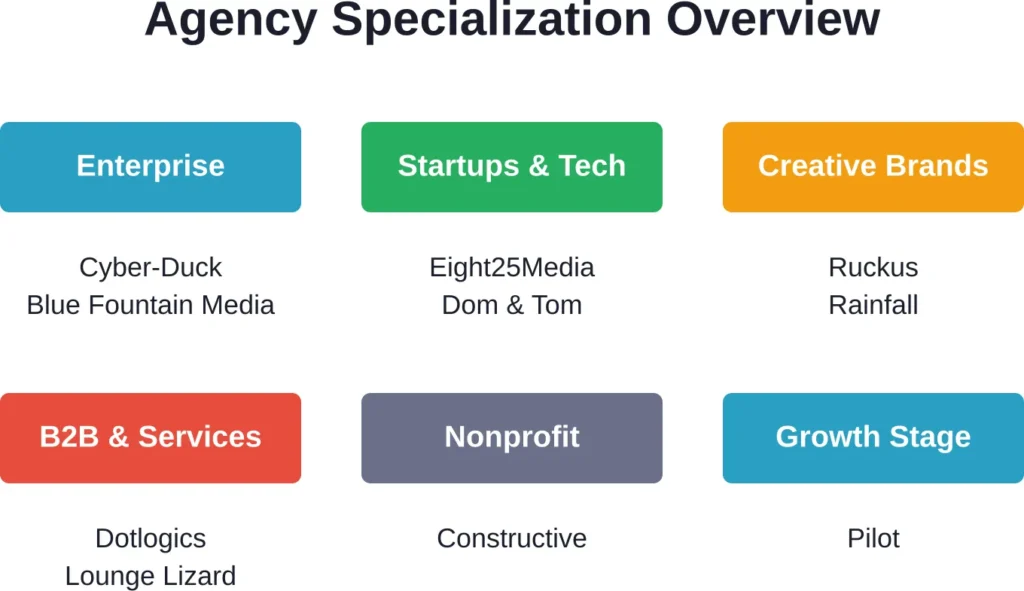
Blue Fountain Media is a full-service digital agency. They work with enterprise clients and growing companies across diverse industries, from finance to healthcare to manufacturing.
Their HTML5 development integrates with broader digital marketing strategies. Sites are built for search visibility from the ground up, with semantic HTML5 providing the foundation for technical SEO. The team implements structured data, proper heading hierarchy, and optimized page structures that support organic search performance.
Blue Fountain Media handles large-scale website migrations and redesigns where legacy content needs to move into modern HTML5 architecture. Projects often involve responsive breakpoint strategies, performance optimization, and cross-browser compatibility testing across extensive page inventories.
The agency brings project management discipline to complex HTML5 implementations. For organizations undertaking major web platform overhauls, their structured approach helps manage technical complexity and stakeholder coordination.
Best for: Enterprise organizations executing large-scale website projects requiring HTML5 expertise combined with digital marketing integration.
7. Constructive
Constructive specializes in nonprofit and social impact organizations. They focus on accessible, inclusive digital experiences that serve diverse communities.
HTML5 development at Constructive prioritizes universal access. Projects demonstrate exemplary semantic markup, ARIA implementation where needed, and testing with actual assistive technologies. The team builds sites that work across older browsers and devices, recognizing that nonprofit audiences often include users with limited technology access.
Their portfolio includes advocacy platforms, fundraising sites, and information resources where content clarity and accessibility aren’t optional. Constructive implements HTML5 features thoughtfully—using native elements when they improve usability, avoiding flashy implementations that create barriers.
The agency’s expertise in multilingual sites and internationalization makes them valuable for organizations serving global audiences. Their HTML5 work reflects an ethos of digital equity and inclusive design.
Best for: Nonprofit organizations and social impact companies requiring highly accessible HTML5 sites that prioritize inclusive design.
8. Dom & Tom
Dom & Tom focuses on digital products for companies in healthcare, finance, and technology sectors. They handle web platforms alongside mobile apps, bringing product thinking to HTML5 development.
Their approach treats websites as products that evolve based on user needs and business metrics. HTML5 implementations emphasize flexibility—component-based architectures that support rapid iteration and A/B testing. Projects frequently include progressive web app features, offline functionality, and app-like interactions built on HTML5 foundations.
Dom & Tom works extensively with startups and innovation teams inside larger organizations. Their HTML5 development supports lean methodologies, with clean markup that enables quick updates and feature additions without technical debt accumulation.
The agency demonstrates strong expertise in HTML5 API integration, particularly geolocation, push notifications, and background sync for PWAs. For companies building web-based products rather than traditional marketing sites, their product-focused approach aligns well.
Best for: Product teams and startups building web platforms and progressive web apps requiring modern HTML5 features and rapid iteration.
9. Rainfall
Rainfall positions itself at the intersection of design and technology, working with clients in entertainment, arts, and creative industries. They build experiences that push creative boundaries while maintaining technical quality.
HTML5 development at Rainfall emphasizes experimentation. Projects showcase creative use of canvas, WebGL implementations, audio APIs, and animation techniques that demonstrate what’s possible with modern web standards. The team builds sites that feel like interactive experiences rather than static pages.
Their portfolio includes artist portfolios, entertainment platforms, and brand campaigns where visual impact drives the brief. Rainfall implements these creative concepts with production-quality code—sites that perform well despite sophisticated interactions.
The agency excels at translating ambitious creative direction into working HTML5. For clients who want sites that stand out and demonstrate technical innovation, Rainfall delivers both the vision and the implementation.
Best for: Creative industries and entertainment companies wanting innovative, experience-driven HTML5 sites with technical sophistication.
10. Pilot
Pilot focuses on growth-stage companies and established brands undertaking digital transformation. Their practice emphasizes measurable outcomes and technical excellence.
HTML5 development at Pilot supports conversion-focused sites where every element serves business goals. Projects demonstrate clean semantic markup optimized for search engines, fast-loading responsive layouts, and progressive enhancement strategies that maximize reach across devices.
The agency conducts extensive technical audits and frequently takes over sites from other developers, requiring deep understanding of HTML5 standards and best practices. Their remediation work often involves restructuring markup for better performance, accessibility, and maintainability.
Pilot brings technical rigor to HTML5 implementation. They document standards, conduct code reviews, and build sites that pass validation and accessibility checks. For organizations that value technical quality and measurable performance, their disciplined approach delivers reliable results.
Best for: Growth companies and established brands needing technically rigorous HTML5 development with focus on performance and business outcomes.
11. Cyber-Duck
Cyber-Duck operates from London building digital experiences for enterprise clients. The agency specializes in user-centered design backed by technical execution that emphasizes web standards and accessibility.
Their HTML5 work focuses on large-scale websites and platforms that need to serve diverse audiences. Projects typically involve complex content structures, multi-device optimization, and integration with backend systems. The team approaches HTML5 as a foundation for accessible, performant sites rather than a feature to advertise.
Case studies show implementations of semantic HTML5 markup across government portals, healthcare platforms, and corporate sites where compliance and accessibility rank as critical requirements. Their process emphasizes progressive enhancement—building core functionality in HTML5 first, then layering JavaScript for enhanced experiences.
Cyber-Duck maintains strong expertise in WCAG compliance and inclusive design. For organizations that need bulletproof HTML5 implementation with accessibility baked in from the start, they’re a solid choice.
Best for: Enterprise organizations requiring accessible, standards-compliant HTML5 sites with complex content structures.
12. Eight25Media

Eight25Media focuses on data-driven design and conversion optimization. They work primarily with tech startups and growth companies building customer-facing web platforms.
Their HTML5 development emphasizes speed and interaction. Projects showcase canvas-based animations, smooth scroll effects, and dynamic content loading—all implemented with performance budgets in mind. The team uses HTML5 form validation extensively and builds progressive web app features for clients who need offline functionality.
Eight25Media’s portfolio includes SaaS landing pages, e-commerce platforms, and product marketing sites where every millisecond of load time matters. They conduct extensive A/B testing and frequently iterate based on user behavior data.
The agency’s technical blog demonstrates deep knowledge of HTML5 APIs, particularly service workers and local storage for PWA development. Their approach works especially well for companies that want measurable performance improvements and conversion gains from their HTML5 implementation.
Best for: Tech companies and startups needing high-performance, conversion-optimized HTML5 websites with modern interactions.
13. Lounge Lizard

Lounge Lizard has a long operational history, giving them perspective on how web standards evolved from table layouts to modern HTML5. They maintain offices across multiple US locations, serving mid-market and enterprise clients.
The agency positions itself as a “brandtenders” focused on cohesive digital experiences. Their HTML5 work emphasizes visual polish—sites with sophisticated animations, video backgrounds, and interactive elements that feel premium without sacrificing usability.
Projects demonstrate strong use of HTML5 semantic elements for SEO advantage and proper implementation of schema markup. Lounge Lizard frequently builds custom CMS themes where clean HTML5 structure matters for content editors and future maintainability.
Their portfolio spans industries from hospitality to healthcare, with consistent attention to mobile-responsive design. The team’s longevity means institutional knowledge about browser quirks and progressive enhancement strategies that newer agencies sometimes miss.
Best for: Established brands seeking visually sophisticated HTML5 sites with strong attention to semantic structure and SEO.
14. Ruckus
Ruckus operates as a full-service digital agency. They specialize in custom web platforms for clients in fashion, beauty, lifestyle, and consumer goods sectors.
Their HTML5 development stands out for creative execution. Projects feature bold typography, immersive scrolling experiences, and sophisticated use of CSS Grid and Flexbox layouts powered by semantic HTML5 structure. The agency frequently implements WebGL and canvas animations for product showcases and brand storytelling.
Ruckus builds many e-commerce sites where HTML5 markup supports complex product filtering, dynamic inventory updates, and checkout flows. Their front-end code tends toward modern, component-based architectures that maintain clean HTML5 at the rendering layer.
The team shows particular strength in translating ambitious creative concepts into working HTML5 implementations. For brands that want sites with personality and technical sophistication, Ruckus delivers both.
Best for: Consumer brands and e-commerce companies wanting creative, visually distinctive HTML5 sites with strong technical execution.
15. Dotlogics
Dotlogics is a custom web development agency focusing on digital strategy for middle-market companies. Their client base includes B2B firms, professional services, and organizations with complex business requirements.
HTML5 development at Dotlogics emphasizes clean architecture and maintainability. They build sites that internal teams can update without breaking layouts or accessibility features. Projects showcase proper use of HTML5 form elements, semantic document structure, and progressive enhancement techniques.
The agency handles many CMS implementations where HTML5 templates need to accommodate varied content types and user-generated input. Their approach prioritizes sustainability—building sites that remain functional and compliant years after launch.
Dotlogics maintains expertise in web accessibility standards and frequently conducts WCAG audits. Their HTML5 work reflects an understanding that markup isn’t just for browsers—it’s for screen readers, search engines, and future developers who’ll maintain the codebase.
Best for: Mid-market B2B companies needing sustainable, maintainable HTML5 sites with strong accessibility and CMS integration.
What to Look for in an HTML5 Development Agency
Technical chops matter. But evaluating HTML5 expertise requires looking beyond portfolios and testimonials.
Start with the code. Request to see actual markup from recent projects. Strong HTML5 work shows proper semantic elements, logical document structure, and clean separation between content and presentation. Red flags include excessive <div> soup, inline styles, and deprecated elements.
Check validator compliance. Professional agencies build sites that pass W3C validation without errors. Minor warnings are acceptable, but clean validation demonstrates attention to standards.
Test accessibility. Use screen readers or automated tools like aXe or WAVE on agency portfolio sites. Proper HTML5 development produces accessible experiences by default through semantic markup and ARIA implementation where needed.
Examine mobile experiences. Don’t just resize browser windows—test on actual devices. HTML5 sites should adapt fluidly without horizontal scrolling, cramped tap targets, or broken layouts. Strong agencies test across device ranges, not just the latest iPhone.
Ask about progressive enhancement. How does the agency handle JavaScript failures or slow connections? Sites built on solid HTML5 foundations remain functional even when enhancements fail. Agencies that understand this principle build more resilient platforms.
Review performance metrics. Request Lighthouse scores or WebPageTest results from recent projects. HTML5 sites should load quickly, score well on Core Web Vitals, and maintain performance across connection speeds. Fast sites require optimized markup, not just clever JavaScript.
Evaluate technical communication. Can the agency explain HTML5 features and implementation approaches in clear terms? Strong technical teams communicate concepts without jargon overload. This matters for ongoing collaboration and maintenance planning.
Consider maintenance implications. Who updates the site after launch? HTML5 projects need agencies that build with long-term sustainability in mind—clean code, documentation, and architectures that support future updates without complete rebuilds.
Common HTML5 Implementation Scenarios
Different projects demand different HTML5 approaches. Understanding common scenarios helps match requirements with agency expertise.
Responsive Corporate Sites
Many organizations need informational websites that work across all devices. These projects prioritize semantic HTML5 structure, accessibility compliance, and CMS integration. The technical complexity lies in content flexibility—templates that accommodate various page types without breaking responsive layouts.
Agencies strong in this scenario excel at information architecture, content modeling, and sustainable CMS implementations. Projects typically involve extensive stakeholder coordination and content migration from legacy systems.
E-commerce Platforms
Online stores require HTML5 markup that supports complex product data, filtering interfaces, and checkout flows. Performance becomes critical—every hundred milliseconds of delay impacts conversion rates. Semantic markup supports SEO for product pages while structured data helps products appear in search features.
Agencies specializing here understand e-commerce platforms, payment integrations, and the specific HTML5 patterns that optimize for both user experience and search visibility.
Progressive Web Apps
PWAs blend website and app experiences using HTML5 APIs for offline functionality, push notifications, and home screen installation. These projects require deep expertise in service workers, caching strategies, and app manifest implementation.
Agencies with PWA experience build sites that feel app-like while remaining universally accessible through browsers. Technical complexity increases significantly compared to traditional sites.
Interactive Experiences
Campaign sites, portfolios, and brand experiences often push HTML5 creative boundaries with canvas animations, scroll effects, and immersive interactions. These projects balance artistic vision with technical feasibility and performance constraints.
Agencies excelling here bridge design and engineering, implementing sophisticated interactions without sacrificing usability or accessibility.
Content Platforms
Publishers, media companies, and content-heavy sites need HTML5 architecture that scales across thousands of pages. Performance optimization, ad integration, and reading experiences demand specialized expertise. Semantic markup becomes crucial for SEO across large content inventories.
Agencies with publishing experience understand content velocity, editorial workflows, and the technical patterns that maintain performance at scale.
HTML5 vs. Other Development Approaches
HTML5 dominates modern web development. But alternatives exist, and understanding trade-offs helps clarify when pure HTML5 development makes sense.
| Approach | Best For | Trade-offs |
|---|---|---|
| HTML5 + Progressive Enhancement | Maximum compatibility and accessibility; content-focused sites | May require more initial planning; some advanced interactions need extra work |
| JavaScript Frameworks (React, Vue) | Complex web apps with heavy interactivity; frequent UI updates | Requires JavaScript; can hurt SEO without server rendering; larger initial payload |
| Static Site Generators | Content sites needing maximum performance and security | Dynamic features require external services; build step adds complexity |
| Headless CMS + HTML5 | Multi-channel content delivery; decoupled architecture | Increased technical complexity; requires API management |
| WordPress + HTML5 Themes | Organizations needing familiar CMS with extensive plugin ecosystem | Performance can suffer; code quality varies by theme/plugin |
Pure HTML5 development—semantic markup with CSS and progressive JavaScript enhancement—works exceptionally well for content sites, marketing pages, and platforms where accessibility and universal compatibility matter most.
JavaScript-heavy approaches suit web applications with complex state management and frequent UI updates. But they trade universal accessibility for interactive capabilities.
The best agencies understand these trade-offs and recommend approaches based on actual project needs rather than technology preferences. Sometimes that means pure HTML5. Sometimes it means React or Vue. Match the tool to the problem.
HTML5 Development Timeline and Process
Understanding typical project phases helps set realistic expectations and evaluate agency processes.
Discovery and Planning (2-4 weeks)
Strong projects start with research. Agencies conduct stakeholder interviews, user research, competitive analysis, and technical audits of existing systems. This phase defines requirements, content structure, and technical architecture.
Deliverables typically include sitemaps, user flows, technical specifications, and project roadmaps. For HTML5 projects, this phase establishes semantic structure approaches, accessibility requirements, and browser support matrices.
Design and Prototyping (3-6 weeks)
Design work defines visual direction and interaction patterns. Agencies produce wireframes, design mockups, and interactive prototypes that demonstrate how the site will function across devices.
For HTML5 projects, design deliverables should include responsive specifications showing how layouts adapt across breakpoints. Style guides document component patterns that will be implemented in semantic HTML5.
Development (6-12 weeks)
Implementation involves building HTML5 templates, integrating with backend systems, and developing custom functionality. Development happens iteratively, with regular reviews and testing.
Professional agencies follow coding standards, conduct code reviews, and implement version control. HTML5 development should produce validated markup, pass accessibility audits, and meet performance benchmarks throughout the process.
Testing and Refinement (2-4 weeks)
Comprehensive testing covers functionality, browser compatibility, device testing, accessibility compliance, and performance optimization. Issues are logged, prioritized, and resolved.
HTML5 projects require testing across browser versions, assistive technologies, and actual devices—not just emulators. Strong agencies maintain device labs or testing services for thorough coverage.
Launch and Support (ongoing)
Deployment involves coordinating DNS changes, content migration, redirects, and monitoring. Post-launch support addresses issues that emerge with real traffic and usage patterns.
HTML5 sites benefit from ongoing maintenance—browser updates, security patches, content updates, and performance monitoring. Clarify support terms before project start.
Total timeline for typical HTML5 projects: 3-6 months from kickoff to launch. Complex platforms or enterprise projects may extend 6-12 months.
Evaluating Agency Portfolio Work
Portfolio reviews reveal more than aesthetic preferences. They demonstrate technical capabilities and problem-solving approaches.
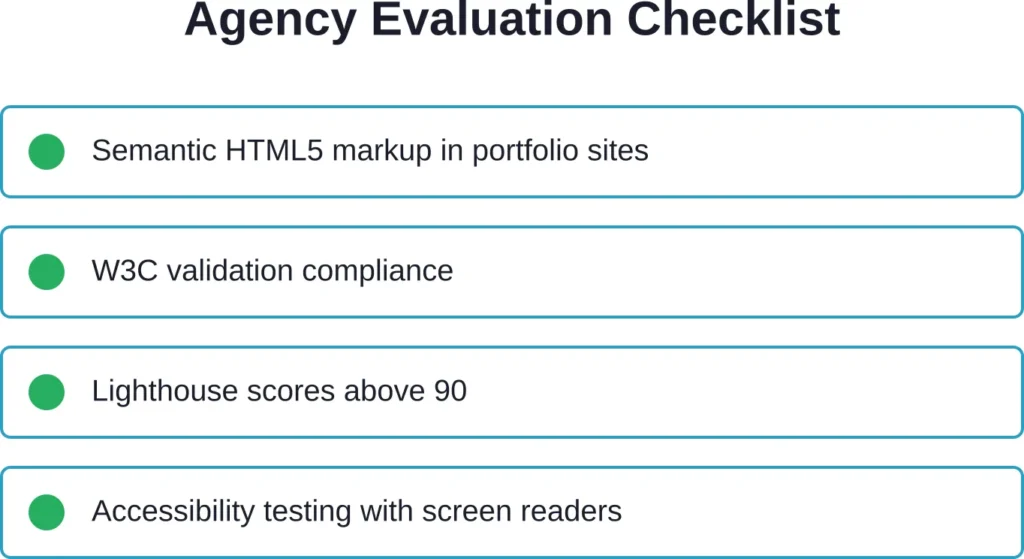
Look beyond surface visuals. Beautiful screenshots tell little about underlying code quality. Request to view live sites, then inspect the source. Strong HTML5 work shows immediately in the markup.
Check semantic structure. Open developer tools and examine the document outline. Proper heading hierarchy, semantic elements like <article> and <section>, and logical document structure indicate competent HTML5 development.
Test responsive behavior. Resize browser windows and test on actual mobile devices. HTML5 sites should reflow naturally without breaking layouts or requiring horizontal scrolling. Media queries should enhance the base experience, not define it entirely.
Run Lighthouse audits. Google’s Lighthouse tool scores performance, accessibility, best practices, and SEO. Portfolio sites scoring consistently above 90 across metrics demonstrate technical excellence.
Test with screen readers. Install NVDA or VoiceOver and navigate portfolio sites. Accessible HTML5 produces logical, navigable experiences for screen reader users. Inaccessible sites reveal careless implementation.
Review page source for cleanliness. View source and scan the HTML. Excessive inline styles, deprecated elements, or commented-out code sections suggest poor development practices. Clean, minimal markup indicates professional work.
Check validator compliance. Run portfolio pages through the W3C HTML validator. Clean validation demonstrates standards compliance and attention to detail.
Ask about challenges. Request case studies explaining technical problems and solutions. Strong agencies articulate how HTML5 capabilities solved specific requirements—not just that they “built a responsive site.”
Questions to Ask Potential Agencies
The right questions reveal technical depth and project approach more effectively than marketing materials.
About HTML5 expertise:
- How do you approach semantic HTML5 structure for different content types?
- What HTML5 APIs have you implemented in recent projects?
- How do you ensure HTML5 sites remain accessible to users with disabilities?
- What’s your process for progressive enhancement vs. graceful degradation?
About development process:
- How do you handle browser compatibility testing?
- What coding standards and quality control processes do you follow?
- How do you optimize HTML5 sites for performance?
- What’s included in post-launch support?
About project specifics:
- Can you share examples of projects similar to ours?
- How do you handle scope changes during development?
- What’s your typical project timeline for sites like this?
- Who will be on the project team and what are their roles?
About long-term considerations:
- How do you build sites for future maintainability?
- What documentation do you provide at project completion?
- Can our internal team make updates after launch?
- How do you handle ongoing maintenance and updates?
Strong agencies answer these questions specifically, often with examples from past projects. Vague responses or reluctance to discuss technical details are warning signs.
Red Flags When Evaluating Agencies
Certain warning signs indicate agencies to avoid, regardless of portfolio quality or client testimonials.
Poor code quality in portfolio work. If agency sites show messy HTML, accessibility failures, or validation errors, they’ll deliver similar quality on client projects. View source on their own website—it demonstrates real priorities.
Inability to discuss technical details. Sales teams don’t need to code. But agencies should connect technical staff during evaluation. If nobody can discuss HTML5 semantics, accessibility implementation, or performance optimization, technical depth may not exist.
One-size-fits-all solutions. Agencies pushing identical approaches for every project lack nuance. Different requirements demand different solutions. Template-driven agencies deliver template results.
Vague timelines and deliverables. Professional agencies define clear milestones, deliverables, and timelines. Vague project plans lead to scope creep, missed deadlines, and budget overruns.
Limited testing processes. If agencies don’t mention browser testing, accessibility audits, or device testing, these steps probably aren’t happening. Quality requires systematic testing throughout development.
Overemphasis on trends. Agencies leading with the latest JavaScript framework or design trend often prioritize novelty over solving actual problems. Strong agencies match tools to requirements rather than forcing current trends into every project.
Poor communication during evaluation. If getting responses takes days and answers lack detail during the sales process, communication won’t improve during the project. Responsive, clear communication matters throughout engagement.
Reluctance to provide references. Professional agencies readily connect prospects with past clients. Hesitation suggests problematic relationships or limited relevant experience.
The Business Case for Quality HTML5 Development
Investing in proper HTML5 development costs more upfront but delivers measurable returns over time.
Search visibility improves with semantic markup. Search engines parse HTML5 elements to understand content structure and meaning. Proper heading hierarchy, semantic elements, and structured data help pages rank for relevant queries. Better rankings drive organic traffic without ongoing ad spend.
Accessibility expands audience reach. Sites built with semantic HTML5 work for users with disabilities, older browsers, and assistive technologies. This isn’t just ethical—it’s practical. Accessible sites reach broader audiences and avoid legal risks from ADA compliance failures.
Performance impacts conversion. Fast sites convert better. HTML5 sites built with performance in mind load quickly, rank better in search, and provide better user experiences. Industry analyses consistently show that page speed directly impacts bounce rates and conversion metrics.
Maintenance costs decrease over time. Clean HTML5 architecture simplifies updates and feature additions. Technical debt accumulates quickly with poorly structured sites, making future changes expensive. Well-architected HTML5 sites remain maintainable years after launch.
Future compatibility extends site lifespan. Standards-compliant HTML5 sites continue working as browsers evolve. Sites built with proprietary techniques or deprecated approaches require expensive rebuilds when technologies change.
Mobile reach expands without separate development. Responsive HTML5 sites serve all devices from a single codebase. Maintaining separate mobile sites or apps multiplies development and maintenance costs.
The ROI calculation favors quality. Cheaper development often means technical shortcuts that cost more long-term through poor search visibility, maintenance difficulties, and limited scalability. Proper HTML5 development pays for itself through better performance, broader reach, and lower long-term costs.
Frequently Asked Questions
HTML5 introduced semantic elements like <article>, <section>, and <nav> that give meaning to content structure. It added native video and audio elements, the canvas element for graphics, and numerous APIs for features like geolocation, local storage, and offline functionality. These capabilities enable app-like experiences without plugins or proprietary technologies.
No. Many agencies list HTML5 as a service because all modern web development uses HTML5 by default. True expertise means understanding semantic markup, accessibility implications, progressive enhancement strategies, and proper use of HTML5 APIs. Evaluate actual code quality in portfolio work rather than trusting marketing claims.
Project costs vary enormously based on scope, complexity, and agency expertise. Simple sites might start around a few thousand dollars. Complex platforms for enterprise organizations can reach six figures. Most professional HTML5 projects for businesses fall somewhere between—expect substantial investment for quality work, but specific numbers depend entirely on requirements.
Location matters less than capability. Many successful projects happen entirely remotely with agencies hundreds or thousands of miles away. Prioritize technical expertise, communication quality, and portfolio fit over geographic proximity. That said, some organizations prefer local agencies for in-person collaboration—just don’t limit options artificially based on location alone.
Run your site through the W3C HTML Validator to check standards compliance. Use Lighthouse in Chrome DevTools to assess performance, accessibility, and best practices. Test with screen readers to evaluate accessibility. Examine the source code for semantic elements and proper structure. Consider hiring an independent technical audit if you need detailed assessment.
HTML5 is the markup language defining content structure and meaning. Responsive design is an approach making sites work across device sizes, typically using CSS media queries and flexible layouts. Professional sites use both—semantic HTML5 markup provides the foundation, responsive CSS makes it adapt across screens. You need both, not one or the other.
Yes. Proper HTML5 sites use progressive enhancement—core functionality works with HTML and CSS alone, with JavaScript adding enhancements. This ensures sites remain functional when JavaScript fails, loads slowly, or is disabled. Agencies building sites that break entirely without JavaScript aren’t following HTML5 best practices.
Moving Forward with Your HTML5 Project
Selecting an HTML5 development agency ultimately comes down to matching expertise with requirements.
Start by clarifying what you actually need. Are you building an informational corporate site? An e-commerce platform? An interactive experience? Different scenarios demand different expertise. The agency perfect for one project may be wrong for another.
Evaluate technical quality above all else. Beautiful portfolios matter, but clean code, accessibility compliance, and performance optimization separate professional work from expensive mistakes. View source. Run audits. Test on devices.
Prioritize communication and process. Technical skills alone don’t guarantee project success. Agencies need clear processes, responsive communication, and ability to translate technical concepts for non-technical stakeholders.
Plan for the long term. Websites aren’t one-time deliverables—they require ongoing maintenance, updates, and evolution. Choose agencies that build sustainable architectures and provide clear maintenance paths.
Don’t optimize solely for cost. Cheap development creates technical debt that becomes expensive to fix later. Professional HTML5 work costs more upfront but delivers better results and lower long-term costs.
The agencies listed here represent strong options across different specializations and client types. Review their portfolios, evaluate their technical work, and reach out to those aligned with your specific needs.
Quality HTML5 development transforms digital presence. It expands reach, improves search visibility, enhances user experience, and provides a sustainable foundation for future growth. Choose your development partner carefully—the decision impacts your digital presence for years to come.
Ready to start your HTML5 project? Review the agencies above, examine their portfolio work, and reach out to discuss your specific requirements. The right development partner is out there.