

Quick Summary: The best web application development companies in 2026 combine technical excellence with business-focused delivery. This curated list features 15 top agencies known for scalable architecture, modern tech stacks, and proven track records across diverse industries — from startups to enterprise clients.
Choosing a web application development partner isn’t just about finding someone who can code. It’s about identifying an agency that understands business objectives, delivers on time, and builds systems that scale as demand grows.
With thousands of development companies competing for attention, cutting through the noise takes time. This guide does that work for you.
Here’s the thing though — not every agency on this list will be right for every project. Some excel at rapid MVP delivery for startups. Others specialize in complex enterprise systems with legacy integrations. The goal is to help match project requirements with agency strengths.
What Makes a Web Application Development Company Stand Out
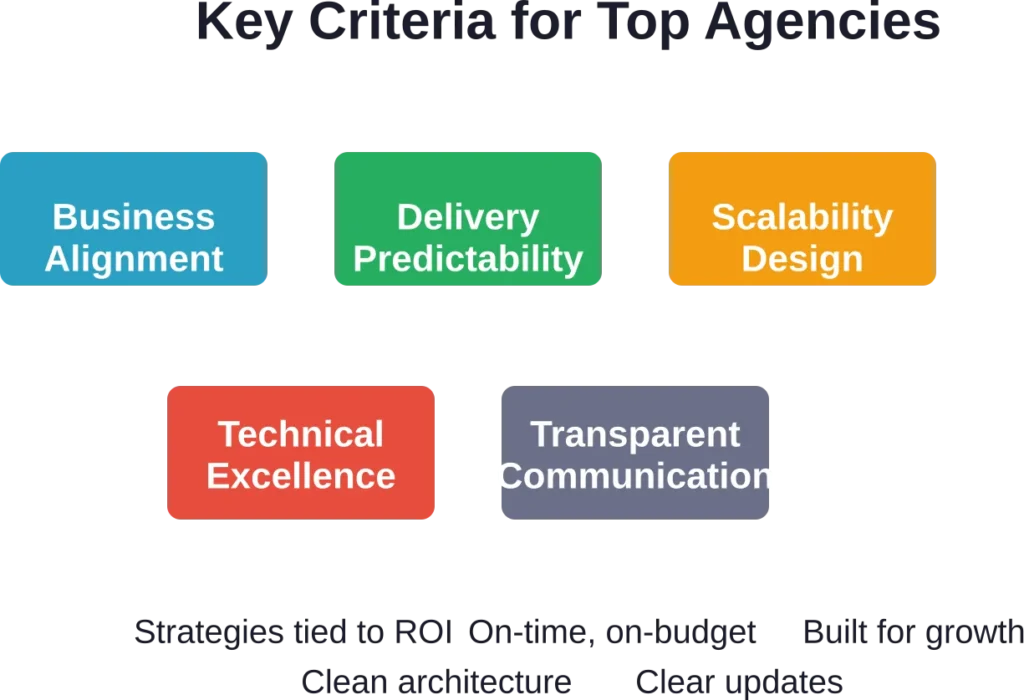
Real talk: technical chops are table stakes. Every agency on this list can write clean code. What separates the good from the great comes down to a handful of critical factors.
First, business alignment. Top agencies don’t just take requirements and disappear. They ask why features matter, what metrics define success, and how the application fits into broader company strategy.
Second, delivery predictability. Missed deadlines and scope creep plague the industry. The best companies have processes that keep projects on track without sacrificing quality.
Third, scalability mindset. Building an app that works for 100 users is fundamentally different from architecting one that handles 100,000. Elite agencies design for growth from day one.
And architecture matters more than most realize. Poor technical decisions made early compound over time, creating maintenance nightmares and limiting future capability. Strong agencies build foundations that adapt as business needs evolve.
Top 15 Web Application Development Companies
1. Gilzor
Gilzor specializes in custom software development with a strong focus on web and mobile applications. The company delivers full-cycle development services for startups and growing businesses looking to launch or scale digital products.
Core offerings include web development, mobile development for iOS and Android, UI/UX design, quality assurance, and go-to-market strategy support. Projects often involve building scalable web applications, e-commerce solutions, and platforms that solve specific business challenges.
The team emphasizes clean architecture, user-centric design, and reliable performance. Gilzor has experience delivering web and mobile solutions across various industries, including e-commerce, aviation, and consumer applications that require robust backend systems and intuitive interfaces.
Their approach covers everything from idea validation and prototyping to development, testing, deployment, and ongoing support and maintenance.
Contact Information:
- Website: www.gilzor.com
- Email: contacts@gilzor.com
- Address: Poland, Warsaw, Office 58, street Adama Mickiewicza 37, 01-625
- LinkedIn: www.linkedin.com/company/gilzor-softwaredevelopment
2. Oski
Oski builds smart, well-engineered software solutions for tech-forward enterprises and ambitious startups. The company focuses on designing, developing, and maintaining high-quality web applications and digital platforms.
Technical capabilities span modern frontend frameworks such as React, Vue, Angular, and Next.js, along with backend technologies including Node.js and .NET. They deliver cloud-native solutions using AWS, Azure, and serverless architectures that ensure scalability and security.
Oski combines strong technical execution with user experience focus, creating intuitive interfaces and seamless integrations. The company serves clients in industries including e-commerce, fintech, education, logistics, travel, and insurance, where reliable and scalable web applications are critical to operations.
Their expertise covers full-stack development, cloud infrastructure, DevOps practices, and AI-enhanced features that add intelligence to business applications.
Contact Information:
- Website: oski.site
- Phone: +48571282759
- Email: [email protected]
- Address: Kaupmehe tn 7, 10114 Tallinn, Estonia
- LinkedIn: www.linkedin.com/company/oski-solutions
3. A-listware
A-listware is a software development and consulting company that provides custom web application development, team augmentation, and dedicated development teams. They deliver secure, responsive, and scalable digital solutions tailored to enterprise, SMB, and startup needs.
Services include software development outsourcing, custom software development, cloud application development, enterprise software development, and legacy modernization. The company also offers UX/UI design, testing and QA, data analytics, and IT consulting to support comprehensive web projects.
A-listware builds enterprise applications such as ERP, CRM, and other internal systems that streamline operations. Their technical expertise covers cloud solutions, machine learning, AI, and full-spectrum software engineering services for complex web platforms.
The company focuses on seamless integration with client teams and delivering high-quality, maintainable code for long-term business value.
Contact Information:
- Website: a-listware.com
- Phone: +1 (888) 337 93 73
- Email: info@a-listware.com
- Address: North Bergen, NJ 07047, USA
- LinkedIn: www.linkedin.com/company/a-listware
- Facebook: www.facebook.com/alistware
4. Lengreo

Lengreo acts as a complete marketing and tech partner, offering integrated website development services alongside powerful B2B lead generation and digital marketing capabilities. The company builds high-converting websites and digital platforms that directly support business growth objectives.
Lengreo specializes in creating eCommerce websites, corporate business sites, portfolio platforms, and optimized landing pages. Their development process includes thorough discovery and business analysis, prototyping and design, full implementation, quality assurance, and ongoing support.
The agency delivers websites engineered for lead generation and conversion. Projects combine clean, modern code with strong SEO foundations, fast performance, and seamless integration with marketing tools and third-party services.
Lengreo has proven results helping IT and software development companies strengthen their online presence through technically solid websites backed by targeted digital strategies. Their approach ensures that every web solution serves as an effective business development asset rather than just a visual presence.
Contact Information:
- Website: Lengreo.com
- Phone: +31 686 147 566
- Email: [email protected]
- Address: Vrijstraat 9 C/D, 5611 AT Eindhoven, Netherlands
- LinkedIn: Lengreo
- Twitter: @Lengreo
- Instagram: @lengreo
5. Mobian Studio
Mobian Studio is a European software development partner specializing in mobile and web solutions with a strong emphasis on AI integration. They build dedicated engineering teams that deliver production-ready web applications for companies in IT, healthcare, fintech, and logistics.
The company operates through outsourcing and outstaffing models, providing end-to-end product development or embedding senior engineers into client teams. Capabilities include full-stack web development, scalable architecture, backend systems, APIs, cloud infrastructure, and legacy system integration.
Mobian delivers clean, documented code and maintains post-launch support. Their expertise covers complex web platforms that require regulatory compliance, high performance, and seamless user experiences, particularly in domains where reliability and scalability are essential.
Contact Information:
- Website: mobian.studio
- Phone: [email protected]
- Address: Harju maakond, Tallinn, Kesklinnalinnaosa, Masina tn 22, 10113
- LinkedIn: www.linkedin.com/company/mobian-studio
6. Oak’s Lab

Oak’s Lab focuses on intelligent solutions — applications that incorporate automation, data analytics, and machine learning capabilities. For companies looking to modernize legacy systems or build data-driven platforms, Oak’s Lab offers relevant expertise.
The agency has worked with recognizable clients including Nasdaq, demonstrating capability to handle demanding, high-stakes projects. Other clients span sectors like residential services, content creation tools, and business software.
Technology approach emphasizes modern JavaScript frameworks and cloud-native architecture. Applications are built to scale horizontally, handle traffic spikes gracefully, and integrate with third-party services via APIs.
The company was founded in 2016 and has grown by focusing on projects where technical innovation drives business value.
Office locations include the Czech Republic. Distributed team structure allows the company to tap specialized talent regardless of geography.
7. Konstant Infosolutions
Konstant Infosolutions has extensive experience in web development services. Longevity brings deep experience across different project types, industries, and technical challenges.
The company offers comprehensive services: web development, mobile app development, UI/UX design, and digital marketing. This breadth appeals to clients who prefer consolidated vendors rather than managing multiple agencies.
Web development capabilities include custom CMS solutions, e-commerce platforms, booking and reservation systems, and enterprise web applications. Technology stack is diverse, covering PHP, .NET, Python, and modern JavaScript frameworks.
Konstant maintains a sizeable team, enabling the company to staff multiple large projects simultaneously. Quality assurance processes include manual testing, automated testing, and security audits.
Client base spans startups, mid-market companies, and large enterprises across healthcare, education, retail, and hospitality verticals.
8. Codal

Codal combines technical development with user experience focus. The agency doesn’t separate design and development into isolated phases. Instead, designers and developers collaborate throughout, ensuring the final product is both functional and intuitive.
The company serves enterprise clients with complex requirements. Projects often involve integrating new web applications with legacy systems, migrating data from old platforms, and maintaining business continuity during transitions.
Technical capabilities include React, Angular, Node.js, Python, and cloud infrastructure across AWS and Azure. Security is a core consideration, especially for healthcare and financial services clients subject to regulatory requirements.
Codal’s process emphasizes discovery and strategy. Initial project phases focus on understanding user needs, mapping workflows, and defining key performance indicators. Development follows agile methodology with regular sprint reviews and stakeholder feedback.
The agency has offices in the United States and abroad, with a team exceeding 200 people. Industry experience spans healthcare, finance, manufacturing, and retail.
9. Iflexion
Iflexion is one of the most established web application development companies. Over two decades of experience means the team has navigated countless technology shifts and project challenges.
The company specializes in custom enterprise software. Typical projects include CRM systems, supply chain management platforms, customer portals, and business intelligence dashboards. These applications require robust architecture, complex business logic, and seamless integration with existing enterprise systems.
Technology expertise covers .NET, Java, PHP, and modern frontend frameworks. Database work includes SQL Server, Oracle, PostgreSQL, and MySQL. Cloud migration and cloud-native development are core capabilities.
Iflexion maintains rigorous quality assurance standards. Testing includes functional testing, performance testing, security testing, and user acceptance testing. The goal is to catch issues before production deployment, minimizing post-launch fixes.
The company maintains a substantial team across multiple locations. Client base includes Fortune 500 companies alongside mid-market businesses across manufacturing, healthcare, retail, and telecommunications.
10. Intellectsoft

Intellectsoft targets complex, high-impact projects. The company works with enterprises and fast-growth companies building applications that are central to business operations.
Specialization areas include blockchain integration, IoT connectivity, and AI-enhanced applications. For companies exploring emerging technologies, Intellectsoft offers relevant technical depth.
Beyond pure development, the agency provides digital transformation consulting. This includes assessing current systems, identifying modernization opportunities, and planning multi-phase transformation roadmaps.
Technical stack is comprehensive: .NET, Java, Node.js, React, Angular, Python, and cloud platforms including AWS, Azure, and Google Cloud. Mobile development (iOS and Android) complements web work, enabling cohesive cross-platform experiences.
Intellectsoft has delivered projects for clients in healthcare, fintech, logistics, and hospitality. The company operates across multiple office locations.
11. SumatoSoft
SumatoSoft specializes in custom web systems for mid-sized businesses and enterprises. The company focuses on complex B2B solutions — think multi-tenant SaaS platforms, internal business tools, and systems that require sophisticated integrations.
Their approach emphasizes requirements analysis before a single line of code is written. Projects start with discovery phases that map business processes, identify bottlenecks, and define success metrics. This groundwork reduces mid-project pivots and keeps timelines predictable.
Technical capabilities span React, Angular, Vue.js on the frontend, with Node.js, Python, and .NET powering backend systems. Database expertise includes PostgreSQL, MongoDB, and MySQL. Cloud infrastructure work covers AWS and Azure deployments.
The company has completed projects across fintech, healthcare, logistics, and e-commerce verticals.
12. Brainhub
Brainhub positions itself as a business-focused development partner rather than a pure coding shop. Every project starts with alignment on ROI, growth objectives, and how the application supports broader company strategy.
The company helps a range of clients, from fast-growing startups to established businesses, focusing on building scalable, high-performance web applications.
Technology stack leans heavily on JavaScript frameworks — React and Node.js form the core of most projects. TypeScript is standard for type safety. GraphQL is used extensively for API layers.
Brainhub’s delivery model emphasizes speed without sacrificing reliability. Automated testing, continuous integration, and regular deployments keep projects moving forward. Performance optimization is baked into the development process, not treated as an afterthought.
Client roster includes scale-ups in SaaS, fintech, and healthtech sectors. The team ranges from 50 to 249 people.
13. Debut Infotech
Debut Infotech brings versatility. The company handles everything from straightforward corporate websites to complex enterprise web applications with advanced feature requirements.
What stands out is breadth. Frontend work spans React, Angular, and Vue.js. Backend capabilities include PHP, Python, Ruby on Rails, and Java. Mobile-responsive design is standard. Progressive web apps (PWAs) are a specialty.
The agency has carved out particular strength in e-commerce platforms. Experience includes custom shopping cart systems, payment gateway integrations, inventory management, and order fulfillment workflows.
Beyond pure development, Debut offers requirements analysis, quality assurance, and ongoing support. This full-service approach appeals to clients who want a single partner rather than coordinating multiple vendors.
The company has worked with clients across retail, healthcare, education, and finance.
14. STX Next
STX Next is Python-first. While the agency works with other technologies, Python expertise is the core differentiator. For projects where Python’s strengths matter — data processing, machine learning integration, rapid prototyping — STX Next is a natural fit.
The company excels at system modernization. Legacy applications built on outdated stacks get refactored into modern architectures. This work requires understanding old codebases, planning migration paths, and executing transitions without business disruption.
Django and Flask frameworks are used extensively. For frontend work, React is the go-to choice. Cloud deployments typically target AWS or Google Cloud Platform.
Strategic support extends beyond coding. STX Next helps clients define technical roadmaps, evaluate architecture options, and plan for scale. This consultative approach works well for companies facing complex technical decisions.
The agency has completed projects for clients in media, fintech, and SaaS. The agency is one of the larger development companies, with significant team capacity.
15. Prismetric
Prismetric has built a reputation around end-to-end solutions. The company doesn’t just deliver applications — it provides complete digital ecosystems including web platforms, mobile apps, and admin dashboards.
Technical expertise spans PHP, Laravel, Python, ReactJS, and Angular. In-house teams handle UX/UI design, so visual and functional aspects are developed in parallel rather than sequenced. This integration speeds timelines and ensures design feasibility.
E-commerce is a specialty vertical. Prismetric has delivered online retail platforms with complex requirements: multi-vendor marketplaces, subscription services, inventory sync across channels, and custom checkout flows.
The agency also handles portal development for enterprise clients — customer portals, vendor portals, employee intranets. These projects involve role-based access, document management, workflow automation, and integration with existing business systems.
With 14+ years of rich industry experience, Prismetric maintains in-house web development experts. Clients span e-commerce, healthcare, real estate, and logistics.
Key Technologies to Look For
Not all technology stacks are created equal. Modern web application development leans heavily on specific frameworks and tools that have proven themselves at scale.
On the frontend, React dominates. Its component-based architecture, large ecosystem, and strong community support make it the default choice for complex user interfaces. Angular remains popular for enterprise applications, especially in organizations already invested in TypeScript. Vue.js offers a gentler learning curve and works well for teams transitioning from traditional server-rendered approaches.
Backend technology choice depends on project requirements. Node.js excels when real-time features matter or when sharing code between frontend and backend provides value. Python brings strengths in data processing, machine learning integration, and rapid prototyping. .NET and Java remain enterprise staples, particularly in organizations with existing investments in those ecosystems.
Database decisions matter more than many realize. Relational databases (PostgreSQL, MySQL) suit applications with structured data and complex queries. NoSQL options (MongoDB, DynamoDB) fit use cases with flexible schemas or massive scale requirements. The best agencies match database technology to actual requirements rather than defaulting to favorites.
Cloud infrastructure has become table stakes. Applications deployed on AWS, Azure, or Google Cloud Platform benefit from managed services that reduce operational overhead. Serverless architectures can dramatically cut costs for applications with variable traffic patterns.
What Web Application Development Actually Costs
Budget expectations need to align with project complexity. Web development typically costs $5,000–$10,000 for a basic corporate site, while complex B2B SaaS can require six-figure budgets.
Several factors drive cost. Custom features cost more than template-based solutions. Complex integrations with third-party systems add development time. Sophisticated security requirements increase both initial build and ongoing maintenance costs.
But here’s the thing: cheap rarely means value. Sub-$10k proposals for custom web applications usually indicate template work, offshore teams with limited experience, or underbidding that leads to scope disputes later.
Real custom development from experienced teams starts at tens of thousands of dollars. That’s not markup — it reflects the actual time required for requirements gathering, architecture planning, iterative development, quality assurance, and deployment.
Top agencies in the United States and Western Europe typically work in rates that reflect their local market costs. Distributed teams in Eastern Europe or Asia often offer cost advantages while maintaining technical quality.
The key is balancing cost with capability. The cheapest option rarely delivers the best long-term value. Technical debt accumulated through poor architecture decisions or rushed development compounds over time, eventually costing more than investing in quality upfront.
Development Timelines: What to Expect
Timeline estimates vary dramatically based on project scope. A straightforward business website might take 4-8 weeks from kickoff to launch. A custom web application with moderate complexity typically requires 3-6 months. Enterprise-grade systems with extensive integrations can stretch to 9-18 months or longer.
Several phases make up typical projects. Discovery and planning come first — understanding requirements, mapping workflows, defining technical architecture. This phase might take 2-4 weeks but pays dividends in preventing mid-project pivots.
Design follows. UI/UX work, wireframing, and visual design typically take 3-6 weeks depending on application complexity and revision cycles. Getting design right before development starts saves enormous time later.
Development itself is iterative. Agile methodology means working features are delivered in sprints, typically 2-week cycles. Stakeholders review progress regularly rather than waiting for a grand reveal at the end.
Quality assurance runs parallel to development. Testing happens continuously — unit tests, integration tests, end-to-end tests. Final QA phases focus on edge cases, performance under load, and security validation.
Deployment and launch include final production setup, data migration if applicable, and initial monitoring to catch any issues that only emerge under real user load.
Sound familiar? Most timeline overruns trace back to inadequate discovery, changing requirements mid-project, or underestimating integration complexity. The best agencies build buffer into estimates rather than offering unrealistically aggressive timelines.
Questions to Ask Before Signing a Contract
Due diligence prevents mismatches. The right agency for one project might be wrong for another. Asking pointed questions during evaluation surfaces potential issues before they become problems.
Start with portfolio review. Request case studies from similar projects — similar industry, similar complexity, similar scale requirements. Generic portfolios that showcase vastly different project types might indicate lack of specialization.
Ask about team structure. Will you work with senior developers or junior staff? How are team members allocated across projects? Agencies that spread senior talent thin across too many simultaneous projects often deliver inconsistent quality.
Understand the development process. How are requirements documented? What does the typical sprint cycle look like? How often are stakeholder reviews scheduled? Agencies with mature processes have clear answers.
Clarify communication norms. Who’s the primary point of contact? What’s the expected response time for questions? How are issues escalated? Communication breakdowns kill more projects than technical failures.
Discuss post-launch support. What happens after deployment? Is ongoing maintenance included? What’s the process for bug fixes versus new features? Knowing support expectations upfront prevents disputes later.
Request references. Talk to past clients about their experience. Were timelines met? How were unexpected challenges handled? Would they work with the agency again? References provide insight that marketing materials don’t.
| Evaluation Factor | What to Look For | Red Flags |
|---|---|---|
| Portfolio Depth | Multiple projects in relevant industry/complexity | Generic showcase with no specialization |
| Team Expertise | Senior developers assigned to project | Junior staff without supervision |
| Process Maturity | Clear documentation, defined workflows | Vague answers about methodology |
| Communication | Defined point of contact, regular updates | Slow response times, unclear escalation |
| Post-Launch Support | Explicit maintenance terms, bug fix process | No support plan or vague commitments |
| References | Verifiable past clients willing to discuss experience | Refusal to provide references |
Custom Development vs. Template Solutions
The custom-versus-template debate comes down to requirements. Template solutions work well for straightforward needs with minimal customization. Custom development makes sense when specific workflows, integrations, or scalability requirements demand it.
Templates offer speed and cost advantages. WordPress, Webflow, Shopify, and similar platforms provide solid foundations. For businesses with standard needs — company website, basic e-commerce, content publishing — templates deliver quickly at reasonable cost.
But templates have limits. Complex business logic doesn’t fit template constraints. Unique workflows require custom code. Integration with specialized internal systems often exceeds template capabilities. Performance at scale can become problematic.
Custom development provides flexibility. Applications built from scratch can implement exactly the required features without template compromises. Architecture decisions optimize for specific use cases. Scaling strategies align with actual growth patterns.
The cost difference is substantial. Template-based sites might cost a few thousand dollars. Custom applications start at tens of thousands and scale from there based on complexity.
Many projects benefit from a hybrid approach. Use proven frameworks and libraries where appropriate, but build custom components for differentiating features. This balances development speed with flexibility.
In-House Teams vs. Development Agencies
Companies face a recurring question: build an in-house development team or partner with an agency? Each approach has merits depending on circumstances.
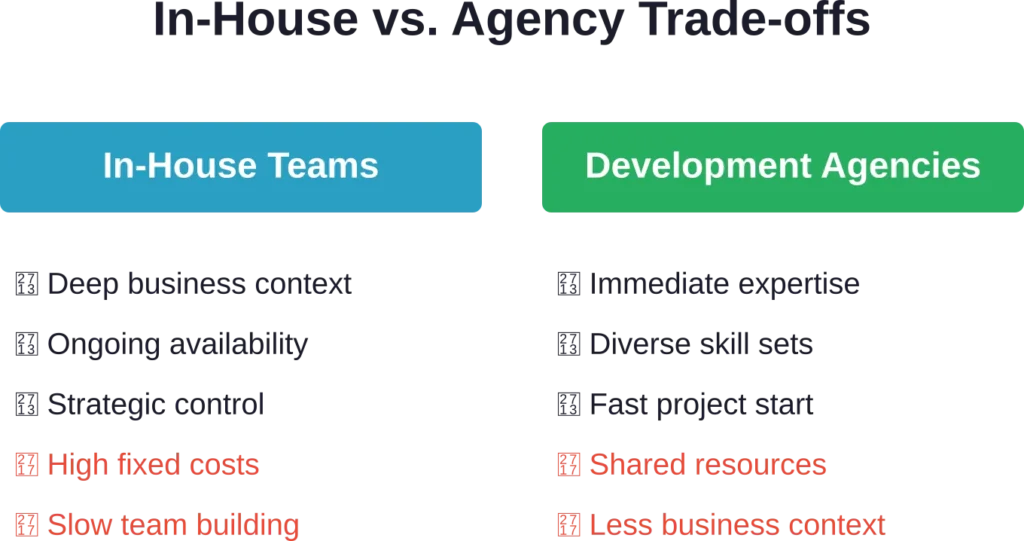
In-house teams offer ongoing availability and deep business context. Developers embedded in the organization understand company culture, strategic direction, and operational nuances. For companies where software is core to business operations, in-house capability provides strategic control.
But in-house teams require significant investment. Salaries, benefits, office space, equipment, training — costs add up quickly. Building a balanced team with frontend, backend, DevOps, and QA expertise requires multiple hires. Time-to-productivity is measured in months.
Agencies provide immediate access to diverse expertise. Need a PostgreSQL specialist? React developer? DevOps engineer? Agencies have those skills on staff. Teams ramp up quickly without long recruiting cycles.
Agencies also bring cross-project experience. Having worked with dozens or hundreds of clients, strong agencies have seen challenges before and know solutions that work. This accumulated knowledge accelerates problem-solving.
The downside? Agencies juggle multiple clients. Your project shares resources with others. Once development wraps, the team moves on. Ongoing maintenance requires either retainer agreements or internal capability.
For many companies, a hybrid model works best. Partner with an agency for initial development, then transition to a small in-house team for maintenance and incremental feature work. This approach balances speed-to-market with long-term capability.
Security Considerations for Web Applications
Security can’t be an afterthought. Applications handle sensitive data — customer information, financial transactions, proprietary business data. Breaches damage reputation, trigger regulatory penalties, and erode customer trust.
Top development companies bake security into every project phase. Threat modeling happens during architecture planning. Code reviews catch common vulnerabilities. Penetration testing validates defenses before launch.
OWASP Top 15 provides a baseline for common web application vulnerabilities: injection attacks, broken authentication, sensitive data exposure, XML external entities, broken access control, security misconfigurations, cross-site scripting, insecure deserialization, using components with known vulnerabilities, and insufficient logging and monitoring.
Strong agencies understand these risks and implement appropriate controls. Input validation prevents injection attacks. Proper authentication and session management protect user accounts. Encryption secures sensitive data in transit and at rest. Access controls ensure users only see data they’re authorized to view.
Compliance requirements add complexity. Healthcare applications must meet HIPAA standards. Financial services face PCI DSS requirements for payment card data. European customers trigger GDPR obligations. The best agencies understand relevant regulations and build compliant systems.
Security isn’t one-and-done. Ongoing maintenance includes monitoring for suspicious activity, applying security patches, and responding to newly discovered vulnerabilities. Post-launch support should explicitly address security updates.
Scalability: Building for Growth
Applications that work for 100 users often break at 10,000. Scalability requires deliberate architecture decisions from day one. Retrofitting scalability into an application designed without it is expensive and risky.
Horizontal scaling — adding more servers rather than bigger servers — is the modern approach. Cloud platforms make this practical. Applications designed to scale horizontally can grow smoothly as traffic increases.
Database architecture matters enormously. A single database server becomes a bottleneck. Solutions include read replicas, database sharding, or distributed databases. The right approach depends on data access patterns and consistency requirements.
Caching reduces load on backend systems. Content delivery networks (CDNs) cache static assets near users. Application caching stores frequently accessed data in memory. Proper caching dramatically improves response times and reduces infrastructure costs.
Asynchronous processing moves time-consuming tasks out of the request path. Users don’t wait for background jobs to complete. Queue systems handle tasks asynchronously, improving responsiveness and enabling better resource utilization.
Monitoring provides visibility into application health. Metrics track response times, error rates, resource utilization. Alerts notify teams when problems emerge. Without monitoring, issues go unnoticed until customers complain.
Elite agencies design systems that scale gracefully. Architecture choices support growth without fundamental rewrites. Infrastructure costs scale reasonably with usage. Performance remains acceptable as load increases.
Ongoing Maintenance and Support
Launch isn’t the finish line. Web applications require ongoing maintenance — security patches, bug fixes, dependency updates, infrastructure monitoring, and performance optimization.
Many agencies offer post-launch support packages. These typically include a certain number of monthly hours for maintenance tasks, priority bug fixes, and infrastructure monitoring. Costs vary based on application complexity and required response times.
Some agencies prefer time-and-materials arrangements. Monthly retainers provide predictable costs for predictable workloads. Project-based work suits occasional feature additions or major updates.
Internal teams can handle maintenance if they have relevant technical skills. This requires access to source code, documentation, infrastructure credentials, and knowledge transfer from the original development team. Agencies that write clean, documented code and provide thorough handoff make this transition smoother.
Maintenance neglect leads to technical debt. Unpatched security vulnerabilities create risk. Outdated dependencies become incompatible with modern infrastructure. Small bugs accumulate into user frustration. Regular maintenance keeps applications healthy.
Making the Final Decision
Choosing a development partner is part technical evaluation, part cultural fit. Technical capability is necessary but not sufficient. Communication style, process compatibility, and shared values matter.
Start by clarifying requirements. What problem does the application solve? Who are the users? What does success look like? Clear requirements enable meaningful agency conversations.
Narrow the field based on relevant experience. Look for agencies with portfolio work in similar industries or with similar technical requirements. Specialization typically beats generalization.
Request proposals from 3-5 agencies. Compare approaches, timelines, and costs. Beware of outliers — proposals drastically cheaper or faster than others likely reflect different scope understanding or unrealistic estimates.
Interview the actual team. Salespeople sell, but developers build. Meeting the people who’ll do the work provides insight into capability and communication style.
Trust matters. Development projects face unexpected challenges. Partnerships work best when both sides approach problems collaboratively rather than defensively. Pay attention to how agencies discuss risks and uncertainties.
Don’t optimize solely on cost. The cheapest option rarely delivers the best value. Balance price against capability, experience, and cultural fit. A slightly more expensive agency that truly understands requirements will deliver better outcomes than a cheap one that doesn’t.
Frequently Asked Questions
Development timelines vary based on complexity. Simple applications might take 4-8 weeks. Moderate complexity projects typically require 3-6 months. Enterprise systems with extensive integrations often take 9-18 months or longer. Timeline depends on scope, team size, and how quickly requirements are finalized.
Websites primarily deliver information — think company sites, blogs, portfolios. Web applications provide interactive functionality — tools users actively work with to accomplish tasks. Gmail is a web application. A company about page is a website. The line blurs, but interaction level is the key difference.
Geography matters less than it once did. Remote collaboration tools enable effective distributed work. Local agencies offer in-person meetings, which some stakeholders prefer. Remote teams often provide cost advantages while maintaining technical quality. Consider timezone overlap for communication, not just physical location.
This risk makes contractual protections important. Ensure contracts include code escrow provisions — source code is held by a third party and released to you if the agency fails to deliver. Regular code deliveries throughout the project reduce exposure. Establish that you own all work product created.
Reputable agencies provide regular code access. Modern development practices include continuous integration and staging environments where you can review work in progress. Waiting until the end to see code is outdated and risky. Regular reviews catch issues early when they’re cheaper to fix.
There’s no single best language — it depends on requirements. JavaScript (Node.js) excels at real-time features. Python offers rapid development and data processing strengths. PHP powers many content-heavy sites. .NET and Java suit enterprise environments. The best agencies match technology to project needs rather than forcing everything into one stack.
Compare proposals from multiple agencies. Outliers — much higher or lower than others — warrant scrutiny. Ask agencies to break down estimates by feature or component. Detailed breakdowns enable line-item evaluation. Request justification for any estimates that seem high. Reputable agencies explain their reasoning.
Conclusion
Finding the right web application development partner requires balancing technical capability, industry experience, communication quality, and budget reality. The 15 companies featured here represent different specializations, team sizes, and geographic footprints.
No single agency is universally best. SumatoSoft’s B2B focus fits certain projects. Brainhub’s rapid delivery model suits others. STX Next’s Python expertise solves specific challenges. The key is matching agency strengths to project requirements.
Start with clear requirements. Understand what success looks like, what constraints matter most, and what trade-offs are acceptable. This clarity enables productive agency conversations.
Evaluate portfolios critically. Look for relevant experience, not just impressive client lists. Ask pointed questions about process, team structure, and communication norms. Request references and actually contact them.
Budget appropriately. Quality custom development requires meaningful investment. Unrealistically low budgets lead to compromised quality, missed deadlines, or scope disputes. The cheapest option rarely delivers the best long-term value.
Ready to move forward? Reach out to 3-5 agencies from this list based on your project needs. Request proposals. Interview teams. Make a decision based on capability, cultural fit, and value — not just price. The right partner turns application ideas into business results.