

Quick Summary: The top web application design companies for 2026 include Lengreo, Gilzor, OSKI Solutions, A-listware, Mobian Studio, Coalition Technologies, Matic Digital, ScienceSoft, 500 Designs, Lounge Lizard, Clay, DreamX Web, Mighty Roar, Riseapps, and Norgram. These agencies excel in custom web development, UI/UX design, enterprise solutions, and digital innovation, delivering exceptional results across industries from startups to Fortune 500 companies.
Professional web application design can make or break digital success in 2026. Research confirms that 88% of online consumers will not return to a website where they’ve faced a bad user experience. The stakes are high.
With thousands of agencies claiming expertise, finding the right partner demands careful evaluation. This guide cuts through the noise to spotlight the 15 web application design companies that consistently deliver exceptional results.
These rankings reflect verified credentials, portfolio quality, industry reputation, and proven track records across diverse projects. Whether building a minimum viable product or scaling an enterprise platform, the agencies listed here represent the best options available today.
What Defines a Top Web Application Design Company in 2026
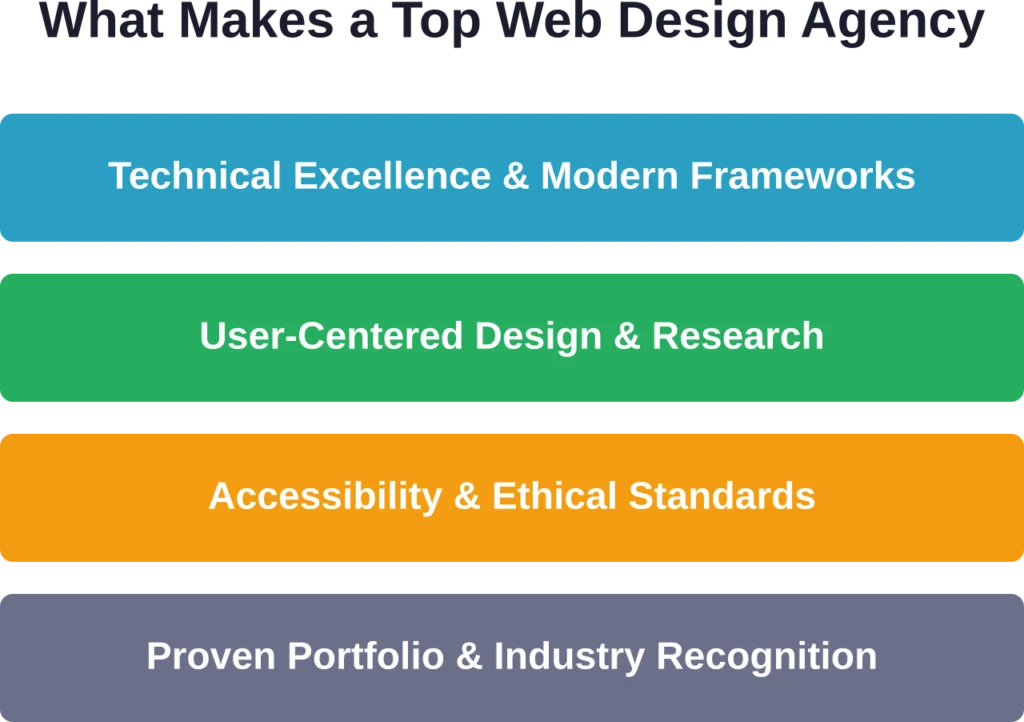
The best agencies share specific characteristics that separate them from average providers. Understanding these markers helps identify partners capable of delivering transformative results.
Technical excellence forms the foundation. Leading companies demonstrate mastery across modern frameworks, responsive design principles, and scalable architectures. They stay current with evolving technologies while maintaining stability and security.
Design thinking distinguishes exceptional work from merely functional solutions. Top firms invest heavily in user research, iterative testing, and interface refinement. They understand that user-centered design and seamless navigation are non-negotiable in today’s market.
Portfolio depth reveals capability. The strongest agencies showcase diverse projects spanning industries, complexities, and scales. Look for case studies demonstrating measurable outcomes—not just attractive screenshots.
But here’s the thing: awards matter. Platforms like Awwwards recognize the talent and effort of the best designers, web developers, and digital agencies worldwide. Companies earning Site of the Day honors or Developer Awards have proven their excellence through peer recognition.
The Role of Accessibility and Ethics
Modern web application design carries ethical responsibilities. Research shows that as many as one in five British people have a disability, yet less than 1% of website homepages are likely to meet accessibility standards for this huge segment of the population.
Leading companies prioritize inclusive design from project inception. They implement WCAG compliance, semantic HTML, keyboard navigation, and screen reader compatibility as standard practice—not afterthoughts.
Data privacy and security represent equally critical concerns. Obtaining explicit consent on how user data is used forms an essential part of establishing trust and loyalty with users.
AI Integration and Modern Workflows
Artificial intelligence has transformed design workflows. According to a 2025 report on the state of AI use in design from Foundation Capital and Designer Fund, nearly 90% of designers currently use AI in some part of their workflow.
Top agencies leverage AI for personalization, visual generation, and task automation while maintaining human creativity and strategic oversight. They understand AI as a tool that enhances—not replaces—skilled designers.
The Top 15 Web Application Design Companies for 2026
This curated list represents agencies that have demonstrated consistent excellence, innovation, and client satisfaction across numerous projects. Each brings unique strengths to the table.

1. Gilzor
Gilzor delivers custom web application design and development for startups and scaling businesses. Their team of creative and strategic thinkers builds digital products from idea validation to full-scale implementation.
The company specializes in web and mobile applications, with strong expertise in user-centric design, scalable architecture, and seamless user experiences. Their work spans e-commerce, airlines, health & wellness, and various product studios.
Gilzor excels at creating intuitive interfaces that improve conversion rates and user engagement. They combine thorough business analysis, prototyping, and quality assurance to ensure every web application meets both user needs and business goals.
What sets them apart? Their full-cycle approach that includes go-to-market strategy support, allowing clients to launch web applications that are not only technically sound but also positioned for market success from day one.
Contact Information:
- Website: www.gilzor.com
- Email: [email protected]
- Address: Poland, Warsaw, Office 58, street Adama Mickiewicza 37, 01-625
- LinkedIn: www.linkedin.com/company/gilzor-softwaredevelopment
2. Oski
Oski builds smart, well-engineered web applications for tech-forward enterprises and ambitious startups. Their focus on quality and innovation helps companies reimagine how their business operates through powerful digital solutions.
The agency specializes in complex web platforms, cloud-based applications, and modern frontend architectures. They deliver solutions across industries including e-commerce, logistics, fintech, education, and travel.
Oski particularly excels at creating scalable and performant web applications. They leverage advanced technologies and AI-accelerated engineering to build intuitive, responsive interfaces that drive efficiency and user satisfaction.
What sets them apart? Their ability to deliver production-ready web solutions with exceptional design, robust architecture, and seamless integration capabilities that support long-term business growth.
Contact Information:
- Website: oski.site
- Phone: +48571282759
- Email: [email protected]
- Address: Kaupmehe tn 7, 10114 Tallinn, Estonia
- LinkedIn: www.linkedin.com/company/oski-solutions
3. Mobian Studio
Mobian Studio creates dedicated engineering teams that deliver production-ready web applications on time and on budget. They specialize in building sophisticated digital products for companies in IT, healthcare, fintech, and logistics.
The agency focuses on end-to-end web application development, scalable architecture, and clean, well-documented code. They handle everything from complex backends to intuitive user interfaces.
Mobian Studio particularly excels at full-stack web solutions and legacy system integration. Their approach ensures web applications are built with future growth in mind and maintainable long after launch.
What sets them apart? Their dual model of project delivery and team augmentation combined with deep domain expertise, allowing them to build web applications that perform reliably under real business conditions while maintaining excellent user experiences.
Contact Information:
- Website: mobian.studio
- Phone: [email protected]
- Address: Harju maakond, Tallinn, Kesklinnalinnaosa, Masina tn 22, 10113
- LinkedIn: www.linkedin.com/company/mobian-studio

4. A-Listware
A-Listware provides expert web application design and software development services with a strong emphasis on quality and seamless delivery. They focus on creating secure, responsive, and scalable digital solutions tailored to each client’s needs.
The company specializes in custom web applications, enterprise systems, cloud solutions, and modern user interfaces. Their expertise covers UX/UI design, full-stack development, and complex system integrations.
A-Listware excels at building enterprise-grade web applications and modernizing legacy systems. They deliver solutions that combine beautiful design with powerful functionality across multiple business domains.
What sets them apart? Their dedication to creating perfectly fitted development teams and web solutions that integrate seamlessly with client processes while maintaining the highest standards of quality and performance.
Contact Information:
- Website: a-listware.com
- Phone: +1 (888) 337 93 73
- Email: [email protected]
- Address: North Bergen, NJ 07047, USA
- LinkedIn: www.linkedin.com/company/a-listware
- Facebook: www.facebook.com/alistware
5. Lengreo
Lengreo stands out as a complete marketing and tech partner specializing in web application design and development. Their integrated approach combines strategic digital marketing with powerful technical implementation.
The agency excels at building high-converting websites, e-commerce platforms, and custom web applications that drive measurable business growth. Their portfolio demonstrates success across software development, architecture, event technology, and IT services companies.
Lengreo particularly shines in data-driven web solutions. They focus on lead generation systems, conversion rate optimization, and user-centric interfaces that transform visitor traffic into qualified business opportunities.
What sets them apart? A results-oriented methodology that merges website development with full-funnel marketing support, delivering websites that don’t just look good — they actively generate clients and revenue.
Contact Information:
- Website: lengreo.com
- Phone: +31 686 147 566
- Email: [email protected]
- Address: Vrijstraat 9 C/D, 5611 AT Eindhoven, Netherlands
- LinkedIn: www.linkedin.com/company/lengreo
- Instagram: www.instagram.com/lengreo.agency
- Twitter: x.com/Lengreo
6. Clay
San Francisco-based Clay operates at the intersection of design and technology. Their multidisciplinary team includes designers, developers, and strategists who collaborate throughout project lifecycles.
Clay specializes in digital product design for web and mobile applications. They’ve partnered with companies like Google, Slack, and Snapchat to create user experiences at massive scale.
The agency’s process emphasizes rapid prototyping and user testing. They validate concepts early and iterate quickly based on real user feedback rather than assumptions.
Clay’s work demonstrates particular strength in complex information architecture and interaction design. They excel at making sophisticated functionality accessible and intuitive.

7. DreamX Web
DreamX Web brings fresh perspective to web application design with emphasis on modern aesthetics and cutting-edge functionality. Their portfolio showcases diverse projects across industries.
The agency particularly excels at custom web applications requiring unique features and integrations. They avoid template-based approaches in favor of tailored solutions aligned with specific business needs.
DreamX Web’s design process prioritizes user research and competitive analysis. They invest time understanding target audiences, market positioning, and business objectives before beginning design work.
Their technical capabilities span modern frameworks and development tools. The team stays current with evolving technologies while maintaining focus on stability and performance.
8. Mighty Roar
Mighty Roar combines strategic thinking with design excellence to create web applications that drive business results. Their approach begins with deep understanding of client objectives and market context.
The agency specializes in growth-focused design. Every interface decision connects to metrics like conversion rates, engagement, and retention rather than purely aesthetic goals.
Mighty Roar’s process emphasizes data-driven iteration. They establish baseline metrics, implement changes, measure results, and refine continuously based on actual user behavior.
Their client roster spans startups seeking product-market fit and established companies optimizing existing applications. Mighty Roar adapts methodology to match organizational maturity and resources.

9. Riseapps
Riseapps brings international perspective to web application design. Their distributed team collaborates across time zones to deliver projects for clients worldwide.
The company specializes in startup ventures and digital products requiring rapid development cycles. They excel at building minimum viable products that validate concepts quickly while maintaining quality.
Riseapps employs agile methodologies that emphasize flexibility and responsiveness. They adapt to changing requirements and market feedback without losing momentum.
Their portfolio demonstrates consistent ability to launch products on schedule and budget. Riseapps understands startup constraints and optimizes processes accordingly.
10. Norgram
Norgram represents the cutting edge of contemporary web design. This design studio earned Awwwards Site of the Day recognition on Dec 9, 2025, demonstrating excellence that peers acknowledge.
The agency describes itself as “driven by collaboration on new ideas, essential aesthetics, and meaningful impact.” Breaking away from traditional big agency models, Norgram maintains boutique focus on design quality.
Their work showcases clean, flat design principles with sophisticated typography and thoughtful use of whitespace. Norgram creates experiences that feel both modern and timeless.
The studio’s portfolio emphasizes essential aesthetics over decorative excess. Every element serves purpose, creating interfaces that communicate clearly while maintaining visual appeal.

11. Coalition Technologies
Based in California, Coalition Technologies stands at the forefront of web application design and development. Their multidisciplinary approach combines cutting-edge design with robust development and strategic digital marketing.
The agency specializes in e-commerce platforms, custom web applications, and enterprise solutions. Their portfolio spans industries from retail and healthcare to finance and technology.
Coalition Technologies excels at building scalable architectures that grow with businesses. They employ modern frameworks and development methodologies that prioritize performance, security, and maintainability.
What sets them apart? A comprehensive service model that extends beyond launch. Coalition provides ongoing optimization, analytics, and marketing support that drives measurable business results.
12. Matic Digital
Colorado-based Matic Digital brings data-driven methodology to web application design. Their analytical approach ensures every design decision supports concrete business objectives.
The agency particularly excels at conversion-focused design. They conduct extensive user research and A/B testing to identify optimal interface patterns and user flows.
Matic Digital’s client roster includes both ambitious startups and established enterprises seeking digital transformation. Their work demonstrates consistent ability to balance aesthetic excellence with functional performance.
Their process emphasizes transparency and collaboration. Clients receive detailed insights into design rationale, performance metrics, and iterative improvements throughout the engagement.
13. ScienceSoft
Texas-headquartered ScienceSoft brings 35+ years of technology experience to web application design. Their extensive history provides deep institutional knowledge across platforms, industries, and technologies.
The company specializes in complex enterprise applications requiring sophisticated functionality and integration. They handle projects involving legacy system modernization, API development, and cloud migration.
ScienceSoft’s team includes specialists in healthcare, finance, retail, and manufacturing—sectors with stringent regulatory and security requirements. They navigate compliance challenges while delivering modern, user-friendly interfaces.
Their portfolio demonstrates capability at scale. ScienceSoft regularly delivers applications supporting millions of users with demanding performance and reliability requirements.
14. 500 Designs
500 Designs operates with a laser focus on design excellence. Their California-based team consists of award-winning designers who’ve worked with leading brands worldwide.
The agency’s strength lies in creating distinctive visual identities that elevate brands while maintaining usability. They understand that effective design must balance beauty with function.
500 Designs particularly excels at responsive design that adapts seamlessly across devices. Their mobile-first approach ensures optimal experiences regardless of screen size or input method.
Client testimonials consistently highlight their collaborative process and ability to translate abstract brand concepts into concrete, effective interfaces.
15. Lounge Lizard
Lounge Lizard has earned reputation as a premier digital agency handling sophisticated web applications for major brands. Their New York and Los Angeles offices serve clients nationwide.
The agency brings full-service capabilities spanning strategy, design, development, and marketing. This integrated approach ensures consistency across all digital touchpoints.
Lounge Lizard’s portfolio includes work for Fortune 500 companies alongside innovative startups. They demonstrate versatility across B2B and B2C contexts, adjusting approach based on target audiences and business models.
Their design philosophy emphasizes storytelling and emotional connection. Lounge Lizard crafts experiences that resonate with users while driving measurable business outcomes.
How to Choose the Right Web Application Design Company
Selecting the optimal agency partner requires methodical evaluation across multiple dimensions. The right choice depends on specific project requirements, organizational context, and long-term objectives.
Assess Portfolio Relevance
Start by examining portfolios for projects similar to your needs. Look for work in your industry, at comparable scale, and addressing similar challenges.
Don’t just admire visual aesthetics. Dig into case studies to understand problem-solving approaches, technical implementations, and measurable outcomes. Strong agencies document their thinking and results transparently.
Pay attention to variety. Agencies showcasing diverse styles demonstrate adaptability rather than rigid house aesthetics. They should tailor approaches to client needs rather than forcing every project into predetermined templates.
Evaluate Technical Capabilities
Modern web applications demand sophisticated technical skills. Verify that prospective agencies possess expertise in technologies relevant to your project.
Ask about their development stack, hosting infrastructure, security practices, and performance optimization techniques. Technical decisions early in projects have long-term implications for scalability and maintenance.
Look, technical debt accumulates when agencies cut corners or lack depth. Choose partners who build sustainably rather than racing to launch regardless of long-term consequences.
Understand Process and Communication
The best technical skills mean little without effective collaboration. Investigate how agencies structure projects, involve clients, and communicate progress.
Ask about methodology—agile, waterfall, or hybrid approaches each suit different project types. Understand milestone definitions, approval processes, and feedback mechanisms.
Communication cadence matters enormously. Weekly check-ins, shared project management tools, and transparent issue tracking prevent surprises and maintain alignment.
Consider Long-Term Partnership Potential
Web applications require ongoing maintenance, updates, and optimization. Evaluate whether agencies offer post-launch support or leave clients stranded after delivery.
The strongest partnerships extend beyond single projects. Agencies that invest in understanding business models and growth trajectories provide increasingly valuable strategic input over time.
Ask about client retention rates and long-term relationships. Agencies with numerous multi-year clients demonstrate sustained value delivery beyond initial launches.
Key Services Offered by Leading Web Application Design Companies
Top agencies provide comprehensive service portfolios addressing diverse needs throughout application lifecycles. Understanding service categories helps identify partners with appropriate capabilities.
Strategy and Research
Projects begin with strategic foundation. Leading companies conduct market research, competitive analysis, user interviews, and technical audits before design work begins.
This discovery phase identifies opportunities, constraints, and requirements that inform all subsequent decisions. Skipping strategic groundwork increases risk of building applications that miss market needs.
User research particularly drives design excellence. Top agencies employ surveys, usability testing, analytics analysis, and ethnographic research to understand target audiences deeply.
UI/UX Design
Interface design represents the most visible agency deliverable. This encompasses information architecture, wireframing, visual design, and interactive prototyping.
Leading companies approach UI/UX holistically. They consider user journeys across multiple touchpoints, design systems for consistency, and accessibility from project inception.
Modern design processes emphasize iteration. Agencies create prototypes, gather feedback, refine designs, and test repeatedly before development begins. This reduces costly changes during implementation.
Custom Development
Technical implementation transforms designs into functional applications. Top agencies employ experienced developers skilled in modern frameworks, databases, and infrastructure.
Custom development services span front-end interfaces, back-end logic, database architecture, API integrations, and third-party service connections. Comprehensive capabilities enable end-to-end delivery.
Quality development practices include code review, automated testing, documentation, and security auditing. These disciplines ensure applications remain maintainable and secure long-term.
Mobile and Responsive Design
Multi-device support is no longer optional. Leading agencies design responsively from the start, ensuring optimal experiences across phones, tablets, and desktops.
Some projects require dedicated mobile applications alongside web interfaces. Full-service agencies handle native iOS and Android development or progressive web apps depending on requirements.
Responsive design involves more than shrinking desktop layouts. Touch interfaces, reduced bandwidth, and different usage contexts demand thoughtful adaptation of functionality and content.
Digital Marketing Integration
Beautiful applications mean nothing without users. Top agencies integrate marketing considerations throughout design, from SEO-friendly architectures to conversion-optimized interfaces.
Services often include content strategy, search engine optimization, analytics implementation, and performance tracking. Data-driven agencies use metrics to guide ongoing optimization.
Some companies provide full-service digital marketing including paid advertising, email campaigns, and social media management. This comprehensive approach aligns all channels toward business objectives.
| Service Category | Key Deliverables | Business Impact |
|---|---|---|
| Strategy & Research | User research, competitive analysis, technical audits, requirements documentation | Reduces risk by validating assumptions and identifying opportunities before major investment |
| UI/UX Design | Wireframes, prototypes, visual designs, design systems, style guides | Creates intuitive experiences that drive engagement, conversion, and user satisfaction |
| Custom Development | Front-end code, back-end logic, database design, API integrations, testing | Delivers scalable, secure technical foundation supporting business growth |
| Mobile & Responsive | Responsive layouts, native apps, progressive web apps, cross-device testing | Ensures consistent experience across devices where users engage with applications |
| Marketing Integration | SEO optimization, analytics, conversion tracking, content strategy | Drives user acquisition and provides data for continuous optimization |
Web Application Design Trends Shaping 2026
The digital landscape evolves constantly. Leading agencies stay ahead of trends while discerning lasting shifts from temporary fads.
AI-Powered Personalization
Artificial intelligence enables unprecedented personalization. Modern applications adapt content, recommendations, and interfaces based on individual user behavior and preferences.
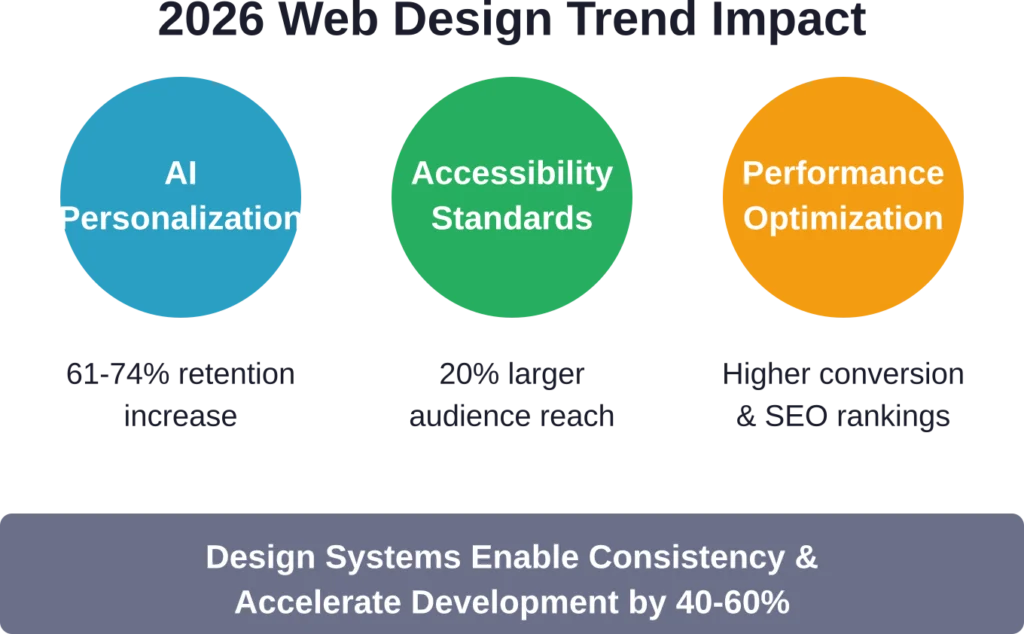
A study of mobile users highlights the power of personalization: brands that send tailored in-app messages retain between 61% and 74% of their users in the subsequent 28 days. This represents massive competitive advantage.
Leading agencies implement AI thoughtfully, balancing personalization benefits against privacy concerns and technical complexity. Ethical AI use respects user autonomy while delivering relevant experiences.
Accessibility as Standard Practice
Accessibility has shifted from niche consideration to baseline expectation. Organizations face legal requirements alongside moral imperatives to serve all users regardless of abilities.
Top agencies implement WCAG 2.1 Level AA standards as minimum. This includes keyboard navigation, screen reader compatibility, sufficient color contrast, and clear content structure.
Accessibility benefits extend beyond disabled users. Clear hierarchy, descriptive labels, and logical flows improve experiences for everyone while expanding potential audiences.
Minimalist and Essential Design
Visual trends favor restraint over decoration. Contemporary interfaces emphasize whitespace, typography, and essential elements rather than gratuitous ornament.
This aesthetic serves functional purposes. Reduced visual noise focuses attention on important content and actions. Simpler interfaces load faster and adapt more easily across devices.
Companies like Norgram exemplify this approach, creating designs that feel both sophisticated and approachable through careful element selection and spatial relationships.
Performance Optimization
Users increasingly demand instant responses. Page load times directly impact bounce rates, conversion rates, and search rankings.
Leading agencies prioritize performance through optimized images, efficient code, content delivery networks, and strategic caching. They measure Core Web Vitals and optimize relentlessly.
Performance considerations influence design decisions from project inception. Heavy animations and large images that degrade experience get eliminated regardless of aesthetic appeal.
Design Systems and Consistency
Organizations with multiple digital properties benefit enormously from design systems—comprehensive libraries of reusable components, patterns, and guidelines.
Systems ensure consistency across applications while accelerating development. Teams build with pre-validated components rather than reinventing interfaces repeatedly.
Top agencies create robust design systems documented in tools like Figma. These systems evolve alongside applications, capturing learnings and expanding capabilities over time.
Questions to Ask When Evaluating Web Design Agencies
Thorough vetting separates agencies making empty promises from those delivering real value. These questions reveal capabilities, processes, and cultural fit.
About Their Process
How do you approach discovery and research phases? What deliverables should we expect before design begins?
How do you involve clients throughout projects? What decisions require our approval versus internal team discretion?
What project management tools and communication channels do you use? How frequently will we receive updates?
About Their Capabilities
Can you show examples of projects similar to ours in industry, scale, and complexity?
What technologies and frameworks do you specialize in? Why do you recommend those for our project?
How do you handle accessibility, security, and performance optimization?
About Outcomes and Support
How do you measure project success? What metrics will we track?
What post-launch support do you provide? How are maintenance and updates handled?
Can you provide references from similar clients? What would they say about working with you?
About Practical Details
What’s the realistic timeline for our project? What factors might extend that?
Who will actually work on our project day-to-day? Can we meet the core team?
How do you handle scope changes and additional requests during projects?
Real talk: agencies hesitant to answer these questions transparently probably aren’t right partners. The best firms welcome scrutiny because they’re confident in their approaches and track records.
The Business Impact of Professional Web Application Design
Investing in quality design delivers measurable returns across multiple business dimensions. Understanding these impacts helps justify appropriate budgets and timelines.
User Acquisition and Retention
First impressions form rapidly. Users typically take just 50 milliseconds to assess the visual appeal of a website, and that assessment heavily influences whether they stay or depart.
Poor design drives users away permanently. Research confirms that 88% of online consumers will not return to a website where they’ve faced a bad user experience.
Conversely, exceptional design creates competitive differentiation. In crowded markets, superior user experience becomes primary distinguishing factor between functionally similar offerings.
Conversion Rate Optimization
Interface design directly impacts conversion rates at every funnel stage. Strategic layout, clear calls-to-action, and friction reduction compound to significantly affect business outcomes.
Small improvements multiply dramatically at scale. A two percent conversion increase on an application processing ten thousand transactions monthly generates substantial additional revenue.
Data-driven agencies like Matic Digital and Mighty Roar specialize in conversion-focused design, conducting systematic testing to identify optimal patterns.
Development Efficiency
Comprehensive upfront design reduces development costs and timelines. When developers receive complete specifications with validated designs, they build efficiently without constant backtracking.
Design systems accelerate development particularly dramatically. Reusable components eliminate redundant work while ensuring consistency. Teams report 40-60% faster feature development with mature design systems.
Technical debt accumulates when design decisions get made during development. This creates inconsistent implementations requiring expensive refactoring later.
Brand Perception and Trust
Digital experiences shape brand perception powerfully. Polished applications signal professionalism, reliability, and attention to detail. Clunky interfaces suggest carelessness regardless of actual product quality.
Security perception connects to design quality. Users judge application trustworthiness partly on visual polish and professional presentation, even though these don’t directly indicate security.
Consistent design across properties reinforces brand identity. Users encountering cohesive experiences develop stronger brand associations and loyalty.
Scalability and Flexibility
Well-architected applications accommodate growth and change efficiently. Solid technical foundations support feature additions, traffic increases, and market expansions without fundamental rebuilds.
Modular design systems enable rapid iteration. Organizations test new features, gather feedback, and refine continuously rather than waiting for major redesign cycles.
Future-focused agencies like ScienceSoft and Coalition Technologies emphasize scalable architectures that protect long-term investments.
| Business Metric | Design Impact | Typical Improvement Range |
|---|---|---|
| User Retention | Improved UX reduces abandonment and increases return visits | 15-40% increase in return users |
| Conversion Rate | Optimized flows and clear CTAs drive action completion | 20-200% conversion lift |
| Development Speed | Design systems and specifications reduce development time | 40-60% faster feature delivery |
| Support Costs | Intuitive interfaces reduce user confusion and support tickets | 25-50% fewer support requests |
| SEO Performance | Technical optimization and performance improve search rankings | 30-100% organic traffic increase |
Red Flags to Watch When Selecting an Agency
Not all agencies deliver on promises. Recognizing warning signs protects against costly mistakes and failed projects.
Unrealistic Promises
Beware agencies guaranteeing specific outcomes like ranking positions or conversion rates. Too many variables lie outside their control to make such commitments.
Similarly, suspicious timelines signal problems. Complex applications require adequate time for research, design, development, and testing. Rush jobs accumulate technical debt and quality issues.
Template-based approaches disguised as custom work represent another red flag. Agencies should tailor solutions to specific needs rather than forcing projects into predetermined molds.
Poor Communication Patterns
Slow response times during sales processes foreshadow worse communication during actual projects. Agencies should demonstrate responsiveness and clarity from initial contact.
Reluctance to document processes or provide detailed proposals suggests disorganization. Professional agencies operate systematically with clear methodologies and deliverables.
Overly technical jargon without plain-language explanation indicates poor client orientation. Strong agencies translate technical concepts accessibly.
Portfolio Limitations
Portfolios featuring only templated designs or single industries reveal limited versatility. While specialization has value, some breadth demonstrates adaptability.
Missing case studies or outcome data suggests agencies focus on aesthetics over results. Look for documented problem-solving and measurable improvements.
Outdated portfolio work raises concerns about current capabilities. Technology and design trends evolve rapidly—portfolios should reflect contemporary standards.
Contractual Issues
Vague scopes of work create disputes later. Comprehensive proposals specify deliverables, timelines, responsibilities, and change management processes clearly.
Unfavorable intellectual property terms occasionally appear. Verify that you’ll own all work products and can engage other vendors for maintenance if needed.
Missing post-launch support provisions leave clients stranded. Clarify bug fixing, update procedures, and ongoing optimization before signing.
The Value of Award-Winning Design
Industry recognition from platforms like Awwwards provides meaningful signals about agency capabilities. These aren’t vanity metrics—peer-reviewed awards indicate genuine excellence.
Awwwards recognizes the talent and effort of the best designers, web developers, and digital agencies. Winning Site of the Day honors requires exceptional work across design, usability, creativity, and technical implementation.
Companies like Norgram and Studio Dado have earned Site of the Day recognition. KVS Studio earned a Site of the Day award. These awards validate capabilities more credibly than self-promotion.
That said, awards aren’t everything. Some excellent agencies focus entirely on client work without entering competitions. Evaluate awards as one factor among many rather than sole decision criteria.
Frequently Asked Questions
Examine portfolios for projects similar to yours in industry, complexity, and scale. Look beyond visual aesthetics to understand problem-solving approaches through detailed case studies. Strong portfolios demonstrate variety across industries and styles, showing adaptability rather than rigid house aesthetics. Verify that agencies document measurable outcomes and user research backing design decisions. Missing case studies or outcome data suggests focus on appearance over results.
Timelines vary dramatically based on project complexity and scope. Simple applications with standard features may require 8-12 weeks from discovery through launch. Mid-complexity applications with custom functionality typically need 4-6 months. Enterprise applications with sophisticated requirements, integrations, and compliance needs often require 9-12 months or longer. Comprehensive projects include discovery, design, development, testing, and refinement phases that shouldn’t be rushed without sacrificing quality.
Responsive design serves most use cases effectively, adapting web applications seamlessly across devices. Consider dedicated native applications when projects require device-specific features like camera access, push notifications, offline functionality, or performance-intensive operations. Progressive web apps provide middle ground, offering app-like experiences through web technologies. Discuss specific requirements with agencies to determine optimal approach based on target audiences, features, and budget constraints.
UI (user interface) design focuses on visual elements—layouts, colors, typography, buttons, and aesthetic presentation. UX (user experience) design encompasses broader interaction patterns, information architecture, user flows, and overall journey through applications. UX research and strategy inform what features exist and how they’re organized. UI design determines how those features look and feel. Both disciplines intertwine closely—exceptional applications require excellence in both areas working cohesively.
Accessibility is critically important both ethically and practically. Research shows one in five British people have disabilities, yet less than 1% of website homepages meet accessibility standards. Implementing WCAG standards ensures applications serve all users regardless of abilities, expanding potential audiences significantly. Accessibility also carries legal implications—organizations face litigation for inaccessible digital properties. Beyond compliance, accessible design benefits everyone through clearer hierarchy, better labels, and logical flows.
Both approaches work effectively with proper processes. Local agencies offer face-to-face meetings and shared time zones, which some clients prefer for complex projects. Remote agencies expand options dramatically, accessing top talent regardless of geography. Modern collaboration tools enable seamless distributed work when agencies have strong communication practices. Evaluate agencies primarily on capabilities, process, and cultural fit rather than location. Verify remote agencies demonstrate responsive communication and systematic project management before committing.
Applications require continuous maintenance including security updates, framework upgrades, bug fixes, performance monitoring, and content updates. Hosting infrastructure needs monitoring for uptime, security threats, and capacity management. Analytics review identifies optimization opportunities and user issues. Feature enhancements and design refinements keep applications competitive as user needs evolve. Budget 15-20% of initial development costs annually for maintenance and iterative improvements. Clarify post-launch support arrangements before projects begin to avoid surprises later.
Conclusion: Choosing Your Web Application Design Partner
The 15 agencies profiled here represent the strongest options available in 2026. Each brings distinct strengths, specializations, and approaches to web application design.
Coalition Technologies excels at comprehensive full-service engagements. Matic Digital leads in data-driven, conversion-focused work. ScienceSoft handles complex enterprise requirements with deep technical expertise. And Norgram pushes creative boundaries with award-winning contemporary design.
The right choice depends entirely on specific project requirements, organizational context, and long-term objectives. No single agency suits every situation—success comes from matching capabilities to needs.
Start by clarifying project scope, budget, and timeline constraints. Define success metrics beyond aesthetics—conversion rates, user retention, performance benchmarks. Evaluate agencies against those specific criteria rather than generic reputation.
Request detailed proposals from 3-4 shortlisted agencies. Compare not just deliverables but processes, communication approaches, and cultural alignment. The strongest technical skills mean little without effective collaboration.
Check references thoroughly. Speak with past clients about actual experiences, not just portfolio highlights. Ask about communication quality, problem-solving ability, and post-launch support.
Remember: professional web application design represents investment, not expense. Quality work delivers measurable returns through improved user acquisition, higher conversion rates, reduced support costs, and sustainable technical foundations.
The 88% of users who won’t return after bad experiences won’t give second chances. Get it right the first time by partnering with proven experts who understand both design excellence and business outcomes.
Ready to elevate your digital presence? Research these 15 agencies thoroughly, evaluate against your specific needs, and choose the partner positioned to transform your vision into exceptional reality.