

Quick Summary: The best web design companies combine strategic thinking with technical excellence to create websites that drive business results. This guide profiles 15 top agencies recognized for their design innovation, client satisfaction, and proven track records across diverse industries, helping you find the right partner for your next web project without focusing on pricing or hourly rates.
Finding the right web design company can make or break the digital presence of a brand. A great website isn’t just about aesthetics—it’s about user experience, conversion optimization, and creating a digital foundation that scales with business growth.
The challenge? Hundreds of agencies claim to be the best. Some specialize in cutting-edge interfaces for startups. Others focus on enterprise-level solutions or ecommerce platforms.
This guide cuts through the noise. The 15 agencies featured here have been selected based on their design quality, client reviews, industry recognition, and demonstrated ability to deliver results across different project types.
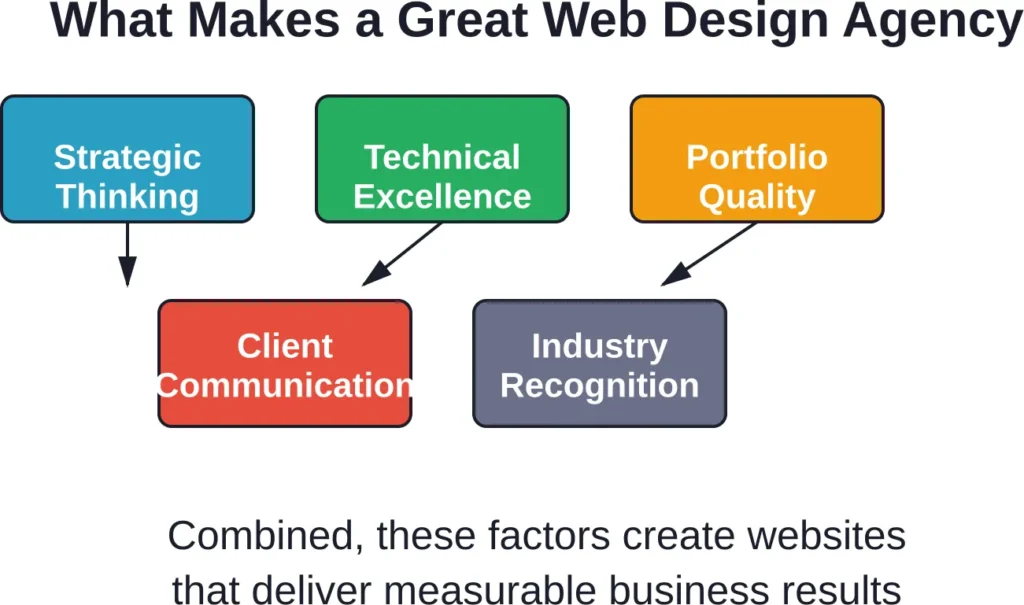
What Makes a Great Web Design Company
Before diving into specific agencies, it helps to understand what separates exceptional web design firms from mediocre ones.
Great web design companies don’t just make things look pretty. They approach projects strategically, asking hard questions about business goals, target audiences, and conversion pathways before a single pixel gets pushed.
Design Process and Methodology
Top agencies follow structured processes that include research, wireframing, prototyping, and iterative testing. They involve clients at key decision points but don’t require endless approval cycles that slow progress.
The best firms balance creativity with practicality. They know when to push boundaries and when to follow established patterns that users already understand.
Technical Expertise
Modern web design requires more than visual skills. Leading agencies understand frontend development, responsive design principles, accessibility standards, and performance optimization.
They build websites that load quickly, work flawlessly across devices, and provide smooth experiences regardless of connection speed or browser choice.
Portfolio Quality and Diversity
A strong portfolio demonstrates range. Look for agencies that have tackled different industries, project sizes, and technical challenges.
According to Awwwards, which recognizes exceptional web design through its Site of the Day awards, the best agencies consistently push creative boundaries while maintaining usability and performance standards.
Client Relationships and Communication
Design projects require collaboration. Top agencies communicate clearly, set realistic expectations, and stay responsive throughout the engagement.
Client reviews on platforms like Clutch provide insight into how agencies handle feedback, meet deadlines, and support projects after launch.
Top 15 Web Design Companies in 2026
The following agencies represent the best in web design across different specializations, company sizes, and geographic locations. Each brings unique strengths to the table.
1. Oski
Oski designs, develops, and maintains well-engineered software solutions with a particular strength in frontend experiences and digital platforms. The agency supports tech-forward enterprises and ambitious startups that demand both innovation and reliability.
What sets Oski apart is their integration of modern web technologies with intelligent design systems. They create interfaces that feel fast, responsive, and aligned with complex business requirements while maintaining exceptional user experiences.
The agency delivers solutions across travel, logistics, e-commerce, education, fintech, and insurance industries. Their web projects combine strong visual design with robust functionality and performance optimization.
Oski’s team brings together expertise in frontend frameworks, cloud architecture, and user interface design. This multidisciplinary approach results in digital products that scale effectively and adapt to evolving business needs.
Contact Information:
- Website: oski.site
- Phone: +48571282759
- Email: [email protected]
- Address: Kaupmehe tn 7, 10114 Tallinn, Estonia
- LinkedIn: www.linkedin.com/company/oski-solutions
2. Lengreo
Lengreo has built a strong reputation as a complete marketing and tech partner for B2B companies seeking growth through digital channels. The agency delivers integrated solutions where website development serves as a core foundation for lead generation and conversion.
What sets Lengreo apart is their results-driven approach that combines strategic marketing with high-performing websites. They create digital experiences specifically engineered to turn visitors into qualified opportunities and long-term clients.
The agency works with software development companies, architecture firms, event technology providers, and sports tech platforms. Their website projects focus on clear value communication, optimized user flows, and measurable business outcomes.
Lengreo’s team approaches each project by first understanding the client’s target audience and sales process. This informs website architecture, design decisions, and conversion paths that support sustainable business growth.
Contact Information:
- Website: Lengreo.com
- Phone: +31 686 147 566
- Email: [email protected]
- Address: Vrijstraat 9 C/D, 5611 AT Eindhoven, Netherlands
- LinkedIn: Lengreo
- Twitter: @Lengreo
- Instagram: @lengreo
3. A-listware

A-listware provides software development and consulting with a dedicated focus on creating exceptional user interfaces and digital experiences. The company acts as a reliable partner for enterprises, SMEs, and startups seeking high-quality web solutions.
What sets A-listware apart is their ability to deliver seamless, responsive digital products that combine technical excellence with thoughtful UX/UI design. They build systems that integrate smoothly with client operations while prioritizing end-user satisfaction.
The agency works with a diverse range of clients, including established enterprises and growing technology companies. Their portfolio features enterprise applications, custom web platforms, and modern interfaces built for real business impact.
A-listware’s team manages every aspect of web development from initial consulting through design, implementation, and ongoing support. This end-to-end approach ensures consistent quality and alignment with each client’s strategic goals.
Contact Information:
- Website: a-listware.com
- Phone: +1 (888) 337 93 73
- Email: [email protected]
- Address: North Bergen, NJ 07047, USA
- LinkedIn: www.linkedin.com/company/a-listware
- Facebook: www.facebook.com/alistware
4. Gilzor
Gilzor specializes in building custom digital products with a strong emphasis on web and mobile applications that drive real user adoption. The studio creates solutions for startups and established businesses looking to launch or scale through thoughtful digital experiences.
What sets Gilzor apart is their full-cycle approach that starts with idea validation and user research, moving through UI/UX design into robust web development. Every project is built to feel intuitive while delivering measurable improvements in engagement and conversion.
The studio has delivered web and mobile solutions across airlines, e-commerce grocery platforms, and health & wellness applications. Their work consistently focuses on functional, attractive interfaces that connect products with their audiences.
Gilzor’s team works closely with clients through discovery, prototyping, and iterative development. This collaborative process ensures websites and applications not only look polished but also perform effectively in real market conditions.
Contact Information:
- Website: www.gilzor.com
- Email: [email protected]
- Address: Poland, Warsaw, Office 58, street Adama Mickiewicza 37, 01-625
- LinkedIn: www.linkedin.com/company/gilzor-softwaredevelopment
5. Mobian
Mobian builds dedicated engineering teams that deliver production-ready digital products for companies in IT, healthcare, fintech, and logistics. The studio focuses on creating scalable web and mobile solutions that competitors struggle to match in speed and quality.
What sets Mobian apart is their ability to combine senior-level execution with clean architecture and user-centered design. They treat every web project as a complete product experience, from initial concept through ongoing optimization.
The studio partners with organizations that need reliable digital solutions, delivering everything from complex web platforms to AI-enhanced interfaces. Their projects emphasize performance, intuitive navigation, and seamless integration with existing systems.
Mobian’s approach includes dedicated teams working exclusively on client projects with full-stack delivery. This model ensures websites and applications are built with long-term scalability and maintainability in mind.
Contact Information:
- Website: mobian.studio
- Phone: [email protected]
- Address: Harju maakond, Tallinn, Kesklinnalinnaosa, Masina tn 22, 10113
- LinkedIn: www.linkedin.com/company/mobian-studio
6. Studio.909
Studio.909 focuses on immersive web design for startups and creative companies. The agency specializes in landing pages designed to capture attention and drive conversions.
Recognized by Awwwards with an Honorable Mention in 2025, Studio.909 builds next-level digital experiences that balance visual impact with functionality. Their landing pages feature bold typography, dynamic layouts, and strategic use of white space.
The studio’s approach emphasizes speed to market without sacrificing quality. They help early-stage companies establish strong digital presences quickly.
Studio.909 works particularly well with clients who want modern, attention-grabbing designs that communicate innovation and forward thinking.
7. Basic Agency (DEPT)
Basic Agency, now part of DEPT, brings a refined aesthetic to digital design projects. The agency has worked with major consumer brands and technology companies to create websites that feel premium and polished.
Their design philosophy emphasizes simplicity and clarity. Layouts are clean, typography is carefully considered, and every element serves a purpose.
Basic’s portfolio demonstrates versatility across industries. They’ve created ecommerce experiences, brand websites, and campaign microsites with equal success.
The agency balances creative ambition with practical considerations like content management systems, SEO requirements, and analytics integration.
8. Ueno
Ueno has built a global reputation for design work that combines European sensibilities with Silicon Valley tech culture. The agency operates from offices in San Francisco, New York, and Iceland.
Their approach emphasizes both brand identity and digital product design. Many projects involve creating comprehensive design systems that work across websites, mobile apps, and marketing materials.
Ueno’s team includes designers, writers, and developers who collaborate intensively. This cross-functional approach ensures that strategy, design, and implementation align throughout projects.
The agency works with venture-backed startups, established tech companies, and traditional brands undergoing digital transformation.
9. Code and Theory
Code and Theory operates as a digital-first creative agency with significant scale. With offices across multiple continents and a team of hundreds, they handle complex projects for enterprise clients.
The agency combines strategic consulting with creative execution. Projects often involve extensive research, stakeholder alignment, and phased implementation across multiple touchpoints.
Code and Theory’s work spans websites, digital platforms, mobile applications, and marketing campaigns. Their scale allows them to handle projects that smaller agencies might struggle with.
They work primarily with large corporations, financial services firms, and global brands that need both creative excellence and operational reliability.
10. Build in Amsterdam
Build in Amsterdam approaches digital design with a focus on interaction and motion. The agency creates websites that feel alive through carefully choreographed animations and transitions.
Their work demonstrates technical sophistication in areas like WebGL, canvas animations, and performance optimization. Websites load quickly despite rich visual elements.
Build in Amsterdam’s portfolio includes work for fashion brands, technology companies, and cultural institutions. Each project features distinctive visual treatments tailored to the brand.
The agency’s European base brings a different aesthetic sensibility than American agencies, with influences from Dutch design traditions and broader European art movements.
11. Clay
Clay has built a reputation as one of the most sought-after design agencies for startups and high-growth companies. Based in San Francisco, the agency focuses on UI/UX design with a product-first approach.
What sets Clay apart is their understanding of how design impacts product adoption and user retention. They don’t just create beautiful interfaces—they build systems that support long-term product evolution.
The agency’s client list includes well-known technology companies and startups that have gone on to raise significant funding. Their work combines clean aesthetics with thoughtful interaction design.
Clay’s team approaches each project with deep research into user behavior and business objectives. This foundation informs design decisions that feel both intuitive and distinctive.
12. Excited Agency
Excited Agency takes a product-focused approach to web design, emphasizing clarity and conversion over surface-level aesthetics. The agency combines UX research, web design, branding, and motion design into cohesive digital experiences.
Their process starts with understanding the product and its market positioning. Then they create websites that communicate value propositions clearly and guide users toward meaningful actions.
The agency works primarily with B2B companies and SaaS platforms, building websites that scale alongside product development. Their designs prioritize information architecture and user flows that support complex buying decisions.
Excited’s portfolio demonstrates a consistent focus on performance and conversion metrics, not just visual impact.
13. Instrument

Instrument operates at the intersection of brand strategy and digital product design. Based in Portland with additional locations in New York and Los Angeles, the agency works with major brands and innovative startups alike.
The firm’s approach combines strategic thinking with technical execution. They handle everything from initial brand positioning through detailed interface design and frontend development.
Instrument’s work often features bold visual design paired with smooth animations and interactions. But the flash never comes at the expense of usability or performance.
Their client roster includes technology companies, consumer brands, and cultural institutions. The diversity of work showcases versatility across different design challenges and business contexts.
14. Fantasy
Fantasy has made a name designing websites for creative companies, fashion brands, and cultural organizations. Their work is immediately recognizable—distinctive typography, sophisticated layouts, and attention to detail.
The agency treats each website as a unique expression of the brand’s identity rather than following templates or established patterns. This approach creates memorable digital experiences that stand apart from competitors.
Fantasy’s team includes designers, developers, and strategists who collaborate closely throughout projects. The result is websites where form and function feel inseparable.
While their aesthetic leans contemporary and refined, the underlying structure remains logical and user-friendly. Navigation stays intuitive even when the visual presentation pushes boundaries.
15. Locomotive
Locomotive, based in Montreal, specializes in creating immersive web experiences with sophisticated animations and scroll-based interactions. Their technical capabilities set them apart in the industry.
The agency develops custom frameworks and tools that enable complex interactions while maintaining smooth performance. Their open-source contributions to the web development community demonstrate their technical depth.
Locomotive’s projects often feature parallax scrolling, WebGL effects, and other advanced techniques. But these elements always serve the content and user experience rather than existing for their own sake.
They work with brands that want websites to feel more like interactive experiences than static pages. Industries include fashion, automotive, and entertainment.
How to Choose the Right Web Design Company
Selecting a design partner involves more than reviewing portfolios. The right agency for one project might be wrong for another.
Define Project Goals and Requirements
Start by clarifying what success looks like. Is the website primarily about brand awareness, lead generation, ecommerce transactions, or something else?
Different goals require different approaches. An agency that excels at creative brand expression might not be the best choice for conversion-optimized landing pages.
Document technical requirements too. Does the website need to integrate with specific systems? Are there content management requirements? What about hosting and maintenance?
Evaluate Portfolio Fit
Look for agencies that have solved problems similar to the ones facing your project. Industry experience can be valuable, though creative cross-pollination from other sectors sometimes brings fresh perspectives.
Pay attention to the variety in an agency’s portfolio. Firms that show too much similarity across projects might be applying templates rather than custom solutions.
According to Awwwards, which showcases exceptional web design through its recognition programs, the best agencies demonstrate consistent quality across diverse projects rather than relying on a single aesthetic approach.
Consider Company Culture and Communication Style
Design projects require collaboration. The agency’s communication style and working methods should align with internal team preferences.
Some agencies prefer detailed documentation and structured check-ins. Others work more fluidly with frequent informal communication. Neither approach is inherently better, but mismatches create friction.
Request reference calls with past clients. Ask about responsiveness, how feedback was handled, and whether the agency met deadlines.
Assess Technical Capabilities
Beautiful design means nothing if the website doesn’t perform. Top agencies understand technical constraints and possibilities.
They build responsive websites that work across devices. They optimize for speed and performance. They consider SEO implications and accessibility standards from the beginning.
Ask about their development process. Do they build custom or use platforms like WordPress, Shopify, or Webflow? What’s their approach to testing and quality assurance?
Review Client Testimonials and Case Studies
Client reviews provide insight into what working with an agency actually feels like. Platforms like Clutch aggregate verified reviews from past clients.
Case studies reveal how agencies approach problems, not just final outputs. Look for documentation of their process, the challenges they faced, and how they measured success.
Be cautious of agencies that only show visual work without explaining strategy or results. Great design should connect to business outcomes.
Current Web Design Trends Shaping the Industry
Understanding current trends helps contextualize the work top agencies are producing. But trends should inform decisions, not dictate them.
Minimalism and White Space
Clean, uncluttered designs continue to dominate, especially in B2B and technology sectors. Generous white space creates breathing room and focuses attention on key elements.
This trend reflects broader shifts toward simplicity in user interfaces. Users have become more sophisticated and don’t need heavy-handed visual cues.
Bold Typography
Large, distinctive typography has become a primary design element. Agencies use type to create visual hierarchy, establish personality, and communicate brand values.
Custom fonts and variable typography allow for unique expressions that differentiate brands in crowded markets.
Dark Mode and Alternative Color Schemes
Dark mode options have moved from nice-to-have to expected, especially for digital products and technology companies. They reduce eye strain and can save battery life on OLED screens.
More broadly, agencies are moving beyond conventional color palettes to create distinctive brand experiences through color.
Micro-interactions and Animation
Subtle animations guide attention, provide feedback, and make interfaces feel responsive. Top agencies use motion purposefully rather than gratuitously.
Scroll-based animations reveal content progressively. Hover states provide visual confirmation. Loading transitions maintain engagement during necessary delays.
Accessibility and Inclusive Design
Accessibility has shifted from checkbox compliance to fundamental design principle. Leading agencies build websites that work for users with diverse abilities.
This includes proper semantic HTML, keyboard navigation, screen reader compatibility, sufficient color contrast, and thoughtful interaction patterns.
AI Integration and Personalization
Artificial intelligence is beginning to influence web design, though the technology remains in early stages. Research from Smashing Magazine notes that AI-driven caching can increase cache hit rates by 15%, improving data availability and reducing latency.
However, the same research points out that according to research on AI sustainability, data centers consume significant global electricity, raising questions about the environmental impact of energy-intensive AI tools in web development.
Agencies are exploring how AI can personalize content, optimize layouts, and improve user experiences while being mindful of sustainability concerns.
Questions to Ask Potential Web Design Partners
These questions help evaluate whether an agency is the right fit:
- What’s your typical design and development process from kickoff to launch?
- How do you handle feedback and revisions during the project?
- What platforms or technologies do you typically build with?
- Can you share examples of projects similar to ours?
- How do you measure the success of websites you create?
- What’s included in ongoing support and maintenance?
- Who will be the primary point of contact on our project?
- What do you need from us to do your best work?
- How do you handle projects that go off-track or face unexpected challenges?
- What makes your approach different from other agencies?
The answers reveal not just capabilities but also how the agency thinks about problems and partnerships.
Red Flags to Watch For
Certain warning signs suggest an agency might not be the right partner:
Overpromising Results
Be skeptical of agencies that guarantee specific traffic increases, conversion rates, or rankings. Too many variables affect these outcomes for anyone to promise results.
Good agencies set realistic expectations and focus on the quality of their work rather than outcomes they can’t fully control.
Poor Communication During Sales Process
If an agency is slow to respond or unclear during initial conversations, communication likely won’t improve after the contract is signed.
The sales process reveals how the agency operates. Disorganization, missed meetings, or vague answers are red flags.
Lack of Process Documentation
Professional agencies can articulate their process clearly. If they can’t explain how they work or what to expect, the project may lack structure.
Established processes don’t mean rigid inflexibility, but they do provide frameworks that keep projects on track.
Portfolio That Looks Dated
Design evolves quickly. An agency whose portfolio looks five years old may not be keeping up with current best practices, tools, or trends.
Recent work should reflect modern design principles and technical capabilities.
Resistance to References
Any agency should readily provide references from recent clients. Hesitation suggests potential issues with past projects or client relationships.
The Value of Specialized Agencies
While generalist agencies offer versatility, specialized firms bring deep expertise in specific areas. The right choice depends on project needs.
Ecommerce-Focused Agencies
Agencies specializing in ecommerce understand the unique challenges of online retail—product presentation, checkout optimization, inventory integration, and payment processing.
They know platforms like Shopify, Magento, and WooCommerce intimately. Their designs prioritize conversion and user experience patterns specific to shopping.
B2B and SaaS Specialists
B2B websites require different approaches than consumer sites. The buying process is longer, involves multiple stakeholders, and emphasizes information and trust-building over impulse.
Agencies specializing in B2B understand complex service offerings, lead generation strategies, and the importance of clear value propositions.
Nonprofit and Mission-Driven Organizations
Nonprofits face unique constraints and goals. Specialized agencies understand fundraising, volunteer recruitment, impact storytelling, and working within limited budgets.
They balance aesthetic appeal with practical considerations like donation processing and constituent management systems.
Enterprise and Large Organizations
Enterprise projects involve complexity that smaller agencies may struggle with—extensive stakeholder management, compliance requirements, integration with legacy systems, and scalability needs.
Large agencies like Code and Theory have the resources and experience to handle these challenges effectively.
Geographic Considerations
Location matters less than it once did, but it still factors into agency selection.
Local vs Remote Agencies
Remote collaboration has become standard, opening options beyond local markets. Video calls, project management tools, and cloud-based design software enable effective distributed work.
That said, some clients prefer in-person meetings, especially during kickoff phases. Local agencies offer this possibility along with shared time zones and cultural context.
International Agencies
Working with agencies in other countries can provide access to different aesthetic sensibilities and technical approaches. Build in Amsterdam, for example, brings European design traditions to their work.
Time zone differences can slow communication but also enable around-the-clock progress on projects. Cost structures may differ significantly based on location.
Understanding Agency Size and Structure
Agency size impacts working style, capabilities, and project fit.
Boutique Agencies (Under 20 People)
Small agencies offer direct access to senior talent and personalized attention. Projects receive focused energy from tight-knit teams.
They’re often more nimble and willing to take creative risks. But capacity constraints may limit the scope of projects they can handle.
Mid-Size Agencies (20-100 People)
Mid-size firms balance personal attention with diverse capabilities. They can staff projects with specialists—strategists, UX researchers, visual designers, developers—while maintaining relatively flat structures.
Many of the agencies in this guide fall into this category. They’re large enough to handle substantial projects but small enough to stay personally invested.
Large Agencies (100+ People)
Large agencies bring resources, established processes, and breadth of services. They can handle complex enterprise projects that require extensive coordination.
The tradeoff is that projects may feel more corporate and less personalized. Junior team members often do much of the execution work.
| Agency Size | Best For | Typical Strengths | Potential Limitations |
|---|---|---|---|
| Boutique (Under 20) | Startups, focused projects | Personal attention, senior talent access, flexibility | Limited capacity, narrower service range |
| Mid-Size (20-100) | Growing companies, diverse needs | Specialized skills, proven processes, balance | May lack enterprise experience |
| Large (100+) | Enterprise, complex projects | Scale, resources, established methods | Less personal, potentially bureaucratic |
| Freelancers/Solo | Small budgets, simple sites | Cost-effective, direct communication | Limited bandwidth, single skill set |
Design Systems and Scalability
The best agencies think beyond individual pages to create comprehensive design systems.
Component-Based Design
Modern web design uses modular components—buttons, cards, navigation elements—that can be combined in different ways. This approach creates consistency while allowing flexibility.
Component libraries ensure that websites can grow and evolve without losing coherence. New pages inherit the established visual language automatically.
Documentation and Handoff
Professional agencies document their design decisions, component usage, and technical implementation. This documentation proves invaluable for future development and maintenance.
Clear handoff processes ensure that internal teams or other developers can work with the website after the agency’s involvement ends.
Content Management Considerations
Websites need updating. Top agencies build with content management in mind, creating intuitive interfaces for non-technical team members to add and edit content.
They balance flexibility with guardrails that prevent users from accidentally breaking designs.
Performance and Technical Excellence
Visual design gets attention, but technical implementation determines actual user experience.
Page Speed and Core Web Vitals
Site speed affects both user experience and search rankings. Leading agencies optimize images, minimize code, and implement performance best practices from the start.
They test across different connection speeds and devices to ensure consistently fast loading times.
Mobile Responsiveness
Mobile traffic often exceeds desktop. Responsive design isn’t optional—it’s fundamental.
Great agencies design mobile experiences first, then scale up to larger screens. This approach ensures that the most constrained context receives proper attention.
Browser Compatibility
Websites should work across all major browsers. Professional agencies test in Chrome, Safari, Firefox, and Edge to catch compatibility issues before launch.
They use progressive enhancement—building a solid baseline experience that improves when more capable browsers add enhancements.
Security Considerations
Security breaches damage brands and put user data at risk. Responsible agencies implement SSL certificates, keep software updated, use secure hosting, and follow security best practices.
Award Recognition and Industry Reputation
Industry recognition provides one measure of agency quality, though it shouldn’t be the only factor.
Awwwards and Design Recognition
Awwwards recognizes exceptional web design through its Site of the Day, Developer Award, and other honors. The platform showcases innovative design and technical execution.
Awwwards has recognized exceptional projects including Capitolium Supercolor (May 18, 2026) and KVS Studio (May 17, 2026) as Site of the Day. Good Fella received Site of the Day honors on March 18, 2026 for their approach to building websites for brands focused on craft.
Earlier winners from 2025 include Adaline (July 31, 2025), which explored the intersection of language and logic through its design, and “Beyond Design Into Experience” from Plus X Creative Partner (October 31, 2025), which demonstrated how design can unify brand touchpoints.
While awards indicate design excellence, they emphasize aesthetics and innovation over business results. Balance award recognition with practical considerations.
Client Reviews and Ratings
Platforms like Clutch provide verified reviews from actual clients. These offer insight into working relationships, communication, deadline adherence, and satisfaction with outcomes.
Look for patterns in reviews. Consistent praise for specific strengths—or repeated mentions of particular weaknesses—reveals what to expect.
Industry Publications and Features
Coverage in design publications like Creative Bloq, Smashing Magazine, and similar outlets indicates that an agency’s work has caught the attention of industry experts.
Creative Bloq’s Brand Impact Awards, for instance, tracked the top-performing agencies over a 12-year period, providing long-term perspective on consistent excellence.
Budget Realities and Value Assessment
While specific pricing isn’t the focus here, understanding budget frameworks helps set realistic expectations.
What Drives Web Design Costs
Several factors influence project costs: design complexity, number of unique page templates, custom functionality, content migration, integrations with other systems, and the level of strategy and research involved.
More established agencies with strong reputations typically command higher fees. But higher cost doesn’t automatically mean better results—fit matters more than price.
Value Beyond Initial Build
The best agencies create websites that continue delivering value long after launch. Consider total cost of ownership, including maintenance, updates, and scalability.
A well-built website with clean code and good documentation costs less to maintain and modify over time.
Investment vs Expense Mindset
Viewing web design as an investment rather than an expense changes the decision-making framework. The question becomes not “what’s the cheapest option” but “what delivers the best return.”
Websites that effectively communicate value, convert visitors, and scale with business growth pay for themselves many times over.
Post-Launch Support and Ongoing Relationships
The agency relationship doesn’t end at launch. Clarify expectations for ongoing support early in the process.
Training and Knowledge Transfer
Good agencies train internal teams on content management, basic troubleshooting, and best practices for maintaining the website.
Comprehensive documentation supports this training, providing reference materials team members can consult later.
Maintenance and Updates
Software updates, security patches, and hosting management require ongoing attention. Some agencies offer maintenance retainers. Others hand off these responsibilities.
Clarify what’s included and what’s additional. Understand who’s responsible for different types of updates.
Analytics and Optimization
Launch is just the beginning. The best agencies help interpret analytics data and recommend optimizations based on actual user behavior.
Ongoing relationships allow for iterative improvements that compound over time.
Frequently Asked Questions
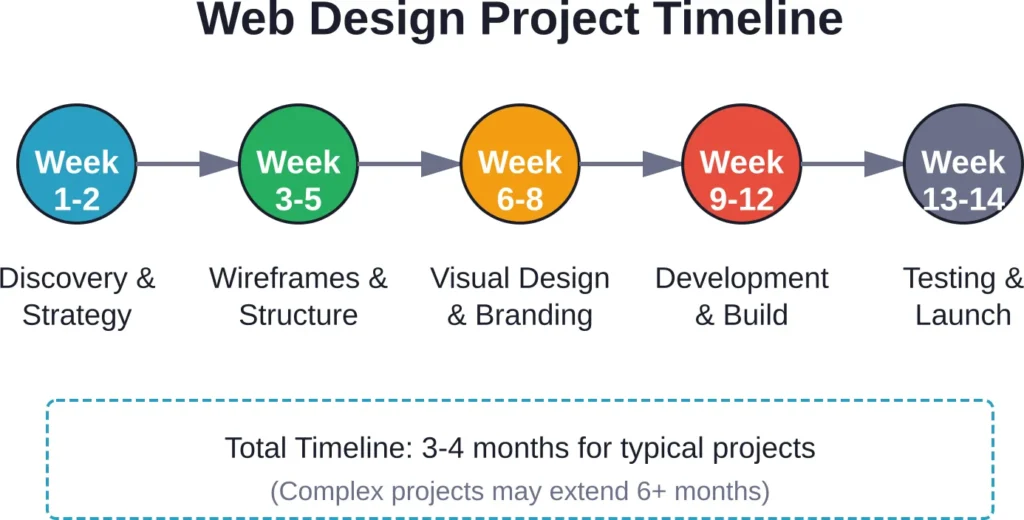
Most web design projects take between 8-16 weeks from kickoff to launch, depending on complexity. Simple brochure sites with standard features might complete in 6-8 weeks. More complex projects with custom functionality, extensive content, or elaborate designs can take 4-6 months or longer. The timeline depends on factors including the number of unique page templates, custom feature requirements, content readiness, stakeholder decision-making speed, and revision rounds. Enterprise projects with multiple stakeholder groups and integration requirements often extend beyond six months.
Industry specialization has benefits—agencies understand domain-specific challenges, know the competitive landscape, and may move faster because they’re familiar with the context. However, generalist agencies bring fresh perspectives and creative cross-pollination from other sectors. The best choice depends on project needs. For highly regulated industries (healthcare, finance) or complex technical domains, specialization often proves valuable. For brand-focused projects where differentiation matters, an agency that isn’t steeped in industry conventions might bring more original thinking. Review portfolios for relevant experience, but don’t make industry focus the only decision criterion.
Web design focuses on visual appearance, user experience, and interface layout—how the website looks and how users interact with it. Web development handles the technical implementation—writing code that makes the design functional. Frontend development translates designs into HTML, CSS, and JavaScript that browsers can render. Backend development builds server-side functionality, databases, and application logic. Many agencies handle both design and development, offering complete solutions. Others specialize in design and partner with development shops. Understanding this distinction helps clarify what services different agencies provide and where hand-offs occur.
The best projects balance client input with agency expertise. Provide clear direction on business goals, brand guidelines, target audience, and functional requirements. Share feedback on design concepts and iterations. But avoid dictating specific design decisions or micromanaging execution—that’s why agencies were hired. Good agencies present design rationale explaining their choices. If recommendations don’t align with goals or brand direction, push back with specific concerns. But trust the agency’s expertise on visual hierarchy, interaction patterns, and technical implementation. The collaboration works best when clients focus on strategic direction while agencies handle tactical execution.
Professional agencies include revision rounds in their process specifically to address this situation. Most contracts specify how many revision rounds are included. The key is providing specific, constructive feedback rather than subjective reactions. Instead of “I don’t like it,” explain what’s not working and why. Good agencies ask probing questions during feedback sessions to understand underlying concerns. They should present design rationale explaining their choices, which sometimes reveals that initial reactions change with context. If concepts miss the mark entirely, the best agencies will revisit discovery work to ensure alignment on goals and direction before proceeding with revisions.
Ownership terms should be explicitly stated in the contract before work begins. Most agencies transfer design ownership to clients upon final payment, though some retain certain rights to display work in portfolios. Review the intellectual property clauses carefully. Ensure the agreement specifies that all design files, code, and assets become client property. Some agencies use open-source code or third-party components with specific licenses—understand any restrictions. Custom fonts or stock images may require separate licensing. Clarify ownership of design systems and component libraries if the relationship ends. Get these terms in writing before the project starts to avoid disputes later.
Many full-service agencies offer content strategy and copywriting as part of their process or as add-on services. They can help structure information architecture, write website copy, source or create images, and develop content guidelines. Other agencies focus purely on design and development, expecting clients to provide finished content. Content significantly impacts timelines—delays in content delivery are one of the most common causes of project delays. Clarify content responsibilities early. If providing content internally, understand the formats and deadlines required. If the agency is creating content, ensure their expertise matches the needs. Technical writing, marketing copy, and brand storytelling require different skills.
Conclusion
Choosing the right web design company shapes digital presence for years to come. The agencies profiled here represent different approaches, specializations, and strengths.
Clay excels with product-focused design for startups. Excited Agency brings strategic thinking to B2B and SaaS websites. Instrument balances brand strategy with digital execution. Fantasy creates distinctive experiences for creative brands and cultural organizations.
Locomotive pushes technical boundaries with immersive interactions. Studio.909 specializes in high-impact landing pages. Basic Agency delivers refined aesthetics. Ueno bridges European design sensibility with Silicon Valley tech culture.
Code and Theory handles enterprise complexity at scale. Build in Amsterdam creates experiences that feel alive through motion and interaction.
The right choice depends on project goals, company stage, budget realities, and desired aesthetic. Don’t choose based on name recognition alone. Evaluate portfolio fit, communication style, technical capabilities, and cultural alignment.
Request detailed proposals that outline process, deliverables, and timelines. Check references. Trust both the agency’s expertise and internal instincts about whether the partnership will work.
Great web design combines aesthetics with strategy, creativity with usability, and innovation with reliability. The agencies featured here demonstrate these qualities consistently.
Take time to find the right partner. The investment in careful selection pays dividends in project outcomes, working relationships, and long-term website performance.
Ready to start the web design journey? Review portfolios, reach out to agencies that align with project needs, and begin conversations about how they can help achieve digital goals. The right partner is out there.