

Quick Summary: The top web design agencies for financial companies in 2026 combine deep regulatory knowledge with modern UX practices to build trust-driven, conversion-optimized websites. This guide profiles 15 leading agencies that specialize in financial services, from fintech startups to established wealth management firms, highlighting their unique approaches to designing compliant, high-performing digital experiences without discussing pricing structures.
Financial companies face a positioning challenge that didn’t exist a decade ago. A company’s established reputation, professional credentials, and track record mean everything to prospective clients. But the website often tells a different story.
When prospects land on a financial services website, they’re making split-second judgments about credibility, security, and competence. According to the Nielsen Norman Group’s State of UX 2026 report (published January 16, 2026), differentiation and business impact have become vital as the field stabilizes after years of instability from layoffs and hiring freezes.
The best financial website designs of 2026 transcend basic service descriptions and contact forms. They create immediate trust through strategic design decisions, simplify complex financial products, and convert visitors into qualified leads—all while navigating strict regulatory requirements.
This guide examines 15 agencies that have proven their ability to deliver exceptional web design for financial companies. Each brings specialized expertise to the unique challenges of the financial services sector.
Why Financial Services Web Design Demands Specialized Expertise
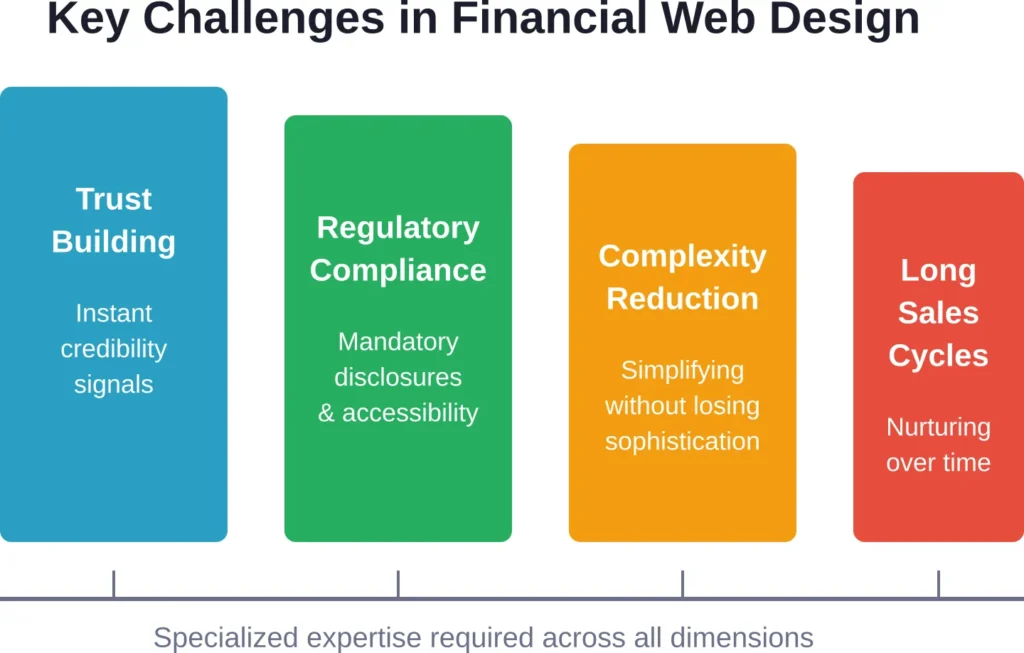
Designing for financial companies isn’t like designing for e-commerce or SaaS brands. The stakes are fundamentally different.
Financial decisions represent some of the most consequential choices people make. Whether someone is choosing a wealth advisor, selecting business insurance, or comparing fintech platforms, trust must be established immediately. A single design misstep—outdated imagery, confusing navigation, or unclear compliance disclosures—can send prospects to a competitor.
Regulatory compliance adds another layer of complexity. Financial websites must balance modern design aesthetics with mandatory disclosures, disclaimers, and accessibility standards. The Nielsen Norman Group emphasizes that four principles of form design—structure, transparency, clarity, and support—minimize cognitive load and improve usability, particularly critical in finance where forms often request sensitive information.
Then there’s the challenge of simplification without oversimplification. Financial products are inherently complex, but prospects shouldn’t need a finance degree to understand value propositions. The best agencies know how to distill complexity into clear, compelling narratives.
Conversion optimization in finance looks different too. The buying cycle is longer, the consideration set is smaller, and decisions involve multiple stakeholders. Websites must nurture prospects through educational content, case studies, and trust signals rather than pushing for immediate conversions.
Top 15 Web Design Agencies for Financial Companies
Based on portfolio depth, vertical expertise, client results, and industry recognition, these 15 agencies represent the best partners for financial services web design in 2026.
1. Oski

Oski designs and develops smart, scalable digital solutions for forward-thinking financial companies and fintech brands. They specialize in creating enterprise-grade websites and applications that combine beautiful interfaces with powerful technology.
The agency’s technical foundation sets them apart. They deliver modern frontend experiences, cloud architecture, and AI-enhanced features that help financial brands stand out while maintaining the highest standards of security and performance.
Oski works with companies in the fintech and insurance sectors that need digital platforms capable of handling complex operations. Their process includes strategic design, seamless CMS integration, and robust development practices.
For financial services, Oski excels at building digital experiences that enhance customer trust and streamline operations. They create solutions ranging from client portals to sophisticated web platforms that support growth and innovation.
Their emphasis on intuitive design and technical excellence helps financial companies deliver digital products that are both visually compelling and functionally reliable.
Contact Information:
- Website: oski.site
- Phone: +48571282759
- Email: [email protected]
- Address: Kaupmehe tn 7, 10114 Tallinn, Estonia
- LinkedIn: www.linkedin.com/company/oski-solutions
2. Mobian

Mobian builds dedicated engineering teams that deliver production-ready digital products for financial companies, particularly in fintech. They specialize in mobile and AI solutions that support modern financial services.
The agency’s dual outsourcing and outstaffing model sets them apart. They provide senior-level execution for companies that need reliable technology without the overhead of in-house hiring.
Mobian works with financial clients who require scalable and secure digital solutions. Their process emphasizes clean architecture, full-stack delivery, and ongoing partnership after launch.
For fintech and financial services, Mobian excels at creating intuitive mobile apps, AI-powered systems, and robust backends that handle complex financial operations while maintaining excellent user experiences.
Their focus on production-ready software and domain expertise in fintech helps financial companies accelerate development and ship reliable digital products faster.
Contact Information:
- Website: mobian.studio
- Phone: [email protected]
- Address: Harju maakond, Tallinn, Kesklinnalinnaosa, Masina tn 22, 10113
- LinkedIn: www.linkedin.com/company/mobian-studio
3. Lengreo

Lengreo specializes in full-funnel B2B digital strategies with a strong focus on website development and lead generation for financial services companies. They create high-converting digital experiences that support complex sales cycles in finance.
What sets Lengreo apart is their performance-driven approach that combines strategic marketing with technical website execution. Rather than generic solutions, they listen to specific business needs and build tailored digital systems.
Lengreo’s process starts with deep marketing audits and business analysis. They map customer journeys, optimize conversion paths, and develop websites that effectively nurture high-value financial prospects. For financial companies, this means creating trust-building digital platforms that turn visitors into qualified opportunities.
Their capabilities include professional website development, landing pages, and seamless integration with lead generation systems. This allows financial services firms to attract, engage, and convert decision-makers more effectively.
Lengreo emphasizes clear, authoritative design balanced with strong conversion focus — essential for companies in finance that need to project credibility while driving measurable business results.
Contact Information:
- Website: lengreo.com
- Phone: +31 686 147 566
- Email: [email protected]
- Address: Vrijstraat 9 C/D, 5611 AT Eindhoven, Netherlands
- LinkedIn: www.linkedin.com/company/lengreo
- Instagram: www.instagram.com/lengreo.agency
- Twitter: x.com/Lengreo
4. Gilzor

Gilzor brings custom software and product design expertise to financial companies looking to build or modernize their digital presence. They excel at creating intuitive web and mobile solutions for fintech and traditional financial institutions.
The agency’s user-centric approach sets them apart. They focus on translating complex financial products into simple, trustworthy digital experiences through thoughtful UI/UX design and robust development.
Gilzor works with financial clients navigating the challenges of building credibility and user adoption. Their process includes thorough business analysis, user research, and iterative design to ensure products meet both regulatory expectations and user needs.
For fintech companies and financial service providers, Gilzor excels at designing customer portals, dashboards, and service platforms that feel modern and secure. They help clients turn sophisticated financial functionality into effortless user experiences.
Their strength lies in full-cycle development — from idea validation and design to launch and scaling — helping financial companies deliver digital products that users trust and love.
Contact Information:
- Website: www.gilzor.com
- Email: [email protected]
- Address: Poland, Warsaw, Office 58, street Adama Mickiewicza 37, 01-625
- LinkedIn: www.linkedin.com/company/gilzor-softwaredevelopment
5. A-Listware

A-Listware provides dedicated development teams and digital solutions tailored for financial services companies undergoing digital transformation. They focus on delivering secure, high-quality web applications and platforms.
The agency’s flexible team model sets them apart. They act as a seamless extension of client teams, providing expert software development, UX/UI design, and technical consulting.
A-Listware works with financial companies ranging from enterprises to startups that need reliable technology partners. Their process includes software consulting, team augmentation, and end-to-end project delivery while maintaining strict security and quality standards.
For financial services, A-Listware excels at building enterprise applications, custom software solutions, and modern digital platforms that support complex business requirements.
Their emphasis on seamless integration and high-quality delivery helps financial companies accelerate their digital initiatives with confidence and control.
Contact Information:
- Website: a-listware.com
- Phone: +1 (888) 337 93 73
- Email: [email protected]
- Address: North Bergen, NJ 07047, USA
- LinkedIn: www.linkedin.com/company/a-listware
- Facebook: www.facebook.com/alistware
6. CyberOptik

CyberOptik specializes in financial services digital marketing, bringing integrated expertise across web design, SEO, content strategy, and paid advertising. This holistic approach ensures websites are designed not just to look good but to generate qualified leads.
The agency’s financial services focus spans wealth advisors, insurance agencies, accounting firms, and regional banks. They understand the competitive dynamics and search behavior patterns specific to each sub-sector.
CyberOptik’s website designs prioritize conversion optimization from the start. They build in lead capture mechanisms, CTAs, and nurture pathways that align with financial services buying cycles.
Their SEO expertise ensures financial companies rank for high-intent search queries. This includes technical SEO, local optimization, and content strategies that establish thought leadership.
For financial advisors concerned about compliance, CyberOptik brings experience navigating FINRA advertising regulations and SEC marketing rules. Their designs incorporate required disclosures without compromising aesthetics.
7. WP Minds

WP Minds brings WordPress expertise specifically tailored to financial services. Their work demonstrates how the WordPress platform can deliver enterprise-grade functionality when architected properly.
The agency specializes in financial services website design with emphasis on performance, security, and scalability. They understand that financial companies need platforms capable of handling sensitive information while maintaining fast load times.
WP Minds excels at creating custom WordPress solutions that integrate with financial services tools—CRM systems, portfolio management platforms, compliance systems, and analytics tools.
Their design approach balances modern aesthetics with the conservative sensibilities common in financial services. This allows financial companies to appear contemporary without alienating traditional client bases.
For financial firms with limited technical resources, WP Minds provides websites that marketing teams can manage without constant developer intervention. Their custom WordPress builds prioritize editor usability.
8. BlueSkyRisk (Park Shield)

BlueSkyRisk represents a unique case—they’ve built exceptional digital experiences for their own financial services brands, including Park Shield insurance. While not a traditional agency, their work exemplifies best practices in financial web design.
Park Shield’s website demonstrates how specialized insurance companies can use design to communicate expertise. The site focuses exclusively on manufactured home community coverage, using design to reinforce niche specialization.
The BlueSkyRisk approach emphasizes clarity in explaining complex insurance products. Their design philosophy prioritizes answering prospect questions immediately rather than forcing navigation through multiple pages.
For financial companies considering in-house design capabilities, BlueSkyRisk’s work shows what’s possible with strong design leadership and clear vision.
Their websites integrate educational content, risk assessment tools, and streamlined quote processes—all designed to move prospects efficiently through consideration and decision stages.
9. LaSoft

LaSoft brings over 10 years of expertise in fintech and insurance software development, positioning them uniquely to design financial services websites that integrate with complex technical ecosystems.
The organization develops scalable, secure, and user-friendly digital products including platforms, applications, and portals. Their technical depth enables them to design websites that are just the visible layer of sophisticated financial technology stacks.
LaSoft’s case studies demonstrate measurable business impact. They focus on solutions that streamline operations, enhance customer engagement, and unlock new revenue opportunities—outcomes that resonate with financial services executives.
For financial companies pursuing digital transformation, LaSoft offers end-to-end capabilities from strategy through implementation. Their websites serve as front-ends to modernized backend systems.
The organization’s work in insurance demonstrates particular strength in explaining and digitizing traditionally offline processes. Their designs make complex insurance products accessible without oversimplification.
10. Digital Silk

Digital Silk brings enterprise-level branding and digital experience design to financial services. Their work spans brand strategy, web design, and digital marketing for established financial institutions.
The agency’s financial services portfolio includes regional banks, investment firms, and insurance companies. Their designs project institutional credibility while incorporating modern UX best practices.
Digital Silk excels at brand refreshes for legacy financial institutions. They help established firms modernize their digital presence without losing the equity built over decades.
Their process includes comprehensive competitive analysis, stakeholder interviews, and customer research. This foundation ensures redesigns address real business challenges rather than just updating visuals.
For financial companies concerned about change management, Digital Silk brings experience rolling out new digital experiences to conservative internal stakeholders and traditional client bases.
11. Blend
Blend specializes in complex B2B buying processes, making them particularly well-suited for financial services companies with multi-stakeholder sales cycles. Based in both the UK and USA, Blend has built websites for notable financial clients including Allica Bank, Cass Information Systems, and Datel.
What sets Blend apart is their approach to relationship-driven business development. They understand that finance companies don’t just need beautiful websites—they need digital experiences that support long sales cycles, multiple decision-makers, and high-consideration purchases.
Blend’s process starts with deep discovery into how prospects actually make buying decisions. They map stakeholder journeys, identify content gaps, and design information architectures that address questions at each consideration stage. For financial services, this means creating clear pathways for different audience segments while maintaining cohesive brand experiences.
Their technical capabilities include sophisticated integrations with CRM systems, marketing automation platforms, and analytics tools. This allows financial companies to track prospect behavior, nurture leads, and measure ROI from their website investments.
Blend emphasizes contemporary design balanced with institutional authority—critical for established financial firms that need to modernize without losing gravitas.
12. Webstacks

Webstacks brings enterprise-grade technical architecture to financial services clients. Their specialty lies in building scalable, high-performance websites for growth-stage fintech companies and established financial institutions undergoing digital transformation.
The agency’s technical foundation sets them apart. They architect websites on modern frameworks that enable rapid iteration, A/B testing, and personalization—capabilities that mature financial brands increasingly demand.
Webstacks works with financial companies navigating complex compliance requirements while pursuing aggressive growth goals. Their process includes compliance audits, accessibility testing, and security reviews integrated throughout the design and development lifecycle.
For fintech companies, Webstacks excels at explaining complex products through clear visual design and intuitive user flows. They understand that fintech success depends on making sophisticated financial technology feel simple and trustworthy.
Their client roster includes several fast-growing financial technology companies that needed websites capable of supporting rapid scaling without constant rebuilds.
13. Superside

Superside operates with a unique model: they provide dedicated design teams that function as extensions of in-house marketing departments. For financial companies with ongoing design needs, this model delivers consistent quality and deep brand knowledge.
Their financial services work emphasizes UX simplicity and performance-led design. Superside’s structured approach to UX audits helps financial companies identify conversion bottlenecks and optimization opportunities.
The agency creates modular design systems that reduce rebuild time, lower costs, and improve brand consistency across digital properties. For financial companies managing multiple sub-brands, products, or market segments, these design systems provide scalability without sacrificing cohesion.
Superside’s distributed team model allows them to match financial clients with designers who have relevant industry experience. This ensures projects benefit from practitioners who understand financial services challenges firsthand.
Their emphasis on measurable improvements aligns well with financial companies’ expectations for ROI demonstration. Superside tracks metrics like conversion rates, engagement depth, and lead quality to prove design impact.
14. Azuro Digital

Azuro Digital has built a strong reputation specifically within wealth management and financial advisory. Their portfolio showcases deep understanding of how high-net-worth individuals evaluate financial services providers.
The agency’s approach emphasizes sophisticated aesthetics that signal expertise without appearing cold or intimidating. They understand that wealth management websites must project competence and exclusivity while remaining approachable.
Azuro Digital excels at integrating case studies and client success stories in ways that demonstrate value without violating confidentiality. Their designs often feature real results with specific outcomes—like “saved 20+ hours per month” and “found $50K in tax deductions”—that help prospects quantify potential benefits.
For financial advisors and wealth management firms, Azuro Digital builds websites that support relationship-based business development. Their designs facilitate trust-building through team bios, thought leadership content, and educational resources.
The agency also understands the importance of local SEO for financial advisors who serve specific geographic markets. Their websites are optimized for local search while maintaining premium positioning.
15. Phenomenon Studio

Phenomenon Studio brings a research-driven product design approach to financial services. Their process starts with extensive user research to understand how target audiences interact with financial products and make decisions.
The agency works globally with financial clients ranging from payment platforms to banking institutions. Their portfolio demonstrates versatility across financial sub-sectors while maintaining consistently high design standards.
Phenomenon Studio’s strength lies in translating complex financial functionality into intuitive interfaces. They excel at designing customer portals, account management systems, and transaction interfaces that feel effortless despite sophisticated backend complexity.
For fintech startups, Phenomenon Studio provides the design rigor necessary to compete with established financial brands. Their work helps newer companies establish credibility through polished, professional digital experiences.
The agency’s research foundation ensures design decisions are grounded in user behavior data rather than assumptions. This evidence-based approach resonates with financial services executives who expect data-driven recommendations.
What Separates the Best Financial Web Design Agencies
Not all agencies claiming financial services expertise actually possess it. The best agencies share several distinguishing characteristics.
Deep vertical expertise comes first. Top agencies have worked extensively with financial clients across multiple sub-sectors—wealth management, banking, insurance, fintech, accounting. They understand the nuances between designing for a robo-advisor versus a family office, or a community bank versus a payment processor.
Regulatory fluency matters enormously. The best agencies know FINRA guidelines, SEC regulations, ADA compliance requirements, and state-specific financial advertising rules. They build compliance checkpoints into their design process rather than treating them as afterthoughts.
Conversion expertise tailored to financial buying cycles sets elite agencies apart. According to industry analyses, customers have achieved conversion lifts of over 30% through structured UX audits and optimization cycles. These agencies understand that conversion for a wealth advisor means getting a prospect to schedule a consultation, not click “Buy Now.”
Technical sophistication enables advanced functionality. Financial websites often require secure client portals, document management systems, sophisticated calculators, CRM integrations, and performance tracking. The best agencies have technical depth beyond visual design.
Strategic thinking matters as much as execution. Elite agencies push back on client assumptions, bring data-driven recommendations, and think beyond the website to the entire digital ecosystem.
Key Selection Criteria for Financial Services Web Design
Choosing the right agency requires evaluating factors beyond portfolio aesthetics. Financial companies should assess potential partners across several dimensions.
Portfolio Depth in Financial Services
Look for agencies with multiple financial services projects, not just one or two. Agencies that have worked across different financial sub-sectors bring broader perspective. They’ve solved varied challenges and can apply lessons learned across contexts.
Examine case studies for specificity. Strong case studies explain the business challenge, design approach, and measurable outcomes. Vague portfolios that only show screenshots suggest superficial involvement.
Ask about work that isn’t publicly visible. Many financial services projects involve client portals, account management systems, and other experiences behind login walls. Agencies should be able to discuss this work even if they can’t show it.
Regulatory Knowledge and Compliance Experience
Quiz potential agencies on relevant regulations for your specific financial services category. FINRA rules differ from insurance regulations differ from banking requirements. Agencies should demonstrate fluency with applicable frameworks.
Ask about their compliance review process. Strong agencies build compliance checkpoints into timelines rather than treating them as final-stage hurdles.
Request examples of how they’ve handled compliance challenges on past projects. The best agencies have refined approaches to common compliance issues like disclosure placement, advertising claim substantiation, and accessibility requirements.
Technical Capabilities Beyond Design
Financial companies increasingly need sophisticated technical implementations. Evaluate agencies on integration experience with CRM systems, marketing automation platforms, analytics tools, and third-party financial services APIs.
According to the Nielsen Norman Group’s guidance on aligning UX metrics with organizational goals, quantitative usability testing may show measurable improvements—for example, improvements like increasing the percentage of participants finding answers without needing live support. Agencies should have experience implementing analytics and testing frameworks to capture these insights.
Ask about their approach to performance optimization. Financial websites often include calculators, document libraries, and media-rich content that can slow load times. Agencies should articulate specific technical strategies for maintaining speed.
Security expertise matters enormously. Financial websites handle sensitive information and face elevated security risks. Agencies should follow security best practices and stay current on vulnerabilities.
Strategic Thinking and Business Acumen
The best agencies act as strategic partners, not order-takers. They should ask probing questions about business objectives, competitive positioning, and target audiences before proposing solutions.
Look for evidence of strategic thinking in case studies. Did the agency challenge initial requirements? Did they bring recommendations based on research? Did they think beyond the website to broader digital strategy?
Financial services expertise includes understanding business models. Agencies should grasp how financial companies acquire clients, what drives lifetime value, and how websites support revenue generation.
Process and Project Management
Financial services projects involve multiple stakeholders—marketing, compliance, legal, technology, and executive leadership. Agencies need structured processes for managing input from diverse groups.
Ask about typical timelines and how they’re structured. Financial services projects often take longer than generic websites due to compliance reviews and stakeholder coordination.
Understand their revision and feedback process. Financial companies often require multiple review cycles. Clear processes prevent scope creep while ensuring thorough review.
| Selection Criteria | What to Evaluate | Red Flags to Watch For |
|---|---|---|
| Portfolio Depth | Multiple financial projects across sub-sectors with detailed case studies | Only 1-2 financial examples or vague portfolio descriptions |
| Regulatory Knowledge | Fluency with relevant regulations and built-in compliance processes | Treating compliance as an afterthought or showing unfamiliarity |
| Technical Capabilities | Integration experience, security expertise, performance optimization | Only offering template implementations or lacking technical depth |
| Strategic Thinking | Asking probing questions and challenging assumptions with research | Immediately proposing solutions without understanding context |
| Project Management | Structured processes for multiple stakeholders and clear timelines | Vague timelines or inflexible processes that don’t accommodate compliance |
Essential Features of High-Performing Financial Websites
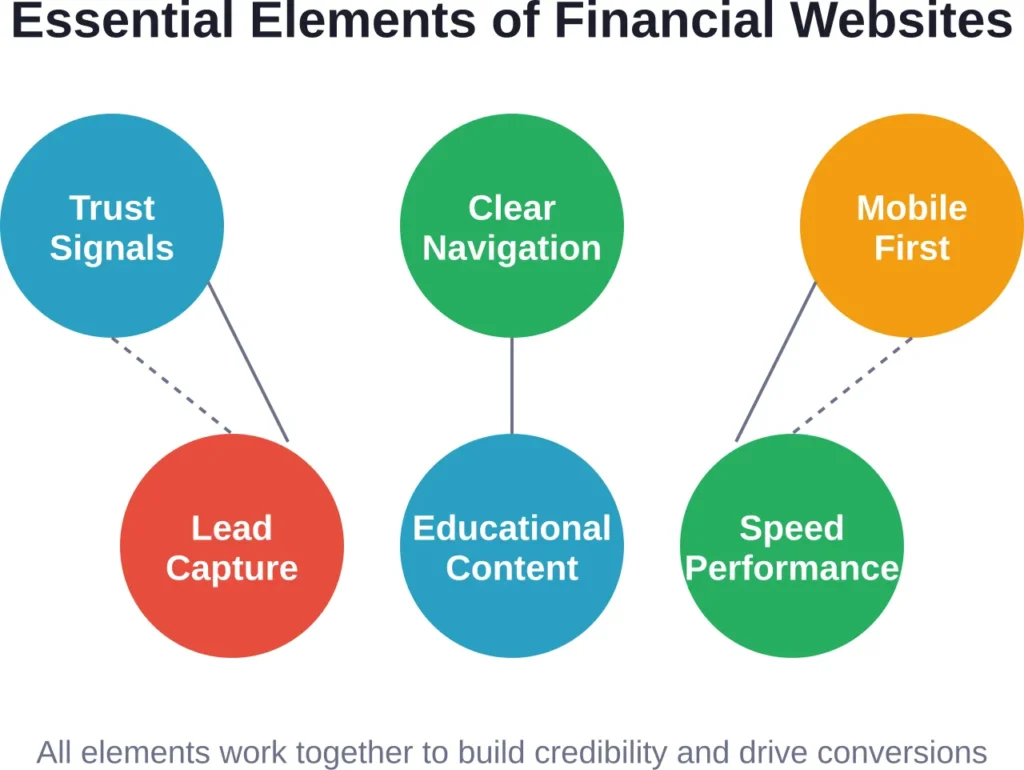
Beyond agency selection, financial companies should understand what elements drive website performance. The best financial websites in 2026 share common characteristics.
Immediate Trust Signals
Trust must be established within seconds. High-performing financial websites deploy multiple trust signals above the fold—recognizable credentials, security badges, client logos, and industry affiliations.
Professional photography matters enormously. Stock photos signal generic service, while authentic imagery of actual team members and offices conveys substance. Financial services remain relationship businesses—websites should reflect that.
Testimonials and case studies provide social proof. But generic praise doesn’t move needles. The best financial websites feature specific outcomes and attributable quotes from real clients.
Simplified Navigation and Information Architecture
Financial websites often suffer from navigation bloat—every service, every team member, every resource competing for menu space. The best sites ruthlessly prioritize based on prospect needs.
Information architecture should match how prospects think, not how the company is organized. Prospect-focused navigation uses language like “For Business Owners” or “Retirement Planning” rather than internal department names.
The Nielsen Norman Group’s principles of reducing cognitive load in forms—structure, transparency, clarity, and support—apply equally to overall site navigation. Every click requires decision-making. Simplified paths reduce mental work.
Mobile-First Experience
Mobile traffic now represents the majority for many financial services categories. Yet many financial websites remain desktop-centric in design philosophy.
Mobile-first design means more than responsive layouts. It means prioritizing content for smaller screens, optimizing touch targets, and ensuring forms work seamlessly on mobile devices.
Financial services often involve research sessions that span multiple devices. Websites should provide consistent experiences whether prospects start on mobile and finish on desktop or vice versa.
Conversion-Optimized Lead Capture
Financial buying cycles rarely end with immediate purchases. Websites must capture leads for nurturing. But aggressive lead capture can undermine trust.
The best financial websites offer value in exchange for contact information—calculators, guides, consultations. They also provide low-commitment options like newsletter signups alongside higher-commitment consultation requests.
Form design matters critically. Following the Nielsen Norman Group’s guidance on minimizing cognitive load, high-performing financial websites structure forms logically, provide transparency about what information is required, offer clarity on what happens next, and support users through inline validation and helpful error messages.
Educational Content and Thought Leadership
Financial decisions involve extensive research. Prospects consume content across multiple sessions before contacting companies. Websites should support this research phase.
Educational content establishes expertise and builds trust. Blog posts, guides, videos, and webinars that genuinely help prospects make better decisions create reciprocity.
Thought leadership differentiates commoditized services. When financial services appear similar, perspective becomes a differentiator. Websites should showcase unique viewpoints and approaches.
Performance and Speed
Site speed impacts both user experience and search rankings. Financial websites often include resource-intensive elements—calculators, document libraries, video content—that can slow performance.
Technical optimization makes the difference between mediocre and exceptional experiences. Image optimization, code minification, caching strategies, and content delivery networks all contribute to speed.
Performance monitoring should be ongoing. Websites slow down over time as content accumulates and plugins proliferate. Regular audits prevent degradation.
Emerging Trends Shaping Financial Web Design in 2026
Financial services web design continues evolving. Several trends are reshaping what best practices look like.
AI Integration Without Losing Human Connection
According to the Nielsen Norman Group’s research on AI agents as users, designing for AI agents requires rethinking what “user” means and prioritizing accessibility. AI agents now interact with digital interfaces alongside humans. Financial websites must design for both audiences.
Chatbots and AI assistants are becoming standard on financial websites. But implementation quality varies dramatically. The best financial sites use AI to handle routine questions while seamlessly escalating complex situations to human advisors.
AI also enables personalization at scale. Financial websites can now dynamically adjust content, recommendations, and user flows based on visitor behavior and characteristics—all while respecting privacy regulations.
The challenge is maintaining human connection. Financial services remain fundamentally about relationships and trust. AI should enhance human advisors, not replace the personal touch that differentiates premium services.
Advanced Personalization and Dynamic Content
Static websites that show identical content to every visitor are increasingly obsolete. Financial websites now deliver personalized experiences based on visitor characteristics, behavior, and stage in the buying journey.
Location-based personalization allows national firms to highlight local expertise. First-time visitors see introductory content while return visitors see deeper resources. Prospects who’ve downloaded guides receive relevant follow-up offers.
This requires sophisticated technical infrastructure and thoughtful strategy. Personalization done poorly creates disjointed experiences. Done well, it makes large firms feel boutique.
Video and Interactive Content
Text-heavy financial websites struggle to engage modern audiences. Video content—team introductions, service explanations, client testimonials—creates connection that text alone cannot.
Interactive tools like calculators, scenario planners, and assessment quizzes provide value while qualifying leads. Visitors who engage with interactive content demonstrate higher intent.
The technical challenge is implementing rich media without sacrificing performance. Lazy loading, adaptive video quality, and progressive enhancement allow compelling content without slow load times.
Accessibility as Standard Practice
Accessibility isn’t just regulatory compliance—it’s good UX design. Financial websites must work for users with diverse abilities and assistive technologies.
The Nielsen Norman Group emphasizes that designing for AI agents and humans requires prioritizing accessibility. Screen reader compatibility, keyboard navigation, sufficient color contrast, and clear language benefit all users.
Accessibility audits should be integrated into design processes rather than retrofitted. Building accessible experiences from the start costs less and delivers better results than remediation.
Sustainability and Performance Optimization
Website sustainability—reducing carbon footprint through efficient code and hosting—is gaining attention. Financial companies with ESG commitments are examining their digital properties’ environmental impact.
Sustainable web design aligns with performance optimization. Smaller images, cleaner code, and efficient hosting reduce both carbon emissions and load times.
This trend will accelerate as tools for measuring website carbon footprint become mainstream and consumers increasingly scrutinize companies’ environmental practices.
Common Mistakes Financial Companies Make With Website Projects
Understanding what not to do helps avoid expensive missteps. Financial companies commonly fall into predictable traps.
Leading With Services Instead of Client Needs
Many financial websites are organized around internal structures—departments, service lines, product categories. But prospects think in terms of their problems and goals, not company org charts.
The best financial websites lead with client problems and life situations. “Planning for Retirement” resonates more than “Asset Management Services.” “Protecting Your Growing Business” works better than “Commercial Insurance Products.”
This requires stepping outside internal perspectives to understand how clients actually think and search for solutions.
Underestimating Compliance Complexity
Financial companies often treat compliance as a late-stage review rather than a design constraint. This leads to expensive rebuilds when compliance teams reject designs that don’t meet regulatory requirements.
Involving compliance early—ideally during discovery and wireframing—prevents wasted work. Agencies with financial services expertise know which compliance questions to ask upfront.
Compliance shouldn’t kill good design. With proper planning, regulatory requirements integrate seamlessly without compromising user experience.
Ignoring Mobile Experience
Despite mobile traffic dominance, some financial websites remain desktop-first in practice. Forms that are painful on mobile, navigation that doesn’t work on small screens, and content that requires horizontal scrolling create friction.
Testing on actual mobile devices—not just browser emulators—reveals problems. Financial companies should review mobile experiences on both iOS and Android across multiple device sizes.
Failing to Plan for Ongoing Optimization
Website launches are beginnings, not endings. But many financial companies treat redesigns as one-time projects rather than starting points for continuous improvement.
The best financial websites evolve based on data. A/B testing, heat mapping, user feedback, and conversion analysis drive iterative enhancements.
This requires both technical infrastructure—analytics implementation, testing tools—and organizational commitment to ongoing optimization.
Prioritizing Aesthetics Over Functionality
Beautiful designs that don’t drive business results represent failed investments. Financial websites must balance aesthetics with functionality, user experience, and conversion optimization.
Award-winning creative sometimes sacrifices usability. Financial companies need websites that work first, impress second. The best designs accomplish both—they’re visually sophisticated and functionally excellent.
Budget Considerations and Investment Expectations
Financial services website projects span wide budget ranges. Understanding what drives costs helps set realistic expectations.
Factors That Influence Project Investment
Site complexity directly impacts costs. A straightforward marketing website costs substantially less than a complex platform with client portals, calculators, integrations, and personalization.
Customization level matters. Template-based sites cost less than custom designs, but may not differentiate effectively in competitive markets. Financial companies must balance budget constraints with strategic needs.
Agency expertise and location affect pricing. Top-tier agencies with deep financial services portfolios command premium rates. Agencies in major markets typically charge more than those in secondary locations.
Content creation represents significant cost. Professional copywriting, photography, and video production add up. Some financial companies provide content internally to control costs, though this often extends timelines.
Integration requirements drive technical costs. Connecting websites to CRM systems, marketing automation, analytics platforms, and financial services APIs requires development expertise.
Understanding Investment Tiers
While specific pricing varies by scope, general patterns exist. Basic financial services websites built on templates or simplified platforms vary widely in cost depending on scope and complexity.
Mid-tier custom websites with professional design, responsive development, and basic integrations vary significantly based on complexity, agency positioning, and location.
Enterprise-level projects for large financial institutions with complex requirements, multiple stakeholder groups, extensive compliance needs, and sophisticated technical integration often require substantial investments.
These ranges reflect project complexity more than page count. A 20-page brochure site costs less than a 10-page site with sophisticated functionality.
Evaluating ROI and Business Impact
Financial services websites should be evaluated as business investments, not expenses. The right website generates returns through lead generation, client acquisition, and operational efficiency.
Calculate potential return by estimating lead volume, conversion rates, and client lifetime value. If a redesigned website generates even a small number of additional high-value clients, ROI often justifies significant investment.
Also consider qualitative benefits—enhanced brand perception, improved client experience, competitive differentiation. These impacts affect business performance even when difficult to quantify precisely.
Questions to Ask Potential Agency Partners
Vetting agencies requires asking specific questions that reveal capabilities and fit.
About Their Financial Services Experience
- How many financial services clients have you worked with in the past three years?
- Which financial sub-sectors do you have the most experience in?
- Can you share case studies with measurable business outcomes, not just design awards?
- What financial services regulations are you familiar with?
- How do you handle compliance reviews and regulatory requirements?
About Their Process and Approach
- What does your typical project timeline look like for a financial services website?
- How do you handle multiple stakeholders with competing priorities?
- What research and discovery activities do you conduct before design?
- How do you validate design decisions during the process?
- What happens if we need revisions beyond the contracted scope?
About Technical Capabilities
- What platforms or technologies do you typically recommend for financial services clients?
- What experience do you have with [specific CRM, marketing automation, or other relevant systems]?
- How do you approach security and data protection?
- What’s your process for performance optimization?
- Do you provide ongoing maintenance and support after launch?
About Measurement and Results
- How do you define project success for financial services clients?
- What analytics and tracking do you implement?
- Do you provide post-launch optimization services?
- Can you share before-and-after metrics from past financial services projects?
- How do you approach A/B testing and conversion optimization?
The Future of Financial Services Web Design
Looking ahead, several forces will continue reshaping financial services digital experiences.
Regulatory evolution will drive design changes. As regulations adapt to digital realities, financial websites must evolve accordingly. Agencies that stay current on regulatory changes will provide increasing value.
AI capabilities will expand dramatically. The transition from rules-based chatbots to genuinely helpful AI assistants will transform how financial websites provide information and guidance. According to the Nielsen Norman Group’s research on AI agents as users, designing for AI agents requires rethinking what “user” means and prioritizing accessibility.
Personalization will become table stakes. Financial websites that show identical content to every visitor will feel increasingly outdated. Dynamic, personalized experiences will differentiate leaders from laggards.
Video and rich media will dominate. Text-heavy financial websites will struggle to compete with engaging video content, interactive tools, and multimedia experiences that connect emotionally while informing rationally.
Voice and conversational interfaces may reshape interaction models. As voice assistants mature, financial companies may need to think beyond visual web interfaces to conversational experiences.
The agencies that thrive will combine deep financial services domain expertise with technical sophistication and strategic thinking. They’ll act as true partners, guiding financial companies through rapid digital evolution while maintaining regulatory compliance and building trust.
Frequently Asked Questions
Financial services web design must balance competing priorities that don’t exist in most industries. Trust-building is paramount—prospects are evaluating whether to entrust their financial futures to a company. Regulatory compliance adds constraints around disclosures, claims, and accessibility that other industries don’t face. Financial products are inherently complex, requiring simplification without oversimplification. Finally, buying cycles are longer and involve higher consideration, so websites must nurture prospects over time rather than pushing immediate transactions.
Timeline varies significantly based on complexity, stakeholder groups, and compliance requirements. A straightforward redesign for a small financial advisory firm might take 8-12 weeks. Mid-sized projects with moderate complexity typically run 3-4 months. Enterprise projects for large financial institutions with extensive compliance review, multiple stakeholder groups, and complex technical requirements often take 6-9 months or longer. The compliance review process, which may involve legal and regulatory teams, often extends timelines beyond what similar projects in other industries require.
Specialization offers advantages but isn’t always necessary. Agencies with deep experience in specific financial sub-sectors—like wealth management or insurance—bring nuanced understanding of that market’s unique challenges, regulations, and competitive dynamics. However, excellent agencies with broader financial services portfolios can deliver outstanding results by applying cross-sector insights. The key is ensuring the agency demonstrates fluency with relevant regulations and understands the specific business model. An agency that has worked with multiple financial sub-sectors may bring fresh perspectives that hyper-specialized firms lack.
Mobile optimization is critical and increasingly represents the primary experience for many financial services categories. Prospective clients research financial services extensively on mobile devices during commutes, at lunch breaks, and in moments of consideration throughout the day. A poor mobile experience signals lack of attention to detail and modern standards—exactly the wrong message for financial services. Beyond user experience, Google’s mobile-first indexing means mobile experience directly affects search rankings. Financial companies should test their websites extensively on actual mobile devices, not just rely on desktop browser responsive views.
Financial services websites should track metrics aligned with business objectives. Lead generation metrics include form submissions, consultation requests, calculator usage, and content downloads. Engagement metrics like time on site, pages per session, and return visitor rate indicate whether content resonates. Conversion funnels show where prospects drop off in the journey from arrival to lead submission. Traffic sources reveal which marketing channels drive qualified visitors. For firms with client portals, login frequency and feature usage indicate client engagement. Teams should track metrics that genuinely show impact rather than vanity metrics that don’t connect to business outcomes.
Full rebuilds every few years represent one approach, but continuous evolution offers a better model. Rather than letting websites stagnate for years before major overhauls, leading financial companies invest in ongoing optimization, incremental improvements, and periodic refreshes. This approach maintains modern standards without the disruption and expense of complete rebuilds. However, technology platforms do eventually require replacement as they become outdated or limiting. Most financial services websites benefit from significant updates every 3-5 years, whether that’s a full rebuild or a comprehensive refresh. Between major updates, continuous testing and optimization keep experiences current and effective.
Smaller financial firms can’t match enterprise budgets but can compete effectively through strategic focus. Rather than trying to build comprehensive websites covering every possible feature, smaller firms should identify their unique differentiators and design experiences that showcase those strengths. Authentic content—real team members, genuine client stories, specific expertise—often outperforms generic institutional messaging. Smaller firms can also move faster, testing and iterating while larger competitors navigate bureaucracy. Focusing budget on areas that directly drive lead generation—strong value propositions, clear calls-to-action, conversion optimization—delivers better ROI than spreading resources across unnecessary features. Many successful financial firms have modest websites that excel at their core purpose: converting qualified prospects into clients.
Making the Right Choice for Your Financial Company
Selecting a web design agency represents a significant decision with lasting business impact. The wrong choice means wasted budget, missed opportunities, and potentially starting over. The right choice delivers a strategic asset that drives growth for years.
Start with clarity about objectives. What specific business problems should the website solve? How will success be measured? What constraints must be accommodated? Clear objectives guide agency selection and ensure alignment.
Evaluate agencies against the criteria outlined in this guide—portfolio depth in financial services, regulatory knowledge, technical capabilities, strategic thinking, and process sophistication. Don’t rely solely on portfolios; ask probing questions that reveal how agencies work and think.
Consider cultural fit alongside capabilities. Website projects require close collaboration over months. Agencies should understand the company’s culture, communicate effectively with stakeholders, and share compatible working styles.
Request detailed proposals that demonstrate understanding of the specific challenge. Generic proposals suggest the agency hasn’t invested time understanding unique needs. Strong proposals include strategic recommendations, clear scope definition, realistic timelines, and transparent investment structures.
Check references thoroughly. Speak with past financial services clients about their experiences. Ask about communication, responsiveness, problem-solving, and whether results matched expectations.
The 15 agencies profiled in this guide represent proven options, each with distinct strengths. But the best agency for one financial company may not be optimal for another. Success comes from matching specific needs with specialized capabilities.
Remember that exceptional websites result from partnership, not just vendor relationships. Financial companies should plan to invest time, provide input, and collaborate throughout the process. Agencies bring expertise, but clients bring essential business knowledge and market understanding.
Done right, a financial services website becomes a strategic asset that attracts qualified prospects, shortens sales cycles, and supports sustained growth. The investment in finding the right agency partner pays dividends for years through improved market positioning, enhanced credibility, and measurable business results.
Ready to transform your financial company’s digital presence? Start by evaluating your current website against the standards outlined in this guide. Identify gaps between current state and where you need to be. Then reach out to agencies whose specializations align with your specific needs. Ask tough questions, review portfolios critically, and choose a partner capable of delivering not just a beautiful website, but a powerful business tool.