

Quick Summary: Choosing the right web design hosting company determines site performance, uptime, and overall digital presence. The best agencies combine design expertise with robust hosting infrastructure, offering specialized services for startups, e-commerce, and enterprise clients. This guide examines 15 leading web design hosting companies evaluated on technical capabilities, support quality, and real-world delivery track records.
Most businesses approach web design and hosting as separate decisions. That’s a mistake.
The agencies that handle both design and hosting under one roof eliminate the finger-pointing that happens when sites go down or load slowly. They own the entire stack—from visual design through server configuration—and that accountability matters.
Look, 77% of agencies agree that bad UX design is a weakness for business websites. But excellent design means nothing if the hosting infrastructure can’t deliver it reliably to visitors. The best web design hosting companies understand this connection.
This guide examines 15 agencies that have proven they can deliver both: sites that look exceptional and perform reliably under real-world conditions.
What Makes a Web Design Hosting Company Different?
Traditional hosting providers give you server space and basic technical support. Traditional design agencies build sites and hand you the files.
Web design hosting companies do both. They architect the visual experience, build it, then host it on infrastructure they control and optimize specifically for the sites they create.
The advantages show up when problems arise. No more support tickets bouncing between your hosting company blaming the code and your developer blaming the server. One team owns the entire solution.
That said, these combined services aren’t right for everyone. Teams with in-house DevOps expertise or very specific hosting requirements might prefer to separate design and infrastructure. But for most businesses—especially those without dedicated technical staff—the integrated approach eliminates complexity.
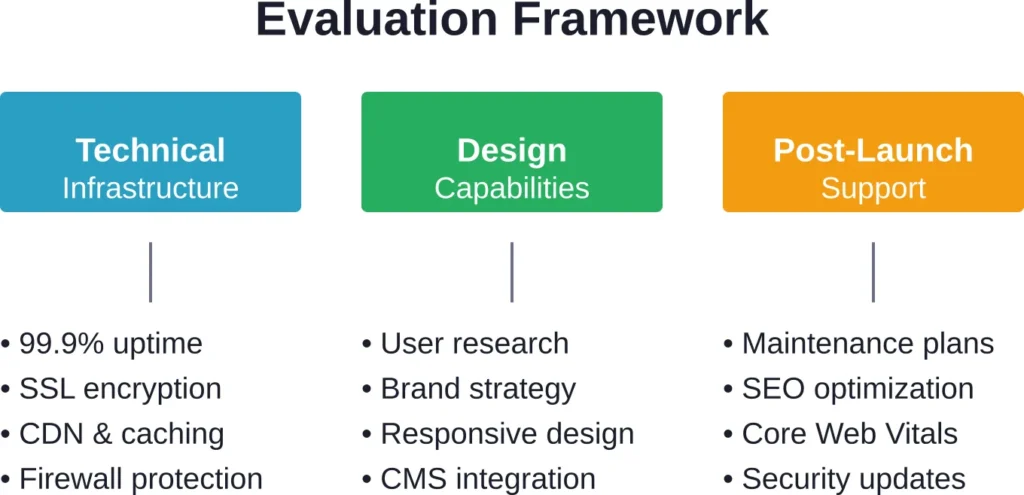
Key Factors in Evaluating Web Design Hosting Companies
Real evaluation requires looking past marketing copy. Here’s what actually matters:
Technical Infrastructure
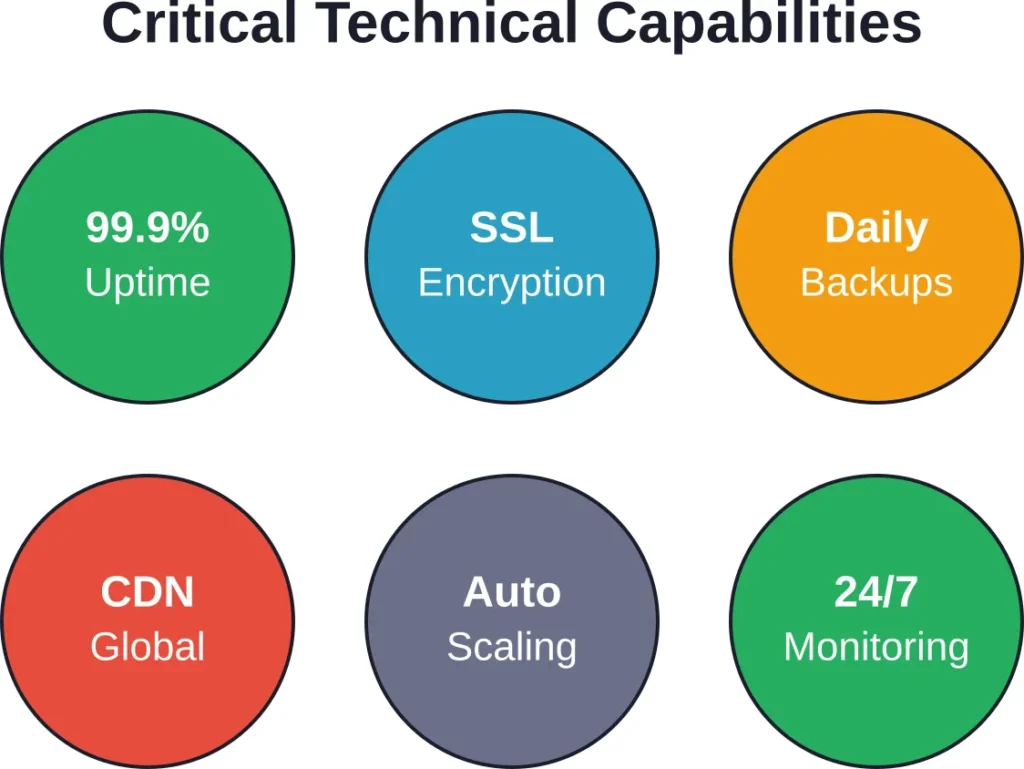
The hosting environment should offer a 99.9% uptime guarantee at minimum. Anything less means your site will be offline too frequently to take seriously.
Look for companies that provide data encryption through SSL certificates and firewall protection to keep malware away from your site. Performance optimization tools like caching should come standard, not as premium add-ons.
Design Capabilities
The best web design hosting companies don’t just build sites—they solve business problems through design. That means starting with brand strategy and user research, not jumping straight to Figma mockups.
Ask to see case studies that show measurable business outcomes, not just pretty screenshots. Did their design work increase conversions? Reduce support tickets? Some analyses indicate that resolving UX flaws can boost revenue by 15% or more when measured properly.
Post-Launch Support
Site maintenance, search engine optimization fixes, and Core Web Vitals monitoring separate serious agencies from one-and-done builders.
The relationship shouldn’t end at launch. Ongoing support terms should be clear before you sign anything.
The 15 Best Web Design Hosting Companies for 2026
The agencies below represent different specializations and scales. Some focus on startups, others on enterprise clients. Some are known for visual excellence, others for technical performance.
Each has demonstrated consistent delivery and maintained strong reputations through real client work.
1. Mobian Studio
Mobian Studio creates dedicated engineering teams that deliver production-ready web and mobile solutions with clean architecture and scalable performance. They specialize in end-to-end product development, from UI/UX design through backend systems and cloud infrastructure, ensuring fast, reliable digital experiences. Their expertise covers legacy integration and systems that can grow from small audiences to large-scale usage. Post-launch support includes maintenance, scaling assistance, and continuous optimization based on real-world usage.
Best for: IT, healthcare, fintech, and logistics companies that need reliable web and digital product development with dedicated technical execution.
Contact Information:
- Website: mobian.studio
- Phone: [email protected]
- Address: Harju maakond, Tallinn, Kesklinnalinnaosa, Masina tn 22, 10113
- LinkedIn: www.linkedin.com/company/mobian-studio
2. A-listware

A-listware delivers software development and digital solutions with strong capabilities in UX/UI design and web application development. They build custom enterprise applications, cloud solutions, and user-friendly interfaces that enhance business operations and customer experiences. Their services include dedicated development teams, application modernization, and full technical implementation. The company ensures seamless integration with existing systems while maintaining high standards for performance and security.
Best for: Enterprises, small and medium businesses, and startups looking for professional web development and scalable digital solutions.
Contact Information:
- Website: a-listware.com
- Phone: +1 (888) 337 93 73
- Email: [email protected]
- Address: North Bergen, NJ 07047, USA
- LinkedIn: www.linkedin.com/company/a-listware
- Facebook: www.facebook.com/alistware
3. Lengreo
Lengreo specializes in full-cycle digital marketing and web solutions that combine strategic lead generation with high-converting website development. Their approach focuses on understanding target audience behavior and building websites and landing pages that not only look professional but actively drive business results through integrated SEO, paid ads, and lead generation systems. The team handles everything from discovery and business analysis to website implementation, quality assurance, and ongoing optimization. They emphasize hyper-personalized outreach and conversion rate improvements that connect marketing efforts directly with technical execution.
Best for: B2B companies and service providers seeking websites that generate qualified leads and measurable business growth.
Contact Information:
- Website: lengreo.com
- Phone: +31 686 147 566
- Email: [email protected]
- Address: Vrijstraat 9 C/D, 5611 AT Eindhoven, Netherlands
- LinkedIn: www.linkedin.com/company/lengreo
- Instagram: www.instagram.com/lengreo.agency
- Twitter: x.com/Lengreo
4. Oski
Oski designs and develops well-engineered web solutions and digital platforms for tech-forward enterprises and ambitious startups. Their expertise spans frontend technologies, cloud infrastructure, and AI integrations, allowing them to build fast, secure, and scalable websites and applications. The team focuses on intuitive UI/UX design combined with robust backend systems and DevOps practices. They provide complete development cycles including deployment and ongoing maintenance to support long-term business growth.
Best for: Enterprises and startups requiring sophisticated web development with modern technologies and reliable hosting architecture.
Contact Information:
- Website: oski.site
- Phone: +48571282759
- Email: [email protected]
- Address: Kaupmehe tn 7, 10114 Tallinn, Estonia
- LinkedIn: www.linkedin.com/company/oski-solutions
5. Gilzor
Gilzor builds custom digital products with a strong focus on web and mobile development that prioritizes user experience and conversion. Their process starts with idea validation and business analysis, followed by user-centric UI/UX design, development, and rigorous quality assurance. They create websites and applications that scale effectively while maintaining excellent performance and accessibility. The studio delivers full-cycle solutions including go-to-market strategy support and post-launch maintenance to ensure long-term product success.
Best for: Startups and product companies needing high-quality web development combined with strategic market positioning.
Contact Information:
- Website: www.gilzor.com
- Email: [email protected]
- Address: Poland, Warsaw, Office 58, street Adama Mickiewicza 37, 01-625
- LinkedIn: www.linkedin.com/company/gilzor-softwaredevelopment
6. Huge

Huge operates as a full-service digital agency with offices globally, handling everything from brand strategy through hosting and ongoing optimization.
Their scale allows them to support enterprise clients with complex requirements—multi-language sites, extensive integrations with existing systems, and coordination across multiple stakeholder groups. The hosting infrastructure includes enterprise-grade security, compliance documentation for regulated industries, and 24/7 monitoring.
That level of service comes with corresponding scope and investment, making them better suited for established companies than early-stage startups.
Best for: Enterprise organizations requiring global scale and comprehensive service offerings.
7. Metalab

Metalab has built products and websites for some of the most recognized technology brands. Their approach emphasizes product thinking even for marketing sites—treating every page as a user experience problem to solve.
The agency’s portfolio shows particular strength in creating sites for products that are themselves design-focused, requiring visual quality that matches what the client sells. Their hosting services include staging environments, git-based deployment workflows, and rollback capabilities that developers appreciate.
The team structure includes dedicated project leads who maintain continuity from strategy through launch and beyond.
Best for: Product companies where the website needs to demonstrate the same design quality as the product.
8. Websystems

Websystems focuses specifically on high-performance hosting paired with custom WordPress development. Their technical expertise shows in page load speeds and Core Web Vitals scores that consistently outperform commodity hosting.
The company’s approach prioritizes performance from the start—choosing hosting configurations, implementing caching strategies, and optimizing images before design work begins. That foundation prevents the common problem where beautiful designs load too slowly to be effective.
Their client base includes content-heavy sites where performance directly impacts SEO rankings and ad revenue.
Best for: Content publishers and businesses where site speed directly impacts revenue.
9. Barrel
Barrel specializes in e-commerce, building Shopify and custom platform sites where design decisions directly impact conversion rates and average order values.
Their process includes conversion rate optimization research, cart abandonment analysis, and ongoing A/B testing after launch. The hosting infrastructure they provide is optimized specifically for e-commerce traffic patterns, handling flash sales and seasonal spikes without degradation.
The agency’s work demonstrates understanding that e-commerce design isn’t about making things pretty—it’s about removing friction from the buying process.
Best for: E-commerce businesses requiring conversion-focused design and reliable peak-traffic handling.
10. Locomotive
Locomotive builds websites with an emphasis on motion design and scroll-based interactions. Their work tends to win design awards, but it also performs—they balance visual ambition with technical performance.
The studio’s hosting services include global CDN distribution, which is essential for delivering the video content and animations their designs often feature. They also provide ongoing performance monitoring to ensure designs remain fast as content grows.
Their client base includes brands where the website serves as a primary brand expression, not just a lead generation tool.
Best for: Brands prioritizing creative excellence and motion-rich experiences.
11. ParallelHQ

ParallelHQ specializes in AI and SaaS startups, combining product design with web development in a way that makes sense for technical founders who need sites that work as hard as their products.
Their approach starts with understanding the actual user journey—not just for marketing site visitors, but for trial users, customers, and advocates. That means the sites they build integrate cleanly with product analytics and customer data platforms.
The team handles everything from brand strategy through hosting configuration, with a particular strength in sites built on modern frameworks like Webflow and Framer.
Best for: AI startups, SaaS companies, and technical products requiring sophisticated user flows.
12. Clay Agency
Clay Agency has built a reputation for brand-forward work with technology companies that need their visual identity to match the sophistication of their products.
Their design process emphasizes brand vision before wireframes, which results in sites that feel distinctly premium compared to template-based competitors. They’ve handled notable projects for major brands where recreating in-store experiences digitally required both creative vision and technical execution.
The agency’s hosting infrastructure supports the high-resolution imagery and custom animations their designs often require, with CDN optimization to prevent slow load times.
Best for: Technology companies prioritizing brand differentiation and visual impact.
13. Lollypop Design Studio

Lollypop brings a user-centered design methodology that starts with research, not assumptions. Their process includes stakeholder interviews, user testing, and iterative refinement before launch.
The studio handles both B2B and B2C clients, with case studies showing work across fintech, healthcare, and e-commerce. Their hosting services include ongoing performance monitoring and optimization based on real usage data.
Post-launch, they provide quarterly design audits to identify friction points and opportunities for conversion improvements.
Best for: Companies requiring user research and data-driven design decisions.
14. Instrument

Instrument operates at the intersection of design, technology, and brand strategy. Their projects tend to be large-scale, complex implementations for established brands.
One notable project involved recreating a major retail brand’s entire digital presence, strategically using minimalist design with brand-specific visual language to translate the in-store experience online. The technical requirements included multi-region hosting, extensive e-commerce integration, and performance optimization for high traffic volumes.
Their team includes strategists, designers, and engineers who collaborate throughout the project lifecycle, which reduces the handoff problems that plague agencies with siloed departments.
Best for: Established brands requiring sophisticated technical implementation alongside creative excellence.
15. Fantasy
Fantasy specializes in helping technology companies tell their stories through digital experiences that feel more like products than traditional marketing sites.
Their work emphasizes interactive elements and scroll-based animations that reveal information progressively. That requires hosting infrastructure capable of delivering JavaScript-heavy sites quickly, which they handle through aggressive caching strategies and edge computing.
The agency’s design philosophy centers on making complex technology accessible through visual storytelling, which works particularly well for developer tools and infrastructure products.
Best for: Developer-focused products and technical platforms requiring interactive storytelling.
Choosing Between an Agency and a Freelancer
Freelancers cost less upfront. That’s their primary advantage.
But agencies provide depth. When your designer is unavailable, agencies have backup. When technical problems arise, agencies have specialists. When projects run into unexpected complexity, agencies have resources to absorb it.
Freelancers make sense for straightforward projects with clear requirements and flexible timelines. Agencies make sense when the project is business-critical, timeline-sensitive, or technically complex.
There’s also the post-launch consideration. Freelancers move on to other projects. Agencies maintain ongoing relationships and infrastructure knowledge.
What to Actually Ask During Agency Selection
Skip the generic discovery calls. Ask questions that reveal how the agency actually works:
Request a discovery call with the actual designer. Many agencies lead with a sales director and assign a junior designer after signing. Meet the person doing the work before you commit.
Ask for post-launch support terms. What’s included in the base project scope versus what requires ongoing retainer fees? When do maintenance windows happen? What’s the response time for critical issues?
Discuss hosting infrastructure specifics. Which data centers will serve your site? What backup frequency and retention policy do they maintain? How do they handle traffic spikes?
Review their technical stack. Are they platform-agnostic or committed to specific tools? Will you own your code and design files? Can you move the site elsewhere if needed?
Understanding Web Design Hosting Packages
Most web design hosting companies offer tiered packages, though the specifics vary considerably. Here’s what different tiers typically include:
| Package Level | Typical Scope | Best For |
|---|---|---|
| Starter | 5-10 page site, template customization, shared hosting | New businesses, simple brochure sites |
| Professional | Custom design, 10-25 pages, managed WordPress or Webflow, CDN | Established small businesses, professional services |
| Business | Full custom design, CMS, e-commerce capabilities, dedicated resources | Growing companies, online retailers |
| Enterprise | Complex functionality, integrations, multi-language, high-availability hosting | Large organizations, high-traffic sites |
The jump between tiers often reflects infrastructure more than design hours. Starter packages typically use shared hosting environments where your site runs alongside dozens of others on the same server. Business and enterprise packages provide dedicated resources, which translates to consistent performance regardless of what other sites are doing.
Common Mistakes When Selecting Design Hosting Companies
Several patterns show up repeatedly when projects go wrong:
Optimizing for Initial Cost Over Total Cost
The cheapest agency rarely delivers the lowest total cost. When sites need to be rebuilt within a year because initial construction cut corners, the savings evaporate.
Planning for proper scope from the beginning costs less than iterative fixes after launch.
Ignoring Content Strategy
Beautiful designs filled with placeholder text accomplish nothing. The best web design hosting companies include content strategy—understanding what message each page needs to convey and structuring information architecture accordingly.
Sites launched without real content rarely get updated properly. Plan content creation as part of the project scope.
Skipping Performance Requirements
Agreeing to designs without specifying performance requirements leads to slow sites that look great in screenshots but frustrate actual visitors.
Set clear expectations: page load times under two seconds, Core Web Vitals in the green, mobile performance matching desktop.
Failing to Define Ownership
Who owns the design files? The code? The hosting account? These questions matter when relationships end or needs change.
Get ownership terms in writing before work begins.
Technical Specifications That Matter
When evaluating web design hosting companies, certain technical capabilities separate serious providers from pretenders:
SSL and Security
SSL certificates should come standard, automatically renewing without manual intervention. Firewall protection and malware scanning should run continuously, not just on demand.
For sites handling customer data or e-commerce transactions, ask about PCI compliance and data encryption standards.
Backup and Recovery
Daily automated backups with retention policies that keep multiple restore points. The ability to restore to any point in the last 30 days prevents catastrophic data loss.
Test restores should happen regularly—backups that haven’t been tested are worthless.
Scalability
Traffic doesn’t grow linearly. Sites need to handle sudden spikes—whether from viral content, media coverage, or seasonal events.
Ask how the hosting infrastructure scales. Is it automatic? Is there downtime during scaling? What’s the maximum load the current plan supports?
The Role of Content Management Systems
Most web design hosting companies build sites on WordPress, Webflow, or custom frameworks. Each has trade-offs:
WordPress dominates because it’s flexible, widely understood, and has plugins for nearly everything. The downside is complexity—more moving parts mean more potential points of failure. Traditional page builders like Elementor, Divi, and Oxygen have been used in WordPress development for years, though modern alternatives are changing expectations around performance and design freedom.
Webflow appeals to designers who want visual control without code but need more flexibility than WordPress page builders provide. Hosting is included, which simplifies the stack. The limitation is cost—Webflow becomes expensive at scale.
Custom frameworks built on React, Next.js, or similar technologies provide maximum flexibility and performance. They require ongoing developer involvement for updates, which increases long-term costs.
The right choice depends on internal capabilities and growth plans. Teams with developers often prefer custom solutions. Teams without technical staff usually do better with WordPress or Webflow.
Measuring Success After Launch
The best web design hosting companies establish success metrics before launch and measure against them afterward.
Relevant metrics include:
- Page load time — Target under two seconds on 4G mobile connections
- Conversion rate — Percentage of visitors completing desired actions
- Bounce rate — Percentage leaving after viewing only one page
- Core Web Vitals — Google’s speed and responsiveness metrics
- Uptime percentage — Should consistently exceed 99.9%
Establishing baseline measurements before redesign allows for meaningful before/after comparison. Research suggests that resolving UX flaws can boost revenue by 15% or more when measured properly.
When to Consider Changing Providers
Several signals indicate it’s time to evaluate alternatives:
Frequent downtime beyond isolated incidents suggests infrastructure problems. If monthly uptime falls below 99.9% regularly, the hosting environment isn’t adequate.
Slow response times from support—measured in days rather than hours—indicate the agency has too many clients for their support capacity.
Inability to implement needed features or integrations suggests technical limitations. Growing businesses eventually outgrow their initial platform.
Performance degradation over time as content grows indicates the hosting environment lacks proper optimization or the CMS wasn’t built to scale.
The Importance of Ongoing Optimization
Launch is the beginning, not the end.
The best web design hosting companies treat sites as living systems requiring continuous improvement. That includes:
Performance monitoring to catch regressions before they impact visitors. Page speed naturally degrades as content and features accumulate without active optimization.
Security updates for the CMS, plugins, and underlying server infrastructure. Unpatched systems become vulnerability vectors.
Content audits to identify outdated information, broken links, and opportunities for improvement. Sites with stale content lose search rankings and visitor trust.
Conversion optimization through iterative testing. Small improvements compound over time into significant revenue increases.
These services typically fall under retainer arrangements once the initial project completes. Understand what’s included in the base hosting package versus what requires additional investment.
Industry Trends Shaping Web Design Hosting
Several trends are changing what businesses should expect from web design hosting companies:
AI Integration
Artificial intelligence is moving beyond chatbots into content generation, image optimization, and personalization. Forward-looking agencies are building infrastructure that supports these capabilities rather than treating them as future add-ons.
Performance as Baseline
Core Web Vitals have moved from nice-to-have to required for search visibility. Agencies that don’t prioritize performance from day one deliver sites that are obsolete at launch.
Privacy and Compliance
GDPR, CCPA, and similar regulations make privacy considerations mandatory rather than optional. Hosting infrastructure needs to support geographic data residency requirements and consent management.
Edge Computing
Serving content from locations geographically close to visitors reduces latency. The best hosting providers now distribute content across global edge networks rather than serving everything from a single data center.
Questions to Ask Before Signing
These questions reveal how agencies actually operate versus how they market themselves:
- What happens if key team members leave during our project?
- Can we see the actual hosting environment specifications, not just marketing descriptions?
- What’s included in post-launch support versus what costs extra?
- Who owns the code, design files, and content after launch?
- What’s the process for scope changes mid-project?
- How do you handle traffic spikes beyond planned capacity?
- What’s your average client relationship length?
Agencies with mature processes answer these questions clearly and quickly. Hesitation or vague responses indicate potential problems.
Frequently Asked Questions
Standard web hosting provides server space and technical infrastructure but no design services. Web design hosting companies handle both—they build your site and host it on infrastructure they control and optimize. This integrated approach eliminates the coordination problems that arise when design and hosting are separate vendors.
Separate services work fine for teams with technical expertise who can coordinate between designers and hosting providers. For most businesses, especially those without dedicated IT staff, combined services eliminate complexity and provide single-point accountability when issues arise.
Simple sites with clear requirements typically take 6-8 weeks from kickoff to launch. Complex sites with custom functionality, extensive content, or multiple stakeholder groups often require 12-16 weeks. Agencies that promise faster timelines either have streamlined processes for simple sites or are cutting corners.
Ask for the actual uptime percentage guarantee in writing—should be 99.9% minimum. Ask what compensation applies when they miss that target. Ask how they define uptime—some providers exclude scheduled maintenance, which creates loopholes. Ask to see their public status page showing historical uptime data.
This depends on ownership terms and technical architecture. Before signing, confirm that you own all code and design files. Ask whether the site uses proprietary systems that create lock-in. Sites built on standard platforms like WordPress are generally portable. Custom applications may have dependencies that complicate migration.
Standard maintenance should include security updates, backup management, uptime monitoring, and basic support. Content updates, feature additions, and significant optimization work typically fall under separate retainer arrangements. Get the scope defined clearly before launch to avoid surprise charges.
Ask which team members worked on specific portfolio pieces—then confirm those same people will work on your project. Ask about typical project budgets for portfolio pieces that impress you. Ask for client references you can contact directly. Portfolio work two years old may not reflect current capabilities or team composition.
Conclusion
The right web design hosting company becomes a genuine partner in your digital presence, not just a vendor delivering a one-time project.
That partnership matters because your website isn’t static. Business needs evolve. Traffic grows. Technology changes. The companies that handle both design and hosting under one roof can adapt the entire system—visual design, content structure, and technical infrastructure—as your requirements change.
The 15 agencies covered here represent different specializations and scales, but they share common traits: technical competence, design excellence, and proven ability to support clients beyond launch.
Start by clarifying your specific requirements. Startup with limited budget and tight timeline? Look at agencies specializing in efficient delivery for emerging companies. Established brand requiring sophisticated visual storytelling? Focus on agencies with creative excellence track records. E-commerce requiring conversion optimization? Prioritize agencies with demonstrated e-commerce expertise.
Then schedule discovery calls—not with sales directors, but with the actual designers and developers who would work on your project. Ask the detailed questions that reveal operational reality, not marketing positioning.
Your website represents your business to every visitor who lands there. Choose the partner who will build and maintain that representation with the seriousness it deserves.