

Quick Summary: This comprehensive guide showcases 15 leading web development companies that specialize in building digital solutions for startups in 2026. The list covers agencies with proven track records in creating scalable, user-friendly websites and applications, evaluated based on client reviews, technical expertise, and startup-focused capabilities.
Choosing the right web development agency can make or break a startup’s digital presence. The wrong partner drains budgets, misses deadlines, and delivers products that don’t scale. The right one becomes an extension of the founding team, understanding lean methodologies and growth priorities.
The challenge? Hundreds of agencies claim they’re “startup-friendly.” Most aren’t.
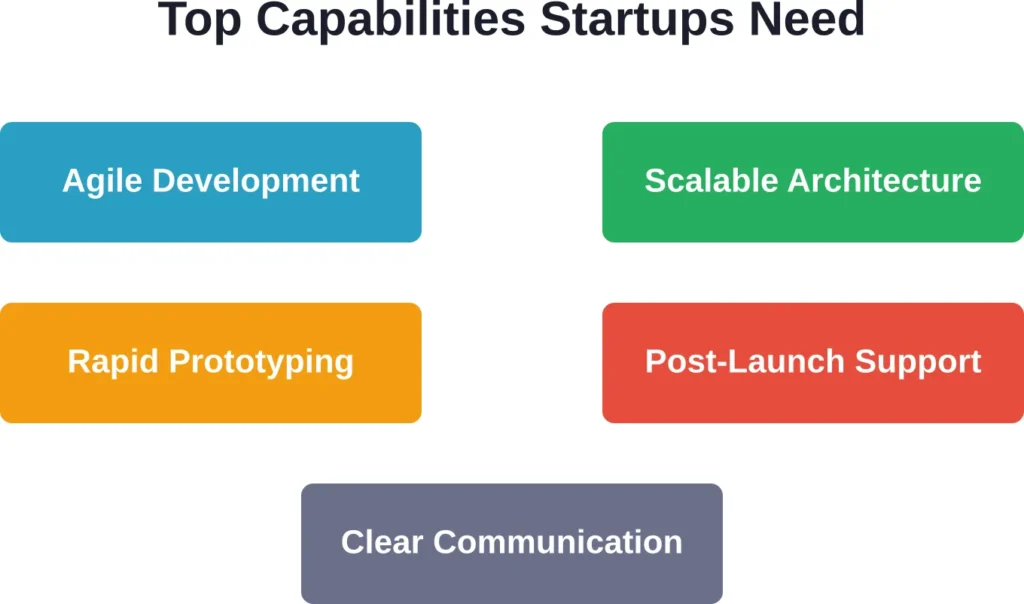
Real startup development requires specific capabilities: rapid prototyping, iterative design, technical debt management, and an understanding of what seed-stage companies actually need versus what enterprise clients want. This list cuts through the noise.
What follows is a carefully curated selection of 15 web development companies that have demonstrated consistent results for early-stage technology companies. Each entry includes what makes them stand out, their core competencies, and the types of startup projects where they excel.
Why Web Development Matters for Startups
Every startup today is a technology company to some degree. Whether building a SaaS platform, a marketplace, or a content-driven product, the website or application is often the product itself.
Poor execution at this stage creates technical debt that compounds. Code written hastily in the early days becomes the foundation that has to support rapid scaling, new features, and evolving user needs. Refactoring later costs more than building it right the first time.
Industry analyses indicate that startups with well-architected initial builds reach product-market fit faster and pivot more effectively when needed. The flexibility to iterate quickly without rebuilding from scratch often determines who survives the first two years.
Beyond the technical foundation, web development shapes first impressions. Landing pages convert investors, early adopters judge credibility by interface quality, and user experience directly impacts retention metrics that determine runway.
Key Considerations When Choosing a Development Partner
Before diving into the list, here’s what separates adequate vendors from genuine partners for startup work.
Technical Stack Alignment
The agency’s preferred technologies should match the product vision and team capabilities. An agency that defaults to WordPress for everything won’t serve a SaaS product well. One that insists on bleeding-edge frameworks might create maintenance problems if the in-house team can’t support it later.
Ask about their recommendations and why. Strong agencies tailor the stack to the specific project requirements, not their comfort zone.
Process Flexibility
Startups change direction. Sometimes weekly. Rigid Waterfall processes or agencies that require complete specifications before starting won’t adapt when pivot discussions happen mid-sprint.
Look for experience with agile methodologies, iterative delivery, and comfort with ambiguity. The best partners help define requirements collaboratively rather than waiting for a perfect brief.
Communication Style
Founders need visibility, not weekly status decks. Agencies that communicate through project managers who filter everything create information lag. Direct access to developers, shared Slack channels, and transparent issue tracking matter more than polished presentations.
Post-Launch Reality
The V1 launch is just the beginning. Bugs emerge, user feedback requires immediate changes, and scaling issues surface under load. Agencies that disappear after deployment or price minor fixes like full projects create operational headaches.
Clarify support terms, response times for critical issues, and how post-launch iteration is priced before signing anything.
Top 15 Web Development Companies for Startups
These agencies represent the strongest options for early-stage companies building web applications, SaaS products, and digital platforms in 2026.
1. Gilzor
Gilzor specializes in full-cycle custom software development with a strong emphasis on helping startups launch digital products that attract users and investors.
Their process starts with idea validation and business analysis, followed by user-centric UI/UX design, web development, rigorous QA, and go-to-market support. This end-to-end approach helps startups move quickly from concept to a functional, scalable web or mobile product while minimizing rework and technical debt.
The team delivers production-ready solutions with clean architecture, focusing on performance, security, and conversion-oriented design — exactly what early-stage companies need to test assumptions and gain traction fast.
Best for: Early-stage startups validating product ideas, SaaS and marketplace platforms, and founders who need both technical execution and go-to-market guidance.
Contact Information:
- Website: www.gilzor.com
- Email: [email protected]
- Address: Poland, Warsaw, Office 58, street Adama Mickiewicza 37, 01-625
- LinkedIn: www.linkedin.com/company/gilzor-softwaredevelopment
2. Oski
Oski builds smart, well-engineered web and software solutions tailored for ambitious startups and tech-forward companies.
They focus on full-stack development using modern frameworks, cloud architecture, and AI integrations, while emphasizing clean code, scalability, and intuitive user experiences from day one. Their frontend expertise combined with robust backend and CMS capabilities allows startups to launch polished digital products quickly.
Client feedback highlights reliable delivery, strong project management, and the ability to turn complex requirements into functional, maintainable web applications.
Best for: Startups needing modern web platforms, e-commerce or SaaS products, and companies looking for AI-enhanced web solutions with long-term scalability in mind.
Contact Information:
- Website: oski.site
- Phone: +48571282759
- Email: [email protected]
- Address: Kaupmehe tn 7, 10114 Tallinn, Estonia
- LinkedIn: www.linkedin.com/company/oski-solutions
3. Mobian Studio
Mobian Studio creates dedicated engineering teams that deliver production-ready web and mobile software for startups that must ship fast and reliably.
They offer both full outsourcing and team augmentation models, covering end-to-end web development, scalable architecture, APIs, and cloud infrastructure. Their approach ensures clean, documented code and seamless integration with existing systems or teams.
Particular strength lies in building systems designed for growth — from early validation to handling significant user loads — while maintaining high engineering standards that prevent costly rewrites later.
Best for: Startups in IT, Fintech, Healthcare, and Logistics needing dedicated web development capacity, scalable digital products, and senior-level execution without building an in-house team from scratch.
Contact Information:
- Website: mobian.studio
- Phone: [email protected]
- Address: Harju maakond, Tallinn, Kesklinnalinnaosa, Masina tn 22, 10113
- LinkedIn: www.linkedin.com/company/mobian-studio
4. A-listware

A-listware provides skilled software development teams and custom web solutions that help startups scale efficiently through outsourcing and dedicated resources.
They handle everything from custom web application development and cloud solutions to UI/UX design and full-stack implementation. Their focus on seamless team integration allows startups to accelerate development without the overhead of hiring and managing internally.
The agency emphasizes high-quality, secure, and responsive digital products built with modern technologies and scalable architecture.
Best for: Startups requiring dedicated development teams, custom web applications, SaaS platforms, and companies that want flexible outsourcing or team augmentation for rapid growth.
Contact Information:
- Website: a-listware.com
- Phone: +1 (888) 337 93 73
- Email: [email protected]
- Address: North Bergen, NJ 07047, USA
- LinkedIn: www.linkedin.com/company/a-listware
- Facebook: www.facebook.com/alistware
5. Lengreo

Lengreo combines website development with full marketing and lead generation support, making them a practical partner for startups that need a functional web presence tied directly to customer acquisition.
They build eCommerce, business websites, landing pages, and web solutions as part of a broader growth strategy, including discovery, prototyping, development, and ongoing optimization. This integrated approach ensures the website is built not just for performance but for measurable business results.
Best for: Startups that need web development tightly connected to B2B marketing, lead generation websites, and companies looking for a single partner handling both technical build and customer acquisition channels.
Contact Information:
- Website: Lengreo.com
- Phone: +31 686 147 566
- Email: [email protected]
- Address: Vrijstraat 9 C/D, 5611 AT Eindhoven, Netherlands
- LinkedIn: Lengreo
- Twitter: @Lengreo
- Instagram: @lengreo
6. Huemor
Huemor specializes in growth-focused web development, building websites and applications optimized for conversion from the ground up.
Their process integrates conversion rate optimization thinking into the design phase rather than treating it as a post-launch activity. This produces interfaces that guide users toward desired actions naturally rather than relying on aggressive popups and pressure tactics.
The team has documented expertise in A/B testing frameworks and analytics implementation, ensuring that startups can measure what’s working and iterate based on data. They build instrumentation into projects from day one.
Huemor has generated measurable results for clients. One documented project for Cleveland Brothers delivered an 82% spike in organic traffic and a Horizon Interactive Award.
Best for: Startups focused on customer acquisition, products where conversion optimization directly impacts unit economics, and companies that make data-driven product decisions.
7. Ruckus
Ruckus has carved out a niche working with technology startups, particularly in the SaaS and B2B software segments.
Their technical approach emphasizes clean code, comprehensive documentation, and architecture that in-house developers can understand and extend. This matters enormously for startups that plan to build internal engineering teams and need to transition ownership gradually.
The agency has experience integrating complex third-party services, building API ecosystems, and handling technical challenges common in B2B products: authentication systems, role-based permissions, data security, and compliance requirements.
Ruckus projects tend to be technically sophisticated rather than design-showcase pieces. They excel at the unglamorous backend work that determines whether applications actually function reliably at scale.
Best for: Technical B2B products, SaaS platforms with complex backend requirements, and startups building developer-facing tools or infrastructure.
8. Top Notch Dezigns

Top Notch Dezigns offers affordable web development specifically targeted at early-stage startups and bootstrapped companies.
Their business model optimizes for efficiency, using proven patterns and accelerated processes to deliver functional websites quickly. While not the choice for highly custom interfaces, they serve startups that need professional web presence without bleeding runway.
The team focuses primarily on content-driven websites, landing pages, and straightforward web applications. They’ve built expertise in rapid deployment using modern frameworks while keeping costs accessible to pre-revenue companies.
Client feedback highlights their communication and reliability. For budget-conscious founders, they represent a middle ground between freelancer risk and agency premiums.
Best for: Bootstrapped startups, pre-revenue companies, content platforms, and founders who need professional execution within constrained budgets.
9. Dotlogics
Dotlogics brings enterprise-grade technical capabilities to startup projects, making them effective for ambitious products that need sophisticated infrastructure from the start.
Their team has experience with high-traffic applications, complex data architecture, and integration challenges that smaller agencies often can’t handle. This expertise proves valuable for startups in regulated industries or those processing sensitive data where security and compliance can’t be afterthoughts.
The agency offers ongoing support and maintenance programs, reducing the burden on internal teams for infrastructure management, security updates, and performance monitoring. For lean startups without dedicated DevOps resources, this operational support extends internal capabilities significantly.
Dotlogics has maintained consistent quality ratings, with verified reviews averaging 4.7/5.0 across client feedback platforms.
Best for: Fintech startups, healthcare technology, products handling sensitive data, and companies that need enterprise-grade security and compliance from launch.
10. Azuro Digital
Azuro Digital focuses exclusively on web development for technology startups and has built their entire service model around the specific needs of early-stage companies.
Their pricing and engagement models accommodate startup constraints, with flexible arrangements that can scale as companies raise funding or reach revenue milestones. This alignment reduces the mismatch between agency billing cycles and startup cash flow realities.
The technical team specializes in modern JavaScript frameworks, particularly React and Node.js, which have become standard for scalable web applications. Their architecture choices prioritize maintainability and future extensibility over showing off technical complexity.
Azuro emphasizes transparency, providing access to code repositories, documentation, and development environments so clients maintain full ownership and visibility throughout projects.
Best for: First-time founders, technical startups that will build in-house teams later, and companies that value transparent partnership over vendor relationships.
11. SumatoSoft
SumatoSoft has built a reputation specifically around early-stage technology companies that need custom web solutions without enterprise overhead.
Their technical focus covers full-stack JavaScript development, progressive web applications, cloud-native architecture, and API-first design. The team structure assigns dedicated technical leads to projects rather than rotating developers, creating continuity that matters when institutional knowledge makes the difference.
What sets them apart for startups is their staged delivery model. Rather than building everything upfront, they help prioritize an MVP scope, deliver it quickly, then iterate based on actual user behavior. This approach aligns development spend with validation milestones instead of speculative features.
Client reviews consistently highlight responsiveness and technical problem-solving. The team maintains ratings around 4.8/5.0 across verified platforms, with specific praise for their ability to translate vague product ideas into concrete technical specifications.
Best for: B2B SaaS products, data-heavy applications, and startups that need technical guidance along with execution.
12. Parallel

Parallel positions itself at the intersection of product design and technical development, making them particularly effective for startups where user experience determines success.
The agency takes a design-first approach, starting with user research and interface prototypes before writing production code. This front-loads validation and prevents the common pattern of building technically sound products that users find confusing.
Their team includes both designers and developers who work collaboratively from project start, reducing the translation problems that happen when design and development are siloed. This integrated workflow accelerates iteration cycles and produces more cohesive final products.
Parallel has documented work with AI startups and developer tools, segments where interface complexity often determines adoption. Their portfolio shows clean, intuitive applications that handle sophisticated functionality without overwhelming users.
Best for: AI and machine learning products, developer-facing tools, and consumer applications where design quality creates competitive advantage.
13. Clay Agency

Clay specializes in brand-forward digital experiences, making them the choice for startups where visual identity and storytelling matter as much as technical infrastructure.
Their process integrates brand strategy, visual design, and web development into a unified engagement. This produces websites and applications that feel cohesive rather than looking like a generic template with a logo dropped in.
The technical work focuses on performance and animation, creating interactions that feel responsive and polished. They’ve built expertise in motion design and micro-interactions that elevate the perceived quality of digital products.
Clay tends to work with well-funded startups that have moved past pure MVP testing and need to establish market presence. Their work skews toward consumer-facing products and companies that compete in crowded categories where differentiation matters.
Best for: Direct-to-consumer startups, well-funded companies building brand equity, and products where emotional connection drives conversion.
14. Lounge Lizard

Lounge Lizard brings nearly two decades of experience across web development, branding, and digital marketing. Their longevity in a volatile industry signals operational stability that matters when choosing a partner.
The agency offers full-service capabilities spanning strategy, design, development, and post-launch marketing. For startups without internal marketing teams, this integrated approach simplifies vendor management and ensures the website is built with acquisition strategy in mind.
Their technical team handles everything from simple landing pages to complex web applications, with particular strength in e-commerce and content-driven platforms. They’ve developed frameworks for rapid deployment that balance customization with efficiency.
Client testimonials emphasize their collaborative process and ability to hit deadlines. The team maintains strong ratings across review platforms, with 4.9/5.0 scores based on verified client feedback.
Best for: Startups that need both development and marketing support, e-commerce products, and companies that value integrated services over specialized boutique agencies.
15. Digital Silk

Digital Silk positions itself as a digital product agency rather than a traditional web development shop, reflecting their focus on strategic outcomes over pure execution.
They emphasize discovery and validation work before development begins, helping startups clarify product positioning, user personas, and feature prioritization. This front-end investment reduces the risk of building the wrong thing efficiently.
The technical team has depth across modern frameworks and specializes in scalable architecture. Their projects are built for growth, with infrastructure decisions that anticipate scaling challenges rather than requiring rewrites when traffic increases.
Digital Silk works primarily with venture-backed startups and has case studies showing multi-year partnerships where they grew with clients from MVP through Series B. This long-term orientation aligns incentives better than agencies optimizing for one-time project revenue.
Best for: Venture-backed startups, products with complex user flows, and companies that need strategic product thinking along with technical execution.
Understanding Web Development Timelines for Startups
Realistic timeline expectations prevent frustration and help founders plan launches, fundraising, and marketing activities appropriately.
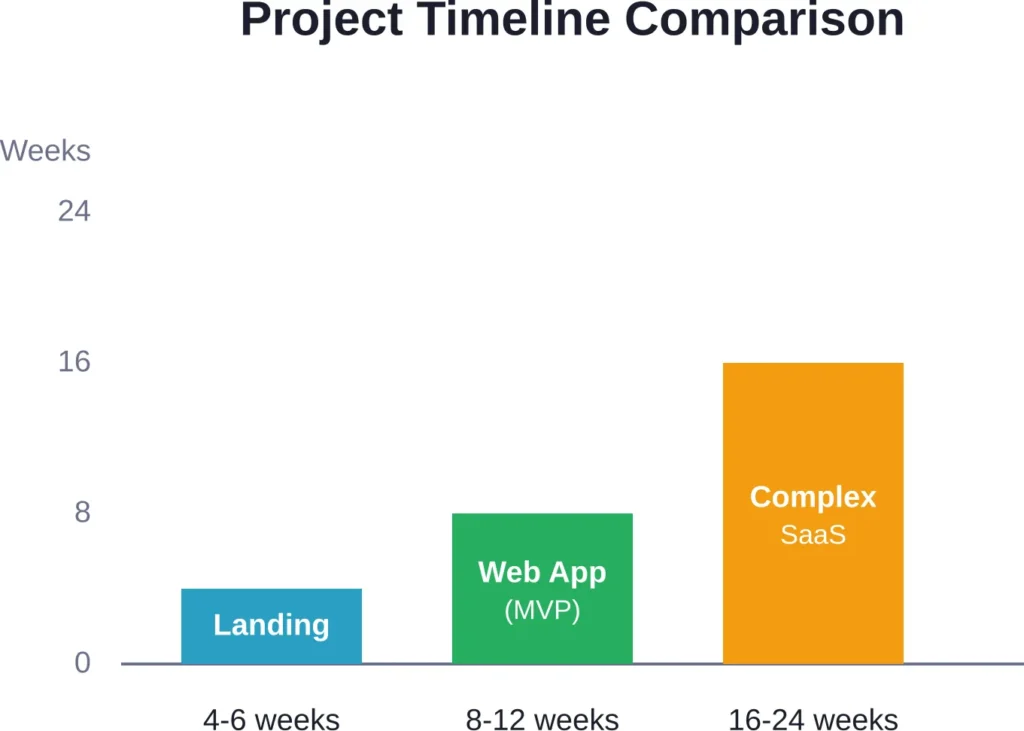
A basic corporate website or landing page typically takes 4-6 weeks from kickoff to launch. This assumes clear requirements, content ready at project start, and reasonable revision cycles.
Custom web applications with moderate complexity generally require 8-16 weeks. This includes products with user authentication, database integration, payment processing, and administrative interfaces. The timeline assumes iterative development with regular feedback cycles.
Complex SaaS platforms or products with sophisticated functionality often span 16-24 weeks or longer. These projects involve significant backend architecture, third-party integrations, security implementation, and extensive testing before production deployment.
Timelines extend when scope changes mid-project, content delivery lags, or feedback cycles drag. The most common delays stem from indecision rather than technical problems. Agencies can only move as fast as clients can make decisions and provide necessary inputs.
Evaluating Agency Fit: Questions to Ask
The right questions during evaluation calls reveal how agencies actually work versus what their marketing claims.
Process and Methodology
Ask specifically about their development process. How do they handle requirements that change mid-project? What happens when priorities shift? How do they balance new feature requests against timeline commitments?
Vague answers about “being flexible” aren’t enough. Strong agencies have actual frameworks for managing change without derailing projects or inflating costs unpredictably.
Team Structure
Who exactly will work on the project? Junior developers, senior engineers, or a mix? Will the team stay consistent or rotate? How many simultaneous projects do team members typically handle?
Agencies that can’t or won’t answer these questions often staff unpredictably or spread senior people too thin across many clients.
Technical Decisions
Why would they recommend specific technologies for the project? What are the tradeoffs? What alternatives did they consider?
Weak agencies recommend the same stack for everything because it’s what the team knows. Strong ones tailor technical decisions to specific project requirements and future plans.
Failure Stories
What projects went poorly and why? How did they recover? What did they learn?
Agencies without failure stories either haven’t done enough work or aren’t being honest. How they handle problems reveals more than their successes.
What Startups Actually Need Versus What Agencies Sell
A gap often exists between what founders request and what will actually help their business succeed.
Many startups ask for feature parity with established competitors, trying to match everything the market leader offers. This wastes resources building features users don’t need while delaying launch and burning runway.
Strong development partners push back on scope creep and help prioritize ruthlessly. The goal is shipping something useful quickly, learning from real users, then iterating based on data rather than assumptions.
Similarly, founders often obsess over visual polish in early versions when speed to market matters more. A functional interface that users find helpful beats a beautiful interface that launches three months late and misses a funding window.
The best agencies understand this tension and guide clients toward pragmatic tradeoffs. They deliver quality work without perfectionism that delays validation.
Red Flags When Evaluating Agencies
Certain warning signs predict problems before contracts are signed.
Unrealistic Promises
Agencies that guarantee first-page Google rankings, promise viral growth, or claim they can build complex applications in impossibly short timeframes are either inexperienced or dishonest. Both are disqualifying.
Poor Communication During Sales
If getting straight answers feels difficult during the sales process, it won’t improve during project execution. Slow responses, vague proposals, and reluctance to commit details in writing all signal future frustration.
No Relevant Portfolio
Agencies with impressive work for Fortune 500 companies but nothing resembling startup projects don’t understand the constraints and priorities of early-stage work. Beautiful case studies from different contexts don’t transfer.
Rigid Processes
Insistence on extensive upfront documentation, long requirement-gathering phases, or resistance to iterative approaches indicates agencies built for enterprise work trying to serve startup clients with incompatible processes.
Unclear Ownership
Ambiguity about code ownership, intellectual property rights, or access to source repositories creates problems later. Everything should be explicitly documented before work begins.
In-House Versus Agency: When Each Makes Sense
Not every startup should outsource web development, and not every one should build internal teams immediately.
Agencies make sense when speed matters more than control, when technical leadership doesn’t exist internally, or when the product needs diverse expertise that single hires can’t provide. They’re particularly effective for defined projects with clear endpoints rather than ongoing product development.
In-house teams become necessary when the product is the core business and continuous iteration is essential. They make sense after product-market fit is established and development needs are consistent enough to support full-time roles.
Many successful startups use a hybrid approach: agencies for initial build and major initiatives, in-house developers for ongoing maintenance and incremental improvements. This balances flexibility with institutional knowledge.
The wrong choice is hiring full-time engineers before the product direction is clear, or outsourcing everything when the product requires deep technical expertise that only committed team members develop over time.
Managing Agency Relationships Effectively
Even excellent agencies deliver poor results when clients mismanage the relationship.
Clarity Beats Flexibility
Vague requirements don’t give agencies creative freedom; they create confusion and rework. The clearer the brief, the more effectively teams execute. Time spent clarifying requirements upfront prevents wasted development cycles later.
Feedback Quality Matters
“I don’t like it” doesn’t help. Specific feedback tied to business objectives enables productive iteration. Strong founders explain the problem they’re trying to solve, not just their aesthetic preferences.
Decision Speed
Agencies bill whether they’re waiting for client feedback or actively developing. Slow decision-making burns budget without producing results. Treat agency time as the expensive resource it is by being responsive.
Scope Discipline
Every “small addition” adds up. Features that seem trivial often require significant backend work. Respect the original scope and save new ideas for defined revision points rather than injecting them continuously.
Common Startup Development Mistakes
Certain patterns show up repeatedly in failed or troubled development projects.
Building for Imagined Scale
Optimizing for millions of users when launching to dozens wastes resources on problems that may never materialize. Build for current needs with scalable architecture, but don’t over-engineer for hypothetical future requirements.
Feature Proliferation
Adding features feels productive but dilutes focus. Successful products typically do fewer things better rather than more things adequately. Every feature added is surface area to maintain, bugs to fix, and complexity for users to navigate.
Ignoring Performance
Slow websites and applications create immediate negative impressions. Users judge credibility by responsiveness. Performance should be a requirement from the start, not an optimization task after launch.
Neglecting Mobile
Mobile traffic dominates most categories. Websites that don’t work well on phones alienate the majority of potential users. Responsive design isn’t optional anymore; it’s baseline functionality.
Skipping Analytics
Launching without instrumentation means flying blind. If the website or application can’t measure user behavior, conversion funnels, and engagement patterns, optimization becomes guesswork.
What Happens After Launch
Launch day is the beginning, not the end, of web development work.
Real users immediately expose assumptions that testing missed. Performance problems emerge under actual load. Workflows that seemed logical in design prove confusing in practice. Copy that tested well doesn’t convert at scale.
Strong agencies plan for this reality with support periods that cover immediate post-launch issues. Clarify what’s included: bug fixes, minor adjustments, or full feature additions. Know response time commitments for critical issues versus nice-to-have improvements.
Many startups benefit from retainer arrangements for ongoing development. Retainer fees vary based on the level of support and development capacity needed. This provides consistent access to development resources without the overhead of full-time hires.
The alternative is project-based engagements for each enhancement, which works when changes are infrequent but creates friction when iteration speed matters.
| Agency Type | Best For | Typical Team Size | Key Strength |
|---|---|---|---|
| Full-Service | Startups needing design + dev + marketing | 50-249 | Integrated capabilities |
| Boutique Technical | Complex SaaS and B2B products | 10-49 | Deep technical expertise |
| Design-First | Consumer products where UX is critical | 10-49 | User experience focus |
| Budget-Friendly | Pre-revenue bootstrapped startups | 10-49 | Efficiency and affordability |
Budgeting for Web Development
Realistic budget expectations prevent sticker shock and help founders allocate resources appropriately.
Professional web development for startups typically costs in the range of $15,000 to $40,000 for an initial build with core features. This gets a functional product with core features, professional design, and clean code that can be extended.
Landing pages and simple marketing sites start lower, with typical ranges from $5,000 to $10,000 for custom work. Template-based solutions cost less but sacrifice flexibility and differentiation.
Complex applications with significant backend infrastructure, third-party integrations, or sophisticated user interfaces easily reach $50,000 to $100,000 or more. These projects involve substantial architecture work, security implementation, and testing.
Geographic location affects costs significantly. Top agencies in major US cities often charge higher rates than distributed teams or agencies in regions with lower costs of operation, though the quality gap has narrowed as remote collaboration has matured.
A website that converts effectively at even moderate rates generates far more value than a cheap one that looks unprofessional or confuses users. Budget decisions should optimize for ROI, not minimum spend.
Technical Debt and Long-Term Thinking
The code written today becomes the foundation for everything that follows. Shortcuts taken to launch faster create technical debt that compounds over time.
Technical debt isn’t always bad. Intentional tradeoffs to validate concepts quickly make sense when speed determines survival. The problem is unintentional debt from poor practices that nobody chose deliberately.
Strong agencies write clean, documented code even on tight timelines. They make architectural decisions that accommodate growth without requiring complete rewrites. They comment code, follow style guides, and use version control properly.
Poor agencies ship functional products built on fragile foundations. Everything works until it doesn’t, and making changes becomes increasingly difficult as the codebase becomes tangled.
Founders without technical backgrounds can’t evaluate code quality directly, but they can ask about practices: testing coverage, documentation standards, code review processes, and how technical decisions get documented for future reference.
Security and Compliance Considerations
Security can’t be an afterthought, especially for startups handling user data, payment information, or operating in regulated industries.
Basic security hygiene should be standard: encrypted data transmission, secure authentication, input validation, and protection against common vulnerabilities. Any agency that treats these as optional add-ons isn’t competent for modern web development.
Startups in healthcare, finance, or education face additional compliance requirements. HIPAA, PCI-DSS, GDPR, and similar regulations impose specific technical and operational requirements that must be built into systems from the start, not retrofitted later.
Ask agencies directly about their security practices and compliance experience. If they seem unfamiliar with requirements relevant to the specific industry, look elsewhere. Compliance failures create existential risks for early-stage companies.
Questions and Answers
Look for agencies with documented startup experience, not just general web development portfolios. Check client reviews specifically from other early-stage companies. During evaluation calls, assess whether they ask insightful questions about the business model and user needs, or just talk about their capabilities. Strong fit shows when agencies challenge assumptions constructively and help refine requirements rather than simply agreeing to build whatever is requested.
Location matters less than it once did. Remote collaboration tools have eliminated most practical differences between local and distributed teams. Focus on communication quality, time zone overlap for real-time discussions, and cultural fit rather than geographic proximity. That said, some founders prefer occasional in-person meetings, which favors local or regional agencies. Neither choice is inherently better; it depends on working preferences and specific project needs.
Developers write code that makes websites and applications function. Designers create the visual interfaces and user experiences. Most projects need both, though the emphasis varies. Simple websites may be design-heavy with straightforward technical implementation. Complex applications may need sophisticated engineering with simpler interfaces. Many agencies provide both services with integrated teams, while some specialize in one discipline and partner with others for complementary capabilities.
For most early-stage technology startups, expect to invest $15,000 to $40,000 for a professional initial build with core features. Simple marketing sites or landing pages typically cost $5,000 to $10,000, while complex SaaS platforms can require $50,000 to $100,000 or more. Budget should align with how critical the website is to the business model and what quality level the target market expects. A cheap website that undermines credibility costs more than it saves.
Ask about their specific process for handling changing requirements, since startups pivot frequently. Request details on team composition and whether assigned developers stay consistent throughout the project. Inquire about their recommended technology stack for the specific project and why those choices make sense. Ask for examples of projects that went poorly and how they recovered. Request clarification on what’s included in post-launch support and how additional work is priced. Strong agencies answer these questions directly and specifically.
Timeline depends on complexity and scope. Basic landing pages take 4-6 weeks, moderate web applications require 8-16 weeks, and complex SaaS platforms often need 16-24 weeks or longer. These estimates assume clear requirements, responsive client feedback, and reasonable revision cycles. Delays usually stem from scope changes, slow decision-making, or content delivery problems rather than technical challenges. Agencies can only work as fast as clients provide necessary inputs and approvals.
This depends entirely on contract terms, which is why reviewing agreements carefully before signing matters enormously. Strong agencies include revision rounds in their proposals and have clear processes for addressing concerns. They typically work in phases with approval milestones, preventing major disconnects from developing unnoticed. Before starting, clarify how disputes are handled, what constitutes acceptable completion, and whether any money-back guarantees or performance commitments exist. The best protection is choosing carefully upfront rather than relying on remedies after problems develop.
Moving Forward With Confidence
Choosing a web development partner ranks among the most consequential early decisions founders make. The right agency accelerates progress, extends internal capabilities, and helps navigate technical decisions that shape the product’s future.
The wrong one drains budgets, misses deadlines, creates technical debt, and forces expensive do-overs that burn precious runway.
This list provides a starting point for evaluation, not a final answer. Every startup has unique requirements, constraints, and priorities that determine which agency represents the best fit.
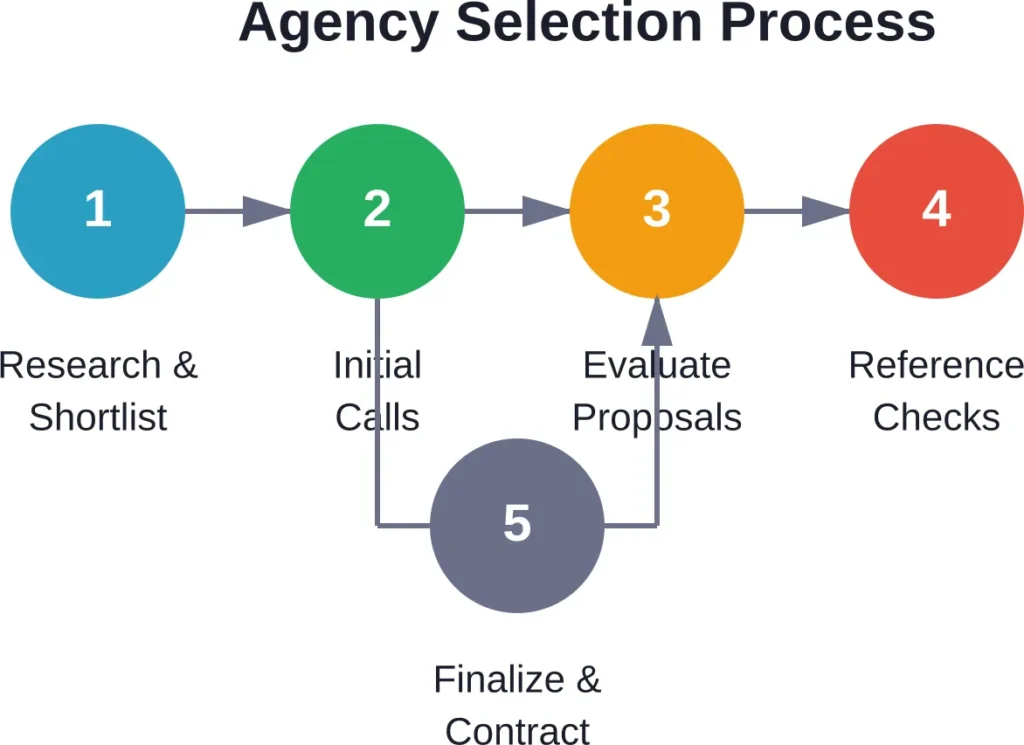
Take time to research thoroughly, have substantive conversations with multiple candidates, check references from similar companies, and clarify expectations in detail before committing. The hours invested in proper vetting pay for themselves many times over through smoother projects and better outcomes.
The agencies highlighted here have demonstrated consistent capability serving startup clients. They understand the unique challenges of early-stage work and have processes adapted to that reality.
Start conversations with 3-5 that seem promising for specific needs. Ask hard questions. Trust the responses that feel honest over the ones that sound impressive. Make the decision based on who will be the best partner through inevitable challenges, not who has the most polished sales presentation.
The right development partner becomes an extension of the founding team, invested in success and committed to building something that matters. Finding that partner is worth the effort it takes.