

Quick Summary: This comprehensive guide ranks the 15 best Webflow web design companies in 2026, covering specialized agencies for B2B SaaS, enterprise brands, startups, and creative projects. Each agency listing includes their core strengths, typical project scope, and what makes them stand out — without pricing details. Whether you need a certified Webflow partner for a complex migration or a boutique studio for brand-driven design, this list helps you find the right match.
Webflow has rapidly become one of the most powerful platforms for businesses that want speed, design flexibility, and full marketing control without traditional development bottlenecks. According to the official Webflow website, 300,000+ brands move the needle with Webflow, and a 2024 Forrester TEI study found that Webflow users saw a 332% ROI over 3 years, with up to 94% reduction in time-to-launch for new pages.
But here’s the catch: building a high-performance Webflow site that converts requires specialized expertise. Not every agency understands how to leverage Webflow’s CMS, animations, and responsive breakpoints to their full potential.
That’s where this guide comes in. We’ve analyzed dozens of Webflow design agencies — from certified Webflow Partners listed on the official experts directory to boutique studios with niche specializations — and identified the 15 best Webflow web design companies operating in 2026.
Each agency below has been evaluated based on their portfolio quality, client results, team expertise, Webflow certifications, and the types of projects they handle best. Whether you’re a fast-growing SaaS startup, an enterprise brand, or a creative firm looking for bold design execution, you’ll find an agency match here.
What Makes a Great Webflow Agency in 2026?
Before diving into the rankings, it helps to understand what separates truly exceptional Webflow agencies from the rest of the pack.
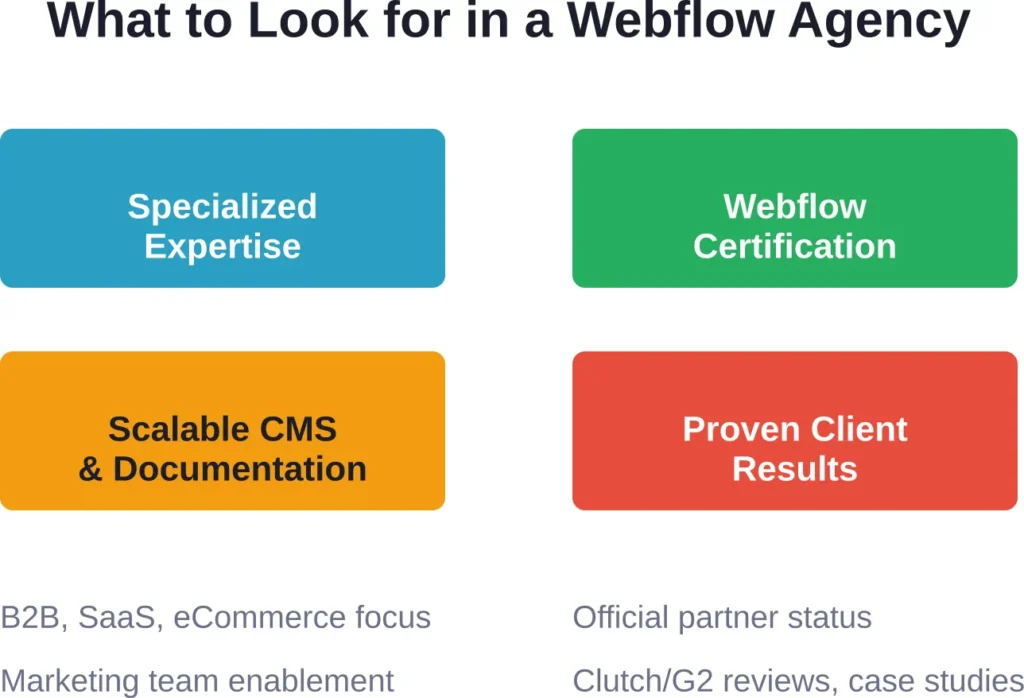
First, specialization matters. The best Webflow agencies don’t just build websites — they solve specific business problems. Some excel at B2B SaaS marketing sites optimized for lead generation. Others focus on enterprise migrations from legacy platforms like WordPress or HubSpot. A handful specialize in creative, brand-first design that pushes Webflow’s animation and interaction capabilities to the limit.
Second, certified expertise counts. According to the official Webflow Experts directory, certified Webflow Partners have passed Webflow’s rigorous training and demonstrated a track record of successful client projects. This certification signals deep platform knowledge and a commitment to best practices.
Third, scalability and post-launch support are critical. Marketing teams want to update content, launch new pages, and run experiments without waiting on developers. The best agencies build sites with clean CMS structures, reusable components, and clear documentation so internal teams can take ownership after launch.
Finally, proven results speak louder than promises. Look for agencies with third-party reviews on Clutch or G2, case studies with quantifiable outcomes, and client testimonials from recognizable brands.
The 15 Best Webflow Web Design Companies in 2026
Now let’s dive into the agencies themselves. Each of the following has been vetted for quality, reliability, and specialty focus. They’re listed in no particular ranking order — instead, each excels in a specific domain.
1. Mobian Studio
Mobian Studio builds dedicated engineering teams that deliver production-ready mobile and AI solutions for companies that demand speed and reliability.
They specialize in end-to-end product development, from mobile apps and AI systems to scalable backend architecture and legacy integrations. Operating through both dedicated team and outstaffing models, Mobian ensures clean code, clear documentation, and senior-level execution.
The studio works with companies in IT, healthcare, fintech, and logistics. Their expertise covers complex domains including regulatory compliance, payment systems, and automation workflows.
Best for: IT, healthcare, fintech, and logistics companies that need fast, high-quality custom software development and dedicated engineering teams to ship products on time and at scale.
Contact Information:
- Website: mobian.studio
- Phone: [email protected]
- Address: Harju maakond, Tallinn, Kesklinnalinnaosa, Masina tn 22, 10113
- LinkedIn: www.linkedin.com/company/mobian-studio
2. Lengreo
Lengreo is a full-service digital marketing and web development partner known for delivering measurable growth through integrated marketing and technical solutions.
The agency stands out for its results-driven approach, combining deep B2B strategy with hands-on execution across SEO, paid ads, lead generation, and custom website development. Their team builds high-converting websites, landing pages, and eCommerce platforms tailored to client objectives.
Lengreo works with software development companies, architecture firms, event technology providers, sports tech companies, and IT services businesses. They focus on hyper-personalized outreach, conversion optimization, and long-term marketing systems that clients can continue to scale.
Best for: B2B companies and tech service providers seeking integrated digital marketing and custom website development that drives qualified leads and measurable revenue growth.
Contact Information:
- Website: lengreo.com
- Phone: +31 686 147 566
- Email: [email protected]
- Address: Vrijstraat 9 C/D, 5611 AT Eindhoven, Netherlands
- LinkedIn: www.linkedin.com/company/lengreo
- Instagram: www.instagram.com/lengreo.agency
- Twitter: x.com/Lengreo
3. A-listware

A-listware is a software development and IT consulting company focused on providing dedicated teams and custom digital solutions.
The agency is known for seamless team augmentation, software development outsourcing, and end-to-end project delivery. They offer expertise in cloud solutions, data analytics, UI/UX design, AI, and enterprise applications like ERP, CRM, and HR systems.
A-listware serves enterprises, small and medium businesses, and startups. Their flexible engagement models allow clients to scale development capacity quickly while maintaining quality and control.
Best for: Companies looking for reliable dedicated development teams, custom software solutions, and technical consulting to enhance their IT capabilities and accelerate product delivery.
Contact Information:
- Website: a-listware.com
- Phone: +1 (888) 337 93 73
- Email: [email protected]
- Address: North Bergen, NJ 07047, USA
- LinkedIn: www.linkedin.com/company/a-listware
- Facebook: www.facebook.com/alistware
4. Gilzor

Gilzor specializes in custom software development and digital product creation, helping startups and growing businesses launch and scale high-quality web and mobile solutions.
What sets Gilzor apart is their full-cycle product development expertise — from idea validation and UI/UX design to development, QA, and go-to-market strategy. They build secure, scalable web applications and mobile apps with a strong focus on user experience and performance.
The company partners with startups, small and medium businesses, and product studios across industries including airlines, e-commerce, and health & wellness. Their strength lies in turning complex ideas into functional, attractive digital products that connect with target audiences.
Best for: Startups and SMBs that need custom web and mobile development combined with product strategy and launch support to validate ideas and accelerate growth.
Contact Information:
- Website: www.gilzor.com
- Email: [email protected]
- Address: Poland, Warsaw, Office 58, street Adama Mickiewicza 37, 01-625
- LinkedIn: www.linkedin.com/company/gilzor-softwaredevelopment
5. Oski
Oski delivers smart, well-engineered software solutions for tech-forward enterprises and ambitious startups.
The team excels at building robust digital platforms using modern technologies across cloud, frontend frameworks, artificial intelligence, and content management systems. They emphasize scalable architecture, intuitive design, and seamless integration to help businesses operate more efficiently.
Oski works with companies in travel, logistics, e-commerce, education, fintech, and insurance. Their solutions range from custom web applications to AI-powered tools and enterprise systems designed for performance and long-term growth.
Best for: Enterprises and innovative startups that require high-quality custom software development, cloud solutions, and AI integrations to power their digital transformation.
Contact Information:
- Website: oski.site
- Phone: +48571282759
- Email: [email protected]
- Address: Kaupmehe tn 7, 10114 Tallinn, Estonia
- LinkedIn: www.linkedin.com/company/oski-solutions
6. Wavespace
Wavespace is a UX-led Webflow agency that specializes in fast-growing startups, particularly those in the B2B SaaS and AI product spaces. The agency has helped 550+ SaaS, B2B, and AI products.
Wavespace emphasizes user experience research and testing. The agency conducts competitive analysis, user interviews, and prototype testing to ensure the final Webflow build is grounded in real user needs rather than aesthetic preferences alone.
The agency extends work beyond the browser to ensure cohesive brand experiences. Many clients require cohesive mobile app design, and the agency coordinates visual systems across platforms to ensure brand consistency.
The team has particular expertise in designing for complex products. If your SaaS platform has intricate feature sets or technical concepts that need to be explained simply, Wavespace excels at creating clear information hierarchies and conversion-focused messaging.
Best for: Fast-growing SaaS and AI startups that need UX-led Webflow design with a focus on conversion and product-market fit.
7. BRIX Agency
BRIX Agency specializes in Webflow design for creative-focused clients. The agency specializes in clean, minimalist design with sophisticated typography and layout work.
BRIX’s portfolio demonstrates a keen eye for whitespace, grid systems, and editorial-style layouts that let client work shine. Their builds often feature case study templates, filterable project galleries, and smooth page transitions that create a premium browsing experience.
The agency also focuses on performance optimization. Even with high-resolution imagery and video content, BRIX sites load quickly thanks to careful image optimization, lazy loading implementation, and efficient Webflow interactions.
BRIX works with design-forward clients. Their understanding of how to showcase visual work makes them a natural fit for portfolio-driven businesses.
Best for: Creative agencies, design studios, and consultancies that need elegant, portfolio-focused Webflow sites.
8. Digital Silk

Digital Silk offers web design and branding services alongside Webflow development. Unlike pure-play Webflow shops, Digital Silk offers strategy, branding, and digital marketing services alongside Webflow development.
This makes them a strong choice for companies that need more than just a website. Digital Silk can handle brand identity development, content strategy, SEO optimization, and ongoing digital marketing — all coordinated with the Webflow build.
The agency serves enterprises across various industries. Their Webflow builds tend to be content-heavy sites with robust blog systems, resource centers, and multi-layered navigation.
Digital Silk’s process is highly collaborative, with dedicated project managers and regular client check-ins throughout the build. Their enterprise focus means they’re accustomed to working with multiple stakeholders and navigating complex approval processes.
Best for: Mid-to-large enterprises that need full-service digital strategy, branding, and marketing alongside Webflow development.
9. Uroboro

Uroboro is a Webflow agency specializing in storytelling-focused web experiences. The agency’s work is characterized by narrative-focused layouts, cinematic transitions, and interactive elements that guide users through content in engaging ways.
Uroboro works with mission-driven and narrative-focused brands. Their builds often feel more like interactive magazines than traditional corporate websites.
The agency excels at translating complex or abstract concepts into visual metaphors and interactive experiences. If your company’s value proposition requires education or emotional connection rather than straightforward feature lists, Uroboro’s storytelling approach can be highly effective.
Uroboro projects tend to be mid-range in scope, focusing on quality over quantity. The agency works closely with clients on content strategy and copywriting to ensure the final site tells a cohesive, compelling story.
Best for: Mission-driven brands and companies with compelling narratives that benefit from scroll-driven, story-focused web experiences.
10. Ammo Studio
Ammo Studio specializes in platform migrations and Webflow rebuilds. The agency focuses specifically on helping companies transition from bloated WordPress sites, rigid HubSpot templates, or outdated custom code to clean, maintainable Webflow builds.
Ammo Studio handles migrations with attention to content audit, URL mapping, and redirect strategies. Their experience with migrations means they understand common pitfalls and can navigate technical challenges that derail less experienced teams.
Beyond migrations, Ammo offers ongoing retainer services for optimization, content updates, and new page builds. This makes them a practical choice for marketing teams that need a reliable Webflow partner for continuous iteration rather than one-off projects.
Ammo Studio works with various industries including professional services and B2B software companies. The agency helps brands transition to Webflow for better design control and marketing agility.
Best for: Companies migrating from WordPress, HubSpot, or custom platforms to Webflow, plus teams that need ongoing optimization and support.
11. Finsweet
Finsweet is widely regarded as one of the most technically sophisticated Webflow agencies in the world. The New York-based team has built a reputation for advanced Webflow development, custom interactions, and pushing the platform’s capabilities beyond what most agencies attempt.
What sets Finsweet apart is their deep technical expertise. The agency has developed some of the most popular Webflow libraries and tools used by the broader community, including advanced filtering systems, CMS solutions, and animation frameworks. The agency has 50+ Webflow professionals, as noted in the official Webflow Experts directory.
Finsweet specializes in enterprise-grade Webflow builds for fast-growing tech companies. The agency works with tech companies across industries. The team handles complex migrations from platforms like WordPress, builds multi-site Webflow instances for global brands, and creates highly interactive web experiences that leverage Webflow’s animation and CMS features to the fullest.
Best for: Mid-to-large tech companies that need advanced Webflow development and custom functionality beyond out-of-the-box capabilities.
12. Flow Ninja

Flow Ninja has established itself as a go-to agency for regulated industries like finance, healthcare, and SaaS platforms. According to authoritative sources, they have successfully migrated sites from WordPress and HubSpot to Webflow while maintaining compliance requirements.
One of Flow Ninja’s standout features is scale. Flow Ninja operates with in-house talent, and they can handle multiple complex projects simultaneously while maintaining consistent quality and communication.
The agency focuses heavily on conversion optimization and performance. Their process includes comprehensive CRO audits, A/B testing frameworks, and analytics implementation to ensure sites don’t just look good but drive measurable business results.
Flow Ninja works with enterprise SaaS companies and fintech startups. The agency’s expertise in scalable CMS architecture means marketing teams can manage content independently post-launch.
Best for: Enterprise SaaS and fintech companies that need compliance-ready, high-performance Webflow sites with robust CMS capabilities.
13. Refokus

Refokus is a Webflow agency known for award-winning design work and specializes in bold, visually stunning websites with advanced animations.
The agency creates visually distinctive Webflow sites with advanced interactions. Their work is characterized by polished execution and technical rigor, ensuring sites load quickly, maintain accessibility standards, and work flawlessly across devices.
Refokus also offers brand strategy and identity design alongside Webflow development, making them a one-stop shop for companies undergoing full rebrands or launching new products.
The agency works with companies in various industries.
Best for: Brands that prioritize cutting-edge design and want a visually distinctive website with advanced animations and interactions.
14. Amply
Amply positions itself as a B2B SaaS specialist for marketing websites. The agency understands the specific needs of SaaS marketers: fast iteration, SEO-optimized blog structures, integration with marketing automation platforms, and conversion-focused landing pages.
What makes Amply stand out is their emphasis on post-launch ownership. The agency builds sites with marketing teams in mind, creating intuitive CMS structures, reusable components, and clear documentation so clients can own and scale their marketing sites after the initial build.
Amply’s process includes conversion rate optimization from day one. They conduct user research, analyze competitor sites, and build testing frameworks into the site architecture. Their retainer model allows ongoing optimization and iteration as companies scale.
Amply works with B2B SaaS companies on custom Webflow builds.
Best for: B2B SaaS companies that want to own and rapidly iterate on their marketing site post-launch.
15. Relume
Relume has built a unique niche by combining Webflow design with AI-powered site planning and component libraries. The agency developed the Relume Library, a massive collection of pre-designed, customizable Webflow components that dramatically speed up the design and build process.
Relume’s approach is particularly valuable for companies that need to launch quickly without sacrificing quality. By leveraging their component library and site planning tools, the agency can accelerate the design and build process.
Relume customizes components to match client branding. The result is a site that feels fully custom but launches in weeks rather than months.
The agency focuses primarily on startups and growth-stage companies that need professional Webflow sites on aggressive timelines. Their component-based approach also makes future updates and expansions easier and more cost-effective.
Best for: Startups and fast-moving teams that need a professional Webflow site launched quickly without compromising on quality.
How to Choose the Right Webflow Agency for Your Project
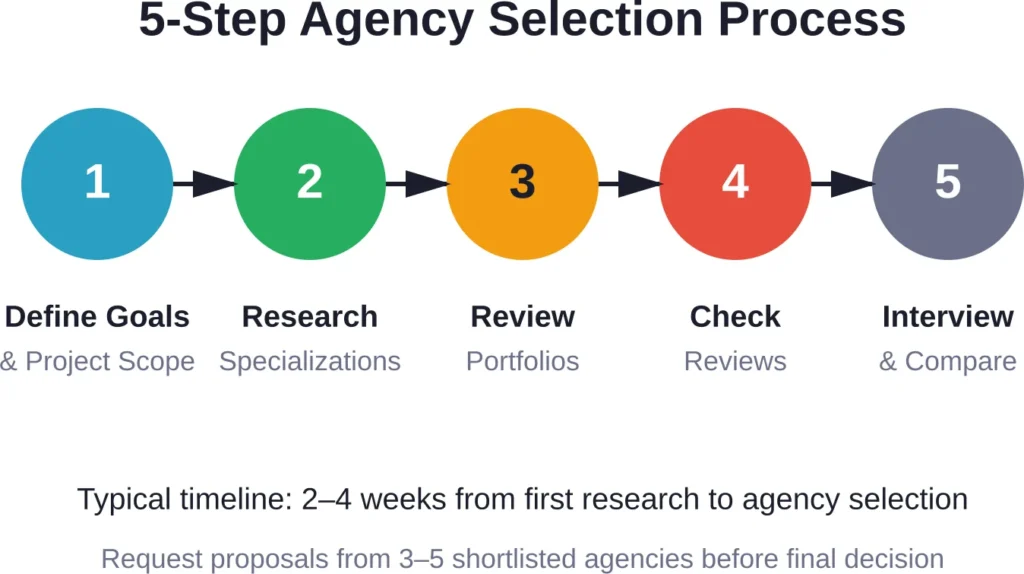
With so many strong options, how do you narrow down the right agency for your specific needs? Here are the key decision criteria to consider.
Define Your Project Scope and Goals
Start by clarifying exactly what success looks like. Are you launching a new brand and need a full website from scratch? Migrating an existing site from another platform? Adding new sections or functionality to an existing Webflow site?
Different agencies excel at different project types. Ammo Studio specializes in migrations. Relume focuses on fast new builds. Finsweet handles complex custom functionality. Match your project type to the agency’s core strength.
Also define your business goals. If lead generation is paramount, agencies like Amply or Wavespace that focus on conversion optimization make sense. If brand perception and visual impact matter most, creative-first agencies like Refokus or BRIX are better fits.
Consider Your Industry and Compliance Needs
Some agencies have deep expertise in specific industries. Flow Ninja specializes in regulated sectors like healthcare and fintech where compliance is critical. Digital Silk works extensively with professional services and enterprise healthcare.
If your industry has specific requirements — HIPAA compliance, accessibility standards, multilingual content, complex user permissions — look for agencies with demonstrated experience in those areas. Ask for relevant case studies and client references.
Evaluate Team Size and Availability
Larger agencies like Finsweet and Flow Ninja can handle multiple simultaneous projects and have resources to staff complex builds with specialists. Smaller boutique agencies offer more personalized attention but may have limited availability.
Ask about current workload and typical timelines to ensure they can meet your project schedule. Also ask about team composition. Will you work with senior strategists and designers, or will much of the work be delegated to junior team members? What’s the ratio of designers to developers? Is the team fully in-house or do they use contractors?
Review Portfolios and Case Studies Carefully
Every agency will showcase their best work on their website. Look beyond visual polish to evaluate whether their portfolio demonstrates the specific capabilities you need.
If you need complex CMS structures with multiple content types, look for case studies that highlight robust content management. If animations and interactions are critical, evaluate whether their portfolio sites actually perform well (some beautiful designs are laggy or break on mobile).
Pay attention to the industries and company sizes represented in their portfolio. An agency that primarily works with Fortune 500 enterprises may not be the right cultural fit for a scrappy startup, and vice versa.
Check Third-Party Reviews and References
Portfolio sites only tell half the story. Third-party review platforms like Clutch, G2, and Google Reviews provide more balanced perspectives on what it’s actually like to work with an agency.
Look for patterns in reviews. Do clients consistently praise communication and responsiveness? Or do multiple reviews mention scope creep and missed deadlines? Are clients still happy six months after launch, or were there post-launch support issues?
Don’t hesitate to ask agencies for client references you can contact directly. Speak with someone in a similar role at a similar company to yours and ask about their experience.
Understand Their Process and Post-Launch Support
Does the agency start with discovery and strategy? What revision rounds are included? What’s the approval process?
Also clarify post-launch support. Some agencies offer ongoing retainers for updates, optimization, and new page builds. Others deliver the site and move on. If you don’t have in-house Webflow expertise, ongoing support may be critical.
Ask about documentation and training. Will the agency provide video tutorials showing your team how to use the CMS? Written documentation? Live training sessions? This matters immensely for long-term success.
What to Expect from the Webflow Design Process
Once you’ve selected an agency, what does a typical Webflow project timeline look like? While every agency has their own process, most follow a similar structure.
Discovery and Strategy (Week 1-2)
Discovery phase typically includes stakeholder interviews, review of existing materials, competitor analysis, and clarification of business goals. This phase often includes user research — surveys, interviews, or usability testing of your current site to understand pain points and opportunities. Agencies with strong UX practices like Wavespace invest heavily in this phase.
The deliverable is usually a creative brief or strategy document that outlines site goals, target audiences, key messages, content structure, and technical requirements. Both parties align on this foundation before design begins.
Information Architecture and Wireframes (Week 2-3)
Next comes site structure. The agency will map out the sitemap, page templates, navigation systems, and content hierarchy. This is typically presented as low-fidelity wireframes that show layout and content flow without visual design.
This phase is critical for complex sites with lots of content or multiple user paths. Getting the information architecture right prevents costly redesigns later when visual design is underway.
Typically, clients provide feedback on wireframes and iterate until the structure is refined. Agencies will typically present 1-2 rounds of wireframe revisions based on your input.
Visual Design (Week 3-5)
With structure approved, the agency moves into visual design. Designers will create high-fidelity mockups in Figma or Adobe XD showing exactly what key pages will look like, including typography, color, imagery, buttons, and components.
Most agencies start with a few key pages — homepage, main service/product page, blog template — to establish the visual system. Once the core design is approved, they design additional pages and templates using the established style.
Most projects include 2-3 rounds of design feedback and revision. Specific feedback with examples helps designers iterate more effectively.
Webflow Development (Week 4-7)
Once designs are approved, developers begin building in Webflow. They’ll create the responsive layouts, set up the CMS structure, build interactions and animations, and implement all the designed pages.
Strong agencies build with scalability in mind from the start — creating reusable components, clean class naming systems, and well-organized CMS collections that make future updates easy.
During this phase, clients typically have access to a staging environment for progress review. Agencies will often demo functionality in weekly check-in calls.
Content Population and Testing (Week 7-8)
With the site built, content gets added. Depending on the project scope, the agency may migrate content from your old site, populate new content you provide, or assist with content creation.
This is also when QA testing happens. The agency will test across browsers and devices, check all links and forms, validate SEO tags, test page speed, and ensure accessibility standards are met.
This phase often reveals small refinements needed, such as layout adjustments with real content, animation timing, or form field clarity. Iteration during this phase is typical.
Training and Launch (Week 8-9)
Before launch, most agencies train internal teams on Webflow CMS management, content updates, page creation using templates, and site maintenance. This usually includes video tutorials, written documentation, and live training sessions.
The actual launch process involves pointing DNS records to Webflow, setting up redirects from old URLs if migrating, connecting the domain, and enabling SSL. Most agencies handle the technical cutover.
Post-launch, expect a brief period of monitoring and quick fixes if any issues arise. Many agencies include 30 days of post-launch support for bug fixes and small adjustments.
Common Webflow Project Challenges and How Agencies Handle Them
Even with experienced agencies, Webflow projects can hit bumps. Here are common challenges and how the best agencies address them.
Content Delays
One of the most common project delays is clients not providing content on time. If the agency is waiting for copy, imagery, or brand assets, development stalls.
Strong agencies mitigate this by clearly defining content needs upfront, providing content templates and examples, and setting hard deadlines in the project timeline. Some agencies offer content creation services to avoid this bottleneck entirely.
Scope Creep
Midway through a project, it’s tempting to add “just one more page” or “a quick integration.” Small additions compound and suddenly the project is behind schedule and over budget.
Professional agencies define scope clearly in the proposal and have formal change request processes. If you want to add something, they’ll assess the impact on timeline and cost before proceeding. This protects both parties.
Technical Limitations
Webflow is incredibly powerful, but it’s not infinitely flexible. Some custom functionality requires code or third-party integrations. Occasionally, a design concept isn’t feasible within Webflow’s constraints.
Experienced agencies flag technical limitations early, during the wireframe or design phase, before significant work is invested. They’ll propose alternatives that achieve similar results within Webflow’s capabilities or suggest custom code solutions if necessary.
Mobile Responsiveness Issues
Designs that look perfect on desktop sometimes have issues on mobile. Text becomes too small, layouts stack awkwardly, or interactions don’t work on touch devices.
The best agencies design for mobile from the start, often following a mobile-first approach. They test on actual devices throughout development, not just in browser dev tools, and iterate until the mobile experience is as polished as desktop.
Performance Problems
Sites with lots of imagery, video, or complex animations can become slow if not optimized properly. Page speed impacts SEO and conversion rates significantly.
Strong Webflow agencies implement performance best practices by default: optimized image formats (WebP), lazy loading, efficient interactions that use transforms instead of layout reflows, and minimal custom code. They test page speed throughout development and optimize before launch.
Beyond the Build: Maximizing Your Webflow Investment Post-Launch
Launching a beautiful Webflow site is just the beginning. The real value comes from continuous optimization, testing, and iteration based on real user data.
A/B Testing and Conversion Optimization
Once your site is live and collecting traffic, start testing. Try different headlines, CTA button colors, form lengths, or page layouts to see what drives more conversions.
Webflow integrates with various A/B testing tools for conversion optimization. Some agencies like Flow Ninja and Amply offer ongoing optimization retainers where they run experiments and implement winning variations.
Content Expansion
Regularly publishing high-quality content improves SEO, establishes thought leadership, and gives prospects reasons to return to your site. Webflow’s CMS enables creation and management of blogs, case study libraries, and resource centers.
The best Webflow builds make content publishing easy for non-technical team members. Take advantage of that by empowering marketers to launch new content without developer dependencies.
Performance Monitoring
Track Core Web Vitals, page load times, and mobile performance regularly. As you add content and features, performance can degrade. Performance monitoring tools can help identify optimization opportunities.
Performance drops are typically caused by changes such as large unoptimized images or videos. Many agencies offer performance audit services if issues are complex.
Security and Compliance Updates
Web standards evolve. Privacy laws change. Browser capabilities advance. Periodically audit your site to ensure accessibility compliance, GDPR cookie consent, updated legal pages, and security best practices.
Webflow handles infrastructure security and platform updates automatically, but content-level compliance (privacy policy accuracy, accessibility tags on images, proper heading hierarchy) requires ongoing attention.
Feature Expansion and Iteration
As your business grows, your website needs will evolve. You might need a customer portal, a gated resource library, e-commerce functionality, or integration with new marketing tools.
Many agencies offer retainer relationships for ongoing development. This provides predictable capacity for enhancements without the overhead of hiring in-house Webflow developers.
Frequently Asked Questions
Agencies typically have larger teams with specialized roles — strategists, designers, developers, project managers. This means they can handle complex projects with tight timelines and offer broader expertise. Freelancers offer more personalized attention and lower costs but have limited capacity and usually specialize in either design or development, not both. For complex projects, agencies typically offer more comprehensive resources and process maturity. Freelancers may offer cost advantages for smaller projects or ongoing maintenance.
Timeline varies significantly based on scope. Simple marketing sites typically require several weeks from kickoff to launch. Complex Webflow projects with custom structures and integrations require extended timelines. Project timelines are affected by content availability, stakeholder approval processes, custom functionality needs, and agency capacity. Always ask agencies for timeline estimates specific to your project scope during the proposal process.
Webflow is designed to enable non-technical team members to manage content and create pages without coding. Well-designed Webflow sites include intuitive CMS collections, components, and templates for marketing team independence. Advanced customizations such as new interactions or complex functionality typically require specialized Webflow expertise. Most agencies provide training and documentation enabling teams to manage content updates independently, with optional retainer support for advanced enhancements.
Yes. Webflow’s CMS can support enterprise-scale sites. Agencies like Finsweet and Flow Ninja regularly build sites managing thousands of pages. Enterprise-scale Webflow sites typically use proper CMS architecture and may integrate external data sources via API. Scale requirements should be discussed with agencies during project discovery.
Webflow project costs vary significantly based on scope and complexity. Custom builds with 10-20 pages and CMS setup are mid-range projects. Enterprise projects with custom functionality and ongoing support command higher budgets. Budget ranges vary among agencies, so clarify project budget during initial consultations. Many agencies also offer retainer arrangements for ongoing work.
Compared to WordPress: Webflow offers a visual design interface, managed hosting, and faster content iteration for marketing teams. Compared to Squarespace: Webflow provides greater design flexibility and more powerful CMS capabilities. Webflow offers greater design control compared to website builders with less extensive visual customization. Webflow is positioned as a middle ground between website builders and fully custom development.
Platform migrations to Webflow are feasible. Agencies like Ammo Studio offer migration services. Migration processes typically include content audit, URL mapping, redirect strategy, design implementation, CMS structure creation, content import, and testing. Migration complexity depends on the extent of custom functionality in the existing WordPress site. Standard blog and page content typically migrates straightforwardly. Complex custom functionality may require custom solutions or updated workflows. WordPress setup details should be discussed with migration specialists for accurate project scoping.
Final Thoughts: Choosing Your Webflow Partner
The Webflow agency you choose becomes a critical partner in your digital presence. The right match brings not just technical execution but strategic thinking, industry expertise, and a collaborative approach that makes the process smooth and the outcome successful.
The 15 agencies profiled here represent the best Webflow has to offer across different specializations, project types, and client sizes. Whether you’re a fast-growing SaaS startup, an enterprise brand undergoing digital transformation, or a creative agency that needs a stunning portfolio showcase, one of these partners likely aligns with your needs.
Begin with clear project goals, budget parameters, and timeline requirements. Evaluate 3-5 agencies whose specializations align with project needs. Review portfolios, check third-party reviews, and schedule initial consultations. Strong agency partners ask substantive discovery questions, articulate clear processes, and show genuine interest in solving specific business challenges.
Remember: a Webflow site is an investment, not an expense. Webflow projects can contribute to business outcomes such as improved conversion rates, SEO performance, and reduced technical overhead. Paired with the right agency partner, your Webflow site becomes a powerful engine for growth.
Ready to take the next step? The official Webflow Experts directory lists additional certified partners. Review portfolios and initiate conversations with agencies aligned with project requirements. Your new Webflow site is closer than you think.