

Quick Summary: The best UI/UX web design companies in 2026 combine strategic thinking, measurable outcomes, and deep specialization across industries like SaaS, fintech, and emerging tech. This curated list features 15 leading agencies—from established pioneers like IDEO and Frog Design to specialized partners like UX studio and Punchcut—that deliver transformative digital experiences backed by proven case studies and trusted client relationships.
Finding the right UI/UX design agency can define the success of a digital product. With strong industry recognition that design serves as a critical business advantage, the stakes have never been higher. User experience isn’t just about aesthetics anymore—it’s about creating intuitive, accessible, and emotionally resonant experiences that drive engagement, loyalty, and measurable business outcomes.
But here’s the challenge: the market is saturated with agencies promising world-class design. Some specialize in rapid prototyping for startups. Others focus on enterprise-scale transformation. A few excel at emerging technologies like AI and IoT.
So how do you cut through the noise?
This guide presents 15 leading UI/UX design companies that have demonstrated excellence through verified portfolios, client caliber, and proven impact. These aren’t random picks—they’re agencies that industry leaders trust, from fast-scaling startups to Fortune 500 enterprises optimizing their digital presence.
What Makes a UI/UX Design Agency Great in 2026?
Before diving into the list, it’s worth understanding what separates exceptional design partners from the rest. The landscape has evolved significantly over the past few years.
Great agencies don’t just push pixels. They approach design as a strategic discipline that bridges user needs, business goals, and technical constraints. They understand that design decisions have downstream effects on conversion, retention, and customer lifetime value.
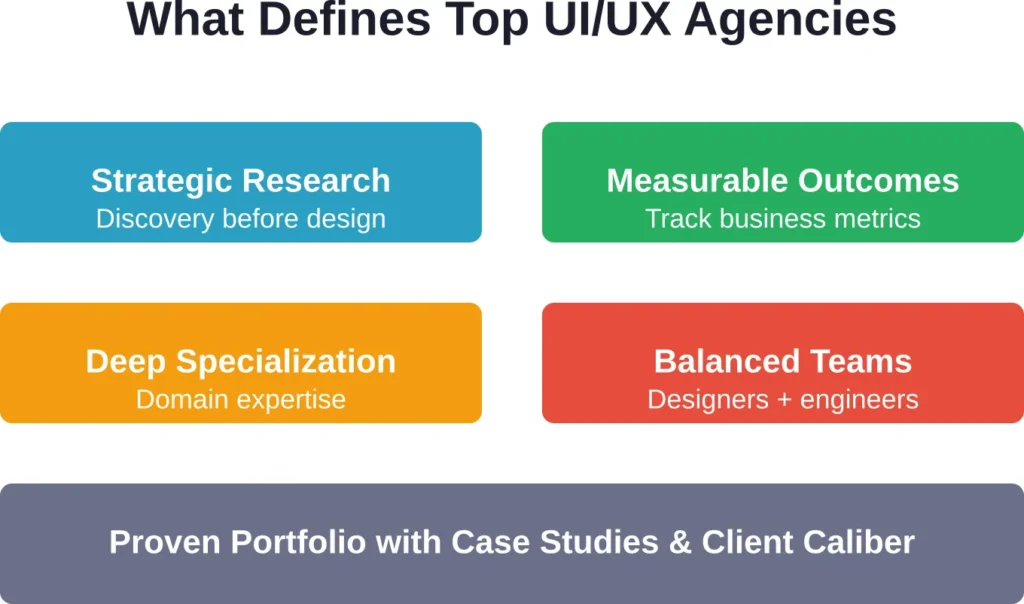
Strategic Thinking Over Execution
The best agencies start with research and discovery. They conduct user interviews, competitive analysis, and stakeholder workshops before touching design tools. This strategic foundation ensures that design decisions are rooted in evidence rather than assumptions.
According to Forrester research cited in industry sources, investing in good design yields significant returns on investment. But that ROI only materializes when design work aligns with core business metrics.
Measurable Outcomes and Business Impact
Top-tier agencies speak the language of business. They don’t just deliver Figma files and call it done. They track metrics like conversion rates, task completion times, and user satisfaction scores. They demonstrate how design improvements translate to revenue growth or cost savings.
Community discussions reveal that businesses increasingly expect agencies to show measurable impact. If checkout improvements increase conversion by 10% on a $50M GMV business, that’s a $5M annual lift. That’s the kind of thinking that separates strategic partners from order-taking vendors.
Deep Specialization vs. Generalist Approach
Some agencies excel across multiple domains. Others carve out expertise in specific verticals like healthcare, fintech, or SaaS. Neither approach is inherently better—it depends on project needs.
For complex, regulated industries like medical devices or financial services, specialized expertise becomes crucial. These agencies understand domain-specific constraints, compliance requirements, and user expectations that generalists might miss.
Team Composition and Capabilities
Look at how agencies structure their teams. The best ones maintain balanced ratios of researchers, strategists, visual designers, and prototypers. Some even employ engineers in-house to ensure design feasibility.
One standout characteristic: agencies where roughly 50% of the team consists of engineers and 50% consists of creatives tend to bridge the design-development gap more effectively. This balance reduces back-and-forth friction and accelerates time-to-market.
The Top 15 UI/UX Web Design Companies for 2026
Now let’s get to the main event. These agencies have been selected based on portfolio quality, client caliber, industry recognition, and demonstrated impact. Each brings unique strengths to the table.
1. Mobian
Mobian builds dedicated engineering teams that deliver production-ready digital products with a focus on mobile solutions and thoughtful user experiences.
What sets Mobian apart is their end-to-end product development approach — from wireframes to deployment — with strong emphasis on clean architecture and user-centered design. They specialize in creating scalable solutions that perform in real-world conditions.
Their expertise includes mobile app development, full-stack delivery, and AI-powered systems for industries such as healthcare, fintech, logistics, and IT. They excel at projects where design and technology must work together seamlessly.
The team emphasizes dedicated, focused delivery with clear communication and post-launch partnership, ensuring products are not only well-designed but also maintainable and scalable.
Mobian works particularly well for companies in regulated or complex sectors that need reliable partners for building and scaling digital products where user experience and technical excellence are equally critical.
Contact Information:
- Website: mobian.studio
- Phone: [email protected]
- Address: Harju maakond, Tallinn, Kesklinnalinnaosa, Masina tn 22, 10113
- LinkedIn: www.linkedin.com/company/mobian-studio
2. Lengreo

Lengreo positions itself as a complete marketing and tech partner that combines digital strategy with website development for B2B companies.
What sets Lengreo apart is their focus on measurable business growth through integrated marketing and web solutions. They go beyond standard design by creating websites and landing pages that actively drive lead generation and conversions.
Their work emphasizes B2B digital marketing strategy, website development, and conversion optimization. Case studies show significant improvements in client acquisition, lead generation, and cost-per-lead reduction for companies in software development, architecture, event technology, and sports tech.
The team works closely with clients as a strategic extension, providing personalized tactics rather than pre-packaged solutions. They combine marketing expertise with technical website development, including prototyping and design development.
Lengreo works particularly well for B2B companies and service providers that need websites and digital systems designed to generate qualified leads and support business development.
Contact Information:
- Website: lengreo.com
- Phone: +31 686 147 566
- Email: [email protected]
- Address: Vrijstraat 9 C/D, 5611 AT Eindhoven, Netherlands
- LinkedIn: www.linkedin.com/company/lengreo
- Instagram: www.instagram.com/lengreo.agency
- Twitter: x.com/Lengreo
3. A-listware

A-listware is a software development and consulting company that offers dedicated teams and comprehensive UX/UI design services as part of end-to-end digital solutions.
What sets A-listware apart is their ability to deliver vibrant, user-focused web and software designs that drive engagement while aligning with brand goals. They combine UX/UI expertise with full development and team augmentation capabilities.
Their services include UX/UI design, responsive web design, SaaS UI design, and complete software development. They create solutions for enterprise applications, ERP, CRM, and other complex systems across various industries.
The team works as a seamless extension of client organizations, providing high-quality, secure, and responsive digital solutions with strong attention to user experience.
A-listware is a strong partner for enterprises, small and medium businesses, and startups that need professional UX/UI design integrated with reliable software development and ongoing technical support.
Contact Information:
- Website: a-listware.com
- Phone: +1 (888) 337 93 73
- Email: [email protected]
- Address: North Bergen, NJ 07047, USA
- LinkedIn: www.linkedin.com/company/a-listware
- Facebook: www.facebook.com/alistware
4. Gilzor

Gilzor specializes in custom digital product development with a strong emphasis on UI/UX design that improves conversion rates and user satisfaction.
What sets Gilzor apart is their full-cycle approach — from idea validation and user-centric design to development and go-to-market strategy. They focus on building functional and attractive products that truly connect with target audiences.
Their portfolio includes web and mobile applications across industries such as airlines, e-commerce, and health & wellness product studios. Case studies highlight apps that deliver measurable user growth and positive market response through thoughtful design and solid execution.
The team consists of creative and strategic thinkers who use a user-centric approach to design interfaces that meet business goals while delivering excellent user experiences.
Gilzor is an excellent choice for startups and small-to-medium businesses looking to launch or scale digital products where strong UI/UX design plays a key role in user adoption and success.
Contact Information:
- Website: www.gilzor.com
- Email: [email protected]
- Address: Poland, Warsaw, Office 58, street Adama Mickiewicza 37, 01-625
- LinkedIn: www.linkedin.com/company/gilzor-softwaredevelopment
5. Oski
Oski builds smart, well-engineered software solutions with a focus on frontend development and intuitive user experiences for enterprises and ambitious startups.
What sets Oski apart is their commitment to innovative design combined with robust technical implementation. They prioritize aesthetically pleasing and intuitive interfaces that adapt to modern web standards while maintaining high performance.
Their expertise covers frontend solutions (React, Vue, Angular, and more), UI/UX design, and full software development across multiple industries including fintech, travel, logistics, e-commerce, and education.
The team delivers end-to-end solutions — from design and development to deployment and maintenance — helping clients reimagine how their businesses operate through digital innovation.
Oski works well for tech-forward enterprises and startups that need high-quality, user-centered digital products where both design excellence and technical reliability are essential.
Contact Information:
- Website: mobian.studio
- Phone: [email protected]
- Address: Harju maakond, Tallinn, Kesklinnalinnaosa, Masina tn 22, 10113
- LinkedIn: www.linkedin.com/company/mobian-studio
6. Work&Co
Work&Co specializes in digital product innovation for ambitious brands. The agency has built a reputation for designing and building products that ship and scale—not just concepts that languish in Figma files.
Their approach emphasizes close collaboration with client product and engineering teams. Work&Co designers work alongside developers throughout the build process, ensuring that design intent translates faithfully to production. This reduces the common problem where beautiful designs get compromised during implementation.
The agency’s portfolio includes major digital products for well-known consumer brands. They handle everything from mobile apps to web platforms to design systems. Their work tends to be polished and performance-oriented—experiences that look great but also load fast and function reliably.
Work&Co maintains a balanced team of designers, strategists, and engineers. This allows them to own projects from concept through launch, reducing coordination overhead for clients. For companies that need both design and development capabilities under one roof, this integrated approach simplifies vendor management.
The agency works best for mid-market to enterprise clients launching new digital products or overhauling existing ones. Their pricing falls in the premium range, but clients gain the advantage of integrated design-development execution that reduces overall project risk.
7. Ramotion

Ramotion operates as a global UX design agency with particular focus on B2B products and SaaS platforms. The agency has built expertise in designing complex interfaces for business users—dashboards, admin panels, workflow tools, and data visualization.
What sets Ramotion apart is their understanding of B2B user needs, which differ significantly from consumer contexts. Business users prioritize efficiency, information density, and reliable functionality over delightful microinteractions. Ramotion designs for users who spend hours per day in products and need speed and clarity above all.
Their portfolio demonstrates work across enterprise software categories: project management tools, analytics platforms, business intelligence systems, and vertical SaaS. These projects require deep understanding of user workflows, information architecture, and system complexity that consumer apps rarely encounter.
Ramotion’s rates and project structures make them accessible for B2B startups and scale-ups. They understand the constraints and priorities of companies building for business buyers—longer sales cycles, pilot requirements, and enterprise feature demands. This context shapes their design approach in ways that consumer-focused agencies often miss.
Choose Ramotion when building B2B products where user productivity, data clarity, and workflow optimization matter more than emotional delight. Their expertise in enterprise contexts delivers tangible value for companies in the business software space.
8. Fuseproject

Fuseproject brings a human-centered innovation approach that spans physical products, digital experiences, and brand strategy. Founded by renowned designer Yves Béhar, the agency emphasizes sustainable design and social impact alongside commercial success.
What distinguishes Fuseproject is their holistic view of design. They consider how digital experiences connect to physical products, retail environments, and brand narratives. For companies launching hardware products with companion apps, or building omnichannel experiences, this integrated perspective proves valuable.
The agency’s portfolio includes iconic consumer products and mission-driven organizations. They excel at projects where design must tell a story and embody values, not just solve usability problems. This makes them particularly effective for brands in sustainability, wellness, and social impact categories.
Fuseproject’s process emphasizes deep user research and iterative prototyping. They invest heavily in understanding context and behavior before proposing solutions. This research-led approach reduces the risk of building features users don’t need or solving problems that don’t exist.
The agency operates at premium pricing tiers and works best for clients who view design as a strategic investment rather than a tactical expense. Projects often involve brand strategy and industrial design alongside digital experience work, making Fuseproject ideal for comprehensive product launches.
9. Blink UX
Blink UX positions itself as a research-driven design consultancy. As the name suggests, user research sits at the core of their process. They conduct extensive discovery work—interviews, usability testing, analytics analysis—before moving into design.
This research-first approach works well for complex products where user needs aren’t obvious or where assumptions need validation. Blink helps clients understand what problems to solve before investing in solutions. This can save substantial time and money compared to building features based on stakeholder opinions.
The agency’s capabilities span the full UX spectrum: research, strategy, information architecture, interaction design, and visual design. They work across industries but show particular strength in healthcare, financial services, and enterprise software—domains where user research provides critical insights.
Blink’s team includes dedicated UX researchers alongside designers. This specialization means research quality tends to be higher than at agencies where designers conduct research as a side activity. The insights generated inform design decisions with evidence rather than intuition.
Choose Blink UX when facing uncertainty about user needs, market fit, or feature prioritization. Their research capabilities shine in early-stage product definition or when redesigning complex existing systems where user pain points need diagnosis before treatment.
10. Excited

Excited positions itself as a design agency focused on product experiences that support growth, retention, and scalability. The agency works primarily with product teams at startups and scale-ups, acting as an extension of in-house capabilities.
What makes Excited notable is their emphasis on designing for product metrics. They think about how interface decisions affect activation, engagement, retention, and monetization. This product-oriented mindset aligns design work with growth objectives rather than treating design as a separate concern.
Their portfolio demonstrates work across SaaS, fintech, and consumer digital products. Excited excels at projects where design directly impacts business KPIs—onboarding flows that increase activation, navigation improvements that boost engagement, or checkout optimizations that lift conversion.
The agency maintains transparent pricing and project structures optimized for startup velocity. With minimum project costs around $10,000 and hourly rates in the $50–$100 range, they’re accessible for funded startups that need professional design without enterprise-scale budgets. They also respond quickly, understanding that startup timelines compress months of work into weeks.
Choose Excited when building or iterating on digital products where design improvements need to demonstrate measurable impact on growth metrics. Their product-focused approach works well for teams that view design as a growth lever rather than a branding exercise.
11. UX studio

UX studio positions itself as a strategic UX design partner for SaaS and digital products. The agency works primarily with scale-ups and enterprises that need integrated design thinking rather than just visual polish.
What sets UX studio apart is their systematic approach to product design. They act as an extension of in-house teams rather than an external vendor, embedding themselves in product strategy and roadmap planning. This collaborative model works particularly well for companies that need ongoing design support as products evolve.
Their portfolio demonstrates strong work across fintech, healthtech, and B2B SaaS platforms. Case studies showcase not just finished interfaces but the strategic thinking behind design decisions—competitive analysis, user research insights, and iterative refinement based on data.
The team combines UX researchers, product designers, and UI specialists who work in cross-functional pods. This structure enables them to handle complex projects that require both strategic vision and detailed execution. According to their published case studies, the agency maintains a 24-hour response time for client inquiries, which speaks to their commitment to partnership dynamics.
UX studio works well for mid-market and enterprise clients who need a reliable, strategic design partner for ongoing product development. Their rates fall in the range of $50–$100 per hour, with minimum project costs starting around $10,000, making them accessible for serious product initiatives without reaching stratospheric price points.
12. Punchcut

Punchcut has built a reputation for designing experiences at the intersection of physical and digital. While they handle web and mobile work, they particularly excel in emerging technology domains—AI interfaces, automotive systems, wearables, and connected devices.
The agency’s integrated capabilities stand out. With a team composition of roughly 50% engineers and 50% creatives, they bridge the often-painful gap between design vision and technical implementation. This balance means designs don’t just look good in prototypes—they’re buildable and performant in production.
Punchcut has worked with major technology brands on high-stakes projects where user experience directly impacts product success. Their portfolio includes work in media, entertainment, and consumer technology sectors. The agency excels at creating engaging, high-performance digital experiences that feel native to their platform rather than generic responsive websites.
Their strength lies in complex interaction design and systems thinking. For products that involve multiple touchpoints, real-time data, or novel interaction paradigms, Punchcut brings both creative vision and technical rigor. They understand hardware constraints, platform limitations, and performance optimization in ways that pure-play design agencies often don’t.
This makes Punchcut an excellent choice for companies building products in AI, IoT, automotive, or other emerging tech categories where design must account for technical complexity and novel user expectations.
13. IDEO
IDEO practically invented design thinking as a formal discipline. For over 40 years, they’ve been pioneers in human-centered design methodology, working with everyone from Fortune 500 companies to social impact organizations.
What IDEO brings to the table is unmatched strategic depth. They don’t just design products—they help organizations build design culture, transform processes, and reimagine business models through a design lens. Their consulting engagements often span months or years rather than weeks.
The agency’s approach emphasizes deep ethnographic research and collaborative ideation. They’re famous for their rapid prototyping methodology—building quick, tangible representations of ideas to test assumptions before committing to full development. This iterative, experimental mindset has influenced how design is practiced globally.
IDEO’s portfolio spans industries: consumer products, healthcare, education, financial services, and public sector work. They’ve designed everything from medical devices to digital banking experiences to social innovation programs. This breadth of experience means they bring cross-industry insights that can spark innovative solutions.
The trade-off? IDEO operates at premium pricing, with rates likely in the $150+ per hour range for consulting engagements. Project minimums are substantial, often exceeding $100,000. This positions them as a strategic partner for large enterprises and well-funded ventures rather than startups or mid-market companies with constrained budgets.
Choose IDEO when the problem requires organizational transformation, not just interface design—when success depends on changing how a company thinks about users, not just what screens look like.
14. Frog Design
Frog Design combines creative innovation with technical execution across digital and physical product design. As part of Capgemini, they bring enterprise-scale resources while maintaining a distinct creative identity.
Frog’s sweet spot is transformational projects for established brands. They work on initiatives where design becomes a competitive differentiator—launching new digital products, reimagining customer experiences, or building design systems that scale across large organizations.
The agency’s capabilities span strategy, branding, product design, and technology implementation. This end-to-end approach works well for clients who need both strategic vision and delivery horsepower. They can conceptualize a digital transformation roadmap and then stick around to design and build the actual products.
Frog’s portfolio demonstrates strong work in consumer technology, automotive, financial services, and retail. They understand how to balance brand expression with usability—creating experiences that feel distinctive while remaining intuitive. Their design systems work tends to be particularly strong, helping large organizations maintain consistency across dozens or hundreds of digital touchpoints.
Like IDEO, Frog operates at premium pricing tiers. Their rates likely range from $150–$200+ per hour, with substantial project minimums. This positions them for enterprise clients and large-scale initiatives rather than lean product development.
15. Clay
Clay describes itself as building transformative digital experiences by blending AI, design, and technology. The agency focuses on branding-led digital experiences, where visual identity and user experience work in concert to create memorable products.
What makes Clay distinctive is their emphasis on brand expression through digital experiences. They don’t just make things usable—they make them feel distinctive and aligned with brand positioning. This matters for products where differentiation depends on emotional resonance as much as functional superiority.
Clay’s portfolio showcases work for venture-backed startups and innovation-focused companies. They excel at creating polished, modern interfaces that feel premium and considered. The agency tends to work well with clients who view design as a core product differentiator rather than a cost center.
Their approach integrates AI capabilities into design processes and product features. As artificial intelligence becomes more central to digital products, agencies that understand how to design AI-native experiences gain advantages. Clay positions itself at this intersection of traditional UX craft and emerging AI paradigms.
The agency works well for companies building consumer-facing products where brand perception and user delight drive success. Their rates and minimums fall in the mid-to-premium range, making them accessible for well-funded startups and growth-stage companies.
How to Choose the Right UI/UX Design Agency
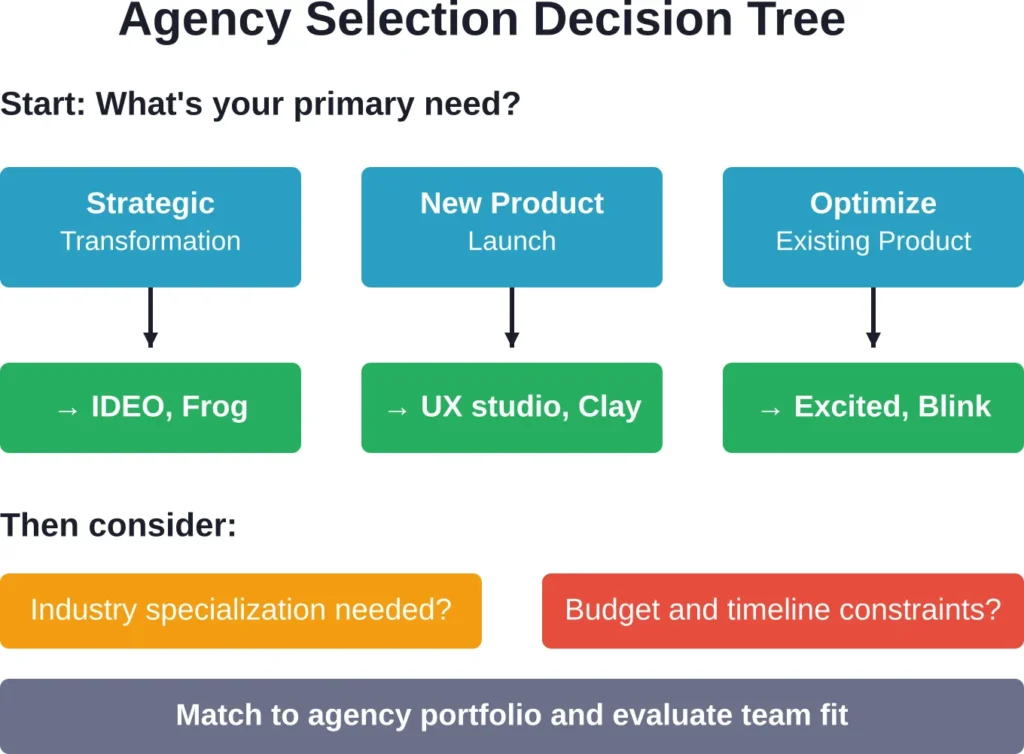
With so many strong options, how do you narrow down to the right partner? The answer depends on project specifics, organizational context, and strategic priorities. But some evaluation frameworks help clarify the decision.
Define Your Project Type and Scope
Start by categorizing what you actually need. Are you launching a new product from scratch? Redesigning an existing one? Building a design system? Conducting user research to inform strategy?
Different project types favor different agency strengths. Net-new products benefit from strategic agencies that excel at discovery and concept validation. Redesigns need agencies skilled at auditing existing systems and iterative improvement. Design systems require systematic thinkers who understand component architecture and scalability.
Be honest about scope and timeline. A three-month project with a fixed budget requires different capabilities than an ongoing partnership with flexible scope. Some agencies excel at defined projects; others thrive as embedded partners.
Match Agency Expertise to Industry Context
Industry specialization matters more than many buyers realize. An agency with deep healthcare experience understands HIPAA compliance, clinical workflows, and patient privacy concerns. That context accelerates projects and reduces mistakes.
Look at agency portfolios for relevant case studies. Don’t just admire pretty interfaces—read about the problems solved and outcomes achieved. Do those challenges mirror yours? Are the solutions applicable to your context?
That said, cross-industry experience brings value too. Sometimes the best solutions come from adapting patterns from adjacent domains. An agency that’s worked across industries might import ideas that feel fresh in your category.
Evaluate Portfolio Quality and Case Studies
Portfolio depth reveals more than visual polish. Look for case studies that explain the thinking behind design decisions. What research informed the strategy? How did the team iterate based on testing? What metrics improved after launch?
Strong case studies demonstrate outcomes, not just outputs. Instead of “we designed a mobile app,” look for “we redesigned the checkout flow, reducing cart abandonment by 18% and increasing mobile conversion by $2.3M annually.” The specificity and business impact indicate strategic maturity.
Also assess breadth. An agency that’s only worked on consumer apps might struggle with enterprise software complexity. Conversely, agencies focused purely on B2B might lack the visual craft needed for consumer products.
Consider Team Composition and Process
Ask agencies about their team structure. Who will actually work on your project? What’s the ratio of strategists to designers to researchers? Will you get senior practitioners or junior executers?
Understand their process. How do they approach discovery? What deliverables mark project milestones? How do they incorporate feedback and iterate? Agencies with mature, documented processes tend to deliver more predictable outcomes than those winging it.
The best agencies assign cross-functional pods rather than passing work between specialized departments. This integrated approach reduces miscommunication and keeps everyone aligned on project goals.
Cultural Fit and Communication Style
Don’t underestimate cultural compatibility. You’ll work closely with your agency for weeks or months. Do they communicate clearly? Do they ask thoughtful questions? Do their values align with yours?
Pay attention during sales conversations. Are they curious about your business and users? Or are they pitching generic capabilities? The best agencies act like consultants who need to understand your context before proposing solutions.
Look for evidence of long-term client relationships. Agencies with clients who return for multiple projects have proven their partnership value beyond initial sales polish.
| Evaluation Criteria | What to Look For | Red Flags |
|---|---|---|
| Portfolio Quality | Detailed case studies with measurable outcomes, relevant industry experience, diverse project types | Only showing visuals without context, no measurable results, all work looks identical |
| Team Structure | Cross-functional pods, clear roles, senior practitioners on projects, balanced designer-researcher-engineer ratios | Unclear who will work on your project, junior-heavy teams, siloed departments |
| Process Maturity | Documented methodology, clear deliverables, regular check-ins, iterative approach with feedback loops | Vague process descriptions, rigid waterfall approach, no room for iteration |
| Industry Expertise | Relevant case studies, understanding of domain constraints, familiarity with user expectations | No experience in your category, generic approach regardless of context |
| Communication | Responsive, asks clarifying questions, explains trade-offs clearly, transparent about capabilities | Slow to respond, makes unrealistic promises, avoids difficult questions |
| Business Alignment | Focuses on outcomes and metrics, understands your business model, ties design to strategy | Only talks about aesthetics, ignores business constraints, treats design as art project |
What to Ask Agencies During Evaluation
Smart questions separate serious agencies from pretenders. Here’s what to probe during discovery calls and proposal reviews.
Questions About Approach and Methodology
Start with process questions that reveal how agencies actually work:
- How do you approach user research and discovery at project start?
- What’s your typical timeline from kickoff to launch for projects like ours?
- How do you balance user needs with business constraints and technical feasibility?
- What does your iteration process look like after initial design delivery?
- How do you incorporate stakeholder feedback without design-by-committee?
Listen for specificity. Vague answers like “we follow a user-centered process” don’t reveal much. Strong answers explain actual methods, tools, and decision frameworks.
Questions About Team and Expertise
Understand who you’ll actually work with:
- Who specifically will be assigned to our project and what are their roles?
- What’s the seniority mix on the team that will work with us?
- Have you worked on projects similar to ours? Can you share relevant case studies?
- What domain expertise do you have in our industry?
- How do you handle knowledge transfer if team members change mid-project?
Agencies should be transparent about team composition and willing to introduce key practitioners before signing contracts.
Questions About Outcomes and Measurement
Probe for business orientation and accountability:
- How do you measure success for projects like ours?
- Can you share examples of measurable improvements from past work?
- What metrics do you typically track during and after design implementation?
- How do you validate designs before full implementation?
- What happens if designs don’t perform as expected after launch?
The best agencies think about measurement from day one and take some accountability for outcomes, not just deliverables.
Questions About Logistics and Collaboration
Clarify the practical working relationship:
- What’s your typical communication cadence and preferred tools?
- How much involvement do you need from our team throughout the project?
- What format will deliverables take? (Figma files? Design system documentation? Code?)
- Do you provide ongoing support after initial delivery?
- How do you handle scope changes or additional work requests?
Clear logistics prevent misunderstandings that derail projects. Nail down expectations early.
Red Flags to Watch For
Some warning signs suggest an agency won’t deliver value despite impressive marketing. Watch for these during evaluation.
Overpromising and Unrealistic Timelines
Be wary of agencies that promise transformational results in unrealistic timeframes. Quality design requires research, iteration, and refinement. Claims like “complete redesign in three weeks” or “guaranteed 50% conversion improvement” should raise skepticism.
Good agencies set realistic expectations and explain trade-offs. Fast, cheap, and good—pick two. Anyone promising all three is probably cutting corners that will hurt later.
Cookie-Cutter Approaches
Generic proposals that could apply to any company suggest the agency hasn’t invested time understanding your context. Strong proposals reference specific challenges you mentioned, ask clarifying questions, and propose tailored approaches rather than standard packages.
If the agency’s portfolio shows work that all looks similar regardless of industry or product type, they might be applying templates rather than solving unique problems.
Poor Communication During Sales
How agencies behave during sales predicts how they’ll behave during projects. Slow responses, missed meetings, or vague answers during evaluation phase indicate problems ahead.
The sales process should demonstrate their working style. Organized, responsive, curious agencies during sales remain organized, responsive, and curious during projects.
Inability to Explain Trade-offs
Design involves constant trade-offs between competing priorities. Agencies that can’t articulate trade-offs clearly—speed vs. quality, user delight vs. development cost, novelty vs. familiarity—lack strategic depth.
Strong agencies explain why they recommend certain approaches over alternatives. They help clients make informed decisions rather than asserting “trust us, we’re experts.”
No Process for Measuring Outcomes
If an agency can’t explain how they’d measure success for your project, they probably won’t deliver measurable results. Outcomes-oriented agencies define success metrics upfront and design with those goals in mind.
Vague answers about “improved user experience” or “better aesthetics” don’t cut it. Look for agencies that talk about specific, measurable improvements tied to business objectives.
The Value of UI/UX Design Investment
Some organizations still view design as a cosmetic expense rather than strategic investment. The data tells a different story.
Business Impact of Good Design
According to industry analysis, good design investment yields significant returns on investment. That ROI materializes through multiple channels:
- Higher conversion rates on e-commerce and SaaS sites
- Reduced support costs when interfaces are intuitive
- Faster user onboarding and shorter time-to-value
- Lower development costs from catching usability issues early
- Improved customer retention and lifetime value
Consider a concrete example: if checkout improvements increase conversion by 10% on a $50M gross merchandise value business, that’s a $5M annual lift. The design investment might cost $50,000–$100,000, delivering a 50x return in the first year alone.
Cost of Poor Design
Conversely, bad design creates hidden costs that compound over time. Users abandon products with poor experiences. Support teams field endless tickets about confusing interfaces. Development teams waste sprints building features users don’t want.
The opportunity cost alone justifies design investment. Launching a product with mediocre UX in a competitive market means watching potential customers choose alternatives. Fixing fundamental design problems post-launch costs dramatically more than getting it right initially.
Design as Competitive Differentiator
In many categories, functional parity makes design the primary differentiator. When three project management tools offer similar features at comparable prices, user experience becomes the tiebreaker. The product that feels intuitive, looks modern, and removes friction wins.
Design-led companies understand this. They invest in research, iteration, and polish because they know user experience directly impacts market position. This isn’t vanity—it’s strategy.
Working Effectively with Your Design Agency
Hiring a great agency is half the battle. The other half is collaborating effectively to maximize their impact.
Set Clear Objectives and Success Metrics
Start engagements with aligned expectations about what success looks like. Define concrete metrics—conversion rates, task completion times, user satisfaction scores, revenue impact. Make these measurable and time-bound.
Clear objectives give the agency a target to design toward. Without them, design becomes subjective debate about aesthetics rather than objective evaluation against goals.
Provide Context and Access
Great agencies need context to do great work. Share analytics data, user feedback, strategic plans, and competitive intelligence. Introduce them to customers and stakeholders. The more context they have, the better their solutions align with reality.
Don’t treat agencies like order-taking vendors who execute specifications. Treat them as strategic partners who need information to make good recommendations. The best work emerges from collaboration, not hand-offs.
Respect Their Process While Maintaining Standards
Good agencies have refined processes through years of experience. Trust their methodology while staying involved at key decision points. Push back when recommendations don’t align with business constraints, but be open to ideas that challenge assumptions.
The balance matters. Micromanaging design decisions undermines the expertise you hired. But abdicating all decisions and waiting for reveals leads to misalignment. Active partnership beats both extremes.
Plan for Iteration and Refinement
First designs are rarely perfect. Build time and budget for iteration based on feedback and testing. Agencies that propose single-round delivery without refinement are either overconfident or inexperienced.
Good design is an iterative process of proposing, testing, learning, and refining. Embrace iteration as part of the methodology rather than treating it as rework.
Think Beyond the Initial Engagement
The best agency relationships extend beyond single projects. Agencies that understand your product, users, and business over time deliver increasingly valuable work. They build institutional knowledge that makes subsequent projects faster and better.
Consider retainer relationships or follow-on projects that deepen the partnership. The investment in onboarding an agency pays dividends across multiple engagements.
Frequently Asked Questions
UI/UX design agency rates vary widely based on location, expertise, and project scope. In the USA, smaller city agencies typically charge $50–$150 per hour, while major design hubs range from $75–$200 per hour. Premium consultancies can charge $250–$500+ per hour for strategic work. In Europe, Eastern European agencies often charge €45–60 per hour, while Western European rates range from €70–150 per hour. Project minimums also vary, from $10,000 for accessible agencies to $100,000+ for premium firms. Fixed-price projects and monthly retainers offer alternative pricing structures for defined scopes or ongoing partnerships.
UX (user experience) designers focus on the overall experience and user journey—conducting research, mapping user flows, creating wireframes, and ensuring products solve real user problems efficiently. UI (user interface) designers focus on visual design, interactive elements, typography, color schemes, and the aesthetic polish of interfaces. In practice, many designers handle both roles, especially at smaller agencies or startups. However, larger agencies often separate these specializations, with UX designers handling strategy and structure while UI designers focus on visual execution. The best outcomes emerge when both disciplines work closely together, ensuring experiences are both functional and visually compelling.
Project timelines depend heavily on scope and complexity. A landing page redesign might take 2–4 weeks, while a complete product redesign could require 3–6 months. Full-scale digital product launches with research, strategy, design, and testing often span 4–8 months or longer. Discovery and research phases alone typically take 2–4 weeks. Design iteration cycles add 2–4 weeks per round. Implementation support and testing add further time. Rush projects sacrifice research and iteration quality, often leading to suboptimal outcomes. The best agencies balance speed with thoroughness, setting realistic timelines that allow for proper discovery, iteration, and validation rather than promising unrealistic delivery dates.
Both approaches have merit depending on circumstances. Agencies bring diverse experience from working across industries and products, deliver faster time-to-value without hiring overhead, scale up or down based on needs, and provide specialized expertise for specific project phases. In-house teams offer deeper product knowledge over time, maintain consistent design language, align closely with engineering and product management, and provide ongoing support for incremental improvements. Many companies use hybrid models—maintaining small in-house teams for ongoing work while engaging agencies for major initiatives, specialized expertise, or capacity overflow. Startups often begin with agencies and build internal teams as products mature and design needs stabilize.
Standard deliverables vary by project scope but typically include user research reports with insights and personas, competitive analysis documentation, user journey maps and flow diagrams, wireframes showing structure and layout, high-fidelity mockups in tools like Figma or Adobe XD, interactive prototypes for testing and stakeholder review, design system documentation with components and guidelines, and usability testing reports with findings and recommendations. Some agencies also provide front-end code, though many focus purely on design files that development teams implement. Clarify deliverable formats and ownership upfront—ensure you’ll receive editable source files and have clear usage rights. The best agencies also provide documentation explaining design decisions and implementation guidance for developers.
Measure design ROI by tracking metrics before and after implementation. For e-commerce and SaaS products, monitor conversion rates, cart abandonment, trial-to-paid conversion, and revenue per user. For engagement-focused products, track daily active users, session duration, feature adoption rates, and retention curves. For efficiency improvements, measure task completion time, error rates, and support ticket volume. Calculate financial impact by multiplying metric improvements by business value—a 10% conversion lift on $50M revenue equals $5M annual impact. Compare this impact to design investment costs to determine ROI. The best agencies help establish baseline metrics during discovery, set improvement targets, and track performance post-launch, demonstrating tangible business value beyond aesthetic improvements.
Strong portfolios demonstrate outcomes, not just visual polish. Look for detailed case studies explaining the problem, research process, design decisions, and measurable results. Quality indicators include specific metrics like conversion improvements or retention gains, explanation of constraints and trade-offs, evidence of user research and testing, variety of project types and industries, and clear articulation of the agency’s specific contribution versus client or partner work. Be skeptical of portfolios showing only beautiful screenshots without context—these reveal aesthetic capability but not strategic thinking or business impact. The best portfolios tell stories about how design solved real problems for real users, with evidence that solutions actually worked in production rather than just concepts that looked good in presentations.
Conclusion: Finding Your Ideal UI/UX Design Partner
Choosing the right UI/UX design agency shapes product success more than most strategic decisions. The agencies featured in this guide—from strategic pioneers like IDEO and Frog Design to specialized partners like UX studio, Punchcut, and Excited—represent the best the industry offers in 2026.
But the “best” agency in absolute terms doesn’t exist. The right choice depends on project specifics, industry context, budget realities, and organizational culture. A startup building its first SaaS product needs different capabilities than an enterprise reimagining its digital customer experience.
Start by defining your actual needs. What problems require solving? What outcomes would constitute success? What constraints shape the project? Clear objectives make agency evaluation straightforward rather than overwhelming.
Then evaluate agencies against those needs. Review portfolios for relevant experience. Ask probing questions about process and approach. Check references and case studies for evidence of impact. Trust your instincts about cultural fit and communication style.
Remember that design investment pays dividends through higher conversion, improved retention, and competitive differentiation. The cost of good design pales compared to the opportunity cost of mediocre experiences that drive users to competitors.
The agencies on this list have earned their reputations through years of excellent work and satisfied clients. Start your search here, but adapt the choice to your unique situation. The perfect partner exists—finding them requires clarity about needs, rigor in evaluation, and willingness to invest in strategic design work that drives measurable business results.
Ready to transform your digital product through world-class design? Review the agencies above, explore their portfolios, and reach out to those that align with your needs. The right partnership begins with a conversation.