
Quick Summary: Without a REAL ID, travelers can still board domestic flights using alternative acceptable IDs like a U.S. passport, passport card, or military ID. Starting February 1, 2026, the TSA introduced a $45 fee option called TSA ConfirmID for passengers without acceptable identification. Access to certain federal facilities also requires REAL ID-compliant identification or an acceptable alternative.
The REAL ID enforcement began on May 7, 2025, fundamentally changing airport security requirements for domestic travelers. But what actually happens if you show up without one?
The short answer? It depends on what identification you bring instead.
Flying Without REAL ID: Acceptable Alternatives
According to the TSA, adult passengers 18 and older must show valid identification at airport checkpoints. State-issued driver’s licenses and ID cards without the REAL ID star marking are no longer accepted on their own.
However, several acceptable alternatives still work perfectly well for domestic air travel:
| Acceptable ID Type | Notes |
|---|---|
| U.S. Passport | Valid or expired (up to two years after expiration) |
| U.S. Passport Card | Compact wallet-sized option |
| Military ID | Active duty or dependent ID cards |
| DHS Trusted Traveler Cards | Global Entry, NEXUS, SENTRI |
| Permanent Resident Card | Green card holders |
| Veteran Health ID Card (VHIC) | Issued by VA |
| Merchant Mariner Credential | For maritime workers |
Digital identification options are expanding too. The TSA now accepts Apple Digital ID, Clear ID, and Google ID Pass at select checkpoints as part of ongoing testing efforts.
The TSA ConfirmID Fee: What It Costs
Here’s where things changed in 2026.
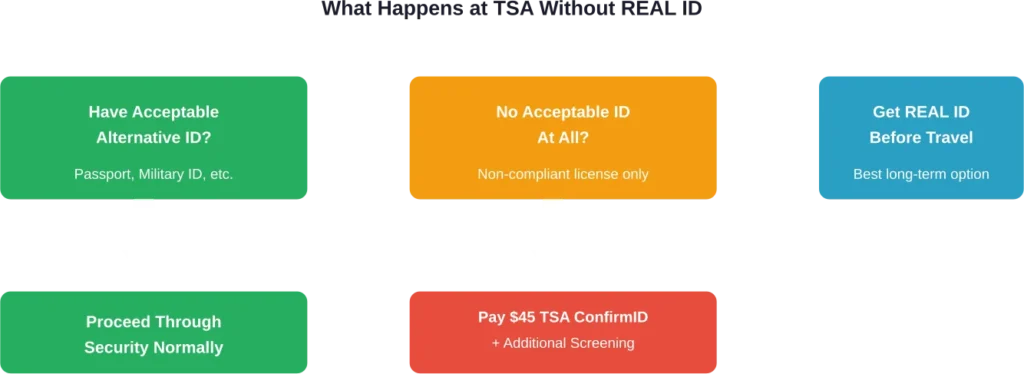
Starting February 1, 2026, the TSA introduced a $45 fee option for travelers who arrive at security checkpoints without acceptable identification. This modernized alternative identity verification system is called TSA ConfirmID.
According to TSA announcements, passengers without valid, acceptable ID can pay the $45 fee to use this system at security checkpoints. The fee-based option aims to streamline processing while maintaining security standards.
Currently, more than 94% of passengers already use their REAL ID or other acceptable forms of identification. The TSA expects increased wait times for passengers who don’t provide standard acceptable IDs and opt for the ConfirmID process instead.
Federal Facility Access Requirements
The REAL ID Act impacts more than just airport security.
Access to certain federal facilities also requires REAL ID-compliant identification or acceptable alternatives. The Act, passed by Congress in 2005, enacted the 9/11 Commission’s recommendation that the federal government set standards for identification issuance.
The Act established minimum security standards for license issuance and production. Federal agencies cannot accept driver’s licenses and identification cards from states not meeting these minimum standards for official purposes.
How to Identify REAL ID-Compliant Cards
REAL ID-compliant driver’s licenses and state IDs display a star marking, typically in the upper corner. Some states use flag markings or the word “Enhanced” instead.
Not sure if your current ID is compliant? Check for these indicators or contact your state’s DMV or motor vehicle department. State requirements and processing times vary significantly.
Additional Screening Measures
Travelers with non-compliant IDs face additional screening measures at TSA checkpoints. According to Department of Homeland Security announcements from May 7, 2025, these enhanced procedures help verify traveler identities when standard acceptable identification isn’t presented.
Real talk: these additional screenings take time. Expect delays compared to presenting acceptable identification upfront.
Frequently Asked Questions
Yes, but only if you present another acceptable form of identification like a U.S. passport, passport card, military ID, or trusted traveler card. Without any acceptable ID, you’ll need to pay the $45 TSA ConfirmID fee and undergo additional screening.
TSA ConfirmID costs $45 per use at airport security checkpoints. This fee was introduced on February 1, 2026, for passengers without acceptable identification who still want to fly.
A driver’s license without the REAL ID star isn’t accepted alone at TSA checkpoints. You’ll need to present an acceptable alternative ID like a passport, pay the $45 ConfirmID fee, or upgrade to a REAL ID-compliant license before traveling.
Children under 18 traveling on domestic flights within the United States don’t need to present identification when traveling with a companion. TSA officers may ask for documentation in some cases, but REAL ID requirements apply only to adult passengers 18 and older.
Absolutely. A valid U.S. passport or passport card is an acceptable form of identification at TSA checkpoints and works perfectly for domestic air travel. Passports expired up to two years after expiration are also accepted.
Access to certain federal facilities requires REAL ID-compliant identification or acceptable alternatives like passports or military IDs. Requirements vary by facility, so check with the specific location before visiting.
No, international flights require a valid passport regardless of REAL ID status. REAL ID enforcement applies specifically to domestic flights within the United States and access to certain federal facilities.
Bottom Line: Plan Ahead
The REAL ID enforcement that began May 7, 2025 created real consequences for unprepared travelers. While acceptable alternatives exist, the new $45 ConfirmID fee and additional screening procedures make flying without proper identification more expensive and time-consuming.
Most travelers—94% according to TSA data—already use REAL ID-compliant licenses or acceptable alternatives. The smoothest airport experience comes from bringing acceptable identification every time.
Check your state’s DMV website for REAL ID upgrade requirements and processing times. Having the right identification ready saves money, reduces stress, and keeps travel plans on track.