

Quick Summary: Not removing wisdom teeth can lead to serious complications including impaction, tooth decay, gum disease, cysts, damage to adjacent teeth, and chronic pain. Research shows that retained third molars increase the risk of second molar pathology nearly 5-fold, while complications from extraction remain relatively low (3.6% dry socket, 0.41% TMD symptoms). While some asymptomatic wisdom teeth can remain safely, most people benefit from early evaluation and removal to prevent irreversible damage.
Third molars, commonly called wisdom teeth, are the last teeth to emerge in early adulthood. For many people, these latecomers cause a variety of dental problems simply because there’s not enough room in the mouth to accommodate them properly.
The decision to extract wisdom teeth remains one of the most common surgical procedures in oral surgery. But what happens if those teeth stay put?
The answer depends on several factors, including tooth position, available space, and overall oral health. Here’s what the research shows about the consequences of leaving wisdom teeth in place.
Understanding Impacted Wisdom Teeth
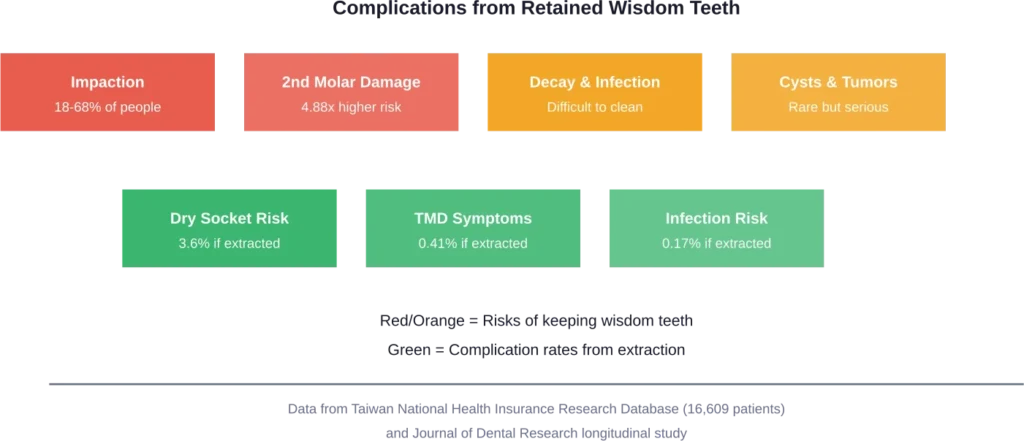
An international study found that impacted third molars occur in 18-68% of people, with a systematic review of 83,400 individuals reporting a prevalence of 24.40%. These teeth become impacted when they lack sufficient space to erupt properly through the gum line.
Impaction comes in several forms. Some wisdom teeth remain completely trapped beneath the gum tissue (soft tissue impaction), while others emerge only partially. The angle of eruption matters too—teeth can grow sideways, angled toward adjacent molars, or even backward.
Research from the Journal of Dental Research found that soft tissue impacted third molars increased the risk of adjacent second molar pathology 4.88-fold, with a 95% confidence interval of 2.62 to 9.08. That’s nearly five times the risk.
The study also noted that the lowest prevalence and incidence of second molar pathology occurred when the adjacent third molar was absent entirely.
Tooth Decay and Gum Disease
Wisdom teeth positioned at the back of the mouth are notoriously difficult to clean. Even for people with excellent oral hygiene habits, reaching these molars with a toothbrush or floss can be challenging.
This cleaning difficulty creates an ideal environment for bacterial growth. Food particles and plaque accumulate around partially erupted wisdom teeth, leading to decay not just in the wisdom tooth itself but in the adjacent second molar as well.
According to Rutgers School of Dental Medicine, most wisdom tooth complications aren’t obvious until the damage becomes too serious to reverse. The decay process happens gradually and often painlessly in early stages.
Gum disease around wisdom teeth, called pericoronitis, occurs when the gum tissue around a partially erupted tooth becomes inflamed and infected. This condition causes pain, swelling, difficulty opening the mouth, and bad breath.
A population-based study found that patients with a history of gingivitis or pericoronitis faced a 1.3-fold increased risk of developing dry socket after eventual extraction.
Damage to Adjacent Teeth
Here’s where things get concerning. When wisdom teeth push against neighboring second molars, they can cause resorption—a process where the roots of healthy teeth gradually dissolve.
This pressure can also create pockets between the wisdom tooth and second molar where bacteria thrive. These periodontal pockets lead to bone loss around both teeth, potentially compromising the second molar that was perfectly healthy before the wisdom tooth became problematic.
Research published in academic journals confirms that the presence of third molars significantly increases second molar pathology risk compared to cases where third molars are absent.
Cysts and Tumors
Though less common, wisdom teeth can develop cysts—fluid-filled sacs that form around the tooth crown. Left untreated, these cysts expand and damage surrounding jawbone and teeth.
In rare cases, tumors can develop around impacted wisdom teeth. While most are benign, they still require surgical removal and can cause significant bone destruction if ignored.
Overcrowding and Shifting Teeth
The idea that wisdom teeth cause orthodontic crowding remains somewhat controversial in dental research. However, many oral surgeons observe that late eruption of third molars can create pressure that shifts previously aligned teeth.
This shifting becomes particularly problematic for patients who’ve completed orthodontic treatment. The investment in braces or aligners can be partially undone by erupting wisdom teeth.
Comparing Extraction Complications to Retention Risks
A study analyzing 16,609 patients who underwent impacted mandibular third molar extraction found relatively low complication rates:
| Complication Type | Incidence Rate | Details |
|---|---|---|
| Dry Socket | 3.6% | Most common post-extraction issue |
| TMD Symptoms | 0.41% | More common in female patients |
| Surgical Site Infection | 0.17% | Requires additional treatment |
The study found that complex odontectomy procedures carried 2.5 times the risk of dry socket compared to simpler extractions. Importantly, patient age wasn’t associated with increased complication risk.
When comparing these extraction risks to the nearly five-fold increase in second molar pathology from retained impacted wisdom teeth, early removal often presents the lower-risk option.
When Wisdom Teeth Can Stay
Not all wisdom teeth require removal. According to medical research, asymptomatic disease-free impacted wisdom teeth may be monitored rather than immediately extracted.
The American Public Health Association has noted that studies of long-term retention of impacted teeth have shown little risk of harm in specific cases. A study examining 3,702 “neglected” impacted teeth found minimal complications in certain circumstances.
Wisdom teeth can remain if they:
- Erupt completely in proper alignment
- Can be cleaned adequately during daily oral hygiene
- Show no signs of decay or gum disease
- Aren’t causing pain or damage to adjacent teeth
- Have sufficient space in the jaw
Regular dental monitoring remains essential even for asymptomatic wisdom teeth, as problems can develop years after initial eruption.
The Case for Early Evaluation
Studies consistently show that early evaluation and treatment result in superior outcomes. Patients are generally first evaluated in the mid-teenage years by their dentist, orthodontist, or oral surgeon.
Younger patients typically experience faster healing and fewer complications. The procedure takes approximately 30-60 minutes, with most patients spending about 90 minutes total at the oral surgery office.
Research supports that surgical intervention should be considered for impacted third molars with risk of gingivitis or pericoronitis to reduce the occurrence of complications like dry socket.
Making an Informed Decision
The decision about wisdom teeth shouldn’t be made in isolation. A thorough oral examination with x-rays allows dental professionals to evaluate tooth position and predict potential problems.
While prophylactic removal of completely asymptomatic wisdom teeth remains debated in medical literature, most dental professionals recommend removal when impaction, partial eruption, or positioning issues are present.
The consequences of leaving problematic wisdom teeth can include irreversible damage to adjacent teeth, bone loss, chronic infection, and eventually more complicated surgical procedures when extraction becomes unavoidable.
Consulting with an oral surgeon provides personalized assessment based on individual tooth position, jaw structure, and overall oral health. That conversation, backed by imaging and clinical examination, offers the best foundation for decision-making.
Frequently Asked Questions
Yes. Wisdom teeth can remain asymptomatic for years before developing complications. Decay, gum disease, and cysts can develop gradually, which is why regular dental monitoring is essential even for wisdom teeth that initially appear problem-free.
Signs include pain or swelling in the back of the mouth, difficulty opening the jaw, bad breath or taste, bleeding gums around the wisdom tooth area, or crowding of other teeth. However, some problems develop without obvious symptoms, making dental x-rays and professional evaluation necessary.
Research shows that 18-68% of people have impacted third molars, with a large systematic review of 83,400 individuals finding a prevalence of 24.40%. Geographic and ethnic factors influence these rates.
Complications are relatively uncommon. A study of 16,609 patients found dry socket in 3.6% of cases, temporomandibular joint symptoms in 0.41%, and surgical site infection in 0.17%. Most complications are temporary and resolve with appropriate treatment.
No. Some wisdom teeth erupt properly with adequate space and can be maintained with good oral hygiene. However, research shows that the lowest rates of second molar pathology occur when third molars are absent, suggesting that even properly erupted wisdom teeth carry some risk.
Yes. Research demonstrates that soft tissue impacted third molars increase the risk of second molar pathology by 4.88-fold. Wisdom teeth can cause root resorption, periodontal disease, and decay in adjacent second molars.
Generally speaking, younger patients experience faster healing and fewer complications. However, a large-scale study found that patient age wasn’t significantly associated with increased complication rates for dry socket, TMD symptoms, or infection.