
Quick Summary: A brown recluse spider bite often goes unnoticed initially but can develop into a painful wound with tissue death (necrosis) over 24-72 hours. Most bites heal with basic wound care, though severe cases may cause systemic symptoms like fever, nausea, and muscle pain. Serious complications including hemolysis and death are rare, occurring in less than 1% of cases. Immediate cleaning, cold compresses, and medical evaluation are recommended for suspected bites.
Brown recluse spiders don’t get the same attention as black widows, but their bites can be far more destructive to tissue. The initial bite often feels like nothing—maybe a slight pinprick, if anything at all. That’s part of what makes these spiders so concerning.
By the time the pain sets in hours later, the venom is already working its way through the skin. Understanding what happens after a brown recluse bite can help with early recognition and proper treatment.
Identifying the Brown Recluse Spider
According to the CDC, brown recluse spiders are found mostly in the south, west, and midwest regions of the United States. They’re not aggressive spiders—most bites happen because someone accidentally traps or touches one.
The brown recluse has a distinctive violin or fiddle-shaped mark on its back, which is why it’s sometimes called a fiddleback spider. Adults measure about 0.5 inches in body length. They have six eyes arranged in pairs, unlike most spiders which have eight eyes.
These spiders prefer dark, undisturbed areas: attics, basements, cupboards, drawers, boxes, bedsheets, and beneath rocks or dead tree bark. Brown recluse spiders are rarely seen during the day and typically avoid human contact.
The Bite: What You’ll Feel Initially
Here’s the thing though—the actual spider bite often goes completely unnoticed. According to medical research published on the National Institutes of Health’s StatPearls platform, the bite often goes unnoticed and symptoms may take hours to develop, making diagnosis and appropriate treatment difficult.
When people do feel the initial bite, it’s usually described as a mild stinging sensation or nothing at all. This delay in recognition is why many brown recluse bites are only identified after symptoms develop.
The spider’s venom contains complex proteins, with two key toxins doing most of the damage:
- Sphingomyelinase D: This enzyme destroys skin tissues and cell membranes
- Hyaluronidase: This compound speeds the venom’s penetration deeper into tissue
The venom amount released during a bite is small, but it’s potent enough to cause significant local tissue damage.
Stages of a Brown Recluse Spider Bite
Brown recluse bites progress through distinct stages. Not every bite follows this exact pattern—some remain mild throughout—but understanding the typical progression helps with monitoring and treatment decisions.
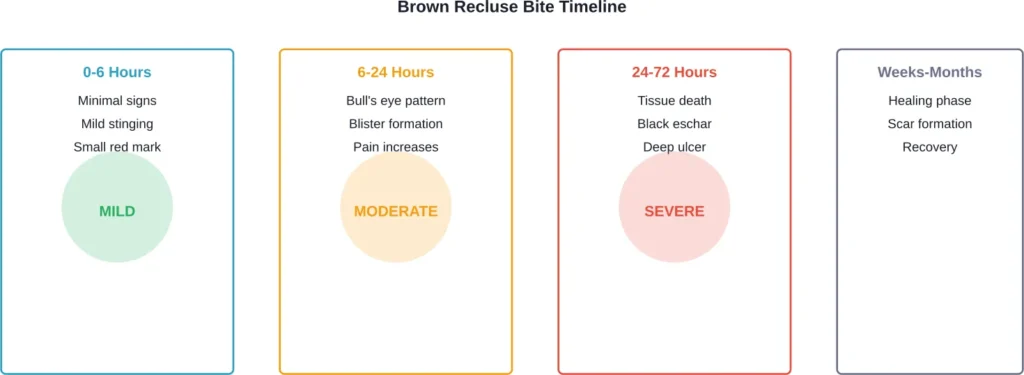
Stage 1: First Few Hours (0-6 Hours)
The bite site might show minimal signs. A small red mark or slight swelling could appear, similar to a mosquito bite. Many people don’t notice anything unusual during this window.
Some individuals report a mild burning or stinging sensation as the first symptom. The area might feel slightly warm to the touch.
Stage 2: Early Reaction (6-24 Hours)
This is when dermonecrotic arachnidism—the local tissue injury from brown recluse envenomation—becomes apparent. The bite site typically develops a characteristic bull’s eye appearance: a central white or pale area surrounded by redness.
Pain intensifies during this stage. The sensation ranges from mild discomfort to severe, throbbing pain depending on venom amount and individual reaction. A blister may form at the center of the bite.
Stage 3: Necrosis Development (24-72 Hours)
The most destructive phase occurs between 24 and 72 hours post-bite. The venom causes injury and death of surrounding tissues—a process called necrosis.
The blister ruptures and a black eschar (dead tissue) forms at the center. The wound may develop into a deep ulcer as tissue breaks down. The area around the bite becomes increasingly red, swollen, and tender.
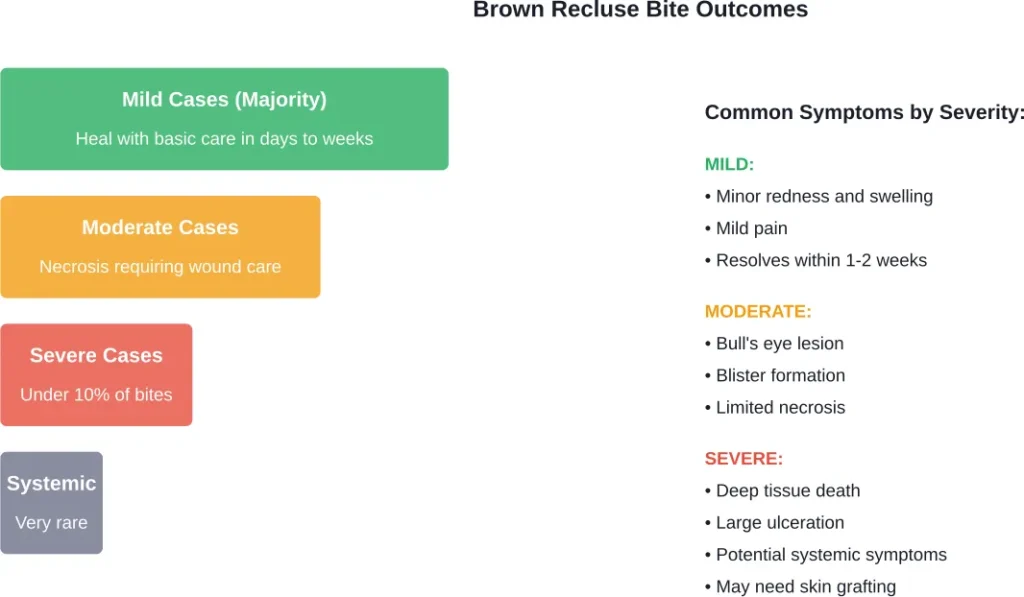
According to research from medical centers treating brown recluse bites, less than about 10% of bites cause ulcers or blisters that damage the skin so badly that medical care is needed.
Stage 4: Healing and Recovery (Weeks to Months)
Clinical studies show that long-term outcome after brown recluse spider bites is generally good. Most wounds heal with supportive care alone.
Mild bites resolve within days to weeks. More severe necrotic wounds can take several months to fully heal. Scarring at the bite site is common with deeper tissue damage.
Systemic Symptoms: When Venom Affects the Whole Body
While most brown recluse bites cause only local skin damage, some individuals develop systemic loxoscelism—a condition where venom affects the entire body. This is rare but serious.
Systemic symptoms typically occur rapidly within 24-48 hours following the bite and include:
- Fever and chills
- Nausea and vomiting
- Muscle pain and joint aches
- Weakness and fatigue
- Rash across larger areas of the body
Even more rarely, the venom can cause widespread hemolysis (destruction of red blood cells), coagulopathy (blood clotting problems), and in extreme cases, death. While hemostatic perturbations are infrequent and clinical coagulopathy is uncommon, serious illness and death from brown recluse bites are rare.
Who’s at Higher Risk for Complications?
Certain populations face increased risk of severe reactions from brown recluse bites. Children are particularly vulnerable due to smaller body mass relative to venom amount.
Individuals with compromised immune systems may experience more extensive tissue damage. People with pre-existing health conditions—especially blood disorders or cardiovascular disease—face higher risk of systemic complications.
The bite location matters too. Bites on areas with more fatty tissue tend to develop larger necrotic areas compared to bites over muscle or bone.
Immediate First Aid for Brown Recluse Bites
If bitten by a brown recluse spider—or if there’s suspicion of such a bite—take these steps immediately:
Clean the wound thoroughly: Wash the bite area with soap and water to reduce infection risk.
Apply cold compresses: Put cold water or a cloth filled with ice on the bite for 10-20 minutes. This helps reduce pain and slow venom spread.
Elevate the affected area: If the bite is on an arm or leg, keep it elevated above heart level to minimize swelling.
Take over-the-counter pain medication: Acetaminophen or ibuprofen can help manage pain. For itching, a non-prescription antihistamine may provide relief.
Monitor the wound closely: Watch for progression of symptoms over the next 24-72 hours.
When to Seek Medical Care
Not every suspected brown recluse bite requires emergency medical attention, but certain warning signs demand professional evaluation.
Seek immediate medical care if:
- The bite develops a rapidly expanding area of redness or darkening
- Severe pain that doesn’t respond to over-the-counter medication
- Fever, chills, or other systemic symptoms develop
- The wound shows signs of infection (increasing warmth, pus, red streaks)
- A large blister forms or the skin turns black
- Symptoms appear in a child or elderly person
According to Poison Control, expert guidance is available 24/7 through the webPOISONCONTROL online tool or by calling 1-800-222-1222. This service is free and confidential.
Treatment Options: What Doctors Can Do
There’s no antivenom available for brown recluse spider bites. Treatment focuses on wound management and preventing complications.
| Treatment Approach | Purpose | When Used |
|---|---|---|
| Wound cleaning and dressing | Prevent infection and promote healing | All cases |
| Antibiotics | Treat or prevent bacterial infection | When infection develops or risk is high |
| Pain management | Control discomfort | Based on pain severity |
| Tetanus booster | Prevent tetanus infection | If not current on tetanus vaccination |
| Debridement | Remove dead tissue | After necrotic area stabilizes |
| Skin grafting | Cover large wounds | Severe cases with extensive tissue loss |
Medical literature reveals that the vast majority of brown recluse bites heal with supportive care alone. Aggressive medical therapy beyond basic wound care doesn’t appear warranted for most cases.
Skin grafting is needed only rarely. Research from family physicians in Oklahoma, where brown recluse bites are relatively common, shows that most bites are not serious and heal without major intervention.
Controversial Treatments to Avoid
Several treatment approaches have been promoted for brown recluse bites despite lacking solid scientific evidence. These include:
Dapsone: This antibiotic has been used to prevent tissue death, but studies show inconsistent results and potential side effects that may outweigh benefits.
Hyperbaric oxygen therapy: While theoretically appealing, clinical evidence doesn’t support its effectiveness for brown recluse envenomation.
Early surgical excision: Cutting out the bite area early can actually worsen outcomes. Debridement should wait until the necrotic area stabilizes.
Electric shock therapy: This has no scientific basis and can cause additional tissue damage.
The Reality of Serious Complications
Let’s talk numbers. Serious illness and death from brown recluse bites are rare. Medical research analyzing brown recluse spider bite cases found that serious complications were uncommon.
Fatal cases do exist in medical literature, but they’re extremely rare. A rare case report described a 44-year-old male with fatal systemic loxoscelism with orbital compartment syndrome requiring emergent lateral canthotomy and cantholysis—but such severe outcomes represent extraordinary exceptions rather than typical progression.
Research on coagulation abnormalities following brown recluse bites found that while hemostatic perturbations are infrequent and clinical coagulopathy is uncommon, the odds of death are statistically significantly greater if disseminated intravascular coagulation (DIC) develops.
The key takeaway: most people bitten by brown recluse spiders recover completely with basic wound care.
Prevention: Reducing Your Risk
The CDC emphasizes that employers and workers can take steps to prevent spider bites, particularly for outdoor workers who may encounter venomous spiders.
Brown recluse spiders are usually not aggressive. Most bites occur because a spider is trapped or accidentally touched. Prevention focuses on avoiding these situations.
Inspect before reaching: Look before placing hands or feet in dark spaces, storage boxes, or woodpiles.
Shake out items: Before putting on clothing, shoes, or gloves that have been stored, shake them out thoroughly.
Use protective gear: When working in areas where brown recluse spiders live, wear long sleeves, pants, and gloves.
Reduce clutter: Spiders hide in cluttered areas. Keeping basements, attics, and storage areas organized reduces hiding spots.
Seal entry points: Close gaps around doors, windows, and pipes to prevent spiders from entering buildings.
Regular cleaning: Vacuum regularly in corners, behind furniture, and in storage areas where spiders might hide.
Misdiagnosis: The Brown Recluse Problem
Here’s something important: brown recluse spider bite is a common diagnosis in almost every state in America. In fact, cases have been reported in areas where the spider has never been seen.
Medical literature reveals that most current concepts regarding brown recluse spider envenomation are based on supposition. Many skin conditions get misdiagnosed as brown recluse bites.
Conditions commonly confused with brown recluse bites include:
- Bacterial skin infections (especially MRSA)
- Fungal infections
- Diabetic ulcers
- Lyme disease
- Poison ivy or oak reactions
- Other insect bites or stings
- Pyoderma gangrenosum (rare skin condition)
Brown recluse spiders are rarely seen or identified at the time of the bite. Without actually seeing the spider, definitive diagnosis is difficult.
Frequently Asked Questions
The bite often goes unnoticed initially. Symptoms typically develop within a few hours but can take up to 24 hours. The most severe symptoms—necrosis and tissue death—usually appear 24-72 hours after the bite.
Death from brown recluse bites is extremely rare. While systemic loxoscelism can cause serious complications including hemolysis and coagulopathy, fatal outcomes represent extraordinary exceptions. The vast majority of people recover completely with proper wound care.
After 24 hours, a brown recluse bite typically develops a characteristic bull’s eye appearance with a pale or white center surrounded by redness. A blister may form at the center, and the area becomes increasingly painful, red, and swollen.
No. Most brown recluse bites are mild and heal without significant tissue death. Less than about 10% of bites cause ulcers or blisters that damage the skin so badly that medical care is needed. Many bites cause only minor local reactions.
Seek medical care if the bite develops rapidly expanding redness or darkening, severe pain, fever, chills, signs of infection, or if a large blister forms. Children and elderly individuals should be evaluated more promptly. For guidance, contact Poison Control at 1-800-222-1222.
Treatment focuses on wound care and symptom management rather than aggressive intervention. This includes cleaning and dressing the wound, pain medication, antibiotics if infection develops, tetanus booster if needed, and monitoring for complications. Skin grafting is rarely necessary.
Brown recluse spiders have a violin or fiddle-shaped mark on their back, six eyes arranged in pairs (rather than eight), and measure about 0.5 inches in body length. They’re found primarily in south, west, and midwest United States. If possible, safely capture the spider for identification—but don’t risk another bite.
The Bottom Line on Brown Recluse Bites
Brown recluse spider bites can be concerning, but understanding what to expect helps with appropriate response and treatment. Most bites heal with basic wound care within days to weeks.
The complex venom causes local tissue injury in many cases, and necrosis develops in a subset of bites. Serious systemic complications remain rare. Research consistently shows that long-term outcomes are generally good, even for bites that develop necrotic wounds.
Real talk: the spider’s reputation often exceeds the typical reality of envenomation. While vigilance and proper wound care are important, panic isn’t warranted for most cases.
If bitten or if there’s suspicion of a brown recluse bite, clean the wound, apply cold compresses, monitor for progression, and seek medical evaluation when warning signs appear. When in doubt, contact Poison Control or a healthcare provider for guidance.
Prevention remains the best strategy. By understanding where these spiders live and taking simple precautions, the risk of encountering a brown recluse can be significantly reduced.