
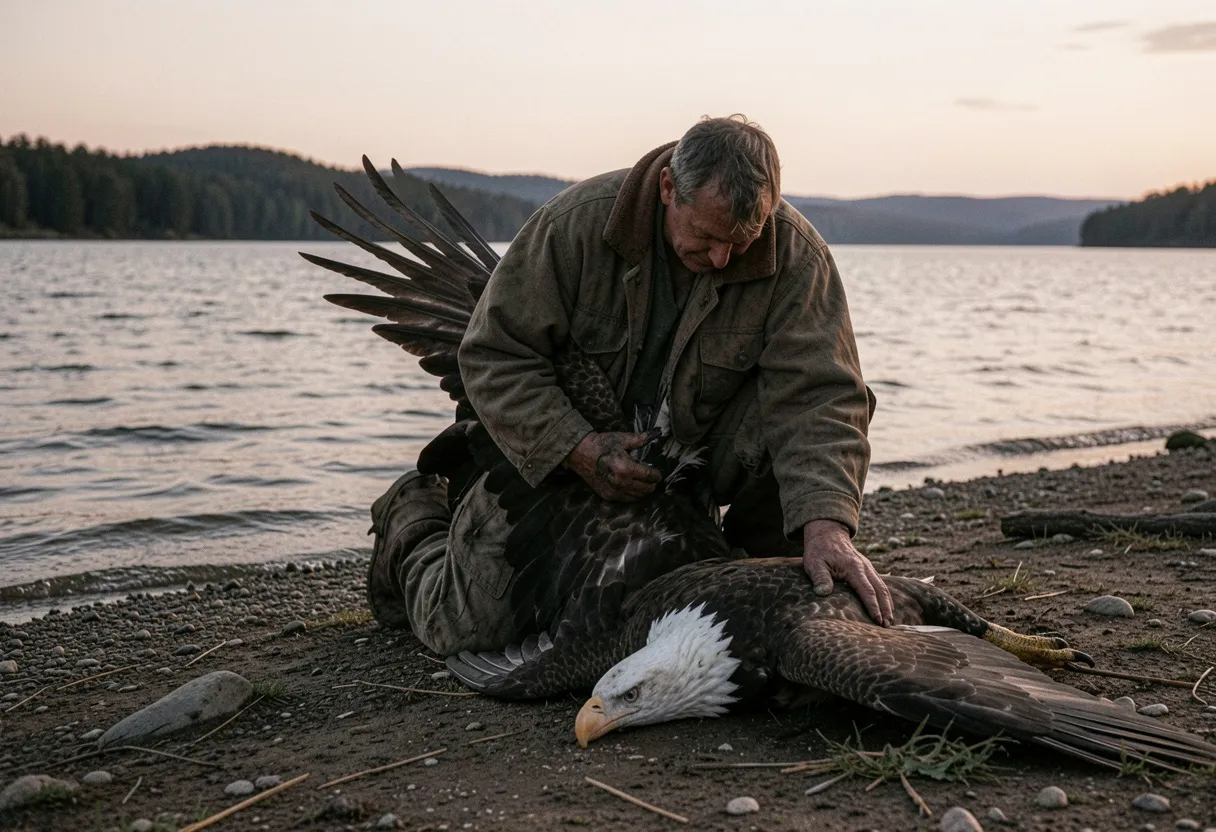
Quick Summary: Killing a bald eagle is a federal crime under the Bald and Golden Eagle Protection Act, with penalties ranging from $5,000 fines and one year in prison for first-time misdemeanor offenses to $250,000 fines and two years imprisonment for felony convictions. The law protects eagles, their nests, eggs, and even feathers, with no exceptions for accidental killings or mistaken identity.
Bald eagles are more than just majestic birds. They’re America’s national symbol, and killing one carries consequences far beyond what most people realize. Whether intentional or accidental, taking the life of a bald eagle triggers serious federal criminal charges.
Two hunters in Michigan learned this the hard way. In early October 2019, they shot what they claimed was a goose near Bear Creek. It wasn’t. The bird turned out to be a bald eagle, and their mistake could cost them a year behind bars and $5,000 in fines. They left the scene without reporting it, which only made things worse.
But here’s the thing—even if they’d reported it immediately, they’d still face charges. Federal law doesn’t care about mistaken identity when it comes to protected wildlife.
The Federal Laws That Protect Bald Eagles
The Bald and Golden Eagle Protection Act, enacted in 1940 and codified at 16 U.S.C. 668-668d, stands as the primary legal shield for these birds. According to the U.S. Fish and Wildlife Service, this law prohibits anyone without a permit from “taking” bald or golden eagles.
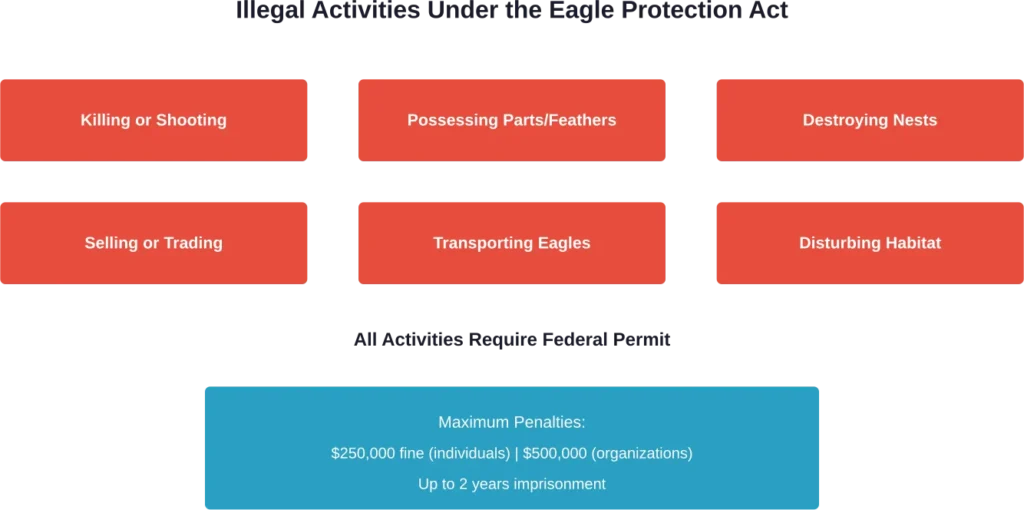
And “taking” means more than just killing. The law covers possessing, selling, purchasing, bartering, transporting, exporting, or importing eagles or their parts—including feathers, nests, and eggs.
The Migratory Bird Treaty Act adds another layer of protection. Passed in 1918, this law implements four international conservation treaties the U.S. entered into with Canada, Mexico, Japan, and Russia. It ensures the sustainability of all protected migratory bird species, including bald eagles.
So when someone kills a bald eagle, they’re typically violating multiple federal statutes simultaneously.
Criminal Penalties Under the Eagle Protection Act
The penalties escalate based on whether prosecutors charge the offense as a misdemeanor or felony. Here’s where things get serious fast.
| Offense Type | Maximum Fine (Individual) | Maximum Fine (Organization) | Maximum Prison Time |
|---|---|---|---|
| First-time Misdemeanor | $5,000 | $10,000 | 1 year |
| Second Conviction | $10,000 | $20,000 | 2 years |
| Felony | $250,000 | $500,000 | 2 years |
According to the American Eagle Foundation, the 1972 amendments to the Act increased civil penalties to a maximum fine of $5,000 or one year imprisonment for a first-time misdemeanor violation for individuals, or $10,000 or not more than two years in prison for a second conviction.
Felony convictions carry a maximum fine of $250,000 or two years of imprisonment. The fine doubles for an organization. That’s not even counting potential civil penalties, which can stack on top of criminal charges.
Real talk: prosecutors don’t take these cases lightly. The U.S. Fish and Wildlife Service offers rewards for information leading to arrests. In one Washington case, the Humane Society of the United States and The Humane Society Wildlife Land Trust offered up to $2,500, adding to an existing $1,000 reward from the U.S. Fish and Wildlife Service, for information about an illegally killed bald eagle.
What Counts as Illegal “Taking” of an Eagle
The legal definition of “taking” is broader than most people think. It’s not just about pulling a trigger or setting a trap.
Disturbing an active nest qualifies as taking. In August 2024, the U.S. Fish and Wildlife Service announced an investigation into the destruction of an active bald eagle nest in North Texas. Destroying nests—even accidentally during construction or land clearing—violates federal law.
Possessing eagle parts is illegal too. Found an eagle feather on a hiking trail? Picking it up and keeping it breaks federal law. There’s no “finders keepers” exception for eagle feathers, no matter how beautiful they are.
Does Accidental Killing Provide a Defense?
Short answer? No. The law doesn’t include exceptions for accidents or cases of mistaken identity.
Those Michigan hunters who thought they shot a goose discovered this harsh reality. Claiming you didn’t know it was an eagle doesn’t absolve legal responsibility. Federal wildlife protection laws operate on strict liability principles for many violations.
Now, this is where it gets interesting. Intent may influence whether prosecutors pursue misdemeanor versus felony charges, and judges might consider circumstances during sentencing. But it won’t prevent charges from being filed in the first place.
Wind energy companies have faced similar legal challenges. Eagles sometimes collide with wind turbines, resulting in what the industry calls “incidental take.” These companies must obtain special permits from the U.S. Fish and Wildlife Service that authorize a limited number of eagle deaths as an unavoidable consequence of operations. Without those permits, companies face the same penalties as individual violators.
When Killing an Eagle Might Be Justified
Self-defense scenarios occasionally arise. What happens if a bald eagle attacks livestock, pets, or even people?
The law technically allows for defense of human life. But the bar is extremely high, and the burden of proof falls on the person who killed the eagle. Authorities will scrutinize every detail to determine whether lethal force was truly necessary or if alternative measures could have prevented harm.
For livestock or pet protection, federal law requires applying for a depredation permit before taking action. These permits allow limited killing or harassment of eagles that pose documented threats to agriculture or domestic animals. Shooting first and explaining later isn’t an option.

Additional Consequences Beyond Criminal Penalties
Criminal fines and prison time aren’t the only consequences. Many states impose their own penalties on top of federal charges.
West Virginia law makes it a misdemeanor to possess, take, or kill bald or golden eagles, with subsequent convictions resulting in felony prosecution and penalties including license revocation for up to ten years. Hunters can lose their hunting privileges for years or permanently.
Organizations face reputational damage that extends far beyond monetary fines. Energy companies, construction firms, and agricultural operations that violate eagle protection laws often face public backlash and regulatory scrutiny that affects future permitting and operations.
Civil penalties can also stack on top of criminal charges. The government may seek restitution for the ecological value of the killed eagle, which can run into tens of thousands of dollars per bird.
Why Eagles Remain Protected Despite Population Recovery
Bald eagles were removed from the endangered species list in 2007. Their populations have recovered dramatically since the 1970s, when DDT pesticide nearly wiped them out.
But that doesn’t mean the legal protections disappeared. The Bald and Golden Eagle Protection Act remains fully enforceable regardless of population status. Eagles continue to face threats from habitat loss, lead poisoning, electrocution from power lines, and vehicle collisions.
According to a U.S. Geological Survey study (published as Open-File Report 2023-1016), trauma, electrocution, and lead poisoning were the three leading causes of death among 172 bald eagles and 142 golden eagles examined between 2014 and 2017. Trauma, electrocution, and lead poisoning were identified as the three leading causes of death among eagles studied across eight western and midwestern states.
These ongoing threats justify continued legal protection, even as populations stabilize.
FAQ About Killing Bald Eagles
Yes. Accidental killing doesn’t provide a legal defense under the Bald and Golden Eagle Protection Act. First-time offenders typically face misdemeanor charges with up to one year in prison and $5,000 fines, even if the killing was unintentional or resulted from mistaken identity.
Possessing eagle feathers without a permit violates federal law, even if you found the feather naturally shed. The same penalties apply as for killing an eagle: fines up to $5,000 and potential imprisonment. Only enrolled members of federally recognized Native American tribes can possess eagle feathers for religious purposes.
Yes. The Bald and Golden Eagle Protection Act covers both species equally. Golden eagles face identical legal protections, and killing one carries the same criminal penalties as killing a bald eagle: fines up to $250,000 and two years imprisonment for felony convictions.
Wind energy companies must obtain incidental take permits from the U.S. Fish and Wildlife Service that authorize a limited number of eagle deaths. Without these permits, companies face the same criminal penalties as individuals. Several energy companies have been prosecuted and fined for eagle deaths caused by turbines.
Only with a permit issued by the Secretary of the Interior. Permits exist for scientific research, Native American religious purposes, and depredation control when eagles threaten livestock or agriculture. Self-defense of human life may provide justification, but the legal standard is extremely high and scrutinized intensively.
Report it immediately to your state wildlife agency or the U.S. Fish and Wildlife Service. While vehicle strikes can still result in charges, prompt reporting and cooperation with authorities demonstrates good faith and may influence how prosecutors handle the case. Never leave the scene or attempt to hide the incident.
The U.S. Fish and Wildlife Service typically offers $1,000 rewards for information leading to arrests and convictions in eagle poaching cases. Conservation organizations often add to these rewards. In one Washington case, the Humane Society of the United States and The Humane Society Wildlife Land Trust offered up to $2,500, adding to an existing $1,000 reward from the U.S. Fish and Wildlife Service, for information about an illegally killed bald eagle.