

Quick Summary: Masturbation becomes excessive when it interferes with daily responsibilities, causes physical discomfort, or negatively impacts relationships and mental health. While there’s no specific number that defines ‘too much,’ research shows that frequent masturbation can correlate with reduced sexual satisfaction in relationships and may be associated with anxiety or depression in some individuals. Most people can enjoy masturbation as a healthy activity without adverse effects.
Masturbation is a normal, healthy part of human sexuality. But like many aspects of life, balance matters.
When people search for what happens if they masturbate too much, they’re usually noticing changes in their daily life, relationships, or physical comfort. The question isn’t really about hitting some magic number. It’s about understanding when a healthy behavior crosses into territory that affects well-being.
According to a 2023 survey published in Springer Nature, 35.9% of men reported masturbating regularly. The practice is widespread and carries documented benefits for immune function, heart health, and mood. Yet concerns about frequency persist.
Here’s the thing though—there’s no universal threshold that defines excessive masturbation. What matters is how it affects different aspects of life.
Understanding Excessive Masturbation
Excessive masturbation isn’t determined by counting sessions. Instead, it’s identified by impact.
Research from Indiana University School of Public Health examined masturbation patterns during the COVID-19 pandemic. The study found that the most frequently endorsed reasons for not masturbating included lack of interest, being in a committed relationship, conflict with personal morals or values, or religious beliefs.
This reveals something important: context matters more than frequency.
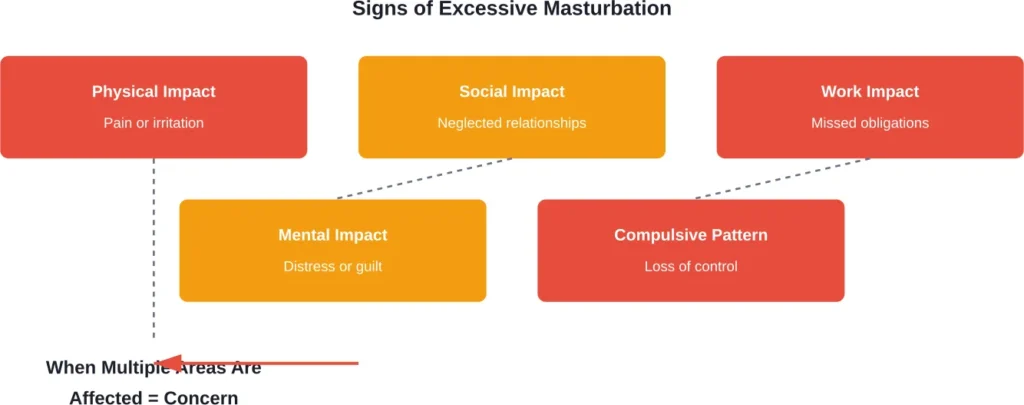
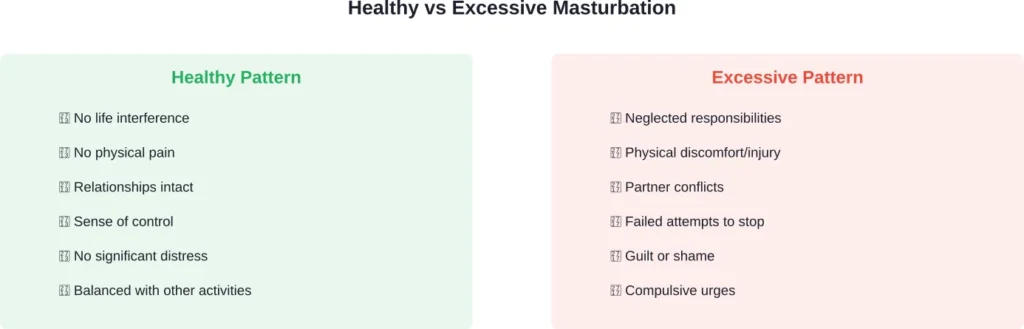
So when does masturbation become excessive? When it starts interfering with daily responsibilities, causes physical discomfort, or creates distress. That’s the clinical perspective.
Physical Effects of Excessive Masturbation
The physical consequences tend to be straightforward and temporary.
Genital Discomfort and Irritation
Frequent masturbation can cause irritation, soreness, or swelling of the genitals. This happens from friction and repeated stimulation. For males, the penis may become tender or develop minor skin irritation. For females, the vaginal area can experience similar discomfort.
These symptoms typically resolve with rest. But persistent discomfort signals the need for a break.
Testicular Pain
Some men worry about testicle pain related to frequent masturbation. In most cases, this pain stems from inflammation or muscle tension rather than damage. The discomfort is temporary and improves with reduced frequency.
However, persistent or severe testicular pain warrants medical evaluation to rule out other conditions.
Impact on Physical Energy
Masturbation involves physical exertion, and excessive frequency can contribute to fatigue. This isn’t about some myth of depleted vital energy—it’s simple physiology. Any repetitive physical activity done excessively can leave someone feeling tired.
Psychological and Emotional Effects
The mental health implications deserve serious attention.
Association with Anxiety and Depression
A study published in Basic and Clinical Andrology (listed as collection date 2026) examined men with psychogenic erectile dysfunction. Researchers found an association between a history of frequent masturbation and higher levels of anxiety and depression in these patients.
The study noted that among males under 40 years old, erectile dysfunction affected 85.2% of the cohort. This suggests a complex relationship between masturbation patterns, mental health, and sexual function.
That said, correlation doesn’t prove causation. The relationship may work in multiple directions—anxiety might increase masturbation frequency as a coping mechanism, or excessive masturbation might contribute to anxiety. More research is needed.
Guilt and Shame
According to Indiana University research, many people cited moral or religious conflicts as reasons for not masturbating. When someone masturbates frequently despite personal values against it, guilt and shame can accumulate.
This internal conflict creates psychological distress that has nothing to do with the physical act itself. It’s about the clash between behavior and beliefs.
Effects on Sexual Satisfaction and Relationships
This is where the research gets particularly interesting.
The Masturbation-Satisfaction Paradox
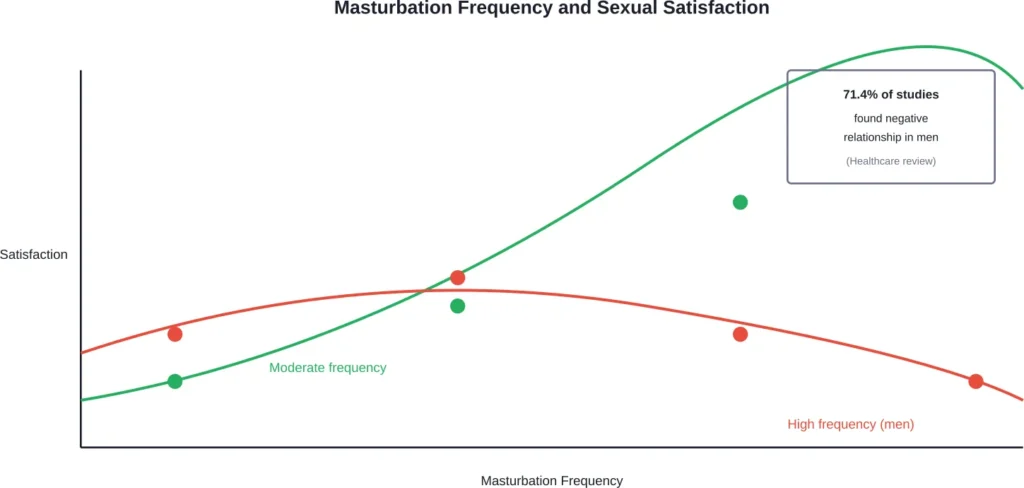
A systematic review published in Healthcare examined the relationship between solitary masturbation and sexual satisfaction. The findings revealed a gender difference: In men, 71.4% of studies found a negative relationship between masturbation and sexual satisfaction, while 21.4% found no relationship, and only 7.2% found a positive relationship.
Research from the University of Oslo described this as a “seemingly paradoxical relationship.” Masturbation has documented benefits, yet increased frequency often correlates with lower sexual satisfaction in relationships.
Why? Possible explanations include:
- Using masturbation as compensation for unsatisfying partnered sex
- Developing sexual preferences that don’t align with partner activities
- Reduced motivation for partnered sexual experiences
- Conditioning arousal patterns to solo stimulation
The research from Indiana University found that among women who desired partnered sex “much more often” or “a little more often,” they were 3.89 times (95% CI: 2.98, 5.08) and 2.07 times (95% CI: 1.63, 2.62), respectively, more likely to report higher frequencies of partnered sex.
Impact on Intimate Relationships
When masturbation becomes excessive, relationships can suffer in several ways:
- Reduced interest in partnered sexual activity
- Emotional distance from a partner
- Time spent masturbating instead of engaging with a partner
- Secrecy and dishonesty that erode trust
These effects don’t occur because masturbation is inherently harmful to relationships. They occur when the behavior becomes compulsive or replaces intimacy with a partner.
When Masturbation Becomes Compulsive
Compulsive sexual behavior is the clinical concern underlying excessive masturbation.
This occurs when someone continues the behavior despite negative consequences and feels unable to stop. The person may experience strong urges, use masturbation to cope with stress or negative emotions, and feel distress about their inability to control the behavior.
Compulsive masturbation shares characteristics with other compulsive behaviors. It’s not about the act itself—it’s about the loss of control.
Common Myths About Excessive Masturbation
Several myths persist despite lack of scientific evidence:
| Myth | Reality |
|---|---|
| Masturbation causes infertility | No evidence supports this. Masturbation doesn’t affect fertility in men or women. |
| It depletes testosterone | A 2021 study in Basic and Clinical Andrology on hormonal response after masturbation in young healthy men found information about testosterone levels and their dynamics. |
| It causes erectile dysfunction | Masturbation itself doesn’t cause ED. However, frequent masturbation may be associated with psychological factors that contribute to psychogenic ED. |
| It leads to physical weakness | No scientific basis. Any fatigue is temporary and related to physical exertion. |
| It causes hair loss or blindness | Complete myth with zero medical evidence. |
How Much Masturbation Is Normal?
There’s no universal standard for normal masturbation frequency.
Research shows enormous variation. Some people masturbate multiple times daily. Others do so weekly, monthly, or not at all. All these patterns can be completely healthy.
The question to ask isn’t “Am I doing this too often compared to others?” It’s “Is this behavior causing problems in my life?”
Real talk: if you’re meeting your responsibilities, maintaining healthy relationships, not experiencing physical discomfort, and feeling satisfied with your sexual life overall, frequency probably isn’t a concern.
Signs You Might Be Masturbating Too Much
Watch for these warning signs:
- Physical injury or persistent discomfort: Pain, irritation, swelling, or skin damage that doesn’t resolve with a brief break
- Interference with work or school: Missing obligations, reduced productivity, or masturbating during work hours
- Relationship problems: Partner expressing concerns, choosing masturbation over intimacy, or hiding the behavior
- Loss of control: Unsuccessful attempts to reduce frequency despite wanting to
- Using masturbation to cope with emotions: Relying on it as the primary way to manage stress, anxiety, or negative feelings
- Financial consequences: Spending beyond means on pornography, sex toys, or related services
- Neglecting social activities: Avoiding friends, family, or hobbies to masturbate instead
If multiple signs apply, it may be time to evaluate the behavior.
What to Do If You’re Concerned
Recognizing a problem is the first step. Here’s what comes next.
Self-Assessment
Start by honestly evaluating the impact. Keep a journal tracking frequency and circumstances. Note when you feel compelled to masturbate, what triggers the urge, and how you feel afterward.
This creates awareness around patterns that might otherwise remain unconscious.
Set Boundaries
Establish limits that support your goals. This might mean setting specific times when masturbation is off-limits, reducing access to triggers like pornography, or creating accountability systems.
Address Underlying Issues
Excessive masturbation often serves as a coping mechanism for stress, anxiety, boredom, or loneliness. Addressing these root causes can reduce compulsive behavior.
Develop alternative coping strategies: exercise, meditation, social activities, creative pursuits, or therapy.
Seek Professional Help
If the behavior feels uncontrollable or causes significant distress, professional support can help. Sex therapists, psychologists, and counselors specialize in compulsive sexual behaviors.
Therapy approaches like cognitive-behavioral therapy have shown effectiveness for compulsive behaviors. There’s no shame in seeking help—it’s a sign of taking health seriously.
Frequently Asked Questions
Masturbation itself doesn’t directly cause erectile dysfunction. However, research found associations between frequent masturbation history and psychogenic erectile dysfunction in younger men, often linked to anxiety and depression. The relationship appears psychological rather than physical.
No. Excessive masturbation isn’t defined by frequency but by impact. If the behavior interferes with daily life, causes physical pain, damages relationships, or creates distress, it may be excessive regardless of the specific number of times.
A 2021 study on hormonal response after masturbation found only temporary fluctuations in testosterone levels, with quick return to baseline. Masturbation doesn’t cause long-term testosterone depletion or hormonal imbalance.
Research suggests it can. A systematic review found that 71.4% of studies showed a negative relationship between masturbation frequency and sexual satisfaction in men. The relationship may involve using masturbation as compensation for unsatisfying partnered sex or developing preferences that don’t align with partner activities.
No scientific evidence supports this myth. Masturbation doesn’t affect fertility in men or women. The body continuously produces sperm in males, and masturbation doesn’t deplete or damage reproductive capacity.
Signs of compulsive masturbation include feeling unable to control the behavior despite negative consequences, using it primarily to cope with negative emotions, experiencing strong urges that interfere with daily activities, and feeling significant distress about the behavior. Multiple life areas being affected simultaneously indicates concern.
Start with self-assessment to understand patterns and triggers. Set boundaries around the behavior, develop alternative coping strategies for stress and emotions, and address underlying psychological issues. If the behavior feels uncontrollable, seek professional help from a therapist or counselor specializing in sexual health.
Conclusion: Finding Your Balance
Masturbation is a healthy sexual behavior for most people. The benefits include stress relief, improved mood, better sleep, and sexual self-awareness.
But when any behavior becomes excessive—when it interferes with work, damages relationships, causes physical harm, or creates psychological distress—it’s worth examining.
The research makes clear that excessive masturbation isn’t about hitting some arbitrary number. It’s about impact. Pay attention to how masturbation affects your life, relationships, and well-being.
If you’re experiencing negative consequences, take action. Adjust your habits, address underlying issues, and don’t hesitate to seek professional support if needed.
Your sexual health is part of your overall health. Treat it with the same seriousness and care you’d give any other aspect of well-being.