

Quick Summary: Not being baptized does not automatically prevent salvation according to most Christian denominations, as salvation comes through faith in Jesus Christ. However, baptism remains an important act of obedience and public declaration of faith. The consequences of never being baptized vary by denomination, ranging from no eternal impact to serious theological concerns about obedience and church membership.
The question of what happens if you never get baptized has puzzled believers and seekers for centuries. It’s personal, urgent, and often misunderstood.
Some worry they’ve missed their chance at heaven. Others wonder if baptism is just a religious formality. And many sit somewhere in between, uncertain about what Scripture actually requires.
Here’s the thing though—the answer depends significantly on which theological tradition you’re examining. Different denominations hold vastly different views on baptism’s role in salvation.
But let’s cut through the confusion and explore what happens when someone never gets baptized.
The Central Question: Is Baptism Required for Salvation?
According to the Holy See’s Catechism, “The Lord himself affirms that Baptism is necessary for salvation.” The Catechism cites multiple Scripture references including John 3:5, where Jesus tells Nicodemus that no one can enter the kingdom of God without being born of water and the Spirit.
That sounds pretty definitive, right?
But community discussions and theological debates reveal significant nuance. Many Protestant traditions distinguish between baptism as a requirement versus a command—a subtle but crucial difference.
The question isn’t whether baptism appears in Scripture. It absolutely does. The real issue is whether it’s the mechanism that saves you or a response to being saved.
Faith Versus Works in Salvation
Most evangelical traditions emphasize that salvation comes through faith alone, not through any work or ritual. Ephesians 2:8-9 states that salvation is by grace through faith, not of works, so no one can boast.
If baptism were required for salvation, critics argue, it would constitute a work—something you do to earn or complete your salvation. This creates theological tension with the concept of grace.
Yet baptism clearly matters. Jesus commanded it. The apostles practiced it. Early Christians considered it essential.
So where does that leave unbaptized believers?
What Different Christian Traditions Teach
The consequences of remaining unbaptized vary significantly across denominational lines.
| Tradition | View on Unbaptized Believers | Salvation Status |
|---|---|---|
| Catholic/Orthodox | Baptism necessary for salvation with exceptions | Complicated—baptism of desire may apply |
| Lutheran/Reformed | Baptism is God’s work, not human work | Serious concern, but grace may apply |
| Baptist/Evangelical | Baptism follows salvation, not required for it | Saved by faith; baptism is obedience |
| Pentecostal | Varies by congregation | Generally saved by faith alone |
How major Christian traditions view baptism and salvation
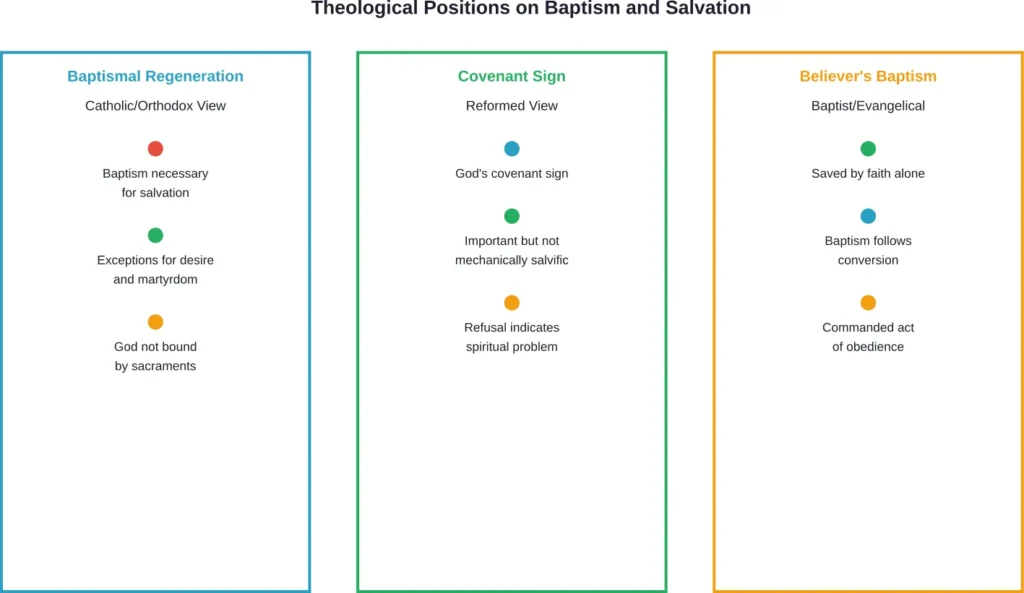
The Catholic and Orthodox Position
According to the Holy See’s official teaching, baptism is necessary for salvation. However, the Church also recognizes “baptism of desire” and “baptism of blood.”
Baptism of desire applies to those who died wanting baptism but never received it. Baptism of blood refers to unbaptized martyrs who died for their faith.
The Catechism acknowledges that “God has bound salvation to the sacrament of Baptism, but he himself is not bound by his sacraments.”
This creates room for God’s mercy toward the unbaptized in extraordinary circumstances.
The Protestant Perspective
Most Baptist and evangelical churches teach that baptism is not required for salvation but is commanded as an act of obedience.
The thief on the cross is often cited as evidence. He never got baptized, yet Jesus promised him paradise that very day. If baptism were absolutely required, this promise would be impossible.
But here’s where it gets interesting.
Even traditions that don’t require baptism for salvation still consider it extremely important. Refusing baptism after genuine conversion raises questions about the authenticity of one’s faith.
The Obedience Dilemma
Let’s address the elephant in the room: If Jesus commanded baptism, isn’t refusing it disobedience? And isn’t disobedience sin?
This question appears frequently in community discussions about baptism.
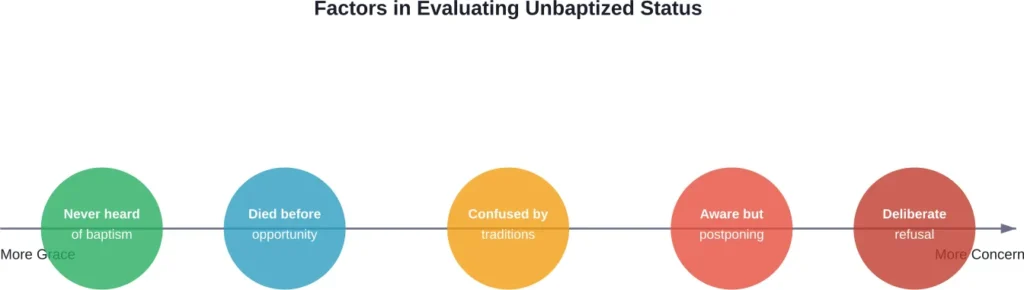
The answer involves distinguishing between different types of situations. Someone who never heard about baptism stands in a different position than someone who deliberately refuses it despite knowing Christ’s command.
Scenarios Where Baptism Doesn’t Occur
Not all unbaptized people are in the same situation:
- New believers who die before baptism can be arranged
- People in isolated areas without access to Christian community
- Those with genuine confusion about different baptismal traditions
- Individuals with severe disabilities that complicate the ritual
- People in hostile environments where baptism risks death
- Those who willfully refuse despite understanding its importance
Most theologians agree that intention and circumstance matter significantly.
Practical Consequences of Remaining Unbaptized
Beyond the salvation question, remaining unbaptized carries other implications.
Church Membership and Participation
According to Southern Baptist Theological Seminary, baptism should precede church membership in Baptist practice. Baptists believe that those who haven’t been immersed as believers haven’t been baptized according to Scripture.
This creates practical barriers. Many churches restrict communion, leadership positions, and voting privileges to baptized members.
The question becomes: Can someone participate fully in Christian community without baptism?
Most traditions answer no. Even those that don’t require baptism for salvation still require it for membership.
Personal Spiritual Development
Baptism serves multiple purposes beyond salvation status. It’s a public declaration of faith, a symbolic death and resurrection with Christ, and an act of identification with the Christian community.
Avoiding baptism means missing these formational experiences. It’s like refusing to attend your own graduation—you’ve completed the work, but you haven’t publicly acknowledged the milestone.
Real talk: Many unbaptized believers report feeling incomplete or disconnected from their church community.
The Mark 16:16 Controversy
One frequently cited verse is Mark 16:16: “Whoever believes and is baptized will be saved, but whoever does not believe will be condemned.”
Notice what it doesn’t say. It doesn’t state that whoever isn’t baptized will be condemned. The condemnation connects to unbelief, not lack of baptism.
But the verse does link baptism with salvation in the positive statement. How do we reconcile this?
Context matters tremendously. In the Great Commission context, Jesus addresses his disciples who would establish the church. The normal pattern would be belief followed by baptism.
The verse describes the standard sequence, not an absolute requirement where exceptions are impossible.
When Baptism Becomes Impossible
Some situations make baptism genuinely impossible. What then?
The thief crucified beside Jesus never got baptized. Jesus still promised him paradise. This single example demonstrates that God can save apart from baptism when circumstances prevent it.
Similarly, someone who comes to genuine faith moments before death in a hospital, prison, or remote location faces no condemnation for missing baptism they had no opportunity to receive.
The key factor is heart posture, not ritual completion.
Frequently Asked Questions
According to most Protestant theology, yes—salvation comes through faith in Jesus Christ, not baptism. The thief on the cross went to paradise unbaptized. However, deliberately refusing baptism after conversion raises serious questions about genuine faith and obedience. Catholic and Orthodox traditions hold baptism as necessary for salvation with exceptions for baptism of desire and blood.
If someone understands that Jesus commanded baptism and deliberately refuses without valid reason, this constitutes disobedience. However, circumstances matter significantly. Never hearing about baptism, dying before opportunity, or genuine confusion differs from willful rejection. The heart attitude matters more than the ritual itself.
Jesus commanded baptism in the Great Commission, telling disciples to baptize in the name of the Father, Son, and Holy Spirit. He also told Nicodemus that no one can enter God’s kingdom without being born of water and the Spirit. However, Jesus also promised paradise to the unbaptized thief on the cross, demonstrating God’s grace supersedes ritual requirements.
Most Christian traditions restrict communion to baptized believers. Baptism typically precedes communion as the initiating sacrament. Some churches allow unbaptized seekers to participate in communion, but this remains controversial and uncommon. Church membership, which usually requires baptism, often determines communion eligibility.
Limbo has been a historical theological concept regarding unbaptized infants in Catholic thought, though it was never formally defined as official doctrine. Modern Catholic theology emphasizes God’s mercy and desire for all to be saved. Most Protestant traditions believe God’s grace covers infants who die before baptism since they cannot yet exercise faith. The theological consensus trends toward trusting God’s goodness.
Catholic and Orthodox traditions teach that baptism removes original sin and personal sins committed before baptism. Most Protestant traditions view baptism as symbolic of the cleansing that occurs through faith in Christ’s sacrifice. The distinction hinges on whether baptism itself cleanses or symbolizes cleansing already accomplished through faith.
Baptist and evangelical churches don’t recognize infant baptism as valid since infants cannot exercise personal faith. They require believer’s baptism upon conversion. Reformed, Lutheran, Catholic, and Orthodox traditions view infant baptism as valid and don’t rebaptize. This remains one of Christianity’s most persistent divisions.
Making the Decision
So what should someone do if they’ve never been baptized?
First, examine why baptism hasn’t happened yet. Lack of opportunity differs vastly from deliberate avoidance.
Second, understand that baptism doesn’t save you, but it does matter. It’s Jesus’s command, a public declaration, and a meaningful step of obedience.
Third, don’t let denominational confusion paralyze you. Yes, traditions disagree about mode and timing. But nearly all agree baptism should happen for believers.
The consequences of remaining unbaptized aren’t primarily about eternal security for genuine believers. They’re about obedience, community belonging, and spiritual formation.
If you believe in Jesus Christ and haven’t been baptized, the question isn’t “Will God still love me?” The question is “Why wouldn’t I want to publicly declare my faith and obey what Jesus commanded?”
Talk with your pastor or church leaders about taking this step. They can address your specific questions and denominational context. Baptism isn’t something to fear—it’s something to embrace as a celebration of your faith.