
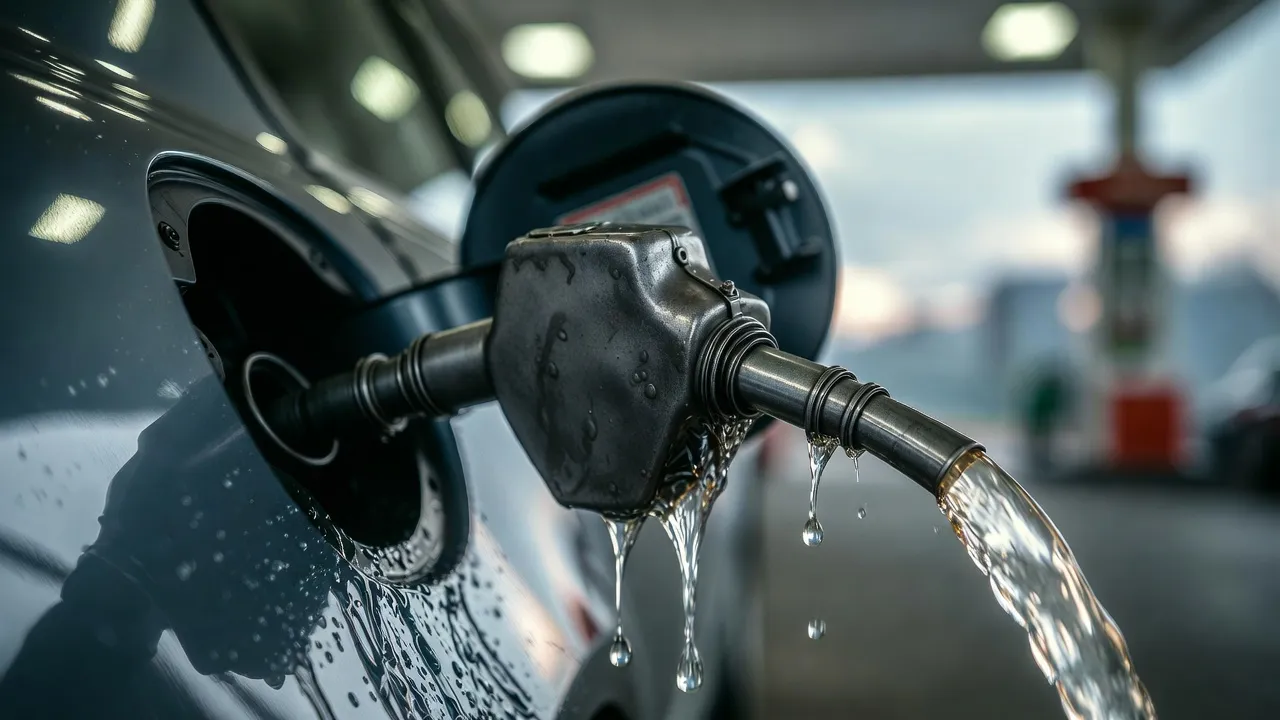
Quick Summary: Overfilling a gas tank forces fuel into the vapor recovery system, potentially damaging the charcoal canister and evaporative emission components. This can trigger check engine lights, cause starting problems, and lead to costly repairs. Modern vehicles have automatic shutoff mechanisms at the pump, but topping off after the click bypasses this safety feature.
Standing at the pump, watching those numbers climb, it’s tempting to squeeze in just a bit more fuel after the nozzle clicks off. Maybe gas prices are high, or perhaps there’s a psychological satisfaction in seeing a perfectly round number.
But here’s the thing—overfilling your gas tank isn’t just messy. It can actually damage your vehicle’s fuel system in ways that lead to expensive repairs down the road.
So what exactly goes wrong when fuel overflows into places it shouldn’t be? Let’s break down the mechanics and consequences.
Understanding What Overfilling Actually Means
Overfilling doesn’t just mean fuel spilling onto the ground (though that happens too). When the pump nozzle clicks off, that’s the signal that your tank has reached its designed capacity.
Most drivers understand this. But the real issue occurs when someone continues pumping after that first click, trying to top off the tank. Those extra squeezes send fuel into areas never meant to hold liquid gasoline.
Modern vehicles often include onboard diagnostic monitoring (OBD-II) systems that can identify malfunctions in fuel fill systems. Vapor recovery systems are designed to capture fuel vapors during refueling. According to EPA documentation on vehicular evaporative emissions, these systems are critical for environmental compliance and vehicle performance.
How the Fuel Tank System Actually Works
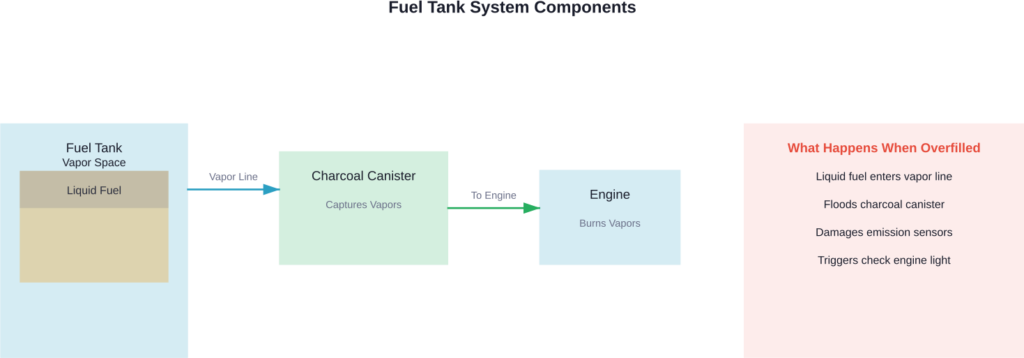
The fuel tank isn’t just a hollow container. There’s deliberate engineering involved. Each tank includes vapor space at the top—room for fuel to expand as temperatures change and for vapors to collect without creating excessive pressure.
When fuel evaporates (which happens constantly), those vapors travel through hoses to a charcoal canister. This canister traps hydrocarbon vapors until the engine can burn them during normal operation. It’s an elegant closed-loop system.
Until liquid fuel floods it.
The Immediate Consequences of Overfilling
When liquid gasoline enters the vapor recovery system, several things can go wrong simultaneously.
Charcoal Canister Damage
The charcoal canister contains activated carbon designed to adsorb fuel vapors—not absorb liquid fuel. When liquid gasoline saturates this canister, the charcoal becomes useless. It can’t be cleaned or dried out effectively.
Replacement isn’t cheap either. Depending on the vehicle, a new charcoal canister typically ranges from $150 to $600 in parts alone, plus labor.
Check Engine Light Activation
Vehicles manufactured in recent years include onboard diagnostic (OBD-II) systems that monitor the evaporative emission system for leaks and malfunctions. Many vehicles include OBD-II systems that can detect vapor recovery issues and trigger diagnostic trouble codes.
When the system detects abnormal pressure readings or fuel vapor flow, the check engine light illuminates. Common codes include P0440 (evaporative emission system malfunction) and P0455 (evaporative emission system leak detected).
Starting and Performance Problems
Flooded emission systems can cause hard starting conditions. The engine management system expects a certain air-fuel ratio, and contaminated vapor lines disrupt this balance.
Some drivers report rough idle, hesitation, or even stalling after overfilling their tanks. These symptoms typically appear shortly after filling up and may persist until the excess fuel evaporates or gets burned off—which can take days of driving.
Long-Term Damage Risks
According to Car Talk Community discussions, occasional overfilling happening only once may not cause permanent damage, though it remains not recommended.
But repeated overfilling? That’s a different story.
Chronic topping off degrades the entire evaporative emission system over time. Fuel vapor pressure sensors fail. Purge valves stick. Vent valves malfunction. Each component failure compounds the problem.
| Component | Function | Overfill Damage Effect | Typical Replacement Cost |
|---|---|---|---|
| Charcoal Canister | Captures fuel vapors | Saturated with liquid fuel | $150 to $600 |
| Purge Valve | Controls vapor flow to engine | Sticks or fails closed | $75 to $200 |
| Vent Valve | Regulates tank pressure | Clogs with fuel residue | $100-$250 |
| Fuel Tank Pressure Sensor | Monitors system integrity | Contaminated readings | $150-$400 |
Why the Pump Clicks Off (And Why You Should Listen)
Gas pump nozzles include a venturi-based shutoff mechanism. When fuel reaches the nozzle tip, it blocks the small air hole near the spout opening. This creates a vacuum that triggers the automatic shutoff.
This isn’t arbitrary. The shutoff point corresponds to the designed fill level that leaves appropriate vapor space in the tank.
Ignoring this shutoff and continuing to pump defeats the entire safety system. Those extra few ounces aren’t worth the risk.
What to Do If It Already Happened
Already overfilled? Here’s what happens next.
First, don’t panic. If this was a one-time occurrence, the damage might be minimal. Drive the vehicle normally and monitor for symptoms like check engine lights or starting problems.
If the check engine light comes on within a day or two of overfilling, get the diagnostic codes read. Many auto parts stores offer free code reading. If the codes relate to the evaporative emission system (P0440 series codes), the overfilling likely caused the issue.
In some cases, simply driving the vehicle for several days allows excess fuel to evaporate and the system to self-correct. The check engine light may clear on its own after several drive cycles.
But if symptoms persist—hard starting, rough idle, or the light stays on—professional diagnosis becomes necessary. Technicians can test the charcoal canister and related components to determine what needs replacement.
Environmental Impact You Might Not Consider
Beyond vehicle damage, overfilling creates environmental problems. Spilled gasoline evaporates quickly, releasing volatile organic compounds (VOCs) into the atmosphere. These compounds contribute to ground-level ozone formation and air quality degradation.
The EPA has established regulations specifically targeting evaporative emissions from vehicles and fueling operations. When fuel systems fail due to overfilling, vehicles emit significantly more hydrocarbons than designed.
Prevention: The Best Policy
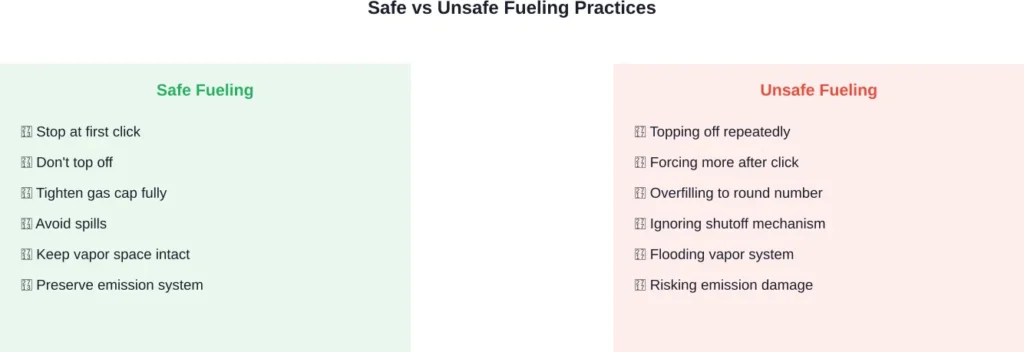
Avoiding overfill damage is straightforward. When the pump clicks off, stop. Walk away. Resist the temptation to round up to the nearest dollar or gallon.
That first click represents careful engineering, not a random event. The vehicle manufacturer determined the optimal fill level through extensive testing.
Real talk: those extra few cents of fuel aren’t worth hundreds in repair bills.
Frequently Asked Questions
If fuel spills out of the filler neck after the pump clicks off, or if the check engine light illuminates within a day or two of filling up, overfilling likely occurred. Hard starting and rough idle are other common indicators.
According to automotive community discussions, a single overfill incident typically won’t cause permanent damage, though it may trigger temporary issues. Chronic topping off degrades emission components over time more severely than occasional overfilling.
Sometimes. After several complete drive cycles (starting cold, driving until the engine reaches operating temperature, then shutting off), the system may self-correct and clear the code. If the light persists beyond three drive cycles, professional diagnosis is recommended.
Repair costs vary depending on which components failed. Charcoal canister replacement typically ranges from $150 to $600, while purge valve replacement typically costs between $75 and $200. If multiple components need replacement, total costs can exceed $1,000 including labor.
The charcoal canister contains activated carbon that captures fuel vapors from the tank, preventing them from escaping to the atmosphere. When functioning properly, these trapped vapors route to the engine for combustion. Liquid fuel saturation renders the charcoal ineffective.
While not directly related to overfilling, fueling with the engine running is dangerous and typically prohibited by law. It increases fire risk and can interfere with vapor recovery systems. Always shut off the engine before fueling.
Pay attention when fueling and stop immediately when the nozzle clicks off automatically. Don’t attempt to top off or round up to even numbers. Set the nozzle to automatic mode rather than holding it manually, which reduces the temptation to override the shutoff.
The Bottom Line
Overfilling a gas tank creates a cascade of potential problems, from saturated charcoal canisters to failed emission sensors. The automatic shutoff on fuel pumps exists for solid engineering reasons, not as a suggestion.
When that nozzle clicks, it’s communicating important information about tank capacity and vapor space requirements. Listen to it.
The few extra ounces gained by topping off simply aren’t worth the repair bills, emission system damage, and environmental impact that can result. Proper fueling technique protects both the vehicle and the wallet.
Next time at the pump, remember: one click and done. The vehicle will thank you for it.