

Quick Summary: Chronically sucking in your stomach can lead to hourglass syndrome, a condition that causes muscle imbalances, breathing problems, pelvic floor dysfunction, and back pain. This habit restricts diaphragmatic movement, reduces oxygen intake, and creates excessive intra-abdominal pressure that weakens core muscles over time.
Many people habitually suck in their stomach throughout the day, whether posing for photos, fitting into clothes, or simply trying to appear thinner. This seemingly harmless habit can trigger serious health consequences when practiced chronically.
The medical term for this pattern is “stomach gripping” or “hourglass syndrome.” And it’s far more common than most realize.
The abdominal muscles rank among the hardest-working muscles in the body. They stabilize every movement and maintain balance during daily activities. When constantly held in an unnatural contracted position, these muscles develop dysfunctional patterns that cascade throughout the body.
What Is Hourglass Syndrome?
Hourglass syndrome occurs when someone chronically contracts their upper abdominal muscles while keeping the lower portion relatively relaxed. This creates an exaggerated narrowing at the waistline.
The condition isn’t just cosmetic. It fundamentally alters how the body moves and breathes.
Over time, the sustained contraction causes the upper abdominal muscles to become overactive and shortened. Meanwhile, the deep core stabilizers—including the transversus abdominis and pelvic floor muscles—weaken from disuse.
This muscle imbalance sets off a chain reaction affecting multiple body systems. The diaphragm can’t move properly. Breathing becomes shallow. Internal organs face abnormal pressure.
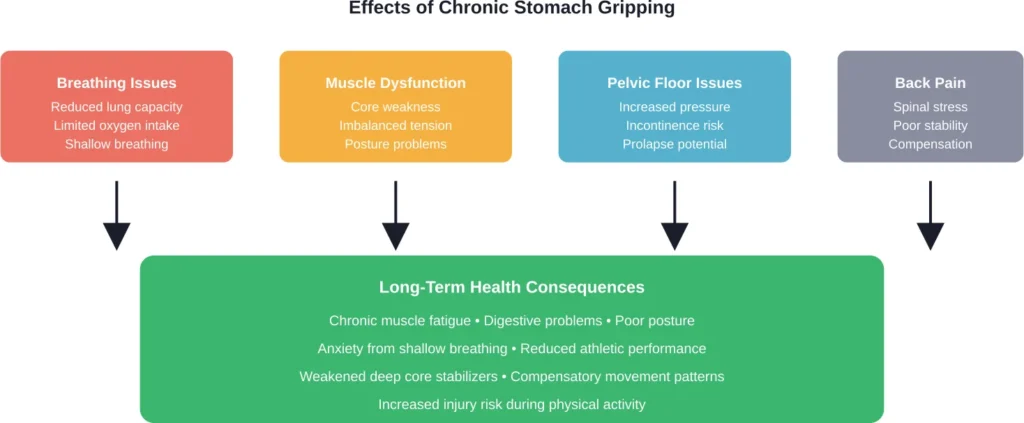
How Stomach Gripping Affects Breathing
The diaphragm serves as the primary muscle for respiration, accounting for up to 80% of inspiratory work according to research in the medical literature. This dome-shaped muscle needs room to descend during inhalation.
When the stomach muscles stay constantly contracted, the diaphragm loses that necessary space. Research demonstrates that diaphragmatic breathing affects multiple body systems through autonomic nervous system modulation.
But stomach gripping prevents proper diaphragmatic movement entirely.
The lungs can’t fully expand. Surface area for oxygen transport decreases. Breathing becomes shallow and inefficient—relegated mostly to the upper chest rather than the belly.
This shallow breathing pattern triggers the body’s stress response. Carbon dioxide builds up. Oxygen delivery to tissues decreases. Some people experience anxiety, lightheadedness, or chronic fatigue as a result.
Pelvic Floor Dysfunction From Constant Stomach Sucking
The relationship between abdominal muscles and the pelvic floor is anatomically interconnected. Research in Scientific Reports demonstrates that breathing patterns significantly affect abdominal muscle activation and intra-abdominal pressure.
During certain breathing patterns and postures, transversus abdominis and internal oblique activity can reach significant levels of maximum voluntary contraction.
When the upper abdominals grip constantly, that pressure doesn’t disappear—it redirects downward onto the pelvic floor. These muscles weren’t designed to withstand chronic elevated pressure.
Over time, this leads to:
- Urinary incontinence or urgency
- Pelvic organ prolapse
- Sexual dysfunction
- Bowel control issues
- Pelvic pain syndromes
The pelvic floor muscles become overstretched and weakened, unable to properly support the bladder, uterus, and rectum. Women face particularly high risk for these complications.
Back Pain and Postural Problems
Core stability depends on balanced activation of multiple muscle groups working together. The deep abdominal muscles, pelvic floor, diaphragm, and back muscles form an integrated stabilization system.
Stomach gripping disrupts this coordination completely.
According to research in the Journal of Physical Therapy Science, co-contraction of abdominal muscles and the diaphragm increases intra-abdominal pressure, fixes the trunk, and reduces spinal stress—but only when these muscles activate properly during functional movements.
Chronic gripping creates the opposite effect. The deep stabilizers weaken. The superficial muscles become overworked and fatigued.
The spine loses its natural support system. Back pain develops as the body compensates with dysfunctional movement patterns. Posture deteriorates as certain muscles become chronically shortened while others overstretch.
Muscle Fatigue and Respiratory Dysfunction
Research on abdominal exercise and respiratory function demonstrates that respiratory muscle fatigue can occur with intensive abdominal work, with some studies showing prolonged effects lasting at least 90 minutes.
Now imagine maintaining abdominal contraction not just during exercise, but throughout the entire day.
The muscles simply can’t sustain it. They become chronically fatigued, losing strength and endurance over time. This creates a vicious cycle where the muscles you’re trying to tone actually become weaker and less functional.
The respiratory muscles suffer particularly. Breathing becomes more effortful. Exercise tolerance decreases. Even daily activities may cause shortness of breath.
| Body System | Normal Function | Effect of Stomach Gripping |
|---|---|---|
| Respiratory | Diaphragm moves freely, lungs expand fully | Restricted breathing, reduced oxygen intake |
| Core Muscles | Balanced activation during movement | Superficial muscles overactive, deep stabilizers weak |
| Pelvic Floor | Supports organs, maintains continence | Excessive downward pressure, increased dysfunction risk |
| Spine | Stable support from core system | Poor stability, compensatory patterns, pain |
| Digestive | Normal organ movement and function | Restricted space, potential motility issues |
Breaking the Stomach Gripping Habit
Awareness is the first step. Most people don’t realize they’re doing it.
Start by checking in with the abdominal muscles several times daily. Are they relaxed or constantly tensed? Can the belly move freely with breathing?
Practice diaphragmatic breathing exercises. Place one hand on the chest and one on the belly. During inhalation, the belly should expand while the chest remains relatively still. This retrains proper breathing mechanics.
Strengthen the deep core stabilizers through targeted exercises rather than endless crunches. Exercises that emphasize transversus abdominis activation—like dead bugs, bird dogs, and planks with proper form—build functional core strength without promoting stomach gripping.
Consider working with a physical therapist who specializes in pelvic floor or core dysfunction. They can assess movement patterns, identify compensations, and design a personalized rehabilitation program.
Address underlying body image concerns if they’re driving the behavior. The desire to appear thinner may feel compelling, but the health consequences aren’t worth it.
Frequently Asked Questions
Chronic stomach gripping can lead to lasting muscle imbalances, pelvic floor dysfunction, and breathing pattern disorders. However, these conditions are typically reversible with proper intervention, breathing retraining, and corrective exercise. The earlier someone addresses the habit, the better the outcomes.
The timeline varies based on how frequently and intensely someone grips their stomach. Some people develop symptoms within months of constant gripping, while others may take years. Symptoms typically emerge gradually rather than suddenly.
Temporarily, yes—but the effect disappears the moment the muscles relax. Chronically gripping doesn’t reduce body fat or create lasting changes to body composition. It only creates the illusion of a smaller waist while muscles remain contracted.
Research suggests connections between diaphragm dysfunction and gastrointestinal issues. Chronic abdominal muscle tension can restrict organ movement and potentially affect digestive motility, though more research is needed on this specific relationship.
No—proper core engagement during exercise is healthy and protective. The problem occurs when muscles stay constantly contracted during rest and daily activities. Core muscles should activate during demanding tasks and relax during low-intensity activities.
Common signs include an exaggerated indentation at the waistline, difficulty breathing deeply into the belly, chronic upper abdominal tension, back pain, and pelvic floor symptoms. A physical therapist can provide a definitive assessment.
Initially, allowing the abdominal muscles to relax may feel uncomfortable or look different. However, developing proper core strength through functional exercises creates better tone and posture than chronic gripping ever could. The body eventually looks and functions better when muscles work correctly.
Conclusion
The seemingly harmless habit of sucking in the stomach carries serious health consequences when practiced chronically. Hourglass syndrome affects breathing, core stability, pelvic floor function, and spinal health.
The solution isn’t more abdominal exercises or tighter control. It’s releasing dysfunctional tension and retraining the body to move and breathe naturally.
If chronic stomach gripping has become an unconscious pattern, breaking the habit takes conscious effort and patience. But the payoff—better breathing, stronger core function, and reduced pain—makes it worthwhile.
Start paying attention to abdominal tension today. The body will thank you for it.