

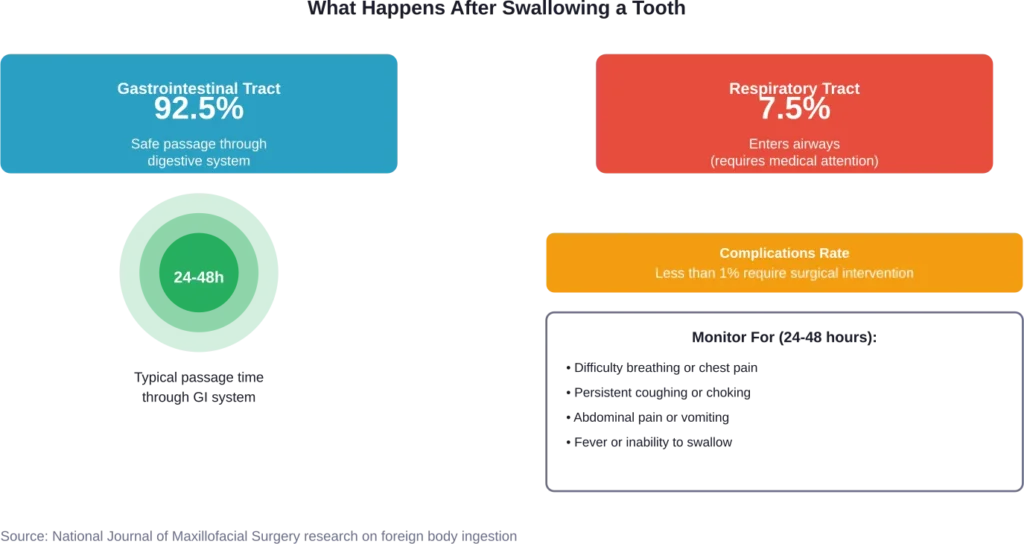
Quick Summary: Swallowing a tooth, especially a baby tooth, is generally harmless and happens more often than parents realize. About 92.5% of swallowed objects pass safely through the digestive system within 24-48 hours without medical intervention. Complications are rare, occurring in less than 1% of cases, but parents should monitor for breathing difficulties, pain, or discomfort.
Picture this: your kid is wiggling a loose tooth during dinner, and suddenly it’s gone. Not on the plate. Not on the floor. Swallowed.
Your heart skips. Is this dangerous? Should you call someone? Head to the emergency room?
Here’s the thing—this happens more frequently than most parents realize. Swallowing a tooth or tooth fragment isn’t unusual, especially when a baby tooth is loose, during sports activities, or in minor accidents.
But does that mean there’s nothing to worry about?
Where Does a Swallowed Tooth Actually Go?
According to research published in the National Journal of Maxillofacial Surgery, approximately 92.5% of swallowed foreign objects enter the gastrointestinal tract. That’s the good news. The digestive system handles small, smooth objects like teeth remarkably well.
Baby teeth are small, generally smooth, and designed to fall out naturally. When swallowed, they follow the same path as food: down the esophagus, through the stomach, into the intestines, and eventually out of the body.
The timeline? Most swallowed teeth pass through the digestive system within 24 to 48 hours. This process depends on your child’s digestion, diet, and overall gastrointestinal health.
That said, the remaining 7.5% of swallowed objects find their way into the tracheobronchial tree—the airways extending into the lungs. This is where things get serious.
When Swallowing a Tooth Becomes Dangerous
Look, most cases resolve without medical intervention. But there are warning signs parents need to recognize immediately.
Research indicates that serious morbidity from foreign object ingestion occurs in less than 1% of emergency department cases. Still, that percentage matters when it’s your child.
Red Flags That Require Immediate Medical Attention
Watch for these symptoms carefully:
- Difficulty breathing or noisy breathing sounds
- Persistent coughing or choking sensations
- Chest pain or discomfort
- Abdominal pain that worsens or doesn’t resolve
- Vomiting, especially with blood
- Inability to swallow liquids or saliva
- Fever developing after swallowing the tooth
If the tooth enters the airway instead of the digestive tract, it becomes a medical emergency. Aspiration—when objects enter the respiratory system—can lead to choking, lung infections, or airway blockage.
According to dental research on foreign body aspiration and ingestion, accidental foreign body aspiration and ingestion are classified among the five major patient safety incidents in dentistry, alongside diagnostic errors and procedural mistakes.
Are Teeth Actually Digestible?
Short answer? No, teeth aren’t digestible.
Tooth enamel is the hardest substance in the human body—even stronger than bone. Stomach acid can’t break it down. Neither can digestive enzymes.
But here’s what matters: the tooth doesn’t need to dissolve to pass safely. It simply travels through the digestive tract intact and exits naturally with bowel movements.
Baby teeth are particularly low-risk. They’re small (typically less than a centimeter), smooth, and rounded. Adult teeth or tooth fragments with sharp edges present slightly more concern, but complications remain rare.
What to Do Immediately After a Tooth Is Swallowed
Real talk: most situations don’t require emergency action. But parents should follow a specific monitoring protocol.
First 10 Minutes
Stay calm. Panicking won’t help, and it’ll likely scare your child.
Check for immediate breathing issues. If your child is coughing, choking, or struggling to breathe, call emergency services immediately. This suggests the tooth entered the airway rather than the esophagus.
If breathing is normal and your child isn’t in distress, the tooth likely went down the right path.
Next 24-48 Hours
Monitor your child for the warning signs mentioned earlier. Keep an eye on bowel movements—though honestly, finding a tiny tooth isn’t always easy or necessary.
Maintain a normal diet. There’s no need to change eating patterns unless a healthcare provider advises otherwise.
Contact a dentist if you’re unsure about what was swallowed. Sometimes what feels like a whole tooth is actually a fragment, and sharp edges carry different risks than smooth surfaces.
When to Call a Healthcare Provider
Contact a doctor or dentist if any concerning symptoms develop, even mild ones. Better to make an unnecessary call than ignore a developing complication.
According to CDC data on foreign object ingestion, approximately 80,000 emergency department visits occurred in 2010 due to swallowed foreign objects. The vast majority involve children, and early intervention prevents most serious complications.
| Scenario | Action Required | Urgency Level |
|---|---|---|
| Baby tooth, no symptoms, normal breathing | Monitor at home for 24-48 hours | Low |
| Adult tooth or large fragment swallowed | Contact dentist or doctor for guidance | Medium |
| Sharp fragment with abdominal pain | Seek medical evaluation | High |
| Any breathing difficulty or choking | Call emergency services immediately | Critical |
| Persistent vomiting or chest pain | Visit emergency department | High |
Can This Be Prevented?
Completely? Probably not. Kids lose 20 baby teeth between ages 6 and 12, and accidents happen.
But parents can reduce the risk with a few practical strategies:
- Encourage kids to wiggle loose teeth with clean hands, not during meals
- Schedule dental checkups when teeth are very loose—dentists can remove teeth that are ready
- Use mouthguards during sports and physical activities
- Teach kids to chew slowly and pay attention while eating
- Keep hard, crunchy foods minimal when teeth are loose
For dental procedures, practitioners use preventive measures including rubber dams, gauze throat screens, and floss ligatures to prevent accidental swallowing of dental materials or instruments.
What About Dental Restorations?
Swallowing a crown, filling, or orthodontic bracket follows similar principles but with some differences.
Dental restorations are typically small and smooth. Most pass without issues. However, certain materials or sharp edges require closer monitoring.
If a crown or filling falls out and gets swallowed, contact the dentist who placed it. They’ll need to schedule a replacement and may recommend specific monitoring based on the restoration’s size and material.
Orthodontic brackets are designed to be relatively safe if swallowed—orthodontists know this is a possibility. Still, notify the orthodontist so they can replace the bracket and check for any additional damage to the braces.
Frequently Asked Questions
A swallowed tooth typically passes through the digestive system within 24 to 48 hours. The exact timing depends on individual digestion speed and dietary factors. Most parents never actually see the tooth exit—it’s small enough to pass unnoticed.
It’s extremely rare. Baby teeth are small and smooth, making intestinal blockage highly unlikely. Research shows that less than 1% of swallowed foreign objects cause complications requiring surgical intervention. Sharp tooth fragments carry slightly higher risk than intact teeth.
No. Never induce vomiting after a foreign object is swallowed. This can cause the object to become lodged in the throat or esophagus, or it may enter the airway during vomiting, creating a more dangerous situation than the original swallowing incident.
If breathing is normal, there’s no pain, and your child is acting typically, the tooth almost certainly entered the digestive tract safely. Monitor for 24-48 hours for any developing symptoms, but expect a completely normal outcome.
Stomach acid cannot significantly damage tooth enamel during the brief time a swallowed tooth remains in the stomach. Tooth enamel is the hardest substance in the human body. The tooth will pass through intact—it won’t dissolve or break down.
It’s not medically necessary. If your child shows no symptoms after 48 hours, the tooth has passed safely whether or not it was visually confirmed. Some parents choose to check for peace of mind, but healthcare providers don’t require it.
Swallowing means the tooth entered the esophagus and digestive system—this is the safe route. Aspiration means the tooth entered the trachea and respiratory system—this is dangerous and causes immediate breathing difficulties, coughing, or choking that doesn’t resolve quickly.
The Bottom Line
Swallowing a tooth—especially a baby tooth—ranks as one of those parenting moments that feels scarier than it actually is.
Medical research consistently shows that the vast majority of cases resolve without intervention. The digestive system handles small, smooth objects efficiently, and complications occur in less than 1% of situations.
The key is knowing the difference between a normal swallowing incident and a respiratory emergency. If breathing remains normal and no concerning symptoms develop, parents can confidently monitor at home.
That said, trust parental instinct. If something feels wrong or symptoms develop, contact a healthcare provider. Dental professionals and pediatricians handle these situations routinely and can provide guidance specific to each case.
Now, about that tooth fairy situation—she’s pretty understanding about missing teeth. Most kids find the story of a swallowed tooth just as exciting as the traditional version.